



How Long Does It Take for Peptides to Work?
The honest answer is not one number. A peptide can begin interacting with a biological target long before a meaningful result can be measured—and different peptide classes have completely different evidence, endpoints, and timelines.
“Working” Can Mean Three Different Things
Most confusion starts when biological exposure, an early sensation, and a durable outcome are treated as the same event. They are not.
1
Target engagement
The molecule reaches circulation or interacts with a receptor. This can happen relatively quickly, but it does not prove a useful outcome.
2
Early signal
A subjective change or a laboratory marker shifts. One observation can be noise, expectation, normal variation, or a true effect.
3
Meaningful outcome
A repeatable change appears in a preselected measure such as weight trend, a validated symptom score, imaging, or a laboratory endpoint.
A Practical Research Timeline
These windows are a framework for understanding research—not a promise, protocol, or recommendation. The correct window comes from the specific compound, formulation, population, and study endpoint.
| Research area | What may appear first | What deserves more time | Evidence caution |
|---|---|---|---|
| Approved incretin medicines (GLP-1/GIP) | Early appetite, glucose, or tolerability changes can occur during the opening weeks and dose-escalation period. | Large body-weight outcomes are evaluated across many months; major phase 3 trials used 68- and 72-week endpoints. | Results from approved medicines and controlled trials cannot be automatically transferred to unapproved products. |
| Growth-hormone-axis research | Controlled studies may detect an acute hormone response sooner than a visible physical change. | Body-composition outcomes require repeated measurements over longer periods. | A laboratory signal is not the same as a proven clinical benefit. |
| Cosmetic and topical peptide research | Hydration or surface appearance may shift before structural skin measures. | Collagen-related or appearance endpoints are generally studied over multiple weeks or months. | Formulation, concentration, stability, and delivery into skin matter. |
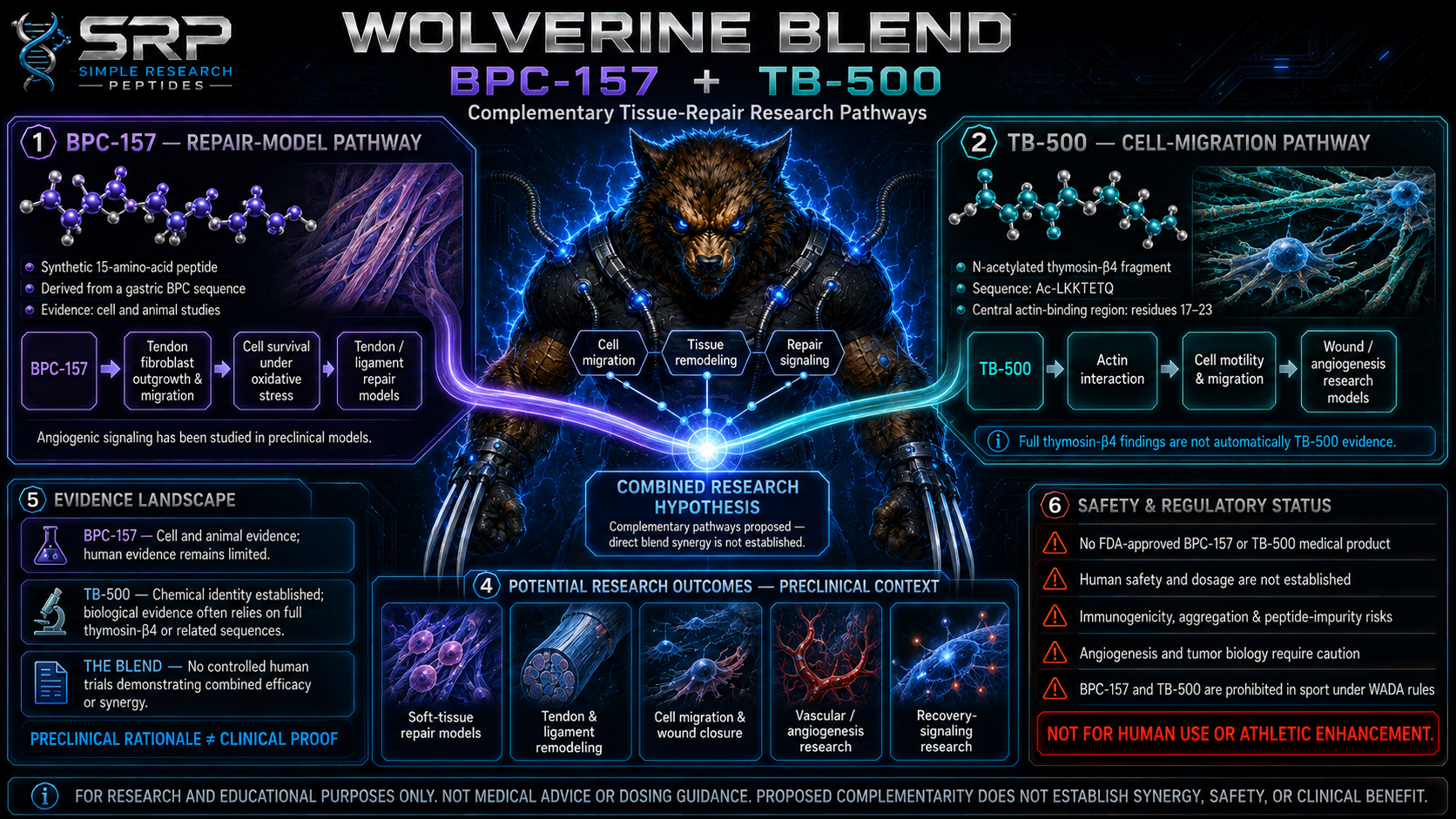
| Injury and recovery compounds | Online reports often describe rapid subjective changes. | Healing should be assessed with function, imaging, or other objective measures appropriate to the injury. | For compounds such as BPC-157 and TB-500, validated human onset timelines are not established. |
| Sleep and cognitive research | A same-day subjective report is possible. | Repeated sleep data, standardized cognitive testing, and baseline comparison are more informative. | Expectation, stress, caffeine, sleep debt, and measurement error can overwhelm a real signal. |
| Mitochondrial and healthy-aging research | Cellular or biomarker hypotheses may be tested before any visible outcome. | Performance, body-composition, and aging-related endpoints require longer, controlled observation. | Many compounds in this category remain investigational and do not have established human timelines. |
Why Peptide Timelines Vary So Much
1
The molecule
Peptides differ in receptor target, half-life, stability, and biological mechanism. “Peptide” describes a broad class—not one type of result.
2
The endpoint
Appetite, glucose, sleep, skin appearance, tissue remodeling, and body composition all change on different clocks.
3
The formulation
Delivery method, excipients, purity, storage, and degradation can change exposure. A label alone cannot establish bioavailability.
4
Baseline biology
Age, health status, medications, nutrition, sleep, training, and genetics can affect both the response and the ability to measure it.
5
Study design
Anecdotes have no control group. Blinded trials, validated endpoints, and adequate follow-up provide much stronger timeline evidence.
6
Consistency of measurement
Comparing random good and bad days creates false conclusions. Use the same conditions, device, and schedule whenever possible.
How Researchers Decide Whether a Signal Is Real
A useful timeline begins before the first observation. Decide what would count as a meaningful change, then measure it consistently.
- Record a baseline before the research period begins.
- Choose one primary endpoint instead of chasing every sensation.
- Use repeat measurements under similar conditions.
- Track confounders such as sleep, diet, training, stress, and medication changes.
- Separate subjective observations from laboratory or functional data.
- Predefine a review date based on published evidence for that exact compound.
Frequently Asked Questions
Can a peptide “work” after the first exposure?
A molecule may reach its target quickly, and a person may notice a same-day sensation. Neither establishes a durable benefit. Repeated, objective measurement is needed.
Why do some people report results faster than others?
Different baselines, expectations, endpoints, formulations, concurrent medications, sleep, nutrition, and normal day-to-day variation can all change what someone reports.
Do peptides have to build up?
Some peptide medicines have pharmacokinetics that produce changing exposure over repeated dosing; others act briefly. This is compound-specific and should be answered from validated pharmacology, not a rule applied to every peptide.
How long should a research project run?
Long enough to capture the preselected endpoint based on published evidence, but not longer simply because no result appeared. If reliable human evidence does not exist, a precise human timeline cannot honestly be claimed.
Are all peptides FDA-approved?
No. Some peptide medicines are FDA-approved for specific indications, while many compounds sold or discussed online are investigational or unapproved. FDA approval, lawful compounding, and laboratory research products are different categories.
The Bottom Line
Peptides do not share one universal clock. Think in layers: target engagement may be fast, a credible signal takes repeated observation, and durable outcomes often take weeks or months. When human evidence is missing, the honest answer is that the timeline is unknown.