






Hormone signaling · Compound guide
IGF-1 DES Research Guide
Explore the mechanisms, study findings and evidence limits behind this research topic.
Product artwork identifies the SRP listing. It does not demonstrate safety or clinical benefit. The evidence guide and its sources follow below.
View product label and documentation →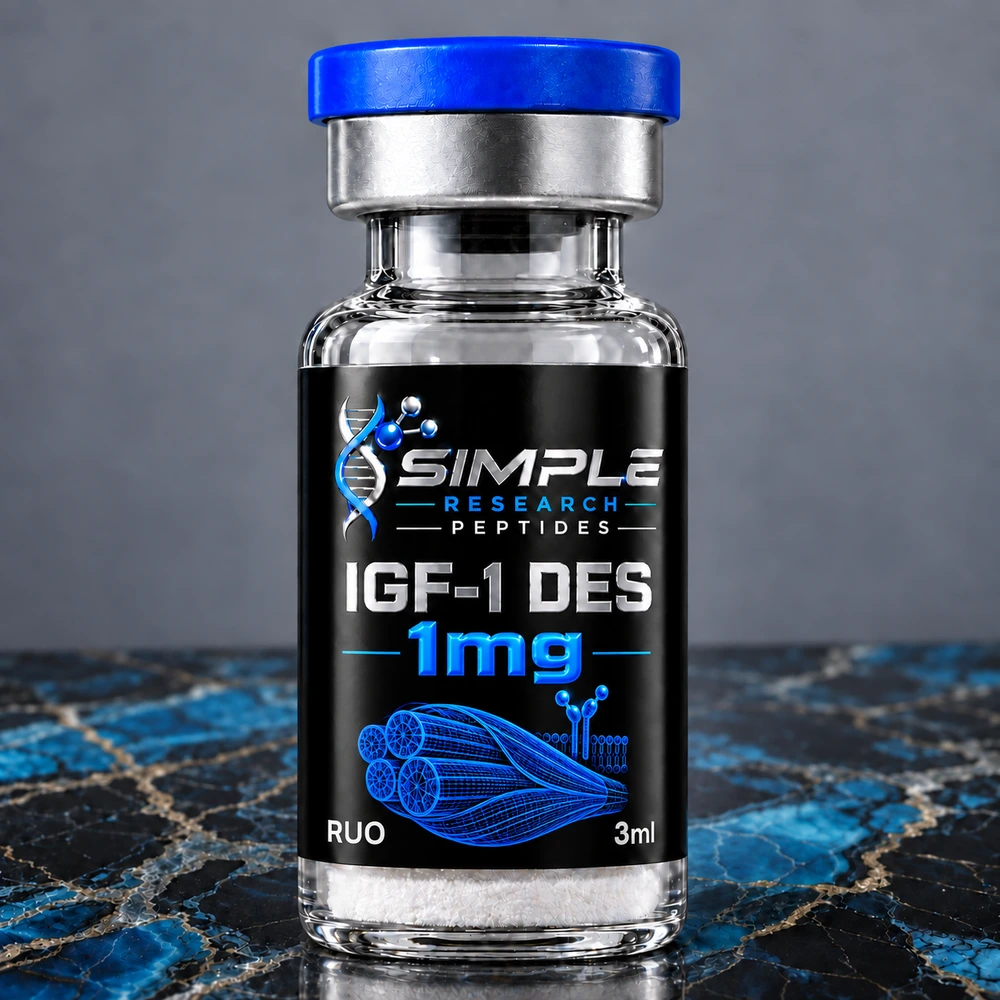
Back to the Research Compound Library
Laboratory growth-factor research
Evidence reviewed September 13, 2026.
Research overview and identity
IGF-1 DES generally refers to des(1-3) IGF-I, a shortened insulin-like growth factor lacking the first three amino acids of the native sequence. It is used to investigate how binding proteins affect growth-factor activity in experimental systems.
Mechanism under investigation
Reduced interaction with IGF-binding proteins can change the amount of ligand available to cells. That does not mean every receptor response or whole-body effect is proportionally stronger; the binding-protein environment is part of the mechanism.
What the studies report
A 1992 rat granulosa-cell study compared des(1-3) IGF-I with intact IGF-I. Greater apparent potency depended on the presence of binding proteins, while activity was similar under conditions in which their influence was removed. Later binding experiments further investigated these molecular interactions. [1] [2]
Limits of the evidence
A cell-assay potency difference cannot be translated into a claim of proportionally greater muscle growth in people. The cited research does not establish a clinical use for research-market IGF-1 DES. Correct sequence, folding and functional activity are necessary for meaningful comparisons.
Matching research material to a paper
Check the material identity, formulation and analytical methods against the study methods. A product name or milligram amount alone does not demonstrate experimental equivalence. Published research does not establish the identity, purity or potency of a retail batch; batch-specific analytical documentation must be assessed separately.
For laboratory research only. Not for human or veterinary use. This guide is educational and contains no dosing, reconstitution or administration instructions.
Sources and further reading
- Des(1-3) IGF-I and binding-protein-dependent activity in granulosa cells (1992)
- Experimental analysis of IGF analogue binding-protein interactions (1999)