5-Amino-1MQ Research Guide
An evidence-mapped overview of 5-amino-1-methylquinolinium (marketplace name: 5-Amino-1MQ) covering chemical identity, NNMT mechanism as far as opened papers support it, published cell and rodent studies, laboratory considerations, and current evidence limitations. This is a small-molecule NNMT inhibitor, not a peptide.
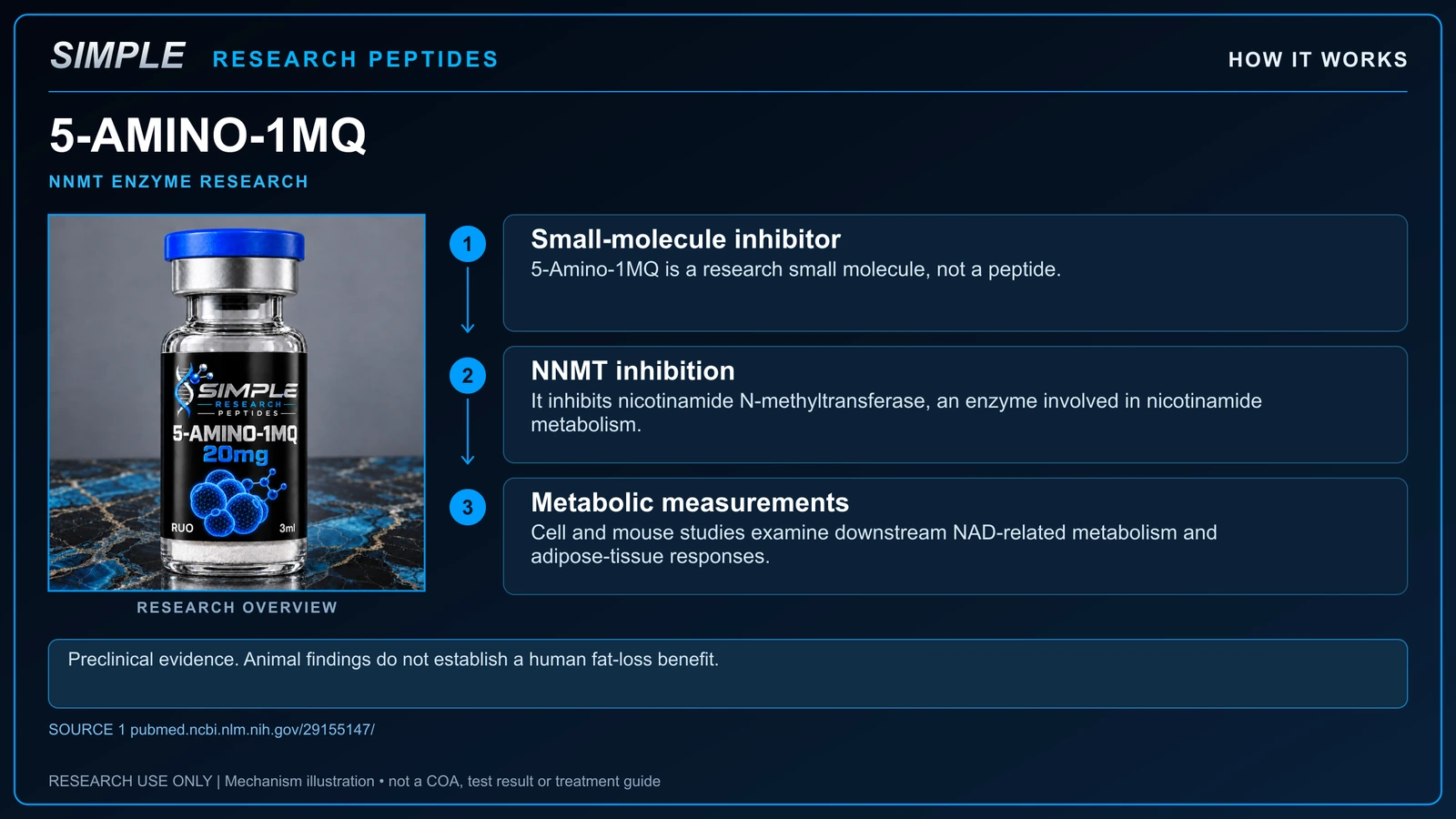
Small-molecule NNMT inhibitor
Not a peptide
Research use only
Educational information only. 5-Amino-1MQ is not an FDA-approved drug for human use. Laboratory research use only; not for human or animal use. The 20 mg and 50 mg listings are the same research compound and share this page. No human dosing, reconstitution, or administration protocol appears here.
Quick Facts
5-Amino-1MQ is the marketplace name for 5-amino-1-methylquinolinium, a quaternary quinolinium small-molecule cation. It is a small-molecule NNMT inhibitor, not a peptide. It is not a SARM, steroid, GHRH analogue, or growth-hormone secretagogue. Papers on other NNMT inhibitors (for example Kannt et al., 2018, Sci Rep, a different chemotype) do not automatically describe 5-amino-1MQ.
Neelakantan, Wang, Vance, Hommel, McHardy, and Watowich (2017) identified quinolinium analogues as a low-micromolar NNMT-inhibitor scaffold (IC50 ~1 µM class) in a structure–activity study (PMID 28548833). The 2018 follow-up paper names 5-amino-1MQ as the lead analogue used in adipocyte and diet-induced-obese (DIO) mouse work, with a biochemical IC50 of 1.2 µM cited from that SAR set (PMID 29155147; PMC5826726).
There is no amino-acid sequence. The cation is a quinoline ring methylated at nitrogen-1 with an amino group at carbon-5. PubChem CID 950107: IUPAC 1-methylquinolin-1-ium-5-amine; formula C10H11N2+; computed molecular weight 159.21 g/mol; CAS 685079-15-6; UNII PMX593N4N3; ChEMBL CHEMBL4116828; formal charge +1. The common research iodide salt is PubChem CID 66522933 (titled “NNMTi”): formula C10H11IN2; computed molecular weight 286.11 g/mol; CAS 42464-96-0; UNII K9G33W2TTZ; ChEMBL CHEMBL4088008. UNII / CAS availability does not imply regulatory review or approval.
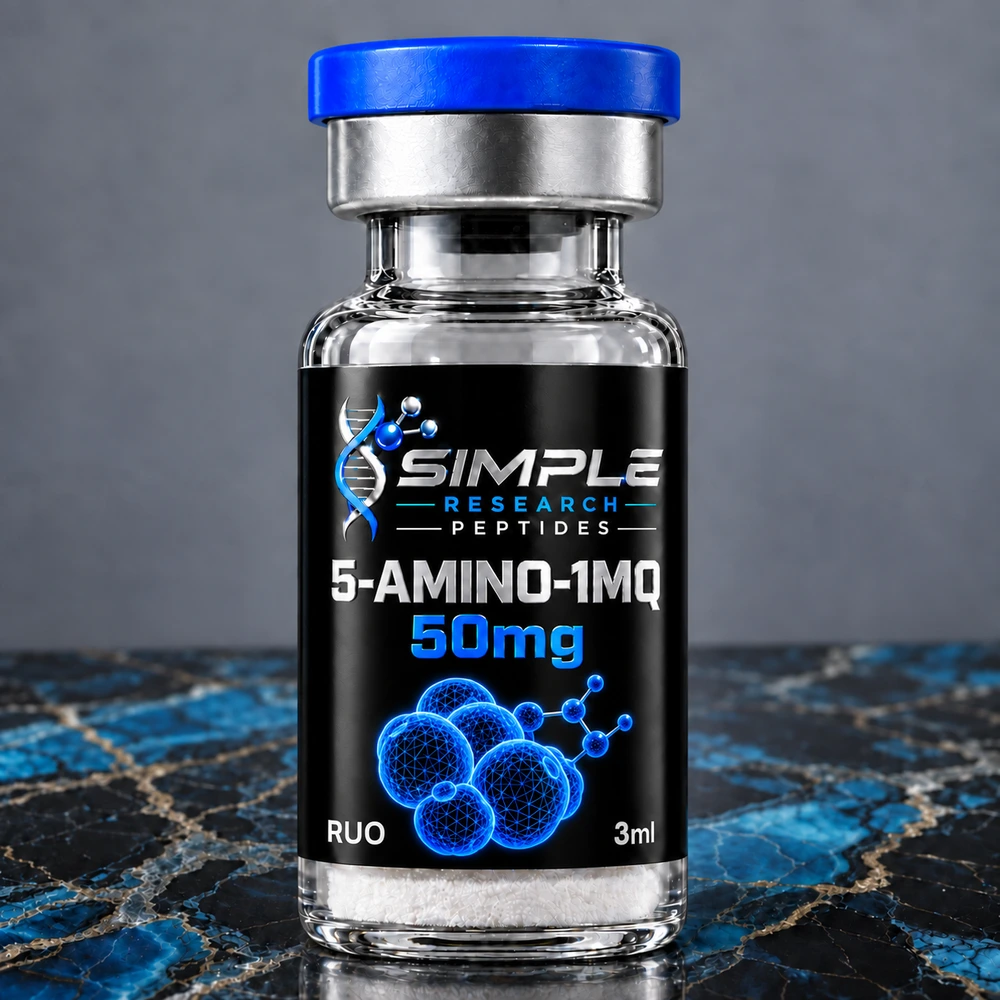
The SRP 20 mg and 50 mg vials are the same research compound at two listed strengths. They share this page. The 50 mg page body also uses generic catalog copy calling the material a “synthetic research peptide.” That phrasing is a template error: this compound is not a peptide.
| Field | Value in opened sources | Note |
|---|---|---|
| Scaffold | N-methylquinolinium with a 5-amino substitution | Distinct from parent 1-methylquinolinium (1-MQ) |
| Cation CAS / UNII | 685079-15-6 / PMX593N4N3 | PubChem / FDA GSRS identifiers on CID 950107 |
| Iodide CAS / UNII | 42464-96-0 / K9G33W2TTZ | PubChem CID 66522933 |
| Parent 1-MQ | IC50 12.1 µM; PAMPA flux 0 | Weaker, poorly permeable analogue (2018 Table 1). Not 5-amino-1MQ. |
What 5-amino-1-methylquinolinium is
NNMT is a cytosolic enzyme that N-methylates nicotinamide using S-adenosyl-L-methionine (SAM) as the methyl donor, producing 1-methylnicotinamide (1-MNA) and S-adenosyl-L-homocysteine (SAH). Kraus et al. (2014) showed that NNMT expression is increased in white adipose tissue and liver of obese and diabetic mice, and that antisense knockdown of Nnmt in WAT and liver protected mice from diet-induced obesity, increased adipose SAM and NAD+, and raised energy expenditure (PMID 24717514). That paper is target biology. It did not test 5-amino-1MQ.
Neelakantan et al. (2017) then built a methylquinolinium SAR and reported quinoliniums as a promising scaffold with IC50 values around 1 µM (PMID 28548833). Neelakantan et al. (2018) selected membrane-permeable amino-substituted analogues, showed that 5-amino-1MQ reduced intracellular 1-MNA, raised NAD+ and SAM, and suppressed lipogenesis in 3T3-L1 adipocytes, and then administered it systemically to DIO mice (PMID 29155147; PMC5826726).
Later opened papers from the same research network used the same probe (named 5-amino-1-methylquinolinium, 5-amino-1-methylquinolium, 5A1MQ, or NNMTi) in aged-muscle injury (2019), lean-diet combination (2021), cecal microbiome (2022), DIO metabolic / PK (2024), and aged-exercise (2024) models. Those are still mouse and cell studies.
Only as far as sources support
Each item is tagged by what was actually studied. 5-amino-1MQ-only means the test article was 5-amino-1-methylquinolinium / 5-amino-1MQ / 5A1MQ / the NNMTi synthesized by the published quinolinium method. Target biology means NNMT knockdown or a different inhibitor. Not shown means this review did not open such a paper. There is no invented receptor diagram and no fake chart on this page.
NNMT inhibition in a biochemical assay
5-amino-1MQ IC50 = 1.2 µM against NNMT in the 2017 SAR values restated in Table 1 of Neelakantan 2018. Parent 1-MQ was 12.1 µM; 1-MNA (product inhibitor) was 9.0 µM.
Neelakantan 2018, PMID 29155147; PMC5826726.
Membrane permeability (in vitro)
Classified as high passive permeability in PAMPA (flux 3.01 × 10⁻⁶ cm/s) and high bidirectional Caco-2 permeability with no meaningful efflux (A→B Papp 34.2 × 10⁻⁶ cm/s; B→A 45.2 × 10⁻⁶ cm/s; efflux ratio 1.33).
Neelakantan 2018, PMID 29155147. This is not demonstrated oral product performance.
Selectivity panel (limited)
Did not produce calculable IC50 values against DNMT1, PRMT3, or COMT; did not inhibit NAMPT up to 100 µM; and did not produce a reliable SIRT1 IC50 (minor reduction only at 600 µM).
Table 3, PMID 29155147.
Adipocyte target engagement
In differentiated 3T3-L1 adipocytes, 5-amino-1MQ lowered 1-MNA (EC50 2.3 ± 1.1 µM), increased NAD+ (~1.2–1.6-fold at 1–60 µM; significant at 10 µM), and increased SAM at higher concentrations (30–60 µM). Nicotinamide and SAH were not significantly changed.
Lipogenesis in 3T3-L1 cells
Continuous 5-amino-1MQ during 3T3-L1 differentiation reduced oil-red-O lipid accumulation (50% at 30 µM; 70% at 60 µM).
NAD+ / SAM flux interpretation
The 2018 authors state that increased flux of NAD+ and SAM “may potentially define the therapeutic mechanism-of-action of NNMT inhibitors.” That is their interpretation of the adipocyte metabolite data plus the Kraus ASO precedent, not a human mechanism study.
NNMT knockdown, not 5-amino-1MQ
Kraus et al. (2014): NNMT knockdown in WAT and liver protected mice from diet-induced obesity; NNMT inhibition (genetic / ASO, not this small molecule) increased adipose SAM and NAD+ and upregulated polyamine-flux enzymes.
Human association papers not opened here
Babula et al. (2024) restate that NNMT methylates nicotinamide to 1-MNA using SAM, and that adipose NNMT expression and circulating 1-MNA associate with insulin resistance in humans with T2D (citing Kannt 2015 and Liu 2015). Those human association papers were not opened as full texts for this draft.
Gaps that matter
No crystal structure of 5-amino-1MQ bound to human NNMT. No proof that marketplace vials reproduce UTMB / Ridgeline lot pharmacology. No human NNMT occupancy, human NAD+/SAM changes, or human 1-MNA suppression. Mouse oral bioavailability in Babula 2024 was 3.5% after 30 mg/kg PO, despite the 2018 Caco-2 “high permeability” classification. Babula 2024 also reported 67.4% inhibition of MAO-A at 10 µM in a Cerep panel.
Where the literature actually sits
Label every cluster. 5-amino-1MQ-only means the test article was 5-amino-1-methylquinolinium / 5-amino-1MQ / 5A1MQ / the NNMTi synthesized by the published quinolinium method. Target biology means NNMT knockdown or a different inhibitor. Not found means this review did not open such a paper. Study amounts below are historical published-study facts, not a protocol.
Discovery / permeability / adipocytes
Quinolinium SAR; IC50 class ~1 µM (Neelakantan 2017, PMID 28548833). PAMPA / Caco-2; selectivity; 3T3-L1 1-MNA, NAD+, SAM, lipogenesis (Neelakantan 2018, PMID 29155147).
DIO mouse metabolic
Male DIO C57Bl/6 mice; 20 mg/kg SC three times daily, 11 days; n = 9/group. Treated mice lost 2.0 ± 0.6 g (~5.1% from baseline) vs control gain 0.6 ± 0.4 g; food intake unchanged; epididymal WAT mass ~35% lower; adipocyte size >30% lower; plasma total cholesterol ~30% lower (Neelakantan 2018, PMID 29155147).
DIO mice switched from Western diet to lean diet ± NNMTi. Combined lean-diet + NNMTi accelerated body-weight and fat loss and improved hepatic steatosis vs lean-diet switch alone; food intake did not differ by treatment group as a main effect (Sampson et al., 2021, PMID 33707534; PMC7952898).
Cecal microbiome companion: NNMTi + lean diet produced a distinct pattern (decreased Erysipelatoclostridium, increased Lactobacillus vs vehicle lean-diet counterparts) (Dimet-Wiley et al., 2022, PMID 35013352).
DIO mice; once-daily SC 10 or 32 mg/kg for 28–30 days. High dose limited weight gain (0.9 g vs 5.4 g control) and fat-mass gain (1.3 g vs 4.7 g) without changing food intake; improved OGTT and suppressed hyperinsulinaemia; reduced liver weight, steatosis, F4/80, ALT/AST, and ketone bodies (Babula et al., 2024, PMID 39161060; PMC11622326).
Aged mouse muscle
24-month-old male mice; BaCl2 tibialis-anterior injury; 5 or 10 mg/kg SC BID. High dose: ~1.8-fold greater regenerating-fiber CSA at 1 week; peak TA torque ~67% higher per gram body mass; plasma chemistry panel not significantly different vs control (Neelakantan et al., 2019, PMID 30753815; PMC6469996).
Female mice treated from 22 to 24 months; NNMTi (5-amino-1-methylquinolinium), progressive weighted wheel running, or both. Abstract: sedentary NNMTi ~40% greater grip strength vs sedentary controls; exercise alone ~20%; combination ~60% (Dimet-Wiley et al., 2024, PMID 38969654).
Mouse PK (not a research-vial human curve)
Babula 2024: IV 5 mg/kg, t½ 6.3 h, high clearance (101 mL/min/kg); SC 25 mg/kg, t½ ~13 h, Tmax ~15 min; PO 30 mg/kg, oral bioavailability 3.5%; distribution to EWAT, quadriceps, and (lower) liver after SC dosing; mouse NNMT biochemical IC50 stated as 78 ng/mL (PMID 39161060).
NNMT ASO and other chemotypes
Kraus 2014 NNMT ASO knockdown (PMID 24717514). Kannt 2018 small-molecule NNMT inhibitor for metabolic disorders (different chemotype; cited inside opened papers; not opened as a 5-amino-1MQ study).
No identifiable human trial
A ClinicalTrials.gov search for 5-amino-1MQ OR 5-amino-1-methylquinolinium OR NNMTi was opened for this draft and did not return identifiable registered trials. No opened paper reported a completed human PK, safety, or efficacy study of this compound.
What was studied, in what system
Read the “compound actually studied” column first. Published study amounts are historical facts from those papers. They are not a protocol.
| Domain | Compound actually studied | System | Status | Source |
|---|---|---|---|---|
| Quinolinium SAR | Methylquinolinium / isoquinolinium / pyridinium / benzimidazolium set | Recombinant NNMT; docking | 5-amino-1MQ is one analogue | PMID 28548833 |
| Permeability, selectivity, adipocyte metabolites, DIO obesity | 5-amino-1MQ | PAMPA; Caco-2; 3T3-L1; male DIO mice, 11 days | 5-amino-1MQ-only | PMID 29155147; PMC5826726 |
| Aged muscle regeneration | 5-amino-1-methylquinolium (NNMTi) | 24-mo male mice; BaCl2 TA injury; C2C12 | 5-amino-1MQ-only | PMID 30753815; PMC6469996 |
| Lean-diet combination | 5-amino-1-methylquinolinium (NNMTi) | Male DIO mice switched to lean diet | 5-amino-1MQ-only (+ diet) | PMID 33707534; PMC7952898 |
| Cecal microbiome | 5-amino-1-methylquinolinium (NNMTi) | Same DIO / lean-diet design | 5-amino-1MQ-only (+ diet) | PMID 35013352 |
| DIO metabolic / liver / mouse PK | 5A1MQ | Male DIO mice 28–30 days; IV/PO/SC PK | 5-amino-1MQ-only | PMID 39161060; PMC11622326 |
| Aged exercise / grip | 5-amino-1-methylquinolinium (5A-1MQ) | Aged female mice ± PoWeR running | 5-amino-1MQ-only (± exercise) | PMID 38969654 |
| NNMT target biology | Nnmt ASO knockdown — not 5-amino-1MQ | Mouse WAT / liver | Target biology only | PMID 24717514 |
| Human trial of 5-amino-1MQ | — | — | Not found | ClinicalTrials.gov search opened; no identifiable record |
| Human weight-loss efficacy | — | — | Not found | No opened human outcome paper |
How the record accumulated
NNMT knockdown protects against DIO
Kraus et al.: Nnmt is highly reciprocally regulated with adipose Glut4; NNMT knockdown in WAT and liver protects against diet-induced obesity and increases adipose SAM and NAD+. This paper does not mention 5-amino-1MQ. PMID 24717514.
Quinolinium scaffold
Neelakantan et al.: quinolinium scaffold; IC50 ~1 µM class; docking to the nicotinamide-binding site. PMID 28548833.
Adipocytes and 11-day DIO mice
Neelakantan et al.: permeability, selectivity, adipocyte 1-MNA/NAD+/SAM, suppressed lipogenesis; 11-day DIO mouse study with 5-amino-1MQ 20 mg/kg SC t.i.d. (historical study fact). PMID 29155147; PMC5826726.
BaCl2 TA injury in 24-month-old mice
Neelakantan et al.: 5-amino-1-methylquinolium after BaCl2 TA injury in 24-month-old mice; greater regenerating CSA and ~70% higher peak torque in the abstract / ~67% per gram body mass in the results. PMID 30753815; PMC6469996.
Lean-diet combination
Sampson et al.: NNMTi plus lean-diet switch normalized body composition and improved steatosis vs diet switch alone. PMID 33707534. Dimet-Wiley et al.: distinct cecal microbiome after NNMTi + lean diet. PMID 35013352.
Babula PK and Dimet-Wiley grip
Babula et al.: 28-day once-daily 5A1MQ in DIO mice; OGTT, insulin, liver histology, and mouse PK including 3.5% oral bioavailability. PMID 39161060. Dimet-Wiley et al.: NNMTi ± exercise in aged female mice; additive grip-strength effect in the abstract. PMID 38969654.
Not found
No opened dated paper or identifiable ClinicalTrials.gov record in this set reports a human administration study of 5-amino-1MQ.
What is not established
These are gaps in the opened record. Treating any of them as settled is incorrect.
No approved therapeutic use
5-Amino-1MQ is not an FDA-approved finished drug in the sources opened here. SRP pages are research-use listings. UNII/CAS registration is identity infrastructure, not approval.
No human trial was identified
The ClinicalTrials.gov search opened for this draft did not return identifiable trials under 5-amino-1MQ, 5-amino-1-methylquinolinium, or NNMTi. No opened paper reported human PK, safety, efficacy, or body-composition outcomes for this compound.
Mouse weight and fat changes are not a human weight-loss claim
Opened DIO studies report mouse body-weight and fat-mass changes, often without a change in food intake. That is a preclinical metabolic signal. It is not evidence that a research vial produces weight loss, fat loss, or “recomposition” in people. The SRP category label “Weight Loss / Metabolic Research” is a catalog category, not a clinical indication.
Vendor / clinic marketing is not supported
Vendor / clinic pages that describe 5-Amino-1MQ as a peptide, an oral fat-loss agent, a “NAD+ booster supplement,” or a muscle-sparing weight-loss drug are not supported by any human paper opened here.
The 2018 DIO study is short and small
The 2018 study is 11 days, n = 9 male DIO mice per group, subcutaneous t.i.d. dosing (PMID 29155147). Historical study fact only.
2021 combines the inhibitor with a lean-diet switch
Diet change is part of the design (PMID 33707534). Do not attribute the whole effect to the molecule alone.
2024 largely limited further gain, not large absolute loss
The 2024 DIO study largely limited further weight and fat gain on a continued high-fat diet rather than demonstrating large absolute weight loss (PMID 39161060).
Lean-mass “sparing” is not a human finding
Babula 2024 reported no significant main treatment effect on longitudinal lean mass in DIO mice. Sampson 2021 reported an increased lean-mass-to-body-weight ratio after NNMTi + diet switch — a ratio change in mice, not a human body-composition trial.
Oral “high bioavailability” is not a product fact
Neelakantan 2018 classified 5-amino-1MQ as highly permeable in PAMPA and Caco-2. Babula 2024 measured 3.5% oral bioavailability in mice after 30 mg/kg PO and attributed the gap to limited enteric absorption and high first-pass metabolism (hepatocyte t½ < 7 min). Caco-2 high-permeability language must not be rewritten as proven oral human or oral-product performance.
Selectivity is a limited panel
The 2018 panel covers DNMT1, PRMT3, COMT, NAMPT, and SIRT1. Babula 2024 added a Cerep screen with MAO-A inhibition (67.4% at 10 µM). That is not a complete human safety pharmacology package.
Aged-muscle findings are injury / exercise models in mice
Greater regenerating-fiber CSA and grip or torque changes after BaCl2 injury or in 22–24-month-old mice are not human sarcopenia, sports-recovery, or “anti-aging” results.
Chronic toxicology is not established
Opened papers report short-to-medium mouse dosing (11 days; ~4 weeks; up to ~7 weeks with diet switch; 2–4 weeks around muscle injury) and selected plasma chemistry panels. That is not a chronic GLP toxicology program and not a human safety dataset.
Marketplace vial ≠ literature lot
Opened analytical/registry records describe the cation and the iodide salt. They do not certify an SRP vial. Confirm chemical identity, counter-ion, purity, and assay before treating a vial as the literature compound.
No human dosing on this page
There is no human dosing, reconstitution, or administration protocol here. Research-use only; not an FDA-approved drug for human use.
| Popular claim | Status after this review |
|---|---|
| “It is a peptide” | False. Quinolinium small molecule (PubChem CID 950107). |
| “Human weight-loss drug / fat burner” | Not found. Mouse DIO data only. No opened human outcome paper. |
| “Muscle-sparing fat loss in people” | Not found. Mouse composition and aged-muscle injury/exercise papers are not a human recomposition trial. |
| “Oral NAD+ / metabolism supplement” | Mouse oral F = 3.5% (Babula 2024). No opened human oral PK. |
| “Clinically proven NNMT blocker” | Preclinical probe. No identified registered human trial in the search opened here. |
| “Raises NAD+ in humans” | Adipocyte NAD+ rose in 3T3-L1 cells (Neelakantan 2018). Not a human NAD+ study. |
| “Safe because mouse chemistry was unchanged” | Short mouse panels only (2019 Table 1; 2021 serum table). Not human safety. |
| “Same as 1-MQ or 1-MNA” | Different potency and permeability (2018 Table 1). |
| Marketplace vial = UTMB / Ridgeline lot | Not established. Identity must be confirmed analytically. |
Primary papers in this map
Every PMID below is from the verified set used to build this page. Kraus 2014 is included so it is not silently re-labeled as 5-amino-1MQ evidence.
Kraus et al., 2014 — Nature
Nnmt knockdown in WAT and liver protected mice from diet-induced obesity; increased adipose SAM and NAD+; linked NNMT to polyamine flux and NAD+-dependent signalling. PMID 24717514. PMCID PMC4107212. Not a 5-amino-1MQ experiment.
Neelakantan, Wang, Vance, Hommel, McHardy, Watowich, 2017 — J Med Chem
Quinolinium analogues identified as a promising NNMT-inhibitor scaffold with IC50 ~1 µM; docking to the nicotinamide-binding site. PMID 28548833. doi: 10.1021/acs.jmedchem.7b00389.
Neelakantan, Vance, Wetzel, Wang, McHardy, Finnerty, Hommel, Watowich, 2018 — Biochem Pharmacol
5-amino-1MQ IC50 1.2 µM; high PAMPA/Caco-2 permeability; selective vs related methyltransferases and NAMPT/SIRT1 at relevant concentrations; lowered adipocyte 1-MNA (EC50 2.3 µM) and raised NAD+/SAM; 11-day DIO mouse SC t.i.d. study reduced body weight, EWAT mass, adipocyte size, and plasma cholesterol without changing food intake. PMID 29155147. PMCID PMC5826726.
Neelakantan, Brightwell, Graber, Maroto, Wang, McHardy, Papaconstantinou, Fry, Watowich, 2019 — Biochem Pharmacol
5-amino-1-methylquinolium after BaCl2 TA injury in 24-month-old mice increased proliferating muSCs, regenerating-fiber CSA (~1.8-fold at 10 mg/kg), and peak torque; C2C12 differentiation increased; 1-week plasma chemistry panel not significantly different vs control. PMID 30753815. PMCID PMC6469996.
Sampson, Dimet, Neelakantan, Ogunseye, Stevenson, Hommel, Watowich, 2021 — Sci Rep
NNMTi (5-amino-1-methylquinolinium) plus lean-diet switch accelerated weight and fat loss and improved hepatic steatosis vs diet switch alone; unique EWAT metabolomic signature. PMID 33707534. PMCID PMC7952898.
Dimet-Wiley, Wu, Wiley, Eswar, Neelakantan, Savidge, Watowich, 2022 — Sci Rep
Same NNMTi + lean-diet design; distinct cecal microbiome vs vehicle lean-diet counterparts (decreased Erysipelatoclostridium, increased Lactobacillus). PMID 35013352. PMCID PMC8748953.
Babula, Bui, Stevenson, Watowich, Neelakantan, 2024 — Diabetes Obes Metab
Once-daily 5A1MQ 10 or 32 mg/kg SC, 28–30 days, DIO mice: limited weight and fat gain, improved OGTT/insulin, reduced steatosis and liver enzymes; mouse IV/SC/PO PK; oral F 3.5%; MAO-A 67.4% inhibition at 10 µM. PMID 39161060. PMCID PMC11622326.
Dimet-Wiley, Latham, Brightwell, Neelakantan, Keeble, Thomas, Noehren, Fry, Watowich, 2024 — Sci Rep
NNMTi (5-amino-1-methylquinolinium) ± intensive exercise in mice treated from 22 to 24 months; abstract reports ~40% grip-strength increase (sedentary NNMTi), ~20% (exercise), ~60% (combination) vs sedentary controls. PMID 38969654. PMCID PMC11226645.
Research-only caution
5-Amino-1MQ is an investigational research compound. It is not an FDA-approved drug for human use. This page is educational. It does not provide dosing, reconstitution, administration, or any human-use instructions.
SRP material is for laboratory research only. It is not for human or animal use, consumption, administration, diagnosis, treatment, or therapeutic application.
Laboratory identity is the first practical issue. Opened registry records treat the cation as C10H11N2+ (CID 950107; CAS 685079-15-6; UNII PMX593N4N3) and the iodide salt as C10H11IN2 (CID 66522933; CAS 42464-96-0; UNII K9G33W2TTZ; 286.11 g/mol). A method or protocol written for a peptide, for 1-MQ, or for a different NNMT inhibitor is not automatically valid for this monomer. Confirm which salt is in the vial before converting masses.
Biological inference has the same problem. Adipocyte NAD+/SAM changes, 11-day or 28-day DIO mouse weight/fat signals, and aged-mouse muscle-injury or grip findings are not interchangeable with marketplace claims about human fat loss, “anti-aging,” or oral NAD+ supplementation. Babula 2024 is a reminder that Caco-2 “high permeability” did not become high oral bioavailability in the mouse PO experiment (3.5%).
Independently sourced research chemicals are not established as equivalent to the synthesized lots in the UTMB / Ridgeline papers. Confirm identity, counter-ion, purity, and assay before treating a vial as the literature compound.
The SRP 20 mg and 50 mg listings are two strengths of the same research material and share this guide. Listed milligram strength is a catalog amount, not a use instruction.
Common questions
What is 5-Amino-1MQ?
A small-molecule cation, 5-amino-1-methylquinolinium (1-methylquinolin-1-ium-5-amine), used as a membrane-permeable NNMT inhibitor probe (Neelakantan et al., 2017–2018). Marketplace name: 5-Amino-1MQ. Literature aliases: 5A1MQ, NNMTi. It is not a peptide.
Is it a peptide?
No. It is a methylquinolinium small molecule (PubChem CID 950107). The SRP 50 mg page template that calls it a “synthetic research peptide” is incorrect.
Do the 20 mg and 50 mg products have different evidence?
No. They are two listed strengths of the same compound. This is one shared guide.
What was actually studied?
Recombinant NNMT; 3T3-L1 adipocytes; C2C12 myoblasts; diet-induced-obese mice; aged mice after muscle injury or with/without exercise; mouse IV/SC/PO pharmacokinetics. Details are in the snapshot table.
Did any opened paper show human weight loss?
No. Opened obesity papers are mouse DIO studies. A ClinicalTrials.gov search opened for this draft did not return an identifiable human trial. Weight-loss marketing is not established in humans.
Does it raise NAD+?
In differentiated 3T3-L1 adipocytes, 5-amino-1MQ increased intracellular NAD+ in a concentration-related way (significant at 10 µM) and lowered 1-MNA (Neelakantan 2018, PMID 29155147). That is a cell finding, not a human NAD+ trial.
Is it orally bioavailable?
Not established as a human or product fact. PAMPA/Caco-2 classified it as highly permeable (2018). Mouse oral bioavailability was 3.5% after 30 mg/kg PO (Babula 2024, PMID 39161060).
Is it the same as 1-MQ or 1-MNA?
No. 1-MQ IC50 12.1 µM and no PAMPA flux; 1-MNA IC50 9.0 µM and no PAMPA flux; 5-amino-1MQ IC50 1.2 µM with high permeability (2018 Table 1).
Is 5-Amino-1MQ FDA-approved?
No. Educational information only. Not an FDA-approved drug for human use. Investigational research compound.
Does this page include human dosing?
No. There is no human dosing, reconstitution, or administration protocol on this page.
Citations used on this page
Full citations for the verified set. Each line is a paper (or registry/identity record) actually opened for this draft. One-line findings are from those opened abstracts or, where noted, opened PMC full texts.
- Kraus D, Yang Q, Kong D, Banks AS, Zhang L, Rodgers JT, Pirinen E, Pulinilkunnil TC, Gong F, Wang YC, Cen Y, Sauve AA, Asara JM, Peroni OD, Monia BP, Bhanot S, Alhonen L, Puigserver P, Kahn BB. Nicotinamide N-methyltransferase knockdown protects against diet-induced obesity. Nature. 2014;508(7495):258-262. doi: 10.1038/nature13198. PMID 24717514. PMCID PMC4107212. Target biology: Nnmt ASO knockdown in WAT/liver protected mice from DIO and increased adipose SAM and NAD+. Not a 5-amino-1MQ experiment.
- Neelakantan H, Wang HY, Vance V, Hommel JD, McHardy SF, Watowich SJ. Structure-activity relationship for small molecule inhibitors of nicotinamide N-methyltransferase. J Med Chem. 2017;60(12):5015-5028. doi: 10.1021/acs.jmedchem.7b00389. PMID 28548833. Quinolinium scaffold; IC50 ~1 µM class; nicotinamide-site docking.
- Neelakantan H, Vance V, Wetzel MD, Wang HL, McHardy SF, Finnerty CC, Hommel JD, Watowich SJ. Selective and membrane-permeable small molecule inhibitors of nicotinamide N-methyltransferase reverse high fat diet-induced obesity in mice. Biochem Pharmacol. 2018;147:141-152. doi: 10.1016/j.bcp.2017.11.007. PMID 29155147. PMCID PMC5826726. 5-amino-1MQ IC50 1.2 µM; high permeability; adipocyte 1-MNA/NAD+/SAM; 11-day DIO mouse weight, EWAT, cholesterol effects without food-intake change.
- Neelakantan H, Brightwell CR, Graber TG, Maroto R, Wang HL, McHardy SF, Papaconstantinou J, Fry CS, Watowich SJ. Small molecule nicotinamide N-methyltransferase inhibitor activates senescent muscle stem cells and improves regenerative capacity of aged skeletal muscle. Biochem Pharmacol. 2019;163:481-492. doi: 10.1016/j.bcp.2019.02.008. PMID 30753815. PMCID PMC6469996. 5-amino-1-methylquinolium after aged-mouse TA injury: greater muSC activity, ~1.8-fold CSA, higher peak torque; C2C12 differentiation.
- Sampson CM, Dimet AL, Neelakantan H, Ogunseye KO, Stevenson HL, Hommel JD, Watowich SJ. Combined nicotinamide N-methyltransferase inhibition and reduced-calorie diet normalizes body composition and enhances metabolic benefits in obese mice. Sci Rep. 2021;11(1):5637. doi: 10.1038/s41598-021-85051-6. PMID 33707534. PMCID PMC7952898. 5-amino-1-methylquinolinium + lean-diet switch accelerated fat/weight loss and improved steatosis vs diet alone.
- Dimet-Wiley A, Wu Q, Wiley JT, Eswar A, Neelakantan H, Savidge T, Watowich S. Reduced calorie diet combined with NNMT inhibition establishes a distinct microbiome in DIO mice. Sci Rep. 2022;12(1):484. doi: 10.1038/s41598-021-03670-5. PMID 35013352. PMCID PMC8748953. NNMTi + lean diet: distinct cecal microbiome vs vehicle lean-diet mice.
- Babula JJ, Bui D, Stevenson HL, Watowich SJ, Neelakantan H. Nicotinamide N-methyltransferase inhibition mitigates obesity-related metabolic dysfunction. Diabetes Obes Metab. 2024;26(11):5272-5282. doi: 10.1111/dom.15879. PMID 39161060. PMCID PMC11622326. 5A1MQ 10/32 mg/kg QD in DIO mice: limited weight/fat gain, better OGTT/insulin and liver histology; mouse PK; oral F 3.5%; MAO-A hit at 10 µM.
- Dimet-Wiley AL, Latham CM, Brightwell CR, Neelakantan H, Keeble AR, Thomas NT, Noehren H, Fry CS, Watowich SJ. Nicotinamide N-methyltransferase inhibition mimics and boosts exercise-mediated improvements in muscle function in aged mice. Sci Rep. 2024;14(1):15554. doi: 10.1038/s41598-024-66034-9. PMID 38969654. PMCID PMC11226645. 5-amino-1-methylquinolinium ± exercise in aged mice; abstract grip-strength increments ~40% / 20% / 60%.
- PubChem. 5-Amino-1-methylquinolinium, CID 950107. Formula C10H11N2+; 159.21 g/mol; CAS 685079-15-6; UNII PMX593N4N3. Record opened.
- PubChem. NNMTi / 5-amino-1-methylquinolinium iodide, CID 66522933. Formula C10H11IN2; 286.11 g/mol; CAS 42464-96-0; UNII K9G33W2TTZ. Record opened.
- ClinicalTrials.gov search (opened 16 August 2026):
5-amino-1MQ OR 5-amino-1-methylquinolinium OR NNMTi— no identifiable registered trial records returned on the page fetched. - Simple Research Peptides. 5-Amino-1MQ (20 mg Vial) product page. http://simpleresearchpeptides.com/product/5-amino-1mq-20-mg-vial/ Fetched 16 August 2026. Research use only. Same compound as the 50 mg listing.
- Simple Research Peptides. 5-Amino-1MQ (50 mg Vial) product page. http://simpleresearchpeptides.com/product/5-amino-1mq-50-mg-vial/ Fetched 16 August 2026. Research use only. Catalog copy calling this a “synthetic research peptide” is a template error.
- Simple Research Peptides. Compound Research Guides directory. http://simpleresearchpeptides.com/research-compound-directory/compound-research-guides/ Fetched. Existing short 5-Amino-1MQ directory blurb already states preclinical evidence and that NNMT inhibition is “not proof of a human weight-loss effect.”
Sources searched but not used as evidence: marketing / peptide-vendor / clinic pages that call 5-Amino-1MQ a peptide, list human capsule or injection protocols, or claim registered Phase 1 trials without a verifiable NCT number; Kannt et al., 2018, Sci Rep (a different small-molecule NNMT inhibitor, cited inside opened 5A1MQ papers, not opened as 5-amino-1MQ evidence); Iyamu & Huang NNMT-inhibitor reviews and cardiovascular NNMT reviews (search hits only); WADA prohibited-list pages and FDA 503A/503B compounding PDFs (not successfully retrieved as complete documents, so no WADA or compounding-status quotes are stated here); secondary explainer sites used only as search leads, never as citations.
Educational information only. 5-Amino-1MQ is not an FDA-approved drug for human use. It is a small-molecule NNMT inhibitor, not a peptide. Investigational compound. Laboratory research use only; not for human or animal use. Last source review: 16 August 2026 (America/Indianapolis). PMIDs above were opened on Europe PMC and/or PMC (full texts opened for 2018, 2019, 2021, and 2024 DOM). Product URLs fetched the same day.