






Cellular health · Compound guide
MOTS-C Research Guide
Explore the mechanisms, study findings and evidence limits behind this research topic.
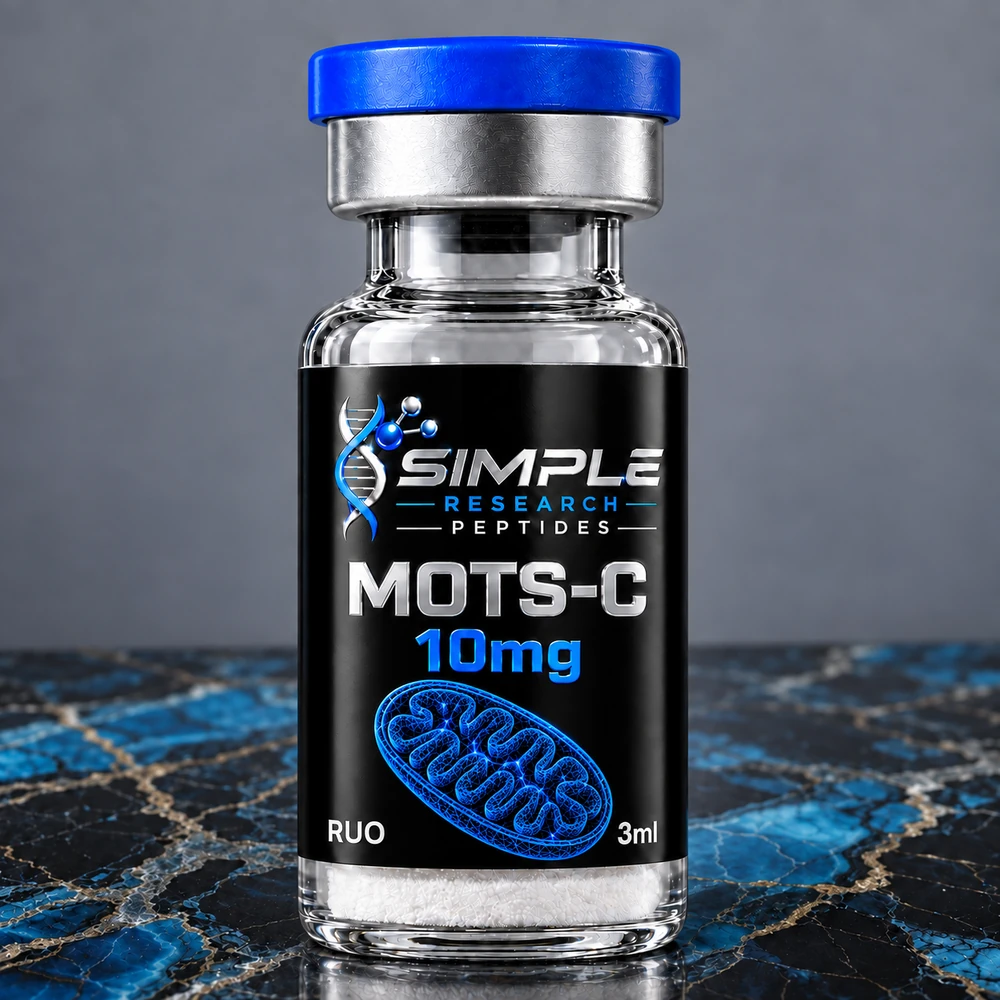
Product artwork identifies the SRP listing. It does not demonstrate safety or clinical benefit. The evidence guide and its sources follow below.
View MOTS-C 10 mg vial and documentation →View MOTS-C 20 mg and 40 mg options
MOTS-C Research Guide: A Comprehensive Scientific Overview
Mitochondria are traditionally understood as the powerhouses of the cell, primarily responsible for generating adenosine triphosphate (ATP). However, advanced cellular research has repositioned mitochondria as dynamic signaling organelles that actively communicate with the nucleus and regulate systemic metabolic homeostasis. A key mechanism of this communication is the expression of mitochondrial-derived peptides (MDPs). Among the most extensively studied MDPs is MOTS-C, an endogenous 16-amino-acid peptide encoded deep within the mitochondrial 12S rRNA.
This guide provides a rigorous, evidence-mapped overview of MOTS-C for laboratory researchers. It explores the peptide’s proposed mechanisms of action, maps the current preclinical and clinical evidence, details significant regulatory updates, and outlines strict considerations for in vitro and in vivo laboratory modeling. MOTS-C is currently an experimental compound and is not approved for human medical use.
🔬 Quick Facts: MOTS-C Identity
- Nomenclature: Mitochondrial Open reading frame of the Twelve S rRNA-c
- Sequence: MRWQEMGYIFYPRKLR
- Origin: Encoded within the mitochondrial 12S ribosomal RNA
- Primary Proposed Targets: Intracellular (folate cycle, AMPK pathway, nuclear genome)
- Current Status: Experimental laboratory research material
What is MOTS-C and Why is it Studied?
MOTS-C was initially identified as part of a novel class of peptides transcribed from mitochondrial DNA (mtDNA) rather than nuclear DNA. Because the mitochondrial genome is highly compact and primarily dedicated to oxidative phosphorylation machinery, the discovery of short, biologically active open reading frames (sORFs) represented a major paradigm shift in cellular biology.
Researchers study MOTS-C to understand how mitochondria signal the rest of the cell during periods of metabolic stress, energy deficit, or oxidative imbalance. The peptide is hypothesized to act as a metabolic regulator, directing cellular resources toward energy conservation and survival pathways. Because metabolic dysregulation is a hallmark of numerous pathological models, MOTS-C serves as a critical biological probe for investigating metabolic flexibility, cellular senescence, and the fundamental mechanics of the one-carbon cycle.
Proposed Mechanisms of Action
The cellular mechanisms of MOTS-C are complex and currently remain model-dependent. Laboratory investigations have proposed several interconnected pathways through which this peptide may exert its effects. These mechanisms are theoretical frameworks derived from cellular assays and should not be interpreted as proven clinical pathways.
1. One-Carbon Metabolism
MOTS-C is proposed to inhibit the folate cycle, specifically targeting enzymes involved in de novo purine biosynthesis. This restriction of purine availability signals a state of metabolic stress.
2. AICAR Accumulation
By inhibiting purine synthesis, MOTS-C models demonstrate an intracellular accumulation of 5-aminoimidazole-4-carboxamide ribonucleotide (AICAR), a well-known metabolic intermediate.
3. AMPK Activation
The accumulation of AICAR subsequently activates AMP-activated protein kinase (AMPK), the primary cellular energy sensor, driving the cell toward catabolic energy production.
4. Nuclear Translocation
Under severe metabolic stress, in vitro observations suggest MOTS-C may translocate from the cytoplasm directly into the nucleus to interact with DNA binding targets like ARE-responsive genes.
Evidence Map: Current Research Findings
The research landscape surrounding MOTS-C is categorized into distinct tiers of evidence. It is vital for researchers to recognize the boundaries of this data and strictly avoid converting preclinical animal findings into clinical human claims.

Regulatory and Evidence Status (July 2026 Update)
As of July 31, 2026, MOTS-C remains an unapproved, experimental substance. It is vital for researchers to remain current on the evolving regulatory landscape surrounding mitochondrial-derived peptides.
⚠️ Prominent FDA PCAC Advisory Briefing
During the Pharmacy Compounding Advisory Committee (PCAC) meeting held July 23-24, 2026, the FDA proposed NOT adding MOTS-C free base or acetate to the 503A Bulks List. This proposal cited significant data gaps, including limited physical and chemical characterization, unknown immunogenicity risks, a lack of pharmacokinetic and toxicokinetic data, and the absence of human safety and effectiveness evidence.
It is crucial to correctly interpret this update: the PCAC briefing is part of an advisory-committee process regarding human pharmaceutical compounding. It is not equivalent to a final regulatory rule, nor does it constitute an FDA ban on the synthesis or distribution of MOTS-C strictly as a laboratory research material. However, the FDA’s documented concerns underscore the immense gaps in clinical safety data.
Evidence Limitations and Unanswered Questions
The leap from murine models to human biology presents substantial hurdles. The scientific community has identified several major limitations in current MOTS-C research:
- Receptor Ambiguity: Unlike many classic peptides, MOTS-C does not have a clearly mapped, single extracellular cell-surface receptor. Its proposed entry mechanisms and intracellular targets require further validation.
- Pharmacokinetics: The exact half-life, systemic distribution, and degradation pathways in non-murine models remain poorly characterized.
- Long-Term Toxicity: There is no substantial longitudinal data regarding the toxicokinetic profile or immunogenicity of exogenous MOTS-C administration over extended periods.
Laboratory Research Considerations
For institutions designing assays involving MOTS-C, controlling the testing environment and material variables is paramount. Accurate results depend entirely on the integrity of the peptide and the experimental design.
- Identity and Purity: Research material must be verified via High-Performance Liquid Chromatography (HPLC) and Mass Spectrometry (MS) to ensure sequence accuracy and the absence of synthesis truncations.
- Sterility and Endotoxins: In vitro cellular assays are highly sensitive to endotoxins. Materials utilized must be subjected to stringent endotoxin limits to avoid triggering false inflammatory responses in cell cultures.
- Batch Documentation: Researchers must maintain rigorous traceability using Certificates of Analysis (COAs) associated with specific batch numbers to ensure reproducibility across experimental repetitions.

Frequently Asked Questions
Is MOTS-C an FDA-approved drug?
No. MOTS-C is not an FDA-approved drug. It is exclusively an experimental compound utilized strictly for in vitro and in vivo animal laboratory research.
What is the primary target of MOTS-C?
Current cellular models propose that MOTS-C targets the intracellular one-carbon/folate cycle, subsequently triggering AMPK activation. However, a single primary receptor has not been definitively mapped.
Does ClinicalTrials.gov registration imply safety?
No. The presence of a study record on ClinicalTrials.gov does not represent evidence of clinical safety, efficacy, or FDA endorsement. It merely documents that a trial protocol was registered.
Conclusion
MOTS-C remains a compelling subject within the emerging field of mitochondrial-derived peptides. While cellular assays and murine models indicate a potential role in metabolic regulation, significant data gaps remain regarding immunogenicity, pharmacokinetics, and human safety. The recent FDA advisory committee evaluations strongly highlight these limitations, reminding the scientific community of the vital distinction between preclinical observation and confirmed safety. Robust, meticulously controlled laboratory modeling is essential for resolving these fundamental unknowns.
Laboratory Research Notice
All materials provided by Simple Research Peptides are manufactured exclusively for laboratory research applications. They are strictly not for human consumption, diagnostic use, or clinical treatment. Researchers must ensure compliance with all institutional safety and regulatory guidelines.
Return to Research LibraryPrimary References & Official Sources
- Lee, C., Zeng, J., Drew, B. G., et al. (2015). The mitochondrial-derived peptide MOTS-c promotes metabolic homeostasis and reduces obesity and insulin resistance. Cell Metabolism. https://pubmed.ncbi.nlm.nih.gov/25738459/
- Reynolds, J. C., Lai, R. W., Woodhead, J. S. T., et al. (2021). MOTS-c is an exercise-induced mitochondrial-encoded regulator of age-dependent physical decline and muscle homeostasis. Nature Communications. https://www.nature.com/articles/s41467-020-20790-0
- FDA Pharmacy Compounding Advisory Committee. (July 2026). Clinical Overview Briefing. https://www.fda.gov/media/193342/download
- FDA Pharmacy Compounding Advisory Committee. (July 2026). MOTS-C Evaluation Briefing. https://www.fda.gov/media/193347/download
- ClinicalTrials.gov. Study Record NCT07505745. https://clinicaltrials.gov/study/NCT07505745