



Pentadecapeptide
A synthetic research peptide containing 15 amino-acid residues.
Products are color coded by category
Peptide research · Compound guide
Explore the mechanisms, study findings and evidence limits behind this research topic.
Product artwork identifies the SRP listing. It does not demonstrate safety or clinical benefit. The evidence guide and its sources follow below.
View product label and documentation →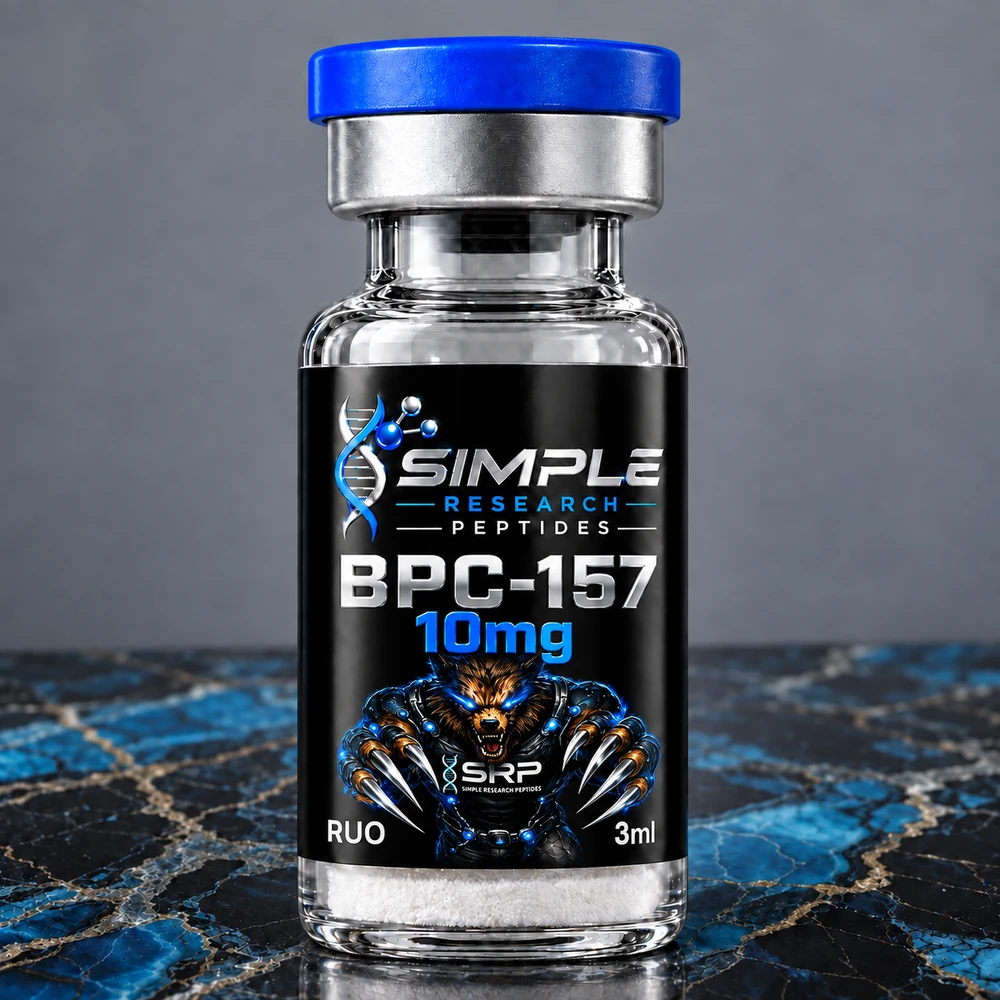
An evidence-mapped overview of BPC-157 covering compound identity, preclinical research themes, proposed biological pathways, published studies, laboratory considerations, and current evidence limitations.
Educational information only. BPC-157 is not FDA-approved for human use.
GEPPPGKPADDAGLV
A high-level identity and evidence-status dashboard for research review.
A synthetic research peptide containing 15 amino-acid residues.
Sequence commonly reported in the experimental literature.
Most published findings come from animal or laboratory models.
Not an FDA-approved drug and not established for human treatment.
BPC-157 is a synthetic 15-residue peptide frequently described in the scientific literature as a stable gastric pentadecapeptide. Researchers have investigated it across multiple experimental systems, including gastrointestinal injury, connective-tissue models, vascular signaling, and cellular migration.
The key limitation is equally important: broad online claims often extend beyond the available evidence. The published record is dominated by preclinical research, so animal or cell-model findings should not be treated as proof of safety or effectiveness in humans.
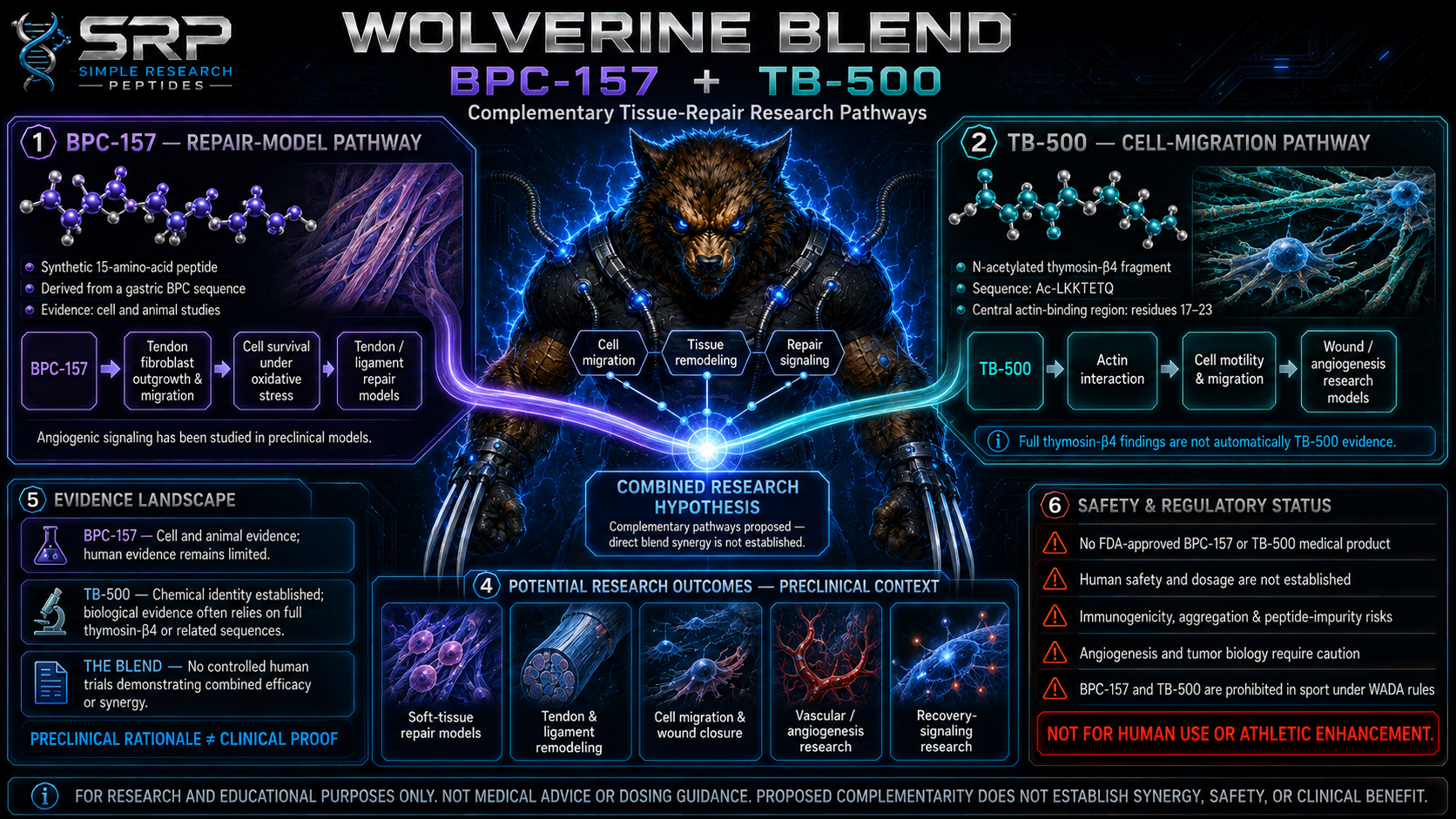
Mechanistic themes reported in experimental literature—not confirmed clinical effects.
Animal studies frequently examine interactions with nitric-oxide pathways using L-arginine and NOS inhibition models.
PROPOSED PATHWAYPreclinical work has evaluated VEGF expression, endothelial behavior, and context-dependent angiogenic responses.
PRECLINICAL SIGNALCell and animal models have explored ERK1/2-linked migration, proliferation, and tissue-remodeling signals.
MODEL DEPENDENTExperimental injury models have measured collagen organization, granulation tissue, and mechanical endpoints.
RESEARCH ENDPOINTOrganized by experimental question rather than consumer benefit claims.
Mucosal injury, ulceration, anastomosis integrity, and inflammatory or oxidative markers.
Fibroblast signaling, collagen organization, vascular response, and mechanical recovery endpoints.
Granulation tissue, re-epithelialization, cellular migration, and extracellular-matrix remodeling.
Nitric-oxide-system interactions, endothelial markers, blood-flow adaptation, and thrombosis models.
Experimental ischemia, toxic-injury, and oxidative-stress endpoints in animal research.
Reproducibility, independent validation, pharmacology, toxicology, and the gap between animal and human evidence.
A transparent view of what the research record can—and cannot—support.
Evidence boundary: Preclinical findings do not establish human safety, effectiveness, dosing, or therapeutic use. FDA has noted limited safety-related information and potential concerns involving immunogenicity and peptide-related impurities for compounded BPC-157.
Selected milestones showing how the experimental literature expanded.
Initial animal publications examined mucosal protection, injury response, granulation tissue, angiogenesis, and collagen-related endpoints.
Published work evaluated VEGF-related markers in cell culture and injured animal tissue, reporting context-dependent vascular modulation.
Tendon fibroblast and wound-model studies examined growth-hormone-receptor expression, ERK1/2 signaling, migration, and remodeling.
Animal research continued across gastrointestinal, vascular, ischemia-reperfusion, and multi-organ injury models while human evidence remained limited.
Independent replication, standardized characterization, pharmacokinetics, toxicology, and controlled human data remain major evidence gaps.
Direct source links are provided for independent review. Inclusion does not imply clinical validation.
In vitro and animal-model evaluation of VEGF expression and vascular response.
PubMed PMID 20388964 ↗ 2014CELL MODELLaboratory study examining gene and protein expression in rat tendon fibroblasts.
PubMed PMID 25415472 ↗ 2015PRECLINICALMurine wound research paired with endothelial-cell migration and signaling assays.
PubMed PMID 25995620 ↗ 2020RAT MODELAnimal study assessing mucosal injury, inflammation, apoptosis, and VEGF-related signaling.
PubMed PMID 33376304 ↗Methodology-centered guidance for lawful laboratory research—not human-use instructions.
Record batch identity, analytical documentation, material condition, receipt date, and storage history before use.
Use appropriate vehicle, positive, and negative controls with predefined endpoints and adequate biological replication.
Follow the product label, batch documentation, and laboratory SOPs. Minimize uncontrolled temperature and light exposure.
Document concentrations, preparation methods, model characteristics, exclusions, adverse observations, and complete outcomes.
Open SRP’s calculation workspace for concentration math, unit conversion, scheduling, and research planning.
Clear answers that separate published research from unsupported conclusions.
No. BPC-157 is investigational and is not an FDA-approved drug for human treatment.
The published literature is primarily composed of animal studies and selected cell-model experiments. Controlled human evidence is insufficient to establish safety or effectiveness.
Frequently studied themes include gastrointestinal injury, connective-tissue models, wound response, vascular signaling, nitric-oxide pathways, and cellular migration.
No. Animal models are valuable for generating and testing hypotheses, but species differences, experimental conditions, exposure, and study quality limit direct translation.
This guide explains the evidence and its limitations. The product page provides batch, purchasing, and research-material information.
This starter source vault will expand during the full evidence-writing pass.
Modulatory effect of gastric pentadecapeptide BPC 157 on angiogenesis in muscle and tendon healing.
PubMed ↗Pentadecapeptide BPC 157 enhances the growth hormone receptor expression in tendon fibroblasts.
PubMed ↗Body protective compound-157 enhances alkali-burn wound healing in vivo and promotes proliferation, migration, and angiogenesis in vitro.
PubMed ↗Clopidogrel-induced gastric injury in rats is attenuated by stable gastric pentadecapeptide BPC 157.
PubMed ↗FDA: Certain bulk drug substances for use in compounding that may present significant safety risks.
FDA ↗2 mins ago