



Cellular health · Compound guide
SS-31
Explore the mechanisms, study findings and evidence limits behind this research topic.
Product artwork identifies the SRP listing. It does not demonstrate safety or clinical benefit. The evidence guide and its sources follow below.
View product label and documentation →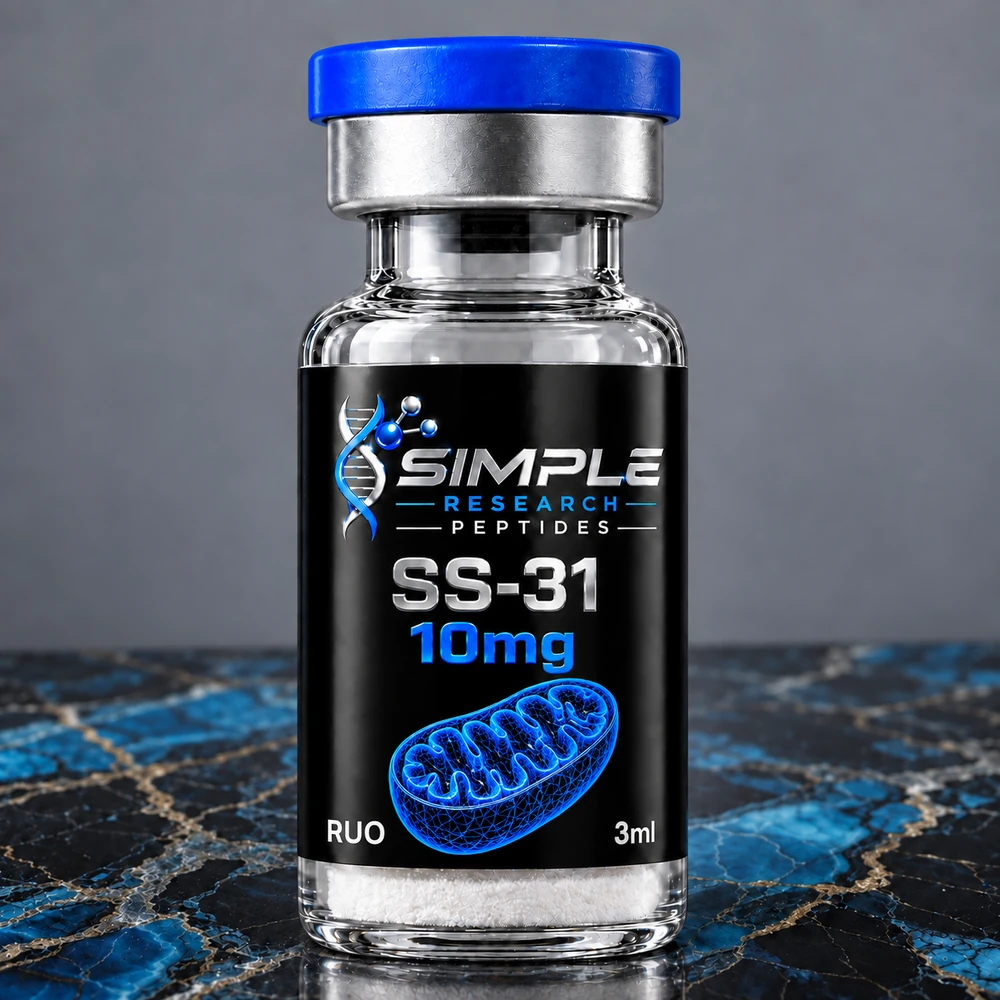
SS-31 / Elamipretide Research Guide
SS-31 is a research name commonly associated with elamipretide, a mitochondria-targeting tetrapeptide investigated for interactions with the inner mitochondrial membrane and cardiolipin. In September 2025, the FDA granted accelerated approval to the finished drug Forzinity (elamipretide) for Barth syndrome in patients weighing at least 30 kg. That approval is narrow and indication-specific; proposed uses outside the approved indication remain investigational. This evidence-mapped guide summarizes current findings and their limitations for laboratory researchers.
Chemical Profile and Quick Facts
What is SS-31?
SS-31 is a synthetic peptide formulated to penetrate cellular barriers to reach the mitochondria. Unlike broad antioxidants that neutralize reactive oxygen species throughout the cytosol, SS-31 is investigated for its highly targeted approach. Researchers have mapped its accumulation specifically to the inner mitochondrial membrane, the critical site of the electron transport chain.
Laboratory studies indicate that this targeted localization allows the peptide to act at the very source of cellular energy production. The interaction heavily influences cytochrome c complex behaviors. Most performance, anti-aging, cardiac, ocular, renal, and neurologic claims surrounding the peptide remain strictly investigational, requiring further robust validation in controlled, large-scale clinical settings before drawing definitive conclusions.
Proposed Mechanisms: Cardiolipin and Mitochondria
The defining structural feature of SS-31 is an alternating sequence of aromatic and basic amino acids. Preclinical analyses suggest this structure enables the peptide to selectively bind to cardiolipin, a phospholipid exclusively found in the inner mitochondrial membrane.
Cardiolipin plays a pivotal role in maintaining the structural integrity of mitochondrial cristae and organizing electron transport chain complexes into efficient supercomplexes. During periods of high cellular stress, cardiolipin can degrade, potentially leading to severe electron leakage and significantly elevated oxidative stress. Research proposes that SS-31 binding physically stabilizes cardiolipin, preserving mitochondrial structure and function without directly acting as a traditional chemical scavenger.
Critical Regulatory Status Update
The regulatory landscape for elamipretide experienced a significant development recently. On September 19, 2025, the FDA granted accelerated approval to Forzinity (elamipretide) injection. This marks the first approved treatment for Barth syndrome, specifically indicated for patients weighing at least 30 kg.
Investigators must recognize that this approval is narrow, indication-specific, and conditional. The official 2025 prescribing information describes the approved product and use, while the FDA approval announcement states that a confirmatory post-approval trial is required. The SS-31 offered by Simple Research Peptides is labeled strictly for laboratory research use only; it is not Forzinity and is not an FDA-approved finished drug.
Evidence Map: The State of Current Research
The scientific literature regarding SS-31 includes a complex mix of preclinical models, open-label extensions, and limited clinical trials across various potential indications.
Preclinical Barth Syndrome Models
A preclinical tafazzin-knockdown mouse study reported favorable changes in cardiac mitochondrial function and bioenergetic measures in a model relevant to Barth syndrome. Animal-model findings do not establish clinical benefit in humans.
TAZPOWER Trial Extensions
Long-term data from the TAZPOWER open-label extension suggested potential sustained improvements in exercise tolerance, though evidence limits persist heavily due to remarkably small population sizes.
The ReNEW phase 3 clinical trial record evaluates subcutaneous elamipretide in dry age-related macular degeneration. It illustrates ongoing, indication-specific clinical investigation and does not establish benefit for other proposed uses. Across the broader evidence base, limitations include small populations, mixed endpoints, open-label extensions, and the need for confirmatory randomized trials.
Laboratory and Research Considerations
When handling SS-31 for in vitro applications, researchers should consistently utilize sterile techniques and precisely controlled laboratory environments. Due to its specific biochemical targeting of cardiolipin, experimental assays typically focus on mitochondrial respiration rates, reactive oxygen species quantification, and structural electron microscopy of cristae membranes.
Researchers should not translate preclinical concentrations or online dosage protocols into human use. Study designs should predefine endpoints, include appropriate controls, document material identity and handling conditions, and distinguish exploratory findings from validated outcomes. Any animal or human research requires appropriate institutional, ethical, and regulatory oversight.
Frequently Asked Questions
How does SS-31 differ from traditional antioxidants?
Traditional antioxidants scavenge reactive oxygen species indiscriminately throughout the cell structure. Conversely, SS-31 is proposed to localize specifically to the inner mitochondrial membrane, interacting with cardiolipin to potentially stabilize mitochondrial architecture and prevent excessive radical formation directly at the biological source.
Is SS-31 approved for widespread human use?
Elamipretide is FDA-approved only as the finished drug Forzinity for Barth syndrome in patients weighing at least 30 kg under accelerated approval. That authorization does not establish broad approval for other proposed uses. SRP’s SS-31 research material is not Forzinity, is not an approved finished drug, and is labeled for laboratory research use only.
References
Advance Your Mitochondrial Research
Simple Research Peptides offers SS-31 labeled strictly for laboratory research use only. Review the product specifications and available batch documentation before selecting material for a research workflow.
Disclaimer: For Research Use Only. Not for human consumption.
View SS-31 10 mg and 50 mg research vials