SRP RESEARCH PULSE
HUGE SALE ON FEATURED ITEMSKLOW 80mgGLOW 70mgHumanin 10mgFOXO4-DRI 10mgACE-031 1mgWolverine 20/20SS-31 10mg5-Amino-1MQ 50mgMOTS-c 40mgBPC-157/TB-500 10mg/10mgSelank 10mgNAD+ 500mgGHK-Cu 100mgRTZ-GLP 30mgTirzepatide 30mgEpithalon 10mgKisspeptin 10mg

Vesugen Research Guide

SRP COMPOUND INTELLIGENCE

Vesugen Research Guide3 residues · KED · sparse / limited evidence

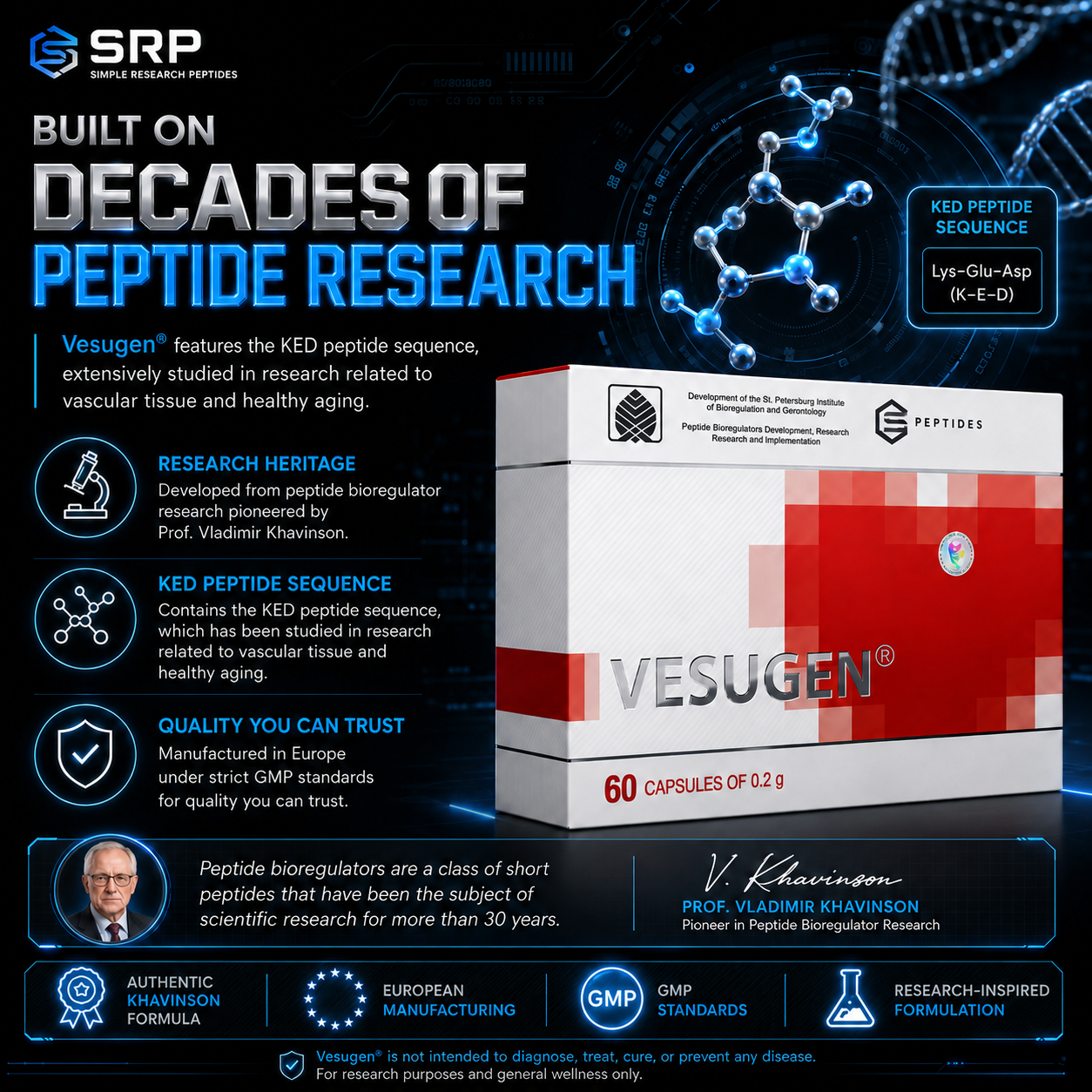
Vesugen research graphic: KED peptide sequence Lys-Glu-Asp

Vesugen is a synthetic tripeptide printed in opened Khavinson-group papers as Lys-Glu-Asp (KED) (opened PMID 22808515 prints “vesugen (Lys-Glu-Asp)”; opened PMID 35887081 Table 2 prints “Vesugen (KED)”), positioned as a short peptide bioregulator associated with vascular-endothelial and gene-expression research. English-language independently replicated evidence is limited. ClinicalTrials.gov returned 0 Vesugen studies. It is not Livagen, not Pinealon, not Epitalon, not Vilon, not Pancragen, and not an FDA-approved drug on any opened registry. Investigational. Research use only. Not medical advice. Not for human use.

3 residues
KED
Lys-Glu-Asp
Sparse / limited evidence
Investigational
0 NCT
Not FDA-approved
Research use only

Educational information only. This page describes a short peptide bioregulator sold as a laboratory research material. It is not medical advice. Simple Research Peptides (SRP) materials are for laboratory research only and are not for human or veterinary use, consumption, administration, diagnosis, treatment, or therapeutic application. Sequence Lys-Glu-Asp / KED is taken from opened papers that print the trade name Vesugen, plus PubChem CID 87571363 titled Lysyl-glutamyl-aspartic acid (not Vesugen). PubChem name lookup vesugen returned HTTP 404. No human dosing, reconstitution, or administration protocol appears on this page. The hero graphic is a visual only; educational facts on this page come from opened papers and registries, not from marketing copy on the image.

01 / Identity

Quick Facts

A high-level identity and evidence-status dashboard for research review. Sequence Lys-Glu-Asp / KED is taken from opened primary papers that print the trade name Vesugen next to that sequence, plus the opened PubChem record for the tripeptide (title Lysyl-glutamyl-aspartic acid, not Vesugen). SRP’s product page prints the marketplace aliases “KED Peptide, Lys-Glu-Asp.” That is vendor language, not an independent certificate of analysis.

01 ClassificationSynthetic tripeptide (Khavinson-catalog bioregulator)A three-residue peptide printed as Lys-Glu-Asp / KED in opened papers that also print the trade name Vesugen.
02 Reported sequenceKED / Lys-Glu-AspVerified on opened PMID 22808515 and opened PMID 35887081 Table 2. PubChem CID 87571363 is the matching L-tripeptide but is not titled Vesugen. Confirm the vial by sequence and assay.
03 Evidence profileSparse / limited evidenceSRP index tag. Most published findings come from the originating St. Petersburg research network: cell and organotypic models, in-silico docking, one 5xFAD mouse paper, and small regional human observations that are not ClinicalTrials.gov records.
04 Regulatory statusInvestigationalNot an FDA-approved drug. NCATS 0, openFDA 404, IUPHAR 404, UNII not found, NCT 0 for Vesugen.
PubChem CID87571363Title: Lysyl-glutamyl-aspartic acid (not Vesugen). Formula C15H26N4O8. MW 390.39. Name vesugen = HTTP 404. Opened 16 August 2026.
CAS on that CID204271-66-9Depositor-supplied synonym only. PUG name lookup resolved to CID 87571363, title Lysyl-glutamyl-aspartic acid. Not a separately opened CAS Common Chemistry record.
ChEBICHEBI:159909Name Lys-Glu-Asp; tripeptide; same InChIKey. Does not print Vesugen.
UNII / NCATS / IUPHARNot foundNCATS search vesugen = total 0. Exact name “VESUGEN” = total 0. IUPHAR name=vesugen / Lys-Glu-Asp / KED all HTTP 404. openFDA vesugen HTTP 404. INN / USAN: none.
ClinicalTrials.gov0 studiesquery.term=vesugen returned totalCount 0. Combined KED-string hit NCT03155100 is a myeloma KEd regimen (carfilzomib + elotuzumab + dexamethasone). Not a Vesugen trial. Unused as evidence.
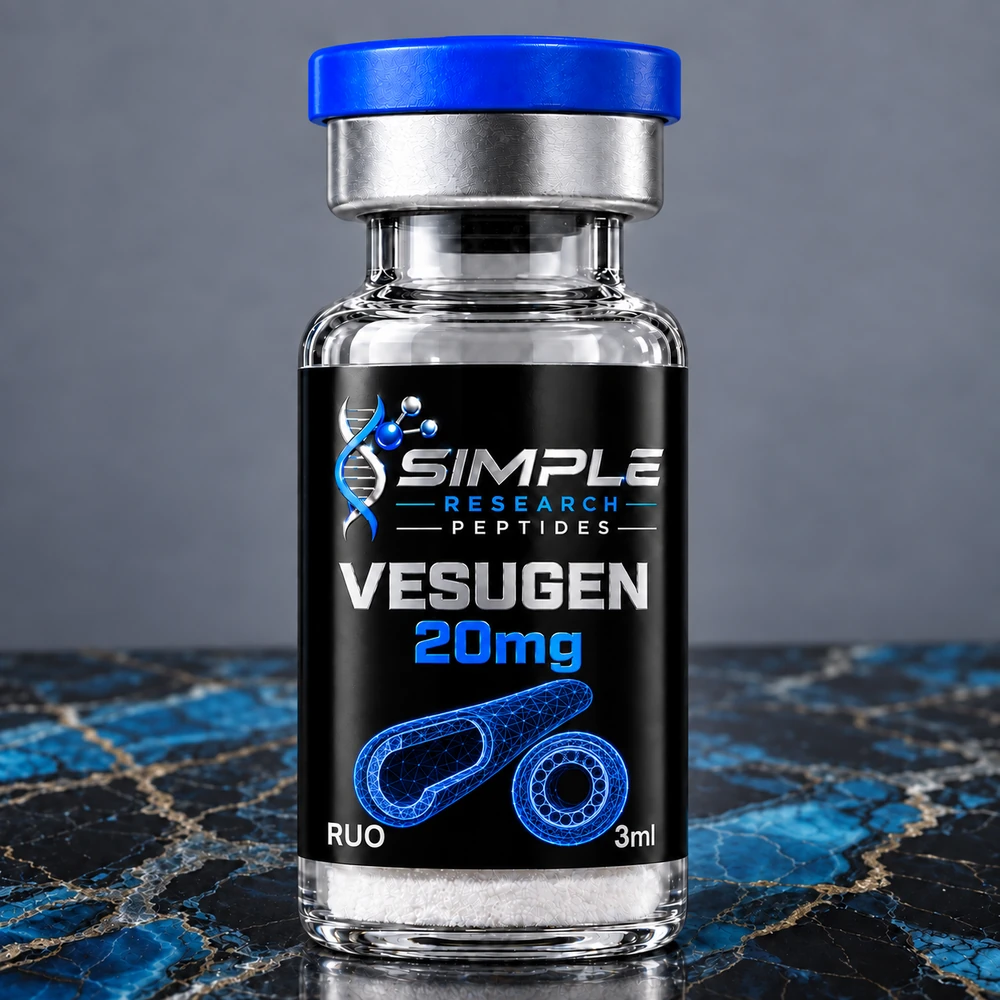
SRP listingVesugen (20 mg Vial)Longevity / Bioregulator Research. Index evidence tag: Sparse/limited evidence. Evidence profile, not a dedicated long-form guide (dedicated guide URLs returned HTTP 404 on 16 August 2026).
Internal designationT-38 (Lys-Glu-Asp)Voicekhovskaya et al. 2012, PMID 22803085, a skin-explant paper that does not print the trade name Vesugen.
Europe PMC hitCount10 for vesugenREST query=vesugen on 16 August 2026. Almost all originate from the Khavinson network.
Identifier Value on opened page Source opened
Trade name on SRP Vesugen (20 mg Vial) SRP product page
SRP listed strength / format Page title and H1: 20 mg Vial. Body also prints “Vesugen (10 mg / 3 mL Vial)” and “10 mg lyophilized research compound in a 3 mL research vial” — internal inconsistency on the opened product page. Treat as a store-page copy issue, not as two verified strengths. SRP product page
SRP store category Longevity / Bioregulator Research SRP product page (store taxonomy, not a clinical indication)
SRP index category / evidence tag Longevity listing “Vesugen (20 mg Vial)”; Evidence profile (not a dedicated long-form guide); evidence tag Sparse/limited evidence SRP compound-research-guides index
Dedicated guide URLs HTTP 404 on 16 August 2026 /research-compound-directory/vesugen-research-guide/ and /vesugen-research/
Sequence printed with the name Vesugen Lys-Glu-Asp (one-letter KED) Khavinson et al. 2012, PMID 22808515 (“vesugen (Lys-Glu-Asp)”); Khavinson et al. 2022, PMID 35887081 Table 2 (“Vesugen (KED)”)
Internal Khavinson designation T-38 (Lys-Glu-Asp) on a skin-explant paper that does not print the trade name Vesugen Voicekhovskaya et al. 2012, PMID 22803085
PubChem CID 87571363. Title: Lysyl-glutamyl-aspartic acid (not Vesugen). Formula C15H26N4O8. MW 390.39 PubChem HTML + PUG REST, opened 16 August 2026. CID 87571363
PubChem name vesugen HTTP 404 PubChem PUG, opened 16 August 2026
PubChem depositor synonyms lysyl-glutamyl-aspartic acid; Lys-Glu-Asp; L-Lysyl-L-glutamyl-L-aspartic acid; SCHEMBL3767701; CHEBI:159909; 204271-66-9 PubChem PUG synonyms JSON
CAS on the Lys-Glu-Asp CID 204271-66-9 (depositor-supplied synonym). PUG name 204271-66-9 resolved to CID 87571363, Title Lysyl-glutamyl-aspartic acid PubChem CID 87571363; PUG name lookup. Common Chemistry not opened
Molecular formula / MW C15H26N4O8; 390.39 g/mol PubChem PUG
Exact / monoisotopic mass 390.17506380 PubChem HTML computed properties
InChIKey LLSUNJYOSCOOEB-GUBZILKMSA-N PubChem PUG
IUPAC name (PubChem computed) (2S)-2-[[(2S)-4-carboxy-2-[[(2S)-2,6-diaminohexanoyl]amino]butanoyl]amino]butanedioic acid PubChem PUG
Sequence / HELM (PubChem biologic) KED; H-Lys-Glu-Asp-OH; H-KED-OH; PEPTIDE1{K.E.D} PubChem HTML
ChEBI CHEBI:159909 — name Lys-Glu-Asp; tripeptide; same InChIKey. Does not print Vesugen ChEBI HTML, opened 16 August 2026
Wikipedia (identity cross-check only) Vesugen (T-38); sequence KED / Lys-Glu-Asp; CID 87571363; CAS 204271-66-9; ChEBI 159909. Also printed ChemSpider 16572739. ChemSpider itself was not opened and is not used here https://en.wikipedia.org/wiki/Vesugen
UNII Not found NCATS substances search vesugen total 0; exact name “VESUGEN” total 0. Fuzzy Lys-Glu-Asp returned 833 unrelated proteins — not used
NCATS Inxight No substance record named vesugen NCATS API, opened 16 August 2026
IUPHAR / GtoPdb No ligand IUPHAR services name=vesugen, name=Lys-Glu-Asp, name=KED all HTTP 404
openFDA Drugs@FDA / labels No matches openFDA search=vesugen HTTP 404 (drugsfda + label)
ClinicalTrials.gov 0 studies for vesugen. Combined KED peptide OR “Lys-Glu-Asp” OR vesugen returned 1 hit: NCT03155100 (acronym KEd = carfilzomib + elotuzumab + dexamethasone for myeloma). Not a Vesugen trial. Unused as evidence. CT.gov API v2, opened 16 August 2026
INN / USAN None on any opened registry

What this is chemically, from opened pages. Opened Khavinson-group papers print Vesugen as unmodified Lys-Glu-Asp (KED). PubChem CID 87571363 is the corresponding L-tripeptide (H-Lys-Glu-Asp-OH) but is not titled Vesugen. Opened PMID 22803085 prints the same three residues as T-38. ChEBI 159909 is the same structure. Salt form, counter-ion, and assay of any SRP vial were not printed on opened SRP pages as a public COA.

What this is not, chemically.

  • Not Livagen (Lys-Glu-Asp-Ala / KEDA). Opened PMID 35887081 Table 2 prints Livagen (KEDA) and Vesugen (KED) as separate rows.
  • Not Pinealon (Glu-Asp-Arg / EDR). Meshchaninov 2015 (PMID 26390612) and Khavinson 2021 (PMID 34071923) test Vesugen/KED and Pinealon/EDR as distinct peptides.
  • Not Epitalon / Epithalon (Ala-Glu-Asp-Gly / AEDG).
  • Not Vilon (Lys-Glu / KE). Linkova 2011 (PMID 22803057): vilon induced pineal immune-cell differentiation; vesugen did not, and only enhanced proliferation.
  • Not Pancragen (Lys-Glu-Asp-Trp / KEDW), Bronchogen (Ala-Glu-Asp-Leu), Prostomax (KEDP), Testagen (KEDG), Ovagen (EDL), or Chonluten (EDG). Those sequences are printed as separate rows on opened PMID 35887081 Table 2 and/or PMID 22808515.
  • Not a tissue extract (catalog names such as Ventfort appear on vendor/blog pages; no Ventfort primary paper was opened here, so extract-vs-tripeptide claims are not assigned from those pages).
  • Not shown on any opened page to be compositionally identical to an SRP 20 mg lyophilized research vial. Confirm sequence, salt form, and assay on the batch.

Not printed on SRP index as independent chemistry: CAS, UNII, formula, CID. The product page aliases are vendor-only until matched to a paper or registry.

Critical identity point: Vesugen on opened papers is the tripeptide Lys-Glu-Asp (KED). PubChem CID 87571363 is the matching L-tripeptide but is titled Lysyl-glutamyl-aspartic acid, not Vesugen. Do not treat Livagen (KEDA), Pinealon (EDR), Vilon (KE), Epitalon (AEDG), or Pancragen (KEDW) papers as Vesugen evidence. Do not invent a sequence as if SRP verified the vial. Do not copy the product-page vendor dosage chart onto this educational page.
Opened page What it printed Why it is not interchangeable with Vesugen
Khavinson et al. 2012
PMID 22808515
vesugen (Lys-Glu-Asp) in prostatic fibroblasts; pancragen (Lys-Glu-Asp-Trp) in pancreatic cells; bronchogen (Ala-Glu-Asp-Leu) in bronchial epithelium Three named peptides, three tissues
Voicekhovskaya et al. 2012
PMID 22803085
T-32 EDA, T-33 EDR (Pinealon sequence), T-34 EDG (Chonluten sequence), T-36 EDP, T-38 KED Five tripeptides in one skin-explant design
Linkova et al. 2011
PMID 22803057
vilon vs epithalon vs vesugen on pineal immune cells Vesugen did not drive the differentiation that vilon did
Khavinson et al. 2021
PMID 34071923
KED and EDR (Pinealon) in 5xFAD mice Co-tested, not the same molecule
Meshchaninov et al. 2015
PMID 26390612
Vesugen and Pinealon in 32 people Two named preparations
Khavinson et al. 2022 Table 2
PMID 35887081 · PMC9323678
Vesugen (KED), ICM −18.91, labeled Vasoprotector / Neuroprotector / Geroprotector; separate rows for Livagen, Pancragen, Prostomax, Testagen, Chonluten, Epitalon, Vilon Same table, different sequences
02 / Overview

What Is Vesugen?

Vesugen is the synthetic tripeptide Lys-Glu-Asp. Opened papers from the St. Petersburg Institute of Bioregulation and Gerontology and collaborators report four clusters of laboratory observations. A well-validated receptor target is not established on any opened page. Independent Western replication of a receptor-level mechanism was not located.

The SRP index card (August 2026 editorial review) already states this correctly: marketed as a short peptide bioregulator associated with vascular-tissue and endothelial research; proposed effects involve gene expression and vascular cell homeostasis, but a well-validated receptor-level mechanism is not established; evidence is mainly preclinical or from small regional studies; independent replication and standardized human safety data are limited; confirm the exact sequence and distinguish this material from other vascular peptide preparations.

Cluster 1

Vascular-endothelial / “vasoprotective” cell models

Ki-67 / MKI67 docking and endothelial-culture work (Khavinson 2014, PMID 25051766); endothelin-1, connexin, and sirtuin-1 language in atherosclerotic / restenotic endothelium in vitro (Kozlov 2016, PMID 28539025); SASP / inflammaging review language for the KED tripeptide (Khavinson 2022, PMID 36611900).

Cluster 2

Tissue-specific differentiation and fibroblast / skin explant models

vesugen (Lys-Glu-Asp) stimulated CXCL12 and WEGC1 in aging human prostatic fibroblasts (PMID 22808515); T-38 (Lys-Glu-Asp) stimulated proliferation in old-rat skin explants (PMID 22803085); KED among KE/AED/AEDG peptides on aging skin-fibroblast markers (PMID 27259496).

Cluster 3

Neurogenesis / AD-model work using the sequence name KED

Trade name Vesugen often not printed. 5xFAD mouse dendritic-spine study (PMID 34071923); KED review (PMID 34173097); hPDLSC neuronal-marker study with an Italian collaborating lab (PMID 30791821); later induced-neuron papers (PMID 39518916; PMID 41020860).

Cluster 4

Small regional human observation

Meshchaninov et al. 2015 (PMID 26390612): 32 people aged 41–83 with polymorbidity and organic brain syndrome in remission received named “Pinealon” and “Vesugen” preparations. This is not an NCT and is not a randomized, placebo-controlled trial on the opened abstract.

Europe PMC REST query=vesugen returned hitCount 10 on 16 August 2026. Almost all originate from the Khavinson network. Independent Western replication of a receptor-level mechanism was not located. A well-validated receptor target is not established on any opened page.
03 / Pathways

Proposed Research Mechanisms

Mechanistic themes reported in experimental literature — not confirmed clinical effects. No opened paper establishes a classical receptor agonist/antagonist assignment for Vesugen. Proposed effects involve gene expression and vascular cell homeostasis. Do not treat this as a validated receptor map.

Gene / docking

Proposed promoter-level / “epigenetic” interaction

Opened papers treat KED/Vesugen as a short peptide that can be docked to DNA hexanucleotide sequences or named promoter fragments (MKI67 core promoter CATC in PMID 25051766; tryptophan-hydroxylase CCTGCC in PMID 24909721; AD-related promoters discussed for EDR more than KED in PMID 34071923). These are computational or correlative gene-expression results, not crystal structures or a validated receptor.

Endo · preclinical signal

Endothelial / vascular-cell markers

Kozlov 2016 (PMID 28539025) reports that KED “normalized” endothelin-1 expression that had increased in atherosclerotic and restenotic endothelium in vitro, restored connexin-related cell interactions, and increased sirtuin-1. Khavinson 2014 (PMID 25051766) reports Ki-67 stimulation in aging vascular-endothelial cultures plus MKI67 docking. These are in-vitro / docking signals.

Diff · model dependent

Tissue-selective differentiation markers

PMID 22808515: vesugen (Lys-Glu-Asp) stimulated CXCL12 and WEGC1 in aging prostatic fibroblasts, while pancragen and bronchogen acted on other tissues. This is the group’s tissue-tropism claim, not a receptor map.

Neuro · research endpoint

Dendritic-spine / neuroplasticity models (KED sequence)

PMID 34071923: KED 400 µg/kg/day i.p. from 2–4 months in 5xFAD mice “tended to increase neuroplasticity”; KED and EDR prevented dendritic-spine loss in 5xFAD-M mice. Docking in that paper is described more fully for EDR. Caputi 2019 (PMID 30791821): KED alone increased GAP43 and nestin in hPDLSCs. Later induced-neuron papers report dendrite arborization (PMID 39518916) and reduced p21 / β-galactosidase with KED or AEDG (PMID 41020860).

Not shown in a paper opened here

No registered trial

A registered ClinicalTrials.gov or WHO-ICTRP trial for Vesugen (NCT: none).

No opened RCT

A peer-reviewed randomized, placebo-controlled human efficacy trial was not opened.

No human pharmacokinetics

Half-life, bioavailability, and tissue distribution for the synthetic tripeptide were not printed on opened pages.

No validated receptor or uptake assay

No modern receptor-panel Ki table, crystal structure, or measured PEPT/LAT uptake assay that used Vesugen as the substrate. PMID 35887081 is docking / review of POT and LAT carriers, not a Vesugen flux experiment.

No independent endothelial replication

Independent Western-laboratory replication of the endothelial Ki-67 / endothelin-1 findings was not located.

No FDA / EMA / NCATS approval

FDA, EMA, or NCATS approval / UNII: none on opened pages.

Do not treat as Vesugen evidence: Livagen/KEDA liver papers; Pinealon/EDR-only neuro papers; Epitalon telomerase papers; Vilon immune papers; NCT03155100 (myeloma KEd regimen); vendor blogs that assign a clinical indication. Historical 400 µg/kg/day i.p. mouse language is a study condition from an opened paper, not a protocol for an SRP vial.
04 / Research Map

Areas of Investigation

Organized by experimental question rather than consumer benefit claims.

01

Vascular-endothelial models

Ki-67 / MKI67, endothelin-1, connexin, sirtuin-1 in endothelial or atherosclerotic/restenotic cultures (PMID 25051766; PMID 28539025).

04

Organotypic neuroimmunoendocrine cultures

Pineal, lymphocyte, and honey-bee memory models using Lys-Glu-Asp (PMID 22803057; PMID 22977872).

05

In-vitro redox / hypoxia panels

Shared short-peptide panels (vesugen among vilon, epitalon, pinealon) on lipoprotein peroxidation, RBC osmotic hemolysis, neuronal ROS, and hypobaric hypoxia (PMID 18546826; PMID 18546825). Pinealon is described as the strongest antihypoxic peptide in that pair.

06

Evidence translation

Reproducibility, independent validation, pharmacology, toxicology, and the gap between regional bioregulator literature and controlled human evidence.

05 / Evidence

Scientific Evidence Snapshot

A transparent view of what the research record can — and cannot — support. Be honest: the record is sparse, geographically concentrated in the Khavinson network, has 0 NCT for Vesugen, and is not FDA-approved.

Evidence tier Current signal Translation confidence Status
Animal models One opened 5xFAD mouse paper (KED ± EDR); older hypoxia/organotypic rodent work Useful for hypothesis generation LIMITED
Cell / explant studies Endothelial, fibroblast, skin-explant, hPDLSC, induced-neuron, pineal-immune panels Mechanistic, model dependent, geographically concentrated EMERGING / SPARSE
In-silico docking MKI67, tryptophan hydroxylase, LAT/POT tables, AD-gene promoters Computational only HYPOTHESIS
Human evidence One opened n=32 regional observation (PMID 26390612); review sentences about “elder people” that cite prior work not opened as RCTs Cannot establish clinical use LIMITED / SPARSE
Regulatory review NCATS 0; openFDA 404; IUPHAR 404; UNII none; NCT 0 Not FDA-approved INVESTIGATIONAL
Evidence boundary: Preclinical and small regional findings do not establish human safety, effectiveness, dosing, or therapeutic use. The Khavinson peptide-bioregulator literature is geographically concentrated. Do not overclaim.
Claim type What opened pages actually support Flag
SRP 20 mg page: name Vesugen (20 mg Vial); $70.00; Longevity / Bioregulator Research; “Also Known As: KED Peptide, Lys-Glu-Asp”; COA available; Made in USA; RUO Quote-accurate for that URL (fetched 16 August 2026). Price, “Made in USA,” and “COA available” are vendor-only, not independent chemistry.
SRP body also prints “Vesugen (10 mg / 3 mL Vial)” Quote-accurate inconsistency on the opened 20 mg listing. Quality note only: do not invent a second SKU from that line. Not a headline.
SRP product “dosage chart” / reconstitution / injection units Present on the product page. Not copied here. Not a research protocol.
SRP index: Sparse/limited evidence; vascular-tissue / endothelial research; confirm sequence Matches this research pass (Europe PMC vesugen n=10; NCT 0). Keep that wording.
Dedicated …/vesugen-research-guide/ or /vesugen-research/ HTTP 404 on 16 August 2026. Do not link as a live guide.
“Sequence is Lys-Glu-Asp / KED.” Printed on opened Vesugen-named papers and Table 2. Fair if attributed to those pages, not to the SRP vial.
“CAS 204271-66-9.” Depositor synonym on CID 87571363; PUG name lookup resolved to that CID. Do not present as a separately verified Common Chemistry record or as an SRP-printed CAS.
“PubChem CID for Vesugen is 87571363.” CID is the Lys-Glu-Asp record. Title is not Vesugen. Name vesugen 404s. Say the CID is the matching tripeptide, not a Vesugen-titled record.
“FDA approved” / “treats atherosclerosis / AD / aging.” Contradicted by openFDA 404, NCATS 0, CT.gov 0. Kozlov 2016 and Meshchaninov 2015 are not RCTs. Do not use.
Using Pinealon, Livagen, or Vilon papers as Vesugen proof Opened pages distinguish the sequences. Common catalog error.
NCT03155100 as a Vesugen trial Acronym KEd = carfilzomib + elotuzumab + dex. Collision only. Unused.
06 / Timeline

Research Timeline

Selected milestones from opened pages only.

Shared in-vitro / hypoxia panels

Kozina papers name vesugen among pinealon, vilon, and epitalon. No direct antioxidant activity; restricted lipoprotein peroxidation by structural modification; RBC membrane stabilization; pinealon strongest in hypobaric hypoxia (PMID 18546826; PMID 18546825).

Trade name printed next to Lys-Glu-Asp

Linkova 2011: vesugen enhanced pineal immune-cell proliferation but not differentiation (PMID 22803057). Khavinson 2012: “vesugen (Lys-Glu-Asp)” in aging prostatic fibroblasts (PMID 22808515). Voicekhovskaya 2012: T-38 (Lys-Glu-Asp) in old-rat skin explants (PMID 22803085). Chalisova 2012: Lys-Glu-Asp in neuroimmunoendocrine cultures and honey-bee memory (PMID 22977872).

Endothelial / “vasoprotective” cluster

Khavinson 2014: vesugen + D-7 on Ki-67 and MKI67 docking (PMID 25051766). Khavinson 2014: Lys-Glu-Asp + EDR on cortical serotonin / docking (PMID 24909721). Kozlov 2016: KED on atherosclerotic/restenotic endothelium in vitro (PMID 28539025). Lin’kova 2016: KED among skin-fibroblast aging markers (PMID 27259496).

Small regional human observation

Meshchaninov et al.: 32 people; named Pinealon and Vesugen preparations; authors describe anabolic / geroprophylactic language, prooxidant chemiluminescence, and reduced CD34+ cells (PMID 26390612). Not an NCT.

KED sequence in neuro / AD models

Caputi et al. 2019 (Chieti + St. Petersburg): KED increased GAP43 and nestin in hPDLSCs (PMID 30791821). Ashapkin 2020: KED modulated IGF1 / FOXO1 / TNKS2 / NFκB in aging FetMSCs (PMID 32399807). Khavinson 2021: 5xFAD mouse + DNA docking (PMID 34071923). Khavinson 2021 review: KED gene list (PMID 34173097).

Catalog docking and later cell models

Khavinson 2022 transport review Table 2: Vesugen (KED), ICM −18.91 (PMID 35887081). SASP/inflammaging review names the KED tripeptide (PMID 36611900). Kraskovskaya 2024 and Sakhenberg 2025: KED in induced-neuron aging models (PMID 39518916; PMID 41020860).

Translation remains the central question

Independent replication, standardized characterization, pharmacokinetics, toxicology, and controlled human data remain major evidence gaps. SRP index tag remains Sparse/limited evidence.

07 / Source Vault

Selected Published Studies

Direct source links are provided for independent review. Inclusion does not imply clinical validation. Only studies whose Europe PMC article page (or full-text XML) was opened for this draft are listed.

2012 · Cell model

Vesugen (Lys-Glu-Asp) in aging prostatic fibroblasts

Trade name + sequence printed. Tissue-specific differentiation-marker study vs pancragen and bronchogen. vesugen (Lys-Glu-Asp) stimulated CXCL12 and WEGC1 in aging human prostatic fibroblasts. Europe PMC PMID 22808515 · PubMed 22808515

2014 · Preclinical + docking

Vesugen and D-7 on endothelial Ki-67 / MKI67 docking

Russian-language Adv Gerontol abstract. Authors link a previously claimed “vasoprotective” effect in elder people to Ki-67 gene regulation — that prior human claim is not an opened RCT. Europe PMC PMID 25051766 · PubMed 25051766

2016 · Cell model

KED on atherosclerotic / restenotic endothelium in vitro

Sequence printed as KED (Lys-Glu-Asp). Endothelin-1, connexin, sirtuin-1. Abstract treatment-language is the authors’ claim, not a clinical trial. Europe PMC PMID 28539025 · PubMed 28539025

2021 · Animal model

KED and EDR in a 5xFAD mouse AD model

Open-access. KED 400 µg/kg/day i.p., 2–4 months; dendritic-spine and docking work; EDR co-tested. Erratum exists (PMID 39861198 noted on the opened record; erratum article itself was not opened as a methods paper). Europe PMC PMID 34071923 · PMC8227791 · PubMed 34071923

2015 · Small human series

Vesugen and Pinealon in 32 people (regional observation)

Not an NCT. Authors describe biological-age / anabolic language and also report prooxidant chemiluminescence and reduced CD34+ cells. Europe PMC PMID 26390612 · PubMed 26390612

2022 · Review + docking

Transport-review table that prints Vesugen (KED)

Table 2: Vesugen (KED), ICM-score −18.91, labeled Vasoprotector / Neuroprotector / Geroprotector. Not a uptake assay. Europe PMC PMID 35887081 · PMC9323678 · PubMed 35887081

View the reference framework below for the full opened-source list.

08 / Laboratory

Study Design & Handling

Methodology-centered guidance for lawful laboratory research — not human-use instructions. The SRP product page contains a vendor “dosage chart” and reconstitution protocol. That vendor protocol is not reproduced here and is not independent chemistry.

Vesugen is a laboratory research peptide. It is not an FDA-approved drug for human use. This page is educational. It does not provide dosing, reconstitution, administration, or any human-use instructions. Simple Research Peptides (SRP) materials are for laboratory research only and are not for human or veterinary use, consumption, administration, diagnosis, treatment, or therapeutic application.

01

Identity & Documentation

Record batch identity, analytical documentation, material condition, receipt date, and storage history before use. Confirm the three-residue sequence (Lys-Glu-Asp / KED) and salt form. Do not treat the trade name as a substitute for molecular identification.

02

Controls & Replication

Use appropriate vehicle, positive, and negative controls with predefined endpoints and adequate biological replication. If comparing bioregulators, include sequence-matched controls (KEDA, EDR, KE, AEDG) rather than assuming tissue tropism.

03

Cold-Chain Handling

Follow the product label, batch documentation, and laboratory SOPs. Minimize uncontrolled temperature and light exposure. Do not copy consumer reconstitution charts into a research protocol without an analytical plan.

04

Transparent Reporting

Document concentrations, preparation methods, model characteristics, exclusions, adverse observations, and complete outcomes. Report the actual sequence used, not only “Vesugen.”

No reconstitution scheme, no administration route, and no human or veterinary use protocol appears on this page. Research use only. Not medical advice. Not for human use. Historical mouse i.p. or regional-observation language is not a protocol for an SRP research vial. The product-page vendor dosage chart is not copied here.
09 / Clarity

Frequently Asked Questions

Is Vesugen approved for human use?

No. Vesugen is investigational and is not an FDA-approved drug for human treatment. Opened NCATS, openFDA, and IUPHAR queries returned no substance/ligand/label. UNII: none. NCT: none.

What type of evidence exists?

Sparse / limited. Opened literature is mainly cell and organotypic work, in-silico docking, one 5xFAD mouse paper, and a 32-person regional observation. Almost all records sit in the Khavinson / St. Petersburg network. Controlled human evidence is insufficient to establish safety or effectiveness.

Is the sequence really Lys-Glu-Asp / KED?

Yes, on opened papers that print the trade name next to that sequence (PMID 22808515; PMID 35887081 Table 2) and on papers that print T-38 (Lys-Glu-Asp) (PMID 22803085). PubChem CID 87571363 is the matching L-tripeptide but is not titled Vesugen. SRP’s product page prints the same aliases as vendor language. Confirm the vial by sequence and assay.

How is this different from Livagen, Pinealon, Epitalon, Vilon, or Pancragen?

Different sequences on opened pages: Livagen KEDA; Pinealon EDR; Epitalon AEDG; Vilon KE; Pancragen KEDW. PMID 35887081 Table 2 prints them as separate rows. PMID 22803057: vesugen did not copy vilon’s pineal immune-cell differentiation effect.

Did any registered trial test Vesugen?

No opened registered trial. ClinicalTrials.gov API v2 query.term=vesugen returned totalCount: 0. The only KED-string hit opened here was NCT03155100 (myeloma regimen acronym KEd). Unused.

Does an animal or cell result predict a human outcome?

No. Animal and cell models are valuable for generating and testing hypotheses, but species differences, experimental conditions, exposure, and study quality limit direct translation.

How is this different from the product page?

This guide explains the evidence and its limitations. The product page provides batch, purchasing, and research-material information, plus vendor protocol language that this educational page does not repeat. A research product is not an approved medicine.

What about the product-page 10 mg vs 20 mg wording?

The opened product URL is titled Vesugen (20 mg Vial) and is the live 20 mg listing, but the fetched body also prints “Vesugen (10 mg / 3 mL Vial).” Treat that as a store-page inconsistency, not as two verified strengths, until SRP corrects the copy. It is a quality note, not a second SKU.

Is PubChem titled Vesugen?

No. CID 87571363 is titled Lysyl-glutamyl-aspartic acid. PubChem name lookup vesugen returned HTTP 404 on 16 August 2026. The CID is the matching L-tripeptide, not a Vesugen-titled record.

Does this page include human dosing?

No. There is no human dosing, reconstitution, or administration protocol on this page. The product-page vendor dosage chart is not copied here. Research use only.

10 / References

Reference Framework

This source vault lists only records opened for this draft. PMIDs that print the trade name Vesugen on the opened record: 22808515, 25051766, 26390612, 22803057, 18546826, 18546825, 35887081. PMIDs that print sequence KED / Lys-Glu-Asp / T-38 (trade name Vesugen not always printed): 34071923, 34173097, 28539025, 22803085, 32399807, 30791821, 39518916, 27259496, 22977872, 24909721, 36611900, 41020860. Opened and unused as Vesugen-specific efficacy: 34834147. No trial registration number is listed because ClinicalTrials.gov returned 0 Vesugen studies. Do not invent one.

  1. Linkova NS, et al. Peptidegic stimulation of differentiation of pineal immune cells. Bull Exp Biol Med. 2011;152(1):124–127. PMID 22803057. DOI 10.1007/s10517-011-1470-1. Vesugen vs vilon vs epithalon.
  2. Khavinson VKh, et al. Peptides tissue-specifically stimulate cell differentiation during their aging. Bull Exp Biol Med. 2012;153(1):148–151. PMID 22808515. DOI 10.1007/s10517-012-1664-1. vesugen (Lys-Glu-Asp).
  3. Voicekhovskaya MA, et al. Effect of bioregulatory tripeptides on the culture of skin cells from young and old rats. Bull Exp Biol Med. 2012;152(3):357–359. PMID 22803085. DOI 10.1007/s10517-012-1527-9. T-38 (Lys-Glu-Asp).
  4. Chalisova NI, et al. Effect of tripeptide Lys-Glu-Asp on physiological activity of neuroimmunoendocrine system cells. Bull Exp Biol Med. 2012;153(4):569–572. PMID 22977872. DOI 10.1007/s10517-012-1768-7.
  5. Khavinson VKh, et al. Epigenetic aspects of peptidergic regulation of vascular endothelial cell proliferation during aging. Adv Gerontol. 2014;27(1):108–114. PMID 25051766. DOI 10.1134/s2079057015040116. vesugen + D-7; MKI67 docking.
  6. Khavinson VKh, et al. Short peptides stimulate serotonin expression in cells of brain cortex. Bull Exp Biol Med. 2014;157(1):77–80. PMID 24909721. DOI 10.1007/s10517-014-2496-y. Lys-Glu-Asp + Glu-Asp-Arg.
  7. Meshchaninov VN, et al. Effect of synthetic peptides on aging of patients with chronic polymorbidity and organic brain syndrome… Adv Gerontol. 2015;28(1):62–67. PMID 26390612. Named Vesugen and Pinealon; n=32; not an NCT.
  8. Kozlov KL, et al. Molecular aspects of vasoprotective peptide KED activity during atherosclerosis and restenosis. Adv Gerontol. 2016;29(4):646–650. PMID 28539025. KED (Lys-Glu-Asp) in vitro. No DOI on the opened record.
  9. Lin’kova NS, et al. Peptide regulation of skin fibroblast functions during their aging in vitro. Bull Exp Biol Med. 2016;161(1):175–178. PMID 27259496. DOI 10.1007/s10517-016-3370-x. KED among KE/AED/AEDG.
  10. Caputi S, et al. Effect of short peptides on neuronal differentiation of stem cells. Int J Immunopathol Pharmacol. 2019;33:2058738419828613. PMID 30791821. PMC6376556. DOI 10.1177/2058738419828613. KED; GAP43; nestin.
  11. Ashapkin V, et al. Gene expression in human mesenchymal stem cell aging cultures: modulation by short peptides. Mol Biol Rep. 2020;47(6):4323–4329. PMID 32399807. DOI 10.1007/s11033-020-05506-3. KED vs AED vs KE.
  12. Khavinson V, et al. Neuroprotective effects of tripeptides—epigenetic regulators in mouse model of Alzheimer’s disease. Pharmaceuticals (Basel). 2021;14(6):515. PMID 34071923. PMC8227791. DOI 10.3390/ph14060515. KED + EDR; 5xFAD.
  13. Khavinson VK, Lin’kova NS, Umnov RS. Peptide KED: molecular-genetic aspects of neurogenesis regulation in Alzheimer’s disease. Bull Exp Biol Med. 2021;171(2):190–193. PMID 34173097. DOI 10.1007/s10517-021-05192-6. Review.
  14. Khavinson V, et al. Transport of biologically active ultrashort peptides using POT and LAT carriers. Int J Mol Sci. 2022;23(14):7733. PMID 35887081. PMC9323678. DOI 10.3390/ijms23147733. Table 2: Vesugen (KED), ICM −18.91.
  15. Khavinson V, et al. Senescence-associated secretory phenotype of cardiovascular system cells and inflammaging. Cells. 2022;12(1):106. PMID 36611900. PMC9818427. DOI 10.3390/cells12010106. Review; KED tripeptide named.
  16. Kraskovskaya N, et al. Short peptides protect fibroblast-derived induced neurons from age-related changes. Int J Mol Sci. 2024;25(21):11363. PMID 39518916. PMC11546785. DOI 10.3390/ijms252111363. KED + EDR + AEDG.
  17. Sakhenberg E, et al. The influence of short peptides on cell senescence and neuronal differentiation. Curr Issues Mol Biol. 2025;47(9):739. PMID 41020860. PMC12468822. DOI 10.3390/cimb47090739. KED + EDR + AEDG.
  18. Kozina LS, et al. Biological activity of regulatory peptides in model experiments in vitro. Adv Gerontol. 2008;21(1):68–73. PMID 18546826. Names vesugen among pinealon, vilon, epitalon. No DOI on the opened record.
  19. Kozina LS. Investigation of antihypoxic properties of short peptides. Adv Gerontol. 2008;21(1):61–67. PMID 18546825. Vesugen named; pinealon strongest. No DOI on the opened record.
  20. PubChem CID 87571363 (Lysyl-glutamyl-aspartic acid; C15H26N4O8; InChIKey LLSUNJYOSCOOEB-GUBZILKMSA-N; synonym 204271-66-9). https://pubchem.ncbi.nlm.nih.gov/compound/87571363 and PUG REST (opened 16 August 2026). Name vesugen = 404.
  21. ChEBI CHEBI:159909 (Lys-Glu-Asp). https://www.ebi.ac.uk/chebi/searchId.do?chebiId=CHEBI:159909 (opened 16 August 2026).
  22. ClinicalTrials.gov API v2 query.term=vesugen — empty studies array (opened 16 August 2026). No trial registration number to list.
  23. NCATS Inxight substances search vesugen — total 0 (opened 16 August 2026).
  24. openFDA Drugs@FDA and label vesugen — HTTP 404 (opened 16 August 2026).
  25. IUPHAR ligand API vesugen / Lys-Glu-Asp / KED — HTTP 404 (opened 16 August 2026).
  26. SRP product page (opened 16 August 2026): http://simpleresearchpeptides.com/product/vesugen-20-mg-vial/. Title/H1: Vesugen (20 mg Vial). Body also prints “Vesugen (10 mg / 3 mL Vial)” (store-page inconsistency). Vendor dosage/reconstitution chart present and not copied here. For laboratory research only. Not for human or animal use.
  27. SRP compound index (opened 16 August 2026): http://simpleresearchpeptides.com/research-compound-directory/compound-research-guides/. Listing: Vesugen (20 mg Vial) under Longevity; evidence tag Sparse/limited evidence; Evidence profile (not a dedicated long-form guide).
  28. SRP dedicated guide URLs — HTTP 404 (opened 16 August 2026): /research-compound-directory/vesugen-research-guide/ and /vesugen-research/. Not linked as live guides.

Opened and not used as Vesugen-specific efficacy: PMID 34834147 (2021 systematic review of peptide–gene regulation; opened abstract does not print Vesugen or KED); NCT03155100 (myeloma KEd collision); Wikipedia ChemSpider 16572739 (ChemSpider HTML not opened).

Allowed DOI list used on this page: 10.1007/s10517-011-1470-1; 10.1007/s10517-012-1664-1; 10.1007/s10517-012-1527-9; 10.1007/s10517-012-1768-7; 10.1134/s2079057015040116; 10.1007/s10517-014-2496-y; 10.1007/s10517-016-3370-x; 10.1177/2058738419828613; 10.1007/s11033-020-05506-3; 10.3390/ph14060515; 10.1007/s10517-021-05192-6; 10.3390/ijms23147733; 10.3390/cells12010106; 10.3390/ijms252111363; 10.3390/cimb47090739. Opened PMC: PMC8227791, PMC9323678, PMC6376556, PMC11546785, PMC9818427, PMC12468822. PMC8619776 unused as Vesugen-specific. No other PMIDs were added. No trial registration number was invented.

FOR LABORATORY RESEARCH USE ONLY. This page is educational and does not provide medical advice, treatment recommendations, or human-use instructions. Products referenced are not for human or veterinary consumption. Vesugen is a synthetic tripeptide printed as Lys-Glu-Asp (KED) in opened papers. PubChem CID 87571363 is titled Lysyl-glutamyl-aspartic acid, not Vesugen. It is not Livagen (KEDA), not Pinealon (EDR), not Vilon (KE), not Epitalon (AEDG), not Pancragen (KEDW), and not an FDA-approved drug. Evidence is sparse / limited: Europe PMC vesugen hitCount 10, almost all from one research network. Human registered trials: NONE. 0 NCT. UNII not found. CAS 204271-66-9 is a PubChem depositor synonym. Laboratory research use only; not for human or animal use. Not medical advice. Not for human use. No human dosing, reconstitution, or administration protocol. Last source review: 16 August 2026 (America/Indianapolis). Locked draft converted to HTML the same day. WordPress, homepage header, ticker, and featured sale were not touched. Nothing was published.

Return to Compound Directory

Scroll to Top
View Cart