






Peptide research · Compound guide
TRH (Protirelin) Research Guide
Explore the mechanisms, study findings and evidence limits behind this research topic.
Product artwork identifies the SRP listing. It does not demonstrate safety or clinical benefit. The evidence guide and its sources follow below.
View product label and documentation →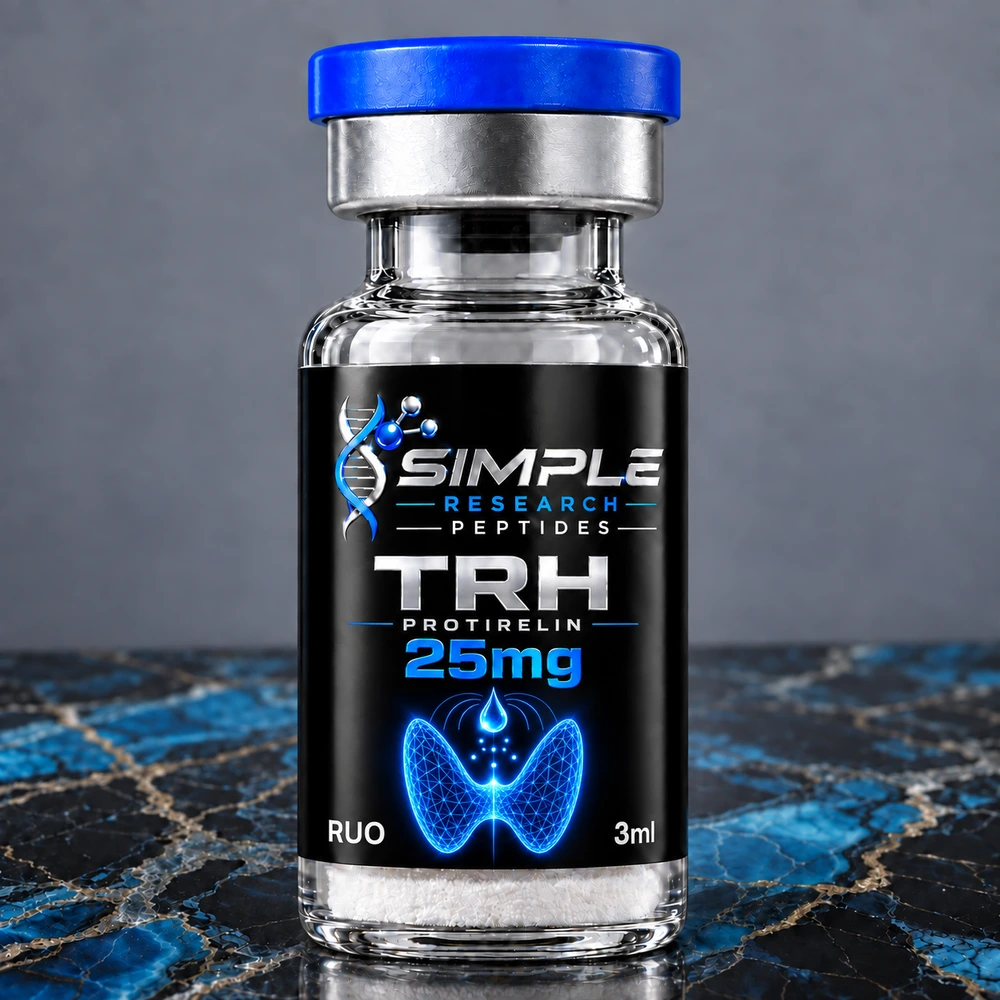
Back to the Research Compound Library
Human endocrine pharmacology
Evidence reviewed September 13, 2026.
Research overview and identity
Protirelin is thyrotropin-releasing hormone, usually abbreviated TRH. It is not thyrotropin itself: thyrotropin is thyroid-stimulating hormone, or TSH. Keeping these names separate is essential when reading endocrine studies.
Mechanism under investigation
TRH participates in pituitary hormone regulation, including TSH and prolactin responses. The response to an experimental TRH challenge reflects endocrine context and cannot be interpreted as a simple measure of general metabolic improvement.
What the studies report
A human pharmacokinetic and pharmacodynamic study examined protirelin in euthyroid participants and found that exposure and response depended on the administration context. Other endocrine studies have used TRH challenges to investigate variation in pituitary responses. [1] [2]
Limits of the evidence
A diagnostic or physiology challenge is not evidence of weight-loss, anti-aging or thyroid-restoration benefit. The cited work does not establish equivalence of a research preparation to a controlled clinical formulation. Interpretation requires attention to baseline endocrine state and the precise outcome measured.
Matching research material to a paper
Check the material identity, formulation and analytical methods against the study methods. A product name or milligram amount alone does not demonstrate experimental equivalence. Published research does not establish the identity, purity or potency of a retail batch; batch-specific analytical documentation must be assessed separately.
For laboratory research only. Not for human or veterinary use. This guide is educational and contains no dosing, reconstitution or administration instructions.
Sources and further reading
- Duntas et al. (1988): pharmacokinetics and pharmacodynamics of protirelin in humans
- Human pituitary responses to TRH in a clinical research setting (1994)