






Peptide research · Compound guide
Testagen Research Guide
Explore the mechanisms, study findings and evidence limits behind this research topic.
Product artwork identifies the SRP listing. It does not demonstrate safety or clinical benefit. The evidence guide and its sources follow below.
View product label and documentation →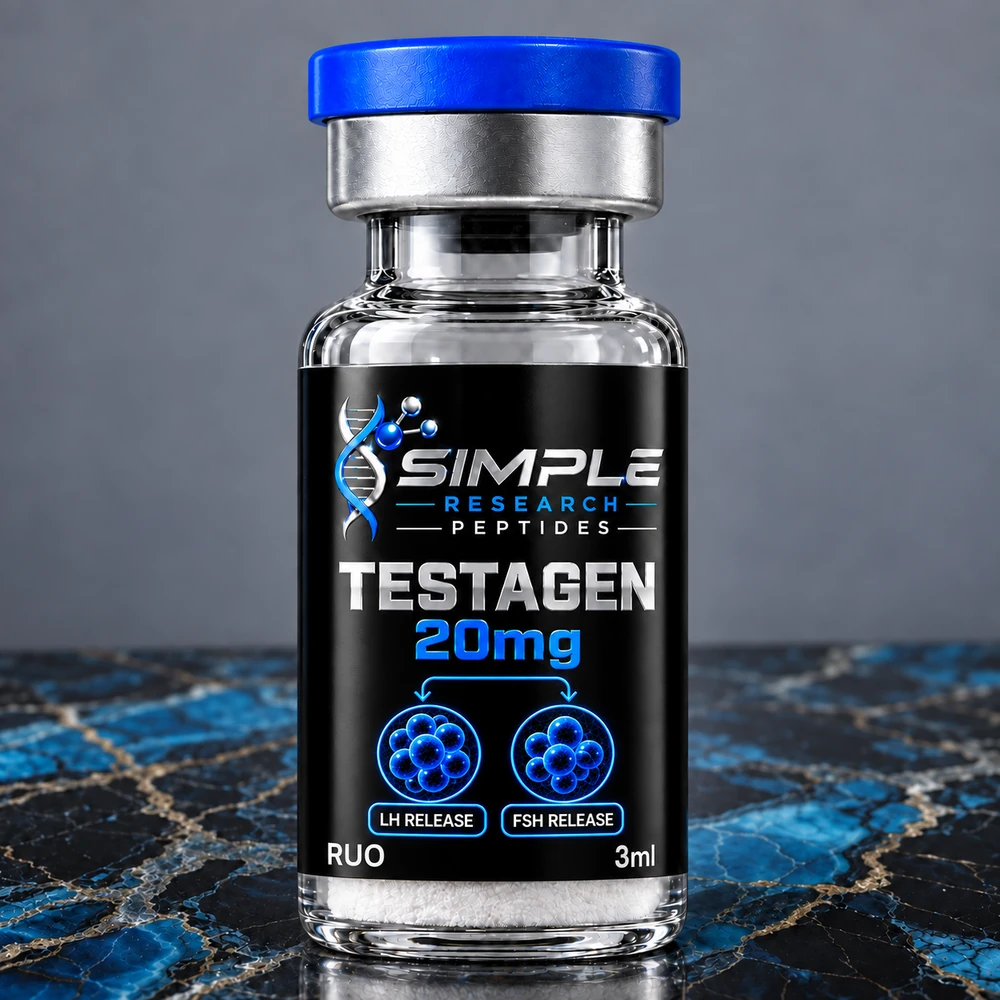
Back to the Research Compound Library
Cellular uptake and molecular-interaction research
Evidence reviewed September 13, 2026.
Research overview and identity
Testagen is described in primary short-peptide research as Lys-Glu-Asp-Gly, or KEDG. It should not be confused with unrelated products that share the name or with complex tissue extracts.
Mechanism under investigation
One research approach investigates interactions of short peptides with cellular and nuclear components. Evidence of uptake or physical association with DNA is a molecular finding, not proof that a compound selectively restores an organ’s function.
What the studies report
A 2011 study used fluorescently labelled short peptides, including Testagen, in HeLa cells and in nucleic-acid interaction experiments. Investigators observed fluorescence in cellular compartments and sequence-dependent interaction measurements. This was a laboratory study rather than a hormone-restoration trial. [1] [2]
Limits of the evidence
Labelled-peptide uptake in a cultured cell line does not establish the behavior of an unlabelled peptide throughout the body. The cited work does not demonstrate increased testosterone, improved fertility or correction of thyroid dysfunction in people. Those claims require separate, directly relevant evidence.
Matching research material to a paper
Check the material identity, formulation and analytical methods against the study methods. A product name or milligram amount alone does not demonstrate experimental equivalence. Published research does not establish the identity, purity or potency of a retail batch; batch-specific analytical documentation must be assessed separately.
For laboratory research only. Not for human or veterinary use. This guide is educational and contains no dosing, reconstitution or administration instructions.
Sources and further reading
- Fedoreyeva et al. (2011): short-peptide cellular uptake and nucleic-acid interactions
- Author-hosted full text of the 2011 short-peptide study