TB-500 Research Guide
An evidence-mapped overview of TB-500 covering compound identity, its relationship to thymosin β4, proposed pathways, published studies, laboratory considerations, and current evidence limitations.
Investigational compound
Research use only
Educational information only. TB-500 is not an FDA-approved drug for human use.
Quick Facts
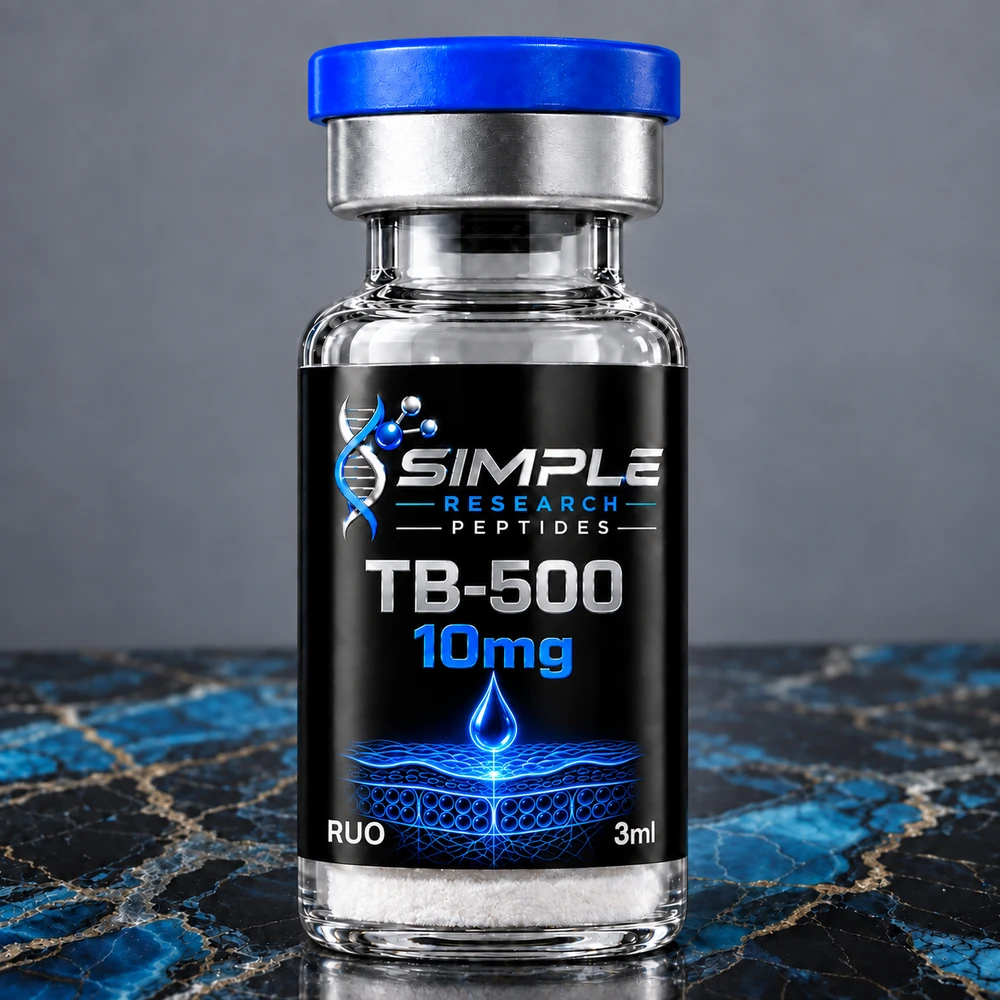
In the research-chemical marketplace, TB-500 is typically described as the N-acetylated 17–23 fragment of thymosin β4 (Tβ4): Ac-LKKTETQ. That is a 7-residue peptide, not the 43-amino-acid parent protein. The distinction is chemical, not semantic. Confiscated material labeled TB-500 has been characterized as Ac-LKKTETQ with a reported monoisotopic mass of 888.4910, versus 4963.4642 for Tβ4 (Esposito et al., 2012, PMID 22962027).
FDA Global Substance Registration System identifiers for N-acetyl-Leu-Lys-Lys-Thr-Glu-Thr-Gln are UNII QHK6Z47GTG and CAS 885340-08-9. Those identifiers describe the heptapeptide, not full-length Tβ4.
What is TB-500?
Thymosin β4 is a 43-residue G-actin-binding polypeptide. Safer, Elzinga, and Nachmias showed that Tβ4 is indistinguishable from Fx and binds G-actin 1:1, inhibiting polymerization (PMID 1999398). That paper is about the intact protein.
Sosne, Qiu, Goldstein, and Wheater later mapped short active-site stretches inside Tβ4 (PMID 20179146). The commercially relevant point for TB-500 is that LKKTETQ (residues 17–23) is one of those stretches — and it is not the only one. Ac-SDKP (residues 1–4) is a different fragment with a different assigned activity set. Ac-SDKP is not TB-500.
Analytical work on seized or administered TB-500 products has treated the label as the acetylated heptapeptide. Esposito and colleagues identified confiscated TB-500 as Ac-LKKTETQ. Ho and colleagues reported detection of TB-500 and related signals in equine plasma and urine after a 10 mg TB-500 administration in horses (PMID 23084823). Those are identity and detection papers, not efficacy trials.
| Region | Sequence | Assigned activities in Sosne 2010 | Relation to TB-500 |
|---|---|---|---|
| Tβ4 1–4 | Ac-SDKP | Anti-inflammatory / anti-fibrotic assignment | Not TB-500. Different fragment. Those findings do not transfer to Ac-LKKTETQ. |
| Tβ4 1–15 | N-terminal stretch | Survival-related assignment | Not the marketplace TB-500 sequence. |
| Tβ4 17–23 | LKKTETQ | Angiogenesis, wound, and migration assignment | This is the stretch marketplace TB-500 is typically built from (usually N-acetylated: Ac-LKKTETQ). |
| Full Tβ4 | 43 amino acids | Intact G-actin-binding protein (~4,963 Da) | Not identical to TB-500. Most biology and all opened human Tβ4 papers below are this protein, not the heptapeptide. |
Observed, proposed, and Tβ4-only
Each item below is tagged by what was actually studied. Observed means data on Ac-LKKTETQ, LKKTETQ, or a stated TB-500 preparation. Proposed means an active-site assignment or extrapolation. Tβ4-only means the experiment used full-length thymosin β4 or a different fragment.
Heptapeptide identity
Confiscated TB-500 characterized as Ac-LKKTETQ, MW 888.4910 versus Tβ4 4963.4642. Equine plasma/urine detection after a 10 mg TB-500 administration in horses.
Esposito 2012, PMID 22962027; Ho 2012, PMID 23084823; FDA GSRS UNII QHK6Z47GTG.
7-aa motif, endothelium
The 7-amino-acid motif was necessary for HUVEC migration and chick aortic-arch sprouting at about 50 nM. Incomplete motifs were inactive.
Philp, Huff, Gho, Hannappel, Kleinman 2003, PMID 14500546.
LKKTETQ in aged mice
LKKTETQ matched Tβ4 dermal repair in 26-month-old mice. In the same paper, Tβ4 itself was used in db/db mice and rats.
Philp, Badamchian, Scheremeta, Nguyen, Goldstein, Kleinman 2003, PMID 12581423.
Parent vs metabolite screen
In a fibroblast wound screen, parent Ac-LKKTETQ was not significant. The metabolite Ac-LKKTE was. This undercuts casual claims that the intact heptapeptide is simply a more stable or more potent Tβ4.
Rahaman et al. 2024, PMID 38382158.
17–23 active-site map
Sosne 2010 assigns angiogenesis, wound, and migration activities to LKKTETQ (17–23). That is a structure–function map inside Tβ4, not a demonstration that marketplace TB-500 reproduces the full Tβ4 phenotype.
Sosne, Qiu, Goldstein, Wheater 2010, PMID 20179146.
G-actin 1:1 binding
Tβ4 = Fx; 1:1 G-actin binding; inhibits polymerization. This is intact 43-aa protein biochemistry, not a TB-500 binding isotherm.
Safer, Elzinga, Nachmias 1991, PMID 1999398.
Ac-SDKP and 1–15
Anti-inflammatory / anti-fibrotic assignment sits on Ac-SDKP (1–4). Survival assignment sits on residues 1–15. Neither is the TB-500 sequence.
Sosne 2010, PMID 20179146.
Cardiac ILK / Akt
Mouse coronary-ligation work reporting integrin-linked kinase / Akt signaling used thymosin β4, not TB-500.
Bock-Marquette et al. 2004, PMID 15565145.
Human Tβ4 exposures
Opened human papers are intravenous or topical Tβ4 (Phase 1 IV; Phase 2 ulcer gel; topical RGN-259, n=9). None is an injectable TB-500 efficacy trial.
Ruff 2010, PMID 20536472; Treadwell 2012, PMID 23050815; Sosne 2015, PMID 25826322.

Where the literature actually sits
Most citations in circulation around “TB-500” are Tβ4 papers. The map below separates identity chemistry, fragment/motif experiments, full-length Tβ4 biology, and human Tβ4 work. A 2026 scoping-review preprint notes that most included studies are Tβ4, that musculoskeletal evidence is sparse, and that only one TB-500 study was identified — flag that document as a preprint, not a peer-reviewed conclusion (McGuire et al., 2026, DOI 10.20944/preprints202605.1124.v1).
Identity and detection
Seized-product characterization of TB-500 as Ac-LKKTETQ, plus equine plasma/urine detection after a labeled TB-500 administration. This cluster answers “what is on the label?” It does not answer efficacy.
LKKTETQ / 7-aa motif
Endothelial migration and chick aortic-arch sprouting at ~50 nM; dermal repair in 26-month-old mice matching Tβ4. A later fibroblast screen found parent Ac-LKKTETQ inactive and a metabolite active.
Full-length Tβ4 biology
G-actin sequestration, active-site mapping (including Ac-SDKP and 1–15), and mouse coronary-ligation ILK/Akt work all used Tβ4 or other fragments — not marketplace TB-500 as the test article.
Human Tβ4 — not TB-500
Opened human studies are IV Tβ4 Phase 1 (40 adults, 42–1260 mg), Tβ4 gel Phase 2 ulcers, and topical Tβ4 RGN-259 (n=9). No controlled human efficacy trial of injectable TB-500 is in this set.
What was studied, in what system
Read the “compound actually studied” column first. Several widely cited papers are Tβ4 papers sitting next to a TB-500 product page. That adjacency is not evidence that the heptapeptide was the test article.
| Domain | Compound actually studied | System | Status | Source |
|---|---|---|---|---|
| Chemical identity | TB-500 / Ac-LKKTETQ | Confiscated product; mass spectrometry | Observed | PMID 22962027 |
| Detection | TB-500 (10 mg administration) | Horse plasma and urine | Observed | PMID 23084823 |
| Registry identity | N-acetyl-Leu-Lys-Lys-Thr-Glu-Thr-Gln | FDA GSRS | Observed | UNII QHK6Z47GTG; CAS 885340-08-9 |
| G-actin binding | Full-length Tβ4 (Fx) | Biochemical 1:1 binding | Tβ4-only | PMID 1999398 |
| Active-site map | Tβ4 fragments, including LKKTETQ and Ac-SDKP | Structure–function review / assignment | Proposed | PMID 20179146 |
| Endothelial migration / sprouting | 7-aa actin-binding motif | HUVEC; chick aortic arch; ~50 nM | Observed | PMID 14500546 |
| Dermal repair, aged mice | LKKTETQ (and Tβ4 in other arms) | 26-month-old mice; Tβ4 also in db/db mice and rats | Observed | PMID 12581423 |
| Fibroblast wound screen | Ac-LKKTETQ vs metabolite Ac-LKKTE | In vitro fibroblast assay; rat metabolite work | Observed | PMID 38382158 |
| Cardiac repair signaling | Thymosin β4, not TB-500 | Mouse coronary ligation; ILK/Akt | Tβ4-only | PMID 15565145 |
| Human IV exposure | Thymosin β4, not TB-500 | Phase 1; 40 adults; 42–1260 mg | Tβ4-only | PMID 20536472 |
| Human ulcer gel | Thymosin β4 gel, not TB-500 | Phase 2 ulcers | Tβ4-only | PMID 23050815 |
| Human topical ocular | Topical Tβ4 (RGN-259), not TB-500 | n=9 | Tβ4-only | PMID 25826322 |
| Tβ4 review | Thymosin β4 literature | Narrative review | Tβ4-only | DOI 10.3389/fendo.2021.767785 |
| Scoping overview | Mostly Tβ4; one TB-500 study noted | Preprint scoping review; musculoskeletal sparse | Preprint | DOI 10.20944/preprints202605.1124.v1 |
How the record accumulated
Tβ4 identified as Fx
Safer, Elzinga, and Nachmias: Tβ4 is indistinguishable from Fx and binds G-actin 1:1. Intact protein, not TB-500. PMID 1999398.
7-aa motif and aged-mouse repair
Philp et al.: the 7-aa motif is necessary for HUVEC migration and chick aortic-arch sprouting (~50 nM; incomplete motifs inactive). A companion paper reports LKKTETQ matching Tβ4 repair in 26-month-old mice, with Tβ4 used in db/db mice and rats. PMID 14500546; PMID 12581423.
Mouse cardiac Tβ4 paper
Bock-Marquette et al.: Tβ4 after coronary ligation; ILK/Akt. Not a TB-500 study. PMID 15565145.
Active sites mapped; IV Tβ4 Phase 1
Sosne et al. assign Ac-SDKP (1–4), residues 1–15, and LKKTETQ (17–23) to different activity sets. Ruff et al. report IV Tβ4 in 40 adults (42–1260 mg) — not TB-500, not an efficacy claim. PMID 20179146; PMID 20536472.
TB-500 named in the analytical record
Esposito et al. characterize confiscated TB-500 as Ac-LKKTETQ (MW 888.4910 vs Tβ4 4963.4642). Ho et al. detect TB-500 in equine plasma and urine after a 10 mg administration. Treadwell et al. report Tβ4 gel in a Phase 2 ulcer setting — again not TB-500. PMID 22962027; PMID 23084823; PMID 23050815.
Topical Tβ4, n=9
Sosne, Dunn, and Kim: topical Tβ4 (RGN-259). Not TB-500. PMID 25826322.
Tβ4 review
Xing et al. review thymosin β4. Used here only as a Tβ4 overview pointer; this page does not repeat secondary Phase II myocardial-infarction claims from that review. DOI 10.3389/fendo.2021.767785.
Parent heptapeptide inactive in a fibroblast screen
Rahaman et al.: acetylated TB-500 metabolites in rats; parent Ac-LKKTETQ did not show significant fibroblast wound activity; metabolite Ac-LKKTE did. PMID 38382158.
Scoping review (not peer-reviewed)
McGuire et al. preprint: most studies are Tβ4; one TB-500 study; musculoskeletal evidence described as sparse. Flag as preprint. DOI 10.20944/preprints202605.1124.v1.
What is not established
These are not open questions phrased softly. They are gaps in the opened record. Treating any of them as settled is incorrect.
TB-500 is not Tβ4
Ac-LKKTETQ (7 residues, ~888 Da) is not the 43-aa protein (~4,963 Da). Identity papers exist specifically because the two were being confused.
No controlled human efficacy trial of injectable TB-500
Opened human studies are Tβ4 (IV Phase 1, ulcer gel Phase 2, topical RGN-259 n=9). They are not TB-500 efficacy trials.
No bodybuilding or “heals any tendon” proof
Those claims are marketing language. They are not supported by a controlled human TB-500 dataset in this guide.
Cardiac regeneration paper is mouse Tβ4
Bock-Marquette 2004 used thymosin β4 after coronary ligation. It is not a TB-500 cardiac study.
Ac-SDKP findings do not apply
Ac-SDKP is Tβ4 residues 1–4. It is not the TB-500 sequence. Anti-fibrotic or anti-inflammatory assignments on Ac-SDKP stay on Ac-SDKP.
“More stable / more potent than Tβ4” is not shown
The 2024 fibroblast screen found parent Ac-LKKTETQ not significant, while metabolite Ac-LKKTE was. That is the opposite of a simple potency upgrade story.
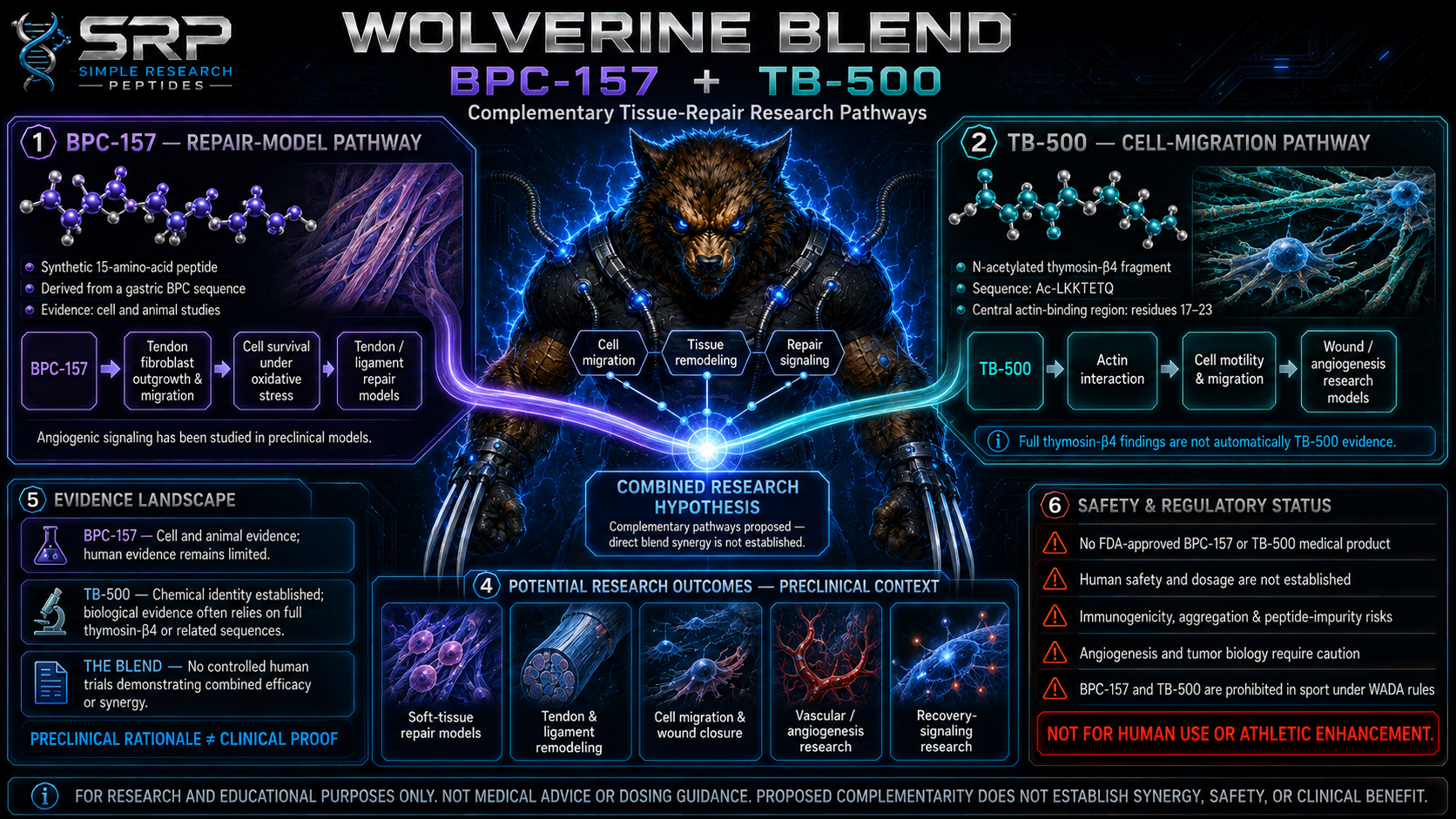
No opened BPC-157 combination study
This guide does not contain a published combination experiment of BPC-157 plus TB-500. A blended research vial is related material, not a dedicated evidence base.
No human dosing on this page
There is no human TB-500 dosing, reconstitution, or administration protocol here. Research-use only; not an FDA-approved drug for human use.
Primary papers in this map
Every PMID below is from the verified set used to build this page. Human Tβ4 papers are included so they are not silently re-labeled as TB-500 evidence.
Esposito et al., 2012 — Drug Test Anal
Confiscated TB-500 characterized as Ac-LKKTETQ, reported MW 888.4910, versus Tβ4 4963.4642. PMID 22962027.
Ho et al., 2012 — J Chromatogr A
Horses; 10 mg TB-500; plasma and urine detection. Analytical / anti-doping context, not an efficacy trial. PMID 23084823.
Safer, Elzinga, Nachmias, 1991 — J Biol Chem
Tβ4 = Fx; 1:1 G-actin binding; inhibits polymerization. PMID 1999398.
Sosne, Qiu, Goldstein, Wheater, 2010 — FASEB J
Active-site assignments: Ac-SDKP (1–4) anti-inflammatory/fibrotic; residues 1–15 survival; LKKTETQ (17–23) angiogenesis/wound/migration. Ac-SDKP is not TB-500. PMID 20179146.
Philp, Huff, Gho, Hannappel, Kleinman, 2003 — FASEB J
7-aa motif necessary for HUVEC migration and chick aortic-arch sprouting; about 50 nM; incomplete motifs inactive. PMID 14500546.
Philp, Badamchian, Scheremeta, Nguyen, Goldstein, Kleinman, 2003 — Wound Repair Regen
LKKTETQ matched Tβ4 dermal repair in 26-month-old mice. Tβ4 was used in db/db mice and rats in the same paper. PMID 12581423.
Rahaman et al., 2024 — J Chromatogr B
Acetylated TB-500 metabolites in rats. Parent Ac-LKKTETQ was not significant in a fibroblast wound screen; metabolite Ac-LKKTE was. PMID 38382158.
Bock-Marquette et al., 2004 — Nature
Tβ4, not TB-500. Mouse coronary ligation; ILK/Akt. PMID 15565145.
Ruff et al., 2010 — Ann N Y Acad Sci
IV Tβ4 Phase 1; 40 adults; 42–1260 mg. Not TB-500; not an efficacy trial of the heptapeptide. PMID 20536472.
Treadwell et al., 2012 — Ann N Y Acad Sci
Tβ4 gel, Phase 2 ulcers. Not TB-500. PMID 23050815.
Sosne, Dunn, Kim, 2015 — Cornea
Topical Tβ4 (RGN-259), n=9. Not TB-500. PMID 25826322.
Xing et al., 2021 — Front Endocrinol
Tβ4 review. Included as a review pointer only. This page does not repeat any Phase II myocardial-infarction “confirmed” claim from that review. DOI 10.3389/fendo.2021.767785.
McGuire et al., 2026 — preprint
Flag as preprint. Most studies Tβ4; one TB-500 study identified; musculoskeletal evidence described as sparse. DOI 10.20944/preprints202605.1124.v1.
Research-only caution
TB-500 is an investigational research compound. It is not an FDA-approved drug for human use. This page is educational. It does not provide dosing, reconstitution, administration, or any human-use instructions.
Laboratory identity is the first practical issue. The opened analytical record treats marketplace TB-500 as Ac-LKKTETQ (~888 Da), not 43-aa Tβ4 (~4,963 Da). A method, certificate, or protocol written for the intact protein is not automatically valid for the heptapeptide, and the reverse is also true.
Biological inference has the same problem. Full-length Tβ4 G-actin biochemistry, Ac-SDKP assignments, mouse cardiac Tβ4 data, and human Tβ4 topical or intravenous exposures are not substitute evidence that Ac-LKKTETQ will behave the same way. The 2024 fibroblast screen is a reminder: the parent heptapeptide and a metabolite did not read out the same.
If a study design needs a positive control or a literature comparison, state the actual test article. “TB-500” and “thymosin β4” should not be used as synonyms in a methods section.
Common questions
Is TB-500 the same as thymosin β4?
No. Marketplace TB-500 is typically the N-acetylated 17–23 fragment Ac-LKKTETQ (7 residues, reported MW 888.4910). Thymosin β4 is a 43-amino-acid protein (reported MW 4963.4642). Esposito et al., 2012, PMID 22962027.
What sequence is reported for TB-500?
Ac-LKKTETQ — N-acetyl-Leu-Lys-Lys-Thr-Glu-Thr-Gln. FDA GSRS: UNII QHK6Z47GTG; CAS 885340-08-9.
Is Ac-SDKP the same as TB-500?
No. Ac-SDKP is Tβ4 residues 1–4. Sosne 2010 assigns anti-inflammatory / anti-fibrotic activity to that fragment. Those findings do not apply to Ac-LKKTETQ. PMID 20179146.
Are there human clinical trials of injectable TB-500?
This guide does not contain a controlled human efficacy trial of injectable TB-500. Opened human papers are Tβ4: IV Phase 1 (Ruff 2010, PMID 20536472), Tβ4 gel Phase 2 ulcers (Treadwell 2012, PMID 23050815), and topical Tβ4 RGN-259, n=9 (Sosne 2015, PMID 25826322).
What did the 2024 metabolite paper find?
Rahaman et al. reported acetylated TB-500 metabolites in rats. Parent Ac-LKKTETQ was not significant in a fibroblast wound screen; the metabolite Ac-LKKTE was. PMID 38382158.
Does the cardiac regeneration paper apply to TB-500?
No. Bock-Marquette et al. 2004 used thymosin β4 in a mouse coronary-ligation model (ILK/Akt). It is not a TB-500 study. PMID 15565145.
Is TB-500 FDA-approved?
No. Educational information only. TB-500 is not an FDA-approved drug for human use. It is an investigational research compound.
Is there a published BPC-157 + TB-500 combination study?
Not in this guide. No combination study was opened for this page. A blended research vial is related material only and does not have a dedicated evidence guide here.
Why does this page discuss so many Tβ4 papers?
Because that is what most of the surrounding literature actually studied. A 2026 scoping-review preprint likewise notes that most included studies are Tβ4, that one TB-500 study was identified, and that musculoskeletal evidence is sparse. Flag that document as a preprint. DOI 10.20944/preprints202605.1124.v1.
Does this page include human dosing?
No. There is no human dosing, reconstitution, or administration protocol on this page. Laboratory work should treat identity (Ac-LKKTETQ versus Tβ4) as a first-order variable.
Citations used on this page
Full citations for the verified set. PMIDs link to PubMed. The 2026 item is a preprint.
- Safer D, Elzinga M, Nachmias VT. Thymosin β4 and Fx, an actin-sequestering peptide, are indistinguishable. J Biol Chem. 1991. PMID 1999398. Tβ4 = Fx; 1:1 G-actin.
- Philp D, Huff T, Gho YS, Hannappel E, Kleinman HK. The actin binding site on thymosin β4 promotes angiogenesis. FASEB J. 2003. PMID 14500546. 7-aa motif; HUVEC and chick aortic arch; ~50 nM.
- Philp D, Badamchian M, Scheremeta B, Nguyen M, Goldstein AL, Kleinman HK. Thymosin β4 and a synthetic peptide containing its actin-binding domain promote dermal wound repair in db/db diabetic mice and in aged mice. Wound Repair Regen. 2003. PMID 12581423. LKKTETQ in 26-month-old mice; Tβ4 in db/db mice and rats.
- Bock-Marquette I, Saxena A, White MD, Dimaio JM, Srivastava D. Thymosin β4 activates integrin-linked kinase and promotes cardiac cell migration, survival and cardiac repair. Nature. 2004. PMID 15565145. Tβ4, not TB-500; mouse coronary ligation; ILK/Akt.
- Sosne G, Qiu P, Goldstein AL, Wheater M. Biological activities of thymosin β4 defined by active sites in short peptide sequences. FASEB J. 2010. PMID 20179146. Ac-SDKP 1–4 vs LKKTETQ 17–23 vs residues 1–15.
- Ruff D, Crockford D, Girardi G, Zhang Y. A randomized, placebo-controlled, single and multiple dose study of intravenous thymosin β4 in healthy volunteers. Ann N Y Acad Sci. 2010. PMID 20536472. IV Tβ4 Phase 1; 40 adults; 42–1260 mg; not TB-500.
- Esposito et al. Drug Test Anal. 2012. PMID 22962027. Confiscated TB-500 = Ac-LKKTETQ; MW 888.4910 vs Tβ4 4963.4642.
- Ho et al. J Chromatogr A. 2012. PMID 23084823. Horses; 10 mg TB-500; plasma and urine detection.
- Treadwell et al. Ann N Y Acad Sci. 2012. PMID 23050815. Tβ4 gel; Phase 2 ulcers; not TB-500.
- Sosne G, Dunn SP, Kim C. Thymosin β4 significantly improves signs and symptoms of severe dry eye in a phase 2 randomized trial. Cornea. 2015. PMID 25826322. Topical Tβ4 RGN-259; n=9; not TB-500.
- Xing et al. Front Endocrinol. 2021. DOI 10.3389/fendo.2021.767785. Tβ4 review. No Phase II myocardial-infarction “confirmed” claim is repeated here.
- Rahaman et al. J Chromatogr B. 2024. PMID 38382158. Parent Ac-LKKTETQ not significant in a fibroblast wound screen; metabolite Ac-LKKTE was.
- McGuire et al. 2026. Preprint. DOI 10.20944/preprints202605.1124.v1. Flag as preprint. Most studies Tβ4; one TB-500 study; musculoskeletal sparse.
- FDA Global Substance Registration System. N-acetyl-Leu-Lys-Lys-Thr-Glu-Thr-Gln. UNII QHK6Z47GTG; CAS 885340-08-9.
Educational information only. TB-500 is not an FDA-approved drug for human use. Investigational compound. Research use only.