Selank Research GuideThr-Lys-Pro-Arg-Pro-Gly-Pro / TKPRPGP · not tuftsin · not Semax

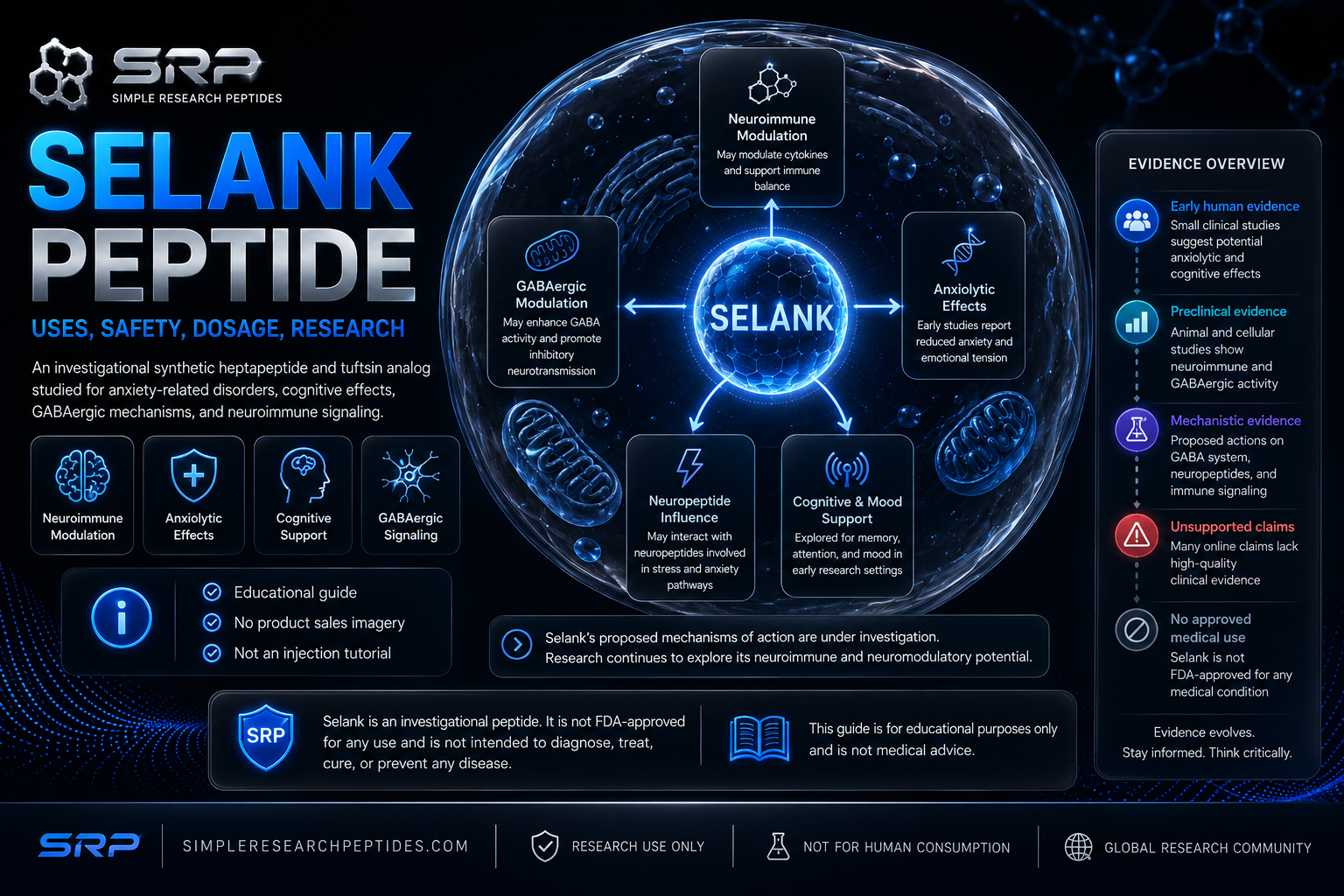
Selank (also Selanc / TP-7) is a synthetic heptapeptide tuftsin analog with opened sequence Thr-Lys-Pro-Arg-Pro-Gly-Pro / TKPRPGP (PubChem CID 11765600; CAS 129954-34-3; UNII TS9JR8EP1G; formula C33H57N11O9; MW 751.9 g/mol). It is not tuftsin (TKPR tetrapeptide), not Semax (MEHFPGP ACTH analog), and not an FDA-approved drug. Opened human reports are geographically concentrated and small. Human efficacy of a research-market 10 mg vial is not established. Historical papers that used the word “anxiolytic” are opened literature, not a treatment claim. Research use only. Not medical advice. Not for human use.

CID 11765600
CAS 129954-34-3
UNII TS9JR8EP1G
No Selank-peptide NCT
Not FDA-approved
Research use only
Educational information only. This page describes an investigational laboratory research heptapeptide. It is not medical advice. Simple Research Peptides (SRP) materials are for laboratory research only and are not for human or veterinary use, consumption, administration, diagnosis, treatment, or therapeutic application. No human dosing, reconstitution, or administration protocol appears on this page. Historical Russian-language clinical papers that used the word “anxiolytic” are opened literature, not a treatment claim and not an FDA indication.
Sequence and chemical identity (opened registries only)
SRP product and index pages do not print CAS, UNII, PubChem CID, molecular formula, sequence, termini (free acid vs amide), salt form, or a public COA. Identity below is taken only from opened public registries and from primary papers that name Selank / Selanc / TP-7 / Thr-Lys-Pro-Arg-Pro-Gly-Pro.
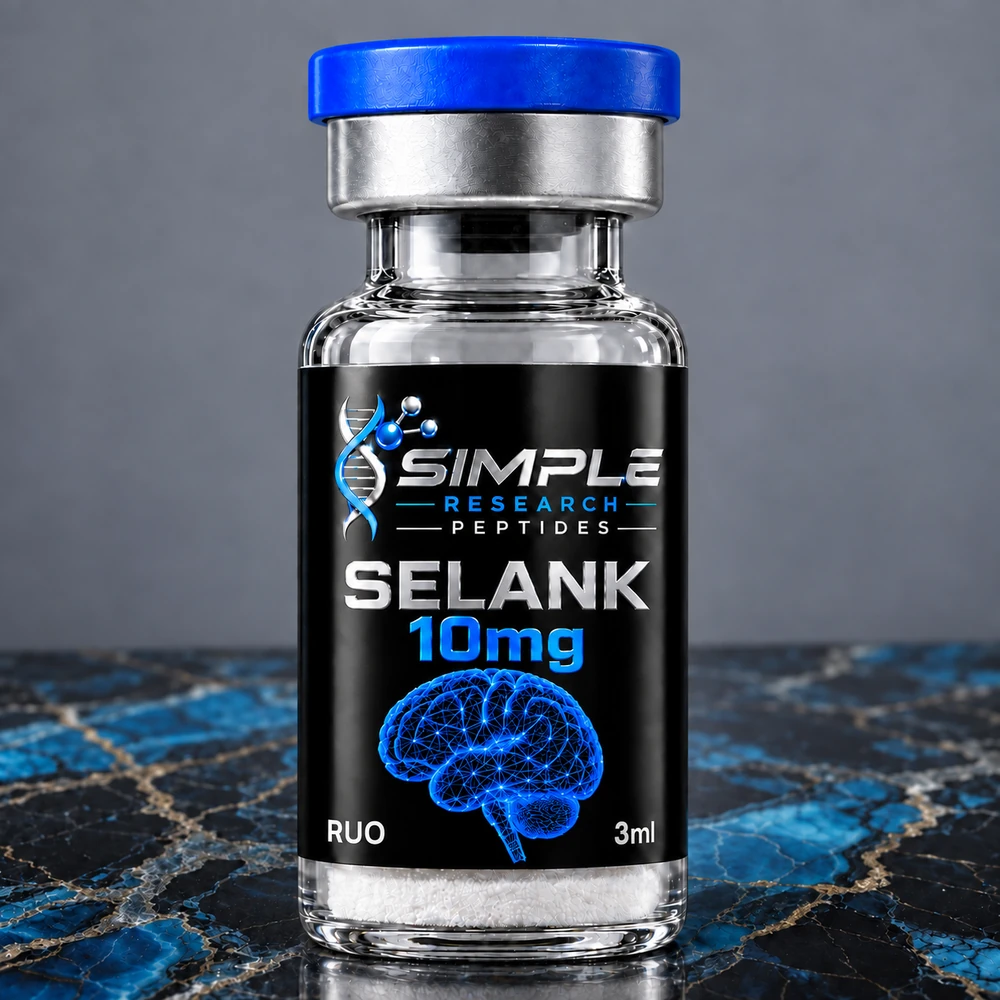
Opened SRP 10 mg product page (16 August 2026): title “Selank 10 mg Neuroscience Research Peptide Vial”. Category: Brain & Mind Research. Price printed $25.00. Subhead: Selank (10 mg Vial) — COA verified research compound. For laboratory research use only. Not for human consumption. Also known as: TP-7. Bullets: 10 mg lyophilized research compound per vial; COA available for batch verification; high-purity research material; intended for qualified laboratory and analytical research; securely packaged; Made and tested in the USA; For Research Use Only. Not for human or veterinary use. Description: supplied for controlled laboratory evaluation of Selank within Brain & Mind Research studies. Footer: for laboratory research only; not for human or animal use, consumption, administration, diagnosis, treatment, or therapeutic application. Availability: 9 in stock (can be backordered). Product URL: http://simpleresearchpeptides.com/product/selank-10-mg-vial/.
Not printed on the opened product page and therefore not claimed as SRP-verified: TKPRPGP sequence; free acid vs amide termini; CAS; UNII; CID; salt/counter-ion (acetate vs TFA vs free base); a public COA file; a published laboratory dose.
Opened SRP index card (compound-research-guides, 16 August 2026): “Selank (10 mg Vial)” under Cognitive; tagged Evidence profile (not Dedicated evidence guide). Overview: Selank is a synthetic heptapeptide analogue related to the immunomodulatory peptide tuftsin and studied mainly in anxiety, cognition, and gene-expression research. That index sentence is vendor/index copy, not a treatment claim. Mechanism: proposed actions include modulation of neurotransmitter systems and immune-neural signaling, but no single mechanism fully explains the reported effects. Evidence: human reports exist, but the literature is geographically concentrated and often small. Large independent, internationally replicated trials are limited. Quality note: separate peer-reviewed findings from marketing claims and verify the full seven-amino-acid sequence. Last editorial review on that index: August 2026.
Opened dedicated-guide URL http://simpleresearchpeptides.com/research-compound-directory/selank-research/ returned HTTP 404. This page is written for that missing guide.
query.term=selank totalCount 10. Opened hits are lexical (balance exercises, PSAPs, a study ID containing TP7, brivaracetam). Unused as Selank-peptide evidence.How Selank is not tuftsin and not Semax
Catalog “Brain & Mind / anxiety / cognition” language does not convert a research heptapeptide into tuftsin, Semax, or an approved anxiolytic. This page does not make anxiolytic treatment claims.
| Identity | What opened sources actually describe | Peptide? | Typical literature role |
|---|---|---|---|
| Selank (this page) | 7 aa; TKPRPGP; CID 11765600; CAS 129954-34-3; UNII TS9JR8EP1G; C33H57N11O9; 751.9 g/mol | Yes (heptapeptide, free-acid CID) | Tuftsin analog + C-terminal Pro-Gly-Pro. Preclinical serotonin / BDNF / enkephalinase literature. Small, regionally concentrated human reports. Not an approved drug. |
| Tuftsin | 4 aa; TKPR; H-Thr-Lys-Pro-Arg-OH; CID 156080; CAS 9063-57-4; UNII QF5336J16C; C21H40N8O6; 500.6 g/mol; InChIKey IESDGNYHXIOKRW-YXMSTPNBSA-N | Yes (tetrapeptide) | Endogenous spleen-derived phagocytosis-stimulating fragment of IgG. Not Selank. Semenova 2009 and Kozlovskaya 2003 distinguish the two. |
| Semax | 7 aa; MEHFPGP; CID 9811102; CAS 80714-61-0; UNII I5FAL2585H; ACTH(4-7)-Pro-Gly-Pro analog | Yes (different heptapeptide) | ACTH-fragment analog. BDNF / ischemia literature. Not Selank. Separate SRP 10 mg listing. |
| Pro-Gly-Pro tail alone | Shared C-terminal tripeptide of both Selank and Semax | Fragment, not the vial | Shared design motif. Does not make the two heptapeptides interchangeable. |
Selank is not tuftsin. Tuftsin is the tetrapeptide Thr-Lys-Pro-Arg (CID 156080). Selank appends Pro-Gly-Pro to that tuftsin core. Semenova et al. 2009 (PMID 19803361) printed both sequences and reported different effects on serotonin metabolism after PCPA pretreatment: Selank enhanced 5-HT metabolism in the brain stem; tuftsin did not, and decreased it in neocortex. Kozlovskaya et al. 2003 (PMID 14969422) compared Selank with short tuftsin-family peptides in rodent stress models. Do not cite tuftsin phagocytosis literature as Selank evidence.
Selank is not Semax. Semax is Met-Glu-His-Phe-Pro-Gly-Pro (CID 9811102), an ACTH(4-10) analog. The two share a C-terminal Pro-Gly-Pro and appear together in Kost et al. 2001 (PMID 11443939) as separate inhibitors of human-serum enkephalin-degrading enzymes (opened IC50: Semax 10 µM; Selank 20 µM). Shared enzyme-assay data are not identity.
Do not equate this vial with tuftsin, Semax, ACTH, melanotan, or an FDA-approved anxiolytic. Research use only.
Proposed mechanism (labeled as such)
Opened primary papers support a tuftsin-analog / glyproline working model with effects on enkephalin-degrading enzymes, monoamines, and hippocampal BDNF in rats / in-vitro serum. It is not a treatment claim. It was not generated with an SRP 10 mg vial. Observed means a measurement in an opened paper. Proposed means a hypothesis. Not shown means the opened papers did not establish it for a research-market lot.
Enkephalin-degrading enzymes
Kost 2001 (PMID 11443939): Semax and Selank inhibited human-serum enkephalin-degrading enzymes. Opened abstract IC50: Semax 10 µM; Selank 20 µM. Zozulya 2001 (PMID 11550013): Selank IC50 15 µM vs plasma enkephalin hydrolysis. In vitro. Not a receptor assignment.
Serotonin vs tuftsin
Semenova 2009 (PMID 19803361): in Wistar rats pretreated with PCPA, Selank enhanced 5-HT metabolism in the brain stem 30 min after injection. Tuftsin induced no brain-stem change and decreased 5-HT metabolism in neocortex. Direct chemical distinction.
Rat hippocampal BDNF
Inozemtseva 2008 (PMID 18841804): intranasal Selank regulated BDNF expression in the rat hippocampus in vivo. Rat gene-expression finding. Not a human BDNF trial. Not an SRP-lot result.
Observed — tuftsin-family behavioral pharmacology (rodents). Kozlovskaya et al. 2003 (PMID 14969422): Selank and short tuftsin-family peptides affected behavioral manifestations of emotional stress in rats and inbred mice. Rodent conflict-situation work. Not a human RCT.
Historical human reports — not a treatment claim. Zozulia et al. 2008 (PMID 18454096): 62 patients with GAD and neurasthenia; Selank (n=30) compared with medazepam (n=32); psychometric scales plus serum enkephalin activity. Authors described similar anxiolytic effects plus antiasthenic / psychostimulant language for Selank. Uchakina et al. 2008 (PMID 18577961): immunomodulatory / Th1–Th2 cytokine observations in patients with anxiety-asthenic disorders and in vitro IL-6 effects. These are opened historical reports from a geographically concentrated literature. They are not FDA indications, not internationally replicated Phase 3 packages, and not evidence that an SRP 10 mg research vial treats anxiety. This page does not adopt those author sentences as treatment claims.
Not shown for an SRP 10 mg vial. Not shown on an opened page: a completed cell-surface receptor assignment; human PK of a research-market lot; proof that the SRP lot is CID 11765600 free acid rather than acetate or TFA salt; BDNF / enkephalinase data generated with that lot; a US ClinicalTrials.gov Selank-peptide administration record; FDA approval.
Where the literature actually sits
Label every row. Selank ≠ tuftsin ≠ Semax. Historical “anxiolytic” language is not a completed therapeutic program and is not an instruction.
Opened Selank records
Kost 2001 enkephalinase (PMID 11443939); Zozulya 2001 enkephalinase / proposed mechanism (PMID 11550013); Kozlovskaya 2003 tuftsin-family rodent behavior (PMID 14969422); Inozemtseva 2008 rat hippocampal BDNF (PMID 18841804); Semenova 2009 Selank vs tuftsin serotonin (PMID 19803361).
Not FDA evidence
Zozulia 2008 GAD / neurasthenia comparison with medazepam (PMID 18454096). Uchakina 2008 cytokine / immunomodulatory observations (PMID 18577961). Geographically concentrated. Not an SRP-vial trial. Not a treatment claim.
No Selank-peptide NCT
query.term=selank totalCount 10. All opened records inspected in the API JSON are lexical (balance, PSAPs, TP7 study-ID fragment, unrelated drugs). Do not invent a Selank administration NCT.
Approval year unknown
NCATS: Approval Year Unknown. No opened NDA/ANDA/BLA for Selank. Not an FDA-approved anxiolytic. Vendor identity is not independently verified: SRP prints the name Selank, AKA TP-7, 10 mg, “COA available,” and research-use-only footers, but does not display sequence, CAS, UNII, termini, salt, or a public COA file.
Opened records, read as they actually sit
Read the “what it did not show” column. Published study designs are historical facts from those papers. They are not a protocol. Cell-culture micromolar concentrations and rodent schedules are study conditions, not instructions for an SRP 10 mg research vial.
| Study | Species / model | What was tested | Actual finding (from the opened record) | What it did not show |
|---|---|---|---|---|
| Kost et al., 2001 PMID 11443939. DOI 10.1023/a:1011373002885. Opened Europe PMC abstract. | Human serum enzymes, in vitro | Semax and Selank vs enkephalin-degrading enzymes | Dose-dependent inhibition. IC50 Semax 10 µM; Selank 20 µM. Heptapeptides and some pentapeptide fragments active. | Human RCT. Receptor assignment. SRP-vial identity. Semax = Selank. |
| Zozulya et al., 2001 PMID 11550013. DOI 10.1023/a:1017979514274. Opened Europe PMC abstract. | Human plasma; patients with anxiety/phobic disorders (enzyme half-life observations) | Selank vs plasma enkephalin hydrolysis | IC50 15 µM. Authors propose enkephalinase inhibition as a possible anxiolytic mechanism. Shortened enkephalin half-life observed in GAD (not panic/agoraphobia) in that paper. | FDA indication. SRP lot. Completed receptor. A protocol. This page does not adopt the 2001 hypothesis as a treatment claim. |
| Kozlovskaya et al., 2003 PMID 14969422. DOI 10.1023/a:1025988519919. Opened Europe PMC abstract. | Rats; C57BL/6 and Balb/c mice; Wistar rats | Selank and tuftsin-family short peptides in conflict / stress models | Positive emotional / antistress actions in those models; individual peptide-structure effects. | Human efficacy. Tuftsin equivalence. |
| Inozemtseva et al., 2008 PMID 18841804. DOI 10.1134/s0012496608040066. Opened Europe PMC record. | Rat hippocampus, in vivo | Intranasal Selank | Regulated BDNF expression. Rats. | Human BDNF trial. SRP lot. Treatment claim. |
| Semenova et al., 2009 PMID 19803361. Opened Europe PMC abstract. | Wistar rats, PCPA-pretreated | Selank vs tuftsin on 5-HT metabolism | Selank enhanced brain-stem 5-HT metabolism at 30 min; tuftsin did not (neocortex decrease). Sequences printed: Selank TKPRPGP; tuftsin TKPR. | Human serotonin trial. Identity collapse. |
| Zozulia et al., 2008 PMID 18454096. Opened Europe PMC abstract. | 62 patients, GAD / neurasthenia | Selank (n=30) vs medazepam (n=32) | Authors: similar anxiolytic effects; Selank also described as antiasthenic / psychostimulant; leu-enkephalin t½ correlations. Historical comparative report. | FDA approval. International Phase 3. Equivalence of an SRP vial. A dosing protocol. Not a treatment claim on this page. |
| Uchakina et al., 2008 PMID 18577961. Opened Europe PMC abstract. | Patients with anxiety-asthenic disorders; in vitro PBMC | Selank | In vitro IL-6 gene-expression suppression at 10−7 M in patient (not control) blood; in vivo Th1/Th2 cytokine-balance changes over 14 days. Historical immunomodulatory report. | FDA indication. SRP lot. Infectious-disease prevention claim. |
Human / NCT snapshot. No opened Selank-peptide administration NCT on ClinicalTrials.gov. Do not invent one. Do not treat lexical hits as drug trials.
Gaps in the opened record
These are gaps. Treating any of them as settled is incorrect.
No FDA-approved therapeutic use
NCATS approval year: Unknown. No opened NDA. Not an FDA-approved anxiolytic.
No opened US Selank-peptide NCT
CT.gov selank hits are lexical. Do not invent an administration NCT.
No proof the SRP vial is CID 11765600 free acid
Sequence, termini, CAS, UNII, salt, and a public COA were not printed on the SRP page.
Enkephalinase inhibition is an in-vitro working model
Not shown for an SRP lot and not an approved mechanism of action.
Rat BDNF / serotonin findings are not a human indication
Inozemtseva 2008 and Semenova 2009 are rodent papers. They are not a human anxiolytic indication.
Tuftsin and Semax findings are not Selank
Different sequences. Different parents. Shared Pro-Gly-Pro is a motif, not identity.
2008 Russian comparative reports are not Phase 3
Not internationally replicated. Not a reason to treat or dose a research vial. Not a treatment claim.
No opened PK / tox package for an SRP 10 mg vial
No opened bioavailability, chronic toxicology, carcinogenicity, or reproductive-tox package.
| Popular claim | Status after this review |
|---|---|
| “Selank is an FDA-approved anxiolytic” | False on the opened record. |
| “It is tuftsin in a 7-aa vial” | False identity. Tuftsin is TKPR (CID 156080). Selank is TKPRPGP. Semenova 2009 shows different 5-HT effects. |
| “It is Semax” | False. Different sequence (MEHFPGP vs TKPRPGP); different parent (ACTH vs tuftsin). |
| “Enkephalinase IC50 proves a human anxiety indication” | Unsupported. In-vitro serum assay + 2001 hypothesis. Not a treatment claim. |
| “The SRP 10 mg vial is the Zozulia 2008 / Inozemtseva 2008 lot” | Not established. Sequence and salt not printed. |
| “CT.gov lists Selank trials” | False for the peptide. Opened hits are lexical. |
| “This page is a treatment or dosing guide” | False. Research use only. No protocol. |
Key papers as short cards
Each card is a single opened record. Historical human language is not a protocol. Micromolar IC50 values and rodent schedules are study conditions, not instructions.
Kost et al., 2001 — Bioorg Khim.
Semax and Selank inhibit human-serum enkephalin-degrading enzymes. IC50 10 µM (Semax) and 20 µM (Selank) in that assay. In vitro. Distinguishes the two heptapeptides while showing a shared enzyme class. PMID 11443939.
Zozulya et al., 2001 — Bull Exp Biol Med.
Selank IC50 15 µM vs plasma enkephalin hydrolysis. Authors propose this as a possible anxiolytic mechanism. Hypothesis, not approval. Not a treatment claim on this page. PMID 11550013.
Kozlovskaya et al., 2003 — Neurosci Behav Physiol.
Selank and tuftsin-family short peptides in rodent stress / conflict models. Selank ≠ tuftsin fragments. PMID 14969422.
Inozemtseva et al., 2008 — Dokl Biol Sci.
Intranasal Selank regulated BDNF expression in rat hippocampus. Rats. PMID 18841804.
Semenova et al., 2009 — Eksp Klin Farmakol.
Selank vs tuftsin on 5-HT metabolism after PCPA. Different effects. Sequences printed. PMID 19803361.
Zozulia et al., 2008 — Zh Nevrol Psikhiatr.
Historical GAD / neurasthenia comparison with medazepam (n=62). Not FDA evidence. Not a protocol. Not a treatment claim. PMID 18454096.
Uchakina et al., 2008 — Zh Nevrol Psikhiatr.
Historical cytokine / immunomodulatory observations. Not an infectious-disease indication. PMID 18577961.
Research-use-only notes
Selank is an investigational laboratory research heptapeptide. It is not an FDA-approved drug for human use. This page is educational. It does not provide dosing, reconstitution, administration, or any human-use instructions. The 10 mg mass is a vendor listing, not a published laboratory protocol.
Simple Research Peptides (SRP) materials are for laboratory research only and are not for human or veterinary use, consumption, administration, diagnosis, treatment, or therapeutic application.
Laboratory identity is the first practical issue. Opened registries describe Selank as CID 11765600 / CAS 129954-34-3 / UNII TS9JR8EP1G / H-TKPRPGP-OH. SRP product pages do not print sequence, CAS, UNII, termini, salt, or a public COA. A method written for tuftsin, Semax, ACTH, or an approved anxiolytic is not automatically valid for this vial.
Confirm peptide identity, termini (free acid vs amide), stereochemistry, salt, and purity by LC-MS before treating a vial as the literature article. Independently sourced research peptides are not established as equivalent to Inozemtseva 2008 or Zozulia 2008 material. Historical rodent schedules and micromolar enzyme IC50 values are study conditions from those papers. They are not a reconstitution scheme.
No reconstitution scheme, no administration route, and no human or veterinary use protocol appears on this page. Research use only.
Frequently asked questions
Is Selank the same as tuftsin?
No. Tuftsin is the tetrapeptide Thr-Lys-Pro-Arg (CID 156080; CAS 9063-57-4; UNII QF5336J16C). Selank is Thr-Lys-Pro-Arg-Pro-Gly-Pro. Semenova 2009 printed both sequences and reported different serotonin-metabolism effects.
Is Selank the same as Semax?
No. Semax is Met-Glu-His-Phe-Pro-Gly-Pro (CID 9811102), an ACTH(4-10) analog. They share a C-terminal Pro-Gly-Pro and appear as separate compounds in Kost 2001.
Is Selank TP-7?
TP-7 is a depositor / marketplace synonym on CID 11765600. It is not a second verified peptide. Confirm sequence on a COA.
Does Selank work by inhibiting enkephalinases?
That is the Kost 2001 / Zozulya 2001 in-vitro working model. It is not a completed receptor assignment and not an approved mechanism.
Does Selank raise BDNF?
Inozemtseva 2008 reported BDNF regulation in rat hippocampus after intranasal Selank. That is not a human BDNF trial and not an SRP-lot result.
Is Selank an FDA-approved anxiolytic?
No. NCATS approval year: Unknown. This page does not make treatment claims.
Is there a Selank NCT?
No opened Selank-peptide administration NCT. CT.gov selank hits are lexical collisions.
Is the SRP vial the same as the 2001–2009 literature material?
Not established. Sequence, termini, and salt are not printed. Confirm on a COA / LC-MS.
Can these findings be used as dosing or administration instructions?
No. SRP listings are for laboratory research only and are not for human or animal use. This page does not provide reconstitution, administration, or dosing instructions.
Does this page include human dosing?
No. There is no human dosing, reconstitution, or administration protocol on this page. Research use only. Not medical advice. Not for human use.
Sources actually opened for this draft
Sources actually opened for this draft. Do not add PMIDs or NCTs that are not on the allowed list.
- Kost NV, Sokolov OIu, Gabaeva MV, et al. Semax and selank inhibit the enkephalin-degrading enzymes from human serum. Bioorg Khim. 2001;27(3):180-183. PMID 11443939. DOI 10.1023/a:1011373002885. In vitro. Abstract.
- Zozulya AA, Kost NV, Yu Sokolov O, et al. The inhibitory effect of Selank on enkephalin-degrading enzymes as a possible mechanism of its anxiolytic activity. Bull Exp Biol Med. 2001;131(4):315-317. PMID 11550013. DOI 10.1023/a:1017979514274. In vitro + historical clinical-enzyme observations. Abstract.
- Kozlovskaya MM, Kozlovskii II, Val’dman EA, Seredenin SB. Selank and short peptides of the tuftsin family in the regulation of adaptive behavior in stress. Neurosci Behav Physiol. 2003;33(9):853-860. PMID 14969422. DOI 10.1023/a:1025988519919. Rodent. Abstract.
- Inozemtseva LS, Karpenko EA, Dolotov OV, et al. Intranasal administration of the peptide Selank regulates BDNF expression in the rat hippocampus in vivo. Dokl Biol Sci. 2008;421:241-243. PMID 18841804. DOI 10.1134/s0012496608040066. Rat BDNF. Record opened.
- Semenova TP, Kozlovskii II, Zakharova NM, Kozlovskaia MM. Comparison of the effects of selank and tuftsin on the metabolism of serotonin in the brain of rats pretreated with PCPA. Eksp Klin Farmakol. 2009;72(4):6-8. PMID 19803361. Rat; Selank ≠ tuftsin. Abstract.
- Zozulia AA, Neznamov GG, Siuniakov TS, et al. Efficacy and possible mechanisms of action of a new peptide anxiolytic selank in the therapy of generalized anxiety disorders and neurasthenia. Zh Nevrol Psikhiatr Im S S Korsakova. 2008;108(4):38-48. PMID 18454096. Historical comparative report. Not a treatment claim. Abstract.
- Uchakina ON, Uchakin PN, Miasoedov NF, et al. Immunomodulatory effects of selank in patients with anxiety-asthenic disorders. Zh Nevrol Psikhiatr Im S S Korsakova. 2008;108(5):71-75. PMID 18577961. Historical cytokine report. Abstract.
- ClinicalTrials.gov API v2
query.term=selank(totalCount 10), opened 16 August 2026. Lexical / unused: NCT06151093, NCT05076045, NCT01770990, others. No Selank-peptide administration NCT used. - PubChem CID 11765600 (Selank; CAS 129954-34-3; UNII TS9JR8EP1G). https://pubchem.ncbi.nlm.nih.gov/compound/11765600
- PubChem CID 156080 (Tuftsin; CAS 9063-57-4; UNII QF5336J16C; sequence TKPR) — distinction only. https://pubchem.ncbi.nlm.nih.gov/compound/156080
- PubChem CID 9811102 (Semax) — distinction only.
- NCATS UNII TS9JR8EP1G (SELANK; Approval Year Unknown; CAS 129954-34-3; PubChem 11765600). TS9JR8EP1G
- SRP pages (opened 16 August 2026): 10 mg http://simpleresearchpeptides.com/product/selank-10-mg-vial/; index compound-research-guides; dedicated-guide guess http://simpleresearchpeptides.com/research-compound-directory/selank-research/ (404). For laboratory research only. Not for human or animal use.
Allowed PMID list used on this page: 11443939, 11550013, 14969422, 18841804, 19803361, 18454096, 18577961. No administration NCT.
Educational information only. The SRP listing Selank 10 mg is a research peptide corresponding, on opened registries, to Selank / TKPRPGP (CID 11765600; CAS 129954-34-3; UNII TS9JR8EP1G; H-TKPRPGP-OH; C33H57N11O9; 751.9 g/mol). It is not tuftsin, not Semax, and not an FDA-approved anxiolytic. No opened Selank-peptide NCT. Not FDA-approved. Termini and salt of an SRP lot are not printed. Historical rodent schedules, micromolar IC50 values, and 2008 comparative reports are study conditions / historical literature, not instructions. This page does not make anxiolytic treatment claims. Laboratory research use only; not for human or animal use. Not medical advice. Not for human use. No human dosing protocol. Last source review: 16 August 2026 (America/Indianapolis). For laboratory research only. Not for human or veterinary use.
| Identifier | Value on opened page | Source opened |
|---|---|---|
| Peptide sequence | TKPRPGP; IUPAC condensed H-Thr-Lys-Pro-Arg-Pro-Gly-Pro-OH; PLN H-TKPRPGP-OH; HELM PEPTIDE1{T.K.P.R.P.G.P}; IUPAC L-threonyl-L-lysyl-L-prolyl-L-arginyl-L-prolyl-glycyl-L-proline | CID 11765600 biologic description |
| PubChem title | Selank | PubChem HTML, opened 16 August 2026 |
| PubChem CID | 11765600 (7 defined / 0 undefined stereocenters) | PubChem HTML + PUG REST |
| CAS | 129954-34-3 | PubChem CID 11765600 HTML (ChemIDplus; EPA DSSTox); NCATS UNII page |
| UNII | TS9JR8EP1G | PubChem synonym block; TS9JR8EP1G title SELANK; Approval Year Unknown |
| Formula / MW | C33H57N11O9; 751.9 g/mol | PubChem HTML + PUG |
| Exact / monoisotopic mass | 751.43407244 Da | PubChem PUG |
| InChIKey | JTDTXGMXNXBGBZ-YVHUGQOKSA-N | PubChem HTML + PUG |
| EPA DSSTox | DTXSID701029276 | PubChem; NCATS |
| RxCUI | 2049928 | NCATS |
| MeSH | Selank (M0408941) | PubChem MeSH |
| Depositor synonyms (selected) | Selanc; Thr-Lys-Pro-Arg-Pro-Gly-Pro; TP-7; TP 7; TP-7 (diacetate); UNII-TS9JR8EP1G; HY-105042 | PubChem synonym block. Diacetate alias is a depositor string, not proof of the SRP lot salt |
| NCATS Inxight | SELANK; Other; Approval Year Unknown; sequence THR-LYS-PRO-ARG-PRO-GLY-PRO | TS9JR8EP1G |
| ClinicalTrials.gov | query.term=selank: totalCount 10. Opened hits are lexical. No opened Selank-peptide administration NCT. |
CT.gov API v2, opened 16 August 2026 |
| FDA-approved Selank drug | None on opened PubChem / NCATS / CT.gov pages. NCATS approval year: Unknown | Same |
| SRP listing | 10 mg vial ($25.00); Brain & Mind Research; AKA TP-7 | SRP product page |
Registry chaos that must not be collapsed. PubChem diacetate synonym is alias noise on the free-acid CID. ClinicalTrials.gov selank hits include NCT06151093 (balance exercises), NCT05076045 (personal sound amplification products / PSAPs), NCT01770990 (telephone psychotherapy; org ID contains TP7), and other lexical collisions. Unused as Selank-peptide evidence. TP-7 is a depositor / marketplace synonym on CID 11765600. It is not a second verified peptide. Tuftsin (CID 156080; TKPR) is the parent tetrapeptide, not Selank.
One-sentence identity restated: Selank (also Selanc / TP-7) is a synthetic heptapeptide tuftsin analog with opened sequence Thr-Lys-Pro-Arg-Pro-Gly-Pro / TKPRPGP (CID 11765600; CAS 129954-34-3; UNII TS9JR8EP1G; formula C33H57N11O9; MW 751.9 g/mol). It is not tuftsin, not Semax, and not an FDA-approved anxiolytic. Opened human reports are geographically concentrated and small. Human efficacy of a research-market 10 mg vial is not established. This page does not make anxiolytic treatment claims.
Kost / Zozulya enkephalinase papers
Kost PMID 11443939 and Zozulya PMID 11550013 report in-vitro inhibition of human-serum / plasma enkephalin-degrading enzymes. IC50 values in those assays are study conditions. The 2001 “possible anxiolytic mechanism” sentence is a hypothesis, not an approval and not a protocol.
Kozlovskaya tuftsin-family rodent work
PMID 14969422: Selank and short tuftsin-family peptides in rodent stress / conflict models. Selank is not interchangeable with tuftsin fragments.
Rat BDNF and historical human reports
Inozemtseva PMID 18841804 (rat hippocampal BDNF). Zozulia PMID 18454096 and Uchakina PMID 18577961 are geographically concentrated historical reports. Not FDA evidence. Not a treatment claim. Not a protocol.
Semenova: Selank ≠ tuftsin on 5-HT
PMID 19803361 printed both sequences and reported different serotonin-metabolism effects after PCPA. Direct chemical distinction.
SRP index / product / dedicated URL
Product page prints name, 10 mg, AKA TP-7, $25.00, RUO footer. Sequence, CAS, UNII, termini, salt, and a public COA were not printed. Index tags Evidence profile. Dedicated selank-research URL returned HTTP 404. CT.gov selank hits are lexical. No administration NCT.
Workspace / index check (16 August 2026). The opened SRP index tags Selank (10 mg Vial) as Evidence profile (not Dedicated evidence guide). Opened dedicated-guide URL returned HTTP 404. This HTML is a locked conversion of the citation-verified facts draft for that missing page. Not published. Not for WordPress in this pass.
Suggested slug recorded in the locked draft: selank-research. Status: locked citation-verified draft converted to a standalone facts page. Do not add PMIDs, NCTs, CAS, UNII, or CIDs that are not on the allowed identifier list. Allowed PMIDs: 11443939, 11550013, 14969422, 18841804, 19803361, 18454096, 18577961. Distinction-only CIDs: 156080 (tuftsin), 9811102 (Semax).