Prostamax Research GuideLys-Glu-Asp-Pro / KEDP · not Vesugen · not Livagen

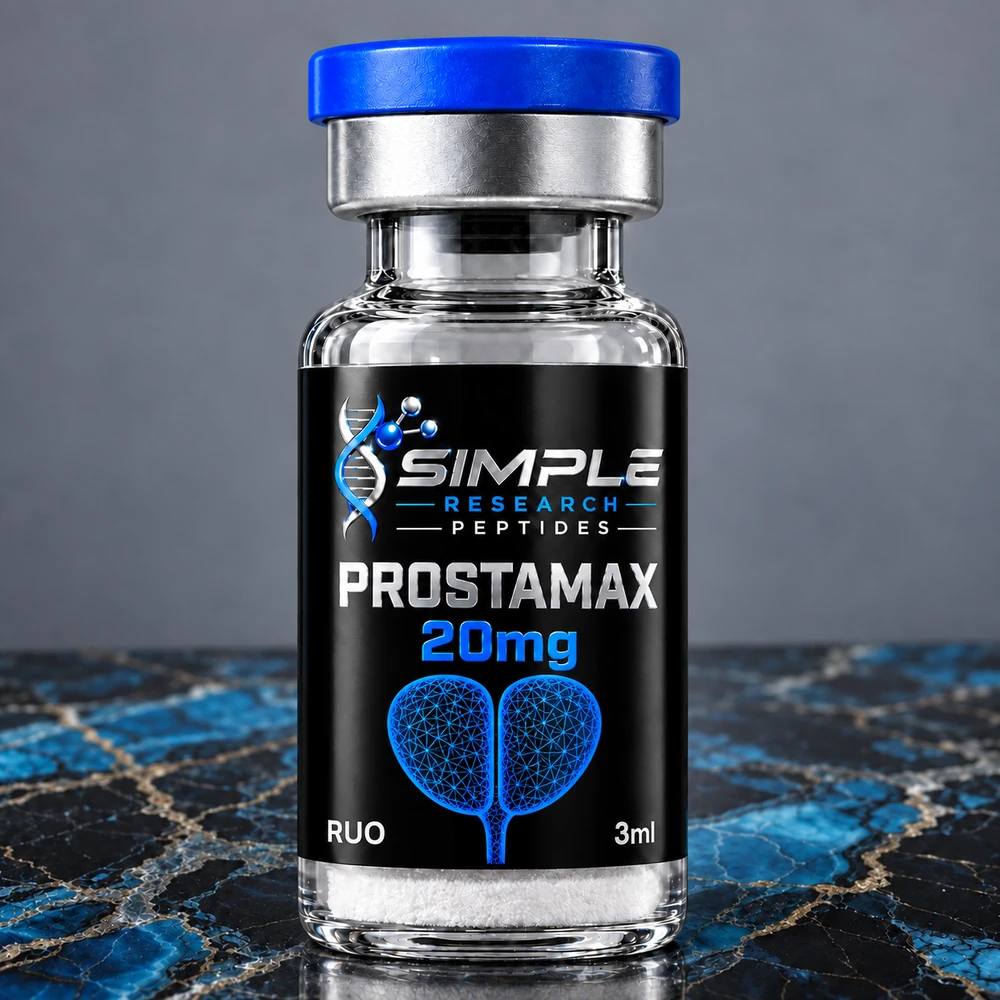
Prostamax is a Khavinson-catalog synthetic tetrapeptide printed in opened papers as Lys-Glu-Asp-Pro (KEDP) (opened PMID 23221144 title prints oligopeptide bioregulator (Lys-Glu-Asp-Pro) and the abstract names Prostamax; opened PMID 35887081 Table 2 prints Prostomax (KEDP)). It is positioned as a short peptide bioregulator associated with prostate-tissue / lymphocyte-chromatin research. English-language independently replicated evidence is sparse. ClinicalTrials.gov returned 0 studies for prostamax or prostomax. It is not Livagen, not Vesugen, not Pancragen, not Pinealon, and not an FDA-approved drug on any opened registry. Research use only. Not medical advice. Not for human use.
CID 9848296
CAS synonym 473578-47-1
UNII not found
0 NCT
Sparse/limited evidence
Not FDA-approved
Research use only
Educational information only. This page describes a short peptide bioregulator sold as a laboratory research material. It is not medical advice. Simple Research Peptides (SRP) materials are for laboratory research only and are not for human or veterinary use, consumption, administration, diagnosis, treatment, or therapeutic application. Sequence, CAS, UNII, formula, and a public COA were not printed on the fetched SRP page. SRP itself tells the buyer to verify sequence, salt form, and assay. An educational dosage and reconstitution table is included below for laboratory / research-context reference only. It is not medical advice and is not a human-use protocol.
Sequence and chemical identity (opened registries only)
SRP product and index pages do not print a sequence, CAS, UNII, molecular formula, or a public COA. Sequence below is taken only from opened primary papers that print the trade name Prostamax next to Lys-Glu-Asp-Pro, from the opened 2022 table that prints Prostomax (KEDP), and from the opened PubChem record titled Prostamax.
How it relates to — and is not — other Khavinson bioregulators
Prostamax (this page) is the tetrapeptide Lys-Glu-Asp-Pro / KEDP. That catalog is a research-network taxonomy, not a receptor-class assignment.
| Opened page | What it printed | Why it is not interchangeable |
|---|---|---|
| Dzhokhadze et al. 2012 PMID 23221144 | Title: oligopeptide bioregulator (Lys-Glu-Asp-Pro); abstract names Prostamax; 75-86-year lymphocyte cultures | Defining trade-name + sequence paper |
| Khavinson, Lezhava, Malinin 2004 PMID 15085253 | Vilon, Epithalon, Livagen, Prostamax, Cortagen on 75-88-year leukocytes | Five named peptides; Prostamax changed chromosome-1 pericentromeric chromatin with Livagen and Epithalon |
| Zakutskii et al. 2006 PMID 17152728 | cardiogen, bronchogen, prostamax, pancragen on heart, lung, prostatic-gland, and pancreas explants | Four tissue-paired cytogens |
| Khavinson et al. 2022 Table 2 PMID 35887081 | Prostomax (KEDP), ICM -13.58, Regulation of prostatic functions; discussion: LAT1 is moderately expressed in prostate but KEDP and AE do not demonstrate a high binding ability to LAT1 in that docking model | Same table, different sequences; docking is not uptake |
| Meskhi 2004 PMID 15612551 / Kiladze 2009 PMID 19359734 | Prostamax on lymphocyte-chromatin calorimetry +/- Cu(II)/Cd(II) | Chromatin-structure papers, not prostate-function trials |
What this is not, chemically.
- Not Vesugen (KED / Lys-Glu-Asp). Same 2022 table, different row (ICM -18.91, vasoprotector).
- Not Livagen (KEDA / Lys-Glu-Asp-Ala). Same table (ICM -22.01). PMID 15085253 tests Livagen and Prostamax as separate named peptides.
- Not Pancragen (KEDW / KEDW-NH2). Same table (ICM -23.47).
- Not Pinealon (EDR). Same table (ICM -30.29, neuroprotector).
- Not Epitalon (AEDG), Vilon (KE), Chonluten (EDG), Testagen (KEDG), or Ovagen (EDL).
- Not Cardiogen or Bronchogen. PMID 17152728 tests them as four tissue-paired cytogens.
- Not a prostate tissue extract, and not a 5-alpha-reductase inhibitor, alpha-blocker, or any FDA-approved urologic drug.
- Not shown to be compositionally identical to an SRP 20 mg lyophilized research vial.
What is Prostamax?
Prostamax is the synthetic tetrapeptide Lys-Glu-Asp-Pro. Opened papers from the St. Petersburg Institute of Bioregulation and Gerontology and Tbilisi collaborators report two clusters of laboratory observations:
Lymphocyte-chromatin / cytogenetic models
Prostamax increased sister-chromatid-exchange frequency and Ag-positive NORs and reduced large pericentromeric C-heterochromatin segments on chromosomes 1 and 9 in 75-86-year cultures (Dzhokhadze 2012, PMID 23221144). The 2004 five-peptide panel reported that Prostamax, with Livagen and Epithalon, decondensed chromosome-1 pericentromeric structural chromatin (PMID 15085253). Calorimetry papers report heat-redistribution / denaturation-temperature shifts (PMID 15612551; PMID 19359734). These are ex vivo cell-culture studies, not randomized clinical trials.
Tissue-specific organotypic explants
Zakutskii 2006 (PMID 17152728): prostamax showed a stimulating effect in prostatic-gland explants from young and aged rats, paired with cardiogen / bronchogen / pancragen in other tissues. The abstract clinic-practice sentence is author language, not a registered trial.
LAT1 table row
Khavinson 2022 (PMID 35887081) is a transport / docking review. Table 2 prints Prostomax (KEDP), ICM -13.58. The opened full text states that KEDP and AE do not demonstrate a high binding ability to LAT1 despite moderate LAT1 expression in prostate. That is docking, not a measured flux.
Europe PMC REST query=prostamax OR prostomax returned hitCount 7 on 16 August 2026. PMID 28948547 is in that hit list; its opened title/abstract in the Livagen pass did not print Prostamax and is not used here as a Prostamax experiment. Independent Western replication of a receptor-level mechanism was not located.
The SRP index card (August 2026) already states this correctly: marketed as a short peptide bioregulator associated with prostate-tissue research; a validated receptor-level mechanism is not established; independent replication, standardized pharmacokinetics, and large controlled human trials are sparse; require exact sequence disclosure and do not infer equivalence to other prostate-derived peptide preparations.
Opened SRP product (16 August 2026): http://simpleresearchpeptides.com/product/prostamax-20-mg/. Dedicated prostamax-research-guide URL returned HTTP 404.
Proposed research mechanisms (not confirmed clinical effects)
No opened paper establishes a classical receptor agonist/antagonist assignment for Prostamax.
Chromatin. PMID 23221144: Prostamax (Lys-Glu-Asp-Pro) increased SCE to 12.0 +/- 0.28 exchanges/cell vs intact 5.9 +/- 0.2; increased Ag-positive NORs to 2.5 per cell vs 0.95; reduced large pericentromeric heterochromatin options on chromosomes 1 and 9. Authors interpret this as decondensation / release of age-repressed genes. PMID 15085253: Prostamax among five peptides activated ribosome genes; with Epithalon and Livagen it decondensed chromosome-1 pericentromeric structural chromatin.
Calorimetry. PMID 15612551: prostamax redistributed heat among endotherms TdIII/TdIV and shifted both to lower temperature (2.9 and 1.0 C); authors suppose partial relaxation of 30-nm fiber toward 10-nm filament. PMID 19359734: joint Cu(II)/Cd(II) + prostamax calorimetry; the opened abstract quantitative sentences focus on the metal ions more than on a Prostamax-only effect.
Explant. PMID 17152728: prostamax stimulated rat prostatic-gland explants (young and 18-month). Tissue-tropism claim, not a receptor map. Printed explant concentration is a study condition, not a protocol.
Docking. PMID 35887081 Table 2: Prostomax (KEDP) ICM -13.58. Opened discussion: KEDP does not show high LAT1 binding in that model. Not a transport assay.
Not shown in a paper opened here: a registered ClinicalTrials.gov trial (NCT: none); a peer-reviewed randomized, placebo-controlled human efficacy trial; human pharmacokinetics; a modern receptor-panel Ki table, crystal structure, or measured PEPT/LAT uptake assay that used Prostamax as the substrate; independent Western-laboratory replication of the chromatin-decondensation cytology; FDA, EMA, or NCATS approval / UNII.
Do not treat as Prostamax evidence: Livagen-only chromatin papers; Vesugen endothelial papers; Pinealon neuro papers; Pancragen pancreas papers; any approved BPH / prostate-cancer drug trial; vendor blogs that assign a urologic indication.
SCE / NOR / C-band
PMID 23221144; PMID 15085253. Aged-donor lymphocytes, not an RCT.
LAT1 docking
PMID 35887081 ICM -13.58; authors note low LAT1 score.
0 NCT
No opened registered trial for prostamax or prostomax.
Areas of investigation (Prostamax / KEDP only)
Prostamax != Vesugen != Livagen != Pancragen != Pinealon. Sequence match is required before collapsing Prostamax and Prostomax.
Cytogenetic models
SCE, Ag-NOR, C-heterochromatin, calorimetry in aged-donor cultures (PMID 23221144; PMID 15085253; PMID 15612551; PMID 19359734).
Prostatic-gland culture
Young vs aged rat tissue culture (PMID 17152728).
LAT1 table row
Prostomax (KEDP), ICM -13.58, with an explicit low-binding comment (PMID 35887081).
The gap
Reproducibility, independent validation, pharmacology, toxicology, and the gap between regional bioregulator literature and controlled human evidence.
Scientific evidence snapshot
| Evidence tier | Current signal | Translation confidence | Status |
|---|---|---|---|
| Animal / explant models | One opened organotypic prostatic-gland paper | Hypothesis-generating only | SPARSE |
| Cell / chromatin studies | Aged-donor lymphocyte SCE / NOR / C-band / calorimetry | Mechanistic, geographically concentrated | SPARSE |
| In-silico docking | Table 2 ICM -13.58; authors note low LAT1 score | Computational only | HYPOTHESIS |
| Human evidence | No opened NCT; no opened RCT. Chromatin papers use human lymphocytes in culture | Cannot establish clinical use | NONE / SPARSE |
| Regulatory review | NCATS 0; openFDA 404; IUPHAR 404; UNII none; NCT 0 | Not FDA-approved | INVESTIGATIONAL |
First opened Prostamax-named chromatin papers
Khavinson / Lezhava five-peptide leukocyte panel (PMID 15085253). Meskhi calorimetry (PMID 15612551).
Organotypic tissue-tropism paper
Zakutskii et al.: prostamax on prostatic-gland explants among four cytogens (PMID 17152728).
Follow-up lymphocyte calorimetry and deheterochromatinization
Kiladze 2009 Cu/Cd +/- prostamax (PMID 19359734). Dzhokhadze 2012: Prostamax = Lys-Glu-Asp-Pro in 75-86-year cultures (PMID 23221144).
Catalog docking row
Table 2: Prostomax (KEDP), ICM -13.58 (PMID 35887081).
Translation remains the central question
Europe PMC name-hit count remains single-digit. SRP index tag remains Sparse/limited evidence.
Selected published studies (opened records only)
Inclusion does not imply clinical validation. Printed explant amounts are study conditions, not instructions for an SRP 20 mg research vial. No human dosing protocol appears here.
Prostamax (Lys-Glu-Asp-Pro) on aged-donor lymphocyte chromatin
Trade name + sequence printed. SCE, Ag-NOR, C-heterochromatin. PMID 23221144.
Five-peptide senile-leukocyte chromatin panel
Prostamax named with Vilon, Epithalon, Livagen, Cortagen. PMID 15085253. DOI 10.1023/b:bebm.0000024393.40560.05.
Organotypic prostatic-gland explants
Prostamax among cardiogen, bronchogen, pancragen. Abstract clinic-practice sentence is author language, not an NCT. PMID 17152728.
Lymphocyte-chromatin calorimetry
Prostamax-named denaturation shifts; 2009 paper also tests Cu(II)/Cd(II). PMID 15612551. PMID 19359734.
Transport-review table that prints Prostomax (KEDP)
Table 2 ICM -13.58. Not an uptake assay. PMID 35887081. PMC9323678.
Study design and handling (not human-use instructions)
- Identity and documentation. Record batch identity, analytical documentation, material condition, receipt date, and storage history. Confirm the four-residue sequence (Lys-Glu-Asp-Pro / KEDP) and salt form. Search both spellings (Prostamax / Prostomax) when matching literature.
- Controls and replication. Use vehicle and sequence-matched controls (KED, KEDA, KEDW, EDR) rather than assuming prostate tropism from the trade name.
- Cold-chain handling. Follow the product label, batch documentation, and laboratory SOPs. Do not invent a reconstitution protocol from other bioregulator pages.
- Transparent reporting. Report the actual sequence used, not only Prostamax.
Simple Research Peptides (SRP) materials are for laboratory research only and are not for human or veterinary use, consumption, administration, diagnosis, treatment, or therapeutic application.
Educational dosage and reconstitution context
This section is an educational laboratory / research-context chart for a 20 mg Prostamax (KEDP) vial. It is not medical advice, not a treatment protocol, and not a claim that Prostamax treats prostate disease. Simple Research Peptides materials are for laboratory research only and are not for human or veterinary use. No published human clinical trials were opened for Prostamax. 0 NCT.
Standard educational dilution used here: add 2.0 mL bacteriostatic water to a 20 mg vial → 10 mg/mL. At 10 mg/mL on a U-100 insulin syringe, 1 unit = 0.01 mL = 100 mcg (0.1 mg).
Reconstitute
Add 2.0 mL bacteriostatic water → 10 mg/mL.
- Draw 2.0 mL bacteriostatic water with a sterile syringe.
- Inject slowly down the vial wall; avoid foaming.
- Gently swirl or roll until dissolved. Do not shake.
- Label and refrigerate at 2–8 °C (35.6–46.4 °F), protected from light; educational use-window after reconstitution is about 2 weeks.
Typical educational range
500 mcg–1 mg once daily, with gradual titration. Commonly discussed as intramuscular; subcutaneous is listed as an alternate route in the same educational notes. No standardized or FDA-approved dosage exists.
Easy measuring: at 10 mg/mL, 1 unit = 0.01 mL = 100 mcg on a U-100 syringe. For volumes ≤10 units, 30- or 50-unit syringes are easier to read.
Storage
Lyophilized, short-term: refrigerate at 4 °C (39.2 °F), dry and dark.
Lyophilized, long-term: freeze at −20 °C (−4 °F).
After reconstitution: refrigerate at 2–8 °C; educational use within about 2 weeks; avoid freeze–thaw cycles. Let vials reach room temperature before opening to reduce condensation.
Protocol overview
Schedule: once daily for an 8–12 week educational window (optional extension to 16 weeks).
Start: 500 mcg (0.5 mg) daily; increase by about 250 mcg every 2 weeks in this table.
Target: 1 mg daily by weeks 5–8. Timing: any consistent time. Rotate sites.
Standard / gradual table (2 mL = 10 mg/mL)
| Phase / week | Daily amount | Units (U-100) | Volume |
|---|---|---|---|
| Weeks 1–2 | 500 mcg (0.5 mg) | 5 units | 0.05 mL |
| Weeks 3–4 | 750 mcg (0.75 mg) | 7.5 units | 0.075 mL |
| Weeks 5–8 | 1,000 mcg (1 mg) | 10 units | 0.10 mL |
| Weeks 9–12 (optional) | 1,000 mcg (1 mg) | 10 units | 0.10 mL |
Frequency in this educational table: once daily. Opened preclinical explant work is not a human schedule. For administrations ≤10 units (≤0.10 mL), 30- or 50-unit insulin syringes improve readability.
Supplies (plan for an 8–16 week daily table)
| Item | 8 weeks | 12 weeks | 16 weeks |
|---|---|---|---|
| Prostamax 20 mg vials | ~2 vials (~40 mg at ~0.7 mg/day average) | ~3 vials (~60 mg) | ~4 vials (~80 mg at ~1 mg/day) |
| U-100 syringes (30- or 50-unit) | 56 (1/day) | 84 | 112 |
| Bacteriostatic water (2.0 mL/vial) | 4 mL → 1 × 10 mL | 6 mL → 1 × 10 mL | 8 mL → 1 × 10 mL |
| Alcohol swabs (2/day) | 112 → 2 × 100-count | 168 → 2 × 100-count | 224 → 3 × 100-count |
Handling notes
- Use a new sterile syringe each time; dispose in a sharps container.
- Rotate sites among large muscle groups (deltoid, vastus lateralis, gluteus) if using the IM educational route.
- Inject slowly; wait a few seconds before withdrawing.
- For volumes ≤10 units, use 30- or 50-unit syringes.
- Document daily amount and site rotation.
Educational technique notes
Clean the vial stopper and skin with alcohol; allow to dry.
IM note: 22–25 gauge, 1–1.5 inch needle at 90° into a large muscle. Aspiration is no longer routinely recommended for most sites in general IM guidance.
SC alternate: 23–25 gauge, 5/8 inch needle at 45° into fatty tissue if that route is used in a lab protocol.
What opened papers actually show
Opened Prostamax work is lymphocyte-chromatin cytology and one rat prostatic-gland explant paper (PMID 17152728), plus a low-score LAT1 docking row. Those findings do not establish human safety, effectiveness, or a clinical dose.
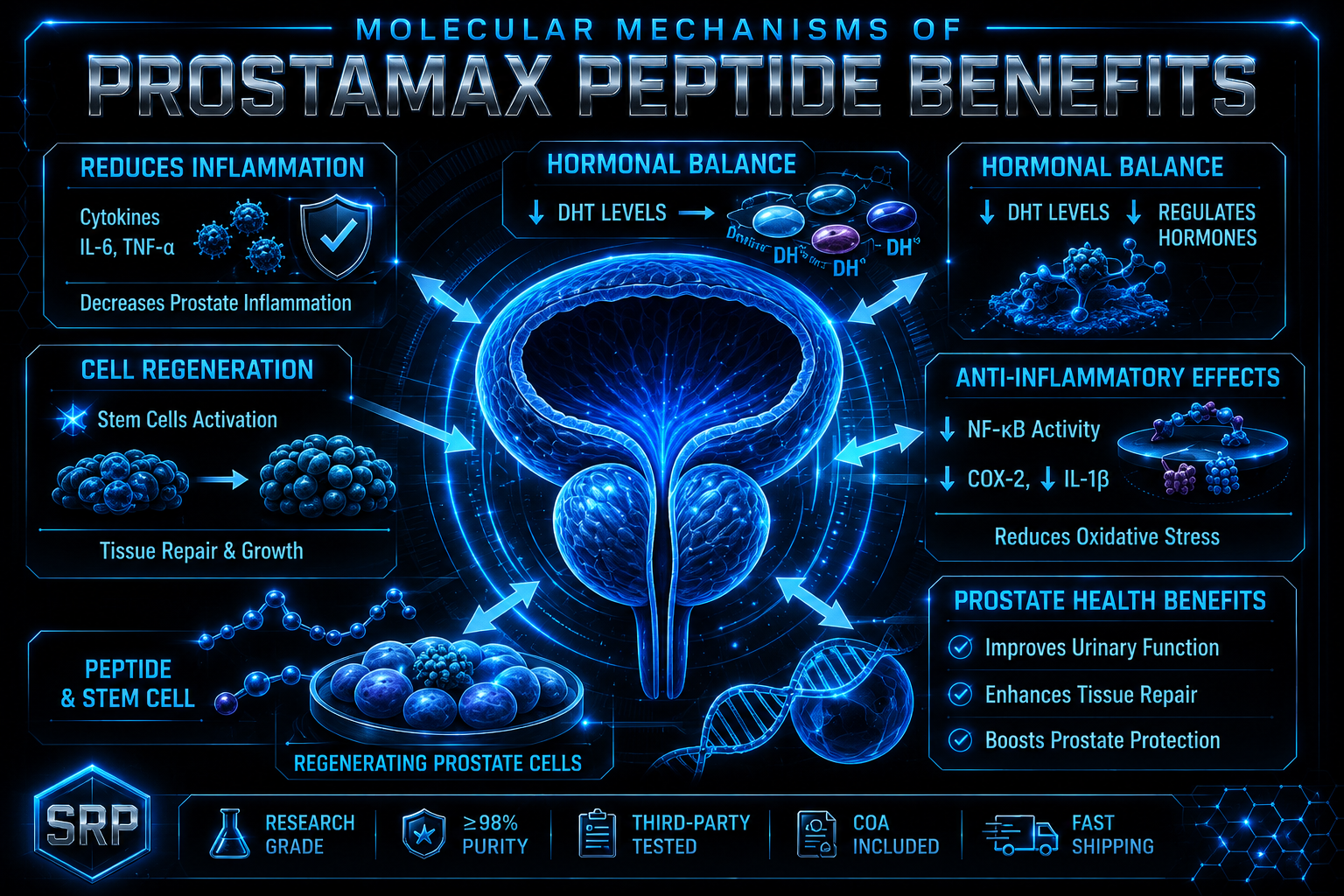
Vendor-style “prostate health” language is not copied here as a benefit claim.
Important note
This content is for educational purposes only and is not medical advice. No human clinical trials have been published for Prostamax on any opened registry. The table is research-context only. Not for human consumption.
Frequently asked questions
Is Prostamax approved for human use?
No. Investigational. NCATS 0, openFDA 404, IUPHAR 404. UNII: none. NCT: none.
What type of evidence exists?
Sparse. Opened work is aged-donor lymphocyte chromatin, one rat prostatic-gland explant paper, and a docking-table row. Europe PMC name search returned 7 hits.
Is the sequence really Lys-Glu-Asp-Pro / KEDP?
Yes, on opened PMID 23221144 and opened PMID 35887081 Table 2, and on CID 9848296 (title Prostamax). SRP does not print the sequence. Confirm the vial by sequence and assay.
Why do some pages say Prostomax?
Opened PMID 35887081 Table 2 uses Prostomax. SRP and several opened abstracts use Prostamax. This page treats them as the same catalog tetrapeptide only where the sequence KEDP is printed. It does not prove that an SRP vial matches every historical lot.
How is this different from Vesugen, Livagen, Pancragen, or Pinealon?
Different sequences on opened Table 2: Vesugen KED; Livagen KEDA; Pancragen KEDW-NH2; Pinealon EDR; Prostomax KEDP.
Did any registered trial test Prostamax?
No. CT.gov prostamax and prostomax both returned totalCount 0.
Does an explant or lymphocyte-culture result predict a human urologic outcome?
No.
Can SRP vials be used as a human dose substitute?
No. SRP listings are for laboratory research only and are not for human or animal use. An educational reconstitution and unit-conversion table is on this page for research-context reference only. SRP materials are not for human or animal use.
Sources actually opened for this draft
Only IDs that appeared on a page opened for this draft. NCT: none.
- Dzhokhadze TA, et al. Deheterochromatinization of the chromatin in old age induced by oligopeptide bioregulator (Lys-Glu-Asp-Pro). Georgian Med News. 2012;(212):76-82. PMID 23221144. Prostamax + sequence.
- Khavinson VKh, Lezhava TA, Malinin VV. Effects of short peptides on lymphocyte chromatin in senile subjects. Bull Exp Biol Med. 2004;137(1):78-81. PMID 15085253. DOI 10.1023/b:bebm.0000024393.40560.05.
- Meskhi T, et al. The influence of the peptide bioregulator prostamax on heterochromatin of human lymphocytes in situ. Biofizika. 2004;49(6):1091-1093. PMID 15612551.
- Kiladze M, et al. Microcalorimetric study of human blood lymphocytes culture at presence of copper, cadmium and prostamax. Georgian Med News. 2009;(168):104-107. PMID 19359734.
- Zakutskii AN, et al. The tissue-specific effect of synthetic peptides-biologic regulators in organotypic tissues culture in young and old rats. Adv Gerontol. 2006;19:93-96. PMID 17152728.
- Khavinson V, et al. Transport of biologically active ultrashort peptides using POT and LAT carriers. Int J Mol Sci. 2022;23(14):7733. PMID 35887081. PMC9323678. DOI 10.3390/ijms23147733. Table 2: Prostomax (KEDP), ICM -13.58.
- PubChem CID 9848296 (Prostamax; C20H33N5O9; InChIKey WUCUNGRTSFLCLI-XUXIUFHCSA-N; synonym 473578-47-1). Opened 16 August 2026.
- ClinicalTrials.gov API v2 prostamax and prostomax — empty (opened 16 August 2026).
- NCATS Inxight prostamax / prostomax — total 0. openFDA prostamax — HTTP 404. IUPHAR prostamax — HTTP 404.
- SRP product page (opened 16 August 2026): product/prostamax-20-mg. Index: compound-research-guides. Dedicated guide URL HTTP 404.
Allowed PMID list: 23221144; 15085253; 15612551; 19359734; 17152728; 35887081. PMC: PMC9323678. Registry: CID 9848296; InChIKey WUCUNGRTSFLCLI-XUXIUFHCSA-N; CAS synonym 473578-47-1. UNII: none. NCT: none.
Opened and not used as a Prostamax experiment: PMID 28948547 (Europe PMC hit; Livagen-pass abstract did not print Prostamax); PMID 36979488 (KEDP appears in a 26-USP docking list on the Livagen-pass XML — trade name Prostamax/Prostomax was not re-opened as a Prostamax-titled experiment this session and is not assigned here beyond the 2022 table already opened).
Educational information only. Prostamax is a synthetic tetrapeptide printed as Lys-Glu-Asp-Pro (KEDP). CID 9848296 is titled Prostamax. Table 2 spelling is Prostomax. CAS 473578-47-1 is a depositor synonym only. It is not Livagen, not Vesugen, not Pancragen, not Pinealon, and not an FDA-approved drug. Evidence is sparse: one research network; 0 NCT; UNII not found. Laboratory research use only; not for human or animal use. Not medical advice. Not for human use. Educational dosage table is research-context only. Last source review: 16 August 2026 (America/Indianapolis). For laboratory research only. Not for human or veterinary use.