






Hormone signaling · Compound guide
PEG-MGF Research Guide
Explore the mechanisms, study findings and evidence limits behind this research topic.
Product artwork identifies the SRP listing. It does not demonstrate safety or clinical benefit. The evidence guide and its sources follow below.
View product label and documentation →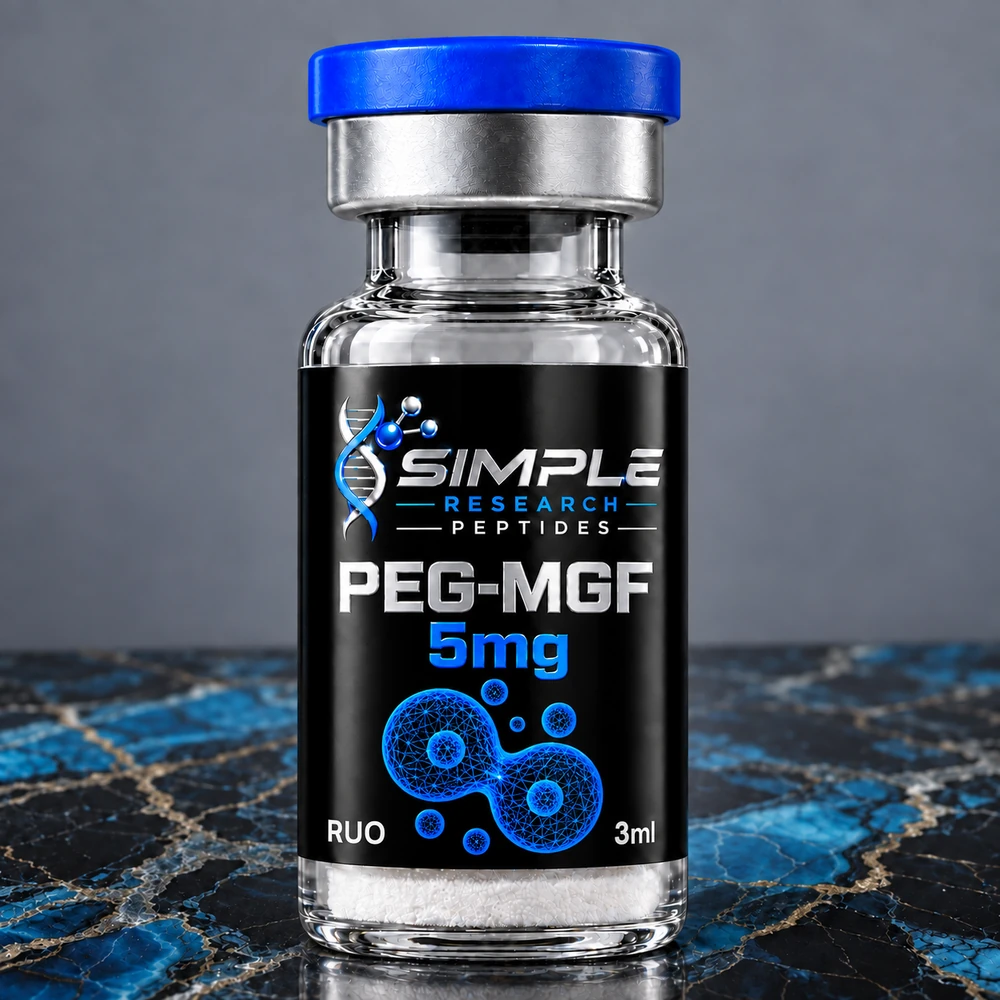
Back to the Research Compound Library
Limited direct evidence; related MGF research is not equivalent
Evidence reviewed September 13, 2026.
Research overview and identity
PEG-MGF is a research-market name for a polyethylene-glycol-modified MGF-related material. The name alone does not define the peptide sequence, PEG size, attachment site or distribution of conjugated species.
Mechanism under investigation
PEG attachment can change molecular properties, but the effect depends on the actual conjugate. It is not scientifically sound to assign a precise human half-life or guarantee improved activity from the word PEG alone.
What the studies report
Related non-PEG MGF peptide research includes both positive reports and unsuccessful replication; a 2014 muscle-cell study did not reproduce proposed peptide effects. That paper addresses the underlying MGF concept and is not direct pharmacokinetic or efficacy evidence for a PEG-MGF product. [1]
Limits of the evidence
The reviewed material did not establish controlled human efficacy or a validated human half-life for the exact commercial conjugate. Research interpretation requires full chemical characterization. Evidence about mature IGF-I, IGF-I splice-variant expression or an unconjugated E-domain peptide should remain clearly separated from evidence about PEG-MGF.
Matching research material to a paper
Check the material identity, formulation and analytical methods against the study methods. A product name or milligram amount alone does not demonstrate experimental equivalence. Published research does not establish the identity, purity or potency of a retail batch; batch-specific analytical documentation must be assessed separately.
For laboratory research only. Not for human or veterinary use. This guide is educational and contains no dosing, reconstitution or administration instructions.