




Peptide research · Compound guide
Pancragen
Explore the mechanisms, study findings and evidence limits behind this research topic.
Product artwork identifies the SRP listing. It does not demonstrate safety or clinical benefit. The evidence guide and its sources follow below.
View product label and documentation →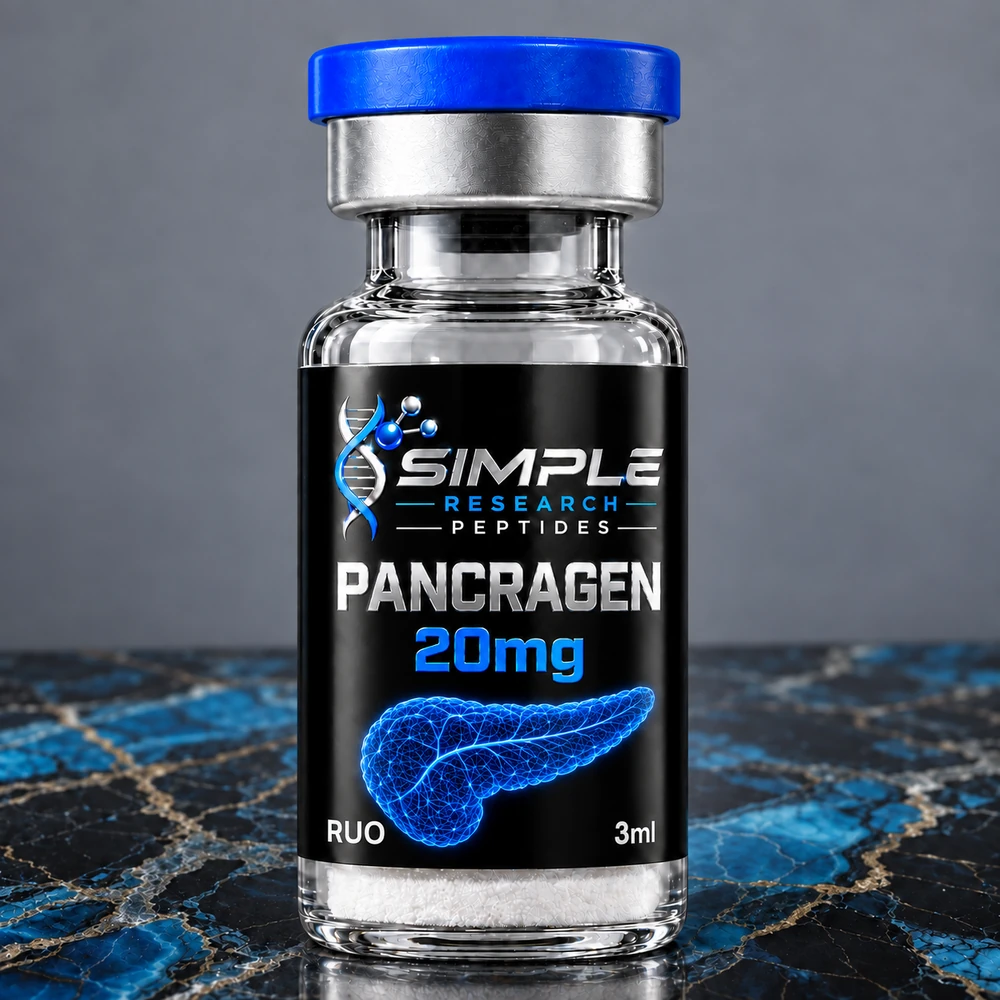
Pancragen Research GuideKEDW / KEDW-NH2 · C-terminus not settled · not insulin
Pancragen is a Khavinson-catalog synthetic tetrapeptide printed in opened papers as Lys-Glu-Asp-Trp (KEDW) and, on other opened pages, as the C-terminal amide Lys-Glu-Asp-Trp-NH2 (KEDW-NH2); it is positioned as a short “peptide bioregulator” associated with pancreatic-cell / gene-expression research; English-language independently replicated evidence is limited, ClinicalTrials.gov returned 0 studies for the trade name or KEDW, and it is not Livagen, not Ovagen, not Pinealon, not Vesugen, not Chonluten, and not insulin, glucagon, amylin, or cagrilintide.
Educational information only. This page describes a laboratory research material. It is not medical advice. Materials are for laboratory research only and are not for human or veterinary use. No human-use protocol appears on this page.
Pancragen Research Guide
Research-use-only framing. This page describes a short peptide bioregulator sold as a laboratory research material. It is not medical advice. Simple Research Peptides (SRP) materials are for laboratory research only and are not for human or veterinary use, consumption, administration, diagnosis, treatment, or therapeutic application.
One-sentence identity. Pancragen is a Khavinson-catalog synthetic tetrapeptide printed in opened papers as Lys-Glu-Asp-Trp (KEDW) and, on other opened pages, as the C-terminal amide Lys-Glu-Asp-Trp-NH2 (KEDW-NH2); it is positioned as a short “peptide bioregulator” associated with pancreatic-cell / gene-expression research; English-language independently replicated evidence is limited, ClinicalTrials.gov returned 0 studies for the trade name or KEDW, and it is not Livagen, not Ovagen, not Pinealon, not Vesugen, not Chonluten, and not insulin, glucagon, amylin, or cagrilintide.
–-
Sequence / chemical identity (opened registries only)
The registry-search results below are historical notes from August 16, 2026. They have not been refreshed in this editorial cleanup. An empty result or failed lookup does not establish regulatory status or confirm a batch identity. Verify the current record and exact chemical form before relying on an identifier.
SRP product and index pages do not print a sequence, CAS, UNII, molecular formula, or a public COA. The sequences below are taken only from opened primary papers and from opened PubChem records that match those printed sequences. PubChem does not list the trade name Pancragen as a synonym on either CID opened here.
| Identifier | Value on opened page | Source opened |
|---|---|---|
| Trade name on SRP | Pancragen 20 mg Research Peptide Vial | SRP product page |
| SRP listed strength / format | 20 mg; “one 20 mg research vial; verify sequence, salt form, and assay” | SRP product page |
| SRP store categories | Metabolic Research; Peptide Bioregulators; Research Peptides | SRP product page |
| SRP index category / evidence tag | Metabolic listing “Pancragen 20 mg”; evidence tag Sparse/limited evidence | SRP compound-research-guides index |
| Sequence printed with the name Pancragen (free acid wording) | Lys-Glu-Asp-Trp (one-letter KEDW) | Goncharova et al. 2014, PMID 25946840 (opened abstract); Khavinson et al. 2012, PMID 22808515 (opened abstract) |
| Sequence printed with the name Pancragen (amide wording) | Lys-Glu-Asp-Trp-NH2 | Khavinson et al. 2007, PMID 18642713 (opened abstract) |
| Sequence printed as Pancragen (KEDW-NH2) on a docking table | Table 2: “Pancragen (KEDW-NH2)”, ICM-score −23.47, labeled “Regulator of pancreatic functions” | Khavinson et al. 2022, PMID 35887081, PMC9323678, Table 2 |
| MeSH substance string on several Pancragen records | lysyl-glutamyl-aspartyl-tryptophanamide (registry number 0 on those records) | Europe PMC core JSON for PMIDs 18642713, 22448364, 22808515, 23486591, 25946840, 28509500 |
PubChem name lookup pancragen | PUGREST.NotFound (HTTP 404) | PubChem PUG REST, opened 16 August 2026 |
| PubChem CID matching free-acid H-Lys-Glu-Asp-Trp-OH | 68452877. Title: H-Lys-Glu-Asp-Trp-OH (not “Pancragen”). Formula C26H36N6O9. MW 576.6. Sequence KEDW / H-KEDW-OH / HELM PEPTIDE1{K.E.D.W} | PubChem HTML + PUG REST, opened 16 August 2026 |
| PubChem CID matching amide H-Lys-Glu-Asp-Trp-NH2 | 68451868. Title: H-Lys-Glu-Asp-Trp-NH2. Formula C26H37N7O8. MW 575.6 | PubChem PUG REST, opened 16 August 2026 |
| PubChem CID 68452887 (vendor/blog number) | Not Pancragen. Opened PUG property JSON: C25H18FN3O4; MW 443.4; InChIKey RDEGCMWRYVMBGQ-FQEVSTJZSA-N; IUPAC 3-[2-(1,3-dihydrobenzimidazol-2-ylidene)-3-[3-[(1R)-1,2-dihydroxyethyl]-2-fluorophenyl]-3-oxopropanoyl]benzonitrile | PubChem PUG CID 68452887 |
| CAS on CID 68452877 | None printed. Synonyms JSON listed only SCHEMBL2946041. xrefs JSON had no RN field | PubChem PUG synonyms + xrefs |
| CAS on CID 68451868 | None printed. Synonyms JSON listed only SCHEMBL2942999 | PubChem PUG synonyms |
| CAS 8057-49-6 (some SDS/vendor pages) | PubChem PUG name lookup HTTP 404. Not assigned as Pancragen on any opened registry | PubChem PUG name 8057-49-6 |
| CAS 45234-02-4 (some vendor pages) | Not Pancragen. Resolves to Lysylglutamic acid (H-Lys-Glu-OH), CID 7010502, C11H21N3O5, MW 275.30, InChIKey UGTZHPSKYRIGRJ-YUMQZZPRSA-N | PubChem PUG name 45234-02-4 |
| Free-acid formula / MW / exact mass | C26H36N6O9; 576.6 g/mol; exact / monoisotopic 576.25437675 | PubChem CID 68452877 |
| Free-acid InChIKey | PIGJHNNSOMRLST-LEAZDLGRSA-N | PubChem CID 68452877 |
| Free-acid IUPAC (PubChem computed) | (4S)-5-[[(2S)-3-carboxy-1-[[(1S)-1-carboxy-2-(1H-indol-3-yl)ethyl]amino]-1-oxopropan-2-yl]amino]-4-[[(2S)-2,6-diaminohexanoyl]amino]-5-oxopentanoic acid | PubChem CID 68452877 |
| Amide formula / MW / exact mass | C26H37N7O8; 575.6 g/mol; exact / monoisotopic 575.27036116 | PubChem PUG CID 68451868 |
| Amide InChIKey | WKJHPWJUFPYRSF-LEAZDLGRSA-N | PubChem PUG CID 68451868 |
| Amide IUPAC (PubChem computed) | (4S)-5-[[(2S)-1-[[(2S)-1-amino-3-(1H-indol-3-yl)-1-oxopropan-2-yl]amino]-3-carboxy-1-oxopropan-2-yl]amino]-4-[[(2S)-2,6-diaminohexanoyl]amino]-5-oxopentanoic acid | PubChem PUG CID 68451868 |
| UNII | Not found | NCATS substances search pancragen total 0; exact-name PANCRAGEN total 0; precision.fda.gov UNII search landing page returned no substance card |
| NCATS Inxight | No substance record named pancragen | NCATS API, opened 16 August 2026 |
| IUPHAR / GtoPdb | No ligand | IUPHAR services name=pancragen HTTP 404; name=KEDW HTTP 404 |
| openFDA Drugs@FDA / labels | No matches | openFDA search=pancragen HTTP 404 |
| ClinicalTrials.gov | 0 studies for pancragen or KEDW. Query Lys-Glu-Asp-Trp returned lexical collisions that are not Pancragen trials | CT.gov API v2, opened 16 August 2026 |
| INN / USAN | None on any opened registry | — |
What this is chemically, from opened pages. Opened Khavinson-group papers print Pancragen as a four-residue peptide built from lysine, glutamic acid, aspartic acid, and tryptophan. They do not agree on the C-terminus. PMID 25946840 and PMID 22808515 print Lys-Glu-Asp-Trp. PMID 18642713 prints Lys-Glu-Asp-Trp-NH2. PMID 35887081 Table 2 prints Pancragen (KEDW-NH2). Several Europe PMC chemical lists use the MeSH string lysyl-glutamyl-aspartyl-tryptophanamide. Those are not the same terminal chemistry. This draft records both printings and does not collapse them.
PubChem has matching structures under sequence titles, not under the marketplace name:
- CID 68452877 = free acid H-Lys-Glu-Asp-Trp-OH / KEDW / C26H36N6O9 / 576.6 Da.
- CID 68451868 = amide H-Lys-Glu-Asp-Trp-NH2 / C26H37N7O8 / 575.6 Da.
Neither CID prints “Pancragen.” Neither CID prints a CAS or UNII.
What this is not, chemically.
- Not Livagen (KEDA / Lys-Glu-Asp-Ala). Same 2022 table, different row (ICM −22.01, “Hepatoprotector”).
- Not Ovagen (EDL). Same table, labeled nephro-/hepatoprotector.
- Not Pinealon (EDR). Same table, labeled neuroprotector.
- Not Vesugen (KED). Same table, labeled vasoprotector. PMID 22808515 tests vesugen on fibroblasts in the same design that tests pancragen on pancreatic cells.
- Not Chonluten (EDG). Same table, labeled gastroprotector / stress protector.
- Not Bronchogen (AEDL on that table). PMID 22808515 and PMID 25761685 pair KEDW with AEDL as tissue-specific counterparts (pancreas vs bronchi).
- Not insulin, glucagon, amylin, pramlintide, or cagrilintide. Those are endogenous or analogue hormones / receptor agonists. Pancragen is a four-residue Khavinson cytogen-style peptide. Do not transfer GLP-1 / amylin-receptor trial evidence.
- Not the vendor CID 68452887 (a fluorinated benzimidazole, C25H18FN3O4).
- Not CAS 45234-02-4 (lysylglutamic acid, the KE dipeptide).
- Not shown on any opened page to be compositionally identical to an SRP 20 mg lyophilized research vial. SRP itself tells the buyer to “verify sequence, salt form, and assay.”
Not printed on SRP pages and therefore not claimed as SRP-verified: sequence, free-acid vs amide status, CAS, UNII, formula, CID, or purity numbers. The product page does not print a public COA.
Pankragen-forte. PMID 28976155 is an opened Russian-language abstract about an oral product spelled pankragen-forte in 12 older adults with impaired glucose tolerance. That abstract does not print Lys-Glu-Asp-Trp or KEDW. It is logged as a related trade-name variant, not as confirmed identity for an SRP vial and not as a diabetes-treatment claim.
–-
How it relates to — and is not — other Khavinson bioregulators, or insulin / amylin analogues
Pancragen (this page) is the tetrapeptide Lys-Glu-Asp-Trp / KEDW, sometimes printed as the amide, on the opened Khavinson / Goncharova / Korkushko pages. It is one name inside the Khavinson / cytomedin-style short-peptide bioregulator catalog. That catalog is a research-network taxonomy, not a receptor-class assignment.
| Opened page | What it printed | Why it is not interchangeable with Pancragen |
|---|---|---|
| Khavinson et al. 2012, PMID 22808515 | pancragen = Lys-Glu-Asp-Trp on pancreatic cells; bronchogen = Ala-Glu-Asp-Leu on bronchial cells; vesugen = Lys-Glu-Asp on fibroblasts | Three named peptides, three tissues |
| Ashapkin et al. 2015, PMID 25761685 | KEDW on pancreatic cultures; AEDL on bronchial cultures | Tissue-paired counterpart, different sequence |
| Khavinson et al. 2022, PMID 35887081 Table 2 | Pancragen (KEDW-NH2) ICM −23.47; Livagen (KEDA) −22.01; Ovagen (EDL) −28.27; Pinealon (EDR) −30.29; Vesugen (KED) −18.91; Chonluten (EDG) −30.30 | Same table, different sequences |
| Khavinson et al. 2023, PMID 36979488 | Library includes KEDW-NH2 and KEDA as separate ligands | Docking library, not a synonym list |
| Khavinson et al. 2020, PMID 31808038 | “AEDL and KEDW induce lung and pancreatic cell differentiation” | Sequence-level review; AEDL is not KEDW |
| SRP cagrilintide / insulin / amylin literature | Long-acting amylin analogue or endogenous hormones | Different molecules, different evidence class |
–-
SRP Pancragen research listing
View Pancragen 20 mg Research Peptide Vial for current price, availability and product information.
SRP supplies this material for laboratory evaluation of pancreatic-tissue and metabolic research models. Review batch documentation to verify sequence, terminal form, salt form and assay before interpreting experimental results.
This guide explains the literature; it is not a certificate for a particular batch or evidence of a treatment benefit. For laboratory research only. Not for human or animal use.
Explore the SRP Research Library to compare other compound guides.
Overview
Pancragen is a synthetic tetrapeptide from the St. Petersburg Institute of Bioregulation and Gerontology catalog. Opened papers report four clusters of laboratory observations:
- Tissue-specific explant / culture effects on pancreatic tissue (Zakutskii et al. 2006, PMID 17152728; Khavinson et al. 2012, PMID 22808515).
- Differentiation-factor expression in aging pancreatic cell cultures — Pdx1, Ptf1a, Pax6, Pax4, Foxa2, Nkx2.2 and related markers (Khavinson et al. 2013, PMID 23486591; review-level restatement in PMID 31808038).
- Promoter-methylation / DNA-binding language for the letters KEDW (Ashapkin et al. 2015, PMID 25761685; Khavinson et al. 2016, PMID 27909961; Khavinson et al. 2021, PMID 34834147 citing the 2015 *Am. J. Biomed. Sci.* KEDW–DNA paper).
- Glucose / insulin / C-peptide readouts in streptozotocin rats (PMID 18642713), aged rhesus monkeys (PMID 25946840; PMID 28509500), and two small regional human reports (PMID 22448364; the separately spelled pankragen-forte abstract PMID 28976155).
Almost all indexed work originates from the Khavinson network and collaborators in St. Petersburg, Sochi (Research Institute of Medical Primatology), and Kiev (Institute of Gerontology). No opened Western independent replication of the differentiation-factor or primate glucose-tolerance findings was located. ClinicalTrials.gov has no Pancragen or KEDW study.
This is not a diabetes medicine, not an insulin secretagogue class, and not a substitute for approved metabolic drugs. Opened abstracts that use treatment-style language are recorded as author claims from those papers, not as SRP indications.
–-
Mechanism (only as far as opened sources support)
Observed in opened Pancragen- or KEDW-named papers
- Tissue-specific differentiation-marker stimulation in aging cultures. Pancragen (Lys-Glu-Asp-Trp) “tissue-specifically stimulated” CXCL12 and Hoxa3 in human embryonic pancreatic-cell cultures; the effect was “more pronounced in aged cultures.” Bronchogen and vesugen acted on bronchial epithelium and fibroblasts, respectively, in the same design (Khavinson et al. 2012, PMID 22808515).
- Acinar and islet transcription-factor panel. “Tetrapeptide pancragen stimulates the expression of differentiation factors of acinar (Pdx1, Ptfla) and islet of Langerhans (Pdx1, Pax6, Pax4, Foxa2, NKx2.2) cells in ‘young’ and ‘aged’ cultures” (Khavinson et al. 2013, PMID 23486591). The opened abstract then uses treatment-style language (“anti-diabetic,” “treatment of diabetes mellitus and pancreatitis”). That language is the authors’ interpretation. It is not a registered trial and is not adopted here as a clinical claim.
- KEDW and promoter methylation in pancreatic cultures. KEDW “tissue-specifically” affected gene expression in pancreatic (not bronchial) cultures. Promoter methylation of PDX1, PAX6, and NGN3 changed with culture aging and with KEDW in a pattern that correlated with expression; PAX4 methylation did not change even though expression did; FOXA2 methylation changed without correlating with expression (Ashapkin et al. 2015, PMID 25761685). The opened abstract does not print the trade name Pancragen.
- In-silico DNA-site language. Docking models in Khavinson, Lin’kova, Tarnovskaya 2016 (PMID 27909961) place KEDW and AED on an acct sequence. The 2021 systematic review (PMID 34834147, PMC8619776) restates that KEDW increased expression of PDX1, NGN3, MNX1, PAX6, FOXA2, NKX2-2, NKX6.1, HOXA3, and PAX4 and cites the 2015 *American Journal of Biomedical Sciences* paper (DOI 10.5099/aj150300156) for DNA-binding / ACCT-promoter language. That 2015 journal article was not itself opened in this pass; claims beyond what PMID 34834147 printed are not used.
- In-silico LAT1 docking (not a transport assay). Pancragen (KEDW-NH2) ICM-score −23.47 on LAT1 (Khavinson et al. 2022, PMID 35887081, Table 2). Follow-up docking of KEDW-NH2 (trade name Pancragen not printed in the 2023 methods list): LAT1 (PDB 6IRT) −28.40; LAT2 (7B00) −21.78; PEPT1 (7PN1) −20.57; PEPT2 (7PMY) +6.90 (Khavinson et al. 2023, PMID 36979488, PMC10046148, Tables 1, 3, 5, 7). The same 2022 paper states KEDW (with KEDA) was “resistant to hydrolysis for 3–4 h in physiological saline, Ringer’s solution, HCl and tissue homogenates,” citing prior hydrolysis work. This is docking / review language, not a measured PEPT/LAT flux for Pancragen.
- Organotypic pancreas explants. Pancragen, grouped with cardiogen, bronchogen, and prostamax, “showed a stimulating effect in appropriate tissue cultures” at the printed explant concentration in young and old rats (Zakutskii et al. 2006, PMID 17152728). Sequence is not printed on that opened abstract.
Glucose-axis observations (preclinical / small regional human; not treatment claims)
- Streptozotocin Wistar rats: opened abstract of PMID 18642713 reports that oral pancragen (printed as Lys-Glu-Asp-Trp-NH2) changed blood glucose during treatment and that intramuscular pancragen changed mesenteric capillary endothelial adhesion without changing permeability. This is a rodent chemical-diabetes model.
- Aged female rhesus monkeys: opened abstract of PMID 25946840 prints Lys-Glu-Asp-Trp and reports faster glucose disappearance and normalized insulin / C-peptide peaks after a 10-day intramuscular course, with a partial effect remaining three weeks later. PMID 28509500 is a related old-monkey comparison with oral glimepiride (n=5 pancragen, n=4 glimepiride). Those are primate laboratory studies, not human trials.
- Elderly humans with type 2 diabetes (Korkushko et al. 2011, PMID 22448364): opened abstract reports 30 healthy older persons and 33 patients with type 2 diabetes; nocturnal melatonin described as reduced in the diabetes group; the pancragen arm is described as decreasing fasting and OGTT glucose, plasma insulin, and an insulin-resistance index, with no change in the no-pancragen subgroup. Route, duration, randomization, and blinding are not stated in the opened abstract. Not an NCT.
- Pankragen-forte (PMID 28976155): 12 older adults with impaired glucose tolerance; oral product; opened abstract describes OGTT glucose falling in “50 percent” of that group. Sequence not printed. Not an NCT. Not used as SRP-vial identity.
Not shown in a paper opened here
- A defined cell-surface receptor (IUPHAR: no ligand).
- Measured LAT1 / PEPT1 flux of Pancragen in a wet assay.
- Pharmacokinetics, oral bioavailability, or human safety package for a research vial.
- Equivalence of free-acid KEDW and KEDW-NH2 in the same experiment.
- Equivalence of an SRP lyophilized vial to the material used in any cited paper.
- Independent Western replication.
–-
Key papers (real PMIDs only)
Evidence quality overall: sparse / limited. One research network. Small n. Several Russian-language abstracts. No registered trial.
| Year | Paper | PMID | Design (from opened record) | What the opened record actually showed | Quality flag |
|---|---|---|---|---|---|
| 2006 | Zakutskii / Chalisova et al., *Adv Gerontol* 19:93–96 | 17152728 | Rat organotypic explants (heart, lung, prostate, pancreas); young vs 18-month | Pancragen grouped with cardiogen, bronchogen, prostamax; “stimulating effect in appropriate tissue cultures.” Sequence not printed | Abstract-only; Russian; no sequence |
| 2007 | Khavinson et al., *Bull Exp Biol Med* 144:559–562 | 18642713 | STZ Wistar rats | Prints Lys-Glu-Asp-Trp-NH2. Oral vs IM readouts on glucose and mesenteric capillaries | Rodent STZ model; not human |
| 2011 | Korkushko et al., *Bull Exp Biol Med* 151:454–456 | 22448364 | 30 healthy elderly + 33 elderly type 2 diabetes | Pancragen arm: fasting / OGTT glucose, insulin, IR index described as decreased; comparator subgroup unchanged. Melatonin described as reduced in DM2. Methods gaps on opened abstract | Small regional human report; not NCT; not an RCT on the opened abstract |
| 2012 | Khavinson et al., *Bull Exp Biol Med* 153:148–151 | 22808515 | Human embryonic pancreatic / bronchial / fibroblast cultures | Prints pancragen (Lys-Glu-Asp-Trp); CXCL12 / Hoxa3 up in pancreatic cells, stronger in late-passage cultures | Cell culture; same-network |
| 2013 | Khavinson et al., *Bull Exp Biol Med* 154:501–504 | 23486591 | Aging pancreatic cell cultures | Pdx1, Ptf1a, Pax6, Pax4, Foxa2, Nkx2.2 panel. MeSH chemical: tryptophanamide | Cell culture; treatment-style abstract language not adopted |
| 2013 | Korkushko et al., *Adv Gerontol* 26:297–308 | 28976155 | 12 older adults with IGT; oral pankragen-forte | OGTT glucose described as falling in half the group. Sequence not printed | Different spelling; not SRP identity; not NCT |
| 2014 | Goncharova et al., *Adv Gerontol* 27:662–667 | 25946840 | Old female rhesus monkeys; GTT | Prints Lys-Glu-Asp-Trp. Glucose disappearance / insulin / C-peptide described as normalized | Primate lab study; Russian abstract |
| 2015 | Goncharova et al., *Adv Gerontol* 28:579–585 | 28509500 | 9 old female rhesus; pancragen n=5 vs glimepiride n=4 | Pancragen described as lowering basal glucose and normalizing insulin / C-peptide vs a more delayed glimepiride hypoglycemic pattern | Primate; small n; not a human trial |
| 2015 | Ashapkin et al., *Biochemistry (Mosc)* 80:310–322 | 25761685 | Human pancreatic vs bronchial cultures | KEDW (name Pancragen not on opened abstract); PDX1 / PAX6 / NGN3 methylation correlation | Sequence-named; methylation, not a trial |
| 2016 | Khavinson / Lin’kova / Tarnovskaya, *Bull Exp Biol Med* 162:288–292 | 27909961 | In-silico DNA docking of 19 peptides | KEDW and AED modeled on acct | Docking only |
| 2020 | Khavinson et al., *Stem Cell Rev Rep* 16:118–125 | 31808038 | Review | “AEDL and KEDW induce lung and pancreatic cell differentiation” | Review; sequence-named |
| 2021 | Khavinson et al., *Molecules* 26:7053 | 34834147 | Systematic review (PMC8619776 opened) | KEDW listed among histone-binding peptides; restates PDX1 / NGN3 / PAX6 / FOXA2 / NKX panel and cites 2015 AJ DNA paper | Review; trade name Pancragen not used as a table entry |
| 2022 | Khavinson et al., *Int J Mol Sci* 23:7733 | 35887081 | LAT1 docking table (PMC9323678 opened) | Pancragen (KEDW-NH2) ICM −23.47 | In silico; names the trade name |
| 2023 | Khavinson et al., *Biomolecules* 13:552 | 36979488 | LAT/PEPT docking (PMC10046148 opened) | KEDW-NH2 scores LAT1 −28.40 / LAT2 −21.78 / PEPT1 −20.57 / PEPT2 +6.90 | In silico; trade name not printed |
Opened and not used as Pancragen evidence: Europe PMC pancragen also returned pancreatic-cyst / IPMN / pancreatic-cancer papers (e.g. PMID 37749004, 41090355, 33207417, 32050465, 35229208, 28739154, 35854467, 36600097, 38472986, 31676330). Those are lexical collisions on “pancrea-”. Unused.
–-
What it is NOT
- Not Livagen (KEDA), Ovagen (EDL), Pinealon (EDR), Vesugen (KED), Chonluten (EDG), Epitalon (AEDG), Vilon (KE), Bronchogen (AEDL), or Prostamax / Prostomax (KEDP).
- Not insulin, proinsulin, C-peptide, glucagon, GLP-1, GIP, amylin, pramlintide, or cagrilintide.
- Not a pancreatic tissue extract (the older cytomedin-style pancreas complex sometimes sold as Suprefort in other catalogs was not opened as a primary identity source and is not treated as the same molecule).
- This is a laboratory research material, not a product offered for human treatment. Historical database lookup failures do not establish regulatory status, clinical approval or safety.
- Not CID 68452887.
- Not CAS 45234-02-4 or the unverified vendor CAS 8057-49-6.
- Not a human diabetes, pancreatitis, or prediabetes treatment. This page does not provide dosing or reconstitution.
–-
Research-use-only notes
- SRP listing is a 20 mg research vial for laboratory evaluation in pancreatic-tissue models, metabolic signaling, and peptide-bioregulator characterization.
- Confirm sequence and C-terminus (free acid KEDW vs KEDW-NH2) on the certificate of analysis. Opened literature uses both.
- Do not assume a trade name equals a PubChem CID. The name
pancragenis not a PubChem title. - Do not copy rodent, monkey, or regional-human exposure details as a laboratory or human protocol.
- Do not merge evidence from insulin, GLP-1, or amylin analogues.
- Independent replication, pharmacokinetics, and standardized human safety data are limited.
–-
Pancragen research FAQ
What is Pancragen?
Pancragen is a synthetic four-residue peptide discussed in pancreatic and metabolic research. A rat study identifies it as Lys-Glu-Asp-Trp-NH2, abbreviated KEDW-NH2. PMID 18642713.
How should researchers verify its identity?
Check the exact sequence, C-terminal form, stereochemistry, salt form and batch assay. A name in a paper or a marketplace listing does not establish that a particular vial contains the same chemical form. The sequence used in the cited rat study should not be treated as independent verification of SRP stock.
Is Pancragen interchangeable with other peptides?
No. Evidence for insulin, glucagon, GLP-1 analogues or another peptide bioregulator cannot be transferred to Pancragen. Measuring insulin as an experimental outcome also does not make the tested compound insulin.
What kinds of evidence are discussed here?
The guide separates cell studies, animal experiments, computational models and human reports. For example, PMID 18642713 concerns rats, while PMID 22448364 describes older people. Study design and the material tested matter when interpreting each result.
Has Pancragen been studied in people?
Yes. A 2011 report describes 30 healthy older participants and 33 with type 2 diabetes. Its abstract does not provide enough detail to assess randomization, blinding or long-term safety. It should not be described as proof of an established treatment. PMID 22448364.
What do trial registrations and patents tell us?
A publication, patent and trial registration are different records. Use the human-evidence section for the dated registry-search limitation and the patent section for patent context. Neither a patent nor a database identifier demonstrates clinical approval.
Does this guide establish a treatment benefit?
No. It describes research and its limits. It does not establish that Pancragen or an SRP vial treats, prevents or manages diabetes, pancreatitis or another condition. Findings in a particular experimental model do not establish benefits for people.
Can the research vial be used in people or animals?
No. The SRP listing is restricted to laboratory research. This guide provides no dosing, reconstitution or administration protocol.
Claims and evidence
| Topic | Evidence in context | Interpretation limit |
|---|---|---|
| Peptide identity | A paper may identify the material used in that experiment. | Verify the identity and terminal form of the specific research batch. Literature names are not a batch certificate. |
| Glucose-related findings | The cited rat study reports experimental glucose and vascular outcomes. PMID 18642713. | Animal results cannot establish human treatment benefits. |
| Human evidence | A small 2011 human report exists. PMID 22448364. | Its abstract alone is insufficient to establish robust clinical effectiveness or long-term safety. |
| Computational and patent findings | Models propose interactions; patents document claimed inventions. | Neither establishes a clinical benefit or validates a retail vial. |
| Store categories and product claims | SRP lists a 20 mg laboratory research vial. | Categories describe research organization, not approved indications. Product identity and assay require batch documentation. |
References and source records
The bibliography retains the distinct literature cited in this guide. Direct experiments, reviews, computational work and patents should be interpreted separately.
- Zakutskii AN, Chalisova NI, Ryzhak GA, Aniskina AI, Filippov SV, Zeziulin PN. The tissue-specific effect of synthetic peptides-biologic regulators in organotypic tissues culture in young and old rats. Adv Gerontol. 2006;19:93–96. PMID 17152728.
- Khavinson VKh, Gavrisheva NA, Malinin VV, Chefu SG, Trofimov EL. Effect of pancragen on blood glucose level, capillary permeability and adhesion in rats with experimental diabetes mellitus. Bull Exp Biol Med. 2007;144(4):559–562. PMID 18642713. DOI 10.1007/s10517-007-0377-3.
- Korkushko OV, Khavinson VKh, Shatilo VB, Antonyk-Sheglova IA, Bondarenko EV. Prospects of using pancragen for correction of metabolic disorders in elderly people. Bull Exp Biol Med. 2011;151(4):454–456. PMID 22448364. DOI 10.1007/s10517-011-1354-4.
- Khavinson VKh, Linkova NS, Polyakova VO, Kheifets OV, Tarnovskaya SI, Kvetnoy IM. Peptides tissue-specifically stimulate cell differentiation during their aging. Bull Exp Biol Med. 2012;153(1):148–151. PMID 22808515. DOI 10.1007/s10517-012-1664-1.
- Korkushko OV, Chizhova VP, Shatilo VB, Khavinson VK. The tetrapeptide pankragen forte efficiency in elderly people with prediabetic state. Adv Gerontol. 2013;26(2):297–308. PMID 28976155. Pankragen-forte spelling; sequence not on opened abstract.
- Khavinson VKh, Durnova AO, Polyakova VO, Tolibova GH, Linkova NS, Kvetnoy IM, Kvetnaia TV, Tarnovskaya SI. Effects of pancragen on the differentiation of pancreatic cells during their ageing. Bull Exp Biol Med. 2013;154(4):501–504. PMID 23486591. DOI 10.1007/s10517-013-1987-6.
- Goncharova ND, Ivanova LG, Oganian TE, Vengerin AA, Khavinson VKh. Impact of tetrapeptide pancragen on endocrine function of the pancreas in old monkeys. Adv Gerontol. 2014;27(4):662–667. PMID 25946840.
- Ashapkin VV, Linkova NS, Khavinson VKh, Vanyushin BF. Epigenetic mechanisms of peptidergic regulation of gene expression during aging of human cells. Biochemistry (Mosc). 2015;80(3):310–322. PMID 25761685. DOI 10.1134/s0006297915030062.
- Goncharova ND, Ivanova LG, Oganyan TE, Vengerin AA, Khavinson VK. Correction of impaired glucose tolerance using tetrapeptide (Pancragen) in old female rhesus monkeys. Adv Gerontol. 2015;28(3):579–585. PMID 28509500.
- Khavinson VK, Lin’kova NS, Tarnovskaya SI. Short peptides regulate gene expression. Bull Exp Biol Med. 2016;162(2):288–292. PMID 27909961. DOI 10.1007/s10517-016-3596-7.
- Khavinson V, Linkova N, Diatlova A, Trofimova S. Peptide regulation of cell differentiation. Stem Cell Rev Rep. 2020;16(1):118–125. PMID 31808038. DOI 10.1007/s12015-019-09938-8.
- Khavinson VK, Popovich IG, Linkova NS, Mironova ES, Ilina AR. Peptide regulation of gene expression: a systematic review. Molecules. 2021;26(22):7053. PMID 34834147. PMC8619776. DOI 10.3390/molecules26227053.
- Khavinson V, Linkova N, Kozhevnikova E, Dyatlova A, Petukhov M. Transport of biologically active ultrashort peptides using POT and LAT carriers. Int J Mol Sci. 2022;23(14):7733. PMID 35887081. PMC9323678. DOI 10.3390/ijms23147733. Table 2: Pancragen (KEDW-NH2), ICM −23.47.
- Khavinson VK, Linkova NS, Rudskoy AI, Petukhov MG. Feasibility of transport of 26 biologically active ultrashort peptides via LAT and PEPT family transporters. Biomolecules. 2023;13(3):552. PMID 36979488. PMC10046148. DOI 10.3390/biom13030552.
- Khavinson VKh, Gapparov MM, Sharanova NE, Vasilyev AV, Ryzhak GA. Study of biological activity of Lys-Glu-Asp-Trp-NH2 endogenous tetrapeptide. Bull Exp Biol Med. 2010;149(3):351–353. PMID 21246099. DOI 10.1007/s10517-010-0944-x. Trade name not on opened abstract.
- Khavinson VKh, Sevost’ianova NN, Durnova AO, Lin’kova NS, Tarnovskaia SI, Dudkov AV, Kvetnaia TV. Tetrapeptide stimulates functional activity of the pancreatic cells in aging. Adv Gerontol. 2012;25(4):680–684. PMID 23734516. DOI 10.1134/s2079057013030053. Sequence H-Lys-Glu-Asp-Trp-NH2.
- Tarnovskaya SI, Yakutseni PP, Khavinson VKh. Study of interactions between DNA and tetrapeptides using methods of molecular mechanics. Bull Exp Biol Med. 2014;156(5):689–693. PMID 24770759. DOI 10.1007/s10517-014-2426-z.
Indirect citation, interpreted through the cited review: Khavinson VK, Tendler SM, Kasyanenko NA, et al. Tetrapeptide KEDW interacts with DNA and regulates gene expression. Am J Biomed Sci. 2015;7:156–169. DOI 10.5099/aj150300156 (cited as ref. 42 in PMID 34834147). No PMID assigned on the citing page. Not used beyond what PMID 34834147 printed.
Context sources, not standalone evidence of Pancragen efficacy: PMID 34834147 (systematic review abstract does not name Pancragen/KEDW); PMID 32019204 (Epitalon neurogenesis); PMID 37435573 (WWASKS COL5 peptide); PMID 39871657 (2025 stem-cell-peptide review).
Identity and patent cross-checks: US7491703B2; PubChem records 68452877, 68451868 and 57562370. These are comparison records, not confirmation of SRP batch identity. Check structure, stereochemistry and terminal form before using an identifier.
Patents (opened)
These are intellectual-property documents, not peer-reviewed trials.
| Patent | Title / sequence | Opened URL | Status on the Google Patents page |
|---|---|---|---|
| US7491703B2 | Tetrapeptide regulating blood glucose level in diabetes mellitus; Lys-Glu-Asp-Trp-NH2 SEQ ID NO:1; C26H37N7O8; 575.62 | https://patents.google.com/patent/US7491703B2/en | Expired — Fee Related; issued 17 February 2009; inventors Khavinson, Malinin, Grigoriev, Ryzhak; later assigned to Limited Liability Company “Peptid Products” |
| US20070142298A1 | Same application publication | Family on the opened US page | Published 21 June 2007 |
| WO2005056580A1 | Same PCT family (PCT/RU2004/000318) | Family list on the opened US page | Ceased |
| EP1697401B1 | Same family | Family list + Europe PMC PAT record | Expired — Lifetime (family list) |
| RU2242241C1 | Priority RU 2003135605, 10 December 2003 | Family list on the opened US page | Russian priority; full RU text not separately opened |
| CA2547873C | Same family | Family list on the opened US page | Expired — Fee Related |
PubChem CID 57562370 xrefs include US07491703-20090217-C00001_1 and US20070142298A1-20070621-C00001_1, which ties that DL-amide CID to this patent family. That is a patent-structure deposit, not proof of an all-L SRP vial.
Patent Example 8 (36 patients, IM 10 µg or oral 100 µg tablet language) is patent-internal clinical narrative. No NCT. No PubMed RCT. Not used as registered-trial evidence and not used as a disease-treatment claim.
–-
Human studies and trial-registration limits
Human reports and registered clinical trials are distinct. The 2011 Pancragen report describes older adults and metabolic measurements. Its abstract does not establish randomization, blinding or a long-term safety assessment. PMID 22448364.
The earlier editorial review recorded no matches for its Pancragen and KEDW searches of ClinicalTrials.gov on August 16, 2026. This is a dated search record, not proof that no human research exists or that no trial could be registered under another name. A current registry search is needed before relying on registration status.
Cell studies using human tissue and examples in a patent are not, by themselves, clinical trials in people. This guide does not present a treatment recommendation.
Research-use and safety boundaries
The SRP product is offered for laboratory research only, not for human or animal use. A database identifier, a patent or a reported experimental effect does not establish clinical approval or product safety.
Older database searches and unsuccessful lookups are not a complete regulatory assessment. This guide makes no claim that Pancragen or the SRP research vial is an approved treatment. Experimental observations do not establish a safe human dose or long-term safety.
Evidence limitations
Keep the experimental model, tested material, study size and measured outcome in view. Cell-culture results, animal studies, computational predictions and human observations answer different questions. A result for one peptide cannot simply be applied to another.
The human abstract cited here provides limited information about study methods and safety. Independent replication, complete protocols and careful identity verification are important before interpreting broad claims. PMID 22448364.
For any research vial, verify sequence, terminal form, stereochemistry, salt form and assay against batch documentation. Neither the product name nor a literature citation completes that check.
Educational information only. Pancragen is a Khavinson-catalog synthetic tetrapeptide printed in opened papers as Lys-Glu-Asp-Trp (KEDW) and, on other opened pages, as the C-terminal amide Lys-Glu-Asp-Trp-NH2 (KEDW-NH2); it is positioned as a short “peptide bioregulator” associated with pancreatic-cell / gene-expression research; English-language independently replicated evidence is limited, ClinicalTrials.gov returned 0 studies for the trade name or KEDW, and it is not Livagen, not Ovagen, not Pinealon, not Vesugen, not Chonluten, and not insulin, glucagon, amylin, or cagrilintide. Materials are for laboratory research only and are not for human or veterinary use. Not medical advice. Not for human use. No human-use protocol. Last source review: 16 August 2026 (America/Indianapolis). For laboratory research only. Not for human or veterinary use.