SRP RESEARCH PULSE
HUGE SALE ON FEATURED ITEMSKLOW 80mgGLOW 70mgHumanin 10mgFOXO4-DRI 10mgACE-031 1mgWolverine 20/20SS-31 10mg5-Amino-1MQ 50mgMOTS-c 40mgBPC-157/TB-500 10mg/10mgSelank 10mgNAD+ 500mgGHK-Cu 100mgRTZ-GLP 30mgTirzepatide 30mgEpithalon 10mgKisspeptin 10mg

Melanotan II Research Guide

Cyclic lactam heptapeptide · limited human evidence · RUO

Melanotan II Research GuideAc-Nle-Asp(1)-His-D-Phe-Arg-Trp-Lys(1)-NH2 · not Scenesse · not Vyleesi

Melanotan II (MT-II) is a synthetic cyclic lactam heptapeptide analogue of alpha-MSH with the opened PubChem condensed sequence Ac-Nle-Asp(1)-His-D-Phe-Arg-Trp-Lys(1)-NH2 (CID 92432; CAS 121062-08-6; UNII UPF5CJ93X7; IUPHAR ligand 1323, not approved). It is a non-selective melanocortin agonist (opened IUPHAR: full agonist at human MC1, MC3, MC4, and MC5). It is not alpha-MSH, not Melanotan I / afamelanotide / Scenesse, not PT-141 / bremelanotide / Vyleesi, and not KPV. Human efficacy of a research-market 10 mg vial is not established. IUPHAR approved is false. openFDA Drugs@FDA search=melanotan returned HTTP 404. Research use only. Not medical advice. Not for human use.

Cyclic lactam heptapeptide
CID 92432
CAS 121062-08-6
UNII UPF5CJ93X7
IUPHAR 1323
Not Scenesse
Not Vyleesi
Not FDA-approved
Research use only

Educational information only. This page describes an investigational laboratory research peptide. It is not medical advice. Simple Research Peptides (SRP) materials are for laboratory research only and are not for human or veterinary use, consumption, administration, diagnosis, treatment, or therapeutic application. No human dosing, reconstitution, or administration protocol appears on this page. The opened SRP listing is a 10 mg lyophilized research vial (Beauty / Skin Research). Sequence, CAS, UNII, CID, salt, and a public COA were not printed on the fetched SRP page. Historical 1990s study conditions are not instructions for an SRP 10 mg vial.

01 / Identity

Sequence and chemical identity (opened registries only)

SRP product and index pages do not print CAS, UNII, PubChem CID, molecular formula, sequence, termini, salt form, or a public COA. Identity below is taken only from opened public registries and from primary papers that name Melanotan II / Melanotan-II / MT-II.

One-sentence identity: Melanotan II (MT-II) is a synthetic cyclic lactam heptapeptide analogue of alpha-MSH with the opened PubChem condensed sequence Ac-Nle-Asp(1)-His-D-Phe-Arg-Trp-Lys(1)-NH2 (CID 92432; CAS 121062-08-6; UNII UPF5CJ93X7; IUPHAR ligand 1323, not approved). It is a non-selective melanocortin agonist (opened IUPHAR: full agonist at human MC1, MC3, MC4, and MC5). It is not alpha-MSH, not Melanotan I / afamelanotide / Scenesse, not PT-141 / bremelanotide / Vyleesi, and not KPV.

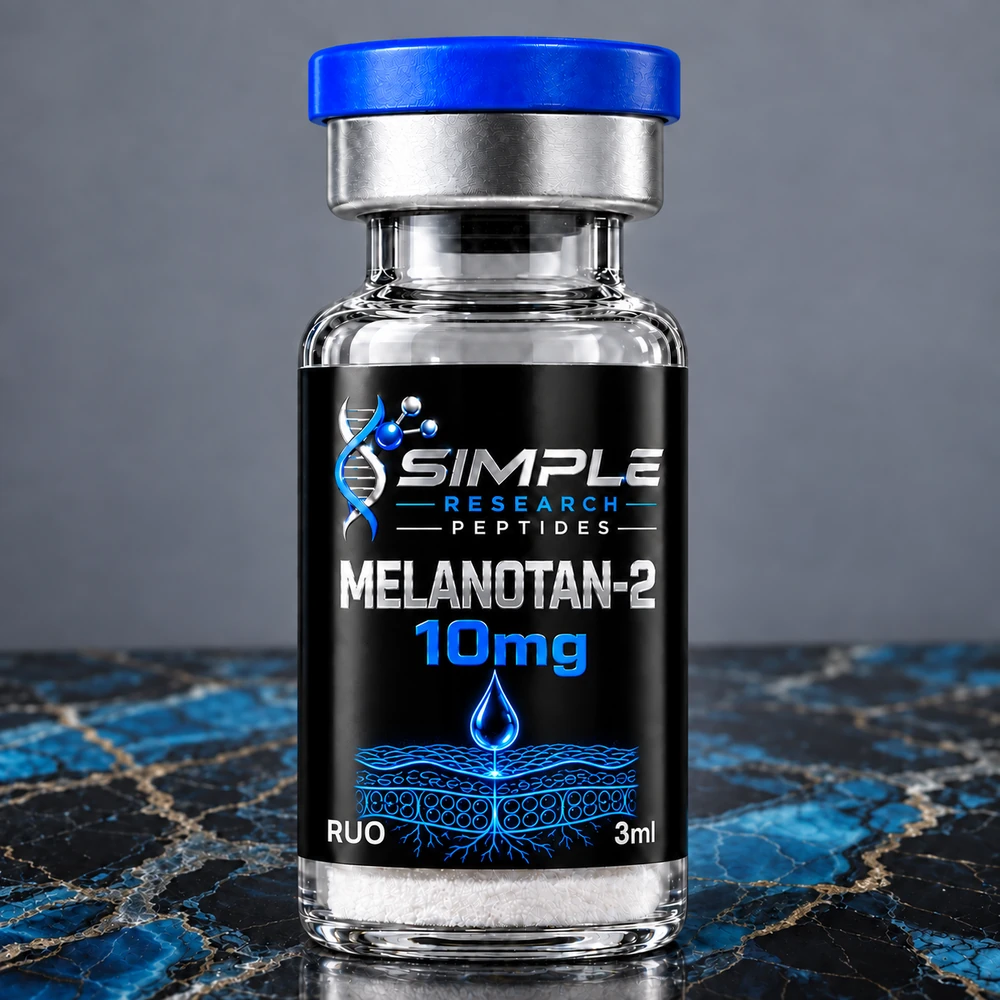
Opened SRP product page (16 August 2026): title “Melanotan II (10 mg Vial)”. Category line: Beauty / Skin Research, Research Compounds. Subhead: “Melanotan II 10mg Research Peptide.” Bullets: Vial Size 3ml/10mg; Purity ≥99%; COA available; Made in the USA; lyophilized research peptide; third-party tested; laboratory and research applications only. Description: supplied for controlled laboratory evaluation of Melanotan II within Beauty / Skin Research studies. Research material: Melanotan II. Listed strength: 10 mg Vial. Footer: for laboratory research only; not for human or animal use, consumption, administration, diagnosis, treatment, or therapeutic application. Price printed $30.00. Availability: “15 in stock (can be backordered).” Shipping-box fields: Weight 1 lbs; Dimensions 1 × .5 × 2 in. Reviews (0). Price, stock, and shipping-box fields are vendor listings, not chemistry.

Not printed on the opened product page and therefore not claimed as SRP-verified: cyclic sequence; free-base vs acetate salt; CAS; UNII; CID; a public COA file; a published 10 mg laboratory dose.

Opened SRP index card (compound-research-guides, 16 August 2026): “Melanotan II (10 mg Vial)” under Other; tag Evidence profile (not “Dedicated evidence guide”); evidence tier Limited human evidence; safety concerns. Overview: “Melanotan II is a synthetic cyclic analogue of alpha-MSH that activates multiple melanocortin receptors.” Mechanism: melanocortin receptor activation can influence pigmentation, appetite, and sexual function; “Its receptor profile is not highly selective.” Evidence: small human studies and case reports exist, but it is not an approved tanning drug and uncontrolled products have been associated with adverse-event concerns. Quality note: “Do not confuse Melanotan II with afamelanotide, a regulated medicine with a different molecule and clinical context.” Last editorial review printed on that index: August 2026.

Opened dedicated-guide URL http://simpleresearchpeptides.com/research-compound-directory/melanotan-ii-research-guide/ returned HTTP 404 on 16 August 2026. This page is written for that missing standalone listing.

IUPAC condensed / HELMAc-Nle-Asp(1)-His-D-Phe-Arg-Trp-Lys(1)-NH2Sequence XDHFRWK. HELM PEPTIDE1{[ac].[Nle].D.H.[dF].R.W.K.[am]}$PEPTIDE1,PEPTIDE1,3:R3-8:R3$$$. PubChem CID 92432 biologic description.
Dorr 1996 printed structureAc-Nle4-Asp5-His6-D-Phe7-Arg8-Trp9-Lys10alpha-MSH4-10-NH2, lactam-bridged. PMID 8637402.
PubChem CID92432Title: melanotan-II. Create 2005-08-08; Modify 2026-08-15. 7 defined / 0 undefined stereocenters.
CAS / UNII121062-08-6 / UPF5CJ93X7ChemIDplus; EPA DSSTox; GSRS PRIMARY. UNII availability is not approval.
Formula / MWC50H69N15O9 / 1024.2GSRS structure mwt 1024.1799. ChEBI average mass 1024.198. Exact / monoisotopic 1023.54026884 Da.
InChIKeyJDKLPDJLXHXHNV-MFVUMRCOSA-NPubChem; IUPHAR; GSRS; ChEBI. C-terminal amide.
IUPHAR ligand1323 / approved falseName MT-II; type Peptide; INN empty. Full agonist MC1/3/4/5.
ChEBI / ChEMBLCHEBI:195326CHEMBL430239; DTXSID90153135; MeSH M0212250; Wikidata Q423855.
ClinicalTrials.govNCT07437560 onlyExample interventional study record. Unused as efficacy. Do not invent an NCT.
SRP standalone listing10 mg vialBeauty / Skin Research; $30.00; ≥99%; COA available; lyophilized. Sequence/CAS not printed.
FDA-approved MT-II drugNoneopenFDA search=melanotan: HTTP 404. IUPHAR approved false.
Adjacent SRP SKUPT-141 10 mgMelanocortin Research Peptide Vial; also known as Bremelanotide, PT-141 Acetate; $60.00. Different molecule.
Identifier Value on opened page Source opened
Common / research names Melanotan II; Melanotan-II; MT-II; MTII; Melatonan; WHO-DD “MELANOTAN II” PubChem CID 92432; GSRS UNII UPF5CJ93X7; IUPHAR ligand 1323
Peptide class Cyclic lactam heptapeptide analogue of alpha-MSH(4–10) PubChem biologic; Dorr 1996 PMID 8637402; Al-Obeidi 1989 PMID 2555512
IUPAC condensed / HELM Ac-Nle-Asp(1)-His-D-Phe-Arg-Trp-Lys(1)-NH2; sequence XDHFRWK; HELM PEPTIDE1{[ac].[Nle].D.H.[dF].R.W.K.[am]}$PEPTIDE1,PEPTIDE1,3:R3-8:R3$$$ PubChem CID 92432 biologic description
Dorr 1996 printed structure Ac-Nle4-Asp5-His6-D-Phe7-Arg8-Trp9-Lys10 alpha-MSH4-10-NH2 (lactam-bridged) Europe PMC abstract PMID 8637402
PubChem CID 92432. Title: melanotan-II. Create 2005-08-08; Modify 2026-08-15 PubChem HTML + PUG REST
CAS 121062-08-6 (ChemIDplus; EPA DSSTox; GSRS PRIMARY) PubChem; GSRS; ChEBI
UNII UPF5CJ93X7 PubChem; GSRS approvalID
Formula / MW C50H69N15O9; 1024.2 g/mol (PubChem computed). GSRS structure mwt 1024.1799. ChEBI average mass 1024.198 PubChem PUG; GSRS; ChEBI
Exact / monoisotopic mass 1023.54026884 Da PubChem PUG; ChEBI monoisotopic 1023.54027
InChIKey JDKLPDJLXHXHNV-MFVUMRCOSA-N PubChem PUG; IUPHAR; GSRS; ChEBI
Defined stereocenters 7 defined / 0 undefined PubChem; GSRS stereoCenters 7
IUPAC (computed) (3S,6S,9R,12S,15S,23S)-15-[[(2S)-2-acetamidohexanoyl]amino]-9-benzyl-6-[3-(diaminomethylideneamino)propyl]-12-(1H-imidazol-5-ylmethyl)-3-(1H-indol-3-ylmethyl)-2,5,8,11,14,17-hexaoxo-1,4,7,10,13,18-hexazacyclotricosane-23-carboxamide PubChem; IUPHAR; GSRS
ChEBI CHEBI:195326; Melanotan II; is a organic molecular entity; CAS 121062-08-6 (SUBMITTER) ChEBI HTML, opened 16 August 2026
ChEMBL CHEMBL430239 PubChem; IUPHAR
EPA DSSTox DTXSID90153135 PubChem; GSRS
IUPHAR / GtoPdb Ligand 1323; name MT-II; type Peptide; approved: false; INN empty IUPHAR HTML + /services/ligands/1323
MeSH melanotan-II; MeSH Unique ID M0212250 PubChem MeSH
Wikidata Q423855 PubChem
GSRS related salt (not opened as a second peptide) Validation note on UNII UPF5CJ93X7: “Record MELANOTAN II ACETATE is a potential duplicate [WYE6CXB7CH]”. Acetate UNII WYE6CXB7CH was not opened. PubChem depositor synonym “Melanotan II acetate salt” sits on the free-base CID. Neither string proves the SRP lot salt. GSRS JSON; PubChem synonyms
ClinicalTrials.gov (MT-II as intervention) Quoted query.term="Melanotan II" OR "Melanotan-II" OR melanotan-II and query.intr=Melanotan: totalCount 1NCT07437560. Broad MT-II OR MTII search hit 1333 lexical collisions (Type II diabetes, CML, etc.) and was unused. CT.gov API v2, versionHolder 2026-08-14
openFDA Drugs@FDA search=melanotan: HTTP 404 openFDA API, opened 16 August 2026
FDA-approved Melanotan II drug None on opened IUPHAR (approved: false), openFDA, PubChem, or GSRS pages Same
SRP standalone listing “Melanotan II (10 mg Vial)”; $30.00; Beauty / Skin Research; 10 mg; ≥99%; COA available; lyophilized SRP product page
Adjacent SRP listing (different SKU) “PT-141 10 mg Melanocortin Research Peptide Vial”; also known as Bremelanotide, PT-141 Acetate; $60.00. Different molecule. SRP PT-141 product page

Critical identity point. CID 92432 / UNII UPF5CJ93X7 is the C-terminal carboxamide cyclic lactam. Bremelanotide (CID 9941379; InChIKey FFHBJDQSGDNCIV-MFVUMRCOSA-N) is the C-terminal carboxylic acid of the same ring (IUPHAR: “23-carboxylic acid”; King 2007 PMID 17584130: “PT-141, which is the carboxylate derivative of MT-II”). An SRP “Melanotan II 10 mg” lot is not automatically the acetate salt, not bremelanotide, and not afamelanotide. Confirm sequence, C-terminus (amide vs acid), stereochemistry (D-Phe), lactam closure, and salt on a COA / LC-MS.

Registry chaos that must not be collapsed.

  • PubChem depositor synonyms include “Melanotan II acetate salt.” That string sits on the free-base CID. It is nomenclature noise, not proof of the SRP counter-ion.
  • GSRS validation warns that MELANOTAN II ACETATE UNII WYE6CXB7CH is a potential duplicate. That substance record was not opened. Do not treat WYE6CXB7CH as the SRP lot.
  • ClinicalTrials.gov MT-II / MTII is a lexical collision against Type II diabetes, CML, and other “II” strings (opened broad query totalCount 1333). Unused.
  • IUPHAR ligand 1323 is MT-II. Ligand 1324 is afamelanotide. Ligand 10408 is bremelanotide. Ligand 1320 is alpha-MSH. Those are four different records.
  • MeSH / chemical lists print alpha-MSH CAS 581-05-5 and NDP-MSH CAS 75921-69-6 next to melanotan-II CAS 121062-08-6. Adjacent listing is not identity.
Critical identity point: Melanotan II on opened registries is the cyclic lactam heptapeptide amide Ac-Nle-Asp(1)-His-D-Phe-Arg-Trp-Lys(1)-NH2 (CID 92432; CAS 121062-08-6; UNII UPF5CJ93X7; C50H69N15O9; 1024.2 g/mol; IUPHAR 1323; approved false). It is not alpha-MSH, not afamelanotide / Scenesse, not bremelanotide / PT-141 / Vyleesi, and not KPV. NCT07437560 is an example record. Not FDA-approved. Research use only.

02 / Overview

How Melanotan II is not alpha-MSH, not Melanotan I / afamelanotide / Scenesse, not PT-141 / bremelanotide, and not KPV

Catalog “Beauty / Skin Research” language does not convert a research cyclic heptapeptide into Scenesse, Vyleesi, endogenous alpha-MSH, or the KPV tripeptide.

Identity What opened sources actually describe Peptide? Typical literature role
Melanotan II (this page) Cyclic lactam heptapeptide; CID 92432; CAS 121062-08-6; UNII UPF5CJ93X7; IUPHAR 1323; C50H69N15O9; MW 1024.2; InChIKey JDKLPDJLXHXHNV-MFVUMRCOSA-N; approved: false Yes (cyclic heptapeptide, C-amide) Non-selective MC1/MC3/MC4/MC5 research ligand. Small 1990s human pilots. Not an approved drug.
alpha-MSH Endogenous tridecapeptide Ac-Ser-Tyr-Ser-Met-Glu-His-Phe-Arg-Trp-Gly-Lys-Pro-Val-NH2 (printed in Al-Obeidi 1989 PMID 2555512); IUPHAR ligand 1320; CAS 581-05-5 Yes (13 aa, linear) Principal endogenous melanocortin peptide. Not MT-II.
Melanotan I / NDP-MSH / afamelanotide / Scenesse Linear [Nle4, D-Phe7]-alpha-MSH. Sawyer 1980 PMID 6777774. IUPHAR 1324; INN afamelanotide (INN 9010); CID 16197727; CAS 75921-69-6; C78H111N21O19; MW 1646.8; InChIKey UAHFGYDRQSXQEB-LEBBXHLNSA-N; EMA 2014 / FDA 2019; synonyms alpha-NDP-MSH, CUV1647, Scenesse. Habbema 2017 chemical list also prints afamelanotide UNII QW68W3J66U Yes (13 aa, linear) Approved alpha-MSH analogue implant in a regulated product for a limited indication. Not this vial.
PT-141 / bremelanotide / Vyleesi Cyclic acid analogue of MT-II. IUPHAR 10408; INN bremelanotide (INN 8737); CID 9941379; CAS 189691-06-3; C50H68N14O10; MW 1025.2; InChIKey FFHBJDQSGDNCIV-MFVUMRCOSA-N; FDA 2019; synonyms PT-141, Vyleesi. King 2007: “carboxylate derivative of MT-II.” Separate SRP 10 mg SKU. Yes (cyclic heptapeptide, C-acid) Approved-drug melanocortin agonist in a regulated product. Not this vial.
KPV C-terminal tripeptide of alpha-MSH: Lys-Pro-Val. Opened SRP index: “KPV is the C-terminal tripeptide Lys-Pro-Val derived from alpha-melanocyte-stimulating hormone and studied for anti-inflammatory activity.” Preclinical evidence tag. CID/CAS not re-opened this session; sequence-only. Yes (tripeptide) Preclinical anti-inflammatory fragment literature. Not MT-II. Different SRP 10 mg SKU.
SHU9119 IUPHAR ligand 1325 (name search for alpha-MSH also returned this). Fan 1997 used it as an MC antagonist / agouti-mimetic vs MTII Different cyclic analogue Antagonist tool compound. Not MT-II.

The standalone vial is not alpha-MSH. Al-Obeidi 1989 (PMID 2555512) designed cyclic lactam fragments of alpha-MSH4–10 / 4–13. The parent hormone is the 13-residue linear peptide with Met4 and L-Phe7. MT-II replaces Met with Nle, Phe with D-Phe, and closes a 23-membered Asp5–Lys10 lactam.

The standalone vial is not Melanotan I / afamelanotide / Scenesse. Sawyer 1980 (PMID 6777774) made linear [Nle4, D-Phe7]-alpha-MSH (CAS 75921-69-6). That linear 13-mer is the molecule IUPHAR names afamelanotide (ligand 1324; Scenesse; EMA 2014 / FDA 2019). Hadley and Dorr 2006 (PMID 16412534) treat MTI as the linear tanning analogue and MTII as the cyclic truncated peptide. Habbema 2017 (PMID 28266027) states afamelanotide “is the only alpha-MSH analogue that is approved for use in a limited number of medical indications” and that “illegal melanotans are likely risky.” Afamelanotide implant trials (example opened: NCT01097044 CUV030 EPP) are not Melanotan II trials. CT.gov query.intr=afamelanotide returned totalCount 23.

The standalone vial is not PT-141 / bremelanotide / Vyleesi. One atom-level difference: MT-II is the 23-carboxamide; bremelanotide is the 23-carboxylic acid (IUPHAR IUPAC). Formula C50H69N15O9 vs C50H68N14O10. InChIKeys share the stereo suffix MFVUMRCOSA-N but have different first blocks. King 2007 (PMID 17584130) and Hadley and Dorr 2006 (PMID 16412534) describe PT-141 as the Palatin carboxylate analogue that entered human sexual-dysfunction development after MT-II. IUPHAR ligand 10408 is approved: true, FDA 2019. CT.gov query.intr=bremelanotide returned totalCount 10. The opened SRP PT-141 10 mg page is a different SKU.

The standalone vial is not KPV. KPV is three residues (Lys-Pro-Val) at the C-terminus of alpha-MSH. MT-II is a cyclic 4–10 fragment analogue. The opened SRP KPV index card is a Recovery / Inflammation Preclinical evidence entry. Do not cite KPV colitis or keratinocyte papers as Melanotan II evidence.

Do not equate this vial with alpha-MSH, ACTH, Melanotan I, afamelanotide / Scenesse, bremelanotide / PT-141 / Vyleesi, KPV, or SHU9119. Research use only.

Do not merge Melanotan II with Scenesse or Vyleesi. Scenesse is afamelanotide (IUPHAR 1324; CID 16197727; CAS 75921-69-6; linear 13 aa; EMA 2014 / FDA 2019). Vyleesi is bremelanotide (IUPHAR 10408; CID 9941379; C50H68N14O10; C-terminal acid; FDA 2019). MT-II is IUPHAR 1323; approved false; C-terminal amide.
03 / Mechanism

Proposed mechanism (labeled as such)

Opened primary papers support a non-selective cyclic melanocortin-agonist working model. It is not a treatment claim. It was not generated with an SRP 10 mg vial. Observed means a measurement in an opened paper. Proposed means a hypothesis. Not shown means the opened papers did not establish it for a research-market lot.

Observed — 23-membered lactam

Al-Obeidi 1989 frog / lizard skin

Al-Obeidi, Castrucci, Hadley and Hruby 1989 (PMID 2555512; J Med Chem) designed cyclic lactam alpha-MSH4-13 and alpha-MSH4-10 analogues, including Ac-[Nle4,Asp5,D-Phe7,Lys10]-alpha-MSH4-10-NH2. Relative to alpha-MSH (potency = 1), that Asp5-Lys10 4-10 cyclic analogue was 90 in the lizard (Anolis) skin bioassay and was among the 23-membered rings that showed prolonged residual activity. Smaller rings (20-22) lost residual activity. This is an amphibian / reptile melanocyte assay. Not a human tanning trial. Not Scenesse.

Observed — IUPHAR receptor table

Human MC1 / MC3 / MC4 / MC5 full agonist

Opened IUPHAR services/ligands/1323/interactions lists MT-II as a full agonist at human MC1 (pIC50 9.4; PMIDs 12007532, 2535874), MC3 (pKi 8.3; PMID 10493100), MC4 (pKi 8.2-8.8; PMIDs 2535874, 10493100, 11101306), and MC5 (pIC50 9.0; PMID 12007532).

IUPHAR cites Al-Obeidi 1989 PMID 2535874 on the MC1/MC4 rows. That opened paper is the linear 4-10 analogue paper, not the cyclic-lactam paper (PMID 2555512). Do not collapse the two 1989 J Med Chem papers.

GSRS-stored affinities

Wikberg 2000 values are stored, not re-measured

GSRS UNII UPF5CJ93X7 also stores TARGET to AGONIST amounts (MC1 Ki 0.67 nM; MC3 Ki 34 nM; MC4 Ki 6.6 nM; MC5 46 nM; plus an MC1 IC50 0.2 nM Eurofins row) and cites Wikberg et al. 2000 (PMID 11023702, opened abstract). Those nanomolar figures are GSRS-stored values, not a re-measurement in this session. Use IUPHAR as the primary opened affinity table.

Observed — mouse ICV feeding

Fan 1997 vs SHU9119

Fan, Boston, Kesterson, Hruby and Cone 1997 (PMID 8990120; Nature) reported that intracerebroventricular MTII inhibited feeding in four hyperphagia models (fasted C57BL/6J, ob/ob, A(Y), and NPY-injected mice) and that the antagonist SHU9119 blocked that inhibition and enhanced nocturnal or fast-induced feeding. Authors conclude melanocortinergic neurons exert tonic inhibition of feeding. Mouse ICV pharmacology. Not a human obesity trial. Not this vial.

Observed — 1996 Phase I pilot

Dorr n=3, not a protocol

Dorr, Lines, Levine, et al. 1996 (PMID 8637402; Life Sci; Europe PMC HTML opened) is a Phase I single-blind study in three male volunteers. The printed structure is the cyclic lactam used on this page. Authors report pigmentation in two of three subjects, plus nausea, stretching/yawning, and spontaneous penile erections. This is a 1996 pilot, not a modern registered trial, and it is not a reconstitution or administration protocol for this SKU.

Observed — 1998 / 2000 ED pilots

Wessells crossovers, no NCT

Wessells, Fuciarelli, Hansen, et al. 1998 (PMID 9679884; J Urol) reported a double-blind placebo-controlled crossover in 10 men with psychogenic erectile dysfunction: 8 of 10 had erections after subcutaneous MT-II versus 1 of 10 after placebo; mean RigiScan rigidity duration 38.0 versus 3.0 minutes. Nausea and yawning/stretching were common. No NCT (pre-ClinicalTrials.gov).

Wessells, Levine, Hadley, Dorr and Hruby 2000 (PMID 11035391; Int J Impot Res) reported a double-blind placebo-controlled crossover in 20 men with psychogenic or organic ED: 17 of 20 had erections after MT-II versus 4 of 20 after placebo; increased sexual desire in 68% of MT-II versus 19% of placebo doses. Authors note the molecule is a non-specific melanocortin agonist. No NCT.

These papers are historical human observations. They do not authorize a human-use protocol, a dose, a reconstitution recipe, or a claim that this vial is a sexual-function or tanning product.

Observed — PT-141 is the C-acid

King 2007 carboxylate distinction

King, Yeh, Guthrie, et al. 2007 (PMID 17584130; Curr Top Med Chem; PMC 2694735 opened) states that PT-141 is the carboxylate derivative of MT-II and reviews melanocortin receptors as emerging erectile-function effectors, with MC4 as a leading candidate. This is the chemical distinction used on this page: same ring, C-terminal amide (MT-II) versus C-terminal acid (PT-141 / bremelanotide).

Hadley and Dorr 2006 (PMID 16412534; Peptides) review Melanotan I as the linear analogue and Melanotan II as the cyclic analogue, and discuss PT-141 as a related molecule. Use this as a secondary identity/history source, not as a receptor-affinity table.

Not shown / do not infer

No cancer-prevention, obesity, or vitiligo claim

Sunlight-induced skin-cancer prevention: Ryakhovsky, Ivanov, et al. 2008 (PMID 19043625; Beilstein J Org Chem; PMC 2587946) is a solution-phase synthesis paper whose opening sentence mentions that use. That sentence is not an approval, a trial result, or a claim for this vial. Human obesity, cachexia, or metabolic-disease treatment: Fan 1997 is mouse ICV feeding. Vitiligo efficacy: the only opened ClinicalTrials.gov Melanotan-II intervention hit is NCT07437560, flagged as an example record. Causation of melanoma: opened case reports and reviews do not prove that MT-II causes melanoma.

Mechanism in one line: non-selective cyclic MC1/MC3/MC4/MC5 agonist with lizard-skin superpotency, mouse ICV anorectic activity, and small 1990s human pilots. Not a treatment claim. Not Scenesse. Not Vyleesi. Not for human use.
04 / Research Map

Where the literature actually sits

SRP index Evidence profile for this SKU: Limited human evidence; safety concerns. That is the house tier. This page does not upgrade it. Label every row. MT-II ≠ alpha-MSH ≠ afamelanotide ≠ PT-141 ≠ KPV. Historical language is not a completed therapeutic program.

Bucket What was opened What it supports What it does not support
Design / identity Al-Obeidi 1989 cyclic lactam PMID 2555512; PubChem CID 92432; GSRS UNII UPF5CJ93X7; IUPHAR 1323; ChEBI CHEBI:195326 Cyclic 4-10 lactam Ac-Nle-c[Asp-His-D-Phe-Arg-Trp-Lys]-NH2 is Melanotan II Linear 4-10 paper PMID 2535874 is not this molecule
Receptor table IUPHAR ligand 1323 interactions; GSRS-stored Wikberg 2000 PMID 11023702 Full agonist at human MC1/MC3/MC4/MC5 as tabulated by IUPHAR A human therapeutic indication
Mouse feeding Fan 1997 PMID 8990120 ICV MTII reduced feeding; SHU9119 blocked it Human weight-loss use
Historical human pilots Dorr 1996 PMID 8637402; Wessells 1998 PMID 9679884; Wessells 2000 PMID 11035391 Pigmentation, nausea, yawning/stretching, erections in small 1990s studies A current protocol, an NCT for those studies, or this SKU as a drug
Related-molecule reviews Hadley & Dorr 2006 PMID 16412534; King 2007 PMID 17584130 MTI linear vs MTII cyclic vs PT-141 acid Approval of MT-II
Unlicensed-use / safety literature Evans-Brown 2009 PMID 19224885; Paurobally 2011 PMID 21564053; Ong & Bowling 2012 PMID 22724573; Habbema 2017 PMID 28266027 Unlicensed tanning-injection reports; melanoma case reports; review that conclusive causal evidence is lacking Proof that this vial causes melanoma; a recommendation to use or avoid as a consumer product
Registered trials CT.gov query.intr=Melanotan totalCount 1: NCT07437560 One vitiligo + NB-UVB record exists Efficacy. BriefSummary starts “This example interventional study record”
NCT07437560 (opened; flag it)

Example record, not efficacy

ClinicalTrials.gov API v2 query.intr=Melanotan returned totalCount 1. The hit is NCT07437560 (Hudson Biotech; acronym MTII-VIT; status RECRUITING; condition vitiligo; intervention Melanotan II plus NB-UVB; estimated enrollment 60; Peking University Shenzhen Hospital). hasResults is false. isFdaRegulatedDrug is false. versionHolder 2026-08-14. The BriefSummary begins: “This example interventional study record…” Treat this as a flagged example record, not as independent evidence that Melanotan II is an approved or validated vitiligo therapy. Do not invent a second NCT for Dorr or Wessells.

Distinction trial counts

Not this molecule

query.intr=afamelanotide totalCount 23. Example opened: NCT01097044 (CUV030 EPP implant; COMPLETED; hasResults true). query.intr=bremelanotide totalCount 10. Examples opened: NCT03973047, NCT00425256, NCT04179734. Those trials belong to Melanotan I / Scenesse and PT-141 / Vyleesi, not to this cyclic amide.

Unlicensed-use literature

Case reports are not causation

Evans-Brown 2009 (PMID 19224885) discusses unlicensed melanotan I and II tanning injections. Paurobally 2011 (PMID 21564053) is a melanotan-associated melanoma case report. Ong and Bowling 2012 (PMID 22724573) reports melanotan-associated melanoma in situ. Habbema 2017 (PMID 28266027) states afamelanotide is the only approved alpha-MSH analogue; illegal melanotans carry risk; four melanoma case reports exist; and conclusive evidence linking these phenomena is lacking. Hjuler 2014 was not confirmed and is omitted.

Regulatory

No FDA-approved MT-II product

IUPHAR ligand 1323: approved false; INN empty. openFDA search=melanotan returned HTTP 404. Afamelanotide / Scenesse and bremelanotide / Vyleesi are different molecules. TGA page fetch timed out. Not cited. SRP product page: Research Use Only footer. No public COA on the opened product HTML.

05 / Snapshot

Opened records, read as they actually sit

Read the “what it did not show” column. Published study designs are historical facts from those papers. They are not a protocol. Historical 1990s study conditions are not instructions for an SRP 10 mg research vial.

Study Species / model What was tested Actual finding (from the opened record) What it did not show
Al-Obeidi et al., 1989 PMID 2555512. Cyclic lactam paper. Frog and lizard skin bioassays Cyclic lactam alpha-MSH4–13 / 4–10 analogs including Ac-[Nle4,Asp5,D-Phe7,Lys10]-alpha-MSH4-10-NH2 Asp5-Lys10 4-10 cyclic analogue potency 90 vs alpha-MSH = 1 in lizard skin; 23-membered rings showed prolonged residual activity; smaller rings lost it. Pigment-cell assay. Human tanning RCT. SRP-vial identity. Afamelanotide implant data. The linear 4-10 paper PMID 2535874.
Al-Obeidi et al., 1989 PMID 2535874. Linear 4-10 paper. Distinction only. Frog / lizard skin (linear analogues) Linear 4-10 analogue set IUPHAR cites this PMID on MC1/MC4 rows. It is not the cyclic-lactam design paper. Identity of CID 92432. Do not collapse with PMID 2555512.
Sawyer et al., 1980 PMID 6777774. Distinction only. Linear analogue design [Nle4, D-Phe7]-alpha-MSH Linear 13-mer that became afamelanotide / Melanotan I (CAS 75921-69-6). Melanotan II identity. This vial.
Dorr et al., 1996 PMID 8637402. 3 male volunteers; Phase I single-blind Cyclic lactam MT-II Pigmentation in 2/3; nausea; stretching/yawning; spontaneous penile erections. 1996 pilot. Modern RCT. Approval. A protocol for this SKU.
Wessells et al., 1998 PMID 9679884. 10 men, psychogenic ED; double-blind placebo crossover Subcutaneous MT-II vs placebo Erections 8/10 vs 1/10 placebo; mean RigiScan rigidity duration 38.0 vs 3.0 min. Nausea and yawning/stretching common. No NCT. Approval. Tanning endpoint. This SKU as a drug.
Wessells et al., 2000 PMID 11035391. 20 men, psychogenic or organic ED; double-blind placebo crossover MT-II vs placebo Erections 17/20 vs 4/20 placebo; increased sexual desire 68% vs 19% of doses. Non-specific melanocortin agonist. No NCT. A current protocol. An NCT. Approval.
Fan et al., 1997 PMID 8990120. Mice; ICV MTII vs SHU9119 MTII inhibited feeding in four hyperphagia models; SHU9119 blocked it and itself increased feeding. Human obesity drug. This vial.
Ryakhovsky et al., 2008 PMID 19043625. PMC 2587946. Organic synthesis Solution-phase MT-II Preparative solution-phase synthesis. Opening sunlight-induced skin-cancer sentence is not an approval. Clinical efficacy. SRP process.
Hadley & Dorr, 2006 PMID 16412534. Secondary. Review MTI vs MTII vs PT-141 Linear MTI vs cyclic MTII; PT-141 as a related molecule. Identity/history, not an affinity table. Approval of MT-II. Proof MT-II = Scenesse or Vyleesi.
King et al., 2007 PMID 17584130. PMC 2694735. Review PT-141 as carboxylate of MT-II PT-141 is the carboxylate derivative of MT-II. MC4 as a leading candidate in that review. Approval of MT-II. Equivalence of this vial to Vyleesi.
Wikberg et al., 2000 PMID 11023702. GSRS-stored citation Stored nM affinities on UNII UPF5CJ93X7 GSRS-stored MC1/3/4/5 values. Not a re-measurement in this session. Use IUPHAR as the primary table. A human indication. SRP-lot affinities.
Evans-Brown 2009 PMID 19224885; Paurobally 2011 PMID 21564053; Ong 2012 PMID 22724573; Habbema 2017 PMID 28266027. Editorial / case reports / review Unlicensed tanning-injection use Unlicensed-use reports; melanoma case reports; Habbema: conclusive causal evidence is lacking; afamelanotide is the only approved analogue. Proof this vial causes melanoma. A consumer-use recommendation.

Human / NCT snapshot. Historical Arizona pilots = Dorr 1996 n=3 plus Wessells 1998 n=10 and Wessells 2000 n=20. ClinicalTrials.gov: no real MT-II NCT used as efficacy. NCT07437560 is an example record. Distinction-only: NCT01097044 (afamelanotide); NCT03973047, NCT00425256, NCT04179734 (bremelanotide). Do not invent an NCT.

06 / Not established

What this page does not claim

  • No human reconstitution, administration, or dosing protocol.
  • No claim that this vial is a tanning product, a sexual-function product, a vitiligo therapy, or a sun-protection agent.
  • No claim that Melanotan II is afamelanotide, Scenesse, PT-141, bremelanotide, Vyleesi, KPV, or native alpha-MSH.
  • No invented CAS, UNII, CID, NCT, or PMID.
  • No use of the unopened acetate UNII WYE6CXB7CH as a second peptide.
  • No use of TGA or the 2007 consumer-notice HTML as opened sources.
  • Case reports of melanoma are listed as case reports. They are not proof of causation.
  • NCT07437560 is flagged as an example record. It is not efficacy evidence.
  • No FDA-approved therapeutic use of Melanotan II. openFDA melanotan: HTTP 404. IUPHAR 1323: approved false.
  • No proof the SRP vial is CID 92432. Sequence, CAS, UNII, salt, and a public COA were not printed.

Not an approved tanning drug

Scenesse is afamelanotide (IUPHAR 1324; CID 16197727; CAS 75921-69-6; EMA 2014 / FDA 2019). MT-II is IUPHAR 1323; approved false. Pigment data are a 1996 n=3 pilot.

Not the same as PT-141 / Vyleesi

Bremelanotide is CID 9941379; C50H68N14O10; FDA 2019 (IUPHAR 10408). King 2007: carboxylate derivative of MT-II. A regulated product is not a research vial.

Not alpha-MSH / KPV

alpha-MSH is a 13-aa POMC peptide (IUPHAR 1320; CAS 581-05-5). KPV is Lys-Pro-Val (sequence-only on this page). Different molecules.

NCT07437560 is not a real vitiligo efficacy trial

The opened record calls itself an example interventional study record. Unused as efficacy. Do not invent an NCT.

07 / Studies

Key papers as short cards

Each card is a single opened record. Reviews are secondary. Historical study conditions are not instructions. No real MT-II NCT is attached as efficacy. Linear 4-10 PMID 2535874 is distinction only.

Design / SAR

Al-Obeidi, Castrucci, Hadley, Hruby, 1989 — J Med Chem (cyclic)

Cyclic lactam analogues of alpha-MSH. Asp5-Lys10 4-10 cyclic analogue potency 90 vs alpha-MSH = 1 in lizard skin. Design paper for the MT-II ring. Frog/lizard pigment cells. Not human. PMID 2555512.

Distinction — linear 4-10

Al-Obeidi et al., 1989 — linear paper

Linear 4-10 analogue paper cited by IUPHAR on MC1/MC4 rows. Not the cyclic-lactam molecule on this page. Do not collapse with PMID 2555512. PMID 2535874.

Distinction — Melanotan I

Sawyer et al., 1980

Linear [Nle4, D-Phe7]-alpha-MSH. That 13-mer is afamelanotide / Melanotan I (CAS 75921-69-6), not this cyclic amide. PMID 6777774.

Human n=3 pilot

Dorr et al., 1996 — Life Sci

Phase I single-blind in three male volunteers. Pigmentation in 2/3; nausea; stretching/yawning; spontaneous erections. Historical study conditions, not a protocol. PMID 8637402.

Human n=10 crossover

Wessells et al., 1998 — J Urol

Double-blind placebo-controlled crossover in 10 men with psychogenic ED. Erections 8/10 vs 1/10; rigidity duration 38.0 vs 3.0 min. No NCT. PMID 9679884.

Human n=20 crossover

Wessells et al., 2000 — Int J Impot Res

Double-blind placebo-controlled crossover in 20 men. Erections 17/20 vs 4/20; desire 68% vs 19%. Non-specific melanocortin agonist. No NCT. PMID 11035391.

Mouse ICV

Fan et al., 1997 — Nature

ICV MTII inhibits feeding in four mouse hyperphagia models; SHU9119 blocks it. Not a human obesity drug. PMID 8990120.

Synthesis

Ryakhovsky et al., 2008 — Beilstein J Org Chem

Solution-phase synthesis. Opening cancer-prevention sentence is not an approval. PMID 19043625. PMC 2587946.

Secondary review

Hadley & Dorr, 2006 — Peptides

MTI linear vs MTII cyclic vs PT-141. Secondary identity/history. PMID 16412534.

C-acid distinction

King et al., 2007 — Curr Top Med Chem

PT-141 is the carboxylate derivative of MT-II. PMC 2694735. PMID 17584130.

Unlicensed-use / safety

Evans-Brown 2009; Paurobally 2011; Ong 2012; Habbema 2017

Unlicensed tanning-injection reports and melanoma case reports. Habbema: conclusive causal evidence is lacking; afamelanotide is the only approved analogue. PMID 19224885; PMID 21564053; PMID 22724573; PMID 28266027.

08 / Lab caution

Research-only caution

Melanotan II is an investigational laboratory research peptide. It is not an FDA-approved drug for human use. This page is educational. It does not provide dosing, reconstitution, administration, or any human-use instructions. The 10 mg mass is a vendor listing, not a published laboratory protocol.

Simple Research Peptides (SRP) materials are for laboratory research only and are not for human or veterinary use, consumption, administration, diagnosis, treatment, or therapeutic application.

Laboratory identity is the first practical issue. Opened registries describe Melanotan II as CID 92432 / CAS 121062-08-6 / UNII UPF5CJ93X7 / Ac-Nle-Asp(1)-His-D-Phe-Arg-Trp-Lys(1)-NH2 / C50H69N15O9. SRP product pages do not print sequence, CAS, UNII, or a public COA. A method written for alpha-MSH, afamelanotide / Scenesse, bremelanotide / PT-141, or KPV is not automatically valid for this vial.

Confirm peptide identity, Asp–Lys lactam cyclization, D-Phe, C-terminal amide (not the bremelanotide acid), stereochemistry, salt, and purity by LC-MS before treating a vial as the literature article. Independently sourced research peptides are not established as equivalent to the Dorr 1996 or Wessells lots. Acetate UNII WYE6CXB7CH was not opened and is not treated as the SRP lot. Historical 1990s study conditions are not a reconstitution scheme.

Opened unlicensed-use literature describes tanning-injection reports and melanoma case reports. Those are reasons for laboratory caution and identity testing, not use instructions. Habbema 2017 states conclusive causal evidence is lacking.

No reconstitution scheme, no administration route, and no human or veterinary use protocol appears on this page. Research use only. Historical 1990s study conditions are not instructions. Confirm sequence, C-terminus (amide vs acid), D-Phe, lactam, and salt by LC-MS before treating a vial as the literature article.
09 / FAQ

Common questions

Is Melanotan II the same as alpha-MSH?

No. alpha-MSH is a linear 13-residue POMC peptide (IUPHAR 1320; CAS 581-05-5). MT-II is a cyclic lactam heptapeptide amide (CID 92432; IUPHAR 1323).

Is Melanotan II the same as afamelanotide / Scenesse / Melanotan I?

No. Afamelanotide is a linear 13-aa analog (CID 16197727; CAS 75921-69-6; IUPHAR 1324; UNII QW68W3J66U; EMA 2014 / FDA 2019). Sawyer 1980 (PMID 6777774) made that linear [Nle4, D-Phe7]-alpha-MSH. The live SRP index already says not to confuse them.

Is Melanotan II the same as PT-141 / bremelanotide / Vyleesi?

No. Bremelanotide is C50H68N14O10 (CID 9941379; CAS 189691-06-3; IUPHAR 10408; FDA 2019). MT-II is C50H69N15O9. King 2007 (PMID 17584130): PT-141 is the carboxylate derivative of MT-II. The opened SRP PT-141 10 mg page is a different SKU.

Is Melanotan II the same as KPV?

No. KPV is the alpha-MSH C-terminal tripeptide Lys-Pro-Val. CID/CAS were not re-opened this session; sequence-only. Different SRP 10 mg SKU. Do not cite KPV papers as Melanotan II evidence.

Is there a real NCT?

Not used as efficacy. The only ClinicalTrials.gov Melanotan intervention hit, NCT07437560, is labeled an example record. Historical Arizona papers have no NCT. Distinction-only: NCT01097044 (afamelanotide); NCT03973047, NCT00425256, NCT04179734 (bremelanotide). Do not invent one.

Is Melanotan II FDA-approved?

No opened approval. openFDA search=melanotan: HTTP 404. IUPHAR 1323: approved false. Not an FDA-approved tanning drug.

Did small human studies exist?

Yes. Opened: Dorr 1996 n=3 (PMID 8637402); Wessells 1998 n=10 (PMID 9679884); Wessells 2000 n=20 (PMID 11035391). Small, older, not an approval.

Does the SRP page prove sequence and salt?

No. It prints a name, 10 mg, ≥99% as a bullet, and “COA available,” but does not display sequence, CAS, UNII, salt, or a public COA file. Acetate UNII WYE6CXB7CH was not opened and is not treated as the SRP lot.

Are melanoma case reports proof of causation?

No. Paurobally 2011 (PMID 21564053) and Ong 2012 (PMID 22724573) are case reports. Habbema 2017 (PMID 28266027) states conclusive evidence linking these phenomena is lacking. Hjuler 2014 was not confirmed and is omitted.

Can these findings be used as dosing or administration instructions?

No. SRP listings are for laboratory research only and are not for human or animal use. This page does not provide reconstitution, administration, or dosing instructions.

Does this page include human dosing?

No. There is no human dosing, reconstitution, or administration protocol on this page. Research use only. Not medical advice. Not for human use.

10 / References

Citations used on this page

Sources actually opened for the locked draft. Do not add PMIDs or NCTs that are not on the allowed list. NCT07437560 is logged as an example record and is not used as a trial.

  1. Al-Obeidi F, Castrucci AM, Hadley ME, Hruby VJ. Potent and prolonged acting cyclic lactam analogues of alpha-melanotropin. J Med Chem. 1989. PMID 2555512. Cyclic lactam design. Frog/lizard skin SAR.
  2. Al-Obeidi et al., 1989 linear 4-10 analogue paper. PMID 2535874. IUPHAR-cited on MC1/MC4 rows. Not the cyclic-lactam molecule. Distinction only.
  3. Sawyer TK, et al. [Nle4, D-Phe7]-alpha-MSH. 1980. PMID 6777774. Linear Melanotan I / afamelanotide precursor. Distinction only.
  4. Dorr RT, Lines R, Levine N, et al. Evaluation of melanotan-II in a pilot phase-I clinical study. Life Sci. 1996. PMID 8637402. n=3 pilot. Abstract.
  5. Wessells H, Fuciarelli K, Hansen J, et al. Synthetic melanotropic peptide initiates erections in men with psychogenic erectile dysfunction. J Urol. 1998. PMID 9679884. n=10. Abstract.
  6. Wessells H, Levine N, Hadley ME, Dorr R, Hruby V. Melanocortin receptor agonists, penile erection, and sexual motivation: human studies with Melanotan II. Int J Impot Res. 2000. PMID 11035391. n=20. Abstract.
  7. Fan W, Boston BA, Kesterson RA, Hruby VJ, Cone RD. Role of melanocortinergic neurons in feeding and the agouti obesity syndrome. Nature. 1997. PMID 8990120. Mouse ICV. Abstract.
  8. Ryakhovsky VV, et al. The first preparative solution phase synthesis of melanotan II. Beilstein J Org Chem. 2008. PMID 19043625. PMC 2587946. Abstract.
  9. Hadley ME, Dorr RT. Melanocortin peptide therapeutics: historical milestones, clinical studies and commercialization. Peptides. 2006. PMID 16412534. Secondary. Abstract.
  10. King SH, Yeh J, Guthrie K, et al. 2007. PMID 17584130. PMC 2694735. PT-141 as carboxylate of MT-II.
  11. Wikberg JES, et al. 2000. PMID 11023702. GSRS-stored affinities. Opened abstract. Not a re-measurement.
  12. IUPHAR-tabulated supporting citations on ligand 1323 interactions: PMID 12007532; PMID 10493100; PMID 11101306; and linear-paper PMID 2535874.
  13. Evans-Brown M, et al. 2009. PMID 19224885. BMJ editorial. Unlicensed melanotan I/II tanning injections.
  14. Paurobally D, et al. 2011. PMID 21564053. Melanotan-associated melanoma case report.
  15. Ong S, Bowling J. 2012. PMID 22724573. Melanotan-associated melanoma in situ.
  16. Habbema L, et al. 2017. PMID 28266027. Review: afamelanotide is the only approved analogue; conclusive causal evidence lacking. UNII QW68W3J66U distinction-only.
  17. ClinicalTrials.gov API v2, opened 16 August 2026: query.intr=Melanotan totalCount 1 = NCT07437560, brief summary “This example interventional study record…”. Unused as a real trial. Distinction-only: NCT01097044 (afamelanotide); NCT03973047, NCT00425256, NCT04179734 (bremelanotide). Afamelanotide intervention totalCount 23; bremelanotide 10.
  18. PubChem CID 92432 (melanotan-II; CAS 121062-08-6; UNII UPF5CJ93X7). https://pubchem.ncbi.nlm.nih.gov/compound/92432
  19. NCATS / GSRS UNII UPF5CJ93X7. https://drugs.ncats.io/drug/UPF5CJ93X7
  20. IUPHAR/BPS ligand 1323 (MT-II; approved false) and interactions API. Distinction ligands: alpha-MSH 1320; afamelanotide 1324 (EMA 2014 / FDA 2019); bremelanotide 10408 (FDA 2019); SHU9119 1325. IUPHAR ligand 1323.
  21. openFDA Drugs@FDA: search=melanotan HTTP 404. Opened 16 August 2026.
  22. Distinction PubChem: afamelanotide CID 16197727 CAS 75921-69-6 UNII QW68W3J66U; bremelanotide CID 9941379 CAS 189691-06-3; alpha-MSH CAS 581-05-5. KPV sequence-only.
  23. SRP pages (opened 16 August 2026): product http://simpleresearchpeptides.com/product/melanotan-ii-10-mg-vial/; index http://simpleresearchpeptides.com/research-compound-directory/compound-research-guides/; dedicated guide 404. Adjacent PT-141 10 mg SKU noted as a different molecule. For laboratory research only. Not for human or animal use.

Allowed PMID list used on this page: 2555512, 2535874, 6777774, 8637402, 8990120, 9679884, 10493100, 11023702, 11035391, 11101306, 12007532, 16412534, 17584130, 19043625, 19224885, 21564053, 22724573, 28266027. Opened PMC: PMC2587946 (Ryakhovsky); PMC2694735 (King). NCT used as a real trial: none. NCT07437560 logged only as an example record. Distinction NCTs: NCT01097044, NCT03973047, NCT00425256, NCT04179734. Not used: 8986799, 28239848, 24758249, 24784483 (wrong-paper lookups). Hjuler 2014 not confirmed. No other PMIDs were added.

Educational information only. The SRP listing Melanotan II 10 mg is a research cyclic lactam heptapeptide corresponding, on opened registries, to Ac-Nle-Asp(1)-His-D-Phe-Arg-Trp-Lys(1)-NH2 (CID 92432; CAS 121062-08-6; UNII UPF5CJ93X7; C50H69N15O9; 1024.2 g/mol; IUPHAR 1323; approved false). It is not alpha-MSH, not afamelanotide / Scenesse, not bremelanotide / PT-141 / Vyleesi, and not KPV. No real NCT used as efficacy. NCT07437560 is an example record. Not FDA-approved. Sequence of an SRP lot is not printed. Historical 1990s study conditions are not instructions. Laboratory research use only; not for human or animal use. Not medical advice. Not for human use. No human dosing protocol. Last source review: 16 August 2026 (America/Indianapolis). Locked draft converted to HTML the same day. For laboratory research only. Not for human or veterinary use.

Scroll to Top
View Cart