






Metabolism · Compound guide
Mazdutide Research Guide
Explore the mechanisms, study findings and evidence limits behind this research topic.
Product artwork identifies the SRP listing. It does not demonstrate safety or clinical benefit. The evidence guide and its sources follow below.
View product label and documentation →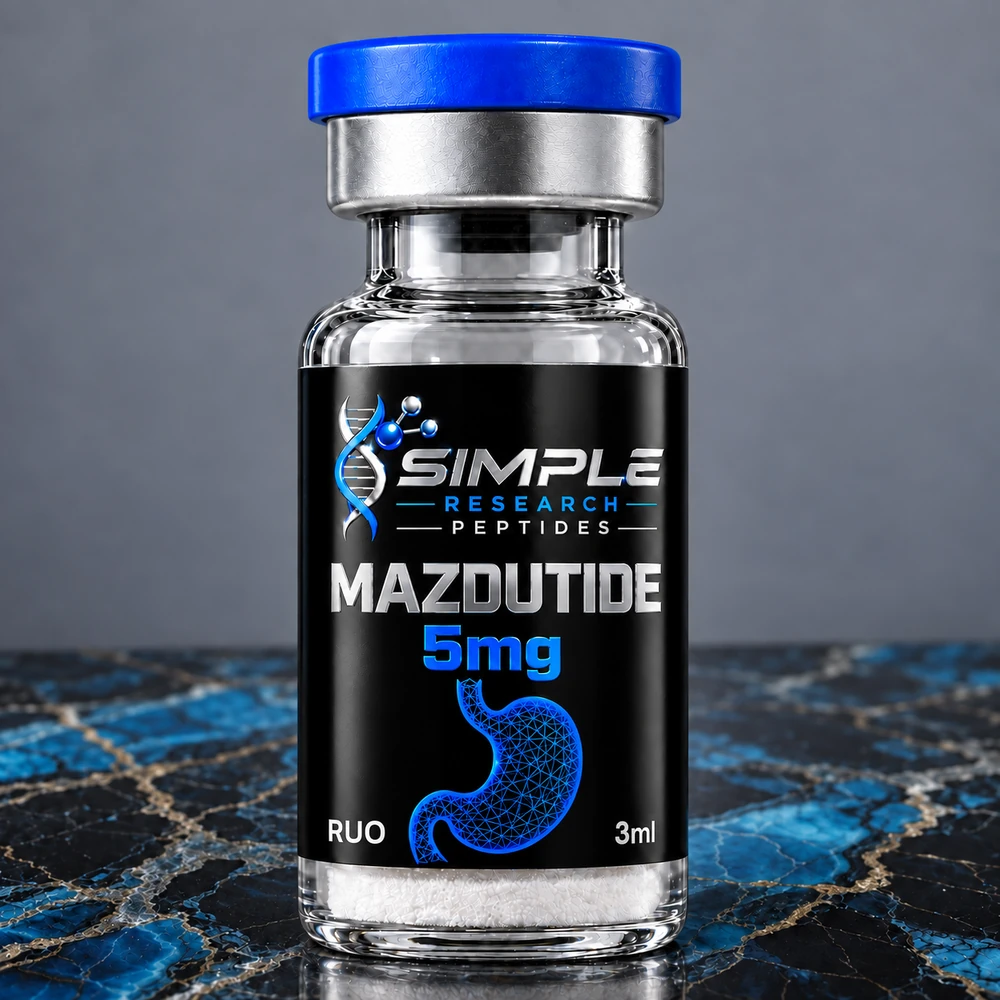
Back to the Research Compound Library
Human phase III clinical research
Evidence reviewed September 13, 2026.
Research overview and identity
Mazdutide is a dual GLP-1 and glucagon receptor agonist investigated in metabolic disease and weight-management trials. It is a specific molecular entity, so results should not be transferred indiscriminately to other dual agonists.
Mechanism under investigation
Its dual-receptor design brings together signaling pathways relevant to glucose regulation, appetite and energy metabolism. Clinical trials are needed to determine the net effect because receptor-level reasoning alone cannot predict efficacy or tolerability.
What the studies report
A 2025 randomized phase III study in Chinese adults with overweight or obesity evaluated body-weight outcomes over 48 weeks. The trial reported greater weight reduction with mazdutide than placebo. Later phase III research has also examined glycemic outcomes in adults with type 2 diabetes. [1] [2]
Limits of the evidence
Trial population, background care, duration and adverse-event reporting are essential to interpretation. These studies concern controlled investigational formulations and do not demonstrate equivalence of a research vial. Weight and glycemic endpoints should not be recast as proof of every proposed long-term health benefit.
Matching research material to a paper
Check the material identity, formulation and analytical methods against the study methods. A product name or milligram amount alone does not demonstrate experimental equivalence. Published research does not establish the identity, purity or potency of a retail batch; batch-specific analytical documentation must be assessed separately.
For laboratory research only. Not for human or veterinary use. This guide is educational and contains no dosing, reconstitution or administration instructions.