



Mouse CRAMP is not human LL-37
UniProt P51437 is CAMP_MOUSE. Mature peptide 135–172. GeneID 12796. IUPHAR names CRAMP as the mouse orthologue. NCBI Gene 820 listing CRAMP as a human CAMP alias is a naming collision, not identity.
Products are color coded by category
Peptide research · Compound guide
Explore the mechanisms, study findings and evidence limits behind this research topic.
Product artwork identifies the SRP listing. It does not demonstrate safety or clinical benefit. The evidence guide and its sources follow below.
View product label and documentation →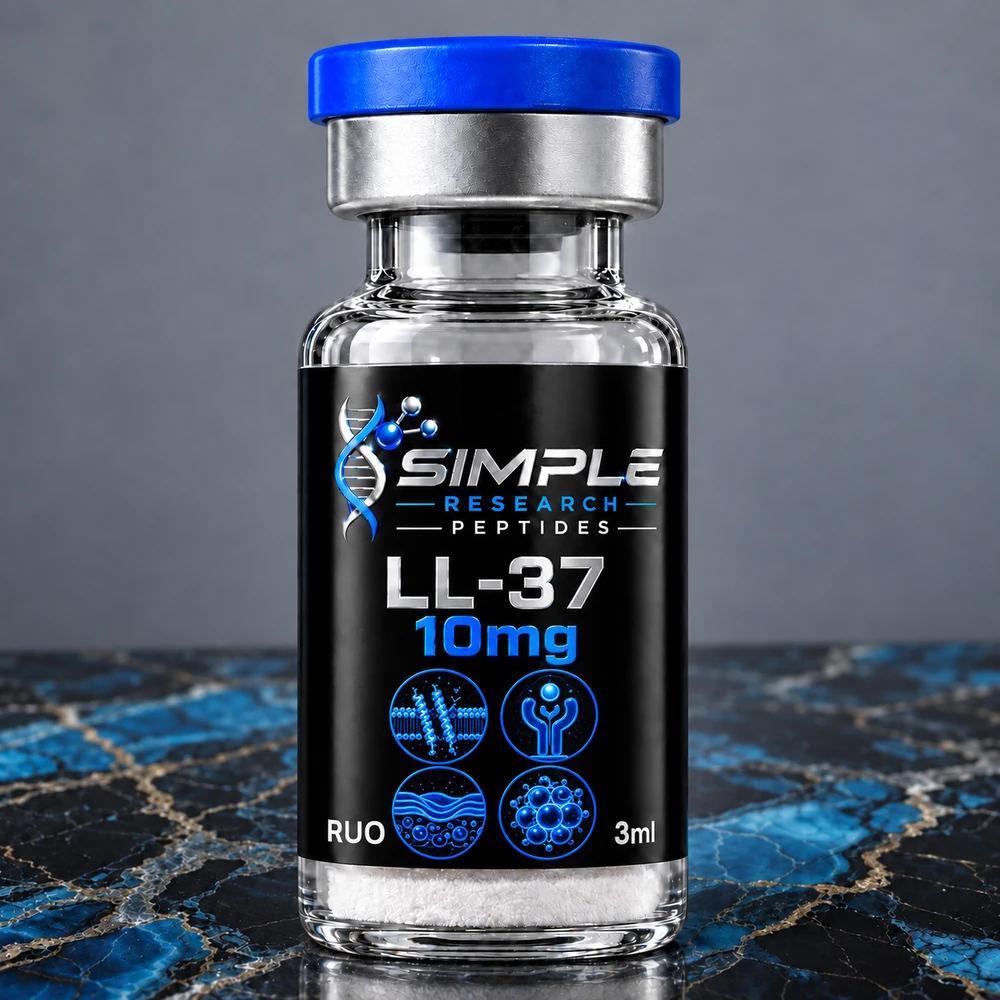
LL-37 is the mature 37-residue C-terminal fragment of the only human cathelicidin (hCAP-18 / CAMP gene product); it is an endogenous cationic amphipathic peptide studied for membrane interaction and innate-immunity signaling, and it is not mouse CRAMP, not KPV, not GHK-Cu, and not an FDA-approved drug. Opened compound record: PubChem CID 16198951; CAS 154947-66-7; UNII 3DD771JO2H (ropocamptide); UniProt P49913 residues 134–170. Sequence LLGDFFRKSKEKIGKEFKRIVQRIKDFLRNLVPRTES. Human efficacy of a research-market 10 mg vial is not established. Research use only. Not medical advice. Not for human use.
Educational information only. LL-37 sold as a research peptide is a laboratory reagent. It is not an approved drug, not a dietary supplement, and is not for human or veterinary use, consumption, administration, diagnosis, or treatment. This page summarizes published laboratory, animal, and investigational clinical research. It does not recommend use in people. No research-use or human dose is given. Simple Research Peptides lists “LL-37 10 mg Antimicrobial Research Peptide Vial” as a 10 mg lyophilized peptide under Immune / Recovery Research. The opened product page did not list a sequence, CAS number, UNII, PubChem CID, or purity certificate. Vendor marketing is not scientific evidence. Doses used in historical trials are not reproduced here as use guidance.
The identity information below draws on PubChem CID 16198951, the FDA/NCATS GSRS record for UNII 3DD771JO2H (ropocamptide), UniProtKB P49913, IUPHAR/BPS Guide to Pharmacology ligand 5527, and NCBI Gene 820. Registry information describes the reference molecule; it does not certify the identity or purity of a specific SRP batch.
One-sentence identity: LL-37 is the mature 37-residue C-terminal fragment of the only human cathelicidin (hCAP-18 / CAMP gene product); it is an endogenous cationic amphipathic peptide studied for membrane interaction and innate-immunity signaling, and it is not mouse CRAMP, not KPV, not GHK-Cu, and not an FDA-approved drug.
SRP product listing: LL-37 10 mg research vial, supplied in lyophilized form for laboratory research. Visit the product page for current price and availability, or ask SRP about current batch documentation. Published research findings are separate from batch-specific product specifications.
The following are not independently verified here for a specific SRP batch: sequence LLGDFFRKSKEKIGKEFKRIVQRIKDFLRNLVPRTES; CAS 154947-66-7; UNII 3DD771JO2H; CID 16198951; C-terminal acid vs amide; N-acetylation; a public COA file; a published laboratory dose.
| Field | Registry value | Source |
|---|---|---|
| Common / research name | LL-37 (also LL37, LL 37, cathelicidin LL-37, antibacterial peptide LL-37) | PubChem; GSRS; UniProt; IUPHAR |
| INN | ropocamptide (INN number 11051; Proposed List 121) | GSRS names/codes; PubChem synonym “ROPOCAMPTIDE [INN]” |
| Precursor protein | Cathelicidin antimicrobial peptide; 18 kDa cationic antimicrobial protein (CAP-18 / hCAP-18 / hCAP18) | UniProt P49913; NCBI Gene 820 |
| Gene | CAMP (synonyms: CAP18, FALL39, FALL-39, LL37, CRAMP, HSD26, CAP-18) | NCBI Gene 820; UniProt; IUPHAR |
| Mature sequence (1-letter) | LLGDFFRKSKEKIGKEFKRIVQRIKDFLRNLVPRTES | PubChem biologic description; GSRS subunit; UniProt peptide 134–170 |
| Mature sequence (3-letter / PLN) | H-Leu-Leu-Gly-Asp-Phe-Phe-Arg-Lys-Ser-Lys-Glu-Lys-Ile-Gly-Lys-Glu-Phe-Lys-Arg-Ile-Val-Gln-Arg-Ile-Lys-Asp-Phe-Leu-Arg-Asn-Leu-Val-Pro-Arg-Thr-Glu-Ser-OH | PubChem |
| Length | 37 amino acids (linear peptide; free C-terminal acid on the opened compound record) | PubChem; GSRS; UniProt feature PRO_0000004724 |
| Precursor mapping | Residues 134–170 of the 170-aa human preproprotein (UniProt P49913) | UniProt peptide feature. Reactome CAMP(134–170) was not used as a primary identity source |
| CAS | 154947-66-7 | GSRS CAS PRIMARY (also points to CAS Common Chemistry); PubChem depositor synonym; IUPHAR (Scifinder) |
| UNII (mature LL-37 / ropocamptide) | 3DD771JO2H | GSRS approvalID; PubChem synonym UNII-3DD771JO2H |
| PubChem CID (opened compound) | 16198951 | PubChem; GSRS PUBCHEM code |
| Molecular formula | C205H340N60O53 (PubChem computed); GSRS lists C205H339N60O53 (estimated) | PubChem PUG REST; GSRS property |
| Molecular weight | 4493 g/mol (PubChem); 4493.0 Da number-average (GSRS); electrospray MS 4492.9 (UniProt, PMID 23406372) | PubChem; GSRS; UniProt |
| Exact / monoisotopic mass | 4492.5821356 Da / 4490.5754259 Da | PubChem computed properties |
| InChIKey | POIUWJQBRNEFGX-XAMSXPGMSA-N | PubChem PUG REST; IUPHAR |
| Other registry IDs | DrugBank DB16532 (page not opened; ID as a cross-reference only); ChEMBL CHEMBL530345; NCI Thesaurus C118292; GtoPdb 5527; HGNC 1472; NCBI Gene 820; Ensembl ENSG00000164047; OMIM 600474; CCDS 2762.3; MANE NM_004345.5 / NP_004336.4 | PubChem; GSRS; IUPHAR; UniProt; NCBI Gene |
| Related GSRS records (not the free acid) | N-acetyl LL-37 UNII R2ER3MD9AJ; LL-37 amide UNII 4HGQ0GC0N6 (same 37-aa sequence, different termini) | GSRS search for name “LL-37” |
| IUPHAR ligand | GtoPdb 5527; CAS 154947-66-7 (Scifinder); CID 134611881 listed (not the opened 16198951 page); mouse orthologue CRAMP | IUPHAR ligand 5527 HTML |
| Approval / marketing | Investigational INN; not described as FDA-approved | GSRS; PubChem/NCI text; NCT02225366 (“LL37 is not FDA approved”) |
| SRP listing | “LL-37 10 mg Antimicrobial Research Peptide Vial”; 10 mg lyophilized; Immune / Recovery Research; laboratory use only | Opened product page. Sequence/CAS/UNII/CID/COA not printed |
Identity uncertainty (state plainly).
Humans have a single cathelicidin gene, CAMP, on chromosome 3 (NCBI Gene 820; HGNC 1472; Ensembl ENSG00000164047). The 170-residue preproprotein (UniProt P49913) has a signal peptide (1–30), a cathelin-like prodomain (31–131), and a C-terminal antimicrobial region. Extracellular cleavage by proteinase 3 (PRTN3) releases LL-37 (PMID 11389039, cited on the opened UniProt record). Neutrophil elastase and cathepsin G also process the precursor (PMID 11389039; PMID 22879591).
Gudmundsson et al. (1996, PMID 8681941) sequenced the FALL39 gene (four exons; exon 4 encodes the mature antibacterial peptide), located FA-LL-37 immunoreactivity in granulocytes, and isolated the mature peptide after degranulation. Structural analysis identified the mature peptide as LL-37. Agerberth et al. (1995, PMID 7529412) had previously predicted FALL-39 from a bone-marrow cDNA. Cowland et al. (1995, PMID 7615076) and Larrick et al. (1995, PMID 7890387) described the neutrophil-granule protein hCAP-18 / human CAP18.
| Related name | What it actually is (opened sources) | Why it is not LL-37 |
|---|---|---|
| hCAP-18 / CAMP preproprotein | 170-aa precursor, UniProt P49913 | LL-37 is only residues 134–170 |
| FALL-39 | Predicted 39-aa C-terminal peptide (132–170) | Two extra N-terminal residues (FA) vs mature LL-37 |
| KR-20, LL-23, LL-29, KS-30, RK-31, FF-33 | Shorter post-secretory fragments of the same precursor | Different lengths and activities (PMID 14978112) |
| CRAMP (mouse) | Mouse Camp gene product; UniProt P51437; mature peptide residues 135–172 (“cathelin-related antimicrobial peptide”) | Different species, different sequence, different gene ID (mouse GeneID 12796). IUPHAR states the mouse orthologue of LL-37 is CRAMP. Human gene alias “CRAMP” is a naming collision only. |
| KPV | α-MSH C-terminal tripeptide Lys-Pro-Val | Unrelated sequence and melanocortin lineage; not a cathelicidin |
| GHK-Cu | Copper(II) complex of Gly-His-Lys | Unrelated tripeptide; not a cathelicidin |
| Defensins (HNP, hBD) | Separate AMP families | Different genes, folds, and receptors (e.g. hBD / CCR6 vs LL-37 / FPRL1 in PMID 11015447) |
| N-acetyl LL-37 / LL-37 amide | Same 37-aa sequence with modified termini (GSRS UNIIs R2ER3MD9AJ and 4HGQ0GC0N6) | Not the unmodified free-acid record 3DD771JO2H |
UniProt P51437 is CAMP_MOUSE. Mature peptide 135–172. GeneID 12796. IUPHAR names CRAMP as the mouse orthologue. NCBI Gene 820 listing CRAMP as a human CAMP alias is a naming collision, not identity.
Agerberth 1995 (PMID 7529412) predicted FALL-39 (UniProt 132–170). Gudmundsson 1996 (PMID 8681941) isolated the mature 37-mer LL-37 (134–170). Two extra N-terminal residues (FA). Not the same length.
KPV is Lys-Pro-Val, the C-terminal tripeptide of α-MSH. Unrelated sequence and melanocortin lineage. No registry overlap on opened LL-37 records. Do not cite KPV papers as LL-37 evidence.
GHK-Cu is the copper(II) complex of Gly-His-Lys. Unrelated tripeptide. Different SRP listing. Do not cite GHK-Cu fibroblast papers as LL-37 evidence.
Opened work describes two layers. Neither layer is a proof that a vendor vial is active in a user’s assay. Observed means a measurement in an opened paper. Proposed means a working model. Class / adjacent means distinction biology. Not shown means the opened papers did not establish it for a research-market lot.
Turner et al. (1998, PMID 9736536) reported that synthetic LL-37 was active in radial-diffusion and broth assays against several Gram-negative and Gram-positive species, permeabilized E. coli membranes, bound E. coli LPS with positive cooperativity, and shifted from random coil to α-helix in the presence of lipid A. Activity against some organisms (including MRSA, P. mirabilis, and C. albicans in that paper) was salt-sensitive. B. cepacia was resistant. Authors’ CF “might have utility” sentence is opinion, not a clinical result.
UniProt restates LPS binding, pore formation, and a non-exhaustive in-vitro organism list, tagged on the opened record to allowed PMIDs including PMID 9736536, PMID 10417311, PMID 18818205, PMID 22879591, PMID 32753597, and PMID 33060695. Hemolytic activity against red cells is also recorded (PMID 10417311).
NMR and crystal structures of the 134–170 peptide or fragments are deposited (opened UniProt PDB list includes 2K6O, 5NMN, 5NNK, 5NNM, 5NNT, 7PDC). Residues 17–29 of LL-37 are annotated as an “active core” (PMID 32753597, PMID 35061360). Wang 2008 (PMID 18818205) reported NMR structures of LL-37 and KR-12 in lipid micelles. KR-12 is not full-length LL-37.
De Yang et al. (2000, PMID 11015447) reported that LL-37 is chemotactic for human neutrophils, monocytes, and T cells and uses formyl peptide receptor–like 1 (FPRL1; now commonly FPR2) as a functional receptor (Ca2+ flux and migration in FPRL1-transfected HEK293 cells; cross-desensitization with an FPRL1 agonist; no response in FPR-transfected cells). That paper did not claim FPRL1 is the only receptor.
Liu et al. (2006, PMID 16497887) reported that TLR activation of human macrophages up-regulated VDR and CYP27B1, induced cathelicidin, and was associated with killing of intracellular M. tuberculosis in that system. That is induction of endogenous CAMP/LL-37, not a test of a synthetic research vial.
Yamasaki et al. (2007, PMID 17676051) reported abnormally high cathelicidin and altered proteolytic processing in rosacea facial skin, and that injection of rosacea-associated cathelicidin peptides, or increased serine-protease activity, increased inflammation in mouse skin in a Camp-dependent manner. That paper is about dysregulated endogenous processing, not a therapeutic claim for exogenous LL-37.
Pütsep et al. (2002, PMID 12387964) reported deficiency of antibacterial peptides, including LL-37, in morbus Kostmann (severe congenital neutropenia). That is a human observational genetics/immunology paper, not a treatment trial of synthetic LL-37.
Sørensen et al. (2001, PMID 11389039) reported that proteinase 3 cleaves hCAP-18 to LL-37 in human neutrophils / extracellular fluid. Neutrophil elastase and cathepsin G also process the precursor (PMID 22879591). Not a drug study.
They did not establish a single high-resolution structure of LL-37 bound to FPRL1/FPR2. They did not prove that every downstream effect (P2X7, EGFR, TLR, DNA-complex effects listed in NCBI GeneRIFs) is FPRL1-dependent. They did not show that a research-grade vendor vial matches clinical-trial material. They did not show that in-vitro MIC or chemotaxis equals human efficacy.
Agerberth (PMID 7529412) predicted FALL-39. Cowland (PMID 7615076) and Larrick (PMID 7890387) described hCAP-18 / human CAP18. Precursor and 39-mer, not isolated mature LL-37 as a treatment.
Four-exon FALL39 gene; mature peptide isolated as LL-37 after degranulation. PMID 8681941. Not a human treatment study.
Synthetic LL-37 in radial-diffusion and broth assays; membrane permeabilization; LPS binding; coil-to-helix. PMID 9736536. Not a clinical result.
Chemotaxis / Ca2+ via FPRL1. Not in-vivo efficacy. PMID 11015447.
Sørensen (PMID 11389039): PRTN3 cleaves hCAP-18 to LL-37. Murakami (PMID 14978112): KR-20, LL-23, and other fragments after secretion. Those fragments ≠ LL-37.
Liu (PMID 16497887): TLR → vitamin D pathway → endogenous cathelicidin. Yamasaki (PMID 17676051): excess / altered cathelicidin peptides promote inflammation. Not exogenous peptide therapy.
Wang (PMID 18818205): LL-37 and KR-12. Sancho-Vaello (PMID 29133814, PMID 33060695): oligomerization / channel-like assemblies. Engelberg & Landau (PMID 32753597): LL-37(17–29) active-core fibril. Core fragment, not the 37-mer vial.
Opened work falls into three layers. None of it is a substitute for controlled laboratory characterization of a specific vial. No human efficacy is claimed here. Where a paper’s title or abstract uses “effective,” that language is the authors’ and is reported as such, including later null or mixed results. Doses used in those trials are historical study conditions only. They are not instructions for a research peptide and are not reproduced here as use guidance.
Agerberth 1995 FALL-39 (PMID 7529412); Cowland 1995 hCAP-18 (PMID 7615076); Larrick 1995 CAP18 (PMID 7890387); Gudmundsson 1996 mature LL-37 (PMID 8681941); Turner 1998 in-vitro MIC/LPS (PMID 9736536); De Yang 2000 FPRL1 (PMID 11015447); Sørensen 2001 PRTN3 (PMID 11389039); Murakami 2004 fragments (PMID 14978112); Wang 2008 NMR (PMID 18818205); Sancho-Vaello 2017/2020 (PMID 29133814, PMID 33060695); Engelberg & Landau 2020 core (PMID 32753597). Not a sales pitch.
Grönberg 2014 VLU first-in-human (PMID 25041740; n=34). Mahlapuu 2021 HEAL LL-37 Phase IIb (DOI 10.1111/wrr.12977; EudraCT 2018-000536-10; n=148; null full cohort; PMID not confirmed). Miranda 2023 DFU cream (PMID 37480520; NCT04098562). NCT02225366 melanoma IT LL37 (COMPLETED; actual n=4). These are the only opened records of exogenous LL-37 peptide administration.
Vitamin D, butyrate, and ELISA biomarker studies measure or induce endogenous LL-37. They must not be described as LL-37 drug trials. Opened classification set: NCT01896544, NCT00800930, NCT03270709, NCT02138591, NCT01398280, NCT04404335, NCT04861493, NCT03923218, NCT03639376, NCT04946617, NCT06219330, NCT07496710, NCT07490587. A ClinicalTrials.gov API search for LL-37 OR LL37 OR ropocamptide (opened 16 August 2026; versionHolder 2026-08-14) returned a mixed set dominated by biomarker studies.
GSRS: protein substance ropocamptide, UNII 3DD771JO2H, INN 11051, CAS 154947-66-7, PubChem 16198951. UNII availability is not approval. PubChem / NCI Thesaurus text describes ropocamptide as a synthetic 37-aa cathelicidin peptide with investigational language. That is not an NDA/BLA. NCT02225366 states LL37 is not FDA approved. No opened source described US marketing authorization for LL-37 / ropocamptide.
Opened product page: LL-37 10 mg Antimicrobial Research Peptide Vial; 10 mg lyophilized; Immune / Recovery Research; laboratory use only. Sequence, CAS, UNII, CID, and a purity certificate were not printed. A vial is not confirmed to match UNII 3DD771JO2H vs amide vs N-acetyl. Product page.
LL-37 = mouse CRAMP is false. LL-37 = FALL-39 is false (39 vs 37). LL-37 = KPV is false. LL-37 = GHK-Cu is false. Vitamin D / butyrate NCTs are not LL-37 drug trials. HEAL LL-37 full-cohort result was null. n=4 melanoma study cannot support efficacy. Do not use those claims.
Read the “what it did not show” column. Published study designs are historical facts from those papers. They are not a protocol and they are not claims that a research-market vial works in people.
| Study (opened) | System | What was actually studied | What it did not show |
|---|---|---|---|
| Agerberth et al., 1995, PNAS, PMID 7529412 | Human bone-marrow cDNA; synthetic FALL-39 | Predicted cysteine-free peptide antibiotic; antibacterial activity of the 39-mer | Did not isolate mature LL-37 from cells |
| Cowland et al., 1995, FEBS Lett, PMID 7615076 | Human neutrophils | hCAP-18 as a cathelin/pro-bactenecin-like granule protein | Not the mature 37-mer pharmacology paper |
| Larrick et al., 1995, Infect Immun, PMID 7890387 | Human CAP18 cDNA | LPS-binding antimicrobial protein | Precursor, not isolated LL-37 |
| Gudmundsson et al., 1996, Eur J Biochem, PMID 8681941 | Human gene + granulocytes | Four-exon FALL39 gene; mature peptide isolated as LL-37 | Not a human treatment study |
| Turner et al., 1998, Antimicrob Agents Chemother, PMID 9736536 | In-vitro MIC, membrane, LPS, CD | Broad in-vitro activity; salt dependence; helix on lipid A | Authors’ CF “might have utility” sentence is opinion, not a clinical result |
| De Yang et al., 2000, J Exp Med, PMID 11015447 | Human leukocytes; FPRL1 transfectants | Chemotaxis / Ca2+ via FPRL1 | Not in-vivo efficacy |
| Sørensen et al., 2001, Blood, PMID 11389039 | Human neutrophils / extracellular fluid | Proteinase 3 cleaves hCAP-18 to LL-37 | Not a drug study |
| Murakami et al., 2004, J Immunol, PMID 14978112 | Human sweat / skin processing | Multiple shorter cathelicidin peptides after secretion | Those fragments ≠ LL-37 |
| Liu et al., 2006, Science, PMID 16497887 | Human macrophages | TLR → vitamin D pathway → endogenous cathelicidin / Mtb killing | Not exogenous peptide therapy |
| Yamasaki et al., 2007, Nat Med, PMID 17676051 | Human rosacea skin; Camp−/− mice | Excess / altered cathelicidin peptides promote inflammation | Argues too much processed cathelicidin can be pro-inflammatory |
| Wang, 2008, J Biol Chem, PMID 18818205 | NMR in lipid micelles | Structures of LL-37 and KR-12 | Fragment KR-12 is not full-length LL-37 |
| Sancho-Vaello et al., 2017 / 2020, Sci Rep, PMID 29133814, PMID 33060695 | X-ray of 134–170 | Oligomerization / channel-like assemblies on membrane mimics | In-vitro structural models |
| Engelberg & Landau, 2020, Nat Commun, PMID 32753597 | X-ray of LL-37(17–29) | Supramolecular fibril / active-core peptide | Core fragment, not the 37-mer vial |
Additional opened UniProt P49913 feature/function PMIDs used in the locked draft (not expanded into invented titles): PMID 8946956; PMID 10417311 (hemolytic activity against red cells); PMID 15778390; PMID 21463582; PMID 22879591 (neutrophil elastase and cathepsin G also process the precursor); PMID 23406372 (electrospray MS 4492.9); PMID 34708076 (UniProt JSON listed with DOI; PubMed HTML cookie-walled; retained only as UniProt-linked); PMID 35061360 (residues 17–29 annotated as an active core, with PMID 32753597). PMID 12387964 is Pütsep 2002 Kostmann (observational deficiency, not a treatment trial). PMID 37246231 is Madruga 2023 GCF LL-37, a biomarker paper, not an administration trial.
Opened records that actually give exogenous LL-37 (not vitamin D, butyrate, or mouthwash as an inducer, and not ELISA of endogenous peptide). Clinical-trial application methods appear below only as historical study conditions. They are not use instructions. Doses used in those trials are not reproduced here.
| Record / paper (opened) | Design | Status / n | What the opened source reported | What it did not show |
|---|---|---|---|---|
| Grönberg et al., 2014, Wound Repair Regen, PMID 25041740 | First-in-human topical LL-37 vs placebo on hard-to-heal venous leg ulcers; randomized double-blind treatment phase after placebo run-in | n=34 | Authors reported higher healing-rate constants vs placebo at two lower concentration arms and no difference at the highest arm; no local/systemic safety concerns in that small trial. “Effective” in the title is the authors’ wording. | Not FDA approval; not a Phase 3 result; does not establish clinical effectiveness |
| Mahlapuu et al., 2021, Wound Repair Regen, DOI 10.1111/wrr.12977 (HEAL LL-37; EudraCT 2018-000536-10) | Phase IIb topical LL-37 vs placebo + compression; hard-to-heal venous leg ulcers | n=148 randomized/completed run-in (EudraCT results page) | Full cohort: no significant improvement vs placebo. Post-hoc large-wound subgroup (≥10 cm²) showed signals the authors said need a dedicated trial. PMID for this 2021 paper was not confirmed on an opened PubMed/EuropePMC article page and is not listed as a PMID on this page. | Not confirmatory efficacy; no US NCT number was present on the opened EudraCT results extract. Do not invent one. |
| Miranda et al., 2023, Arch Dermatol Res, PMID 37480520; NCT04098562 | Randomized double-blind topical LL-37 cream vs placebo, DFU with mild infection, 4 weeks | Registry status on opened ClinicalTrials.gov page: dates listed, overallStatus appeared as unknown in the API extract; paper says registered as NCT04098562 | Authors reported greater granulation-index increase vs placebo on serial days; no significant decrease in IL-1α, TNF-α, or aerobic colonization vs placebo | Not a regulatory approval; mixed biomarker result |
| NCT02225366 (MD Anderson / NCI) | Phase 1/2 intratumoral LL37 in unresectable cutaneous/nodal melanoma | COMPLETED; actual enrollment 4 | Dose-finding / immune-response study. Registry text: “LL37 is not FDA approved or commercially available. It is currently being used for research purposes only.” | n=4 cannot support an efficacy claim |
Authors reported improved healing-rate constants at two lower topical concentration arms versus placebo and no difference at the highest arm (n=34 after run-in). Safety in that short trial was described as acceptable. This does not establish clinical effectiveness. Not FDA approval. PMID 25041740.
Opened paper/registry text: no significant healing benefit versus placebo in the full 148-patient cohort. A post-hoc large-ulcer subgroup is hypothesis-generating only. That is a null primary result. DOI 10.1111/wrr.12977. PMID not confirmed on an opened PubMed/EuropePMC article header. No confirmed US NCT on the opened extract. EudraCT 2018-000536-10 results.
Authors reported greater granulation-index change versus placebo and no significant effect on the measured inflammatory markers or aerobic colonization. Mixed, small, single-center. PMID 37480520. Registered as NCT04098562. Not a regulatory approval.
Completed Phase 1/2 dose-finding / immune-response study with actual enrollment 4. Registry: LL37 is not FDA approved. No efficacy conclusion is justified. NCT02225366.
These records must not be described as LL-37 drug trials. They are opened for classification only. They are not peptide-administration trials.
| NCT (opened API or study page) | Status | What was done | What it is not |
|---|---|---|---|
| NCT01896544 | COMPLETED (results posted) | Cholecalciferol vs placebo in suspected sepsis; serum LL-37 was a measured analyte, not the intervention | Not exogenous LL-37 |
| NCT00800930 | COMPLETED | Sodium butyrate enema in shigellosis; endpoint included induction of endogenous LL-37 | Not a synthetic LL-37 vial trial |
| NCT03270709 | TERMINATED (funding / COVID) | High-dose vitamin D3; LL-37 as outcome | Not peptide administration |
| NCT02138591 | WITHDRAWN | Planned preoperative vitamin D; cathelicidin as biomarker; n=0 | Not a drug trial of LL-37 |
| NCT01398280 | COMPLETED | Topical aminocaproic acid to inhibit KLK5 / LL-37 production in rosacea (trying to reduce processed cathelicidin) | Opposite direction from giving LL-37 |
| NCT04404335, NCT04861493, NCT03923218, NCT03639376, NCT04946617, NCT06219330, NCT07496710 | Observational / biomarker | ELISA of salivary, GCF, or tissue LL-37 | Not administration of the peptide |
| NCT07490587 | RECRUITING | Infant probiotic trial; fecal LL-37 as a mucosal marker, not the study drug | Not an LL-37 peptide trial |
Only the rows in the exogenous-trial section summarize records of exogenous LL-37 peptide administration: NCT02225366, NCT04098562, and EudraCT 2018-000536-10 (no confirmed US NCT). This review does not assign a US ClinicalTrials.gov identifier to HEAL LL-37.
Venous leg ulcers — small first-in-human (PMID 25041740). Authors reported improved healing-rate constants at two lower topical concentration arms versus placebo and no difference at the highest arm (n=34 after run-in). Safety in that short trial was described as acceptable. This does not establish clinical effectiveness.
Venous leg ulcers — Phase IIb HEAL LL-37 (DOI 10.1111/wrr.12977; EudraCT 2018-000536-10). Opened paper/registry text: no significant healing benefit versus placebo in the full 148-patient cohort. A post-hoc large-ulcer subgroup is hypothesis-generating only. That is a null primary result.
Diabetic foot ulcer cream (PMID 37480520; NCT04098562). Authors reported greater granulation-index change versus placebo and no significant effect on the measured inflammatory markers or aerobic colonization. Mixed, small, single-center.
Melanoma intratumoral (NCT02225366). Completed Phase 1/2 dose-finding study with actual n=4. No efficacy conclusion is justified.
Endogenous-induction trials (vitamin D, butyrate) do not test a synthetic LL-37 vial.
Protein substance ropocamptide, UNII 3DD771JO2H, INN 11051, CAS 154947-66-7, PubChem 16198951. UNII availability is not approval.
PubChem / NCI Thesaurus text describes ropocamptide as a synthetic 37-aa cathelicidin peptide with investigational language. That is not an NDA/BLA.
Registry text: LL37 is not FDA approved. No opened source described US marketing authorization for LL-37 / ropocamptide.
These are gaps. Treating any of them as settled is incorrect. This page does not claim human efficacy.
| Popular claim | Status after this review |
|---|---|
| “LL-37 is an FDA-approved antimicrobial or wound drug” | False on opened registries. Investigational INN. NCT02225366: not FDA approved. No US marketing authorization opened. |
| “The Phase IIb proved it heals venous ulcers” | False. HEAL LL-37 full cohort: no significant improvement vs placebo. Null primary result. |
| “The n=4 melanoma study shows efficacy” | Unsupported. Actual enrollment 4. Dose-finding / immune-response study only. |
| “Vitamin D trials are LL-37 drug trials” | False. Those NCTs measure or induce endogenous peptide. Not administration of synthetic LL-37. |
| “LL-37 is mouse CRAMP / FALL-39 / KPV / GHK-Cu” | False identity. Different sequences (and, for CRAMP, different species). FALL-39 is a 39-mer. |
| “The SRP 10 mg vial is confirmed UNII 3DD771JO2H” | Not established. Sequence, termini, and COA were not printed on the opened product page. |
| “In-vitro killing equals human efficacy” | Unsupported. Turner 1998 is in vitro. Salt-sensitive for some organisms. Not a clinical result. |
| “This page includes a research or human dose” | False. No dose is given. Historical trial conditions are not reproduced as use guidance. |
Small first-in-human signal, a null Phase IIb, a mixed DFU cream paper, and n=4 melanoma. Authors’ “effective” title wording is not approval. Research use only.
CID 16198951 / UNII 3DD771JO2H is the free-acid record. Amide and N-acetyl UNIIs exist. Confirm sequence and termini on a COA / LC-MS.
NCT01896544, NCT00800930, and the ELISA rows measure endogenous LL-37. They are not this vial. Only NCT02225366, NCT04098562, and EudraCT 2018-000536-10 administered peptide.
Mouse CRAMP is P51437. KPV is Lys-Pro-Val. GHK-Cu is Gly-His-Lys copper. FALL-39 is 39 residues. Catalog language does not merge them.
Opened product language and the peptide’s published properties point to in-vitro / biochemical use: membrane-binding and permeabilization assays, LPS-binding, conformational (CD/NMR) work, leukocyte chemotaxis / FPRL1 assays, and comparison with fragments (KR-12, LL-23, KR-20) or the mouse orthologue CRAMP. Those are research questions. They are not human indications.
A user who needs identity confirmation should independently verify sequence, C-terminus (acid vs amide), counter-ion, and HPLC/MS against the opened registry values above. This page cannot authenticate any commercial lot.
LL-37 / ropocamptide is an investigational laboratory research peptide. It is not an FDA-approved drug for human use. This page is educational. It does not provide dosing, reconstitution, administration, or any human-use instructions.
Simple Research Peptides (SRP) materials are for laboratory research only and are not for human or veterinary use, consumption, administration, diagnosis, treatment, or therapeutic application.
Laboratory identity is the first practical issue. Opened papers and PubChem CID 16198951 describe the 37-aa free-acid fragment LLGDFFRKSKEKIGKEFKRIVQRIKDFLRNLVPRTES (INN ropocamptide; CAS 154947-66-7; UNII 3DD771JO2H; UniProt P49913 residues 134–170; C205H340N60O53; 4493 g/mol; InChIKey POIUWJQBRNEFGX-XAMSXPGMSA-N). A research vial labeled “LL-37” is not chemically identified until sequence, termini, and salt are confirmed analytically.
Confirm sequence, C-terminus, and salt by LC-MS before treating a vial as the literature article. Independently sourced research peptides are not established as equivalent to clinical-trial material, the Grönberg 2014 lot, HEAL LL-37 material, or CID 16198951 free acid. Historical trial application methods are study conditions from those papers. They are not a reconstitution scheme and they are not a use guide for an SRP 10 mg research vial.
The mature 37-residue C-terminal fragment of the only human cathelicidin (hCAP-18 / CAMP gene product). INN ropocamptide. Opened identity: CID 16198951; CAS 154947-66-7; UNII 3DD771JO2H; UniProt P49913 residues 134–170; sequence LLGDFFRKSKEKIGKEFKRIVQRIKDFLRNLVPRTES. Research use only.
No. Mouse CRAMP is UniProt P51437, GeneID 12796, mature peptide 135–172. IUPHAR names CRAMP as the mouse orthologue of LL-37. NCBI Gene 820 lists CRAMP as an alias of human CAMP — a naming collision, not identity.
No. FALL-39 is the predicted 39-aa C-terminal peptide (UniProt 132–170; PMID 7529412). Mature LL-37 is 37 residues (134–170; PMID 8681941). Two extra N-terminal residues (FA).
No. KPV is the α-MSH C-terminal tripeptide Lys-Pro-Val. GHK-Cu is the copper(II) complex of Gly-His-Lys. Unrelated sequences; not cathelicidins. Do not cite those papers as LL-37 evidence.
No. Investigational INN. NCT02225366 states LL37 is not FDA approved. No opened source described US marketing authorization. UNII 3DD771JO2H is not approval.
Opened administration records: NCT02225366 (melanoma IT; COMPLETED; n=4); NCT04098562 (DFU cream; PMID 37480520); EudraCT 2018-000536-10 (HEAL LL-37 topical; no confirmed US NCT). Vitamin D / butyrate / ELISA NCTs measure or induce endogenous peptide and are not administration trials.
No. HEAL LL-37 (DOI 10.1111/wrr.12977; EudraCT 2018-000536-10): no significant improvement vs placebo in the full 148-patient cohort. That is a null primary result. A post-hoc large-wound subgroup is hypothesis-generating only.
No. It prints a name, 10 mg lyophilized, Immune / Recovery Research, and laboratory use only. Sequence, CAS, UNII, CID, C-terminus, and a purity certificate were not printed. A vial is not confirmed to match UNII 3DD771JO2H vs amide vs N-acetyl.
No. SRP listings are for laboratory research only and are not for human or animal use. This page does not provide reconstitution, administration, or dosing instructions. Historical trial conditions are not instructions. No research-use or human dose is given.
Not established here. The opened compound page and GSRS PUBCHEM code are CID 16198951. IUPHAR ligand 5527 lists CID 134611881. That second CID page was not opened. Do not treat them as proven identical salt/charge forms.
No. Murakami 2004 (PMID 14978112) described shorter post-secretory fragments. Wang 2008 (PMID 18818205) solved KR-12 as well as LL-37. Engelberg & Landau 2020 (PMID 32753597) studied LL-37(17–29). Different lengths. Not the 37-mer vial.
No. There is no human dosing, reconstitution, or administration protocol on this page. Research use only. Not medical advice. Not for human use.
Reference records used in this guide. PubMed identifiers: 7529412, 7615076, 7890387, 8681941, 8946956, 9736536, 10417311, 11015447, 11389039, 12387964, 14978112, 15778390, 16497887, 17676051, 18818205, 21463582, 22879591, 23406372, 25041740, 29133814, 32753597, 33060695, 34708076, 35061360, 37246231, 37480520. Peptide-administration study identifiers: NCT02225366; NCT04098562; EudraCT 2018-000536-10. Biomarker / inducer NCTs are listed only for classification. HEAL LL-37 is cited by DOI 10.1111/wrr.12977; its PMID was not confirmed.
LL-37 OR LL37 OR ropocamptide (versionHolder 2026-08-14). Biomarker / inducer classification only: NCT01896544, NCT00800930, NCT03270709, NCT02138591, NCT01398280, NCT04404335, NCT04861493, NCT03923218, NCT03639376, NCT04946617, NCT06219330, NCT07496710, NCT07490587.PubMed identifiers cited in this guide: 7529412, 7615076, 7890387, 8681941, 8946956, 9736536, 10417311, 11015447, 11389039, 12387964, 14978112, 15778390, 16497887, 17676051, 18818205, 21463582, 22879591, 23406372, 25041740, 29133814, 32753597, 33060695, 34708076, 35061360, 37246231, 37480520. The US ClinicalTrials.gov identifier for HEAL LL-37 was not confirmed in this review. DrugBank DB16532 was recorded only as a cross-reference; the original record was not independently reviewed.
Educational information only. LL-37 is the mature 37-residue C-terminal fragment of the only human cathelicidin (hCAP-18 / CAMP gene product); INN ropocamptide (CID 16198951; CAS 154947-66-7; UNII 3DD771JO2H; UniProt P49913 residues 134–170; sequence LLGDFFRKSKEKIGKEFKRIVQRIKDFLRNLVPRTES). It is not mouse CRAMP, not FALL-39, not KPV, not GHK-Cu, and not an FDA-approved drug. Opened exogenous records: NCT02225366 (n=4); NCT04098562 / PMID 37480520; EudraCT 2018-000536-10 (null full cohort; no confirmed US NCT). Vitamin D / butyrate / ELISA NCTs are not peptide-administration trials. Human efficacy of a research-market vial is not established. No research-use or human dose is given. Laboratory research use only; not for human or animal use. Not medical advice. Not for human use. No human dosing protocol. Last source review: 16 August 2026 (America/Indianapolis). Locked draft converted to HTML the same day. For laboratory research only. Not for human or veterinary use.
2 mins ago