Livagen Research GuideLys-Glu-Asp-Ala (KEDA) · not Epitalon · not FDA-approved
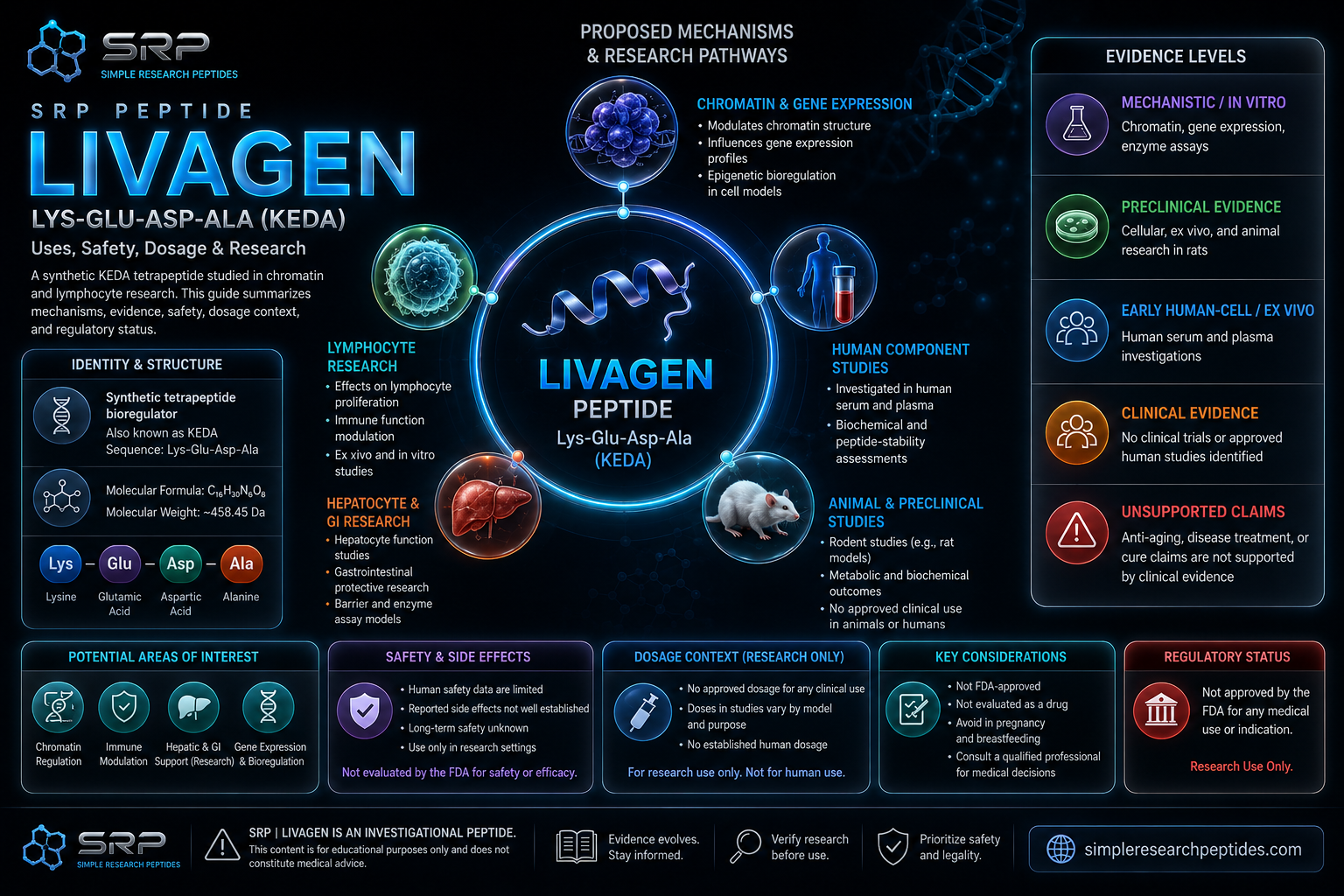
Livagen is a synthetic tetrapeptide printed in opened Khavinson-group papers and opened patents as Lys-Glu-Asp-Ala (KEDA), positioned as a short peptide bioregulator associated with hepatic-cell / chromatin-structure research. English-language independently replicated evidence is limited. ClinicalTrials.gov returned 0 studies. It is not Liv.52, not Epitalon, not Vilon, not Ventvil, and not an FDA-approved drug on any opened registry. Research use only. Not medical advice. Not for human use.
Lys-Glu-Asp-Ala
CID 87919683
CAS 433257-50-2
0 NCT
Sparse/limited evidence
Not Epitalon
Not FDA-approved
Educational information only. This page describes a short peptide bioregulator sold as a laboratory research material. It is not medical advice. Simple Research Peptides (SRP) materials are for laboratory research only and are not for human or veterinary use, consumption, administration, diagnosis, treatment, or therapeutic application. Sequence Lys-Glu-Asp-Ala / KEDA is taken from opened papers, opened patents, and PubChem CID 87919683 titled Livagen, not from the SRP product page. No human dosing, reconstitution, or administration protocol appears on this page.
Sequence and chemical identity
SRP product and index pages do not print a sequence, CAS, UNII, molecular formula, or a public COA. The sequence below is taken only from opened primary papers and opened patents that print the trade name Livagen next to Lys-Glu-Asp-Ala / KEDA, plus the opened PubChem record titled Livagen.
One-sentence identity: Livagen is a synthetic tetrapeptide printed in opened Khavinson-group papers and opened patents as Lys-Glu-Asp-Ala (KEDA), positioned as a short peptide bioregulator associated with hepatic-cell / chromatin-structure research. English-language independently replicated evidence is limited. ClinicalTrials.gov returned 0 studies. It is not Liv.52, not Epitalon, not Vilon, not Ventvil, and not an FDA-approved drug on any opened registry.
| Identifier | Value on opened page | Source opened |
|---|---|---|
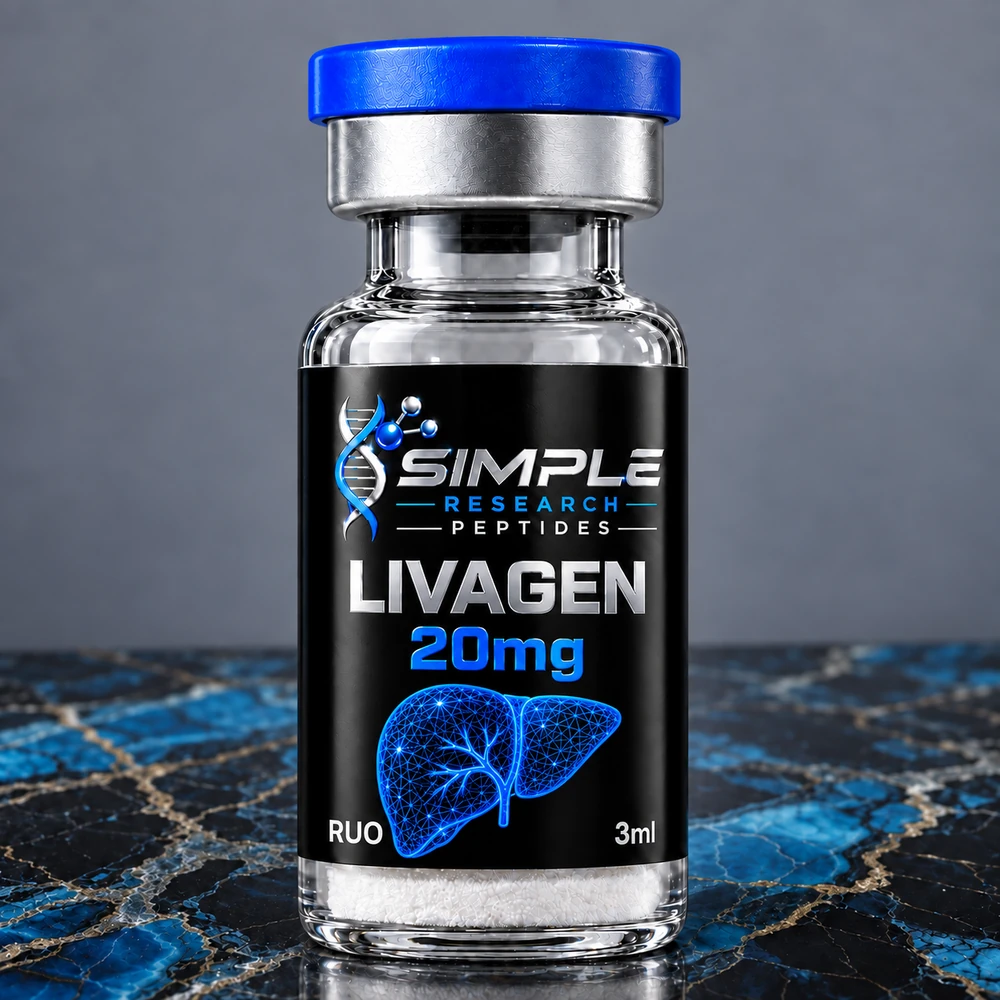
| Trade name on SRP | Livagen 20 mg Research Peptide Vial | SRP product page |
| SRP listed strength / format | 20 mg; “one 20 mg research vial; verify sequence, salt form, and assay” | SRP product page |
| SRP store categories | Liver Research; Peptide Bioregulators; Research Peptides | SRP product page (store taxonomy, not a clinical indication) |
| SRP index category / evidence tag | Longevity listing “Livagen 20 mg”; evidence tag Sparse/limited evidence | SRP compound-research-guides index |
| Dedicated guide URL | HTTP 404 on 16 August 2026 | http://simpleresearchpeptides.com/research-compound-directory/livagen-research-guide/ |
| Sequence printed with the name Livagen | Lys-Glu-Asp-Ala (one-letter KEDA); PubChem biologic H-Lys-Glu-Asp-Ala-OH | PubChem CID 87919683; Kost et al. 2003, PMID 12942748; Timofeeva et al. 2005, PMID 16075683; Kuznik et al. 2020, PMID 32362099 |
| Sequence printed as Livagen (KEDA) | Table 2: Livagen (KEDA), ICM-score −22.01, labeled Hepatoprotector | Khavinson et al. 2022, PMID 35887081, PMC9323678, Table 2 |
| Alternate spelling in one opened abstract | “lyvagen (Lys-Glu-Asp-Ala)” | Brodskii et al. 2001, PMID 15926314 |
| PubChem CID | 87919683. Title: Livagen. Formula C18H31N5O9. MW 461.5 | PubChem HTML + PUG REST, opened 16 August 2026 |
| PubChem depositor synonyms | Livagen; SCHEMBL5967826; EX-A16866; 433257-50-2 | PubChem PUG synonyms JSON |
| CAS on the Livagen CID | 433257-50-2 (depositor-supplied synonym only) | PubChem CID 87919683. PUG name lookup of that RN on 16 August 2026 resolves to CID 87919683, title Livagen. Common Chemistry not opened |
| CAS 195875-84-4 (blog/vendor number) | Not Livagen. Resolved to Tesofensine, CID 11370864, C17H23Cl2NO, InChIKey VCVWXKKWDOJNIT-ZOMKSWQUSA-N | PubChem PUG name 195875-84-4 |
| Molecular formula / MW | C18H31N5O9; 461.5 g/mol (PubChem computed). Patent prints 461.48 without ion pair | PubChem PUG; US7101854B2 Example 1 |
| Exact / monoisotopic mass | 461.21217758 | PubChem PUG property |
| InChIKey | IKVDKWACACMDLR-BJDJZHNGSA-N | PubChem PUG |
| IUPAC name (PubChem computed) | (4S)-5-[[(2S)-3-carboxy-1-[[(1S)-1-carboxyethyl]amino]-1-oxopropan-2-yl]amino]-4-[[(2S)-2,6-diaminohexanoyl]amino]-5-oxopentanoic acid | PubChem PUG |
| Sequence / HELM (PubChem biologic) | KEDA; H-KEDA-OH; PEPTIDE1{K.E.D.A} | PubChem HTML |
| Wikipedia (identity cross-check only) | Sequence KEDA / Lys-Glu-Asp-Ala; CID 87919683; ChemSpider 57489559 printed on that page. ChemSpider itself was not opened | https://en.wikipedia.org/wiki/Livagen |
| UNII | Not found | NCATS substances search livagen total 0; precision.fda.gov UNII search page returned no substance card |
| NCATS Inxight | No substance record named livagen | NCATS API, opened 16 August 2026 |
| IUPHAR / GtoPdb | No ligand | IUPHAR services name=Livagen HTTP 404 |
| openFDA Drugs@FDA | No matches | openFDA search=livagen HTTP 404 |
| ClinicalTrials.gov | 0 studies for Livagen, KEDA tetrapeptide, or “Lys-Glu-Asp-Ala”. No trial registration number is available to list. | CT.gov API v2, opened 16 August 2026 |
| INN / USAN | None on any opened registry | — |
| Patent compound (opened) | Lys-Glu-Asp-Ala / SEQ ID NO:1; C18H31N5O9; 461.48; acetate; HPLC peptide content 98.75% in Example 1, not an SRP COA. Opened US text does not print the trade name Livagen. EP Google Patents page lists “Livagen Proteins.” | US7101854B2; EP1325026B1 |
What this is chemically, from opened pages. Opened Khavinson-group papers and the opened Khavinson hepatocyte patents print Livagen / the hepatocyte tetrapeptide as unmodified Lys-Glu-Asp-Ala (KEDA). PubChem CID 87919683 is titled Livagen and prints the same sequence, formula, and InChIKey. Opened US7101854B2 prints Lys-Glu-Asp-Ala (SEQ ID NO:1), C18H31N5O9, 461.48 Da without ion pair, and optional acetate / hydrochloride / oxalate / metal-carboxylate salts — patent language, not an SRP vial specification. That US text does not use the trade name Livagen. Opened EP1325026B1 is the same family and the Google Patents page links UniProt Livagen to the sequence.
What this is not, chemically.
- Not Liv.52 (Himalaya polyherbal). PMID 38784689 and PMID 16758471 are Liv.52 papers and were not used as Livagen evidence.
- Not Epitalon / Epithalon (Ala-Glu-Asp-Gly / AEDG). Kost 2003 (PMID 12942748) tests both peptides side by side; they are different sequences.
- Not Vilon (Lys-Glu / KE). Khavinson, Lezhava, and Malinin 2004 (PMID 15085253) and Lezhava 2006 (PMID 16705247) report that Vilon does not decondense pericentromeric structural heterochromatin the way Livagen and Epitalon do in those designs.
- Not Ventvil, the polypeptide liver complex reviewed alongside KEDA in Kuznik et al. 2020 (PMID 32362099). Ventvil is a tissue extract; Livagen is the synthetic tetrapeptide.
- Not Ovagen (EDL), Vesugen (KED), Prostamax / Prostomax (KEDP), Pancragen (KEDW-NH2), Testagen (KEDG), or Chonluten (EDG). Those sequences are printed as separate rows on the opened Khavinson 2022 LAT1 docking table (PMID 35887081, PMC9323678, Table 2).
- Not Tesofensine. CAS 195875-84-4, used for Livagen on some vendor/blog pages, resolved on PubChem to Tesofensine CID 11370864.
- Not shown on any opened page to be compositionally identical to an SRP 20 mg lyophilized research vial. SRP itself tells the buyer to “verify sequence, salt form, and assay.”
Not printed on SRP pages and therefore not claimed as SRP-verified: sequence, CAS, UNII, formula, salt form, or purity numbers. The product page does not print a public COA.
How it relates to — and is not — other Khavinson bioregulators, Liv.52, or Ventvil
Livagen (this page) is the tetrapeptide Lys-Glu-Asp-Ala (KEDA) on the opened PubChem record, opened Khavinson/Lezhava chromatin papers, opened Kost 2003 enzyme paper, opened Timofeeva 2005 digestive-enzyme paper, opened Kuznik 2020 review, and opened US/EP hepatocyte patents. It is one name inside the Khavinson / cytomedin-style short-peptide bioregulator catalog. That catalog is a research-network taxonomy, not a receptor-class assignment.
| Opened page | What it printed | Why it is not interchangeable with Livagen |
|---|---|---|
| Kost et al. 2003 PMID 12942748 |
Livagen = Lys-Glu-Asp-Ala; Epitalon = Ala-Glu-Asp-Gly; Livagen IC50 20 µM vs Epitalon 500 µM on serum enkephalin-degrading enzymes | Two different tetrapeptides in one assay. |
| Khavinson, Lezhava, Malinin 2004 PMID 15085253 |
Vilon, Epithalon, Livagen, Prostamax, Cortagen tested on senile-subject leukocyte chromatin | Five named peptides; Livagen and Epithalon (not Vilon) changed chromosome-1 and -9 pericentromeric C-heterochromatin. |
| Lezhava et al. 2006 PMID 16705247 |
Epitalon, Livagen, Vilon on 75–88-year donor lymphocytes | Vilon did not decondense pericentromeric structural heterochromatin of chromosomes 1 and 9. |
| Kuznik et al. 2020 PMID 32362099 |
Liver polypeptide complex Ventvil and tetrapeptide KEDA (Lys-Glu-Asp-Ala, Livagen) reviewed together | Extract vs synthetic tetrapeptide. |
| Khavinson et al. 2022, Table 2 PMID 35887081 |
Livagen (KEDA), ICM-score −22.01, labeled Hepatoprotector; separate rows for Epitalon, Vilon, Ovagen, Vesugen, Prostomax, Pancragen, Chonluten | Same table, different sequences. |
| PubMed 38784689 / 16758471 — NOT Livagen efficacy | Liv.52 DS / Liv 52 botanical mixture | Name collision only. Do not cite as Livagen evidence. |
Epitalon is AEDG, not KEDA
Kost 2003 tests both peptides side by side (IC50 20 µM vs 500 µM). Brodskii 2001: epitalon did not change hepatocyte protein-synthesis intensity, while lyvagen (Lys-Glu-Asp-Ala) did. Do not treat Epitalon telomerase papers as Livagen evidence.
Vilon is KE, not KEDA
Khavinson 2004 and Lezhava 2006 report that Vilon does not decondense pericentromeric structural heterochromatin the way Livagen and Epitalon do in those designs. Shared chromatin language is class-level, not identity.
Ventvil / Hepalin are extracts
Kuznik 2020 distinguishes the liver polypeptide complex Ventvil from the KEDA tetrapeptide (Livagen). Concordant review language is not proof they are the same molecule. Do not cite Ventvil animal models as if they were KEDA-only.
Liv.52 is a polyherbal product
PMID 38784689 and PMID 16758471 are Liv.52 botanical papers. Name collision only. Label: NOT Livagen efficacy.
Proposed mechanism (label the evidence layer)
Opened pages support a working model from one research network, not a locked receptor identity. None of this is a treatment claim, and none of it identifies which salt or assay is in an SRP vial. Observed means a measurement in an opened paper that names Livagen. Proposed means docking or review-level language. Class / review means related-family or review text. Not shown means the opened papers did not establish it.
Ribosomal-gene activation in elderly-donor lymphocytes
Livagen “induced activation of ribosomal genes, decondensation of pericentromeric structural heterochromatin, and release of genes repressed due to age-related condensation of euchromatic regions” (PMID 12533768). Follow-up in 75–88-year donor leukocytes: Livagen and Epithalon (not Vilon) changed chromosome-1 and chromosome-9 pericentromeric C-heterochromatin (PMID 15085253; PMID 16705247). These are ex vivo cell-culture studies, not randomized clinical trials.
CoCl2 + Livagen changes SCE distribution
In 80–91-year donor lymphocytes, Livagen induced deheterochromatinization; CoCl2 increased chromosomal aberrations; Livagen reduced CoCl2-induced changes to 3.4 ± 0.6% vs control 4.2 ± 0.7%; CoCl2 alone targeted pericentromeric heterochromatin (15.4 ± 1.8% SCE) while CoCl2 + Livagen shifted SCE toward telomeric heterochromatin (12.0 ± 1.2%) (Lezhava and Jokhadze 2007, PMID 17460203).
Enkephalinase inhibition, not opioid agonism
Livagen IC50 20 µM vs Epitalon 500 µM on human-serum 3H-Leu-enkephalin hydrolysis; no binding to µ- or δ-opioid receptors on rat-brain membranes (Kost et al. 2003, PMID 12942748). Enzyme finding, not analgesia evidence.
Protein-synthesis rhythm in rat hepatocytes
Lyvagen (Lys-Glu-Asp-Ala) increased protein-synthesis level in monolayer hepatocytes from rats 1–24 months old, with the largest effect in old-animal cells, and increased oscillation amplitude in old rats; Epitalon did not change hepatocyte protein-synthesis intensity in that design (Brodskii et al. 2001, PMID 15926314).
Weak hydrolysis / digestive-enzyme pattern
Livagen “is a weakly hydrolyzed peptide. Peptide hydrolases of small intestine do not hydrolyze Livagen even to a small extent.” In vitro it reduced glycyl-L-leucine dipeptidase activity in small intestine by 50%. After two weeks oral administration, digestive-enzyme activity fell in young rats and rose in old rats toward young-control levels (Timofeeva et al. 2005, PMID 16075683). Rodent oral-administration experiment. Not a reconstitution or dosing instruction.
Tissue-specific explant growth and liver-culture morphology
Synthetic cytogens Cortagen, Epithalon, Livagen, and Vilon “stimulated the growth of explants from rat brain cortex, subcortical structures, liver, and thymus, respectively” (Khavinson 2001, PMID 11713572). Riadnova 2002: tetrapeptide “stimulates structural and functional homeostasis of cell populations in the liver culture” (PMID 12577697).
Transporter docking is a model, not uptake data
Livagen (KEDA) ICM-score −22.01, labeled Hepatoprotector, on a computed LAT1-binding table of 27 ultrashort peptides (Khavinson et al. 2022, PMID 35887081, Table 2). The same paper states KEDA was “resistant to hydrolysis for 3–4 h in physiological saline, Ringer’s solution, HCl and tissue homogenates” (citing prior hydrolysis work). This is docking / review language, not a measured PEPT/LAT flux for Livagen. A 2023 follow-up docks sequence KEDA among 26 ultrashort peptides (LAT1 −28.83; LAT2 −21.45; PEPT1 −16.70; PEPT2 +11.60) but the opened full text does not print the trade name Livagen (PMID 36979488).
Ventvil + KEDA hepatitis / fibrosis language
Kuznik et al. 2020 (PMID 32362099) is a Russian-language review of Ventvil plus KEDA in experimental liver-fibrosis / hepatitis models. Concordant immune/antioxidant/liver-function language; maximal effect “verified in aging.” Primary animal-model methods are not in the opened abstract. It is not a new primary trial.
US/EP hepatocyte-patent numbers
US7101854B2 / EP1325026B1 report 0.005 µg/mL tetrapeptide raised [3H]-leucine protein synthesis in 4-, 8-, and 18-month rat hepatocyte monolayers; 20 ng/mL increased chick-embryo liver-explant square index by 24%; IM 1 µg/rat in a CCl4 model moved liver-function markers toward intact values; 1 µg/kg × 10 days inhibited transplanted hepatoma-27 growth. These numbers live in the patent, not in a PubMed-indexed methods paper opened here.
Where the literature actually sits
Human numbers below, where a paper mentions cultured lymphocytes from named donor or patient groups, are ex vivo culture findings. They are not instructions for using SRP research vials, and they are not claims that research-grade material works in people.
English-language independently replicated evidence is limited / sparse. NCBI E-utilities term=Livagen returned 19 PMIDs on 16 August 2026. Almost all originate from the Khavinson and/or Lezhava groups (St. Petersburg Institute of Bioregulation and Gerontology / Tbilisi State University). No opened Western independent replication of the chromatin-decondensation finding was located. No trial registration. No opened human RCT.
Elderly-donor lymphocyte cultures
Khavinson 2002 (PMID 12533768), Khavinson 2004 (PMID 15085253), Lezhava 2006 (PMID 16705247), Lezhava 2007 (PMID 17460203), plus later Georgian Medical News cytogenetic papers. Human tissue in culture. Not randomized clinical trials.
Rodent, chick, and human-serum assays
Brodskii 2001 hepatocytes (PMID 15926314); Khavinson 2001 / 2002 explants (PMID 11713572, PMID 12096446); Riadnova 2002 liver culture (PMID 12577697); Kost 2003 serum enkephalinase (PMID 12942748); Timofeeva 2005 rat oral enzymes (PMID 16075683).
Not new trials
Kuznik 2020 review of Ventvil + KEDA (PMID 32362099). Khavinson 2022 transport review + docking, Table 2 Livagen (KEDA) ICM −22.01 (PMID 35887081). Neither paper is a new trial.
NONE opened
ClinicalTrials.gov API v2 returned 0 studies for Livagen, KEDA tetrapeptide, or “Lys-Glu-Asp-Ala”. No trial registration number is available to list. Do not invent one. Patent Example 7 (23-patient hepatitis narrative) is patent-internal text, not a registry trial.
SRP 20 mg page prints no sequence
Opened SRP page: Livagen 20 mg Research Peptide Vial; $72.99; categories Liver Research / Peptide Bioregulators; verify sequence, salt form, and assay. Sequence, CAS, UNII, molecular formula, and a public COA were not printed. Index tag: Sparse/limited evidence. Dedicated guide URL returned HTTP 404. Product page.
False equivalences
Livagen = Epitalon is false. Livagen = Ventvil is false. Livagen = Liv.52 is false. Marketplace CAS 195875-84-4 is Tesofensine. FDA approved / treats hepatitis / fibrosis / aging / atherosclerosis is contradicted by openFDA empty results, ClinicalTrials.gov zero studies, and the fact that chromatin papers are ex-vivo lymphocytes. Do not use those claims.
Chromatin / cytogenetics (human lymphocyte culture)
Read the what it did not show column. Published study designs are historical facts from those papers. They are not a protocol. These are ex vivo cell-culture studies, not randomized clinical trials. Almost every record is from the Khavinson and/or Lezhava groups.
| Study | Model | What it showed | What it did not show |
|---|---|---|---|
| Khavinson, Lezhava, Monaselidze, et al., 2002 Bull Exp Biol Med 134(4):389–392. PMID 12533768. DOI 10.1023/a:1021924702103. |
Lymphocytes from old people (cultured). | Livagen activated ribosomal genes, decondensed pericentromeric structural heterochromatin, and released age-repressed euchromatic genes. | A living-person treatment trial. Printed three-letter sequence on this opened abstract. Liver tissue. Independence from the originating network. |
| Khavinson, Lezhava, Malinin, 2004 Bull Exp Biol Med 137(1):78–81. PMID 15085253. DOI 10.1023/b:bebm.0000024393.40560.05. |
Leukocytes from subjects aged 75–88 years. Vilon, Epithalon, Livagen, Prostamax, Cortagen. | All activated ribosome genes and decondensed densely packed chromatin. Epithalon, Livagen, and Prostamax decondensed chromosome-1 pericentromeric structural chromatin; Epithalon and Livagen also changed chromosome 9. | A clinical endpoint. That Vilon matched Livagen on pericentromeric C-heterochromatin (it did not, in this design and in 2006). |
| Lezhava, Monaselidze, Kadotani, et al., 2006 Georgian Med News (133):111–115. PMID 16705247. |
75–88-year cultivated lymphocytes. Epitalon, Livagen, Vilon. | Epitalon and Livagen decondensed pericentromeric structural heterochromatin of chromosomes 1 and 9; Vilon did not. | An RCT. A receptor. That the three peptides are interchangeable. |
| Lezhava and Jokhadze, 2007 Ann N Y Acad Sci 1100:387–399. PMID 17460203. DOI 10.1196/annals.1395.043. |
80–91-year vs 18–30-year donors; CoCl2 ± Livagen; SCE mapping. | Livagen induced deheterochromatinization; reduced CoCl2-induced changes to 3.4 ± 0.6% vs control 4.2 ± 0.7%; CoCl2 + Livagen shifted SCE toward telomeric heterochromatin (12.0 ± 1.2%). | In-vivo cobalt or Livagen treatment. A human trial. |
| Dzhokhadze, Buadze, Dvalishvili, Lezhava, 2007 Georgian Med News (148–149):50–54. PMID 17921545. |
PHA-stimulated cells from 72–86-year donors. | Livagen “corrective activity” reported on radiation / copper-chloride adaptive-response endpoints. | A radiation-protection trial. PK. Independence from the Lezhava group. |
| Dzhokhadze, Ganozishvili, Lezhava, 2008 Georgian Med News (162):11–14. PMID 18830022. |
Heavy-metal ions and peptide bioregulators on chromosome fragile-site expression. | Livagen and Epithalon lessened heavy-metal effects; statistically reliable only in the young group. | A heavy-metal treatment claim. Effect in the old group as statistically reliable on the opened abstract. |
| Dzhokhadze, Buadze, Gaiozishvili, et al., 2013 Georgian Med News (225):94–97. PMID 24423684. |
HCM patients and relatives; Epithalon, Vilon, and Livagen (± CoCl2). | Authors judged Epithalon the most effective protective agent for chromosomal-instability endpoints in that design. | HCM treatment. That Livagen was the lead peptide in this design. |
| Georgian Med News, 2014 (234):134–137. PMID 25341254. |
HCM patients and relatives; Livagen ± cobalt; NOR activity and acrocentric-chromosome associations. | Livagen ± cobalt increased large-sized scoring-2 NORs and association frequency; authors interpret this as decondensation of heterochromatinized chromatin. | HCM treatment. A clinical prevention trial. |
| Dzhokhadze, Buadze, Gaiozishvili, et al., 2014 Georgian Med News (236):82–86. PMID 25541832. |
Lymphocyte cultures from atherosclerosis patients (80+ years) and a 30–35-year comparison group. | Livagen ± cobalt “promotes normalization of altered genomic indicators.” Abstract language that this “proves its efficacy in prevention of atherosclerosis” is the authors’ claim, not a clinical prevention trial. | Atherosclerosis prevention or treatment in living patients. A registered trial. |
| Jokhadze, Gaiozishvili, Buadze, et al., 2017 Georgian Med News (265):120–125. PMID 28574395. |
Ductal breast-cancer patient lymphocyte cultures; Livagen and cobalt as modifying agents. | Protective effect on DNA single-strand breaks, chromosomal abnormalities, and chromatin condensation in patient lymphocyte cultures. | Cancer therapy. In-vivo efficacy. A human dosing protocol. |
| Lezhava, Jokhadze, Monaselidze, et al., 2023 Georgian Med News (335):79–83. PMID 37042594. |
Epitalon, Livagen, Cortagen, Vilon in 75–88-year lymphocyte cultures. | Each peptide described as having a selective effect on definite chromosome regions. | A trial registration. That the four named peptides are the same molecule. |

Khavinson, Lezhava, Monaselidze, et al., 2002 — Bull Exp Biol Med
Effects of Livagen peptide on chromatin activation in lymphocytes from old people. Livagen activated ribosomal genes, decondensed pericentromeric structural heterochromatin, and released age-repressed euchromatic genes. This is cultured human tissue, not a clinical trial. PMID 12533768. DOI 10.1023/a:1021924702103.
Khavinson, Lezhava, Malinin, 2004 — Bull Exp Biol Med
Vilon, Epithalon, Livagen, Prostamax, Cortagen in leukocytes from subjects aged 75–88 years. Livagen and Epithalon (not Vilon) changed chromosome-1 and chromosome-9 pericentromeric C-heterochromatin. PMID 15085253. DOI 10.1023/b:bebm.0000024393.40560.05.
Liver / protein synthesis / digestive enzymes / serum enkephalinase
These papers name Livagen / lyvagen / KEDA in rodent, chick, organotypic, or human-serum systems. They are not human treatment trials. Historical culture concentrations and a two-week oral-rat enzyme study are study conditions from opened papers, not instructions for an SRP 20 mg vial.
| Study | What the opened text actually said | What it did not show |
|---|---|---|
| Brodskii, Khavinson, Zolotarev, et al., 2001 Izv Akad Nauk Ser Biol (5):517–521. PMID 15926314. DOI 10.1023/a:1016797124500. |
Rhythm of protein synthesis in hepatocyte cultures from rats of different ages; effect of livagen. Sequence printed as Lys-Glu-Asp-Ala (spelling lyvagen). Strongest protein-synthesis increase in old-animal cells. Epitalon negative in hepatocytes. | Human PK. That epitalon and livagen are interchangeable. A research-vial dose. |
| Khavinson, 2001 Bull Exp Biol Med 132(2):807–808. PMID 11713572. DOI 10.1023/a:1013058701974. |
Tissue-specific effects of peptides. Synthetic cytogens Cortagen, Epithalon, Livagen, and Vilon stimulated the growth of explants from rat brain cortex, subcortical structures, liver, and thymus, respectively. Livagen stimulated liver explants. | A receptor assignment. Human liver occupancy. |
| Khavinson, Malinin, Chalisova, Grigor’ev, 2002 Adv Gerontol 9:95–100. PMID 12096446. |
Tissue-specific action of peptides in tissue culture of rats of various ages. Cortexin, Epithalamin, Hepalin, Thymalin plus Cortagen, Epitalon, Livagen, Vilon in organotypic cultures. | That Hepalin (extract) equals Livagen (tetrapeptide). A human trial. |
| Riadnova, Filippov, Iuzhakov, 2002 Adv Gerontol 10:88–94. PMID 12577697. |
Functional morphology of an organotypic liver culture exposed to livagen. Immunocytochemical / morphometric analysis: tetrapeptide “stimulates structural and functional homeostasis of cell populations in the liver culture” and was “directed to the stabilisation of morphological safety and reinforcement of the processes of cellular and intracellular forms of regeneration.” | Quantified human liver outcomes. A licensed indication. |
| Timofeeva, Khavinson, Malinin, et al., 2005 Adv Gerontol 16:92–96. PMID 16075683. |
Effect of peptide Livagen on digestive enzymes in GI tract and non-digestive organs in rats of different ages. Weak hydrolysis; two-week oral course; young vs old enzyme-activity pattern as above. In vitro reduced glycyl-L-leucine dipeptidase activity in small intestine by 50%. | Human oral bioavailability. A reconstitution scheme. An SRP-vial dose. |
| Kost, Sokolov, Gabaeva, et al., 2003 Izv Akad Nauk Ser Biol (4):427–429. PMID 12942748. English: Biology Bulletin 30(4):351–353, DOI 10.1023/A:1024809822681. |
Livagen and Epitalon on enkephalin-degrading enzymes in human serum. IC50 20 µM (Livagen) vs 500 µM (Epitalon). No µ/δ receptor binding on rat-brain membranes. | Opioid-receptor agonism. Analgesia evidence. A human pain trial. |
Brodskii et al., 2001 — Izv Akad Nauk Ser Biol
Rhythm of protein synthesis in hepatocyte cultures from rats of different ages; effect of livagen. Sequence printed as Lys-Glu-Asp-Ala. Strongest protein-synthesis increase in old-animal cells. Epitalon did not change hepatocyte protein-synthesis intensity in that design. PMID 15926314. DOI 10.1023/a:1016797124500.
Kost et al., 2003 — Izv Akad Nauk Ser Biol
Livagen IC50 20 µM vs Epitalon 500 µM on human-serum 3H-Leu-enkephalin hydrolysis. No binding to µ- or δ-opioid receptors. Two different tetrapeptides in one assay. PMID 12942748. DOI 10.1023/A:1024809822681 (English translation bibliographic page).
Reviews, docking, patents, and papers that are NOT Livagen evidence
Reviews that name Livagen or KEDA are not new trials. Patents are intellectual-property documents, not peer-reviewed trials. Distinction PMIDs are logged so they are not silently reused.
| Study / document | What the opened text actually said | What it did not show |
|---|---|---|
| Kuznik, Khasanova, Ryzhak, et al., 2020. Review. Adv Gerontol 33(1):159–164. PMID 32362099. |
Influence of polypeptide liver complex and tetrapeptide KEDA on physiological function in norm and age-related pathology. Review of Ventvil + KEDA in experimental liver-fibrosis / acute and chronic hepatitis models; concordant immune/antioxidant/liver-function language; maximal effect “verified in aging.” | Primary animal-model methods in this opened abstract. A new trial. That Ventvil equals KEDA. |
| Khavinson, Linkova, Kozhevnikova, et al., 2022. Review + docking. Int J Mol Sci 23(14):7733. PMID 35887081. DOI 10.3390/ijms23147733. PMC9323678. |
Transport of biologically active ultrashort peptides using POT and LAT carriers. Full-text XML opened. Table 2: Livagen (KEDA), ICM-score −22.01, Hepatoprotector. Hydrolysis paragraph: KEDA resistant 3–4 h. | Measured cellular uptake of Livagen. A liver efficacy study. A human trial. LAT1 docking only. |
| US7101854B2 / EP1325026B1 Patent family, not a PubMed paper. US7101854B2 (expired — fee related; issued 5 September 2006; inventor Vladimir Khatskelevich Khavinson; later assigned to Geropharm, Ltd.). EP1325026B1 (expired — lifetime; granted 18 August 2004; claims page uses the UniProt-style name Livagen for Lys-Glu-Asp-Ala). Same family: WO2002030955A2 (ceased); RU2166957C1 (priority 9 October 2000); CA2425445C (expired — fee related). |
Lys-Glu-Asp-Ala SEQ ID NO:1. Acetate salt described; HPLC peptide content 98.75% in the patent example. Rodent CCl4 hepatitis and hepatoma-27 experiments. Patent-internal 23-patient chronic-persistent-hepatitis Example 7 (IM 0.01–100 µg/kg, 10–40 days). Acute IM 1–5 mg/kg in mice: no deaths in 72 h / 14 days. | A ClinicalTrials.gov record. A PubMed-indexed RCT. An SRP COA. Example 7 is not used as registered-trial evidence. |
| Lezhava, Jokhadze, Monaselidze, et al., 2020 Georgian Med News (309):120–124. PMID 33526740. Sequence-named only. |
Epigenetic modification under the influence of peptide bioregulators on “aged” heterochromatin. Opened abstract prints sequences Ala-Glu-Asp-Gly; Lys-Glu-Asp-Ala; Ala-Glu-Asp-Pro; Lys-Glu. Trade name Livagen is not printed. 75–88 and 20–40 year lymphocyte cultures; deheterochromatinization language. Not in the NCBI term=Livagen 19-PMID set. |
The trade name Livagen. A Livagen-named trial. Do not cite as if the abstract printed Livagen. |
| Khavinson, Linkova, Rudskoy, Petukhov, 2023. Docking only. Biomolecules. PMID 36979488. DOI 10.3390/biom13030552. PMC10046148. Sequence-named only. |
Feasibility of transport of 26 biologically active ultrashort peptides via LAT and PEPT family transporters. Full-text XML opened. Sequence KEDA is in the 26-USP list. Opened tables print ICM-scores LAT1 (PDB 6IRT) −28.83, LAT2 (7CMH) −21.45, PEPT1 (7PN1) −16.70, PEPT2 (7PMY) +11.60. Discussion groups KEDA with peptides that “are more potent inhibitors of the LAT2 amino acid transporter” in the docking model. Trade name Livagen is not printed. No measured cellular uptake. | The trade name Livagen. Measured Livagen flux. A transport assay. |
| Khavinson, Kormilets, Mar’yanovich, 2017 Bull Exp Biol Med. PMID 28948547. DOI 10.1007/s10517-017-3876-x. NOT Livagen efficacy |
Peptides (epigenetic regulators) in the structure of long- vs short-lived rodents. Opened abstract does not name Livagen; the record is in the PubMed Livagen supplementary-concept hit list. | A Livagen experiment. Do not cite as Livagen efficacy. |
| Lezhava et al., 2011 Biogerontology. PMID 20480236. NOT Livagen efficacy |
Georgia gerontology overview. Livagen appears in the Europe PMC Livagen hit list. Abstract not used as a Livagen experiment. | A Livagen primary experiment. |
| Araj et al., 2025 PMID 40141333. NOT Livagen efficacy |
Epitalon review. Europe PMC Livagen hit. Epitalon paper, not a Livagen experiment. | Livagen efficacy. Do not transfer Epitalon telomerase language. |
| Liv.52 papers PMID 38784689; PMID 16758471. NOT Livagen efficacy |
Liv.52 DS / Liv 52 botanical mixture. Name collision only. | Anything about the tetrapeptide KEDA. |
| EP1179008B1 — NOT Livagen | Epitalon (Ala-Glu-Asp-Gly) geroprotector patent. Opened during search and rejected as a Livagen ID. | Livagen identity or efficacy. |
Human trials: NONE
None opened. ClinicalTrials.gov API v2 opened 16 August 2026:
query.term=livagenandquery.intr=livagen→ totalCount 0query.term=KEDA tetrapeptide OR "Lys-Glu-Asp-Ala" OR Livagen→ totalCount 0- Bare
query.term=KEDA→ totalCount 95 lexical hits (treprostinil TPIP, handwriting OT, palazestrant, etc.). Not Livagen-peptide trials. Unused. - Bare
query.term=Lys-Glu-Asp-Ala→ totalCount 25 lexical nutrition/amino-acid hits. Unused.
NCT: none found. No NCT ID is assigned. Do not invent one.
The chromatin papers use primary human lymphocytes in culture. That is human tissue, not a clinical trial. Cultured lymphocytes taken from older donors, atherosclerosis patients, HCM patients, or breast-cancer patients are not registered interventional trials of Livagen.
Patent Example 7 (23 patients, chronic persistent hepatitis, IM 0.01–100 µg/kg, 10–40 days) is patent-internal clinical narrative. No NCT. No PubMed RCT. Not used as registered-trial evidence.
This page does not provide reconstitution, administration, or dosing instructions. Historical patent or rat-oral language is not a protocol for an SRP research vial.
Regulatory status (opened pages only)
Bottom line from opened sources: Livagen is a research-marketplace / Khavinson-catalog name for a tetrapeptide. It is not FDA-approved as a US drug on any opened FDA or NCATS page. An SRP research vial is not a licensed medicine. Research use only. Not medical advice. Not for human use.
| Claim | What an opened page actually said | What we did not open / confirm |
|---|---|---|
| US FDA marketing approval | openFDA Drugs@FDA livagen: 404 / no matches. NCATS Inxight search livagen: total 0. IUPHAR ligand Livagen: 404. |
A Drugs@FDA NDA/BLA page (none found). Do not invent an NDA, ANDA, or BLA number. |
| UNII / GSRS | PubChem CID 87919683 has no UNII heading on the opened HTML. FDA UNII search page for Livagen returned no substance card. NCATS name search empty. | A UNII for Lys-Glu-Asp-Ala. Absence of a found UNII is not proof that SRS will never assign one. |
| INN / USAN | None on opened WHO/NCATS/IUPHAR pages. | A WHO INN list entry (not found, not opened). |
| Patent toxicology | US7101854B2 Example 2: no acute deaths in mice at 1–5 mg/kg IM; 90-day and 6-month rat IM toxicity described as without pathologic alterations at 100–1000× the patent’s “therapeutic” dose. | An FDA review. That language is patent toxicology, not a regulator assessment. |
| Patents (IP, not trials) | US7101854B2 expired — fee related. EP1325026B1 expired — lifetime; claims page uses the name Livagen. EP1179008B1 is Epitalon and was rejected as a Livagen ID. | A country-by-country marketing-authorization table. |
What is NOT established
The following are not established on opened pages. Keep this list visible. Sparse evidence is not mixed evidence. The chromatin papers use primary human lymphocytes in culture. Almost every Livagen PMID is from the originating St. Petersburg / Tbilisi network.
Any registered human efficacy, dose, route, or treatment effect
No opened RCT, no trial registration, no opened primary clinical paper that names Livagen as an interventional drug. Patent Example 7 is not a registry trial. Chromatin papers are ex-vivo lymphocytes.
FDA (or opened EMA) approval
Not FDA-approved for any indication on opened FDA, NCATS, or openFDA pages as of 16 August 2026. UNII: none. NCATS total 0. IUPHAR no ligand.
English-language independent replication
The chromatin-decondensation cytology, hepatocyte protein-synthesis finding, or enkephalinase IC50 have not been independently replicated outside the Khavinson / Lezhava network in opened English-language papers.
A receptor, human PK, oral bioavailability, half-life, or tissue distribution
No opened paper identified a defined cell-surface receptor for Livagen / KEDA. Kost 2003 is a negative µ/δ binding result. Timofeeva 2005 is rat oral enzyme activity, not human PK. No PEPT1/PEPT2 uptake assay that actually used Livagen as the substrate.
That Ventvil / Hepalin extract papers, or Epitalon telomerase papers, describe Livagen
Those are different sequences or a tissue extract on the opened pages.
That CAS 195875-84-4 is Livagen
Opened PubChem assigns that CAS to Tesofensine, CID 11370864. Marketplace blogs that copy it onto Livagen are wrong.
That cultured-lymphocyte “normalization” equals disease prevention
Atherosclerosis, HCM, and breast-cancer papers in this set are lymphocyte cultures. Abstract prevention language is the authors’ claim, not a clinical trial.
That research-vial material is chemically identical to the culture reagent
SRP pages do not print sequence, CAS, salt, or a public COA. SRP itself tells the buyer to verify sequence, salt form, and assay.
A research-use dose, reconstitution scheme, or equivalent to any oral cytogen capsule
Out of scope for this facts page. No human dosing protocol appears here.
Safety of laboratory or any other use in humans or animals
Patent toxicology is not an FDA review. No opened GLP program, no opened SAE table.
Marketing claims vs opened evidence
Category names are store taxonomy, not clinical indications. Keep the sparse/limited evidence wording. Do not invent a sequence as if SRP verified it.
| Claim type | What opened pages actually support | Flag |
|---|---|---|
| SRP 20 mg page: name “Livagen 20 mg Research Peptide Vial”; 20 mg; $72.99; categories Liver Research / Peptide Bioregulators / Research Peptides; “For laboratory research only…” | Quote-accurate for that URL (fetched 16 August 2026). http://simpleresearchpeptides.com/product/livagen-20-mg/ | Category names are store taxonomy, not clinical indications. |
| SRP page: “verify sequence, salt form, and assay” | Quote-accurate. Consistent with the identity gap (no sequence printed). | Do not invent a sequence as if SRP verified it. |
| SRP index: “Sparse/limited evidence”; publicly indexed, independently replicated evidence limited | Matches this research pass (PubMed n=19, almost all Khavinson/Lezhava; NCT 0). | Keep that wording. Evidence is sparse. |
Dedicated …/livagen-research-guide/ |
HTTP 404 on 16 August 2026. | Do not link it as a live guide. |
| “Sequence is Lys-Glu-Asp-Ala / KEDA.” | Printed on multiple opened Livagen-named papers and on PubChem CID 87919683 (title Livagen). | Fair if attributed to those pages, not to the SRP vial. |
| “CAS 433257-50-2.” | Depositor synonym + RN xref on CID 87919683. PUG name lookup of that RN on 16 August 2026 resolves to CID 87919683, title Livagen. Common Chemistry not opened. | Do not present it as a separately verified CAS Common Chemistry record or as an SRP-printed CAS. |
| Marketplace CAS 195875-84-4 | PubChem name lookup resolved this RN to Tesofensine, CID 11370864. | Do not copy onto Livagen. |
| “FDA approved” / “treats hepatitis / fibrosis / aging / atherosclerosis.” | Contradicted by openFDA 404, NCATS total 0, CT.gov 0 studies, and the fact that Kuznik 2020 is a review. Chromatin papers are ex-vivo lymphocytes. | Do not use. |
| Using Ventvil / Hepalin polypeptide-complex papers as Livagen proof | Kuznik 2020 and Khavinson 2002 distinguish extract vs tetrapeptide. | Common catalog error. |
| Using Epitalon telomerase / Avolio 2022 THP-1 data as Livagen proof | Different sequences; Avolio opened XML has 0 Livagen hits. | Do not transfer. |
| Patent Example 7 (n=23 hepatitis) as a registered trial | Patent-internal narrative. No NCT. No PubMed RCT. | Cite only as patent content. |
Research-only caution
Livagen is a laboratory research peptide. It is not an FDA-approved drug for human use. This page is educational. It does not provide dosing, reconstitution, administration, or any human-use instructions.
Simple Research Peptides (SRP) materials are for laboratory research only and are not for human or veterinary use, consumption, administration, diagnosis, treatment, or therapeutic application.
Laboratory identity is the first practical issue. Opened papers and PubChem CID 87919683 print Livagen as Lys-Glu-Asp-Ala (KEDA). CAS 433257-50-2 is a depositor synonym on that CID, not a separately verified Common Chemistry record. Vendor/blog CAS 195875-84-4 is Tesofensine. SRP product pages do not print sequence, CAS, UNII, or formula. A method written for Epitalon (AEDG), Vilon (KE), Ventvil (extract), or any other bioregulator is not automatically valid for this tetrapeptide.
Biological inference has the same problem. PubMed Livagen = 19 records, almost all from one research network. Chromatin papers are ex-vivo lymphocytes. Kuznik 2020 is a review. LAT1 docking is a model only. Human trials: NONE. Independently sourced research peptides are not established as equivalent to the culture reagent in 2001–2023 papers. Confirm sequence and assay before treating a vial as the literature compound.
Common questions
What is Livagen in one sentence?
A Khavinson-catalog synthetic tetrapeptide printed as Lys-Glu-Asp-Ala (KEDA) on opened papers and on PubChem CID 87919683, sold as a 20 mg research vial. Research-use-only. Evidence is sparse.
Is the sequence really KEDA?
Yes, on opened papers that print the trade name next to Lys-Glu-Asp-Ala / KEDA (Kost 2003, PMID 12942748; Timofeeva 2005, PMID 16075683; Kuznik 2020, PMID 32362099; Lezhava 2023, PMID 37042594; Khavinson 2022 Table 2, PMID 35887081) and on PubChem CID 87919683. Brodskii 2001 uses the spelling lyvagen for the same four residues. SRP’s own page does not print the sequence. Confirm the vial by sequence and assay.
How is it different from Ventvil or Hepalin?
Those names are liver polypeptide complexes / extracts on the opened Kuznik 2020 and Khavinson 2002 pages. Livagen is the synthetic tetrapeptide KEDA. Concordant review language is not proof they are the same molecule.
How is it different from Epitalon, Vesugen, Ovagen, or Chonluten?
Different sequences on opened pages: Epitalon AEDG; Vesugen KED; Ovagen EDL; Chonluten EDG. Kost 2003 tested Livagen and Epitalon side by side (IC50 20 µM vs 500 µM). Brodskii 2001: epitalon did not change hepatocyte protein synthesis; lyvagen did.
Did any human trial test Livagen?
No opened registered trial. ClinicalTrials.gov API v2 query.term=livagen returned an empty studies array on 16 August 2026. NCT: none. Chromatin papers use cultured lymphocytes from older donors — that is human tissue, not a clinical trial. Patent Example 7 is not a registry trial.
Is it FDA-approved?
Not on any opened FDA, NCATS, openFDA, or IUPHAR page as of 16 August 2026. UNII: none. Not FDA-approved.
What did the opened papers actually show?
Three laboratory clusters: (1) rodent/chick liver explants and hepatocyte protein synthesis; (2) ex-vivo lymphocyte chromatin decondensation from the Khavinson–Lezhava network; (3) in-vitro serum enkephalinase inhibition (IC50 20 µM) without µ/δ opioid binding, plus a rat digestive-enzyme paper. Plus in-silico LAT1 docking (ICM −22.01). No opened RCT.
Can SRP vials be used as a human dose substitute?
No. SRP listings are for laboratory research only and are not for human or animal use. This page does not provide reconstitution, administration, or dosing instructions. Not medical advice. Not for human use.
Is the evidence mixed or just thin?
Thin. PubMed Livagen = 19 records, almost all from one research network. Independently replicated English-language evidence, PK, and controlled human data are not established. This page says so.
Does this page include human dosing?
No. There is no human dosing, reconstitution, or administration protocol on this page. Research use only.
Citations used on this page
Sources actually opened for this draft. PMIDs that name Livagen / KEDA / lyvagen: 11713572, 15926314, 12577697, 12533768, 12096446, 12942748, 15085253, 16075683, 16705247, 17460203, 17921545, 18830022, 24423684, 25341254, 25541832, 28574395, 32362099, 35887081, 37042594. Sequence KEDA / Lys-Glu-Asp-Ala on opened page, trade name Livagen not printed: 33526740, 36979488. Distinction-only PMIDs (label as NOT Livagen efficacy): 28948547, 20480236, 40141333, 38784689, 16758471. No trial registration number is listed because ClinicalTrials.gov returned 0 studies. Do not invent one.
- Khavinson VKh. Tissue-specific effects of peptides. Bull Exp Biol Med. 2001;132(2):807–808. PMID 11713572. DOI 10.1023/a:1013058701974.
- Brodskii VY, et al. Rhythm of protein synthesis in cultures of hepatocytes from rats of different ages. Effect of livagen. Izv Akad Nauk Ser Biol. 2001;(5):517–521. PMID 15926314. DOI 10.1023/a:1016797124500. Sequence printed as lyvagen (Lys-Glu-Asp-Ala).
- Riadnova IV, Filippov SV, Iuzhakov VV. Functional morphology of an organotypic liver culture exposed to livagen. Adv Gerontol. 2002;10:88–94. PMID 12577697.
- Khavinson VKh, et al. Effects of Livagen peptide on chromatin activation in lymphocytes from old people. Bull Exp Biol Med. 2002;134(4):389–392. PMID 12533768. DOI 10.1023/a:1021924702103.
- Khavinson VKh, Malinin VV, Chalisova NI, Grigor’ev EI. Tissue-specific action of peptides in tissue culture of rats of various ages. Adv Gerontol. 2002;9:95–100. PMID 12096446.
- Kost NV, et al. Effect of Livagen and Epitalon on enkephalin-degrading enzymes from human serum. Izv Akad Nauk Ser Biol. 2003;(4):427–429. PMID 12942748. English: Biology Bulletin 30(4):351–353, DOI 10.1023/A:1024809822681.
- Khavinson VKh, Lezhava TA, Malinin VV. Effects of short peptides on lymphocyte chromatin in senile subjects. Bull Exp Biol Med. 2004;137(1):78–81. PMID 15085253. DOI 10.1023/b:bebm.0000024393.40560.05.
- Timofeeva NM, et al. Effect of peptide Livagen on activity of digestive enzymes in gastrointestinal tract and non-digestive organs of rats of different ages. Adv Gerontol. 2005;16:92–96. PMID 16075683.
- Lezhava T, et al. Anti-aging peptide bioregulators induce reactivation of chromatin. Georgian Med News. 2006;(133):111–115. PMID 16705247.
- Lezhava T, Jokhadze T. Activation of pericentromeric and telomeric heterochromatin in cultured lymphocytes from old individuals. Ann N Y Acad Sci. 2007;1100:387–399. PMID 17460203. DOI 10.1196/annals.1395.043.
- Dzhokhadze TA, Buadze TZh, Dvalishvili NA, Lezhava TA. Variability of radiation-induced adaptive response in old-age individuals and their correction by peptide bioregulator Livagen. Georgian Med News. 2007;(148–149):50–54. PMID 17921545.
- Dzhokhadze TA, Ganozishvili MN, Lezhava TA. Heavy-metal ions and peptide bioregulators on chromosome fragile-site expression. Georgian Med News. 2008;(162):11–14. PMID 18830022.
- Dzhokhadze TA, et al. Functional regulation of genome with peptide bioregulators in hypertrophic cardiomyopathy patients and relatives. Georgian Med News. 2013;(225):94–97. PMID 24423684. Authors judged Epithalon most effective in that HCM design.
- Georgian Med News. 2014;(234):134–137. PMID 25341254. Peptide bioregulator and cobalt ions on NOR activity in HCM patients and relatives.
- Dzhokhadze TA, et al. Genomic instability in atherosclerosis. Georgian Med News. 2014;(236):82–86. PMID 25541832.
- Jokhadze T, et al. Genomic parameters in ductal breast-cancer patients. Georgian Med News. 2017;(265):120–125. PMID 28574395.
- Kuznik BI, et al. Influence of polypeptide liver complex and tetrapeptide KEDA on physiological function in norm and age-related pathology. Adv Gerontol. 2020;33(1):159–164. PMID 32362099. Review of Ventvil and KEDA/Livagen.
- Khavinson V, Linkova N, Kozhevnikova E, Dyatlova A, Petukhov M. Transport of biologically active ultrashort peptides using POT and LAT carriers. Int J Mol Sci. 2022;23(14):7733. PMID 35887081. PMC9323678. DOI 10.3390/ijms23147733. Table 2: Livagen (KEDA), ICM −22.01, Hepatoprotector.
- Lezhava T, et al. Epigenetic modification under the influence of peptide bioregulators on “old” chromatin. Georgian Med News. 2023;(335):79–83. PMID 37042594.
- Lezhava T, et al. Epigenetic modification under the influence of peptide bioregulators on “aged” heterochromatin. Georgian Med News. 2020;(309):120–124. PMID 33526740. Prints Lys-Glu-Asp-Ala; trade name Livagen not printed. Sequence-named only.
- Khavinson V, Linkova N, Rudskoy A, Petukhov M. Feasibility of transport of 26 biologically active ultrashort peptides via LAT and PEPT family transporters. Biomolecules. 2023;13(3):552. PMID 36979488. PMC10046148. DOI 10.3390/biom13030552. Sequence KEDA docked; trade name Livagen not printed. Docking only.
- PubChem CID 87919683 (Livagen; C18H31N5O9; InChIKey IKVDKWACACMDLR-BJDJZHNGSA-N; synonym 433257-50-2). https://pubchem.ncbi.nlm.nih.gov/compound/87919683 and PUG REST (opened 16 August 2026).
- US7101854B2 / EP1325026B1 (Lys-Glu-Asp-Ala hepatocyte tetrapeptide; EP claims use the name Livagen). Google Patents HTML opened 16 August 2026. US7101854B2; EP1325026B1.
- ClinicalTrials.gov API v2
query.term=livagen— empty studies array (opened 16 August 2026). No trial registration number to list. - NCATS Inxight substances search
livagen— total 0 (opened 16 August 2026). - openFDA Drugs@FDA
livagen— HTTP 404 (opened 16 August 2026). - IUPHAR ligand API
Livagen— HTTP 404 (opened 16 August 2026). - Simple Research Peptides. Livagen 20 mg product page (opened 16 August 2026): http://simpleresearchpeptides.com/product/livagen-20-mg/. Title: Livagen 20 mg Research Peptide Vial. Sequence, CAS, UNII, molecular formula, and a public COA were not printed on the fetched page. For laboratory research only. Not for human or animal use.
- Simple Research Peptides. Compound Research Guides directory (opened 16 August 2026): http://simpleresearchpeptides.com/research-compound-directory/compound-research-guides/. Listing: Livagen 20 mg under Longevity; evidence tag Sparse/limited evidence.
- Simple Research Peptides. Dedicated guide URL — HTTP 404 (opened 16 August 2026): http://simpleresearchpeptides.com/research-compound-directory/livagen-research-guide/
Opened and not used as Livagen efficacy: PMID 28948547 (mole-rat peptide list; abstract does not name Livagen); PMID 20480236 (Georgia gerontology overview); PMID 40141333 (Epitalon review); PMC7103906 (2009 poster compilation); PMID 38784689 and PMID 16758471 (Liv.52 herbal); EP1179008B1 (Epitalon patent).
Allowed PMID list used on this page. Named Livagen / KEDA / lyvagen: 11713572, 15926314, 12577697, 12533768, 12096446, 12942748, 15085253, 16075683, 16705247, 17460203, 17921545, 18830022, 24423684, 25341254, 25541832, 28574395, 32362099, 35887081, 37042594. Sequence-named only (Livagen not printed): 33526740, 36979488. Distinction only: 28948547, 20480236, 40141333, 38784689, 16758471. Allowed DOI list: 10.1023/a:1013058701974; 10.1023/a:1016797124500; 10.1023/a:1021924702103; 10.1023/b:bebm.0000024393.40560.05; 10.1196/annals.1395.043; 10.3390/ijms23147733; 10.3390/biom13030552; 10.1007/s10522-010-9283-6; 10.3390/ijms26062691; 10.1007/s10517-017-3876-x. Opened PMC: PMC9323678, PMC10046148, PMC3063552, PMC11943447. No other PMIDs were added. No trial registration number was invented.
Educational information only. Livagen is a synthetic tetrapeptide printed as Lys-Glu-Asp-Ala (KEDA) in opened papers and on PubChem CID 87919683. It is not Epitalon, not Vilon, not Ventvil, not Liv.52, and not an FDA-approved drug. Evidence is sparse: PubMed n=19, almost all from one research network. Human trials: NONE. 0 NCT. UNII not found. CAS 433257-50-2 is a PubChem depositor synonym; marketplace CAS 195875-84-4 is Tesofensine. Laboratory research use only; not for human or animal use. Not medical advice. Not for human use. No human dosing protocol. Last source review: 16 August 2026 (America/Indianapolis). Locked draft converted to HTML the same day. For laboratory research only. Not for human or veterinary use.