SRP RESEARCH PULSE
HUGE SALE ON FEATURED ITEMSKLOW 80mgGLOW 70mgHumanin 10mgFOXO4-DRI 10mgACE-031 1mgWolverine 20/20SS-31 10mg5-Amino-1MQ 50mgMOTS-c 40mgBPC-157/TB-500 10mg/10mgSelank 10mgNAD+ 500mgGHK-Cu 100mgRTZ-GLP 30mgTirzepatide 30mgEpithalon 10mgKisspeptin 10mg

IGF-1 LR3 Research Guide

Research library · 83-aa analog · laboratory reagent

IGF-1 LR3 Research GuideLong R3 IGF-1 · not mecasermin · not DES

IGF-1 LR3 (Long R3 IGF-1 / Long-[Arg3]IGF-I / LR3IGF-I) is an 83-amino-acid recombinant analog of mature human insulin-like growth factor I: a 13-residue N-terminal extension plus the 70-residue IGF-I chain with Arg substituted for Glu at position 3. It is not endogenous somatomedin C, not recombinant human IGF-1 / mecasermin (Increlex), not mecasermin rinfabate (IPLEX), not [Arg3]IGF-I without the Long extension, and not IGF-1 DES(1-3). Opened evidence is cell-culture and animal-reagent work. No opened ClinicalTrials.gov study names Long R3 / IGF-1 LR3 as an intervention. Human efficacy of a research-market 1 mg vial is not established. Research use only. Not medical advice. Not for human use.

83 aa
CAS 143045-27-6
UNII M9L22Y19H9
BMRB 4494
PubChem CID not found
No LR3 NCT
Not Increlex
Research use only

Educational information only. This page describes an investigational laboratory research protein analog. It is not medical advice. Simple Research Peptides (SRP) materials are for laboratory research only and are not for human or veterinary use, consumption, administration, diagnosis, treatment, or therapeutic application. The opened SRP listing is a 1 mg lyophilized research compound in a 3 mL research vial. Sequence, CAS, UNII, molecular formula, and a public COA were not printed on the fetched SRP page. No human dosing, reconstitution, or administration protocol appears on this page. Historical animal µg/day and mg/kg figures are study conditions from opened papers, not instructions.

01 / Identity

Sequence and chemical identity (opened registries only)

SRP product and index pages do not print a sequence, CAS, UNII, molecular formula, or a public COA. Identity below is taken only from opened public registries and primary papers that name Long-[Arg3]IGF-I, Long R3 IGF-I, LR3IGF-I, or IGF-1 LR3.

One-sentence identity: IGF-1 LR3 is an 83-amino-acid recombinant analog of mature human IGF-I (13-residue N-terminal extension plus the 70-residue IGF-I chain with Arg substituted for Glu at position 3). It is not endogenous somatomedin C, not mecasermin / Increlex, not mecasermin rinfabate / IPLEX, not [Arg3]IGF-I without the Long extension, and not IGF-1 DES(1-3). This is a defined literature / registry object, not a sequence printed on the SRP vial page.

Trade / development namesLong R3 IGF-I; IGF-1 LR3Long-(Arg3)insulin-like growth factor-I; Long-[Arg3]IGF-I; LR3IGF-I. NCATS UNII M9L22Y19H9; Francis 1992 PMID 1378742; BMRB 4494.
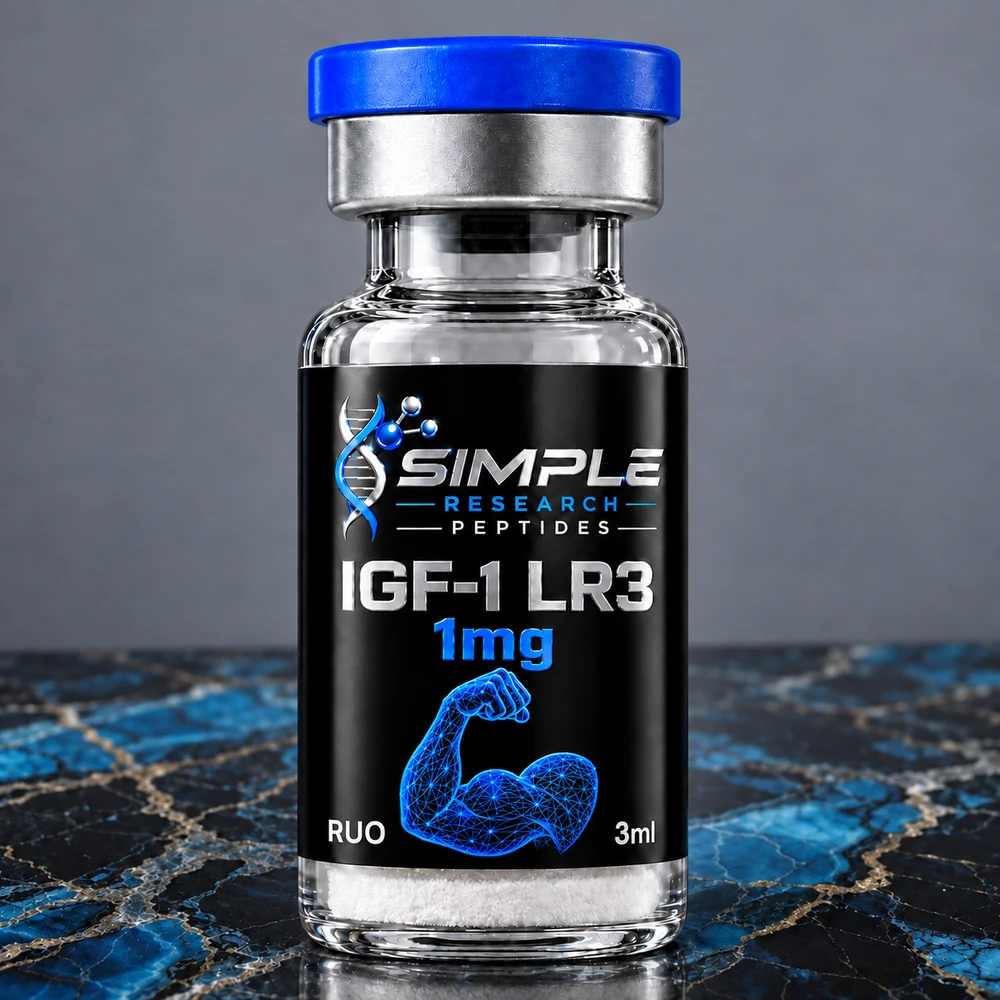
SRP listing nameIGF-1 LR3 (1 mg Vial)Page also prints “IGF-1 LR3 (1 mg / 3 mL Vial)”. Also-known-as: Insulin-Like Growth Factor-1 Long R3, Long R3 IGF-1.
SRP listed strength1 mg / 3 mL research vial1 mg lyophilized research compound. SKU not printed. Sequence, CAS, UNII, and a public COA were not printed.
Index evidence tagLaboratory reagent evidenceIndex listing: “IGF-1 LR3 (1 mg Vial)” under Growth; Evidence profile. Field: Growth-factor research.
Chemical classRecombinant single-chain IGF-I analogProtein, not a short linear peptide. NCATS substance class protein; Francis 1992; Laajoki 2000.
Residue count83NCATS subunit length 83; BMRB 4494 “83 residues”; 13-aa extension + Glu3→Arg.
Sequence (opened)MFPAMPLSSLFVN…KSAFull FASTA on NCATS M9L22Y19H9 and BMRB 4494 (same string).
CAS (Long R3)143045-27-6NCATS PRIMARY; PubChem SID 375085922 RN. Marketplace 946870-92-4 rejected.
UNIIM9L22Y19H9Display name LONG-(ARG3)INSULIN-LIKE GROWTH FACTOR-I. Approval Year Unknown. Record “approved” is a GSRS flag, not an FDA drug approval.
PubChem CIDNot foundName lookups and CAS 143045-27-6 xref/RN returned HTTP 404. SID 375085922 is a GSRS deposit, not a CID.
BMRB4494Long-[Arg3]IGF-1; 83-aa FASTA; vector p[MET1]pGH(1-11)-VAL-ASN-[ARG3]-IGF-I.
IUPHAR / CT.govNo LR3 ligand; 0 NCTsIUPHAR 4971 is IGF-1 / mecasermin — NOT the SRP vial. CT.gov LR3-term query: 0 studies.
Identifier Value on opened page Source opened
Trade / development names Long-(Arg3)insulin-like growth factor-I; Long R3 insulin-like growth factor-I; IGF-1 LR3; insulin-like growth factor long chain R3; Long-[Arg3]IGF-I; LR3IGF-I; Long R3 IGF-I NCATS UNII M9L22Y19H9; Francis 1992 PMID 1378742; Tomas 1992 PMID 1371669 (full PDF); BMRB 4494
Systematic / CAS-style name on NCATS 1-13-somatotropin (swine reduced), 1-L-methionine-12-L-valine-, (13→1′)-protein with 3-L-arginine insulin-like growth factor I (human) NCATS M9L22Y19H9
SRP listing name IGF-1 LR3 (1 mg Vial); page also prints “IGF-1 LR3 (1 mg / 3 mL Vial)” SRP product page
SRP also-known-as line Insulin-Like Growth Factor-1 Long R3, Long R3 IGF-1 SRP product page
SRP listed strength / format 1 mg lyophilized research compound in a 3 mL research vial SRP product page
SRP SKU Not printed on the fetched product page SRP product page
SRP store / research category Growth / Recovery Research SRP product page (store taxonomy, not a clinical indication)
SRP index listing “IGF-1 LR3 (1 mg Vial)” under Growth; “Evidence profile”; evidence tag Laboratory reagent evidence; field Growth-factor research SRP compound-research-guides index
Chemical class Recombinant single-chain IGF-I analog (protein, not a short linear peptide) NCATS substance class protein; Francis 1992; Laajoki 2000
Residue count 83 NCATS subunit length 83; BMRB 4494 “83 residues”; Laajoki 2000 (13-aa extension + Glu3→Arg)
Sequence printed on opened pages MFPAMPLSSLFVNGPRTLCGAELVDALQFVCGDRGFYFNKPTGYGSSSRRAPQTGIVDECCFRSCDLRRLEMYCAPLKPAKSA NCATS M9L22Y19H9 subunit; BMRB 4494 FASTA (same string)
N-terminal extension (as printed) Met-Phe-Pro-Ala-Met-Pro-Leu-Ser-Ser-Leu-Phe-Val-Asn (13 aa). Francis 1992: first 11 residues of methionyl porcine GH plus Val-Asn. Tomas 1992 PDF: “N-terminal extension Met-Phe-Pro-Ala-Met-Pro-Leu-Ser-Ser-Leu-Phe-Val-Asn.” Tomas 1992 full PDF; Francis 1992 abstract; BMRB vector p[MET1]pGH(1-11)-VAL-ASN-[ARG3]-IGF-I
Position-3 substitution Glu-3 of the human IGF-I sequence replaced by Arg. On the 83-aa numbering the IGF-I domain starts at residue 14 (Gly), so Arg is residue 16. Francis 1992; Laajoki 2000; NCATS sequence GPR… after the 13-aa leader
Disulfide links (NCATS 83-aa numbering) 19–61, 31–74, 60–65 (three intramolecular bridges) NCATS API _disulfideLinks shorthand
Native mature IGF-I (for comparison; not this analog) GPETLCGAELVDALQFVCGDRGFYFNKPTGYGSSSRRAPQTGIVDECCFRSCDLRRLEMYCAPLKPAKSA (70 aa). UniProt P05019 chain 49–118. Rinderknecht 1978: 70 residues, calculated MW 7649. Increlex label: “70 amino acids… molecular weight of 7649 Da… sequence identical to endogenous human IGF-1.” UniProt P05019; NCATS mecasermin 7GR9I2683O; PMID 632300; DailyMed Increlex. NOT the SRP vial.
UniProt for endogenous IGF-1 (not LR3) P05019 (IGF1_HUMAN). Reviewed Swiss-Prot. 195-aa precursor; mature chain 49–118. Gene IGF1 / GeneID 3479. MIM 147440 (gene), 608747 (IGF1 deficiency). UniProt REST JSON + FASTA, opened 16 August 2026
PubChem compound CID for IGF-1 LR3 / Long R3 IGF-1 / Long Arg3 IGF-I None. Name lookups returned HTTP 404 / PUGREST.NotFound. CAS 143045-27-6 xref/RN also 404 (no CID). PubChem PUG REST, opened 16 August 2026
PubChem substance SID (GSRS deposit) SID 375085922 (source id M9L22Y19H9; synonyms include IGF-1 LR3, 143045-27-6, LONG R3 INSULIN-LIKE GROWTH FACTOR-I). SID 381123731 also returned on the name lookup; not re-opened as a second identity. PubChem substance JSON
CAS printed for Long-(Arg3)IGF-I 143045-27-6 (NCATS PRIMARY; PubChem SID 375085922 RN) NCATS M9L22Y19H9; PubChem SID
Marketplace CAS 946870-92-4 PubChem xref/RN resolved to CID 168009904, title a C80H154N4O6S2 lipid/amine (InChIKey CRZOPHSORDIMRX-UHFFFAOYSA-N). Rejected. Not used. PubChem PUG REST + compound page
UNII M9L22Y19H9. Display name LONG-(ARG3)INSULIN-LIKE GROWTH FACTOR-I. Approval Year Unknown. Development status Other. Record status “approved” is a GSRS record flag, not an FDA drug approval. https://drugs.ncats.io/drug/M9L22Y19H9
NCATS name search LONG R3 IGF-1 (quoted) total 0. The hit required LONG ARG3. NCATS API
IUPHAR / GtoPdb ligand for Long R3 / IGF-1 LR3 No ligand. Search Long R3 returned HTTP 404. IUPHAR services, opened 16 August 2026
IUPHAR ligand for native / recombinant IGF-1 (not LR3) Ligand 4971, name insulin-like growth factor 1, INN mecasermin, approved true, FDA (2005), species Human, gene IGF1, precursor prepro-insulin-like growth factor I. NOT the SRP vial. IUPHAR HTML + services
ClinicalTrials.gov (LR3 / Long R3 / Long Arg3 / LR3IGF / IGF-1 LR3) 0 studies CT.gov API v2, opened 16 August 2026
ClinicalTrials.gov query.intr=mecasermin Studies exist for rhIGF-1 / Increlex / rhIGF-1/rhIGFBP-3, not for Long R3. Examples opened: NCT00764699, NCT01406444, NCT02386839, NCT00572156, NCT01588093. Not the SRP vial. CT.gov API v2
NCT01767909 (seen as a data citation on Engel 2025) SNIFF trial of intranasal insulin (Humulin R), not LR3. Unused as LR3 evidence. CT.gov API v2
openFDA / Drugs@FDA INCRELEX / mecasermin = BLA021839, approved 2005-08-30, UNII 7GR9I2683O. No Long R3 / IGF-1 LR3 application. NOT the SRP vial. openFDA Drugs@FDA JSON
FDA-approved Long R3 / IGF-1 LR3 product None on the opened NCATS / openFDA / IUPHAR / CT.gov pages NCATS Approval Year Unknown; IUPHAR no ligand; CT.gov 0

What the molecule actually is. Francis, Ross, Ballard, Wallace and colleagues (1992, PMID 1378742) expressed E. coli fusion peptides built from the first 11 amino acids of methionyl porcine GH plus Val-Asn fused to human IGF-I, including the Glu-3→Arg variant they named Long [Arg3]-IGF-I. Tomas et al. 1992 (PMID 1371669; full PDF opened) print the same chemistry as “arginine replacing glutamate at position 3 of human IGF-I and the N-terminal extension Met-Phe-Pro-Ala-Met-Pro-Leu-Ser-Ser-Leu-Phe-Val-Asn,” supplied as recombinant human LR3IGF-I by GroPep. BMRB entry 4494 and NCATS UNII M9L22Y19H9 store the matching 83-residue FASTA. Laajoki et al. 2000 (PMID 10744677) determined the NMR solution structure and attributed reduced IGFBP affinity to reorientation of the N-terminal three residues of the IGF-I domain. A research vial labeled “IGF-1 LR3” is not chemically identified until that 83-aa Long-[Arg3] sequence, fold, and disulfide pairing are confirmed analytically.

Naming that must not be collapsed.

  • Long [Arg3]-IGF-I / LR3IGF-I / IGF-1 LR3 (this page) = 13-aa N-terminal extension + 70-aa IGF-I with E3R = 83 aa.
  • [Arg3]-IGF-I / [Gly3]-IGF-I (King 1992, PMID 1311930) = 70-aa IGF-I with only the position-3 substitution. The fusion leader was cleaved off. Not the Long analog.
  • Long IGF-I (Francis 1992) = the same 13-aa extension on unmodified IGF-I (Glu-3 retained). Weaker than Long [Arg3] in IGFBP-secreting cells.
  • des(1-3)IGF-I / IGF-1 DES = 67-aa truncation that removes Gly-Pro-Glu. Ballard 1996 (PMID 8930132). Different analog.
  • Endogenous IGF-1 / somatomedin C = 70-aa circulating chain from UniProt P05019.
  • Mecasermin / Increlex = recombinant 70-aa human IGF-1 (UNII 7GR9I2683O). Not the SRP vial.
  • Mecasermin rinfabate / IPLEX = rhIGF-1 plus rhIGFBP-3 (UNII NZ8M50KKRG). Not the SRP vial.

Registry chaos that must not be collapsed.

  • Marketplace CAS 946870-92-4 resolved on PubChem to an unrelated C80 lipid (CID 168009904). Not used.
  • Native-IGF-1 CAS 67763-96-6 (NCATS “GENERIC (FAMILY)”) and 68562-41-4 (PRIMARY on mecasermin) identify 70-aa IGF-1 / mecasermin, not Long R3.
  • UniProt P05019 is the endogenous precursor, not an 83-aa analog record.
  • IUPHAR 4971 is IGF-1 / mecasermin. There is no Long R3 ligand.
  • PubChem has no compound CID for Long R3. SID 375085922 is a GSRS substance deposit, not a small-molecule CID.
  • Vendor pages that cite PMID 1280101 for Francis 1992 are wrong. Opened PMID 1280101 is a pancreatic-acini PKA paper (O’Sullivan & Jamieson, Biochem J 1992). The defining Long [Arg3] paper is PMID 1378742.

Not printed on SRP pages and therefore not claimed as SRP-verified: amino-acid sequence, CAS, UNII, disulfide pairing, folding, endotoxin, bioactivity, or a public COA file. The product page prints “COA (Certificate of Analysis) available for batch verification” as a catalog bullet. That bullet is not an opened analytical package.

Critical identity point: IGF-1 LR3 / Long-[Arg3]IGF-I on opened registries is the 83-aa analog MFPAMPLSSLFVNGPRTLCGAELVDALQFVCGDRGFYFNKPTGYGSSSRRAPQTGIVDECCFRSCDLRRLEMYCAPLKPAKSA (UNII M9L22Y19H9; CAS 143045-27-6; BMRB 4494). PubChem CID not found. Marketplace CAS 946870-92-4 / CID 168009904 is an unrelated lipid and is rejected. Mecasermin is UNII 7GR9I2683O / CAS 68562-41-4 / BLA 021839 — NOT the SRP vial. No sequence is printed on the SRP page. Not FDA-approved as Long R3. Research use only.
02 / Overview

How it is not endogenous IGF-1, mecasermin / Increlex, DES(1-3), or [Arg3]IGF-I

This page is Long-[Arg3]IGF-I / IGF-1 LR3 only. Catalog “IGF-1” or “growth peptide” language is a nickname, not a chemical identity.

Identity What opened sources actually describe Length Typical literature role
Endogenous IGF-1 / somatomedin C UniProt P05019 mature chain 49–118; Rinderknecht 1978 (PMID 632300): 70 aa, MW 7649, three disulfides, proinsulin homology. Woods 1996 (PMID 8857020): human IGF1 gene deletion → IUGR and postnatal growth failure. 70 aa Circulating GH-axis effector. Not the analog.
Mecasermin / Increlex (NOT the SRP vial) NCATS UNII 7GR9I2683O; sequence identical to mature human IGF-1; CAS 68562-41-4 (PRIMARY) / 67763-96-6 (family); DrugBank DB01277; IUPHAR 4971; BLA 021839; FDA 2005. DailyMed: 70 aa, 7649 Da, E. coli rhIGF-1. 70 aa Approved pediatric rhIGF-1 for severe primary IGFD / GH-gene-deletion neutralizing antibodies. Not Long R3. NOT the SRP vial.
Mecasermin rinfabate / IPLEX (NOT the SRP vial) NCATS UNII NZ8M50KKRG; two subunits (264-aa IGFBP-3 + 70-aa IGF-1); CAS 478166-15-3; DrugBank DB14751. CT.gov NCT02386839 used rhIGF-1/rhIGFBP-3. Complex Co-formulated IGF-1 + IGFBP-3. Opposite of an IGFBP-resistant analog. NOT the SRP vial.
[Arg3]IGF-I or [Gly3]IGF-I (no Long) King 1992 (PMID 1311930): 70-aa peptides after cleavage of a pGH(1-46)-Val-Asn fusion. Poor bovine IGFBP-2 binding; slightly lower type-1 receptor binding; more potent than IGF-I on L6 myoblasts. 70 aa Position-3 point mutants. Not the 83-aa Long form.
des(1-3)IGF-I / IGF-1 DES Ballard 1996 (PMID 8930132): Gly-Pro-Glu removed from the N-terminus; isolated from bovine colostrum, human brain, porcine uterus; ~10-fold more potent in culture because Glu-3 is gone. 67 aa Truncated analog. Francis 1992 compared it with Long [Arg3]; they are not interchangeable.
Long IGF-I (Glu-3 retained) Francis 1992: [Met1]-pGH(1-11)-Val-Asn-IGF-I. More potent than IGF-I in IGFBP-secreting cells, less potent than Long [Arg3] or des(1-3). 83 aa Extension-only analog. Not R3.
Mechano growth factor / IGF-1Eb UniProt alternative name on P05019; splice/E-peptide biology. UniProt alternative-name / splice-product biology; not opened as an LR3 paper. Different product Not Long R3.
IGF-1 LR3 / Long-[Arg3]IGF-I (this page) 13-aa pGH-derived extension + E3R; 83 aa; UNII M9L22Y19H9; CAS 143045-27-6; BMRB 4494 83 aa Cell-culture / animal reagent; no opened human trial

Long R3 is not endogenous IGF-1

Native IGF-1 is a 70-aa serum peptide that spends most of its circulating life in an IGFBP-3 / ALS ternary complex (Increlex label §12.3: “>80% bound as a complex with IGFBP-3 and an acid-labile subunit”). Long R3 was built so that IGFBP binding is poor (Francis 1992; Tomas 1992; Laajoki 2000). Using somatomedin-C physiology as if it were LR3 pharmacology is a category error.

Long R3 is not Increlex / mecasermin

Increlex is 70-aa rhIGF-1 whose sequence “is identical to that of endogenous human IGF-1” (DailyMed description). NCATS, IUPHAR, openFDA, and the Increlex label do not list an Arg3 substitution or a 13-aa leader. Chernausek 2007 (PMID 17192294) and the Increlex pooled pediatric program are mecasermin data. They are labeled on this page as NOT the SRP vial.

Long R3 is not DES(1-3)

DES removes the first three residues. Long R3 adds thirteen residues and replaces residue 3. Francis 1992 ranked Long [Arg3] with des(1-3) in IGFBP-secreting cells and below native IGF-I in chicken embryo fibroblasts that do not secrete detectable IGFBPs — the opposite of a potency-always-higher story.

Long R3 is not [Arg3]IGF-I and is not an FDA-approved drug

King 1992 (PMID 1311930) made the 70-aa E3R/G3R peptides by cleaving a longer fusion. Those reagents share the Arg3 idea and the IGFBP-resistance logic; they do not contain the Long leader that Laajoki showed reorients the IGF-I N-terminus. NCATS Approval Year is Unknown. IUPHAR has no Long R3 ligand. ClinicalTrials.gov returned zero Long R3 studies. openFDA’s Increlex record is mecasermin.

Do not equate IGF-1 LR3 with endogenous IGF-1, Increlex / mecasermin, IPLEX, DES(1-3), or cleaved [Arg3]IGF-I. Long-[Arg3]IGF-I is the 83-aa analog (UNII M9L22Y19H9; CAS 143045-27-6; BMRB 4494). Mecasermin is UNII 7GR9I2683O, CAS 68562-41-4, BLA 021839, IUPHAR 4971, UniProt P05019 — NOT the SRP vial. PubChem CID not found. No LR3 NCT.
03 / Mechanism

Proposed mechanism (IGF-1R agonist with reduced IGFBP sequestration)

Opened primary papers support a working laboratory model. It is not a treatment claim for an SRP vial. Observed means a measurement on the opened paper or registry. Proposed means a mechanistic inference the authors or this page mark as such. Class / adjacent means distinction biology (mecasermin, native IGF-1). Not shown means absent from the opened record.

Class / adjacent — IGF-1, not LR3-specific

Native IGF-1 signaling

UniProt P05019: IGF-1 binds the IGF1R α-subunit, activates the receptor tyrosine kinase, and initiates PI3K–AKT and Ras–MAPK cascades; it also binds integrins and can form ternary complexes with IGF1R. Increlex label §12.1: Type 1 IGF-1 receptor activation stimulates processes that result in statural growth and has insulin-like effects on glucose, fatty-acid, and amino-acid uptake. Those sentences describe IGF-1 / mecasermin, not a research-market LR3 lot. NOT the SRP vial.

Observed — why Long R3 was built

Changed IGFBP interactions, not higher receptor affinity

Francis 1992: N-terminal analogs show increased biological potency in IGFBP-secreting cells because of changed IGFBP interactions, not higher receptor affinity. In chicken embryo fibroblasts that do not secrete detectable IGFBPs, Long [Arg3]-IGF-I was less potent than IGF-I. King 1992 (the 70-aa Arg3/Gly3 pair): both analogs “bound very poorly to bovine IGF-binding protein-2 and slightly less well than IGF-I to the type-1 receptor.” Tomas 1992 PDF: LR3IGF-I “binds 3-fold less well than IGF-I to the type 1 IGF receptor” yet was ~2.5-fold more potent than IGF-I in dexamethasone-treated rats; the authors attribute that to poor IGFBP binding and faster blood-to-tissue transfer. (PMID 1378742; PMID 1371669; PMID 1311930.)

Observed — NMR

N-terminal reorientation, flexible 13-aa extension

Laajoki 1997 (PMID 9450557) and 2000 (PMID 10744677): the IGF-I domain fold is largely retained; the major change is reorientation of the N-terminal three residues of the IGF-I domain; the 13-aa extension is flexible (negative heteronuclear NOEs) with some transitory structure. The authors interpret those N-terminal changes as the structural basis for lower IGFBP affinity. BMRB 4494 stores the 83-aa sequence used here.

Observed — named models

Downstream laboratory readouts

In L6 myoblasts and other IGFBP-secreting lines, Long [Arg3] stimulated protein and DNA synthesis and inhibited protein breakdown more potently than IGF-I (Francis 1992). In dexamethasone-treated rats, LR3IGF-I improved body-weight change and nitrogen retention ~2.5-fold more potently than IGF-I and increased gut weight by up to 45% (Tomas 1992). In streptozotocin-diabetic rats, variants restored growth without restoring insulin-like control of glucosuria or Nτ-methyl-histidine excretion (Tomas 1993). In guinea pigs, LR3IGF-I increased fractional weights of adrenals, gut, kidneys, and spleen without increasing body-weight gain (Conlon 1995). In finisher pigs, LR3IGF-I decreased average daily gain, food intake, plasma GH, IGFBP-3, IGF-I, and insulin (Dunaiski 1997). Those are species- and model-specific reagent findings, not a human indication.

Proposed — not shown for an SRP vial

Folded 83-aa lot with GroPep pharmacology

That a lyophilized 1 mg catalog protein is the folded 83-aa Long-[Arg3] chain with the three NCATS disulfides, low endotoxin, and the IGFBP-resistant pharmacology of GroPep / CSIRO material. That marketplace “20–30 hour half-life” figures (common on unopened vendor pages) apply to any lot. No opened paper printed a human LR3 half-life. Increlex’s labeled terminal t½ of 5.8 hours is mecasermin, and even that value is IGFBP-3–dependent (DailyMed §12.3). NOT the SRP vial.

Not shown on an opened page

No cloned LR3 receptor; no human PK of a vial

A cloned “LR3 receptor” distinct from IGF1R / insulin receptor; human PK of an SRP vial; proof that research-market material is Long-[Arg3] rather than native IGF-1, [Arg3]IGF-I, DES, aggregated chain, or a mislabeled peptide; an FDA-approved LR3 drug; interchangeability with Increlex. IUPHAR has no Long R3 ligand. ClinicalTrials.gov returned 0 LR3 studies.

Rinderknecht & Humbel define mature IGF-1

70 aa, three disulfides, calculated MW 7649, proinsulin homology. Used only so the 70-aa chain is not collapsed into the 83-aa analog. PMID 632300.

Francis et al. define Long [Arg3]-IGF-I

Extension = pGH(1-11) + Val-Asn. In IGFBP-secreting lines, potency order Long [Arg3] ≈ des(1-3) > Long [Gly3] > Long IGF-I > IGF-I. In CEF (no detectable secreted IGFBPs), Long [Arg3] was less potent than IGF-I. PMID 1378742.

King et al. make cleaved 70-aa Arg3/Gly3

Fusion leader cleaved off. Poor bovine IGFBP-2 binding. Not the Long analog. PMID 1311930.

Tomas et al.: LR3IGF-I in dex-treated rats

Sequence printed; ~2.5× IGF-I potency; receptor 3-fold less well; gut +45%. Rat osmotic pumps. PMID 1371669. PMC 1130894.

Guinea-pig organs without body growth; pigs lose gain

Conlon 1995 (PMID 7561636): organ growth, no body-weight gain. Dunaiski 1997 (PMID 9488001): pigs decreased ADG and suppressed GH.

Laajoki: N-terminal reorientation

Solution structure of Long-[Arg3]IGF-I. BMRB 4494 stores the 83-aa sequence. PMID 10744677.

Increlex BLA 021839; Chernausek pediatric program

70-aa rhIGF-1. UNII 7GR9I2683O. NOT the SRP vial. PMID 17192294.

Engel: plaque remodeling, no cognitive preservation

Intranasal LR3-IGF-1 in 5XFAD mice. Data citation NCT01767909 is the SNIFF insulin trial, not LR3. PMID 39610283.

Not shown on an opened page: a cloned “LR3 receptor” distinct from IGF1R; human PK of an SRP vial; proof that research-market material is the folded 83-aa Long-[Arg3] chain; a human LR3 half-life; an FDA-approved LR3 drug; interchangeability with Increlex. Marketplace “20–30 hour half-life” figures were not taken from an opened primary paper.

Mechanism in one line: an IGF-1R agonist analog built for poor IGFBP binding, not higher receptor affinity. Francis 1992 already showed Long [Arg3] can be less potent than IGF-I when IGFBPs are absent. Not a treatment claim. Not for human use.
04 / Research Map

Where the literature actually sits

Label every row. LR3 ≠ native IGF-1 ≠ mecasermin / Increlex ≠ DES(1-3) ≠ [Arg3]IGF-I ≠ SRP vial. Human mecasermin numbers are historical facts about a different molecule. Historical µg/day and mg/kg figures from animal papers are facts from opened records, not reconstitution or dosing instructions for an SRP vial.

A. Identity / biochemistry / cell systems

Francis 1992 defines the analog

Francis et al. 1992, PMID 1378742: Long [Arg3]-IGF-I named; potency order in IGFBP-secreting lines; less potent than IGF-I in CEF. King 1992, PMID 1311930: 70-aa [Arg3]/[Gly3] after cleavage — not Long. Laajoki 2000, PMID 10744677: NMR; BMRB 4494. Xi 2004, PMID 15254966: rpIGFBP-3 still restrains LR3 proliferation. Cell systems. Not a vial COA. Not human.

B. Animal / organ / muscle preclinical

Rats, guinea pigs, pigs, mice — mixed endpoints

Tomas 1992, PMID 1371669 (full PDF): dex-treated rats; ~2.5× IGF-I; gut +45%. Tomas 1993, PMID 7683875: diabetic rats; growth without insulin-like metabolism. Steeb 1995, PMID 8549937: 3-day rat gut. Conlon 1995, PMID 7561636: guinea-pig organs without body growth. Dunaiski 1997, PMID 9488001: pigs decreased ADG. Engel 2025, PMID 39610283: 5XFAD mice; plaque remodeling, no cognitive preservation. Usually GroPep / CSIRO material, not an SRP 1 mg vial.

C. Human / regulatory — NOT the SRP vial

Increlex / mecasermin is a different molecule

DailyMed INCRELEX (mecasermin) label; openFDA BLA 021839; UNII 7GR9I2683O; CAS 68562-41-4; IUPHAR 4971; UniProt P05019. Chernausek 2007, PMID 17192294: rhIGF-I in children. Woods 1996, PMID 8857020: IGF1 gene deletion. CT.gov mecasermin NCTs exist; zero Long R3 NCTs. Every row in this block is NOT the SRP vial and is not Long R3.

D. Regulatory — 0 LR3 studies, not FDA-approved

No ClinicalTrials.gov record for Long R3

CT.gov API v2 queries for IGF-1 LR3 / Long R3 / Long-R3 / Long Arg3 / LR3IGF each returned {"studies":[]}. NCATS Approval Year Unknown. IUPHAR: no Long R3 ligand. openFDA Increlex is mecasermin. Do not invent NCTs.

E. Distinctions — not this analog

Native IGF-1, DES, cleaved Arg3, IPLEX

Native 70-aa IGF-1: PMID 632300; UniProt P05019. DES: Ballard 1996, PMID 8930132. Cleaved [Arg3]: King 1992, PMID 1311930. IPLEX / mecasermin rinfabate: UNII NZ8M50KKRG. Marketplace CAS 946870-92-4 / CID 168009904 rejected. Vendor PMID 1280101 is a pancreatic-acini paper, not Francis 1992.

Vendor identity — not independently verified

SRP 1 mg vial prints no sequence

Opened SRP page: IGF-1 LR3 (1 mg Vial); Growth / Recovery Research; 1 mg / 3 mL; also-known-as Long R3 IGF-1; research use only. Sequence, CAS, UNII, molecular formula, SKU, and a public COA were not printed. Index tag: Laboratory reagent evidence. Product page.

05 / Snapshot

Opened records, read as they actually sit

Read the “what it did not show” column. Published study designs are historical facts from those papers. They are not a protocol. Animal µg/day and mg/kg figures are study conditions, not instructions for an SRP research vial. Evidence snapshot date: 16 August 2026, America/Indianapolis.

A. Identity / biochemistry / cell systems

Study Species / model What was tested Actual finding (from the opened record) What it did not show
Rinderknecht & Humbel, 1978
PMID 632300. DOI 10.1016/s0021-9258(17)40889-1. Opened abstract. Distinction only.
Human serum IGF-I Native sequence Defines mature IGF-1, not LR3. 70 aa, three disulfides, calculated MW 7649, proinsulin homology. Used only so the 70-aa chain is not collapsed into the 83-aa analog. Anything about Long R3. An SRP-vial identity. A human LR3 trial.
King et al., 1992
PMID 1311930. DOI 10.1677/jme.0.0080029. Opened abstract. Distinction: [Arg3] not Long.
E. coli fusion → cleaved [Gly3]-IGF-I and [Arg3]-IGF-I (70 aa); rat L6 myoblasts; bovine IGFBP-2 Position-3 point mutants without the Long leader Both analogs more potent than IGF-I on protein/DNA synthesis and protein-breakdown inhibition. Bound very poorly to bovine IGFBP-2 and slightly less well than IGF-I to the L6 type-1 receptor. Authors: reduced IGFBP binding, not increased receptor binding, explains potency. Not Long R3. The 83-aa Long analog. An SRP vial. Human data.
Francis et al., 1992
PMID 1378742. DOI 10.1677/jme.0.0080213. Opened abstract. Defines Long [Arg3].
E. coli Long IGF-I, Long [Gly3]-IGF-I, Long [Arg3]-IGF-I; L6 myoblasts; H35 hepatoma; chicken embryo fibroblasts Defines the Long [Arg3] name Extension = pGH(1-11) + Val-Asn. In IGFBP-secreting lines, potency order Long [Arg3] ≈ des(1-3) > Long [Gly3] > Long IGF-I > IGF-I. In CEF (no detectable secreted IGFBPs), Long [Arg3] was less potent than IGF-I. Receptor/IGFBP association “reinforced… increased biological potency due to changes in the degree of their IGFBP interactions.” Not a vial COA. Not human. Human data. A public COA for a research-market vial. Proof that an SRP lot is GroPep material.
Laajoki et al., 1997
PMID 9450557. DOI 10.1016/s0014-5793(97)01496-8. Opened Europe PMC core abstract.
15N-labelled Long-[Arg-3]-IGF-I NMR Secondary structure IGF-I domain “almost identical” to IGF-I; N-terminal seven extension residues have few medium/long-range NOEs; next five form a turn near helix 1. Interpreted as increased potency and decreased IGFBP binding. Human PK. An SRP-vial fold confirmation. A crystal structure of a marketplace lot.
Laajoki et al., 2000
PMID 10744677. DOI 10.1074/jbc.275.14.10009. Opened abstract.
15N Long-[Arg3]IGF-I NMR + dynamics Solution structure Helix backbone RMSD 0.82 ± 0.28 Å. Major change vs IGF-I: reorientation of the N-terminal three residues of the IGF-I domain, interpreted as lower IGFBP affinity. Extension flexible (negative hetNOEs) with some transitory structure. BMRB 4494 stores the 83-aa sequence used here. Human data. Proof a catalog vial matches this NMR construct.
Gajanandana et al., 1998
PMID 9582496. DOI 10.1677/joe.0.1560407. Opened abstract.
LR3IGF-I ELISA vs IGF-I/II; cow plasma after LR3 treatment Analog-specific assay Detected 50 pg / 100 µl; native IGF-I and -II <0.01% cross-reactivity; IGFBPs did not affect the ELISA. Used to measure LR3 in cows given a “pharmacologically active dose.” Animal assay paper, not human PK. Human PK of an SRP vial. A clinical immunoassay claim.
Xi et al., 2004
PMID 15254966. DOI 10.1002/jcp.20068. Opened abstract.
L6 myoblasts; recombinant porcine IGFBP-3 vs IGF-I and Long-R3-IGF-I Does IGFBP-3 still restrain LR3? rpIGFBP-3 suppressed both IGF-I- and Long-R3-stimulated proliferation (IGF-dependent and IGF-independent). It suppressed IGF-I-stimulated differentiation but not Long-R3-stimulated differentiation. Cell line. Not a vial bioassay. Human muscle. An SRP-lot bioassay. A treatment claim.
NCATS M9L22Y19H9 + BMRB 4494 + UniProt P05019 Human reference sequences Identity map 83-aa Long-(Arg3) record with CAS 143045-27-6 and UNII M9L22Y19H9; native precursor P05019 / 70-aa mature chain. PubChem CID not found. An FDA approval for Long R3. A CID. An SRP COA.

B. Animal / organ / muscle preclinical (Long R3 named)

These rows test infused or added Long R3 / LR3IGF-I, usually GroPep / CSIRO recombinant material, not an SRP 1 mg vial. Historical µg/day and mg/kg figures are study conditions, not instructions.

Study Species / model What was tested Actual finding (from the opened record) What it did not show
Tomas et al., 1992
PMID 1371669. PMC 1130894. DOI 10.1042/bj2820091. Opened full PDF.
150 g male Hooded Wistar rats; dexamethasone 20 µg/day; osmotic-pump IGF-I, des(1-3)IGF-I, or LR3IGF-I Catabolic-rat anabolism Dex-only: −19 g / 7 days. IGF-I 695 µg/day: +6 g. des(1-3) and LR3 ~2.5-fold more potent than IGF-I on weight and nitrogen retention. LR3 binds type-1 receptor 3-fold less well than IGF-I. Gut weight up to +45%. Fractional carcass weight stayed low; carcass gain was nitrogen, not fat. 3MH excretion fell; muscle Ks only partly restored (highest Ks still ~60% of pair-fed). Thymus atrophy not reversed. Rat osmotic pumps. Historical µg/day figures are not vial instructions. Human anabolism. An SRP-vial protocol. Reversal of all catabolic features.
Tomas et al., 1993
PMID 7683875. PMC 1132436. DOI 10.1042/bj2910781. Opened abstract.
Streptozotocin-diabetic ~160 g rats; IGF-I, des(1-3), LR3-IGF-I; insulin 30 IU/day reference Growth vs insulin-like metabolism IGF-I 695 µg/day: +48.1 ± 1.7 g / 7 days vs +11.0 ± 2.8 g vehicle. Variants 2.5–3× more potent than IGF-I. Insulin gained more weight, but the extra gain was fat. IGFs did not decrease glucosuria or Nτ-MH excretion; insulin did. Authors: IGFs restore growth without restoring all insulin-dependent liver/muscle/adipose processes. Diabetic rat. Not human diabetes. Human diabetes treatment. Insulin replacement. An SRP-vial indication.
Steeb, Trahair, Read, 1995
PMID 8549937. PMC 1382866. DOI 10.1136/gut.37.5.630. Opened abstract.
Female rats ~110 g; 3-day infusion IGF-I or LR3IGF-I 2.5 mg/kg/day Short-term gut mitogenesis LR3IGF-I, not IGF-I, increased body weight and small- and large-intestine wet weight +20%. Duodenal/ileal crypt length +13% / +22% with LR3 only. Both peptides raised thymidine labelling (up to 14%); only LR3 enlarged the crypt compartment. Authors: LR3 more potent and faster. 3-day rat infusion. Human gut growth. A chronic program. An SRP-vial instruction (2.5 mg/kg/day is a historical rat exposure).
Conlon et al., 1995
PMID 7561636. DOI 10.1677/joe.0.1460247. Opened abstract.
Female guinea pigs ~350 g; 7-day IGF-I, IGF-II, or LR3IGF-I 120 µg/day (IGFs also 360 µg/day) Species with circulating IGF-I and IGF-II No significant effect on body-weight gain, feed intake, feed conversion, or carcass composition. High-dose IGF-I increased adrenal fractional weight only. LR3IGF-I increased fractional weight of adrenals, gut, kidneys, and spleen without stimulating overall growth. IGF-I and IGF-II infusions did not raise total circulating IGF; LR3 still grew selected organs. Guinea pig. Organ growth ≠ body growth. A simple “more IGF = more growth” claim. Human organ-growth safety. An SRP-vial protocol.
Dunaiski, Dunshea, Walton, Goddard, 1997
PMID 9488001. DOI 10.1677/joe.0.1550559. Opened abstract.
Finisher pigs; 4-day LR3IGF-I 180 µg/kg/day ± pGH 30 µg/kg/day; IGF-I comparator Livestock growth LR3IGF-I decreased average daily gain, food intake, plasma IGFBP-3, IGF-I, and insulin. Mean plasma GH −23%; area under GH peaks −60%. pGH co-administration did not restore those suppressions. IGF-I decreased insulin and mean GH but did not significantly change IGFBP-3, ADG, or feed intake. Plasma glucose unchanged. Authors: GH suppression may explain the inhibitory effect of LR3 on pig growth. Opposite of a simple “more IGF = more growth” claim. Human muscle gain. Transferability to people. An SRP-vial livestock or bodybuilding protocol.
Engel et al., 2025
PMID 39610283. PMC 12617435. DOI 10.1177/13872877241299056. Opened abstract.
Male wild-type and 5XFAD mice; 7 months (ages 3–10) intranasal LR3-IGF-1 vs vehicle; n = 19–27/group Alzheimer-model cognition / Aβ Improved body composition. Did not significantly alter cognitive symptoms on multiple assays. Cortex: fewer filamentous plaques, more inert plaques, lower low-MW Aβ oligomers. In vitro, LR3 enhanced BV2 uptake of Aβ1-42 and actin-remodeling / endocytosis gene pathways. Authors: does not support LR3 as monotherapy; plaque remodeling without preserved cognition. Mouse IN study. Not a human AD trial. The paper’s CT.gov data citation NCT01767909 is the SNIFF insulin trial, not LR3. A human Alzheimer trial of LR3. Cognitive benefit. An SRP-vial CNS protocol.

C. Human / regulatory (clearly labeled: NOT the SRP vial; NOT Long R3)

These rows are historical facts about mecasermin / Increlex / endogenous IGF-1. They are not Long R3 evidence and they are not the SRP vial.

Study / record What was tested Actual finding (from the opened record) Why it is not the SRP vial
DailyMed INCRELEX (mecasermin) label
setid a8b27a1b-a611-4f91-ad22-76d4b390c3ae, revised 07/2025. Opened HTML. NOT the SRP vial.
70-aa rhIGF-1, BLA 021839 Pediatric indication: growth failure in patients ≥2 y with severe primary IGF-1 deficiency (height SDS ≤ −3.0, basal IGF-1 SDS ≤ −3.0, normal/elevated GH) or GH-gene deletion with neutralizing GH antibodies. 70 aa, 7649 Da, sequence identical to endogenous IGF-1. Warnings include hypoglycemia, hypersensitivity, intracranial hypertension, lymphoid hypertrophy, SCFE, scoliosis progression, malignant neoplasia, benzyl-alcohol risk in infants. Pooled 71-subject program: year-1 height velocity 2.8 → 8.0 cm/yr. Terminal t½ after 0.12 mg/kg SC in n=3: 5.8 h. Mecasermin, not Long R3. NOT the SRP vial. Label never names Arg3 or an 83-aa extension. UNII 7GR9I2683O; CAS 68562-41-4; BLA 021839.
openFDA Drugs@FDA INCRELEX / BLA021839
Opened JSON. NOT the SRP vial.
Regulatory file Priority NME, orphan, approved 2005-08-30; UNII 7GR9I2683O. Same: approved 70-aa product. NOT the SRP vial.
Chernausek et al., 2007
PMID 17192294. DOI 10.1210/jc.2006-1610. Opened Europe PMC core abstract. Mecasermin-class. NOT the SRP vial.
rhIGF-I in 76 children with GH-insensitivity IGF-I deficiency; up to 12 y Height velocity 2.8 → 8.0 cm/yr in year 1 (P < 0.0001); remained above baseline up to 8 y. Hypoglycemia 49%; lipohypertrophy 32%; tonsillar/adenoidal hypertrophy 22%. rhIGF-I / mecasermin-class. Not Long R3. NOT the SRP vial.
Woods et al., 1996
PMID 8857020. DOI 10.1056/nejm199610313351805. Opened page (no abstract text). Distinction only.
Human IGF1 gene deletion Title: intrauterine growth retardation and postnatal growth failure associated with deletion of the IGF-I gene. UniProt cites this for IGF1 deficiency (MIM 608747). Endogenous-gene human biology. Not LR3. NOT the SRP vial.
CT.gov query.intr=mecasermin (opened 16 August 2026)
NOT the SRP vial.
Increlex / rhIGF-1 / rhIGF-1+IGFBP-3 NCT00764699 (Increlex, Crohn, terminated); NCT01406444 (rhIGF-1, anorexia, completed); NCT02386839 (rhIGF-1/rhIGFBP-3, ROP follow-up, completed); NCT00572156 (Increlex + somatropin, terminated); NCT01588093 (Increlex, muscle glucose, completed). Mecasermin or IGF-1/IGFBP-3. NOT the SRP vial. Zero Long R3 NCTs on the LR3-term query.

Evidence snapshot answers (16 August 2026, America/Indianapolis)

Question Opened-record answer
Is IGF-1 LR3 a defined molecule? Yes, as a literature / registry object. 83-aa Long-[Arg3]IGF-I; sequence concordant on NCATS M9L22Y19H9, BMRB 4494, and Tomas 1992.
Did SRP print that sequence? No. 1 mg / 3 mL vial; no sequence, CAS, UNII, or public COA.
Is there a UNII / CAS? UNII M9L22Y19H9; CAS 143045-27-6. Marketplace CAS 946870-92-4 rejected (CID 168009904).
PubChem CID? Not found.
IUPHAR ligand? Not found for Long R3. Ligand 4971 is IGF-1 / mecasermin. NOT the SRP vial.
Human LR3 trial? None on opened CT.gov LR3 queries. No LR3 NCT.
Strongest LR3-specific evidence? Francis 1992 (defines the analog); Tomas 1992/1993 (rat anabolism, with important limits); Steeb 1995 (gut); Conlon 1995 (guinea-pig organs without body growth); Dunaiski 1997 (pigs: growth down); Laajoki 2000 (structure); Engel 2025 (mice: plaque remodeling, no cognitive preservation).
Does that equal human efficacy of a 1 mg vial? No.
Is Increlex evidence transferable? No. Different sequence, IGFBP binding, and regulatory object. NOT the SRP vial.
Evidence tier (matches the live SRP index card): laboratory-reagent / preclinical. Not a completed clinical program for research-market LR3.
06 / Not established

What is not established

  • Human efficacy, safety, pharmacokinetics, or bioavailability of marketplace IGF-1 LR3 vials, including the SRP 1 mg listing.
  • Interchangeability with Increlex / mecasermin, with mecasermin rinfabate, with endogenous IGF-1, with [Arg3]IGF-I, or with DES(1-3).
  • Any human dose, reconstitution, or administration scheme for Long R3. This page does not provide one. Animal µg/day and mg/kg figures are historical experimental exposures.
  • A registered ClinicalTrials.gov study of Long R3 / IGF-1 LR3 as an intervention (0 hits on the opened queries). No LR3 NCT.
  • An FDA-approved Long R3 product. NCATS Approval Year Unknown; openFDA Increlex is mecasermin.
  • That an SRP lyophilizate is folded, disulfide-correct, low-endotoxin, and IGFBP-resistant the way GroPep / CSIRO LR3IGF-I was in the 1990s papers.
  • A single, species-independent “growth” effect. Opened pigs (Dunaiski 1997) lost gain and suppressed GH; opened guinea pigs (Conlon 1995) grew organs without growing the animal; opened 5XFAD mice (Engel 2025) remodeled plaques without preserving cognition.
  • A human half-life for LR3. Vendor “20–30 hour” figures were not taken from an opened primary paper. Increlex t½ 5.8 h is mecasermin and is IGFBP-3–dependent. NOT the SRP vial.
  • Tumor, hypoglycemia, or organ-overgrowth risk quantified for a research vial. Increlex’s neoplasia and hypoglycemia warnings apply to mecasermin. IGF-1R is mitogenic (Increlex §12.2; UniProt function). That is mechanism context, not a completed LR3 toxicology package.
Popular claim Status after this review
“IGF-1 LR3 is the same as IGF-1 / somatomedin C” False identity. 83-aa analog vs 70-aa native chain.
“It is Increlex / mecasermin” False. Increlex is 70-aa rhIGF-1 (UNII 7GR9I2683O; BLA 021839; CAS 68562-41-4). NOT the SRP vial.
“It is IPLEX / mecasermin rinfabate” False. That product adds IGFBP-3. LR3 was built to avoid IGFBPs. NOT the SRP vial.
“It is IGF-1 DES / des(1-3)” False. DES is a 67-aa truncation (PMID 8930132).
“CAS 946870-92-4 identifies Long R3” Not used. PubChem mapped that RN to an unrelated lipid (CID 168009904).
“PMID 1280101 is the Francis Long R3 paper” False. Opened 1280101 is a pancreatic-acini paper. Use 1378742.
“Human trials proved research-market LR3 builds muscle” Unsupported. 0 LR3 NCTs. Mecasermin trials are a different molecule.
“Pigs and rats both grew on LR3, so people will” False reading. Dunaiski 1997 pigs reduced gain; Conlon 1995 guinea pigs grew organs without body-weight gain.
“Increlex dosing can be copied onto an LR3 vial” False and out of scope. Different molecule; SRP material is RUO only. This page does not provide dosing.
“There is an FDA-approved IGF-1 LR3 drug” False on opened NCATS / openFDA / IUPHAR / CT.gov.
Research vial = GroPep / CSIRO study lot Not established. No sequence/CAS/public COA on the SRP page.

No human LR3 trial

ClinicalTrials.gov returned 0 studies for IGF-1 LR3 / Long R3 / Long Arg3 / LR3IGF. Mecasermin NCTs are a different molecule and are labeled NOT the SRP vial.

No PubChem CID; marketplace CAS rejected

PubChem compound CID not found. CAS 143045-27-6 has no CID. Marketplace 946870-92-4 maps to CID 168009904, an unrelated C80 lipid. Not used.

Species-dependent “growth”

Rats retained nitrogen and grew gut. Guinea pigs grew organs without body-weight gain. Pigs lost gain and suppressed GH. 5XFAD mice remodeled plaques without preserving cognition.

SRP vial identity unconfirmed

Opened product page prints no sequence, CAS, UNII, or public COA. A catalog 1 mg lyophilizate is not established as the folded 83-aa BMRB 4494 chain.

Do not treat marketplace IGF-1 LR3 as Increlex. Do not claim FDA approval for Long R3. Do not invent an LR3 NCT. Do not copy mecasermin dosing onto a research vial. Research use only. Not for human use.
07 / Studies

Key papers as short cards

Each card is a single opened record. Historical animal exposures are study conditions, not instructions. No LR3 NCT is attached because ClinicalTrials.gov returned 0 studies. Mecasermin cards are labeled NOT the SRP vial.

Defines Long [Arg3]

Francis, Ross, Ballard, et al., 1992 — J Mol Endocrinol

Novel recombinant fusion protein analogues of insulin-like growth factor (IGF)-I indicate the relative importance of IGF-binding protein and receptor binding for enhanced biological potency. Defines Long [Arg3]-IGF-I as [Met1]-pGH(1-11)-Val-Asn-[Arg3]-IGF-I. In IGFBP-secreting lines, potency order Long [Arg3] ≈ des(1-3) > Long [Gly3] > Long IGF-I > IGF-I. In chicken embryo fibroblasts that do not secrete detectable IGFBPs, Long [Arg3] was less potent than IGF-I. Not a vial COA. Not human. PMID 1378742. DOI 10.1677/jme.0.0080213.

Distinction: [Arg3] not Long

King, Wells, Krieg, et al., 1992 — J Mol Endocrinol

Production and characterization of recombinant IGF-I and potent analogues with Gly or Arg substituted for Glu3, following expression in E. coli as fusion proteins. 70-aa [Arg3]/[Gly3] after cleavage of a pGH(1-46)-Val-Asn fusion. Bound very poorly to bovine IGFBP-2 and slightly less well than IGF-I to the type-1 receptor. Not the 83-aa Long analog. PMID 1311930. DOI 10.1677/jme.0.0080029.

Full PDF Sequence printed

Tomas, Knowles, Owens, et al., 1992 — Biochem J

IGF-I and especially IGF-I variants are anabolic in dexamethasone-treated rats. Prints the LR3IGF-I chemistry (Arg replacing Glu at position 3 plus the 13-aa Met-Phe-Pro-Ala-Met-Pro-Leu-Ser-Ser-Leu-Phe-Val-Asn extension); GroPep recombinant human LR3IGF-I. ~2.5-fold more potent than IGF-I on weight and nitrogen retention; binds type-1 receptor 3-fold less well; gut weight up to +45%. Rat osmotic pumps. Historical µg/day figures are not vial instructions. PMID 1371669. DOI 10.1042/bj2820091. PMC 1130894.

Diabetic rat

Tomas, Knowles, Owens, et al., 1993 — Biochem J

IGF-I and more potent variants restore growth of diabetic rats without inducing all characteristic insulin effects. Streptozotocin-diabetic rats. Variants 2.5–3× more potent than IGF-I. IGFs did not decrease glucosuria or Nτ-MH excretion; insulin did. Not human diabetes. PMID 7683875. DOI 10.1042/bj2910781. PMC 1132436.

Rat gut

Steeb, Trahair, Read, 1995 — Gut

Administration of IGF-I peptides for three days stimulates proliferation of the small intestinal epithelium in rats. LR3IGF-I, not IGF-I, increased body weight and small- and large-intestine wet weight +20%. Only LR3 enlarged the crypt compartment. 3-day rat infusion. Historical 2.5 mg/kg/day is a study condition, not an instruction. PMID 8549937. DOI 10.1136/gut.37.5.630. PMC 1382866.

Guinea pig No body-weight gain

Conlon, Tomas, Owens, Wallace, Howarth, Ballard, 1995 — J Endocrinol

Long R3 IGF-I infusion stimulates organ growth but reduces plasma IGF-I, IGF-II and IGF binding protein concentrations in the guinea pig. No significant effect on body-weight gain, feed intake, feed conversion, or carcass composition. LR3IGF-I increased fractional weight of adrenals, gut, kidneys, and spleen without stimulating overall growth. Organ growth ≠ body growth. PMID 7561636. DOI 10.1677/joe.0.1460247.

Pigs: growth down

Dunaiski, Dunshea, Walton, Goddard, 1997 — J Endocrinol

Long [R3] IGF-I reduces growth, plasma growth hormone, IGF binding protein-3 and endogenous IGF-I concentrations in pigs. LR3IGF-I decreased average daily gain, food intake, plasma IGFBP-3, IGF-I, and insulin. Mean plasma GH −23%; area under GH peaks −60%. Opposite of a simple “more IGF = more growth” claim. PMID 9488001. DOI 10.1677/joe.0.1550559.

NMR secondary structure

Laajoki, Le Breton, Shooter, et al., 1997 — FEBS Lett

Secondary structure determination of 15N-labelled human Long-[Arg-3]-insulin-like growth factor 1 by multidimensional NMR spectroscopy. IGF-I domain almost identical to IGF-I; N-terminal seven extension residues have few medium/long-range NOEs. Europe PMC core JSON opened. PMID 9450557. DOI 10.1016/s0014-5793(97)01496-8.

Solution structure BMRB 4494

Laajoki, Francis, Wallace, Carver, Keniry, 2000 — J Biol Chem

Solution structure and backbone dynamics of long-[Arg(3)]insulin-like growth factor-I. Major change vs IGF-I: reorientation of the N-terminal three residues of the IGF-I domain, interpreted as lower IGFBP affinity. Extension flexible. BMRB 4494 stores the 83-aa sequence. PMID 10744677. DOI 10.1074/jbc.275.14.10009.

Analog ELISA

Gajanandana, Irvine, Grant, et al., 1998 — J Endocrinol

Measurement of an analog of IGF-I in blood plasma using a novel ELISA. Detected LR3 with native IGF-I and -II <0.01% cross-reactivity. Animal assay paper, not human PK. PMID 9582496. DOI 10.1677/joe.0.1560407.

L6 + IGFBP-3

Xi, Kamanga-Sollo, Pampusch, White, Hathaway, Dayton, 2004 — J Cell Physiol

Effect of recombinant porcine IGFBP-3 on IGF-I and long-R3-IGF-I-stimulated proliferation and differentiation of L6 myogenic cells. rpIGFBP-3 suppressed both IGF-I- and Long-R3-stimulated proliferation. It suppressed IGF-I-stimulated differentiation but not Long-R3-stimulated differentiation. Cell line. Not a vial bioassay. PMID 15254966. DOI 10.1002/jcp.20068.

DES distinction

Ballard, Wallace, Francis, Read, Tomas, 1996 — Int J Biochem Cell Biol

Des(1-3)IGF-I: a truncated form of insulin-like growth factor-I. Gly-Pro-Glu removed; 67 aa. Different analog. Francis 1992 compared it with Long [Arg3]; they are not interchangeable. PMID 8930132. DOI 10.1016/1357-2725(96)00056-8.

5XFAD mice No cognitive preservation

Engel, Narayan, Cui, et al., 2025 — J Alzheimers Dis

Intranasal long R3 insulin-like growth factor-1 treatment promotes amyloid plaque remodeling in cerebral cortex but fails to preserve cognitive function in male 5XFAD mice. Did not significantly alter cognitive symptoms. Authors: does not support LR3 as monotherapy. Mouse IN study. Not a human AD trial. Data citation NCT01767909 is the SNIFF insulin trial, not LR3. PMID 39610283. DOI 10.1177/13872877241299056. PMC 12617435.

Native 70-aa IGF-1

Rinderknecht & Humbel, 1978 — J Biol Chem

The amino acid sequence of human insulin-like growth factor I and its structural homology with proinsulin. 70 aa, MW 7649. Defines mature IGF-1, not LR3. PMID 632300. DOI 10.1016/s0021-9258(17)40889-1.

Endogenous IGF1 deletion

Woods, Camacho-Hübner, Savage, Clark, 1996 — N Engl J Med

Intrauterine growth retardation and postnatal growth failure associated with deletion of the insulin-like growth factor I gene. Endogenous-gene human biology. Not LR3. Page opened (no abstract text). PMID 8857020. DOI 10.1056/nejm199610313351805.

Mecasermin-class NOT the SRP vial

Chernausek, Backeljauw, Frane, Kuntze, Underwood, 2007 — J Clin Endocrinol Metab

Long-term treatment with recombinant IGF-I in children with severe IGF-I deficiency due to growth hormone insensitivity. Height velocity 2.8 → 8.0 cm/yr in year 1. rhIGF-I / mecasermin-class. Not Long R3. NOT the SRP vial. Europe PMC core opened. PMID 17192294. DOI 10.1210/jc.2006-1610.

08 / Lab caution

Research-only caution

IGF-1 LR3 / Long-[Arg3]IGF-I is an investigational laboratory research protein analog. It is not an FDA-approved drug for human use. This page is educational. It does not provide dosing, reconstitution, administration, or any human-use instructions.

Simple Research Peptides (SRP) materials are for laboratory research only and are not for human or veterinary use, consumption, administration, diagnosis, treatment, or therapeutic application.

Laboratory identity is the first practical issue. Opened papers, NCATS UNII M9L22Y19H9, and BMRB 4494 describe the 83-aa analog MFPAMPLSSLFVNGPRTLCGAELVDALQFVCGDRGFYFNKPTGYGSSSRRAPQTGIVDECCFRSCDLRRLEMYCAPLKPAKSA (CAS 143045-27-6; disulfides 19–61, 31–74, 60–65 on 83-aa numbering). PubChem compound CID was not found. Marketplace CAS 946870-92-4 resolved to CID 168009904, an unrelated C80 lipid, and is rejected. Mecasermin / Increlex (UNII 7GR9I2683O; CAS 68562-41-4; BLA 021839; IUPHAR 4971; UniProt P05019) is 70-aa rhIGF-1 — NOT the SRP vial. [Arg3]IGF-I without the Long leader (PMID 1311930) and DES(1-3) (PMID 8930132) are different analogs. SRP product pages do not print sequence, CAS, UNII, formula, or a public COA. A method written for Increlex, native IGF-1, DES, or cleaved [Arg3]IGF-I is not automatically valid for this 83-aa analog.

Confirm the 83-aa Long-[Arg3] sequence, disulfide pairing, and fold before treating a vial as the literature article. Independently sourced research proteins are not established as equivalent to GroPep / CSIRO LR3IGF-I used in the 1990s papers. Historical animal µg/day and mg/kg figures are study conditions from those papers. They are not a reconstitution scheme and they are not a use guide for an SRP 1 mg / 3 mL research vial.

Biological inference has the same problem. The opened record is strong on analog identity and IGFBP-resistance biochemistry, real but model-dependent on animal growth/organ effects (rats up, pigs down, guinea-pig organs without body growth), empty on human LR3 trials (0 NCTs), and not transferable from mecasermin. That is a laboratory-reagent evidence profile, which matches the live SRP index card.

No reconstitution scheme, no administration route, and no human or veterinary use protocol appears on this page. Research use only. Historical animal µg/day and mg/kg figures are study conditions, not instructions. Confirm the 83-aa sequence and disulfides before treating a vial as the literature article. Increlex is NOT the SRP vial.
09 / FAQ

Common questions

Is IGF-1 LR3 a real, defined analog?

Yes, as a 1992 CSIRO / GroPep recombinant protein. Francis 1992 named Long [Arg3]-IGF-I. Tomas 1992, BMRB 4494, and NCATS M9L22Y19H9 print the same 83-aa idea (13-aa extension + Arg3). Sequence: MFPAMPLSSLFVNGPRTLCGAELVDALQFVCGDRGFYFNKPTGYGSSSRRAPQTGIVDECCFRSCDLRRLEMYCAPLKPAKSA. Whether a given research vial is that folded chain is not established without analytical identity testing. PMID 1378742.

What does the SRP vial claim?

Opened product page: 1 mg lyophilized material in a 3 mL research vial; also-known-as “Insulin-Like Growth Factor-1 Long R3, Long R3 IGF-1”; Growth / Recovery Research; RUO. No sequence. http://simpleresearchpeptides.com/product/igf-1-lr3-1-mg-vial/

Is it endogenous IGF-1?

No. Endogenous IGF-1 is the 70-aa somatomedin-C chain (P05019 residues 49–118; Rinderknecht 1978, PMID 632300).

Is it Increlex / mecasermin?

No. Increlex is recombinant 70-aa human IGF-1 (UNII 7GR9I2683O; CAS 68562-41-4; BLA 021839; IUPHAR 4971; UniProt P05019; FDA 2005) for a narrow pediatric IGFD indication. That label and Chernausek 2007 (PMID 17192294) are not Long R3 evidence and are NOT the SRP vial.

Is it IGF-1 DES?

No. DES(1-3) lacks the first three residues (Ballard 1996, PMID 8930132). Long R3 adds a 13-aa leader and substitutes Arg at position 3.

Is it [Arg3]IGF-I without the Long extension?

No. King 1992 (PMID 1311930) made 70-aa E3R/G3R peptides by cleaving a longer fusion. Those reagents do not contain the Long leader.

Has a human Long R3 trial been registered?

Not on the opened ClinicalTrials.gov queries (0 studies). No LR3 NCT. Human PK, efficacy, and safety of research-market LR3 are not established.

Did the animal studies use the same material as an SRP vial?

Not shown. Tomas 1992 used GroPep recombinant human LR3IGF-I in osmotic pumps. SRP does not print sequence, CAS, or a public COA. Historical animal exposures are not instructions.

Why do some animal papers show more growth and some show less?

Opened record is mixed by species and endpoint. Rats: more nitrogen retention and gut growth (Tomas 1992; Steeb 1995). Guinea pigs: organ growth without body-weight gain (Conlon 1995, PMID 7561636). Pigs: less gain and suppressed GH (Dunaiski 1997, PMID 9488001). 5XFAD mice: plaque remodeling without cognitive preservation (Engel 2025, PMID 39610283). Francis 1992 already showed Long [Arg3] can be less potent than IGF-I when IGFBPs are absent.

Is there a UNII or CAS?

UNII M9L22Y19H9 and CAS 143045-27-6 on opened NCATS / PubChem SID pages. Do not use 946870-92-4 (CID 168009904). PubChem CID not found.

Can SRP vials be used as a human dose substitute for Increlex?

No. SRP listings are for laboratory research only and are not for human or animal use. This page does not provide reconstitution, administration, or dosing instructions. Increlex is a different molecule. NOT the SRP vial.

Is the evidence mixed?

Yes. The opened record is strong on analog identity and IGFBP-resistance biochemistry, real but model-dependent on animal growth/organ effects, empty on human LR3 trials, and not transferable from mecasermin. That is a laboratory-reagent evidence profile, which matches the live SRP index card.

Does this page include human dosing?

No. There is no human dosing, reconstitution, or administration protocol on this page. Historical animal µg/day and mg/kg figures are study conditions, not instructions. Research use only. Not medical advice. Not for human use.

10 / References

Citations used on this page

Sources actually opened for this draft. Do not add PMIDs or NCTs that are not on the allowed list. ClinicalTrials.gov returned 0 Long R3 studies; no LR3 NCT is listed as an intervention.

  1. Francis GL, Ross M, Ballard FJ, et al. Novel recombinant fusion protein analogues of insulin-like growth factor (IGF)-I indicate the relative importance of IGF-binding protein and receptor binding for enhanced biological potency. J Mol Endocrinol. 1992;8(3):213-223. PMID 1378742. DOI 10.1677/jme.0.0080213. Defines Long [Arg3]-IGF-I. Europe PMC abstract opened.
  2. King R, Wells JR, Krieg P, et al. Production and characterization of recombinant insulin-like growth factor-I (IGF-I) and potent analogues of IGF-I, with Gly or Arg substituted for Glu3, following their expression in Escherichia coli as fusion proteins. J Mol Endocrinol. 1992;8(1):29-41. PMID 1311930. DOI 10.1677/jme.0.0080029. 70-aa [Arg3]/[Gly3] after cleavage — distinction from Long. Abstract opened.
  3. Tomas FM, Knowles SE, Owens PC, et al. Insulin-like growth factor-I (IGF-I) and especially IGF-I variants are anabolic in dexamethasone-treated rats. Biochem J. 1992;282(Pt 1):91-97. PMID 1371669. DOI 10.1042/bj2820091. PMC 1130894. LR3IGF-I sequence printed; ~2.5× IGF-I potency; gut +45%. Full PDF opened.
  4. Tomas FM, Knowles SE, Owens PC, et al. Insulin-like growth factor-I and more potent variants restore growth of diabetic rats without inducing all characteristic insulin effects. Biochem J. 1993;291(Pt 3):781-786. PMID 7683875. DOI 10.1042/bj2910781. PMC 1132436. Opened abstract.
  5. Steeb CB, Trahair JF, Read LC. Administration of insulin-like growth factor-I (IGF-I) peptides for three days stimulates proliferation of the small intestinal epithelium in rats. Gut. 1995;37(5):630-638. PMID 8549937. DOI 10.1136/gut.37.5.630. PMC 1382866. Opened abstract.
  6. Conlon MA, Tomas FM, Owens PC, Wallace JC, Howarth GS, Ballard FJ. Long R3 insulin-like growth factor-I (IGF-I) infusion stimulates organ growth but reduces plasma IGF-I, IGF-II and IGF binding protein concentrations in the guinea pig. J Endocrinol. 1995;146(2):247-253. PMID 7561636. DOI 10.1677/joe.0.1460247. Opened abstract.
  7. Dunaiski V, Dunshea FR, Walton PE, Goddard C. Long [R3] insulin-like growth factor-I reduces growth, plasma growth hormone, IGF binding protein-3 and endogenous IGF-I concentrations in pigs. J Endocrinol. 1997;155(3):559-565. PMID 9488001. DOI 10.1677/joe.0.1550559. Opened abstract.
  8. Laajoki LG, Le Breton E, Shooter GK, et al. Secondary structure determination of 15N-labelled human Long-[Arg-3]-insulin-like growth factor 1 by multidimensional NMR spectroscopy. FEBS Lett. 1997;420(1):97-102. PMID 9450557. DOI 10.1016/s0014-5793(97)01496-8. Europe PMC core JSON opened.
  9. Laajoki LG, Francis GL, Wallace JC, Carver JA, Keniry MA. Solution structure and backbone dynamics of long-[Arg(3)]insulin-like growth factor-I. J Biol Chem. 2000;275(14):10009-10015. PMID 10744677. DOI 10.1074/jbc.275.14.10009. Opened abstract. BMRB 4494.
  10. Gajanandana O, Irvine K, Grant PA, et al. Measurement of an analog of insulin-like growth factor-I in blood plasma using a novel enzyme-linked immunosorbent assay. J Endocrinol. 1998;156(3):407-414. PMID 9582496. DOI 10.1677/joe.0.1560407. Opened abstract.
  11. Xi G, Kamanga-Sollo E, Pampusch MS, White ME, Hathaway MR, Dayton WR. Effect of recombinant porcine IGFBP-3 on IGF-I and long-R3-IGF-I-stimulated proliferation and differentiation of L6 myogenic cells. J Cell Physiol. 2004;200(3):387-394. PMID 15254966. DOI 10.1002/jcp.20068. Opened abstract.
  12. Ballard FJ, Wallace JC, Francis GL, Read LC, Tomas FM. Des(1-3)IGF-I: a truncated form of insulin-like growth factor-I. Int J Biochem Cell Biol. 1996;28(10):1085-1087. PMID 8930132. DOI 10.1016/1357-2725(96)00056-8. DES distinction. Opened abstract.
  13. Engel MG, Narayan S, Cui MH, et al. Intranasal long R3 insulin-like growth factor-1 treatment promotes amyloid plaque remodeling in cerebral cortex but fails to preserve cognitive function in male 5XFAD mice. J Alzheimers Dis. 2025;103(1):113-126. PMID 39610283. DOI 10.1177/13872877241299056. PMC 12617435. Opened abstract.
  14. Rinderknecht E, Humbel RE. The amino acid sequence of human insulin-like growth factor I and its structural homology with proinsulin. J Biol Chem. 1978;253(8):2769-2776. PMID 632300. DOI 10.1016/s0021-9258(17)40889-1. Native 70-aa IGF-1. Opened abstract.
  15. Woods KA, Camacho-Hübner C, Savage MO, Clark AJ. Intrauterine growth retardation and postnatal growth failure associated with deletion of the insulin-like growth factor I gene. N Engl J Med. 1996;335(18):1363-1367. PMID 8857020. DOI 10.1056/nejm199610313351805. Endogenous IGF1 deletion. Page opened (no abstract text).
  16. Chernausek SD, Backeljauw PF, Frane J, Kuntze J, Underwood LE, GH Insensitivity Syndrome Collaborative Group. Long-term treatment with recombinant insulin-like growth factor (IGF)-I in children with severe IGF-I deficiency due to growth hormone insensitivity. J Clin Endocrinol Metab. 2007;92(3):902-910. PMID 17192294. DOI 10.1210/jc.2006-1610. Mecasermin-class; NOT the SRP vial. Europe PMC core opened.
  17. DailyMed INCRELEX (mecasermin) injection. setid a8b27a1b-a611-4f91-ad22-76d4b390c3ae. Revised 07/2025. Opened HTML. NOT the SRP vial. UNII 7GR9I2683O; CAS 68562-41-4; BLA 021839.
  18. ClinicalTrials.gov API v2: LR3-term query (0 studies); query.intr=mecasermin (NCT00764699, NCT01406444, NCT02386839, NCT00572156, NCT01588093); NCT01767909 (insulin SNIFF; unused). Opened 16 August 2026. No LR3 NCT. Do not invent one.
  19. UniProt P05019 REST JSON + FASTA (opened 16 August 2026). https://rest.uniprot.org/uniprotkb/P05019.json. Endogenous IGF-1, not the analog.
  20. NCATS Inxight LONG-(ARG3)INSULIN-LIKE GROWTH FACTOR-I UNII M9L22Y19H9 (https://drugs.ncats.io/drug/M9L22Y19H9) and MECASERMIN UNII 7GR9I2683O; mecasermin rinfabate NZ8M50KKRG. Opened 16 August 2026.
  21. IUPHAR/BPS ligand 4971 (IGF-1 / mecasermin). Search Long R3 = no ligand. Opened 16 August 2026. NOT the SRP vial.
  22. PubChem: no CID for Long R3 names; CAS 143045-27-6 no CID; CAS 946870-92-4 → CID 168009904 (rejected); SID 375085922 (GSRS M9L22Y19H9). Opened 16 August 2026.
  23. BMRB entry 4494 (Long-[Arg3]IGF-1; 83-aa FASTA). https://bmrb.io/data_library/summary/index.php?bmrbId=4494 (opened 16 August 2026).
  24. openFDA Drugs@FDA INCRELEX / BLA021839 (opened 16 August 2026). NOT the SRP vial.
  25. SRP pages (opened 16 August 2026): product http://simpleresearchpeptides.com/product/igf-1-lr3-1-mg-vial/ ; index http://simpleresearchpeptides.com/research-compound-directory/compound-research-guides/. For laboratory research only. Not for human or animal use.
  26. PMID 1280101 (O’Sullivan & Jamieson 1992) was opened only to reject a vendor mis-citation. Unused as LR3 evidence.

Allowed PMID list used on this page (Long R3 named): 1378742, 1371669, 7683875, 8549937, 7561636, 9488001, 9450557, 10744677, 9582496, 15254966, 39610283. Distinction PMIDs (do not cite as LR3-vial efficacy): 1311930 ([Arg3] not Long), 8930132 (DES), 632300 (native), 8857020 (IGF1 deletion), 17192294 (mecasermin-class). PMID opened only to reject a bad citation: 1280101. NCT: none for Long R3 / IGF-1 LR3. Adjacent unused IDs (mecasermin or insulin, not LR3): NCT00764699, NCT01406444, NCT02386839, NCT00572156, NCT01588093, NCT01767909. Opened PMC: PMC1130894, PMC1132436, PMC1382866, PMC12617435. UniProt P05019 (endogenous IGF-1, not the analog). UNII/CAS used: M9L22Y19H9 / 143045-27-6 (Long R3); 7GR9I2683O (mecasermin, distinction); NZ8M50KKRG (mecasermin rinfabate, distinction). CAS rejected: 946870-92-4 (CID 168009904). No other PMIDs were added. No LR3 NCT was invented.

Educational information only. IGF-1 LR3 (Long R3 IGF-1 / Long-[Arg3]IGF-I / LR3IGF-I) is an 83-amino-acid recombinant analog of mature human IGF-I: a 13-residue N-terminal extension plus the 70-residue IGF-I chain with Arg substituted for Glu at position 3. Opened sequence (BMRB 4494 / NCATS M9L22Y19H9): MFPAMPLSSLFVNGPRTLCGAELVDALQFVCGDRGFYFNKPTGYGSSSRRAPQTGIVDECCFRSCDLRRLEMYCAPLKPAKSA. CAS 143045-27-6. UNII M9L22Y19H9. PubChem CID not found. Marketplace CAS 946870-92-4 / CID 168009904 rejected. It is not endogenous somatomedin C (UniProt P05019; PMID 632300), not mecasermin / Increlex (UNII 7GR9I2683O; CAS 68562-41-4; BLA 021839; IUPHAR 4971) — NOT the SRP vial, not mecasermin rinfabate / IPLEX, not [Arg3]IGF-I without the Long extension (PMID 1311930), and not IGF-1 DES(1-3) (PMID 8930132). Francis 1992 (PMID 1378742) defines the analog. Tomas 1992 (PMID 1371669) printed the sequence. Laajoki 2000 (PMID 10744677) determined the NMR structure. Conlon 1995 (PMID 7561636) and Dunaiski 1997 (PMID 9488001) show species-dependent limits. Engel 2025 (PMID 39610283) remodeled plaques without preserving cognition. Chernausek 2007 (PMID 17192294) is mecasermin-class — NOT the SRP vial. Not FDA-approved as Long R3. ClinicalTrials.gov returned 0 Long R3 studies; no LR3 NCT. Historical animal µg/day and mg/kg figures are study conditions, not instructions. Laboratory research use only; not for human or animal use. Not medical advice. Not for human use. No human dosing protocol. Last source review: 16 August 2026 (America/Indianapolis). Locked draft converted to HTML the same day. For laboratory research only. Not for human or veterinary use.

Scroll to Top
View Cart