






Hormone signaling · Compound guide
HGH Fragment 176-191 Research Guide
Explore the mechanisms, study findings and evidence limits behind this research topic.
Product artwork identifies the SRP listing. It does not demonstrate safety or clinical benefit. The evidence guide and its sources follow below.
View product label and documentation →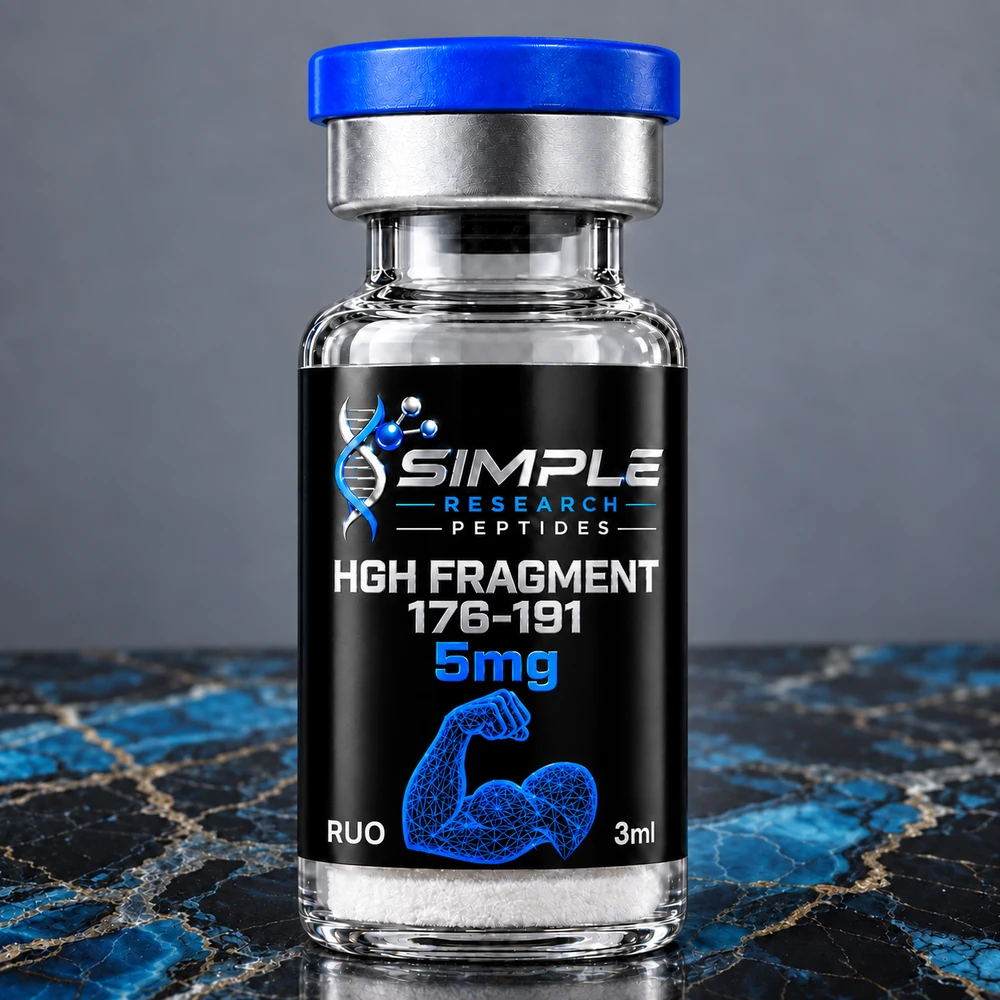
Back to the Research Compound Library
Related-fragment preclinical evidence; exact-sequence caution
Evidence reviewed September 13, 2026.
Research overview and identity
HGH Fragment 176-191 names a segment derived from the C-terminal region of human growth hormone. Fragment length and chemical modifications matter: literature on residues 177-191 or on modified AOD-9604 is not automatically direct evidence for an unmodified 176-191 preparation.
Mechanism under investigation
The research rationale is to examine selected metabolic actions of growth-hormone fragments separately from the full hormone. This is a hypothesis about structure and function, not a guarantee that a short fragment retains a desired effect or avoids every effect of the parent hormone.
What the studies report
A 1993 laboratory study investigated the related hGH 177-191 fragment in rat adipose tissue. It reported reduced lipogenesis without a significant increase in the measured lipolysis endpoint. That distinction matters when interpreting simplified claims that all C-terminal fragments directly accelerate fat breakdown. [1]
Limits of the evidence
The cited experiment used a different sequence boundary and a rat-tissue model. It does not establish human weight loss or validate the identity and activity of a retail 176-191 vial. Exact-sequence studies, independently confirmed chemistry and formulation-specific evidence are needed for stronger conclusions.
Matching research material to a paper
Check the material identity, formulation and analytical methods against the study methods. A product name or milligram amount alone does not demonstrate experimental equivalence. Published research does not establish the identity, purity or potency of a retail batch; batch-specific analytical documentation must be assessed separately.
For laboratory research only. Not for human or veterinary use. This guide is educational and contains no dosing, reconstitution or administration instructions.