






Hormone signaling · Compound guide
GHK Basic Research Guide
Explore the mechanisms, study findings and evidence limits behind this research topic.
Product artwork identifies the SRP listing. It does not demonstrate safety or clinical benefit. The evidence guide and its sources follow below.
View product label and documentation →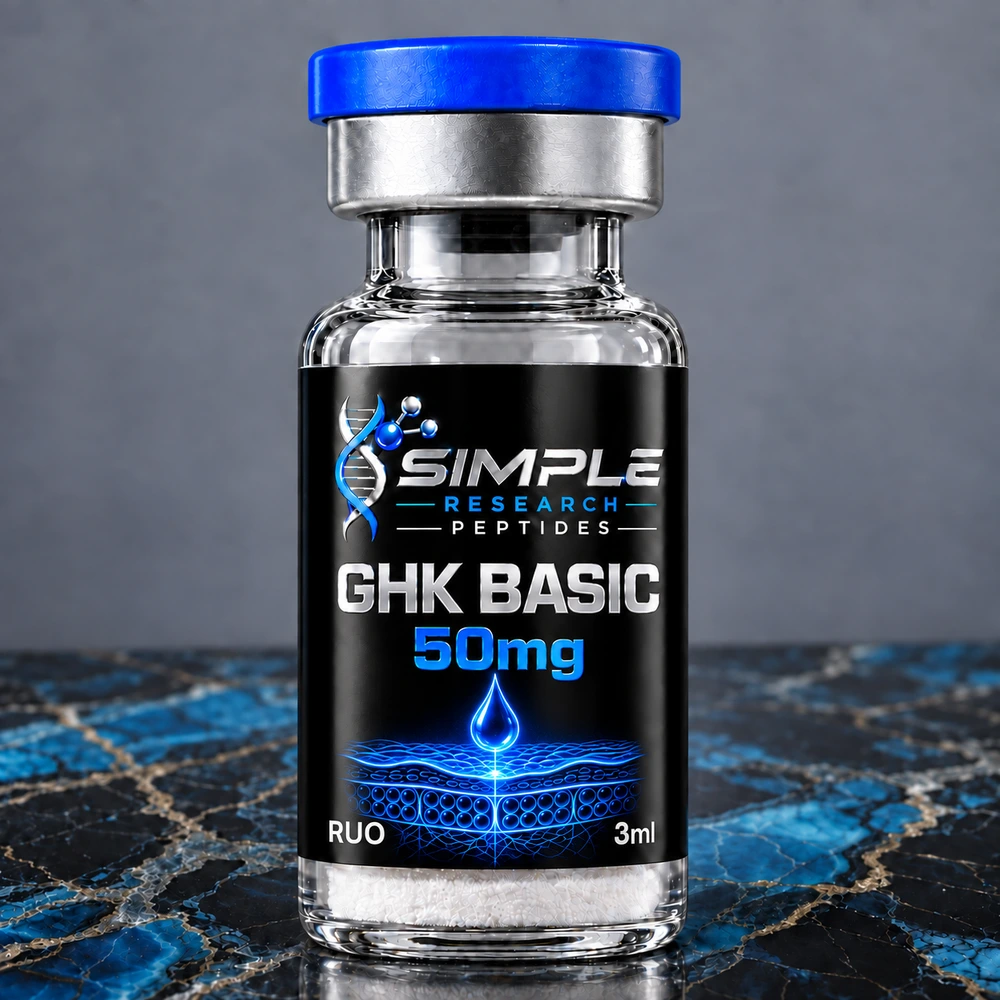
Back to the Research Compound Library
Cell and tissue-model research
Evidence reviewed September 13, 2026.
Research overview and identity
GHK Basic refers to the copper-free tripeptide glycyl-L-histidyl-L-lysine. Its identity matters because GHK and its copper complex, GHK-Cu, are related but distinct experimental materials. A study using one form should not automatically be cited as evidence for the other.
Mechanism under investigation
Research examines how GHK influences cellular behavior in skin models. Copper binding can change the chemical context, so investigators should record whether copper is supplied, already complexed, or present in the culture medium.
What the studies report
A 2012 study examined copper-free GHK in keratinocytes and skin-equivalent models and reported changes in proliferation and markers associated with the basal epidermal compartment. A separate fibroblast study compared GHK, GHK-Cu and copper chloride, illustrating why the peptide and metal components need to be evaluated separately. [1] [2]
Limits of the evidence
Cell proliferation and gene-expression measurements are experimental endpoints, not proof of visible rejuvenation or wound repair in people. The cited systems do not establish systemic use, clinical effectiveness, or a validated exposure schedule. Copper-free identity should be verified rather than inferred from the product name.
Matching research material to a paper
Check the material identity, formulation and analytical methods against the study methods. A product name or milligram amount alone does not demonstrate experimental equivalence. Published research does not establish the identity, purity or potency of a retail batch; batch-specific analytical documentation must be assessed separately.
For laboratory research only. Not for human or veterinary use. This guide is educational and contains no dosing, reconstitution or administration instructions.
Sources and further reading
- Copper-free GHK in keratinocytes and skin equivalents (2012)
- Comparative fibroblast research on GHK, GHK-Cu and copper chloride