SRP RESEARCH PULSE
HUGE SALE ON FEATURED ITEMSKLOW 80mgGLOW 70mgHumanin 10mgFOXO4-DRI 10mgACE-031 1mgWolverine 20/20SS-31 10mg5-Amino-1MQ 50mgMOTS-c 40mgBPC-157/TB-500 10mg/10mgSelank 10mgNAD+ 500mgGHK-Cu 100mgRTZ-GLP 30mgTirzepatide 30mgEpithalon 10mgKisspeptin 10mg

DSIP Research Guide

Research library · nonapeptide

DSIP Research GuideWAGGDASGE · emideltide · not melatonin · not GHB

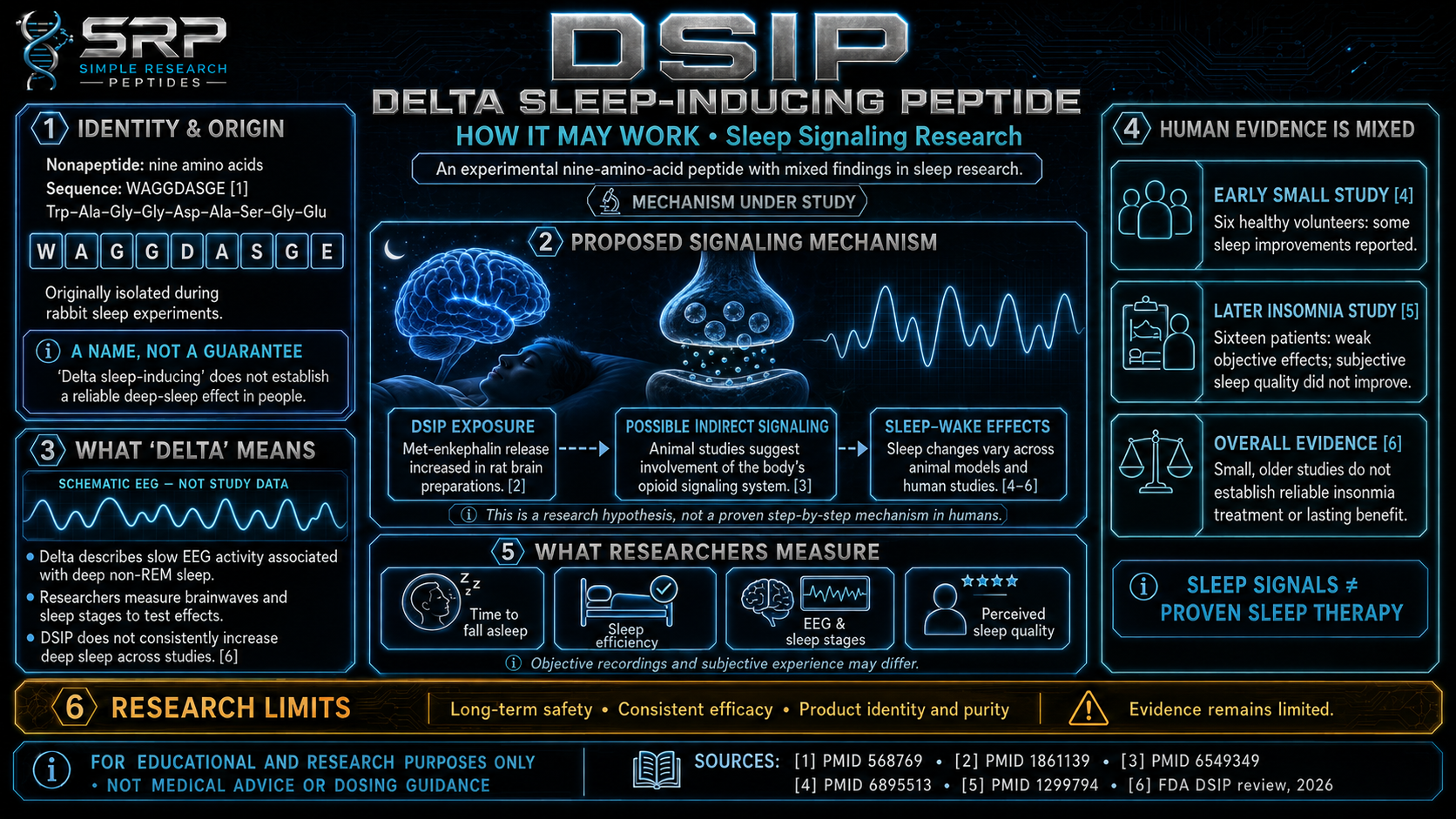
DSIP (delta sleep-inducing peptide; INN emideltide) is a synthetic nonapeptide whose classic sequence is Trp-Ala-Gly-Gly-Asp-Ala-Ser-Gly-Glu (WAGGDASGE / H-WAGGDASGE-OH), first reported from rabbit cerebral-venous dialysate in 1977–1978 sleep-EEG experiments. It is not melatonin, not GHB / sodium oxybate / Xyrem, not a benzodiazepine or Z-drug, and not an orexin antagonist. Endogenous existence of the free nonapeptide, a receptor, a precursor gene, and reproducible sleep pharmacology remain debated. Historical sleep claims are not a proven human sleep drug. Research use only. Not medical advice. Not for human use.

WAGGDASGE
emideltide
CID 68816
CAS 62568-57-4
UNII YN28Z5YZ73
Not FDA-approved
No IUPHAR ligand
Research use only

Educational information only. This page describes an investigational laboratory research peptide. It is not medical advice. Simple Research Peptides (SRP) materials are for laboratory research only and are not for human or veterinary use, consumption, administration, diagnosis, treatment, or therapeutic application. The opened SRP listing is a 5 mg / 3 mL research vial (SKU DSIP-5MG). Sequence, CAS, UNII, formula, and a public COA were not printed on the fetched SRP page. No human dosing, reconstitution, or administration protocol appears on this page. Historical 25–30 nmol/kg IV and 6 nmol/kg i.c.v. figures are study conditions from 1977–1987 papers, not instructions.

01 / Identity

Sequence and chemical identity (opened registries only)

SRP product and index pages do not print a sequence, CAS, UNII, molecular formula, or a public COA. Identity below is taken only from opened public registries and primary papers that name DSIP / delta sleep-inducing peptide / emideltide.

One-sentence identity: DSIP (INN emideltide) is a synthetic nonapeptide whose classic sequence is Trp-Ala-Gly-Gly-Asp-Ala-Ser-Gly-Glu (WAGGDASGE), first reported from rabbit cerebral-venous dialysate in 1977–1978. It is not melatonin, not GHB / sodium oxybate, not a benzodiazepine or Z-drug, and not an orexin antagonist. Endogenous existence of the free nonapeptide, a receptor, and a precursor gene remain debated. This is a defined sequence, not a tissue extract or undefined mixture.

Trade / development namesDSIP; emideltide (INN)Delta sleep-inducing peptide; DSIP nonapeptide. PubChem CID 68816; NCATS UNII YN28Z5YZ73; Schoenenberger & Monnier 1977 PMID 265572.
SRP listing nameDSIP 5 mg Sleep Research Peptide VialBrain & Mind Research. Lead: listed for qualified laboratory research use only.
SRP listed strength5 mg Vial (3ml Vial/5mg)SKU DSIP-5MG on the /products/ path. Sequence, CAS, UNII, formula, and a public COA were not printed.
Index evidence tagOlder, inconsistent evidenceIndex listing: “DSIP (5 mg Vial)” under Cognitive; Evidence profile. Field: Sleep and neuroendocrine research.
Chemical classLinear nonapeptideNine coded L-amino acids; free N- and C-termini; L-alpha-aspartyl at position 5 on opened PubChem / 1978 characterization.
Sequence (three-letter)Trp-Ala-Gly-Gly-Asp-Ala-Ser-Gly-GluPNAS 1977 Table 1; Pflügers 1978 abstract; PubChem / NCATS / MeSH.
Sequence (one-letter)WAGGDASGEPubChem: H-WAGGDASGE-OH; HELM PEPTIDE1{{W.A.G.G.D.A.S.G.E}}.
PubChem CID68816Title: Delta Sleep-Inducing Peptide. Opened 16 August 2026.
CAS on CID 6881662568-57-4 (primary)Also 69431-45-4. NCATS marks 62568-57-4 PRIMARY and 69431-45-4 “NO STRUCTURE GIVEN.”
UNIIYN28Z5YZ73PubChem CID 68816; NCATS Inxight Drugs.
Formula / MWC35H48N10O15 / 848.8PNAS 1977 Table 1 prints MW 849. Exact / monoisotopic mass 848.33006086. XLogP −7.1.
InChIKeyZRZROXNBKJAOKB-GFVHOAGBSA-NPubChem CID 68816; NCATS. Stereo-defined.
Identifier Value on opened page Source opened
Trade / development names DSIP; delta sleep-inducing peptide; delta-sleep-inducing peptide; DSIP nonapeptide; emideltide (INN) PubChem CID 68816; NCATS Inxight UNII YN28Z5YZ73; Schoenenberger & Monnier 1977 PMID 265572
SRP listing name DSIP 5 mg Sleep Research Peptide Vial SRP product page
SRP listed strength / format 5 mg Vial (page also prints “3ml Vial/5mg”) SRP product page
SRP SKU DSIP-5MG SRP /products/ page
SRP store / research category Brain & Mind Research SRP product page (store taxonomy, not a clinical indication)
SRP index listing “DSIP (5 mg Vial)”; Cognitive; “Evidence profile”; evidence tag Older, inconsistent evidence SRP compound-research-guides index
Chemical class Linear nonapeptide of nine coded L-amino acids; free N- and C-termini; L-alpha-aspartyl at position 5 on the opened PubChem / 1978 characterization PubChem biologic description; Schoenenberger et al. 1978 PMID 568769
Sequence (three-letter) Trp-Ala-Gly-Gly-Asp-Ala-Ser-Gly-Glu PNAS 1977 Table 1; Pflügers 1978 abstract; PubChem / NCATS / MeSH
Sequence (one-letter / HELM) WAGGDASGE; PubChem: H-WAGGDASGE-OH; HELM PEPTIDE1{W.A.G.G.D.A.S.G.E} PubChem CID 68816 biologic description
PubChem CID 68816. Title: Delta Sleep-Inducing Peptide PubChem PUG REST / PUG View / HTML, opened 16 August 2026
CAS on CID 68816 62568-57-4 (primary); also 69431-45-4 PubChem CID 68816; NCATS Inxight
Deprecated / extra CAS Deprecated 81659-81-6 (PubChem). PUG xrefs also listed 86349-55-5. Do not collapse these as independent identities. PubChem PUG View / xrefs
UNII YN28Z5YZ73 PubChem CID 68816; NCATS Inxight
Molecular formula / MW C35H48N10O15; 848.8 g/mol. PNAS 1977 Table 1 prints MW 849. Exact / monoisotopic mass 848.33006086 PubChem CID 68816; PNAS 1977
XLogP −7.1 PubChem PUG property
InChIKey ZRZROXNBKJAOKB-GFVHOAGBSA-N PubChem CID 68816; NCATS
IUPAC (computed) (2S)-2-[[2-[[(2S)-2-[[(2S)-2-[[(2S)-2-[[2-[[2-[[(2S)-2-[[(2S)-2-amino-3-(1H-indol-3-yl)propanoyl]amino]propanoyl]amino]acetyl]amino]acetyl]amino]-3-carboxypropanoyl]amino]propanoyl]amino]-3-hydroxypropanoyl]amino]acetyl]amino]pentanedioic acid PubChem PUG View
Systematic / CAS-style name L-Glutamic acid, L-tryptophyl-L-alanylglycylglycyl-L-alpha-aspartyl-L-alanyl-L-serylglycyl- PubChem; NCATS
PubChem condensed sequence H-Trp-Ala-Gly-Gly-Asp-Ala-Ser-Gly-Glu-OH; L-tryptophyl-L-alanyl-glycyl-glycyl-L-alpha-aspartyl-L-alanyl-L-seryl-glycyl-L-glutamic acid PubChem biologic description
NCATS Inxight EMIDELTIDE; Investigational; Approval Year: Unknown; originator field “Schoenenberger and Monnier” https://drugs.ncats.io/drug/YN28Z5YZ73
INN emideltide (PubChem “Emideltide [INN]”; NCATS source line INN:emideltide) PubChem; NCATS
ChEMBL CHEMBL2104403. HTML also prints “Max Phase Phase 2.” That is a ChEMBL field, not a ClinicalTrials.gov record. PubChem CID 68816 HTML
EPA DSSTox DTXSID20978151 PubChem; NCATS
NCI Thesaurus C80673 PubChem; NCATS
IUPHAR / GtoPdb ligand No ligand record for DSIP, emideltide, “delta sleep,” or WAGGDASGE IUPHAR services API, opened 16 August 2026
ClinicalTrials.gov (DSIP / emideltide / “delta sleep-inducing peptide”) 0 studies CT.gov API v2, opened 16 August 2026
openFDA Drugs@FDA / labels No DSIP / emideltide / UNII YN28Z5YZ73 match (NOT_FOUND) openFDA API, opened 16 August 2026
FDA-approved product None. NCATS: Investigational; Approval Year Unknown NCATS Inxight

What the molecule actually is. Schoenenberger & Monnier 1977 (PMID 265572; PMC 430668) name delta-sleep-inducing peptide (DSIP) and print the sequence Trp-Ala-Gly-Gly-Asp-Ala-Ser-Gly-Glu (Table 1, MW 849). Schoenenberger et al. 1978 (PMID 568769) repeat that sequence from amino-acid analysis of rabbit cerebral-venous dialysate and state that synthetic DSIP was infused at 6 nmol/kg i.c.v. in rabbits — a historical rabbit-assay condition, not an instruction. PubChem CID 68816 encodes the same nonapeptide as H-Trp-Ala-Gly-Gly-Asp-Ala-Ser-Gly-Glu-OH with an L-alpha-aspartyl residue. The 1978 paper states that only the pure alpha-aspartyl peptide is highly active, in contrast to its β-Asp isomer. A research vial labeled “DSIP” is not chemically identified until that sequence (and alpha-Asp vs β-Asp) is confirmed analytically.

Registry chaos that must not be collapsed.

  • PubChem CID 3623358 is a same-formula, unspecified-stereo twin (InChIKey ZRZROXNBKJAOKB-UHFFFAOYSA-N). Do not treat it as a second peptide.
  • NCATS also has N-Acetyl Emideltide, UNII CL985USD2K, a different record. It is not the SRP listing and is not classic DSIP.
  • CAS 62568-57-4 and 69431-45-4 both appear on CID 68816. NCATS marks 62568-57-4 PRIMARY and 69431-45-4 “NO STRUCTURE GIVEN.” Do not invent a reason they differ.
  • PubChem MeSH / NCATS prose blocks say DSIP “is found in neurons, peripheral organs, and plasma” and “induces mainly delta sleep in mammals,” including humans. Those sentences were not used as primary findings. The opened 2006 Kovalzon review and the immunoreactivity papers contradict treating endogenous occurrence or human sleep induction as settled.
  • ChEMBL “Max Phase Phase 2” is not an NCT and is not a modern efficacy program. ClinicalTrials.gov returned zero studies.

Not printed on SRP pages and therefore not claimed as SRP-verified: sequence, CAS, UNII, formula, alpha-Asp vs β-Asp, or purity numbers. The product page prints a “COA verified” bullet but does not display a public COA. SRP itself is a research-material listing, not a Schoenenberger-lab or clinical lot.

Critical identity point: DSIP / emideltide on opened registries is the nonapeptide Trp-Ala-Gly-Gly-Asp-Ala-Ser-Gly-Glu (WAGGDASGE; CID 68816; CAS 62568-57-4; UNII YN28Z5YZ73; C35H48N10O15). CID 3623358 is a stereo twin, not a second peptide. N-acetyl emideltide (UNII CL985USD2K) is a different record. No sequence is printed on the SRP page. Not FDA-approved. Research use only.
02 / Overview

How it is not melatonin, GHB, a GABA hypnotic, or an orexin drug

This page is DSIP / emideltide only. Marketplace “sleep peptide” language is a catalog nickname, not a receptor assignment. DSIP is a nine-residue peptide with a printed sequence. It is not an indoleamine, not a four-carbon hydroxy-acid, and not a mapped GABA-A or orexin ligand.

Identity What opened sources actually describe Peptide? Typical literature role
Melatonin Endogenous ligand of MT1 (IUPHAR target 287) and MT2 (target 288). IUPHAR ligand id 224. Indoleamine, not a peptide. No Circadian / MT1–MT2 pharmacology. Not DSIP.
GHB / γ-hydroxybutyrate IUPHAR ligand 4711; 4-hydroxybutanoic acid; MW ~104; CAS 591-81-1; approved-drug field Yes (FDA 2002 / EMA 2005); synonyms include Xyrem® (sodium oxybate). No (small hydroxy-acid) Approved narcolepsy chemistry in regulated products. Not DSIP.
Benzodiazepines / Z-drugs GABA-A positive modulators. Not opened here as DSIP evidence. No Clinical hypnotics with a mapped receptor. DSIP has no IUPHAR ligand.
Dual orexin-receptor antagonists OX1/OX2 antagonists. Not opened here as DSIP evidence. No Modern insomnia drug class. Not DSIP.
Pappenheimer Factor S Sleep-promoting material from goat CSF / sheep brain; PNAS 1977 explicitly says DSIP differs in molecular weight from Factor S. Different chemistry Historical “sleep factor” literature. Not DSIP.
DSIP / emideltide (this page) Nonapeptide WAGGDASGE; C35H48N10O15; MW ~849 Yes (nonapeptide) 1977–78 rabbit EEG isolation/synthesis; later small, older human IV series; endogenous identity debated
KND (WKGGNASGE) Mikhaleva et al. 2013: computer-found DSIP-related nonapeptide at a JMJD1B site; authors call it a putative endogenous prototype, not DSIP Yes (different nonapeptide) Hypothesis paper. Not the SRP sequence.
N-Acetyl emideltide NCATS UNII CL985USD2K Modified DSIP Different record. Not this listing.

DSIP is not melatonin

Melatonin is N-acetyl-5-methoxytryptamine acting at MT1/MT2 (IUPHAR ligand 224; targets 287 / 288). DSIP is a nine-residue peptide with no IUPHAR melatonin-receptor ligand record. Calling a research vial a “sleep peptide” does not make it melatonin.

DSIP is not GHB or sodium oxybate

GHB is a four-carbon hydroxy-acid (IUPHAR 4711) with approved-drug products (Xyrem® / sodium oxybate). A catalog nickname does not convert WAGGDASGE into Xyrem.

DSIP is not a mapped GABA-A or orexin drug

Opened IUPHAR searches found no DSIP ligand. A receptor for the nonapeptide is not established. Benzodiazepine, Z-drug, and dual orexin-antagonist papers were not opened as DSIP evidence.

Immunoreactivity is not automatically the nonapeptide

Graf, Kastin & Fischman 1984 (PMID 6549071) themselves wrote that, years after isolation, “no definitive evidence has been presented for the natural existence of the free peptide,” then reported a chromatography peak of DSIP-LI matching synthetic DSIP. Fischman, Kastin & Graf 1984 (PMID 6548808) separately warned that HPLC–RIA shadowing can produce false-positive “endogenous” peaks (up to 10% carry-over with DSIP). Sillard et al. 1993 (PMID 8375381) isolated a 77-residue porcine-brain peptide (DIP) recognized by a DSIP antiserum whose sequence is not related to DSIP. Vgontzas et al. 1995 (PMID 8532601) found no significant difference in morning plasma DSIP-LI among sleep-apnea, narcolepsy, and control groups. Immunoreactivity ≠ proven endogenous WAGGDASGE.

Do not equate DSIP with melatonin, GHB / Xyrem, Factor S, KND, or N-acetyl emideltide. DSIP / emideltide is the nonapeptide WAGGDASGE (CID 68816; CAS 62568-57-4; UNII YN28Z5YZ73). Melatonin is an indoleamine at MT1/MT2. GHB is 4-hydroxybutanoic acid (IUPHAR 4711). KND is WKGGNASGE. N-acetyl emideltide is UNII CL985USD2K. Factor S differs in molecular weight on the 1977 PNAS page.
03 / Mechanism

Proposed mechanism (uncertain; no established receptor)

Opened primary papers support only a historical working model. It is not a treatment claim. Observed means a measurement in an opened isolation or EEG paper. Proposed means a hypothesis or analogue observation. Class / adjacent means distinction biology (melatonin, GHB). Not shown means the opened papers did not establish it.

Observed — isolation context, not a receptor

Name records an EEG readout

DSIP was isolated from extracorporeal dialysate of rabbit cerebral venous blood during hypnogenic electrical stimulation of the thalamic intralaminar area (Schoenenberger 1978 abstract; PNAS 1977 cites the Monnier humoral-transmission series). The name records an EEG readout (delta / spindle enhancement after intraventricular infusion), not a cloned target. (PMID 265572; PMID 568769.)

Observed — 1977 rabbit assay

Only DSIP enhanced delta / spindles

Synthetic DSIP vs eight analogues/fragments, 58 rabbits including controls, i.c.v. infusion, double-blind, FFT of neocortical and limbic EEG. Only the DSIP nonapeptide showed significant delta/spindle enhancement. Time-integral median increase vs controls: neocortical delta +53.9% (controls −21.3 ± 6.1%; DSIP +32.7 ± 15.4%) and limbic delta +39.3%. Effects appeared about 10 min after infusion. The paper itself calls this a restrained-rabbit, short-observation, i.c.v. experimental model with little REM interference. That is not human sleep-architecture pharmacology. (PMID 265572.)

Observed — alpha-Asp vs β-Asp

Only the pure alpha-aspartyl peptide is highly active

Schoenenberger 1978: synthetic DSIP 6 nmol/kg i.c.v. in 61 rabbits including controls — a historical rabbit-assay condition, not an instruction. Mean delta activity +35% vs CSF-like solution or the other eight peptides; only the pure alpha-aspartyl peptide is highly active versus the β-Asp isomer. A catalog “DSIP” that is the isoaspartyl species would not match the active 1978 material. (PMID 568769.)

Not shown — no opened receptor

IUPHAR empty; gene / protein never isolated

IUPHAR has no DSIP / emideltide ligand. Graf & Kastin 1986 (PMID 3550726) wrote that a possible mechanism “involving the modulation of adrenergic transmission remain[s] to be established.” Kovalzon & Strekalova 2006 (PMID 16539679) state that the DSIP gene, protein, and possible related receptor were never isolated, that the sleep-factor hypothesis is “extremely poorly documented and still weak,” and that natural occurrence and biological activity remain obscure. In their own earlier work, certain artificial DSIP analogues (but not DSIP itself) promoted SWS in rabbits and rats. That is the opposite of a completed receptor story.

Proposed — DSIP-like peptide(s)

Kovalzon’s riddle, not a gene

The 2006 mini-review hypothesizes that DSIP-like peptide(s) — not necessarily WAGGDASGE — may account for DSIP-like immunoreactivity and some biological activity, citing hypothalamic immunoreactivity that is “not particularly relevant for sleep regulation,” a wide in-vitro activity spectrum, analogue (not DSIP) SWS activity, and a dermorphin-decapeptide with partial sequence similarity. That hypothesis is not proof of an endogenous DSIP gene. (PMID 16539679.)

Distinction — KND is a different sequence

WKGGNASGE is not WAGGDASGE

Mikhaleva et al. 2013 (PMID 24397026) report computer homology to WKGGNASGE (K2,N5-DSIP) inside human lysine-specific demethylase 3B / JMJD1B and call KND a “putative endogenous prototype.” Even if that peptide exists, it is not WAGGDASGE and is not this SRP listing.

Schoenenberger & Monnier define DSIP

Sequence Trp-Ala-Gly-Gly-Asp-Ala-Ser-Gly-Glu (Table 1, MW 849). Only synthetic DSIP enhanced rabbit i.c.v. delta/spindles. Distinguishes MW from Factor S. PMID 265572. PMC 430668.

Only the pure alpha-aspartyl peptide highly active

61 rabbits; mean delta +35%; β-Asp isomer contrasted. PMID 568769.

Schneider-Helmert / Schoenenberger network

n typically 6–18; intravenous synthetic DSIP; no NCT. Historical study conditions, not a modern RCT and not an SRP-vial protocol.

Free-peptide claim + HPLC shadowing

Graf PMID 6549071: no prior definitive free-peptide evidence, then a DSIP-LI peak. Fischman PMID 6548808: up to 10% HPLC–RIA carry-over.

DIP is 77 aa and not DSIP; Vgontzas null

Sillard PMID 8375381; Vgontzas PMID 8532601.

Kovalzon: gene, protein, receptor never isolated

Analogues but not DSIP itself had SWS activity in the authors’ early work. PMID 16539679.

WKGGNASGE is not this sequence

Mikhaleva PMID 24397026. Different nonapeptide.

Not shown on an opened page: a cloned DSIP receptor; a precursor gene that is processed to WAGGDASGE; a crystal structure; human PK of an SRP vial; proof that research-market material is the alpha-Asp nonapeptide; a modern, independently replicated human sleep RCT. IUPHAR melatonin ligand 224 and GHB ligand 4711 are distinction biology, not DSIP pharmacology.

Mechanism in one line: a 1977–78 rabbit i.c.v. EEG isolation/synthesis with no established receptor. Kovalzon 2006 still calls DSIP an unresolved riddle — gene, protein, and receptor never isolated; analogues (not DSIP itself) had SWS activity in that group’s early work. Not a treatment claim. Not for human use.
04 / Research Map

Where the literature actually sits

Label every row. DSIP ≠ melatonin ≠ GHB ≠ Factor S ≠ KND. Historical sleep papers are listed as what they are — small, old, and concentrated — not as a completed therapeutic program. Historical IV and i.c.v. figures below are study conditions, not instructions for using an SRP research vial, and they are not claims that research-grade material works in people.

A. Isolation / rabbit EEG — defines the name

Schoenenberger 1977–78

Schoenenberger & Monnier 1977, PMID 265572, PMC 430668: synthetic Trp-Ala-Gly-Gly-Asp-Ala-Ser-Gly-Glu vs fragments/analogues; 58 rabbits; only DSIP enhanced delta/spindles; neocortical delta +53.9%. Schoenenberger 1978, PMID 568769: sequence + only the pure alpha-aspartyl peptide highly active; mean delta +35% in 61 rabbits. Rabbit i.c.v. EEG model. Not human. Not a receptor paper.

B. Human IV 1981–87 — small, old, one network

Schneider-Helmert / Schoenenberger

Opened human abstracts used intravenous synthetic DSIP, typically 25–30 nmol/kg as a historical trial-lot exposure, not an SRP-vial instruction. n = 1 to 18. First human application PMID 6895513 (n=6 volunteers). Insomnia series PMID 7028502, PMID 6689058, PMID 3792404, PMID 3622582, PMID 3758119; n=1 delayed-sleep-phase PMID 3582201; n=7 pain pilot PMID 6548970. No NCT. Not a modern independent RCT.

C. Endogenous identity contested

Immunoreactivity ≠ WAGGDASGE

Graf PMID 6549071: authors open by saying no definitive free-peptide evidence, then report DSIP-LI. Fischman PMID 6548808: up to 10% HPLC shadowing. Sillard PMID 8375381: 77-aa DIP, sequence not related to DSIP. Vgontzas PMID 8532601: no significant plasma DSIP-LI differences. Kovalzon PMID 16539679: gene, protein, receptor never isolated; natural occurrence obscure.

D. Regulatory — 0 studies, not FDA-approved

No ClinicalTrials.gov record

CT.gov API v2 queries DSIP, emideltide, "delta sleep-inducing peptide", "delta sleep inducing peptide", and query.intr=DSIP each returned {"studies":[]}. openFDA: NOT_FOUND. NCATS: Investigational; Approval Year Unknown. ChEMBL “Phase 2” is a field, not an NCT. Do not invent NCTs.

E. Distinctions — not this peptide

Melatonin, GHB, Factor S, KND, N-acetyl

Melatonin = IUPHAR 224 / MT1 287 / MT2 288. GHB = ligand 4711 (Xyrem chemistry). Factor S differs in MW (PNAS 1977). KND = WKGGNASGE (PMID 24397026). N-acetyl emideltide = UNII CL985USD2K. Graf reviews PMID 6145137 and PMID 3550726 are secondary. Unused (opened, no abstract): PMID 11437870, PMID 862769, PMID 560681.

Vendor identity — not independently verified

SRP 5 mg vial prints no sequence

Opened SRP page: DSIP 5 mg Sleep Research Peptide Vial; Brain & Mind Research; 3ml Vial/5mg; SKU DSIP-5MG; research use only. Sequence, CAS, UNII, molecular formula, and a public COA were not printed. Index tag: Older, inconsistent evidence. Product page.

05 / Snapshot

Opened records, read as they actually sit

Read the “what it did not show” column. Published study designs are historical facts from those papers. They are not a protocol. Human IV figures (typically 25–30 nmol/kg) and the 1978 rabbit i.c.v. 6 nmol/kg condition are study conditions, not instructions for an SRP research vial.

A. Isolation / rabbit EEG

Study Species / model What was tested Actual finding (from the opened record) What it did not show
Schoenenberger & Monnier, 1977
PMID 265572. PMC 430668. DOI 10.1073/pnas.74.3.1282. Opened full PDF via Europe PMC.
Restrained rabbits, i.c.v. infusion; 58 animals including controls; double-blind; Univac 1108 FFT of neocortical and limbic EEG Synthetic Trp-Ala-Gly-Gly-Asp-Ala-Ser-Gly-Glu (Table 1, MW 849) vs 5 fragments, 2 exchanged nonapeptide analogues, and tripeptide Trp-Ser-Glu Defines the name and sequence. Only synthetic DSIP enhanced delta (2–4 Hz) and spindle (12–14 Hz) bands; analogues/fragments did not. Neocortical delta time-integral +53.9% vs controls; limbic +39.3%. Authors distinguish DSIP MW from Pappenheimer Factor S and Uchizono rat-brain sleep material. Rabbit i.c.v. EEG model. Human data. A receptor. Proof that an SRP vial is the 1977 Basel lot. Oral or subcutaneous sleep architecture. Endogenous human WAGGDASGE.
Schoenenberger, Maier, Tobler, Wilson, Monnier, 1978
PMID 568769. DOI 10.1007/bf00581575. Opened abstract.
Isolation from extracorporeal dialysate of rabbit cerebral venous blood after hypnogenic thalamic stimulation; then 61 rabbits including controls, i.c.v. 6 nmol/kg in 0.05 ml CSF-like solution over 3.5 min, double-blind Sequence determination + synthetic DSIP vs 8 related peptides Sequence Trp-Ala-Gly-Gly-Asp-Ala-Ser-Gly-Glu. Synthetic DSIP: mean delta +35% in neocortex and limbic cortex vs CSF or the other peptides. Only the pure alpha-aspartyl peptide highly active vs β-Asp isomer. Rabbit. Abstract only for activity numbers. Human data. A public COA or alpha-Asp confirmation for a research-market vial. A cloned receptor. Full-text activity tables (abstract only).

B. Human IV series (n=1 to 18; Schneider-Helmert)

These abstracts report what the authors claimed. They are not modern, independently replicated efficacy trials and they are not ClinicalTrials.gov records. All used intravenous synthetic DSIP, typically 25–30 nmol/kg. That is historical trial-lot exposure, not an SRP-vial instruction.

Study Species / model What was tested Actual finding (from the opened record) What it did not show
Schneider-Helmert, Gnirss, Monnier, Schenker, Schoenenberger, 1981
PMID 6895513
6 healthy volunteers (4 M / 2 F); double-blind crossover Slow IV synthetic DSIP 25 nmol/kg in the morning (historical study condition) First human application on the opened record. Subjects reported sleep pressure; total sleep time +59% (median) in a 130-min post-treatment interval vs placebo. Delayed night-sleep: shorter sleep onset, less stage 1, better efficiency. Authors say EEG/behavior did not show classic pharmacologic sedation. n = 6. Not a disease trial. A disease indication. An NCT. Independent replication. Equivalence to an SRP 5 mg vial. A receptor.
Schneider-Helmert & Schoenenberger, 1981
PMID 7028502. DOI 10.1007/bf01971753
6 middle-aged chronic insomniacs Acute IV synthetic DSIP 25 nmol/kg (historical study condition) Longer sleep, fewer interruptions, slightly more REM; no daytime sedation. Sleep-promoting effect only in the second hour; first hour “slight arousing effect.” Lasted up to 6 h of night sleep. n = 6. Modern RCT design. Independent site. Comparison to an approved hypnotic on a current label. Vial-to-brain PK for research-market material.
Schneider-Helmert & Schoenenberger, 1983
PMID 6689058. DOI 10.1159/000117964
Summary of five human studies; single and repeated IV DSIP; double-blind; psychophysiologic tests + polygraphy IV DSIP (slow injection “proved essential”) Authors report ~1 h latency of sleep induction, duration up to 20 h; “complete normalization” of disturbed sleep after four consecutive injections in insomniacs; higher daytime alertness/performance. Compatibility described as good. Pooled narrative from the same group; not a large RCT. A registered trial. Independent confirmation. Proof that “complete normalization” is a modern efficacy endpoint.
Schneider-Helmert, 1986
PMID 3792404. DOI 10.1159/000116050
18 chronic psychophysiological insomniacs; middle-aged (29–59) vs older (60–83) One week DSIP 6 × 30 nmol/kg IV; follow-up week (historical study condition) Middle-aged: sleep to “normal values” by end of administration, maintained at follow-up. Elderly: larger immediate effect but “full normalization” only at end of follow-up. Authors correlate effect with severity of disturbance. Sleep-lab study; no NCT; same investigator. An NCT. Multi-center independent replication. FDA-label comparison. Research-vial identity.
Schneider-Helmert, 1987
PMID 3622582. DOI 10.1159/000116143
14 middle-aged chronic insomniacs; placebo-controlled, double-blind, 7 nights Intermediate-term IV DSIP; polysomnograms at baseline, start, end, and one post-treatment placebo night Authors report improved night sleep with first and repeated doses, maintained on first post-treatment placebo night; daytime alertness/performance increased. Efficiency said to reach “levels of normal controls.” n = 14. Not independently replicated on an opened modern trial. Modern independent RCT. ClinicalTrials.gov registration. Proof of a receptor.
Schneider-Helmert, 1986
PMID 3758119. DOI 10.1159/000116097
Short summary of double-blind insomniac studies plus a narcolepsy single case DSIP injections Thin abstract: effects on night sleep and waking; single-case narcolepsy. Does not add independent n. Independent n. A narcolepsy program. An NCT.
Schneider-Helmert, Hermann, Schoenenberger, 1987
PMID 3582201. DOI 10.1055/s-2008-1068167
One 47-year-old woman; delayed-sleep-phase insomnia + low-dose benzodiazepine dependence; inpatient, polygraphic Intensive-care DSIP for one week Authors report advancing main sleep phase by 5 hours, abrupt flunitrazepam withdrawal, “normal” sleep profile; actographic control in an after-treatment week said the change was maintained. n = 1. Not a withdrawal-drug approval study. A withdrawal-drug approval. n > 1. An NCT. Equivalence to research-market material.
Larbig, Gerber, Kluck, Schoenenberger, 1984
PMID 6548970. DOI 10.1159/000115716
7 patients (migraine / vasomotor headache, chronic tinnitus, psychogenic pain) IV DSIP on 5 consecutive days then 5 injections every 48–72 h (historical study condition) Authors: pain lowered in 6 of 7; simultaneous reduction of “depressive states.” Pilot. n = 7. Not a pain-drug trial. A pain-drug trial. Sleep-architecture primary endpoint. Independent modern replication.

C. Immunoreactivity / endogenous debate

Record What it is What the opened page showed What it did not show How this page treats it
Graf, Kastin & Fischman, 1984, PMID 6549071 Claimed free DSIP in plasma / CSF / urine by gel filtration + HPLC + RIA Authors open by saying no definitive evidence had been presented for natural free peptide; then report a DSIP-LI peak co-eluting with synthetic DSIP in rabbit, human, rat, and dog plasma, and in human CSF; urine mostly a phosphorylated-analogue position A cloned gene. Sequence-level proof that the peak is WAGGDASGE. Immunity to HPLC artifacts. Not genomic proof. Chromatography + RIA of “DSIP-LI.”
Fischman, Kastin & Graf, 1984, PMID 6548808 Method paper on HPLC–RIA artifacts DSIP shadowing (standard carry-over) as high as 10% (1% with 125I-Tyr-DSIP). False-positive “endogenous” peaks. A clean endogenous identification method that erases the 6549071-style claim. Directly limits the 6549071-style identification.
Sillard et al., 1993, PMID 8375381 Isolation of a 77-residue porcine-brain peptide (DIP) recognized by anti-DSIP serum Sequence not related to DSIP; leucine-zipper; acetylated N-terminus; homology to a TGF-β-induced protein / baculoviral p10 That DIP is WAGGDASGE. That antiserum is sequence-specific for DSIP. Shows DSIP antiserum can bind a different protein. Immunoreactivity ≠ WAGGDASGE.
Vgontzas et al., 1995, PMID 8532601 Morning plasma DSIP-LI in sleep apnea (n=9), narcolepsy (n=10), controls (n=11); second cohort apnea vs controls No significant differences. Trend toward lower DSIP-LI in narcolepsy, especially unmedicated. Authors: single plasma DSIP measures do not appear to be a disease-activity marker in sleep apnea. Proven circulating WAGGDASGE. A useful sleep-disorder biomarker. Negative/null human biomarker study. Measures LI, not proven sequence.
Kovalzon & Strekalova, 2006, PMID 16539679. DOI 10.1111/j.1471-4159.2006.03693.x. Opened abstract (Wiley PDF timed out; full PDF unused). Mini-review: “DSIP: a still unresolved riddle” Isolated 1977; sleep link never further characterized; gene, protein, receptor never isolated; sleep-factor hypothesis “extremely poorly documented and still weak”; natural occurrence and biological activity “still remain obscure”; unique structure; hypothesis of DSIP-like peptide(s); analogues but not DSIP itself had SWS activity in the authors’ rabbit/rat work A completed receptor. Proof that WAGGDASGE is a human hormone. Repair of the 1980s IV series. Primary framing source for the endogenous/mechanism debate.
Mikhaleva et al., 2013, PMID 24397026 Russian-language paper on peptide KND (WKGGNASGE) Computer hit in JMJD1B; authors say KND showed similar or stronger antioxidant / anticonvulsive / behavioral effects than DSIP and may be a “possible endogenous prototype of ‘real’ DSIP” That KND is WAGGDASGE. That the SRP listing is KND. Different sequence. Does not establish WAGGDASGE as endogenous.

Adjacent records opened for distinction or logged unused. Graf & Kastin 1984 review (PMID 6145137): early secondary review (MW 849; extra-sleep claims are a catalog of reports, not a receptor). Graf & Kastin 1986 update (PMID 3550726): mechanism “remain to be established.” Pollard & Pomfrett 2001 (PMID 11437870): NCATS cites it; no abstract on the opened Europe PMC page; unused as findings. Monnier et al. 1977 (PMID 862769): isolation-series title; no abstract; unused beyond bibliographic identity. Schoenenberger et al. 1977 (PMID 560681): Pflügers isolation paper X; no abstract; unused beyond bibliographic identity. IUPHAR MT1 287 / melatonin ligand 224 / GHB ligand 4711: distinction table, not DSIP pharmacology.

No ClinicalTrials.gov studies. API v2 queries each returned {"studies":[]}. Do not invent NCTs. 1980s IV series were not registered on the opened CT.gov record.

06 / Not established

Gaps in the opened record

These are gaps in the opened record. Treating any of them as settled is incorrect. Highlight: 0 NCT; Kovalzon riddle; no receptor; small 1980s IV series; alpha-Asp unknown on the SRP vial.

  • No FDA-approved therapeutic use of DSIP / emideltide. NCATS: Investigational; Approval Year Unknown. openFDA: no Drugs@FDA or label hit. Not FDA-approved.
  • No ClinicalTrials.gov study. Human efficacy, modern PK, and long-term safety of DSIP are not established. ChEMBL “Phase 2” is not an NCT. CT.gov returned 0 studies.
  • Endogenous WAGGDASGE is not an established fact. Isolation was from stimulated-rabbit venous dialysate in 1977–78. Kovalzon 2006: gene, protein, and receptor never isolated; natural occurrence remains obscure. RIA “DSIP-LI” can be a different 77-aa protein (Sillard 1993) or an HPLC shadow (Fischman 1984). Vgontzas 1995 did not support plasma DSIP-LI as a sleep-disorder biomarker.
  • A DSIP receptor is not established. IUPHAR has no ligand. Graf 1986 left adrenergic modulation “to be established.” Kovalzon: possible related receptor never isolated.
  • Historical sleep claims ≠ proven human sleep drug. Opened human work is 1981–1987, IV, n typically 6–18, largely Schneider-Helmert / Schoenenberger. Abstracts report sleep improvement. There is no opened modern, independently replicated, registered RCT, and no comparison to approved hypnotics on a current label.
  • Rabbit i.c.v. delta-EEG is not human oral/subcutaneous sleep architecture. PNAS 1977 is a 94-minute restrained-rabbit ventricular-infusion model.
  • Alpha- vs β-aspartyl identity of a research vial is not shown. 1978: only alpha-Asp highly active. SRP does not print sequence or a public COA.
  • KND / DIP / Factor S / melatonin / GHB findings are not DSIP findings.
  • No opened chronic toxicology, carcinogenicity, or reproductive-tox package for DSIP.
  • No opened human dose, bioavailability, or vial-to-brain exposure study that applies to an SRP 5 mg vial. Historical 25–30 nmol/kg IV figures are not instructions.
  • Pain, withdrawal, “stress,” antioxidant, and stroke-model papers are not sleep-drug evidence unless a row above actually tested DSIP for that endpoint — and even then they remain small/old or preclinical.
  • IUPHAR does not list a DSIP ligand. Receptor assignment is absent, not pending on a Ki table.
Popular claim Status after this review
“DSIP is the body’s natural sleep peptide / proven endogenous hormone” Not established. Isolated from rabbit dialysate; gene/receptor never isolated on the opened Kovalzon review; immunoreactivity is chemically ambiguous.
“It is melatonin / a melatonin analogue / the peptide version of melatonin” False identity. Melatonin is an indoleamine at MT1/MT2 (IUPHAR 224 / 287 / 288).
“It is GHB / Xyrem / sodium oxybate in peptide form” False. GHB is 4-hydroxybutanoic acid (IUPHAR 4711), an approved small molecule.
“Human trials proved it is an insomnia drug” Unsupported. Small 1980s IV series from one network; 0 NCTs; no modern independent RCT on the opened record.
“It has a known receptor” False on opened IUPHAR. Unknown.
“DSIP-like immunoreactivity in blood means the nonapeptide is circulating” Not established. HPLC shadowing and a 77-aa cross-reactive protein are opened counterexamples.
“KND / WKGGNASGE is the same as DSIP” False. Different sequence.
Research vial = 1977 Basel isolation lot or a clinical IV ampoule Not established. No sequence/CAS/public COA on the SRP page.
Rabbit delta-EEG increase = human slow-wave sleep drug False. Preclinical EEG model ≠ approved or even modern-trial hypnotic.

0 NCT

ClinicalTrials.gov API v2 returned an empty studies array for DSIP, emideltide, and both quoted peptide-name strings. ChEMBL Phase 2 is not an NCT. Do not invent one.

Kovalzon riddle

The 2006 mini-review still calls DSIP a still unresolved riddle: gene, protein, and receptor never isolated; sleep-factor hypothesis extremely poorly documented; analogues but not DSIP itself had SWS activity in that group’s early work. (PMID 16539679.)

No receptor

IUPHAR has no DSIP / emideltide ligand. Graf 1986 left a possible adrenergic mechanism to be established. Receptor assignment is absent.

Small 1980s IV series; alpha-Asp unknown on SRP

Opened human work is 1981–1987, IV, n typically 6–18, one investigator network. 1978 activity depended on the alpha-aspartyl isomer. SRP prints no sequence and no public COA.

Do not treat endogenous WAGGDASGE as proven. Do not claim FDA approval. Do not claim a receptor. Do not equate DSIP with melatonin, GHB/Xyrem, Factor S, KND, or N-acetyl emideltide. Research use only. Not for human use.
07 / Studies

Key papers as short cards

Each card is a single opened record. Historical IV and i.c.v. figures are study conditions, not instructions. No NCT is attached because ClinicalTrials.gov returned 0 studies.

Defines DSIP Full PDF

Schoenenberger & Monnier, 1977 — Proc Natl Acad Sci U S A

Characterization of a delta-electroencephalogram (-sleep)-inducing peptide. Defines the name and the sequence Trp-Ala-Gly-Gly-Asp-Ala-Ser-Gly-Glu (Table 1, MW 849). Synthetic DSIP versus eight analogues/fragments in 58 restrained rabbits including controls; i.c.v.; double-blind; FFT. Only DSIP enhanced neocortical delta (+53.9% time-integral vs controls) and spindles. Authors distinguish MW from Pappenheimer Factor S. Restrained-rabbit, short-observation, i.c.v. experimental model. Not human. Not a receptor paper. PMID 265572. DOI 10.1073/pnas.74.3.1282. PMC 430668.

Sequence + alpha-Asp Abstract only

Schoenenberger, Maier, Tobler, Wilson, Monnier, 1978 — Pflugers Arch

The delta EEG (sleep)-inducing peptide (DSIP). XI. Amino-acid analysis, sequence, synthesis and activity of the nonapeptide. Sequence Trp-Ala-Gly-Gly-Asp-Ala-Ser-Gly-Glu from rabbit cerebral-venous dialysate. Synthetic DSIP 6 nmol/kg i.c.v. in 61 rabbits including controls (historical assay condition). Mean delta +35% vs CSF-like solution or eight other peptides. Only the pure alpha-aspartyl peptide is highly active versus the β-Asp isomer. Rabbit. Abstract only for activity numbers. PMID 568769. DOI 10.1007/bf00581575.

Unresolved riddle Primary framing

Kovalzon & Strekalova, 2006 — J Neurochem

Delta sleep-inducing peptide (DSIP): a still unresolved riddle. Isolated 1977; sleep link never further characterized; gene, protein, and possible related receptor never isolated; sleep-factor hypothesis extremely poorly documented and still weak; natural occurrence and biological activity still remain obscure. Hypothesis of DSIP-like peptide(s). Authors’ early work: certain artificial DSIP analogues (but not DSIP itself) had significant SWS activity in rabbits and rats. Opened abstract; Wiley PDF timed out. PMID 16539679. DOI 10.1111/j.1471-4159.2006.03693.x.

Secondary review

Graf & Kastin, 1984 — Neurosci Biobehav Rev

Delta-sleep-inducing peptide (DSIP): a review. Nonapeptide MW 849; mainly delta-sleep in rabbits, rats, mice, and humans; in cats REM more pronounced; U-shaped dose and infusion-time curves; DSIP-LI by RIA. Secondary; written while the isolation group’s story was still being built. Extra-sleep claims are a catalog of reports, not a receptor. PMID 6145137. DOI 10.1016/0149-7634(84)90022-8.

Secondary update Mechanism not established

Graf & Kastin, 1986 — Peptides

Delta-sleep-inducing peptide (DSIP): an update. Further animal sleep reports; proposed therapeutic evaluation (insomnia, pain, withdrawal); immunohistochemistry/RIA of DSIP-like material; possible mechanism involving modulation of adrenergic transmission remain to be established. Secondary. Does not repair the later Kovalzon critique. PMID 3550726. DOI 10.1016/0196-9781(86)90148-8.

DSIP-LI chromatography

Graf, Kastin & Fischman, 1984 — Pharmacol Biochem Behav

DSIP occurs in free form in mammalian plasma, human CSF and urine. Authors open by saying no definitive evidence had been presented for the natural existence of the free peptide, then report a DSIP-LI peak matching synthetic DSIP. Chromatography + RIA, not gene cloning. PMID 6549071. DOI 10.1016/s0091-3057(84)80016-7.

Method limit Up to 10% shadowing

Fischman, Kastin & Graf, 1984 — Peptides

HPLC shadowing: artifacts in peptide characterization monitored by RIA. DSIP shadowing (standard carry-over) as high as 10% (1% with 125I-Tyr-DSIP). False-positive “endogenous” peaks. Directly limits the 6549071-style identification. PMID 6548808. DOI 10.1016/0196-9781(84)90128-1.

Cross-reactive protein

Sillard et al., 1993 — Eur J Biochem

A novel 77-residue peptide from porcine brain contains a leucine-zipper motif and is recognized by an antiserum to delta-sleep-inducing peptide. Sequence of DIP is not related to DSIP. Immunoreactivity ≠ WAGGDASGE. PMID 8375381. DOI 10.1111/j.1432-1033.1993.tb18160.x.

Null biomarker

Vgontzas et al., 1995 — Peptides

Delta sleep-inducing peptide in normal humans and in patients with sleep apnea and narcolepsy. Morning plasma DSIP-LI: no significant differences among sleep apnea (n=9), narcolepsy (n=10), and controls (n=11). Authors: single plasma DSIP measures do not appear to be a disease-activity marker in sleep apnea. Measures LI, not proven sequence. PMID 8532601. DOI 10.1016/0196-9781(95)00092-x.

First human IV n=6

Schneider-Helmert, Gnirss, Monnier, Schenker, Schoenenberger, 1981 — Int J Clin Pharmacol Ther Toxicol

Acute and delayed effects of DSIP on human sleep behavior. 6 healthy volunteers; double-blind crossover; slow IV synthetic DSIP 25 nmol/kg in the morning (historical study condition, not an instruction). Sleep pressure; TST +59% median in 130 min vs placebo; delayed night-sleep shorter onset, less stage 1, better efficiency; no classic sedation. Not a disease trial. No NCT. PMID 6895513.

n=6 insomniacs

Schneider-Helmert & Schoenenberger, 1981 — Experientia

The influence of synthetic DSIP on disturbed human sleep. 6 middle-aged chronic insomniacs; acute IV 25 nmol/kg (historical study condition). Longer sleep, fewer interruptions, slightly more REM; no daytime sedation; effect up to 6 h; sleep promotion only in the second hour; first hour slight arousal. PMID 7028502. DOI 10.1007/bf01971753.

Same-group narrative

Schneider-Helmert & Schoenenberger, 1983 — Neuropsychobiology

Effects of DSIP in man. Summary of five human studies from the same group; single and repeated IV; double-blind. Authors report ~1 h latency, duration up to 20 h; “complete normalization” after four consecutive injections in insomniacs. Pooled narrative, not a large RCT. No NCT. PMID 6689058. DOI 10.1159/000117964.

n=18 sleep-lab

Schneider-Helmert, 1986 — Eur Neurol

Efficacy of DSIP to normalize sleep in middle-aged and elderly chronic insomniacs. 18 chronic psychophysiological insomniacs; one week 6 × 30 nmol/kg IV (historical study condition) plus follow-up week. Middle-aged vs older. Same investigator. No NCT. PMID 3792404. DOI 10.1159/000116050.

n=14; 7-night IV

Schneider-Helmert, 1987 — Eur Neurol

Effects of delta-sleep-inducing peptide on 24-hour sleep-wake behaviour in severe chronic insomnia. 14 middle-aged chronic insomniacs; placebo-controlled, double-blind, 7 nights. Authors report improved night sleep and daytime performance. Not independently replicated on an opened modern trial. PMID 3622582. DOI 10.1159/000116143.

Thin summary n=1 narcolepsy

Schneider-Helmert, 1986 supplement — Eur Neurol

DSIP in sleep disturbances. Thin abstract of double-blind insomniac studies plus a narcolepsy single case. Does not add independent n. PMID 3758119. DOI 10.1159/000116097.

n=1 delayed-sleep-phase

Schneider-Helmert, Hermann & Schoenenberger, 1987 — Dtsch Med Wochenschr

The use of DSIP in the correction of phase-shifted insomnia. One 47-year-old woman; delayed-sleep-phase insomnia + low-dose benzodiazepine dependence. Authors report a 5-hour advance of main sleep phase and abrupt flunitrazepam withdrawal. n = 1. Not a withdrawal-drug approval study. PMID 3582201. DOI 10.1055/s-2008-1068167.

n=7 pain pilot

Larbig, Gerber, Kluck, Schoenenberger, 1984 — Eur Neurol

Therapeutic effects of DSIP in patients with chronic, pronounced pain episodes. A clinical pilot study. 7 patients (migraine / vasomotor headache, chronic tinnitus, psychogenic pain). Authors: pain lowered in 6 of 7. Pilot. Not a pain-drug trial and not a sleep RCT. PMID 6548970. DOI 10.1159/000115716.

Distinction only Different sequence

Mikhaleva et al., 2013 — Bioorg Khim

Olygopeptide KND as a putative endogenous prototype of DSIP. KND = WKGGNASGE (K2,N5-DSIP) from a computer hit in JMJD1B. Different sequence. Does not establish WAGGDASGE as endogenous. Not the SRP listing. PMID 24397026. DOI 10.1134/s1068162013030096.

08 / Lab caution

Research-only caution

DSIP / emideltide is an investigational laboratory research peptide. It is not an FDA-approved drug for human use. This page is educational. It does not provide dosing, reconstitution, administration, or any human-use instructions.

Simple Research Peptides (SRP) materials are for laboratory research only and are not for human or veterinary use, consumption, administration, diagnosis, treatment, or therapeutic application.

Laboratory identity is the first practical issue. Opened papers and PubChem CID 68816 describe the nonapeptide Trp-Ala-Gly-Gly-Asp-Ala-Ser-Gly-Glu (WAGGDASGE / H-WAGGDASGE-OH; CAS 62568-57-4; UNII YN28Z5YZ73; C35H48N10O15; MW 848.8; INN emideltide). The 1978 characterization states that only the pure alpha-aspartyl peptide is highly active versus the β-Asp isomer. CID 3623358 is a same-formula unspecified-stereo twin, not a second peptide. N-acetyl emideltide (UNII CL985USD2K) is a different record. KND (WKGGNASGE) is a different sequence. SRP product pages do not print sequence, CAS, UNII, formula, or a public COA. A method written for melatonin, GHB / sodium oxybate, a benzodiazepine, an orexin antagonist, Factor S, or KND is not automatically valid for this nonapeptide.

Confirm sequence and alpha- vs β-Asp by LC-MS before treating a vial as the literature article. Independently sourced research peptides are not established as equivalent to the 1977 Basel isolation lot or to 1980s clinical IV ampoules. Historical 25–30 nmol/kg IV and 6 nmol/kg i.c.v. figures are study conditions from those papers. They are not a reconstitution scheme and they are not a use guide for an SRP 5 mg / 3 mL research vial. This page does not reproduce NCATS sample-use language as an instruction.

Biological inference has the same problem. The opened record is a 1977–78 rabbit EEG isolation/synthesis, a 1980s human IV series that was never registered on ClinicalTrials.gov (0 studies), immunoreactivity methods with known artifacts, a 1993 cross-reactive 77-aa protein, and a 2006 review that still calls DSIP an unresolved riddle. That is not a completed sleep-drug program and is not evidence for research-market vials.

No reconstitution scheme, no administration route, and no human or veterinary use protocol appears on this page. Research use only. Historical 25–30 nmol/kg IV and 6 nmol/kg i.c.v. figures are study conditions, not instructions. Confirm sequence and alpha- vs β-Asp by LC-MS before treating a vial as the literature article.
09 / FAQ

Common questions

Is DSIP a real peptide with a known sequence?

The synthetic nonapeptide used in the 1977–78 papers and in public registries is Trp-Ala-Gly-Gly-Asp-Ala-Ser-Gly-Glu (WAGGDASGE; PubChem CID 68816; UNII YN28Z5YZ73; INN emideltide). Whether that sequence is a genuine, gene-encoded human hormone is not established.

Is it melatonin or GHB?

No. Melatonin is an indoleamine at MT1/MT2 (IUPHAR ligand 224; targets 287 / 288). GHB/sodium oxybate is a small hydroxy-acid (IUPHAR 4711) with approved products. DSIP is a nine-amino-acid peptide with no IUPHAR ligand.

Has a receptor been identified?

Not on any opened IUPHAR page. Kovalzon 2006 states that a related receptor was never isolated. PMID 16539679.

Does it exist naturally in people?

That is the open debate. Isolation was from stimulated rabbits. Later “DSIP-LI” measurements used antibodies that can see other molecules (Sillard 1993, PMID 8375381) and HPLC methods that can shadow standards (Fischman 1984, PMID 6548808). Kovalzon 2006 still called natural occurrence obscure. Endogenous WAGGDASGE is not established.

Were there human sleep studies?

Yes, small ones, mostly 1981–1987, intravenous, n = 6 to 18, largely one Swiss investigator group. Abstracts report sleep improvement. There is no opened ClinicalTrials.gov record and no opened modern independent RCT. That is not the same as an approved hypnotic. No NCT.

Did those human studies use the same material as an SRP vial?

Not shown. They used synthetic DSIP given IV at ~25–30 nmol/kg as a historical trial-lot exposure. SRP does not print sequence, CAS, or a public COA. 1978 activity depended on the alpha-aspartyl isomer. Those figures are study conditions, not instructions.

Is emideltide a different drug?

No. Emideltide is the INN for this nonapeptide on opened PubChem / NCATS pages. N-acetyl emideltide (UNII CL985USD2K) is a different record.

Can SRP vials be used as a human dose substitute?

No. SRP listings are for laboratory research only and are not for human or animal use. This page does not provide reconstitution, administration, or dosing instructions.

Is the evidence mixed?

The opened record is old, small, and internally contested: a 1977–78 rabbit EEG isolation/synthesis, a 1980s human IV series that was never registered on CT.gov, immunoreactivity methods with known artifacts, a 1993 cross-reactive 77-aa protein, and a 2006 review that still calls DSIP an unresolved riddle. That is not a completed sleep-drug program and is not evidence for research-market vials.

Is DSIP FDA-approved?

No. NCATS lists emideltide as investigational with unknown approval year. openFDA returned NOT_FOUND. ClinicalTrials.gov returned 0 studies. Not FDA-approved. Research use only.

What about KND / WKGGNASGE?

Different sequence. Mikhaleva et al. 2013 (PMID 24397026) call KND a putative endogenous prototype. Even if that peptide exists, it is not WAGGDASGE and is not this SRP listing.

Does this page include human dosing?

No. There is no human dosing, reconstitution, or administration protocol on this page. Historical 25–30 nmol/kg IV and 6 nmol/kg i.c.v. figures are study conditions, not instructions. Research use only. Not medical advice. Not for human use.

10 / References

Citations used on this page

Sources actually opened for this draft. Do not add PMIDs or NCTs that are not on the allowed list. ClinicalTrials.gov returned 0 studies; no NCT is listed.

  1. Schoenenberger GA, Monnier M. Characterization of a delta-electroencephalogram (-sleep)-inducing peptide. Proc Natl Acad Sci U S A. 1977;74(3):1282-1286. PMID 265572. DOI 10.1073/pnas.74.3.1282. PMC 430668. Defines DSIP sequence and rabbit i.c.v. EEG assay. Full PDF opened.
  2. Schoenenberger GA, Maier PF, Tobler HJ, Wilson K, Monnier M. The delta EEG (sleep)-inducing peptide (DSIP). XI. Amino-acid analysis, sequence, synthesis and activity of the nonapeptide. Pflugers Arch. 1978;376(2):119-129. PMID 568769. DOI 10.1007/bf00581575. Sequence + alpha-Asp vs β-Asp; 61-rabbit abstract.
  3. Kovalzon VM, Strekalova TV. Delta sleep-inducing peptide (DSIP): a still unresolved riddle. J Neurochem. 2006;97(2):303-309. PMID 16539679. DOI 10.1111/j.1471-4159.2006.03693.x. Review: gene/protein/receptor never isolated; endogenous identity obscure.
  4. Graf MV, Kastin AJ. Delta-sleep-inducing peptide (DSIP): a review. Neurosci Biobehav Rev. 1984;8(1):83-93. PMID 6145137. DOI 10.1016/0149-7634(84)90022-8. Secondary 1984 review.
  5. Graf MV, Kastin AJ. Delta-sleep-inducing peptide (DSIP): an update. Peptides. 1986;7(6):1165-1187. PMID 3550726. DOI 10.1016/0196-9781(86)90148-8. Secondary 1986 update; mechanism not established.
  6. Graf MV, Kastin AJ, Fischman AJ. DSIP occurs in free form in mammalian plasma, human CSF and urine. Pharmacol Biochem Behav. 1984;21(5):761-766. PMID 6549071. DOI 10.1016/s0091-3057(84)80016-7. DSIP-LI chromatography; authors note prior lack of definitive free-peptide evidence.
  7. Fischman AJ, Kastin AJ, Graf MV. HPLC shadowing: artifacts in peptide characterization monitored by RIA. Peptides. 1984;5(5):1007-1010. PMID 6548808. DOI 10.1016/0196-9781(84)90128-1. Up to 10% HPLC–RIA carry-over with DSIP.
  8. Sillard R, Schulz-Knappe P, Vogel P, et al. A novel 77-residue peptide from porcine brain contains a leucine-zipper motif and is recognized by an antiserum to delta-sleep-inducing peptide. Eur J Biochem. 1993;216(2):429-436. PMID 8375381. DOI 10.1111/j.1432-1033.1993.tb18160.x. Cross-reactive protein, sequence not DSIP.
  9. Vgontzas AN, Friedman TC, Chrousos GP, Bixler EO, Vela-Bueno A, Kales A. Delta sleep-inducing peptide in normal humans and in patients with sleep apnea and narcolepsy. Peptides. 1995;16(6):1153-1156. PMID 8532601. DOI 10.1016/0196-9781(95)00092-x. Plasma DSIP-LI not a sleep-apnea marker.
  10. Schneider-Helmert D, Gnirss F, Monnier M, Schenker J, Schoenenberger GA. Acute and delayed effects of DSIP (delta sleep-inducing peptide) on human sleep behavior. Int J Clin Pharmacol Ther Toxicol. 1981;19(8):341-345. PMID 6895513. First opened human study; n=6 volunteers.
  11. Schneider-Helmert D, Schoenenberger GA. The influence of synthetic DSIP (delta-sleep-inducing-peptide) on disturbed human sleep. Experientia. 1981;37(9):913-917. PMID 7028502. DOI 10.1007/bf01971753. n=6 insomniacs.
  12. Schneider-Helmert D, Schoenenberger GA. Effects of DSIP in man. Multifunctional psychophysiological properties besides induction of natural sleep. Neuropsychobiology. 1983;9(4):197-206. PMID 6689058. DOI 10.1159/000117964. Narrative of five human studies from the same group.
  13. Schneider-Helmert D. Efficacy of DSIP to normalize sleep in middle-aged and elderly chronic insomniacs. Eur Neurol. 1986;25(6):448-453. PMID 3792404. DOI 10.1159/000116050. n=18 sleep-lab.
  14. Schneider-Helmert D. Effects of delta-sleep-inducing peptide on 24-hour sleep-wake behaviour in severe chronic insomnia. Eur Neurol. 1987;27(2):120-129. PMID 3622582. DOI 10.1159/000116143. n=14; 7-night IV.
  15. Schneider-Helmert D. DSIP in sleep disturbances. Eur Neurol. 1986;25 Suppl 2:154-157. PMID 3758119. DOI 10.1159/000116097. Thin summary + narcolepsy single case.
  16. Schneider-Helmert D, Hermann E, Schoenenberger GA. [The use of DSIP (delta sleep-inducing peptide) in the correction of phase-shifted insomnia]. Dtsch Med Wochenschr. 1987;112(23):922-925. PMID 3582201. DOI 10.1055/s-2008-1068167. n=1 delayed-sleep-phase case.
  17. Larbig W, Gerber WD, Kluck M, Schoenenberger GA. Therapeutic effects of delta-sleep-inducing peptide (DSIP) in patients with chronic, pronounced pain episodes. A clinical pilot study. Eur Neurol. 1984;23(5):372-385. PMID 6548970. DOI 10.1159/000115716. n=7 pain pilot.
  18. Mikhaleva II, Ivanov VT, Voïtenkov VB, Vechkanov EM, Bondarenko TI. [Olygopeptide KND as a putative endogenous prototype of delta sleep inducing peptide (DSIP). Comparative study of biological properties]. Bioorg Khim. 2013;39(3):277-284. PMID 24397026. DOI 10.1134/s1068162013030096. KND = WKGGNASGE — distinction only.
  19. ClinicalTrials.gov API v2 queries DSIP, emideltide, "delta sleep-inducing peptide", "delta sleep inducing peptide", and query.intr=DSIP (0 studies), opened 16 August 2026. No NCT. Do not invent one.
  20. PubChem CID 68816 (Delta Sleep-Inducing Peptide; CAS 62568-57-4; UNII YN28Z5YZ73; sequence WAGGDASGE). https://pubchem.ncbi.nlm.nih.gov/compound/68816 and PUG REST / PUG View (opened 16 August 2026).
  21. NCATS Inxight Drugs, UNII YN28Z5YZ73 (EMIDELTIDE). https://drugs.ncats.io/drug/YN28Z5YZ73 (opened 16 August 2026). Identity fields used; MeSH/Wikipedia-style sleep-prose unused as primary findings. N-acetyl emideltide UNII CL985USD2K opened for distinction: https://drugs.ncats.io/drug/CL985USD2K
  22. IUPHAR/BPS Guide to PHARMACOLOGY: no DSIP/emideltide ligand; MT1 receptor target 287 (endogenous ligand melatonin, ligand 224); GHB ligand 4711. Opened 16 August 2026.
  23. SRP pages (opened 16 August 2026): product http://simpleresearchpeptides.com/product/dsip-5-mg-vial/ ; alternate http://simpleresearchpeptides.com/products/dsip-5-mg-vial ; index http://simpleresearchpeptides.com/research-compound-directory/compound-research-guides/. For laboratory research only. Not for human or animal use.

Allowed PMID list used on this page: 265572, 568769, 16539679, 6145137, 3550726, 6549071, 6548808, 8375381, 8532601, 6895513, 7028502, 6689058, 3792404, 3622582, 3758119, 3582201, 6548970, 24397026. PMID logged unused (opened, no abstract, unused as findings): 11437870, 862769, 560681. NCT: none. Opened PMC: PMC430668 (Schoenenberger & Monnier 1977 PNAS). No other PMIDs were added. No NCT was invented.

Educational information only. DSIP (delta sleep-inducing peptide; INN emideltide) is a synthetic nonapeptide whose classic sequence is Trp-Ala-Gly-Gly-Asp-Ala-Ser-Gly-Glu (WAGGDASGE; PubChem CID 68816; CAS 62568-57-4; UNII YN28Z5YZ73; C35H48N10O15; MW 848.8). It is not melatonin, not GHB / sodium oxybate / Xyrem, not a benzodiazepine or Z-drug, not an orexin antagonist, not Factor S, not KND (WKGGNASGE), and not N-acetyl emideltide (UNII CL985USD2K). Endogenous WAGGDASGE is not established. A receptor is not established. Not FDA-approved. ClinicalTrials.gov returned 0 studies; no NCT. Schoenenberger & Monnier 1977 (PMID 265572; PMC 430668) defines the name. Kovalzon 2006 (PMID 16539679) still calls DSIP an unresolved riddle. Historical 25–30 nmol/kg IV and 6 nmol/kg i.c.v. figures are study conditions, not instructions. Laboratory research use only; not for human or animal use. Not medical advice. Not for human use. No human dosing protocol. Last source review: 16 August 2026 (America/Indianapolis). Locked draft converted to HTML the same day. For laboratory research only. Not for human or veterinary use.

Scroll to Top
View Cart