SRP RESEARCH PULSE
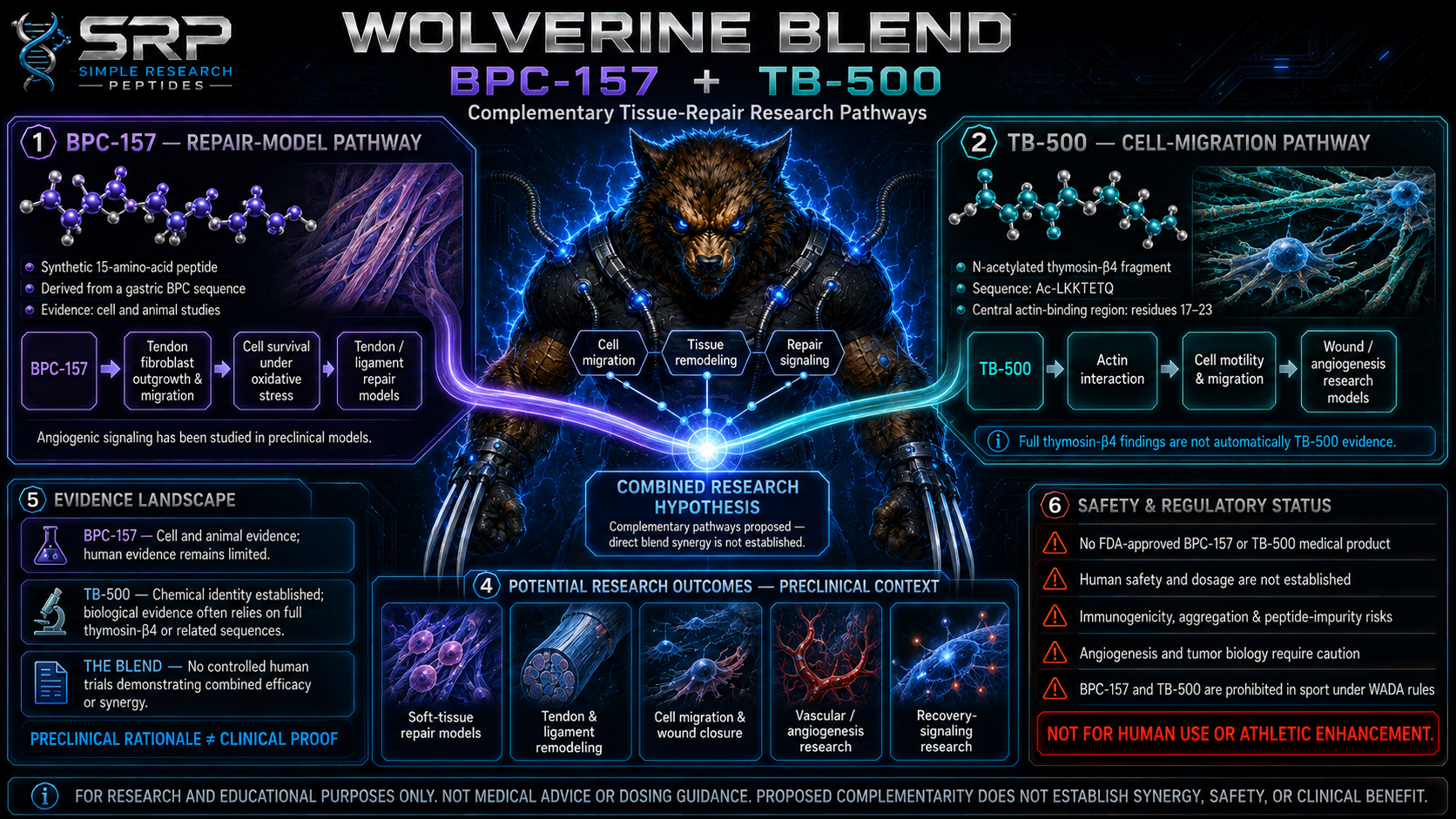
HUGE SALE ON FEATURED ITEMSKLOW 80mgGLOW 70mgHumanin 10mgFOXO4-DRI 10mgACE-031 1mgWolverine 20/20SS-31 10mg5-Amino-1MQ 50mgMOTS-c 40mgBPC-157/TB-500 10mg/10mgSelank 10mgNAD+ 500mgGHK-Cu 100mgRTZ-GLP 30mgTirzepatide 30mgEpithalon 10mgKisspeptin 10mg

Dihexa Research Guide

PNB-0408 · PRECLINICAL ONLY · RUO

Dihexa Research GuideNot a conventional peptide · not fosgonimeton · not FDA-approved

Dihexa (developmental code PNB-0408; also ATH-1001) is an angiotensin IV–derived small-molecule peptidomimetic — chemically N-hexanoic-Tyr-Ile-(6) aminohexanoic amide / N-(1-oxohexyl)-L-tyrosyl-N-(6-amino-6-oxohexyl)-L-isoleucinamide. It is not a conventional peptide, not angiotensin II, not angiotensin IV, not hepatocyte growth factor (HGF) protein, and not the clinical-stage phosphate prodrug fosgonimeton (ATH-1017 / NDX-1017). English-language evidence that actually names Dihexa is cell and animal. There is no opened human efficacy trial of Dihexa itself and no ClinicalTrials.gov record for dihexa or PNB-0408. Research use only. Not medical advice. Not for human use.

Not a peptide
PNB-0408
CAS 1401708-83-5
Preclinical only
Not fosgonimeton
Not FDA-approved

Educational information only. This page describes an investigational laboratory research compound. It is not medical advice. Simple Research Peptides (SRP) materials are for laboratory research only and are not for human or veterinary use, consumption, administration, diagnosis, treatment, or therapeutic application. CAS, UNII, CID, and formula below are taken from opened public registries and primary papers that name Dihexa / N-hexanoic-Tyr-Ile-(6) aminohexanoic amide / PNB-0408 — not from the SRP product page. No human dosing, reconstitution, or administration protocol appears on this page.

01 / Identity

Chemical identity (opened registries only)

SRP product and index pages do not print a sequence, CAS, UNII, molecular formula, or a public COA. Identity below is taken only from opened public registries and primary papers that name Dihexa / N-hexanoic-Tyr-Ile-(6) aminohexanoic amide / PNB-0408.

One-sentence identity: Dihexa (PNB-0408; also ATH-1001) is an angiotensin IV–derived small-molecule peptidomimetic — N-hexanoic-Tyr-Ile-(6) aminohexanoic amide. It is not a conventional peptide, not angiotensin II, not angiotensin IV, not HGF protein, and not fosgonimeton. English-language evidence that names Dihexa is cell and animal. There is no opened human efficacy trial of Dihexa itself and no ClinicalTrials.gov record for dihexa or PNB-0408.

Trade / development namesDihexa; PNB-0408; ATH-1001Also N-hexanoic-Tyr-Ile-(6) aminohexanoic amide; Hexanoyl-Tyr-Ile-Ahx-NH2. PubChem CID 129010512; NCATS UNII 9WYX65A5C2; McCoy 2013 PMID 23055539.
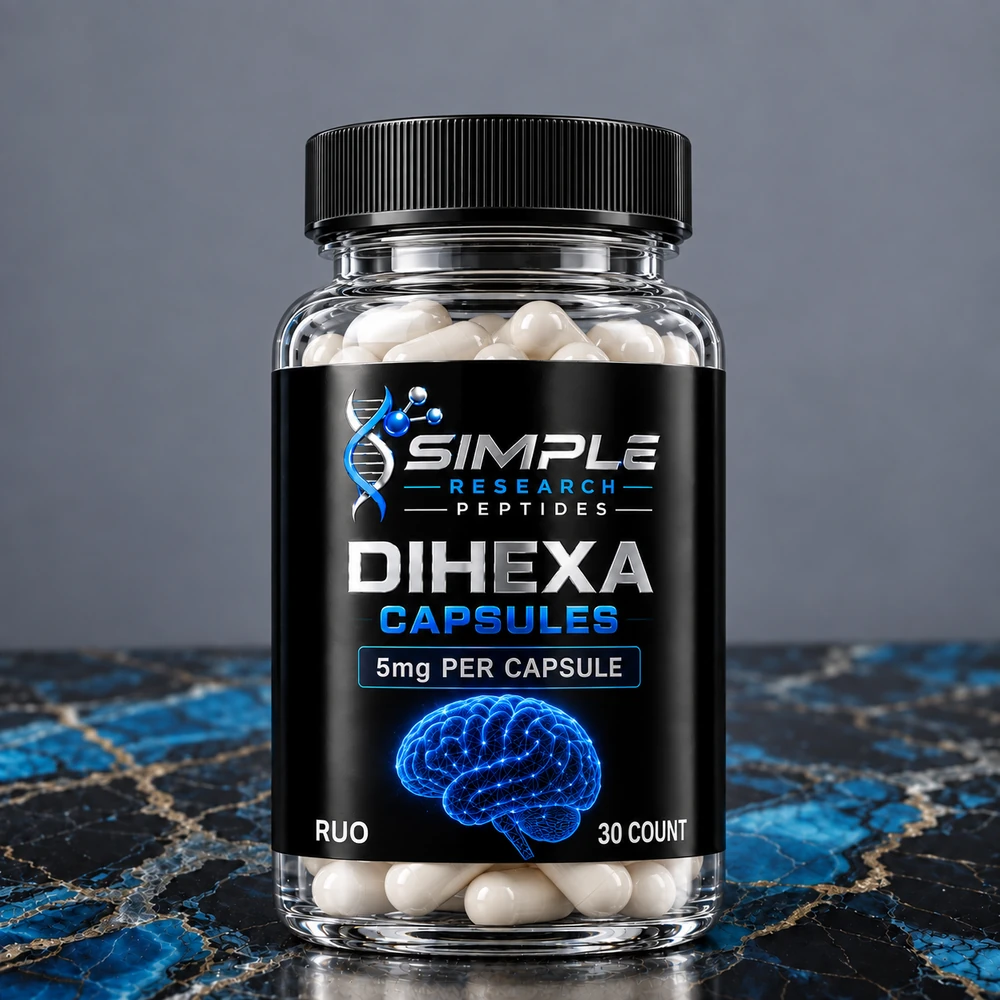
SRP listing nameDihexa (5 mg Capsules, 30 Count)Lead line: 5 mg each and 30 count. Store / research category: Brain & Mind Research.
SRP listed strength5 mg Capsules, 30 CountSequence, CAS, UNII, formula, and a public COA were not printed on the fetched page.
Index evidence tagPreclinical evidenceIndex listing: “Dihexa (5 mg Capsules, 30 Count)” under Cognitive; Evidence profile. Confirm chemical identity because Dihexa is not a conventional peptide despite its derivation.
Chemical classSmall-molecule peptidomimeticHexanoyl-capped Tyr-Ile plus C-terminal 6-aminohexanamide. Not a conventional peptide. McCoy 2013 full text; PubChem systematic name.
PubChem CID129010512Title: N-(1-Oxohexyl)-L-tyrosyl-N-(6-amino-6-oxohexyl)-L-isoleucinamide. Opened 16 August 2026.
CAS on CID 1290105121401708-83-5PubChem CID 129010512; NCATS Inxight.
UNII9WYX65A5C2PubChem CID 129010512; NCATS Inxight Drugs.
Formula / MWC27H44N4O5 / 504.7NCATS: 504.6621. Exact / monoisotopic mass 504.33117052. XLogP 2.3.
InChIKeyXEUVNVNAVKZSPT-JTJYXVOQSA-NPubChem CID 129010512; NCATS.
NCATS InxightInvestigationalApproval Year: Unknown. https://drugs.ncats.io/drug/9WYX65A5C2
Not this moleculeFosgonimeton / Ang II / Ang IV / HGFFosgonimeton is CID 156596375; CAS 2093305-05-4; UNII H91OA9858J. Native Ang IV is VYIHPF.
Identifier Value on opened page Source opened
Trade / development names Dihexa; PNB-0408; ATH-1001; N-hexanoic-Tyr-Ile-(6) aminohexanoic amide; Hexanoyl-Tyr-Ile-Ahx-NH2 PubChem CID 129010512; NCATS Inxight UNII 9WYX65A5C2; McCoy 2013 PMID 23055539
SRP listing name Dihexa (5 mg Capsules, 30 Count) SRP product page
SRP listed strength / format 5 mg Capsules, 30 Count (lead line: “5 mg each and 30 count”) SRP product page
SRP store / research category Brain & Mind Research SRP product page (store taxonomy, not a clinical indication)
SRP index listing “Dihexa (5 mg Capsules, 30 Count)”; Cognitive; “Evidence profile”; evidence tag Preclinical evidence SRP compound-research-guides index
Chemical class Angiotensin IV–derived small-molecule peptidomimetic (hexanoyl-capped Tyr-Ile plus C-terminal 6-aminohexanamide). Not a conventional peptide. McCoy 2013 full text; PubChem systematic name; SRP index research-quality note
PubChem CID 129010512. Title: N-(1-Oxohexyl)-L-tyrosyl-N-(6-amino-6-oxohexyl)-L-isoleucinamide PubChem PUG REST / PUG View, opened 16 August 2026
CAS on CID 129010512 1401708-83-5 PubChem CID 129010512; NCATS Inxight
UNII 9WYX65A5C2 PubChem CID 129010512; NCATS Inxight
Molecular formula / MW C27H44N4O5; 504.7 g/mol (NCATS: 504.6621) PubChem CID 129010512; NCATS
Exact / monoisotopic mass 504.33117052 PubChem PUG property
XLogP 2.3 PubChem PUG property
InChIKey XEUVNVNAVKZSPT-JTJYXVOQSA-N PubChem CID 129010512; NCATS
IUPAC (computed) (2S,3S)-N-(6-amino-6-oxohexyl)-2-[[(2S)-2-(hexanoylamino)-3-(4-hydroxyphenyl)propanoyl]amino]-3-methylpentanamide PubChem PUG View
Systematic / CAS-style name L-Isoleucinamide, N-(1-oxohexyl)-L-tyrosyl-N-(6-amino-6-oxohexyl)- PubChem; NCATS
NCATS Inxight DIHEXA; Investigational; Approval Year: Unknown https://drugs.ncats.io/drug/9WYX65A5C2
EPA DSSTox DTXSID701032895 PubChem; NCATS
IUPHAR / GtoPdb ligand No ligand record for Dihexa, PNB-0408, or fosgonimeton (services ligands?name= returned “No ligands found”) IUPHAR services API, opened 16 August 2026
IUPHAR receptor class (proposed pathway only) MET proto-oncogene, receptor tyrosine kinase, target id 1815; Type X RTKs: HGF receptor family; endogenous ligand hepatocyte growth factor; unofficial names include c-Met / HGF receptor. Dihexa is not listed as a ligand on that page. IUPHAR ObjectDisplay 1815
ClinicalTrials.gov (dihexa / PNB-0408 / “N-hexanoic-Tyr-Ile”) 0 studies CT.gov API v2, opened 16 August 2026
ClinicalTrials.gov (fosgonimeton / ATH-1017 / NDX-1017) 6 studies of a different molecule (see distinction table). Not Dihexa NCTs. CT.gov API v2, opened 16 August 2026
openFDA Drugs@FDA / labels No Dihexa match (NOT_FOUND) openFDA API, opened 16 August 2026
INN / USAN None for Dihexa on opened PubChem / NCATS identity fields. Fosgonimeton is the INN/USAN of the phosphate prodrug (PubChem CID 156596375) PubChem fosgonimeton synonyms
FDA-approved product None. NCATS: Investigational; Approval Year Unknown NCATS Inxight

What the molecule actually is. McCoy et al. 2013 (PMID 23055539; PMC 3533412) define Dihexa in words as N-hexanoic-Tyr-Ile-(6) aminohexanoic amide. The opened PubChem / NCATS names encode the same construct: an N-hexanoyl-L-tyrosine linked to L-isoleucine, capped at the C-terminus with 6-aminohexanamide (Ahx-NH2). That is two coded amino acids plus two non-peptide caps. Native angiotensin IV is the hexapeptide Val-Tyr-Ile-His-Pro-Phe (McCoy abstract: AngIV: VYIHPF). Dihexa keeps only the Tyr-Ile motif from that hexapeptide.

Registry chaos that must not be collapsed.

  • NCATS Inxight for UNII 9WYX65A5C2 labels the record DIHEXA and also prints “INN:fosgonimeton [INN]” as a source line and “PRODRUG (METABOLITE ACTIVE)”. Fosgonimeton is a different structure (tyrosine-phenol phosphate; C27H45N4O8P; CID 156596375; CAS 2093305-05-4; UNII H91OA9858J). Do not treat the NCATS “INN:fosgonimeton” string as proof that Dihexa has an INN, and do not treat fosgonimeton NCTs as Dihexa trials.
  • NCATS copies Wikipedia-style sentences (HGF binding; “seven orders of magnitude more potent than BDNF”) and a nootropix.com quote. Those NCATS prose blocks were not used as primary findings. The BDNF-potency sentence was not on the opened McCoy 2013 full text.
  • A name search for DIHEXA on the NCATS substances API also returned calcium sorbate (UNII 2P47R6817F). Unused false hit.
  • Marketplace “peptide” labeling does not change the chemistry. SRP’s own index research-quality note: “Confirm chemical identity because Dihexa is not a conventional peptide despite its derivation.”

Not printed on SRP pages and therefore not claimed as SRP-verified: sequence, CAS, UNII, formula, stereochemistry, or purity numbers. The product page does not print a public COA. SRP itself is a research-material listing, not a Washington State University / M3 Biotechnology / Athira clinical lot.

Critical identity point: Dihexa is N-hexanoic-Tyr-Ile-(6) aminohexanoic amide on PubChem CID 129010512 (CAS 1401708-83-5; UNII 9WYX65A5C2; C27H44N4O5). It is not a conventional peptide. Fosgonimeton is a different molecule (CID 156596375; CAS 2093305-05-4; UNII H91OA9858J). Do not treat a label that says only “Dihexa” as proof of hexanoyl-Tyr-Ile-Ahx-NH2 versus a random catalog analog versus the phosphate prodrug. Not FDA-approved. Research use only.
02 / Not a peptide

How it is not a conventional peptide, not angiotensin II / IV, not HGF protein, and not fosgonimeton

This page is Dihexa (PNB-0408) only. Marketplace “nootropic peptide” language is a catalog error, not a chemical classification. Dihexa is not a conventional peptide. Native angiotensin II papers, native angiotensin IV papers, HGF-protein papers, MET-inhibitor oncology papers, and fosgonimeton / ATH-1017 human trials are not Dihexa evidence unless the opened paper actually dosed Dihexa / PNB-0408 / N-hexanoic-Tyr-Ile-(6) aminohexanoic amide.

Identity What opened sources actually describe Peptide? Typical literature role
Native angiotensin II Octapeptide Asp-Arg-Val-Tyr-Ile-His-Pro-Phe (class RAS ligand). Not opened here as Dihexa evidence. Yes (octapeptide) Pressor / AT1 / AT2 biology
Native angiotensin IV Hexapeptide Val-Tyr-Ile-His-Pro-Phe (AngIV: VYIHPF) Yes (hexapeptide) Historical AT4 / procognitive peptide literature. Not Dihexa.
Nle1-AngIV Nle-Tyr-Ile-His-Pro-Phe; McCoy’s parent analog Yes (hexapeptide analog) WSU SAR starting point. Benoist 2011 (PMID 21719467) truncates this analog — it does not test Dihexa.
Dihexa / PNB-0408 (this page) N-hexanoic-Tyr-Ile-(6) aminohexanoic amide; C27H44N4O5; MW ~505 No — small-molecule peptidomimetic (2 aa + hexanoyl + Ahx-NH2) McCoy 2013 named lead; later WSU reviews; one independent APP/PS1 mouse paper; one negative 3-NP rat paper
HGF protein Endogenous ligand of MET / c-Met (IUPHAR 1815) Protein growth factor Class biology only. An HGF paper is not Dihexa evidence.
Fosgonimeton (ATH-1017 / NDX-1017) O-phosphono tyrosine ester of the same backbone; C27H45N4O8P; MW 584.6; INN/USAN fosgonimeton; UNII H91OA9858J; CAS 2093305-05-4 Also a small molecule; different formula Athira / LeonaBio subcutaneous clinical candidate. Human NCTs exist. Not Dihexa.

Dihexa is not a conventional peptide

A conventional research peptide is a chain of coded amino acids with peptide bonds throughout. Dihexa is a hexanoyl-Tyr-Ile-aminohexanamide. McCoy designed the N-terminal hexanoyl (no N-terminal α-amine) and the C-terminal 6-aminohexanamide specifically to raise hydrophobicity, cut hydrogen bonding, and resist aminopeptidases — the properties native AngIV lacked. Calling the SRP capsule a “peptide” because the catalog sits in a peptide store does not make it AngIV, tesamorelin, or Semax.

Angiotensin II papers are not Dihexa evidence

Ang II, candesartan, ACE-inhibitor, and AT1/AT2 papers were not treated as Dihexa pharmacology unless the opened paper actually dosed Dihexa / PNB-0408. Those molecules are different ligands of a different RAS story.

Angiotensin IV papers are not automatically Dihexa evidence

Benoist 2011 (PMID 21719467) tests C-terminal-truncated Nle1-AngIV fragments (tri- and tetrapeptides). McCoy cites that paper as the SAR step that located activity in Nle-Tyr-Ile. It does not name or dose Dihexa.

HGF / c-Met protein or inhibitor papers are class biology, not Dihexa trials

IUPHAR target 1815 lists hepatocyte growth factor as the endogenous ligand and catalogs MET inhibitors (crizotinib, SGX-523, and others). Those ligands are not Dihexa. MET is a proto-oncogene; opened IUPHAR disease rows include papillary renal-cell carcinoma and pediatric hepatocellular carcinoma. That is the mechanism-based safety question. It is not a Dihexa carcinogenicity study.

Fosgonimeton is a third, clinical-stage molecule. PubChem CID 156596375 is the tyrosine-phenol dihydrogen phosphate of the Dihexa backbone (IUPAC starts “[4-[(2S)-3-[[(2S,3S)-1-[(6-amino-6-oxohexyl)amino]…”). Hua et al. 2022 (PMID 35180125) and NCT03298672 / NCT04488419 / NCT04491006 / NCT04831281 / NCT04886063 / NCT05511558 study fosgonimeton / ATH-1017 / NDX-1017, given subcutaneously. They are not oral Dihexa capsule trials and they do not establish human efficacy of PNB-0408. Those NCTs appear only in the labeled distinction box below. Do not invent a Dihexa NCT.

Do not merge Dihexa with angiotensin II, angiotensin IV, HGF protein, or fosgonimeton. Dihexa is a hexanoyl-Tyr-Ile-aminohexanamide small molecule (CID 129010512; CAS 1401708-83-5; UNII 9WYX65A5C2). Native Ang IV is VYIHPF. Fosgonimeton is the tyrosine-phosphate prodrug (C27H45N4O8P; CID 156596375; CAS 2093305-05-4; UNII H91OA9858J) with its own subcutaneous NCT list. Human fosgonimeton data are not Dihexa human data.
03 / Mechanism

Proposed mechanism (HGF/c-Met is a hypothesis with a retracted keystone)

Opened primary papers support only a working model. It is not a treatment claim. The highest-cited molecular keystone for “Dihexa = HGF/c-Met potentiator” was retracted in April 2025. Observed means a measurement in an opened, non-retracted Dihexa paper (still read the Notice of Concern on McCoy). Proposed means analogue-design rationale or a hypothesis. Class / adjacent means receptor-class biology or a WSU review. Not shown / retracted means the opened papers did not establish it, or the paper that claimed it was retracted.

Observed — design intent (flagged paper)

Hexanoyl + Ahx-NH2 for stability

Native AngIV and Nle1-AngIV were described as procognitive in earlier WSU work but metabolically fragile and not gut- or BBB-permeant. McCoy shortened the active core to Nle-Tyr-Ile (from Benoist 2011), then replaced the N-terminal residue with a straight-chain hexanoyl (no α-amine) and amidated the C-terminus as 6-aminohexanamide. The paper reports rat-serum half-life 335.5 ± 9.5 min versus 1.42 ± 0.26 min for Nle1-AngIV; low rat-microsome clearance; IV terminal t½ 12.68 days (n = 3; large SEM); IP t½ 8.83 ± 2.41 days; and brain-region concentration of [3H]dihexa above a [14C]inulin vascular marker 30 min after carotid infusion. Those numbers are rat PK from a paper that later received a journal Notice of Concern (PMID 34551989). They are not human PK and they are not SRP-capsule PK. (PMID 23055539.)

Observed — what McCoy measured as “mechanism”

Spines and mEPSCs; HGF unpublished

Hippocampal-culture spinogenesis / synaptogenesis at 10−12 M, colocalization with VGLUT1 / synapsin / PSD-95, and a 1.6-fold rise in mEPSC frequency versus vehicle. The discussion states that HGF/c-Met binding was unpublished data at the time (“C. C. Benoist, Kawas LH, and Harding, JW, unpublished data”). McCoy is not a completed HGF-binding paper. It carries a 2021 Notice of Concern and is not a human cognition trial.

Retracted — do not use as fact

Benoist 2014 HGF-dependence paper

Benoist et al. 2014 (PMID 25187433) asserted that Dihexa “binds with high affinity to hepatocyte growth factor (HGF)” and that procognitive / synaptogenic actions required HGF/c-Met. Europe PMC marks that article retracted. The opened retraction notice (PMID 40312093, DOI 10.1016/j.jpet.2025.103567, April 2025) states that, after a Washington State University investigation, Figures 1B, 2A/C, and data in the subsequent erratum submission “have been found to contain falsified and/or fabricated data” and that Leen H. Kawas and Joseph W. Harding were found to be solely responsible. This page does not treat Kd values, c-Met phosphorylation, cell-scattering, or “HGF-antagonist blocks oral Dihexa” claims from that paper as established facts.

Retracted — not even a Dihexa paper

Kawas 2012 HGF-antagonist paper

Kawas et al. 2012 (PMID 22129598) described 6-AH family AngIV analogs as HGF-dimerization inhibitors / Met antagonists (including a melanoma-colonization experiment). The opened abstract does not name Dihexa. Europe PMC marks it retracted (notice PMID 40312092). It is logged only so readers do not recycle “AngIV analog = HGF/Met modifier” from a retracted antagonist paper as if it were Dihexa potentiation.

Class / adjacent — remains with or without Dihexa

MET is a proto-oncogene (IUPHAR 1815)

IUPHAR MET (1815) is a receptor tyrosine kinase whose endogenous ligand is HGF. Wright & Harding 2015 (PMID 25649658) and Wright, Kawas & Harding 2015 (PMID 25455861) are reviews from the same WSU / M3 Biotechnology authors that present Dihexa as an orally active, BBB-permeant AngIV-based small molecule acting through HGF/c-Met. Those reviews predate the 2025 retractions and cannot repair a retracted primary paper. Sun et al. 2021 (PMID 34827486), an independent APP/PS1 mouse study, reports PI3K/AKT pathway changes after Dihexa and does not itself prove HGF binding.

Not shown on an opened, non-retracted page

No HGF isotherm; no human BBB; c-Met is a question

Not shown: a durable, independently replicated human or rodent HGF-binding isotherm for Dihexa; a crystal structure of Dihexa on HGF or MET; proof that an SRP 5 mg capsule matches McCoy’s Harding-lab lot; human BBB penetration; human half-life. MET is a proto-oncogene. Opened IUPHAR pathophysiology rows include hereditary / papillary renal-cell carcinoma and pediatric hepatocellular carcinoma. HGF/c-Met signaling is used in development, tissue repair, and cell growth. A research capsule that is hypothesized to touch that pathway has a mechanism-based oncology question. No opened Dihexa paper is a human cancer-risk trial. The question is unanswered, not disproven. It is not a completed tox package.

Benoist 2011 locates activity in Nle-Tyr-Ile

C-terminal truncated Nle1-AngIV fragments. Distinction only. PMID 21719467.

Kawas 2012: 6-AH family as HGF/Met antagonists

Retracted (notice PMID 40312092). Not Dihexa evidence. PMID 22129598.

McCoy defines Dihexa; HGF binding called unpublished

Rat PK / MWM / spines. Notice of Concern PMID 34551989. Not retracted as of the 2026-08-16 Europe PMC record. PMID 23055539.

Benoist 2014 claimed HGF/c-Met dependence

WSU investigation: Figs 1B, 2A/C and erratum data falsified/fabricated; Kawas and Harding solely responsible. Not used as mechanism fact. PMID 25187433; notice PMID 40312093.

Wright & Harding reviews cannot repair a retracted keystone

Secondary. Same WSU / M3 authors. PMIDs 25649658 and 25455861.

Sun APP/PS1 mice (mixed methods route); Wells 3-NP rats negative

Sun PMID 34827486. Wells PMID 38489193: PNB-0408 did not protect.

Mechanism in one line: HGF/c-Met potentiation is a hypothesis with a retracted keystone. McCoy 2013 called HGF binding unpublished and later received a Notice of Concern. Benoist 2014, the paper that claimed dependence, is retracted for falsified/fabricated figures. MET (IUPHAR 1815) is a proto-oncogene — a mechanism-based safety question, not a completed tox package. Not a treatment claim. Not for human use.
04 / Research Map

Where the literature actually sits

Label every row. Dihexa ≠ angiotensin II ≠ angiotensin IV ≠ HGF protein ≠ fosgonimeton. Retracted papers are listed so they are not silently reused. Human numbers do not exist for Dihexa itself. Historical animal regimens below are not instructions for using SRP research capsules, and they are not claims that research-grade material works in people.

A. Chemistry / rat PK / culture / behavior — WSU naming paper

McCoy 2013 — Notice of Concern

McCoy et al. 2013, PMID 23055539, PMC 3533412. Defines N-hexanoic-Tyr-Ile-(6) aminohexanoic amide (dihexa). Rat serum t½ 335.5 ± 9.5 min vs Nle1-AngIV 1.42 ± 0.26 min. IV modeled t½ 12.68 days. Oral 2.0 mg/kg reversed scopolamine MWM deficit. Cultures: 10−12 M spines. Notice of Concern PMID 34551989 (2021). Not retracted as of the 2026-08-16 Europe PMC record. Wright and Harding disclosed as founders/shareholders of M3 Biotechnology. Rat / culture only. Not a human cognition trial.

B. Independent (or outside-WSU-cognition) papers that dosed Dihexa

Sun 2021; Wells 2024; Uribe 2015; Weiss 2021

Sun PMID 34827486: APP/PS1 mice; MWM and PI3K/AKT; route wording internally inconsistent; not WSU. Wells PMID 38489193: PNB-0408 / Dihexa in 3-NP HD-like rats — negative. Uribe PMID 25674052: zebrafish hair cells; WSU/M3; not cognition. Weiss PMID 34703584: sciatic-nerve combo with MSC; Harding coauthor; not cognition monotherapy.

C. Retracted or editorially flagged records

Benoist 2014 retracted; Kawas 2012 retracted; McCoy concern

Benoist 2014 PMID 25187433 RETRACTED (notice PMID 40312093): the HGF-dependence paper. Kawas 2012 PMID 22129598 RETRACTED (notice PMID 40312092): does not name Dihexa. McCoy Notice of Concern PMID 34551989. Logged so they are not reused as facts.

D. Adjacent records — distinction only

Nle1-AngIV SAR, WSU reviews, fosgonimeton NCTs

Benoist 2011 PMID 21719467: Nle1-AngIV fragments, not Dihexa. Wright 2015 reviews (25649658, 25455861): secondary, pre-retraction. Hua 2022 PMID 35180125 and six ATH-1017 / fosgonimeton NCTs: different molecule, listed only in a labeled distinction box. IUPHAR MET 1815: class receptor; no Dihexa ligand. 0 Dihexa NCTs. Do not invent one.

Vendor identity — not independently verified

SRP 5 mg capsules print no CAS

Opened SRP page: Dihexa (5 mg Capsules, 30 Count); Brain & Mind Research; research capsules for qualified laboratory investigation; not for human or veterinary use. Sequence, CAS, UNII, molecular formula, and a public COA were not printed. Index tag: Preclinical evidence. Research-quality note: not a conventional peptide despite its derivation. Product page.

Common web errors

False equivalences

Dihexa is a peptide / the angiotensin IV peptide is false. It is angiotensin II / an ARB is false. It is HGF or a completed c-Met agonist pill is not established (2014 paper retracted). It is fosgonimeton / ATH-1017 / the Alzheimer’s shot is false. Human trials proved it works for memory is false — 0 Dihexa NCTs. “Seven orders of magnitude more potent than BDNF” was not on the opened McCoy full text. A 12-day half-life so one capsule lasts weeks in people is McCoy rat IV t½ from a Notice-of-Concern paper, not human PK.

05 / Evidence A

Chemistry / rat PK / culture / behavior — WSU paper that names Dihexa (Expression of Concern)

Read the actual-finding column. Published study designs are historical facts from those papers. They are not a protocol. This paper names N-hexanoic-Tyr-Ile-(6) aminohexanoic amide (dihexa). It carries a 2021 journal Notice of Concern. It has not been retracted on the opened Europe PMC record. It is not a human cognition trial and not SRP-capsule PK.

Study Species / model What was tested Actual finding (from the opened record)
McCoy et al., J Pharmacol Exp Ther 2013
PMID 23055539. PMC 3533412. DOI 10.1124/jpet.112.199497. Notice of Concern PMID 34551989 (J Pharmacol Exp Ther 2021;378:313). Not retracted as of the 2026-08-16 Europe PMC record. Wright and Harding disclosed as founders/shareholders of M3 Biotechnology.
Rat serum metabolism; male Sprague-Dawley IV (10 mg/kg) and IP (20 mg/kg) PK; [3H]dihexa + [14C]inulin carotid BBB; rat liver microsomes; i.c.v. / i.p. / oral scopolamine Morris water maze; 24-month mixed-sex aged rats oral 2 mg/kg (n = 6/group, not prescreened); P1 hippocampal cultures and organotypic slices N-hexanoic-Tyr-Ile-(6) aminohexanoic amide (dihexa), synthesized in the Harding lab Defines the name. Serum t½ 335.5 ± 9.5 min vs Nle1-AngIV 1.42 ± 0.26 min. IV modeled t½ 12.68 days; Vd 54.4 ± 14.8 L/kg; microsomal Clint 2.72 µl/min/mg. All dissected brain regions concentrated 3H above the inulin ratio. Scopolamine MWM: i.c.v. 1 nmol indistinguishable from vehicle; i.p. 0.50 mg/kg and oral 2.0 mg/kg reversed the deficit; oral 1.25 mg/kg partial. Aged-rat oral 2 mg/kg improved latency (Mann-Whitney P < 0.03) with high untreated-group variability. Cultures: 10−12 M, 5 days, ~41 vs 15 spines / 50 µm; 30-min acute increase; mEPSC frequency 4.82 vs 3.06 Hz. Rat / culture only. Paper carries a 2021 journal Notice of Concern. Not a human cognition trial.
Defines Dihexa Notice of Concern 2021

McCoy, Benoist, Wright, Kawas, Bule-Ghogare, Zhu, Appleyard, Wayman, Harding, 2013 — JPET

Evaluation of metabolically stabilized angiotensin IV analogs as procognitive/antidementia agents. Defines Dihexa as N-hexanoic-Tyr-Ile-(6) aminohexanoic amide, synthesized in the Harding lab. Rat-serum half-life 335.5 ± 9.5 min versus 1.42 ± 0.26 min for Nle1-AngIV; low rat-microsome clearance (Clint 2.72 µl/min/mg); IV terminal t½ 12.68 days (n = 3; large SEM; t½ 18,256 ± 7,787 min); Vd 54.4 ± 14.8 L/kg; IP t½ 8.83 ± 2.41 days. [3H]dihexa concentrated in dissected brain regions above a [14C]inulin vascular marker 30 min after carotid infusion. Scopolamine Morris water maze: i.c.v. 1 nmol indistinguishable from vehicle; i.p. 0.50 mg/kg and oral 2.0 mg/kg reversed the deficit; oral 1.25 mg/kg partial. Aged 24-month mixed-sex rats, oral 2 mg/kg, n = 6/group, not prescreened: improved latency (Mann-Whitney P < 0.03) with high untreated-group variability. P1 hippocampal cultures: 10−12 M, 5 days, ~41 vs 15 spines / 50 µm; 30-min acute increase (23.9 vs 17.4); mEPSC frequency 4.82 vs 3.06 Hz (1.6-fold). HGF/c-Met binding described as unpublished data. Wright and Harding disclosed as founders/shareholders of M3 Biotechnology. Journal Notice of Concern 2021, PMID 34551989. Not retracted as of the 16 August 2026 Europe PMC record. Rat / culture only. Not a human cognition trial. Not SRP-capsule PK. PMID 23055539. DOI 10.1124/jpet.112.199497. PMC 3533412.

Expression of Concern

Notice of Concern for McCoy 2013 — JPET 2021

Journal notice, September 2021, J Pharmacol Exp Ther 378:313. Europe PMC type: Expression of Concern for PMID 23055539. No abstract text on the opened Europe PMC page. Publisher PDF 503 / DOI 406 — full notice wording unused beyond the bibliographic fact of the concern. Every McCoy row on this page is labeled with the Notice of Concern. PMID 34551989. DOI 10.1124/jpet.112.199497concern.

McCoy 2013 defines Dihexa and is the main rat MWM / PK / spine dataset. It carries a 2021 Notice of Concern (PMID 34551989). It has not been retracted on the opened Europe PMC record. Do not treat rat IV t½ ~12.7 days (n = 3, large SEM) as human PK. Do not treat oral 2 mg/kg rat as a protocol for an SRP research capsule. HGF binding was unpublished in this paper.
06 / Evidence B

Independent (or outside-WSU-cognition) papers that actually dosed Dihexa / PNB-0408

These four opened records name Dihexa or PNB-0408 as the test article. They are not human trials. Sun 2021 is the only opened independent (non-WSU) cognition-adjacent mouse study. Wells 2024 is an independent negative Huntington-like rat result. Uribe 2015 and Weiss 2021 involve WSU / Harding authors and are not cognition monotherapy.

Study Species / model What was tested Actual finding (from the opened record)
Sun et al., Brain Sci. 2021
PMID 34827486. PMC 8615599. DOI 10.3390/brainsci11111487. China Pharmaceutical University / Nanjing First Hospital. Not a WSU authorship.
6-month APP/PS1 mice vs WT; 3-month treatment; MWM; Nissl; SYP / GFAP / Iba-1; cytokines; PI3K/AKT ± wortmannin Dihexa 1.44 and 2.88 mg/kg (MedChemExpress). Methods text says both intragastric dissolution/administration and “administered intraperitoneally … from six to nine months old” — an internal route inconsistency on the opened page. APP/PS1 brain AngIV ELISA lower than WT; Dihexa groups had higher AngIV ELISA signal. Escape latency fell and platform crossings rose vs APP/PS1 vehicle. Nissl-positive neurons and synaptophysin increased; TNF-α / IL-1β down, IL-10 up; GFAP / Iba-1 down; PI3K and p-AKT up; wortmannin reversed those readouts. Authors interpret an AngIV / PI3K/AKT axis, not a new HGF-binding isotherm. Mouse only. Methods route is internally inconsistent. Not human efficacy.
Wells, Azzam, Hiller, Sardinia, J Huntingtons Dis. 2024
PMID 38489193. DOI 10.3233/jhd-231507. Whitworth University / OHSU.
Male Wistar rats; 3-nitropropionic acid HD-like model; n randomized to vehicle / 3-NP / 3-NP + PNB-0408 PNB-0408, also known as Dihexa (N-hexanoic-Tyr-Ile-(6)-amino hexanoic amide), given with chronic 3-NP 3-NP reduced weight gain and impaired spatial learning, memory, and motor function. “PNB-0408 did not protect rats from the deficits induced by 3-NP neurotoxicity.” Authors conclude it “may not be an efficacious treatment strategy” in this preclinical HD-like model. Negative animal result. Not a human trial.
Uribe, Kawas, Harding, Coffin, Front Cell Neurosci. 2015
PMID 25674052. PMC 4309183. DOI 10.3389/fncel.2015.00003.
Larval zebrafish lateral-line hair cells; neomycin and gentamicin Dihexa, described as a “small molecule drug candidate” / “synthetic HGF mimetic”; 1 µM called optimal in the abstract; protection attenuated by HGF antagonist 6-AH and partly by Akt / TOR / MEK inhibitors Abstract: 1 µM Dihexa protected hair cells from acute neomycin or gentamicin; pretreatment did not change tagged-gentamicin entry. Zebrafish ototoxicity screen. WSU / M3 authors. Mechanism language depends on the HGF-mimetic framing later undermined by the 2025 retractions. Not cognition. Not human.
Weiss et al., Ann Med Surg (Lond) 2021
PMID 34703584. PMC 8524106. DOI 10.1016/j.amsu.2021.102917. Harding is a coauthor.
Male Lewis rats; sciatic-nerve transection-repair; 10 groups, n = 6–8 MSC ± G-CSF ± Dihexa 2–4 mg/kg local / systemic / intramuscular Sensory grades recovered in all groups by 8 weeks. Motor footprints at 8–16 weeks improved with MSC + G-CSF or MSC + Dihexa into gastrocnemius. Combination peripheral-nerve study, not Dihexa cognition monotherapy, not human.
Independent mouse — not WSU

Sun, Deng, Fu, Wang, Duan, Zhang, 2021 — Brain Sci.

AngIV-analog Dihexa rescues cognitive impairment and recovers memory in the APP/PS1 mouse via the PI3K/AKT signaling pathway. Six-month APP/PS1 versus WT; Dihexa 1.44 and 2.88 mg/kg for 3 months; MWM; Nissl; synaptophysin; GFAP/Iba-1; IL-1β/TNF-α/IL-10; PI3K/AKT ± wortmannin 0.5 mg/kg. China Pharmaceutical University / Nanjing First Hospital. No WSU authorship. Opened methods disagree with themselves: Dihexa “administered intragastrically” and, in the next sentences, “The Dihexa was administered intraperitoneally … from six to nine months old.” This page reports both wordings and does not pick one. APP/PS1 AngIV ELISA lower than WT; Dihexa raised that ELISA signal; MWM improvement; more Nissl-positive neurons and SYP; less GFAP/Iba-1 and pro-inflammatory cytokines; PI3K/p-AKT up; wortmannin reversed. Authors interpret an AngIV / PI3K/AKT axis. Does not show human data, a new HGF-binding table, or a clean single route. PMID 34827486. DOI 10.3390/brainsci11111487. PMC 8615599.

Independent rat — NEGATIVE HD-like model

Wells, Azzam, Hiller, Sardinia, 2024 — J Huntingtons Dis.

Effects of an angiotensin IV analog on 3-nitropropionic acid-induced Huntington’s disease-like symptoms in rats. N-hexanoic-Tyr-Ile-(6)-amino hexanoic amide (PNB-0408, also known as Dihexa) with chronic 3-NP in male Wistar rats. 3-NP impaired weight, spatial learning, memory, and motor function. “PNB-0408 did not protect rats from the deficits induced by 3-NP neurotoxicity.” Authors conclude it may not be an efficacious treatment strategy in this preclinical HD-like model. Publisher full text not opened (subscription); abstract used only. Negative animal result. Not human. PMID 38489193. DOI 10.3233/jhd-231507.

Zebrafish — WSU/M3; not cognition

Uribe, Kawas, Harding, Coffin, 2015 — Front Cell Neurosci.

Hepatocyte growth factor mimetic protects lateral line hair cells from aminoglycoside exposure. Dihexa described as a “synthetic HGF mimetic”; 1 µM optimal versus neomycin/gentamicin in larval zebrafish lateral line; not via blocking aminoglycoside entry; attenuated by 6-AH and partly by Akt/TOR/MEK inhibitors. Abstract used. Not cognition. Mechanism language depends on HGF-mimetic framing later undermined by the 2025 retractions. Not human. PMID 25674052. DOI 10.3389/fncel.2015.00003. PMC 4309183.

Combo peripheral nerve — Harding coauthor

Weiss, Phillips, Malin, Gorantla, Harding, Salgar, 2021 — Ann Med Surg

Stem cell, granulocyte-colony stimulating factor and/or Dihexa to promote limb function recovery in a rat sciatic nerve damage-repair model. MSC ± G-CSF ± Dihexa 2–4 mg/kg in Lewis rat sciatic transection-repair; motor footprints improved with MSC+G-CSF or MSC+Dihexa into gastrocnemius. Combination peripheral-nerve study, not Dihexa cognition monotherapy, not human. PMID 34703584. DOI 10.1016/j.amsu.2021.102917. PMC 8524106.

Independent animal work is mixed. Sun 2021 reported MWM and PI3K/AKT changes in APP/PS1 mice (route wording internally inconsistent). Wells 2024 reported no protection by PNB-0408 in a 3-NP Huntington-like rat model. Uribe and Weiss are not cognition monotherapy. None of these is a human trial. Do not treat animal regimens as a protocol for an SRP research capsule.
07 / Retractions

Retracted or editorially flagged records — logged so they are not reused as facts

These records are listed so they are not silently reused. Benoist 2014 is the paper that claimed Dihexa’s procognitive / synaptogenic effects depend on HGF/c-Met. It is retracted. Kawas 2012 is a related HGF-antagonist paper that does not name Dihexa and is also retracted. McCoy 2013 is not retracted but carries a Notice of Concern.

Record What it is What the opened page showed How this page treats it
Benoist et al., 2014
PMID 25187433. PMC 4201273. DOI 10.1124/jpet.114.218735.
The paper that claimed Dihexa’s procognitive / synaptogenic effects depend on HGF/c-Met Abstract (still visible): high-affinity HGF binding; c-Met phosphorylation with subthreshold HGF; cell scattering; spinogenesis blocked by HGF antagonist / c-Met shRNA; oral Dihexa MWM blocked by i.c.v. HGF antagonist. Europe PMC banner: This article has been retracted (notice 10.1016/j.jpet.2025.103567) and a 2021 Notice of Concern. Not used as mechanism or efficacy evidence. Retraction notice (opened PDF, PMID 40312093): WSU investigation; Figs 1B, 2A/C and erratum data falsified/fabricated; Kawas and Harding solely responsible.
Retraction notice to Benoist 2014
PMID 40312093. DOI 10.1016/j.jpet.2025.103567. PMC 13095468. J Pharmacol Exp Ther 2025;392(4):103567.
April 2025 retraction after WSU investigation Opened PDF: retracted at Editor’s request; Figures 1B, 2A/C, and data in the subsequent erratum submission contained falsified and/or fabricated data; Leen H. Kawas and Joseph W. Harding solely responsible. Bibliographic and PDF fact of the retraction. Does not restore any Kd, phosphorylation, or antagonist-block claim from the retracted paper.
Kawas et al., 2012
PMID 22129598. DOI 10.1124/jpet.111.188136.
6-AH AngIV analogs as HGF/Met antagonists Abstract does not name Dihexa. Retracted (notice PMID 40312092). 2021 Notice of Concern PMID 34551990. Not Dihexa evidence. Logged so “AngIV analog / HGF” is not laundered from a retracted antagonist paper.
McCoy 2013 Notice of Concern
PMID 34551989. DOI 10.1124/jpet.112.199497concern.
Journal notice, Sep 2021, J Pharmacol Exp Ther 378:313 Europe PMC type: Expression of Concern for PMID 23055539. No abstract text on the opened Europe PMC page. Publisher PDF 503 / DOI 406 — full notice wording unused beyond the bibliographic fact of the concern. Every McCoy row on this page is labeled with the Notice of Concern. McCoy is not retracted as of the 2026-08-16 Europe PMC record.
Benoist 2014RETRACTEDPMID 25187433. Notice PMID 40312093. Falsified/fabricated Figs 1B, 2A/C and erratum data. Not used as mechanism fact.
Kawas 2012RETRACTED; not Dihexa-namedPMID 22129598. Notice PMID 40312092. 6-AH HGF-antagonist family. Do not recycle as Dihexa potentiation.
McCoy 2013Notice of Concern; not retractedPMID 23055539. Concern PMID 34551989. Naming paper. Rat / culture only.
Do not cite Benoist 2014 (PMID 25187433) as Dihexa mechanism or efficacy. It is retracted (PMID 40312093) after a WSU investigation found falsified/fabricated figure data. Do not cite Kawas 2012 (PMID 22129598) as Dihexa evidence; it is retracted and does not name Dihexa. Label every McCoy 2013 citation with the 2021 Notice of Concern (PMID 34551989).
08 / Distinction

Adjacent records — opened for distinction only

Logged so they are not silently reused. Each distinction record is labeled so it is not cited as Dihexa efficacy. Fosgonimeton / ATH-1017 / NDX-1017 NCTs appear only in the labeled box below. They are not Dihexa trials. There is no Dihexa NCT. Do not invent one.

Record Why it was opened Why it is not Dihexa evidence
Benoist et al., 2011
PMID 21719467. DOI 10.1124/jpet.111.182220. PMC 3186286.
SAR that located Nle1-AngIV activity in N-terminal tri-/tetrapeptides Tests Nle1-AngIV fragments, not N-hexanoic-Tyr-Ile-(6) aminohexanoic amide.
Wright & Harding 2015, J Alzheimers Dis
PMID 25649658. DOI 10.3233/jad-142814.
Review that names Dihexa and HGF/c-Met Secondary; same WSU / M3 authors; written before the 2025 retractions. Cannot repair a retracted primary paper.
Wright, Kawas & Harding 2015, Prog Neurobiol
PMID 25455861. DOI 10.1016/j.pneurobio.2014.11.004.
Review that names Dihexa and the AT4 vs IRAP vs HGF/c-Met controversy Same limitation. Mentions IRAP (Albiston) as a competing AT4 identity. Not a new Dihexa experiment.
Hua et al., 2022
PMID 35180125. NCT03298672. DOI 10.3233/jad-215511. PMC 9108585.
Phase 1 of fosgonimeton Different molecule (C27H45N4O8P); subcutaneous ATH-1017 / NDX-1017; 88 subjects. Not oral Dihexa.
IUPHAR MET 1815
ObjectDisplay 1815
Class receptor / proto-oncogene context No Dihexa ligand. Endogenous ligand is HGF. Disease rows include papillary renal-cell carcinoma and pediatric hepatocellular carcinoma.
SRP index Dihexa blurb Cross-check catalog language Not a primary experiment. Index already says Dihexa is not a conventional peptide despite its derivation.
Fosgonimeton NCTs are not Dihexa trials. This box is a distinction table only. CT.gov API v2 query dihexa OR PNB-0408 OR "N-hexanoic-Tyr-Ile" returned []0 studies. The fosgonimeton / ATH-1017 / NDX-1017 query returned six studies of a different molecule (C27H45N4O8P; CID 156596375; CAS 2093305-05-4; UNII H91OA9858J), given subcutaneously. Do not cite these NCTs as Dihexa evidence. Do not invent a Dihexa NCT.
NCT (fosgonimeton distinction only) Opened status (API v2, 2026-08-16) Intervention named Why it is not a Dihexa trial
NCT03298672 COMPLETED Phase 1 NDX-1017 Hua 2022: subcutaneous fosgonimeton, 88 subjects. Different drug, different route, not PNB-0408 capsules.
NCT04488419 (LIFT-AD) COMPLETED Phase 2/3; results posted 2025-04-04 ATH-1017 40 mg (and a 70 mg arm in the results module) vs placebo, daily SC Official title and interventions name ATH-1017 / fosgonimeton. Posted primary GST LS means (primary analysis population, not on AChEIs): placebo −0.126 (SE 0.0683, n=144) vs 40 mg −0.208 (SE 0.0707, n=143). ADAS-Cog11 change: −0.39 vs −1.09. ADCS-ADL23: −0.02 vs +0.65. The opened results module did not print a p-value next to those LS means. Enrollment listed 554 actual; safety population 549. Different drug, different route, not PNB-0408 capsules.
NCT04491006 (ACT-AD) COMPLETED Phase 2 ATH-1017 Fosgonimeton. Not Dihexa.
NCT04831281 (SHAPE) TERMINATED Phase 2 ATH-1017 PDD / DLB; fosgonimeton. Not Dihexa.
NCT04886063 TERMINATED Phase 2/3 OLE ATH-1017 Fosgonimeton extension. Not Dihexa.
NCT05511558 COMPLETED Phase 1 ADME [14C]-Fosgonimeton Labeled fosgonimeton, not Dihexa.

Do not transfer LIFT-AD numbers onto an SRP Dihexa capsule. Posted GST / ADAS-Cog11 / ADCS-ADL23 LS means are small numerical differences on a different molecule. They do not convert an SRP capsule into a cognition drug, and they do not rescue the retracted Dihexa mechanism paper. There is no Dihexa NCT.

09 / Regulatory

Regulatory status (opened pages only)

Bottom line from opened sources: Dihexa is an investigational small-molecule peptidomimetic. It is not FDA-approved as a US drug on any opened FDA or NCATS page. Fosgonimeton’s human program is a different molecule. An SRP research capsule is not a licensed medicine. Research use only. Not medical advice. Not for human use.

Claim What an opened page actually said What we did not open / confirm
US FDA marketing approval NCATS Inxight: Investigational; Approval Year Unknown. openFDA Drugs@FDA / labels: no Dihexa match (NOT_FOUND). A Drugs@FDA NDA/BLA page (none found). Do not invent an NDA, ANDA, or BLA number. Fosgonimeton human data are a different molecule.
UNII / GSRS UNII 9WYX65A5C2 on PubChem CID 129010512 and NCATS Inxight. That UNII is a registry identity, not an approval. NCATS also prints “INN:fosgonimeton [INN]” as a source line — logged as registry chaos, not as a Dihexa INN.
INN / USAN None for Dihexa on opened PubChem / NCATS identity fields. Fosgonimeton is the INN/USAN of the phosphate prodrug (CID 156596375). A WHO INN list entry for Dihexa (not found, not opened).
IUPHAR ligand No ligand record for Dihexa, PNB-0408, or fosgonimeton. Receptor class proposed only: MET target 1815 (endogenous ligand HGF). Dihexa is not listed as a ligand on that page. A curated human-receptor Ki table for Dihexa.
Clinical development of Dihexa itself CT.gov API v2: 0 studies for dihexa / PNB-0408 / “N-hexanoic-Tyr-Ile”. No opened human efficacy, human PK, or human BBB study of Dihexa. An unpublished Dihexa IND or a hidden NCT. This page does not invent one.
Clinical development of fosgonimeton Six ATH-1017 / NDX-1017 / fosgonimeton studies, including LIFT-AD (NCT04488419) with posted results. Different molecule, subcutaneous route. Do not treat those results as Dihexa human data.
Dihexa is not FDA-approved. NCATS: Investigational; Approval Year Unknown. There is no Dihexa NCT. Fosgonimeton is a different drug (C27H45N4O8P) with its own NCT list. An SRP 5 mg research capsule is not a licensed medicine and is not a WSU / M3 / Athira clinical lot.
10 / Not established

What is NOT established

These are gaps in the opened record. Treating any of them as settled is incorrect. Keep this list visible.

No FDA-approved therapeutic use of Dihexa

NCATS: Investigational; Approval Year Unknown. openFDA: no Drugs@FDA or label hit. Fosgonimeton human data are not Dihexa human data.

No ClinicalTrials.gov study of Dihexa or PNB-0408

Human efficacy, human PK, human BBB penetration, and long-term human safety of Dihexa are not established. Do not invent a Dihexa NCT.

Fosgonimeton human data are not Dihexa human data

LIFT-AD (NCT04488419) is a completed Phase 2/3 of subcutaneous ATH-1017. Posted GST / ADAS-Cog11 / ADCS-ADL23 LS means are small numerical differences on a different molecule. They do not convert an SRP capsule into a cognition drug, and they do not rescue the retracted Dihexa mechanism paper.

The HGF/c-Met potentiation story is not an established fact

The 2014 paper that claimed dependence on HGF/c-Met was retracted for falsified/fabricated figures. McCoy 2013 called the HGF binding unpublished. Wright 2015 reviews repeat the hypothesis. Sun 2021 reports PI3K/AKT changes in mice without a new HGF-binding table.

McCoy 2013 is not a clean, unflagged foundation

It is the naming paper and the main rat MWM / PK / spine dataset, and it carries a 2021 Notice of Concern. This page quotes it with that flag. It has not been retracted on the opened Europe PMC record.

“Seven orders of magnitude more potent than BDNF” is not an opened McCoy result

That sentence appears on Wikipedia-derived NCATS prose and vendor pages. It was not in the opened McCoy 2013 full text. It is not used here.

Preclinical ≠ human cognition drug

Scopolamine-rat MWM, aged-rat MWM (n = 6, mixed sex, not prescreened), APP/PS1 mouse MWM, zebrafish hair cells, and a sciatic-nerve combo study do not establish a human nootropic, Alzheimer’s drug, or “neurogenesis stack.”

One opened independent neurodegeneration model was negative

Wells 2024: PNB-0408 did not protect 3-NP-treated rats.

Research-market capsules are not Harding-lab or Athira lots

SRP does not print sequence, CAS, or a public COA. Identity must be confirmed analytically (hexanoyl-Tyr-Ile-Ahx-NH2 vs a random “Dihexa” label vs fosgonimeton phosphate).

No opened chronic toxicology, carcinogenicity, or reproductive-tox package for Dihexa

c-Met’s proto-oncogene biology (IUPHAR 1815) is a question, not a demonstrated Dihexa tumor finding and not a demonstrated all-clear. It is a mechanism-based safety question, not a completed tox package.

No opened human dose, oral bioavailability, or capsule-to-brain exposure study

McCoy’s oral 2 mg/kg rat number is not a human dose and is not an instruction.

IUPHAR does not list a Dihexa ligand

Receptor assignment is a hypothesis plus retracted primary data, not a curated Ki table. Sun 2021 does not repair the human gap and its opened methods disagree with themselves on oral vs intraperitoneal dosing.

Popular claim Status after this review
“Dihexa is a peptide / the angiotensin IV peptide” False identity. It is a hexanoyl-Tyr-Ile-aminohexanamide small molecule derived from an AngIV SAR. Native AngIV is VYIHPF. Not a conventional peptide.
“It is angiotensin II / an ARB / candesartan-like” False. Different molecules. Those papers were not used as Dihexa evidence.
“It is HGF” or “it is a c-Met agonist pill with a completed mechanism” Not established. The 2014 dependence paper is retracted. HGF is a protein. MET is a proto-oncogene on IUPHAR 1815.
“It is fosgonimeton / ATH-1017 / the Alzheimer’s shot” False. Fosgonimeton is the tyrosine-phosphate prodrug (C27H45N4O8P). Different CID, CAS, UNII, route, and NCT list.
“Human trials proved it works for memory” False. 0 Dihexa NCTs. Fosgonimeton Phase 1 (Hua 2022) is a different drug. LIFT-AD posted results are fosgonimeton, not PNB-0408.
“Seven orders of magnitude more potent than BDNF” Not found on the opened McCoy 2013 full text. Not used.
“12-day half-life, so one capsule lasts weeks in people” McCoy’s rat IV modeled t½ (~12.7 days, n = 3, large SEM) is from a Notice-of-Concern paper. Not human PK.
Research capsule = WSU / M3 / Athira clinical material Not established. SRP does not print sequence, CAS, or a public COA.
Rodent water-maze improvement = human cognition drug False. Preclinical ≠ approved or even tested-in-human Dihexa.
10b / Marketing vs data

Marketing claims vs opened evidence

Category names are store taxonomy, not clinical indications. Keep the preclinical-evidence wording. Do not invent a sequence as if SRP verified it. Do not transfer fosgonimeton NCT numbers onto a Dihexa capsule. Do not recycle retracted HGF-binding claims as catalog copy.

Claim type What opened pages actually support Flag
SRP 5 mg page: “Dihexa (5 mg Capsules, 30 Count)”; Brain & Mind Research; lead line “Dihexa research capsules, 5 mg each and 30 count, for qualified laboratory investigation. Not for human or veterinary use.” Quote-accurate for that URL. Sequence, CAS, UNII, molecular formula, and a public COA were not printed on the fetched page. http://simpleresearchpeptides.com/product/dihexa-5-mg-capsules-30-count/ Category names are store taxonomy, not clinical indications. Footer: for laboratory research only; not for human or animal use, consumption, administration, diagnosis, treatment, or therapeutic application.
SRP index: Preclinical evidence; “Do not translate rodent cognitive findings directly to people. Confirm chemical identity because Dihexa is not a conventional peptide despite its derivation.” Matches what this research pass found. Overview: angiotensin IV–derived small molecule studied for effects on synaptic biology and cognition in experimental systems. Mechanism blurb notes HGF/c-Met and cell-growth safety questions. Evidence summary: published work is dominated by cell and animal models; controlled human efficacy, pharmacokinetics, and long-term safety have not been established. Keep that wording. Not a conventional peptide. Preclinical only.
Construct is N-hexanoic-Tyr-Ile-(6) aminohexanoic amide; CAS 1401708-83-5; UNII 9WYX65A5C2; CID 129010512; C27H44N4O5; PNB-0408; ATH-1001. Printed on PubChem CID 129010512 and/or NCATS; McCoy 2013 defines the name in words. Do not present these as SRP-printed identifiers. Fosgonimeton is a different CID/CAS/UNII.
FDA approved / same as fosgonimeton / ATH-1017 / the Alzheimer’s shot. Contradicted by NCATS Investigational, openFDA NOT_FOUND, 0 Dihexa NCTs, and fosgonimeton being C27H45N4O8P with its own NCT list. Do not use.
Using Benoist 2014 HGF Kd / c-Met phosphorylation / antagonist-block claims as current mechanism copy. That paper is retracted (PMID 40312093) after a WSU investigation found falsified/fabricated figures. Do not use as fact. Log the retraction.
“Seven orders of magnitude more potent than BDNF.” Not on the opened McCoy 2013 full text. Appears on Wikipedia-derived NCATS prose and vendor pages. Do not use.
10c / Laboratory

Research-only caution

Dihexa is a laboratory research compound. It is not an FDA-approved drug for human use. It is not a conventional peptide. This page is educational. It does not provide dosing, reconstitution, administration, or any human-use instructions.

Simple Research Peptides (SRP) materials are for laboratory research only and are not for human or veterinary use, consumption, administration, diagnosis, treatment, or therapeutic application.

Laboratory identity is the first practical issue. Opened papers and PubChem CID 129010512 describe N-hexanoic-Tyr-Ile-(6) aminohexanoic amide (CAS 1401708-83-5; UNII 9WYX65A5C2; C27H44N4O5; PNB-0408; ATH-1001). Fosgonimeton is the tyrosine-phenol phosphate of that backbone (CID 156596375; CAS 2093305-05-4; UNII H91OA9858J; C27H45N4O8P) and must not be collapsed into this construct. Native angiotensin IV is VYIHPF. SRP product pages do not print sequence, CAS, UNII, or formula. A method written for angiotensin II, angiotensin IV, HGF protein, MET-inhibitor oncology drugs, or fosgonimeton is not automatically valid for this small molecule. Confirm hexanoyl-Tyr-Ile-Ahx-NH2 before treating a capsule as the literature Dihexa compound.

Biological inference has the same problem. McCoy 2013 is rat / culture work with a 2021 Notice of Concern. Benoist 2014, the HGF-dependence paper, is retracted. Sun 2021 is an independent mouse study with internally inconsistent route wording. Wells 2024 is a negative 3-NP rat result. There is no Dihexa NCT. Independently sourced research capsules are not established as equivalent to Harding-lab or Athira clinical lots. c-Met is a proto-oncogene (IUPHAR 1815) — a mechanism-based safety question, not a completed tox package. Research use only. Not medical advice. Not for human use.

No reconstitution scheme, no administration route, and no human or veterinary use protocol appears on this page. Research use only. Not medical advice. Not for human use. Historical animal regimens are not instructions.
11 / FAQ

Common questions

Is Dihexa a peptide?

No, not in the conventional sense. Opened chemistry is N-hexanoic-Tyr-Ile-(6) aminohexanoic amide: two amino acids plus an N-hexanoyl cap and a 6-aminohexanamide tail (C27H44N4O5, MW ~505). SRP’s index already says it is “not a conventional peptide despite its derivation.” Marketplace “peptide” labeling is catalog language. Not a conventional peptide.

Is it angiotensin II or angiotensin IV?

No. Ang II is an octapeptide. Ang IV is VYIHPF. Dihexa is a designed analog that keeps only the Tyr-Ile motif. Angiotensin II and angiotensin IV papers are not automatically Dihexa evidence.

Is it the same as fosgonimeton / ATH-1017?

No. Fosgonimeton is the phosphate ester of the tyrosine phenol (C27H45N4O8P; CID 156596375; UNII H91OA9858J; CAS 2093305-05-4). Human trials of ATH-1017 / NDX-1017 are not Dihexa trials. Those NCTs appear on this page only in a labeled distinction box.

Has Dihexa been tested in humans?

Not on any opened ClinicalTrials.gov record. Queries for dihexa and PNB-0408 returned zero studies. Do not invent NCTs. There is no Dihexa NCT.

Did a paper prove it works through HGF/c-Met?

The 2014 JPET paper that claimed that dependence (PMID 25187433) was retracted in April 2025 after a WSU investigation found falsified/fabricated figure data (notice PMID 40312093). McCoy 2013 treated HGF binding as unpublished. The pathway remains a hypothesis with a broken keystone, plus class biology of MET (IUPHAR 1815). MET is a proto-oncogene — a mechanism-based safety question, not a completed tox package.

Is there any independent animal work?

Yes, with mixed results. Sun 2021 (APP/PS1 mice, PMID 34827486) reported MWM and PI3K/AKT changes after Dihexa (route wording on that paper is internally inconsistent). Wells 2024 (PMID 38489193) reported no protection by PNB-0408 in a 3-NP Huntington-like rat model. Uribe 2015 (PMID 25674052) is a zebrafish hair-cell screen. Weiss 2021 (PMID 34703584) is a sciatic-nerve combination study.

Is McCoy 2013 still citable?

It is the naming paper and the main rat dataset. Europe PMC still lists it as published, with a 2021 Notice of Concern (PMID 34551989). This page cites it only with that flag and does not treat it as unflagged human-grade evidence. PMID 23055539.

Can SRP capsules be used as a human dose substitute?

No. SRP listings are for laboratory research only and are not for human or animal use. This page does not provide reconstitution, administration, or dosing instructions. Not medical advice. Not for human use.

Is the evidence mixed?

The opened English record is preclinical, concentrated in one WSU laboratory, with a retracted mechanism paper, a Notice of Concern on the naming paper, one independent positive mouse study, one independent negative rat study, and no Dihexa human trial. That is not a completed therapeutic program and is not evidence for research-market capsules.

What about Kawas 2012?

Kawas et al. 2012 (PMID 22129598) described 6-AH family AngIV analogs as HGF-dimerization inhibitors / Met antagonists. The opened abstract does not name Dihexa. It is retracted (notice PMID 40312092). It is not Dihexa evidence.

Is Dihexa FDA-approved?

No. NCATS lists it as investigational with unknown approval year. openFDA returned NOT_FOUND. Not FDA-approved. Research use only.

Does this page include human dosing?

No. There is no human dosing, reconstitution, or administration protocol on this page. Research use only. Not medical advice. Not for human use.

12 / References

Citations used on this page

Sources actually opened for this draft. Dihexa / PNB-0408 named on the opened record (use with the flags in the evidence map): 23055539 (McCoy 2013; Notice of Concern 34551989); 34827486 (Sun 2021); 38489193 (Wells 2024); 25674052 (Uribe 2015); 34703584 (Weiss 2021). Reviews that name Dihexa (secondary, pre-retraction): 25649658; 25455861. Retracted — do not cite as Dihexa efficacy or as established HGF mechanism: 25187433 (Benoist 2014, retracted; notice 40312093); 22129598 (Kawas 2012, retracted; notice 40312092; does not name Dihexa). Distinction / Nle1-AngIV SAR: 21719467. Fosgonimeton Phase 1 (do not cite as Dihexa evidence): 35180125. No Dihexa NCT. Fosgonimeton NCTs listed only in the distinction box.

  1. McCoy AT, Benoist CC, Wright JW, et al. Evaluation of metabolically stabilized angiotensin IV analogs as procognitive/antidementia agents. J Pharmacol Exp Ther. 2013;344(1):141-154. PMID 23055539. DOI 10.1124/jpet.112.199497. PMC 3533412. Defines Dihexa. Rat PK / MWM / spines. Notice of Concern 2021.
  2. Notice of Concern for McCoy 2013. J Pharmacol Exp Ther. 2021;378(3):313. PMID 34551989. DOI 10.1124/jpet.112.199497concern. Expression of Concern (bibliographic record opened; publisher PDF unused).
  3. Benoist CC, Kawas LH, Zhu M, et al. The procognitive and synaptogenic effects of angiotensin IV-derived peptides are dependent on activation of the hepatocyte growth factor/c-Met system. J Pharmacol Exp Ther. 2014;351(2):390-402. PMID 25187433. DOI 10.1124/jpet.114.218735. PMC 4201273. RETRACTED. Abstract opened only to record what was claimed.
  4. Retraction notice to Benoist 2014. J Pharmacol Exp Ther. 2025;392(4):103567. PMID 40312093. DOI 10.1016/j.jpet.2025.103567. PMC 13095468. Opened PDF: WSU investigation; Figs 1B, 2A/C and erratum data falsified/fabricated; Kawas and Harding solely responsible.
  5. Kawas LH, McCoy AT, Yamamoto BJ, Wright JW, Harding JW. Development of angiotensin IV analogs as hepatocyte growth factor/Met modifiers. J Pharmacol Exp Ther. 2012;340(3):539-548. PMID 22129598. DOI 10.1124/jpet.111.188136. RETRACTED. Does not name Dihexa. HGF-antagonist 6-AH family.
  6. Retraction notice to Kawas 2012. J Pharmacol Exp Ther. 2025;392(4):103566. PMID 40312092. DOI 10.1016/j.jpet.2025.103566. Bibliographic retraction record opened; full notice PDF not retrieved.
  7. Benoist CC, Wright JW, Zhu M, Appleyard SM, Wayman GA, Harding JW. Facilitation of hippocampal synaptogenesis and spatial memory by C-terminal truncated Nle1-angiotensin IV analogs. J Pharmacol Exp Ther. 2011;339(1):35-44. PMID 21719467. DOI 10.1124/jpet.111.182220. PMC 3186286. Nle1-AngIV fragments — distinction only.
  8. Sun X, Deng Y, Fu X, Wang S, Duan R, Zhang Y. AngIV-analog Dihexa rescues cognitive impairment and recovers memory in the APP/PS1 mouse via the PI3K/AKT signaling pathway. Brain Sci. 2021;11(11):1487. PMID 34827486. DOI 10.3390/brainsci11111487. PMC 8615599. Independent mouse study; route wording inconsistent.
  9. Wells RG, Azzam AF, Hiller AL, Sardinia MF. Effects of an angiotensin IV analog on 3-nitropropionic acid-induced Huntington’s disease-like symptoms in rats. J Huntingtons Dis. 2024;13(1):55-66. PMID 38489193. DOI 10.3233/jhd-231507. PNB-0408 / Dihexa; negative 3-NP result.
  10. Uribe PM, Kawas LH, Harding JW, Coffin AB. Hepatocyte growth factor mimetic protects lateral line hair cells from aminoglycoside exposure. Front Cell Neurosci. 2015;9:3. PMID 25674052. DOI 10.3389/fncel.2015.00003. PMC 4309183. Zebrafish; WSU/M3; not cognition.
  11. Weiss JB, Phillips CJ, Malin EW, Gorantla VS, Harding JW, Salgar SK. Stem cell, granulocyte-colony stimulating factor and/or Dihexa to promote limb function recovery in a rat sciatic nerve damage-repair model. Ann Med Surg (Lond). 2021;71:102917. PMID 34703584. DOI 10.1016/j.amsu.2021.102917. PMC 8524106. Combination peripheral-nerve study.
  12. Wright JW, Harding JW. The brain hepatocyte growth factor/c-Met receptor system: a new target for the treatment of Alzheimer’s disease. J Alzheimers Dis. 2015;45(4):985-1000. PMID 25649658. DOI 10.3233/jad-142814. Review; names Dihexa; pre-retraction.
  13. Wright JW, Kawas LH, Harding JW. The development of small molecule angiotensin IV analogs to treat Alzheimer’s and Parkinson’s diseases. Prog Neurobiol. 2015;125:26-46. PMID 25455861. DOI 10.1016/j.pneurobio.2014.11.004. Review; names Dihexa; pre-retraction.
  14. Hua X, Church K, Walker W, et al. Safety, tolerability, pharmacokinetics, and pharmacodynamics of the positive modulator of HGF/MET, fosgonimeton, in healthy volunteers and subjects with Alzheimer’s disease. J Alzheimers Dis. 2022;86(3):1399-1413. PMID 35180125. DOI 10.3233/jad-215511. PMC 9108585. NCT03298672. Fosgonimeton Phase 1 — distinction only.
  15. ClinicalTrials.gov NCT04488419 (LIFT-AD). ATH-1017 / fosgonimeton Phase 2/3; COMPLETED; results posted. https://clinicaltrials.gov/study/NCT04488419 (API v2 opened 16 August 2026). Not Dihexa.
  16. ClinicalTrials.gov API v2 queries dihexa OR PNB-0408 OR "N-hexanoic-Tyr-Ile" (0 studies) and fosgonimeton OR ATH-1017 OR NDX-1017 (6 studies), opened 16 August 2026. No Dihexa NCT.
  17. PubChem CID 129010512 (Dihexa; CAS 1401708-83-5; UNII 9WYX65A5C2). https://pubchem.ncbi.nlm.nih.gov/compound/129010512 and PUG REST / PUG View (opened 16 August 2026).
  18. PubChem CID 156596375 (Fosgonimeton; C27H45N4O8P; CAS 2093305-05-4; UNII H91OA9858J). PUG REST / synonyms (opened 16 August 2026). Distinction only.
  19. NCATS Inxight Drugs, UNII 9WYX65A5C2. https://drugs.ncats.io/drug/9WYX65A5C2 (opened 16 August 2026). Identity fields used; Wikipedia/nootropix prose unused.
  20. IUPHAR/BPS Guide to PHARMACOLOGY, MET proto-oncogene target 1815. https://www.guidetopharmacology.org/GRAC/ObjectDisplayForward?objectId=1815 (opened 16 August 2026). Receptor class; no Dihexa ligand. Proto-oncogene.
  21. Simple Research Peptides pages (opened 16 August 2026): product http://simpleresearchpeptides.com/product/dihexa-5-mg-capsules-30-count/; alternate http://simpleresearchpeptides.com/products/dihexa-5-mg-capsules-30-count; index http://simpleresearchpeptides.com/research-compound-directory/compound-research-guides/. For laboratory research only. Not for human or animal use.

Allowed PMID list used on this page. Dihexa / PNB-0408 named on the opened record — use with the flags in the evidence map: 23055539 (Notice of Concern 34551989); 34827486; 38489193; 25674052; 34703584. Reviews that name Dihexa — secondary, pre-retraction: 25649658; 25455861. Retracted — do not cite as Dihexa efficacy or as established HGF mechanism: 25187433 (retracted; notice 40312093); 22129598 (retracted; notice 40312092; does not name Dihexa). Opened for distinction / Nle1-AngIV SAR — do not cite as Dihexa efficacy: 21719467. Fosgonimeton human Phase 1 — do not cite as Dihexa evidence: 35180125. Journal notices: 34551989; 40312093; 40312092. Allowed DOI list: 10.1124/jpet.112.199497; 10.1124/jpet.112.199497concern; 10.1124/jpet.114.218735; 10.1016/j.jpet.2025.103567; 10.1124/jpet.111.188136; 10.1016/j.jpet.2025.103566; 10.1124/jpet.111.182220; 10.3390/brainsci11111487; 10.3233/jhd-231507; 10.3389/fncel.2015.00003; 10.1016/j.amsu.2021.102917; 10.3233/jad-142814; 10.1016/j.pneurobio.2014.11.004; 10.3233/jad-215511. NCT: none for Dihexa / PNB-0408. Fosgonimeton / ATH-1017 / NDX-1017 (do not cite as Dihexa evidence): NCT03298672; NCT04488419; NCT04491006; NCT04831281; NCT04886063; NCT05511558. Opened PMC: PMC3533412 (McCoy 2013); PMC8615599 (Sun 2021); PMC4309183 (Uribe 2015); PMC8524106 (Weiss 2021); PMC13095468 (Benoist 2014 retraction notice PDF). Bibliographic / abstract confirmation only: PMC3186286 (Benoist 2011); PMC4201273 (Benoist 2014 retracted article record); PMC9108585 (Hua 2022 fosgonimeton). No other PMIDs were added. No Dihexa NCT was invented.

Educational information only. Dihexa (PNB-0408; also ATH-1001) is an angiotensin IV–derived small-molecule peptidomimetic: N-hexanoic-Tyr-Ile-(6) aminohexanoic amide (PubChem CID 129010512; CAS 1401708-83-5; UNII 9WYX65A5C2; C27H44N4O5). It is not a conventional peptide, not angiotensin II, not angiotensin IV (VYIHPF), not HGF protein, and not fosgonimeton (CID 156596375; CAS 2093305-05-4; UNII H91OA9858J). McCoy 2013 (PMID 23055539) defines the name and carries a 2021 Notice of Concern (PMID 34551989). Benoist 2014 (PMID 25187433) is retracted (PMID 40312093). Kawas 2012 (PMID 22129598) is retracted and does not name Dihexa. Independent: Sun 2021 PMID 34827486; Wells 2024 PMID 38489193 (negative HD rat); Uribe 2015 PMID 25674052; Weiss 2021 PMID 34703584. c-Met is a proto-oncogene (IUPHAR 1815) — a mechanism-based safety question, not a completed tox package. No Dihexa NCT. Fosgonimeton NCTs are a different molecule and appear only in a labeled distinction box. Laboratory research use only; not for human or animal use. Not medical advice. Not for human use. No human dosing protocol. Last source review: 16 August 2026 (America/Indianapolis). Locked draft converted to HTML the same day. For laboratory research only. Not for human or veterinary use.

Scroll to Top
View Cart