






Brain & sleep · Compound guide
Cortagen Research Guide
Explore the mechanisms, study findings and evidence limits behind this research topic.
Product artwork identifies the SRP listing. It does not demonstrate safety or clinical benefit. The evidence guide and its sources follow below.
View product label and documentation →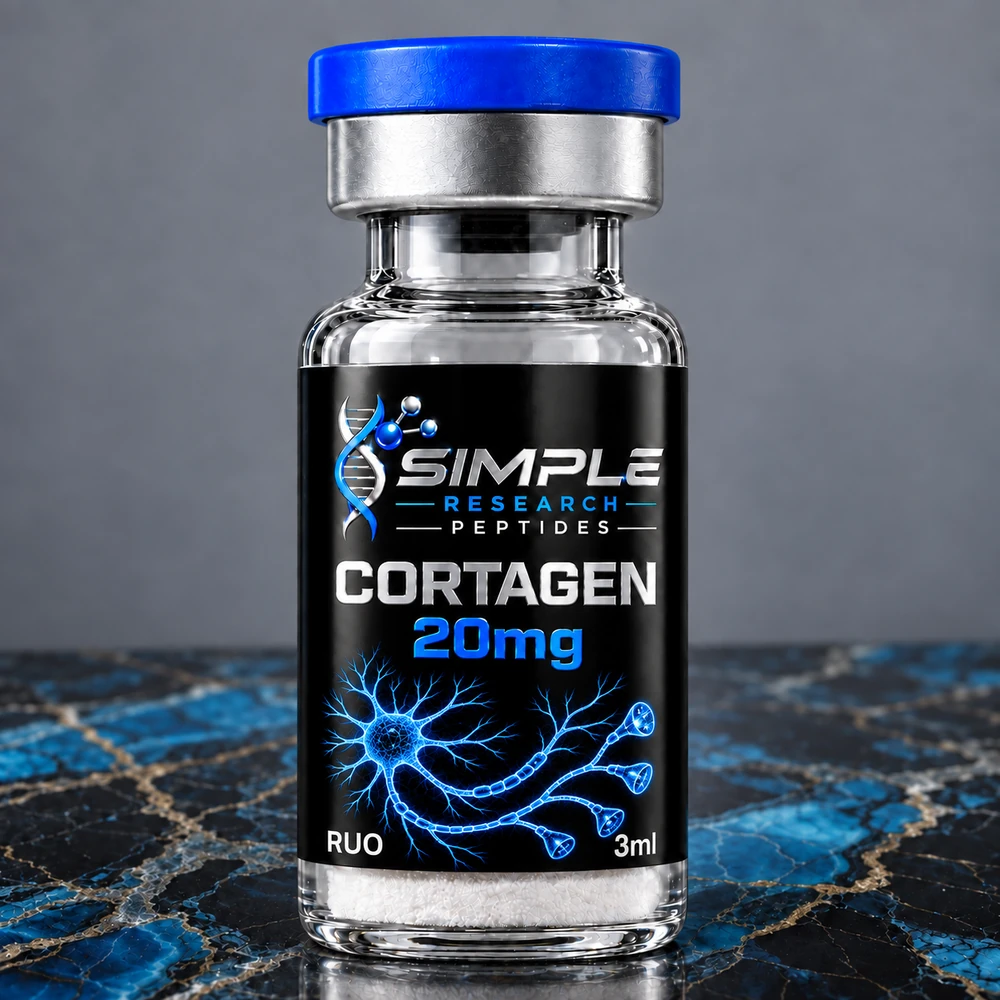
Back to the Research Compound Library
Preclinical electrophysiology evidence
Evidence reviewed September 13, 2026.
Research overview and identity
Cortagen is a synthetic tetrapeptide investigated in neural and cellular research. It is distinct from Cortexin, a peptide-containing preparation. A similarity in names does not make the experimental materials interchangeable.
Mechanism under investigation
Electrophysiological experiments examine how a compound changes membrane potential, spontaneous firing and ionic currents. These measurements can help characterize neural activity, but they do not establish improved cognition or recovery from neurological disease.
What the studies report
A 2013 primary report compared Cortagen, Cortexin-related materials and glycine in neurons from the mollusk Planorbarius corneus. The authors reported changes in neuronal membrane potential and activity with Cortagen. The paper also discusses concentration-dependent responses, emphasizing the importance of experimental conditions. [1]
Limits of the evidence
This is an isolated-neuron model from a nonhuman species. Describing an effect as neuroprotective in that model does not establish human treatment efficacy. Sequence confirmation and separation of findings for Cortagen from those for Cortexin are essential when reviewing the literature.
Matching research material to a paper
Check the material identity, formulation and analytical methods against the study methods. A product name or milligram amount alone does not demonstrate experimental equivalence. Published research does not establish the identity, purity or potency of a retail batch; batch-specific analytical documentation must be assessed separately.
For laboratory research only. Not for human or veterinary use. This guide is educational and contains no dosing, reconstitution or administration instructions.