






Peptide research · Compound guide
Cardiogen Research Guide
Explore the mechanisms, study findings and evidence limits behind this research topic.
Product artwork identifies the SRP listing. It does not demonstrate safety or clinical benefit. The evidence guide and its sources follow below.
View product label and documentation →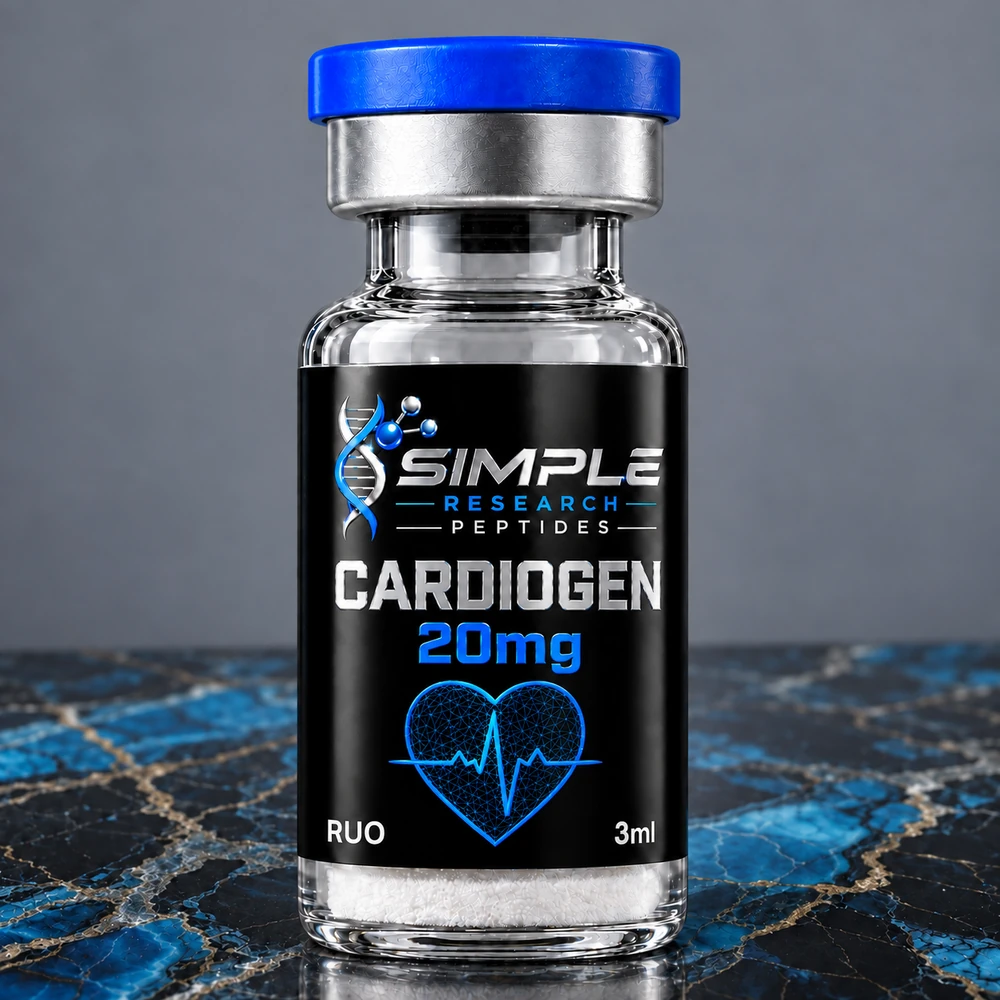
Back to the Research Compound Library
Preclinical tissue-culture evidence
Evidence reviewed September 13, 2026.
Research overview and identity
Cardiogen is a name used for a synthetic short peptide in tissue-specific bioregulator research. The study below investigated tissue explants from rats. It should not be confused with unrelated products or organizations that share a similar name.
Mechanism under investigation
The experiment asked whether short peptides altered growth of organotypic tissue cultures. This type of assay measures a tissue response; it does not by itself identify a selective receptor, establish a gene-targeting mechanism, or demonstrate improved heart performance.
What the studies report
A 2006 study tested Cardiogen and other peptides in heart, lung, prostate and pancreatic explants from young and aged rats. The abstract reports stimulation in corresponding tissue cultures relative to control explants. The linked Russian-language paper has an English abstract. [1]
Limits of the evidence
The authors’ discussion of potential clinical application goes beyond what an explant experiment alone demonstrates. Growth in a culture dish is not evidence of treatment for heart failure, arrhythmia or other cardiovascular disease. Confirm the sequence and material described in the full methods before comparing research batches.
Matching research material to a paper
Check the material identity, formulation and analytical methods against the study methods. A product name or milligram amount alone does not demonstrate experimental equivalence. Published research does not establish the identity, purity or potency of a retail batch; batch-specific analytical documentation must be assessed separately.
For laboratory research only. Not for human or veterinary use. This guide is educational and contains no dosing, reconstitution or administration instructions.