01 / Identity
Sequence and chemical identity
Cagrilintide (INN number 11430; Latin INN cagrilintidum; USAN CAGRILINTIDE) is a long-acting, lipidated 37-residue amylin analogue. Opened development codes are AM833 / AM-833, analogue 23, NN0174-0833 (IUPHAR / Kruse), and NNC0174-0833 (ClinicalTrials.gov). It is still investigational as a monotherapy on the registries and papers opened for this page (16 August 2026).
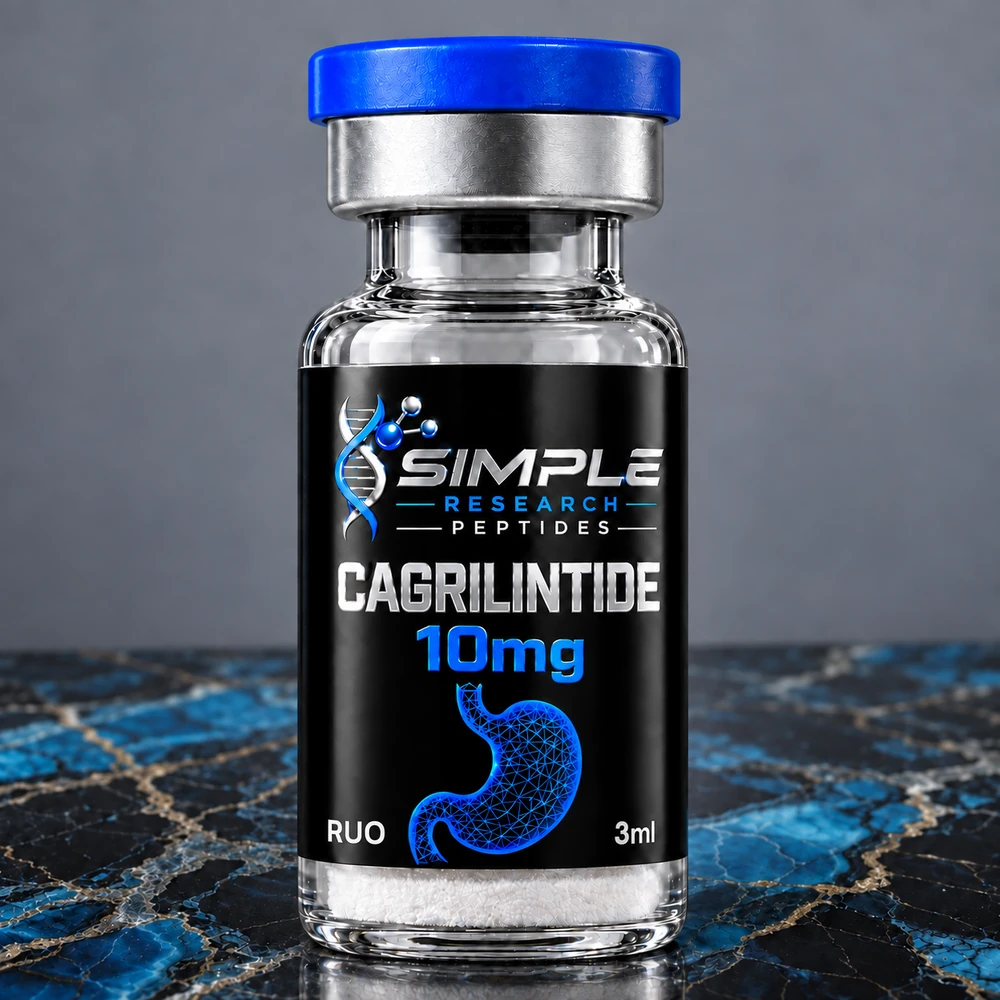
SRP product pages do not print a sequence, CAS, UNII, or molecular formula. Identity below is taken only from opened public registries and primary chemistry/structure papers.
INN / USANcagrilintide (INN 11430)CAGRILINTIDE [USAN]; IUPHAR ligand 13768; WHO Proposed INN List 123; NCATS Inxight
Development codesAM833 / NNC0174-0833Also AM-833; analogue 23; NN0174-0833 (IUPHAR/Kruse)
CAS1415456-99-3PubChem CID 171397054; IUPHAR (WHO INN); WHO PL123; NCATS
UNIIAO43BIF1U8PubChem; NCATS Inxight
PubChemCID 171397054Opened 16 August 2026
Formula / massC194H312N54O59S2 / 4409PubChem computed; exact mass 4408.2582207 Da
InChIKeyLDERDVMBIYGIOI-IZVMHKDJSA-NPubChem; IUPHAR
Other registry IDsDB18887 / CHEMBL4802169NCI Thesaurus C175752; GtoPdb 13768; EC 974-120-5
Sequence (PubChem)XKCNTATCATQRLAEFLRHSSNNFGPILPPTNVGSNTPX = N-terminal lipid (C20 / γ-Glu)
Length37-aa backboneLipidated; C-terminal prolinamide; (3→8) disulfide
ApprovalInvestigationalNCATS approval year Unknown; not FDA-approved
Not this peptideSemaglutide / pramlintide / CagriSemaDifferent receptors or a combination product
WHO Proposed INN List 123 (opened PDF, 29 July 2020) — official chemical description. N2.1-[N-(19-carboxynonadecanoyl)-L-γ-glutamyl]-[N14>E, V17>R, A25>P, S28>P, S29>P, Y37>P]-human amylin (islet amyloid polypeptide, IAPP; INN: amlintide), (35-40)-disulfide. Action and use on that list: amylin analogue. Formula and CAS on that list match PubChem (C194H312N54O59S2; 1415456-99-3).
PubChem biologic sequence (one-letter; X = N-terminal modification): XKCNTATCATQRLAEFLRHSSNNFGPILPPTNVGSNTP
Systematic name (PubChem synonym, condensed): L-prolinamide, N-(19-carboxy-1-oxononadecyl)-L-γ-glutamyl-L-lysyl-L-cysteinyl-L-asparaginyl-L-threonyl-L-alanyl-L-threonyl-L-cysteinyl-L-alanyl-L-threonyl-L-glutaminyl-L-arginyl-L-leucyl-L-alanyl-L-α-glutamyl-L-phenylalanyl-L-leucyl-L-arginyl-L-histidyl-L-seryl-L-seryl-L-asparaginyl-L-asparaginyl-L-phenylalanylglycyl-L-prolyl-L-isoleucyl-L-leucyl-L-prolyl-L-prolyl-L-threonyl-L-asparaginyl-L-valylglycyl-L-seryl-L-asparaginyl-L-threonyl-, cyclic (3→8)-disulfide.
Structural features recorded on opened pages
- 37-residue amylin-family backbone with a Cys2–Cys7 disulfide (cyclic 3→8 in the systematic numbering; WHO PL123 lists the bridge as (35-40) on the IAPP precursor numbering). (PubChem; WHO PL123; Cao et al. 2025.)
- N-terminal lipidation: N-(19-carboxynonadecanoyl)-L-γ-glutamyl attached at Lys1 (C20 fatty diacid via a γ-Glu linker). (WHO PL123; Cao et al. 2025.)
- C-terminus is prolinamide (not free acid). (PubChem systematic name; Cao et al. 2025: all peptides C-terminally amidated.)
- Substitutions versus human amylin, as printed on WHO PL123: N14E, V17R, A25P, S28P, S29P, Y37P. Cao et al. 2025 state the backbone used for generation of cagrilintide is pramlintide and mark residues that differ from pramlintide (N14E, V17R, Y37P plus the N-terminal lipid).
- Kruse et al. selected a pramlintide-like backbone rather than native human amylin to reduce amyloid fibril formation, then lipidated the analogue for once-weekly pharmacokinetics. (Kruse et al. 2021, PMID 34288673.)
Not printed on SRP pages and therefore not claimed as SRP-verified: sequence, CAS, UNII, formula, or purity numbers beyond the vendor’s own “COA available / high-purity” language.
Critical identity point: Cagrilintide is a lipidated 37-aa amylin analogue (AM833 / NNC0174-0833). It is not semaglutide, not tirzepatide, not pramlintide, and not CagriSema. A combination-trial result is not automatically a single-agent result.