






Peptide research · Compound guide
Argireline Research Guide
Explore the mechanisms, study findings and evidence limits behind this research topic.
Product artwork identifies the SRP listing. It does not demonstrate safety or clinical benefit. The evidence guide and its sources follow below.
View product label and documentation →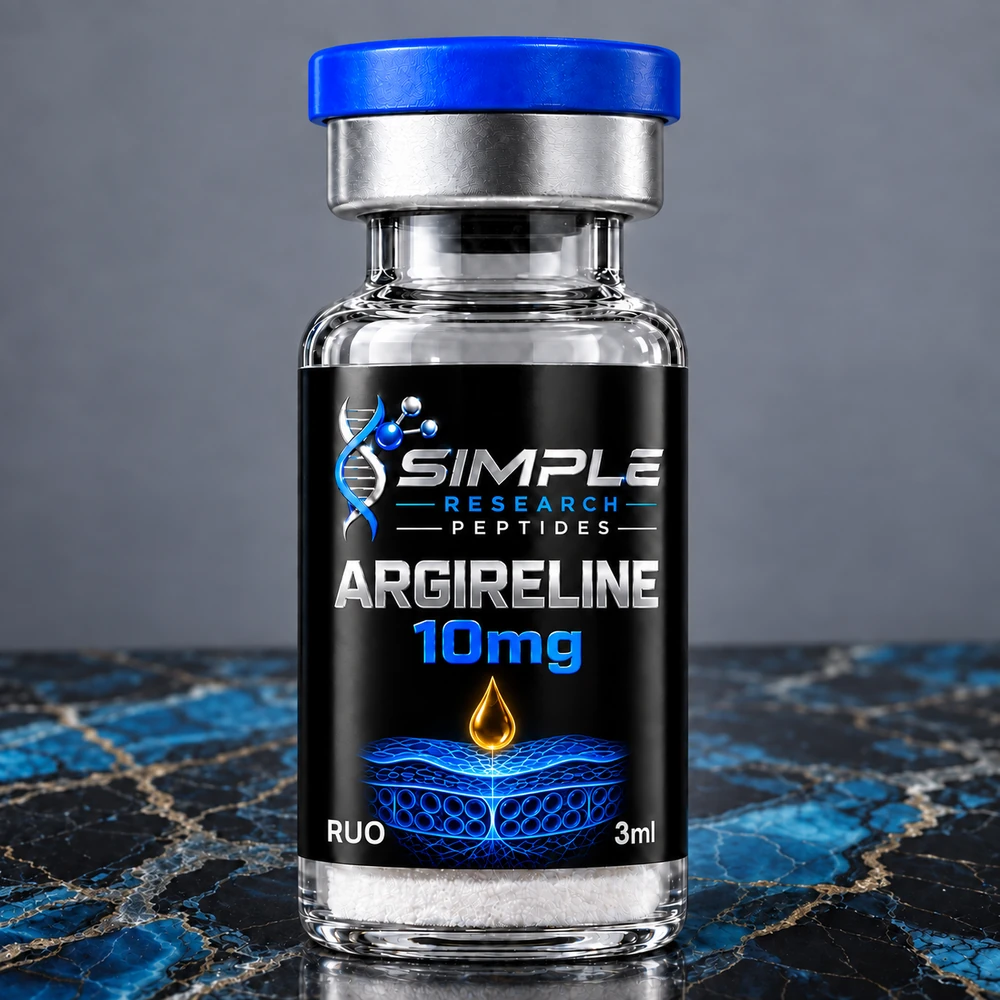
Explore the mechanism chart
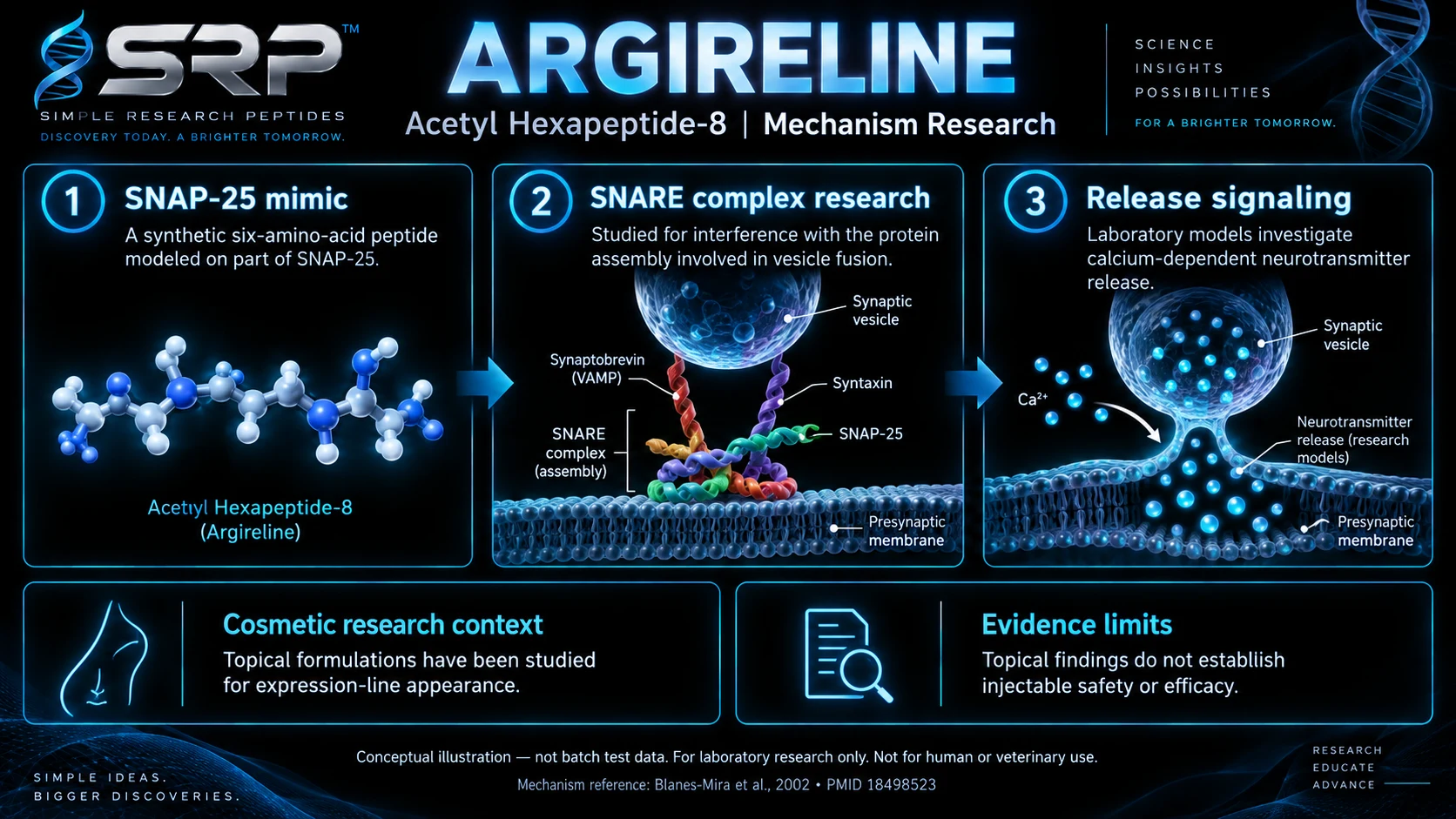
Mechanistic illustration. Interpret alongside the evidence and limitations below.
Back to the Research Compound Library
Laboratory and topical cosmetic research
Evidence reviewed September 13, 2026.
Research overview and identity
Argireline is a trade name associated with acetyl hexapeptide-8, also historically called acetyl hexapeptide-3. The original paper identifies the acetylated, amidated sequence Ac-EEMQRR-NH2. It must be distinguished from SNAP-8, a different peptide.
Mechanism under investigation
The original laboratory work investigated interference with the SNARE machinery involved in vesicle fusion and neurotransmitter release. The peptide showed lower efficacy than botulinum neurotoxin in that system. Sharing a proposed pathway does not make the materials clinically interchangeable.
What the studies report
The 2002 report combined laboratory assays with a topical emulsion study in women, reporting a change in measured wrinkle depth over 30 days. This was research on a particular cosmetic formulation and exposure, rather than evidence about administering a laboratory vial. [1]
Limits of the evidence
Formulation, skin penetration and study design affect interpretation. A result from an emulsion cannot establish the safety or effectiveness of a different route or formulation. The paper’s favorable safety language should not be generalized to every exposure, product or individual.
Matching research material to a paper
Check the material identity, formulation and analytical methods against the study methods. A product name or milligram amount alone does not demonstrate experimental equivalence. Published research does not establish the identity, purity or potency of a retail batch; batch-specific analytical documentation must be assessed separately.
For laboratory research only. Not for human or veterinary use. This guide is educational and contains no dosing, reconstitution or administration instructions.