






Peptide research · Compound guide
ANP (Atrial Natriuretic Peptide)
Explore the mechanisms, study findings and evidence limits behind this research topic.
Product artwork identifies the SRP listing. It does not demonstrate safety or clinical benefit. The evidence guide and its sources follow below.
View product label and documentation →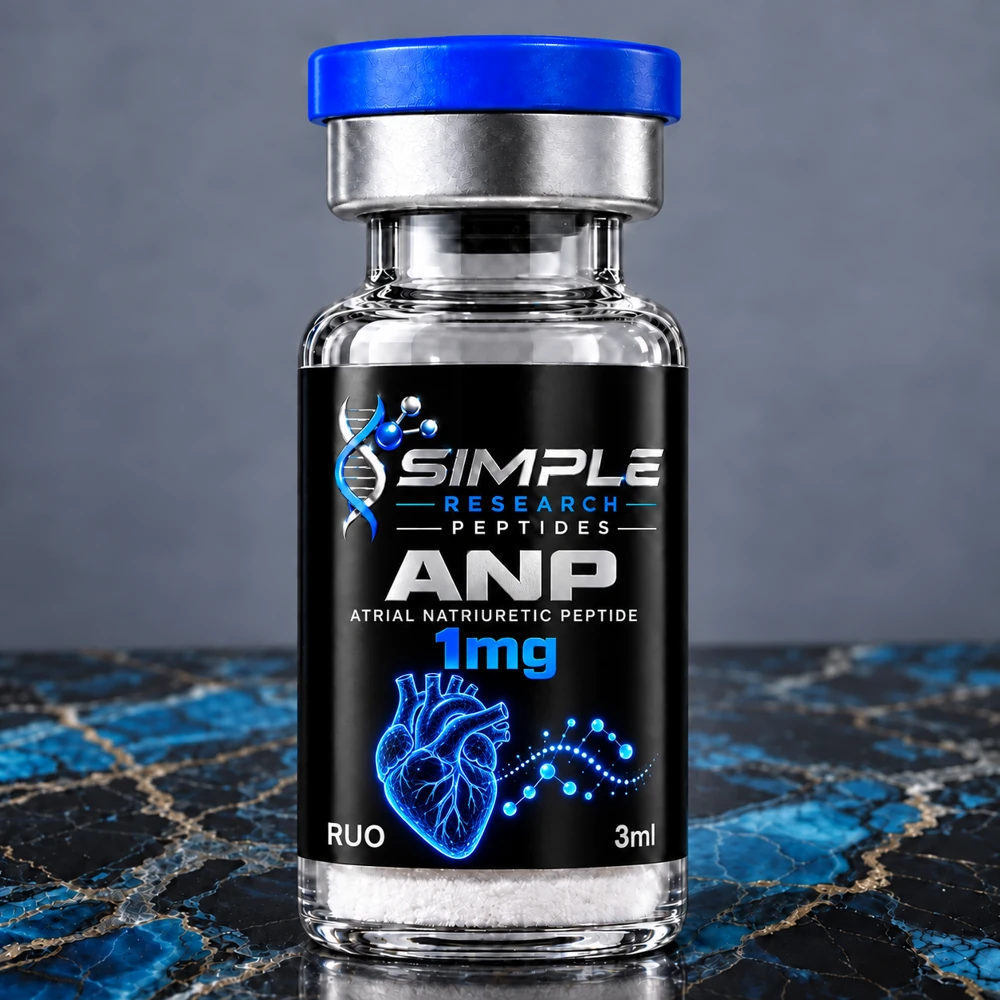
Back to the Research Compound Library
Cardiac, renal and vascular signaling. Evidence reviewed September 29, 2026.
Research overview and identity
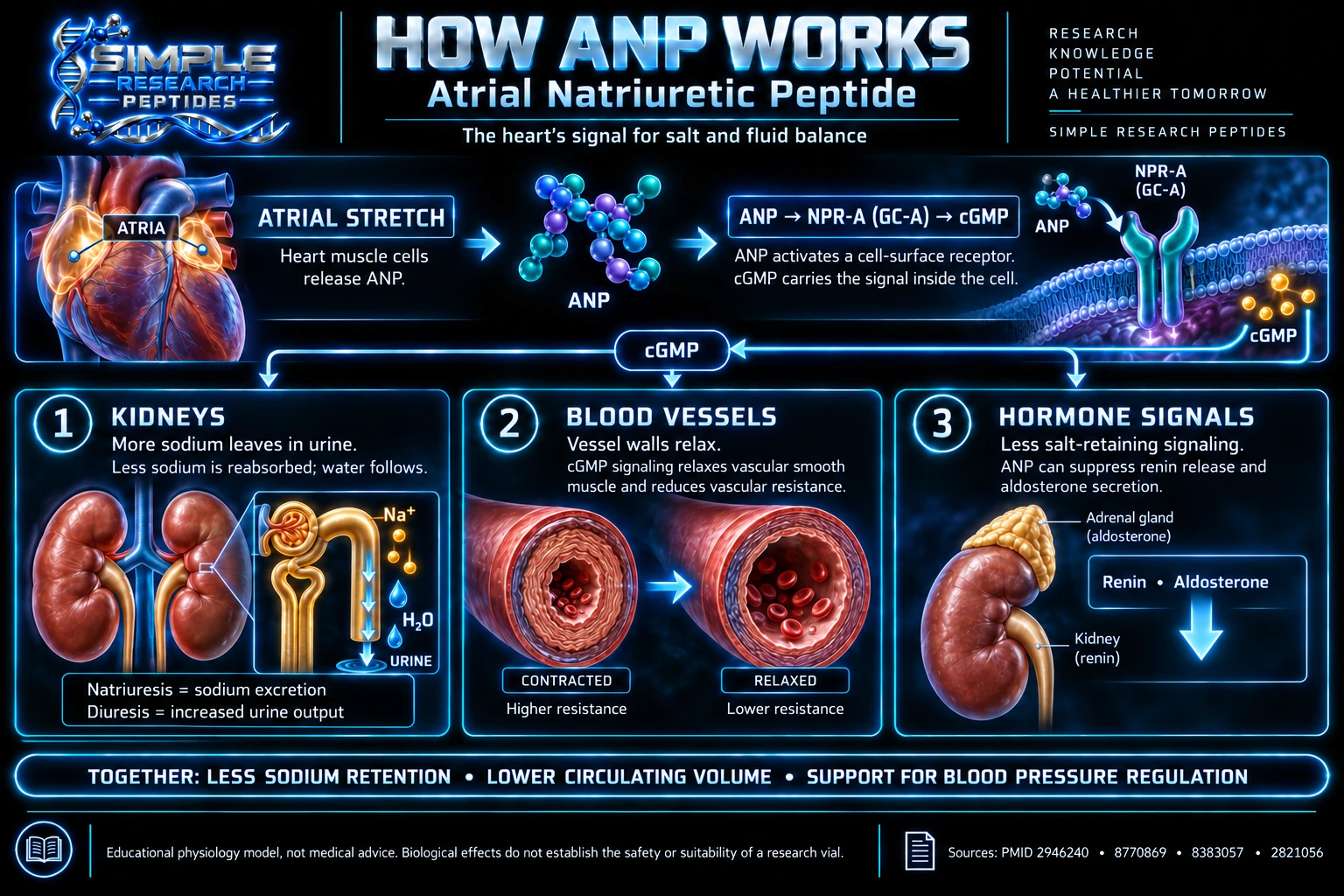
Atrial natriuretic peptide (ANP), historically called atrial natriuretic factor (ANF), is a cardiac peptide signal involved in sodium, fluid and blood-pressure regulation. ANP biology connects the heart’s sensing of filling and stretch with responses in the kidneys, blood vessels and hormone systems.
Mechanism under investigation
Atrial stretch can stimulate ANP release. Binding to NPR-A, also called guanylyl cyclase A or GC-A, promotes formation of the intracellular messenger cyclic GMP (cGMP). ANP is the external signal; cGMP carries part of that signal inside the cell. The related NPR-C receptor participates in clearance and is not interchangeable with NPR-A.
Downstream responses include increased sodium excretion, changes in renal water handling and relaxation of vascular smooth muscle. ANP also interacts with renin and aldosterone pathways. These mechanisms depend on the tissue, experimental conditions and receptor context.
What the studies report
- Isolated atrial tissue, 1986: Bilder and colleagues found that mechanical stretch increased ANF release from isolated rat atria, supporting the stretch-to-signal step. [1]
- Receptor pharmacology and rats, 1996: Jin and colleagues studied an ANP analog selective for NPR-A over NPR-C. It stimulated cGMP through cloned NPR-A and altered renal responses in rats. This is receptor/mechanism evidence for that analog, not a clinical result for a retail ANP vial. [2]
- Controlled human physiology, 1993: Eiskjaer and Pedersen studied 50 healthy subjects. ANP administration increased urinary sodium and water excretion and cGMP, with changes in blood pressure and pulse. Responses were not simply proportional at every tested exposure. [3]
- Hormonal study, 1987: Cuneo and colleagues studied six healthy men under controlled dietary and infusion conditions. Findings included inhibition of angiotensin-stimulated aldosterone secretion and suppression of renin activity in parts of the protocol. [4]
Limits of the evidence
These studies address specific physiological and pharmacological questions. Healthy-volunteer responses and animal or isolated-tissue findings are not interchangeable with long-term clinical outcomes. They do not establish the safety, identity, purity or efficacy of SRP’s current inventory. The diagram is a simplified educational model, not a literal molecular structure or complete map of each nephron site.
Matching research material to a paper
Compare peptide identity, formulation, experimental model and analytical methods with the original paper. Check the actual vial lot against the corresponding report. A label amount or purity percentage alone cannot establish experimental equivalence, freedom from every contaminant or suitability for human use. The generic gallery COA and analytical charts are teaching examples, not batch test data.
For laboratory research only. Not for human or veterinary use. This educational guide provides no dosing, reconstitution or administration instructions.
Sources and further reading
- Bilder et al. Release of atrial natriuretic factor. Effects of repetitive stretch and temperature. 1986.
- Jin et al. Novel analog of atrial natriuretic peptide selective for receptor-A produces increased diuresis and natriuresis in rats. 1996.
- Eiskjaer and Pedersen. Dose-response study of atrial natriuretic peptide bolus injection in healthy man. 1993.
- Cuneo et al. Effect of physiological levels of atrial natriuretic peptide on hormone secretion. 1987.