






Metabolism · Compound guide
Adipotide Research Guide
Explore the mechanisms, study findings and evidence limits behind this research topic.
Product artwork identifies the SRP listing. It does not demonstrate safety or clinical benefit. The evidence guide and its sources follow below.
View product label and documentation →
Explore the mechanism chart
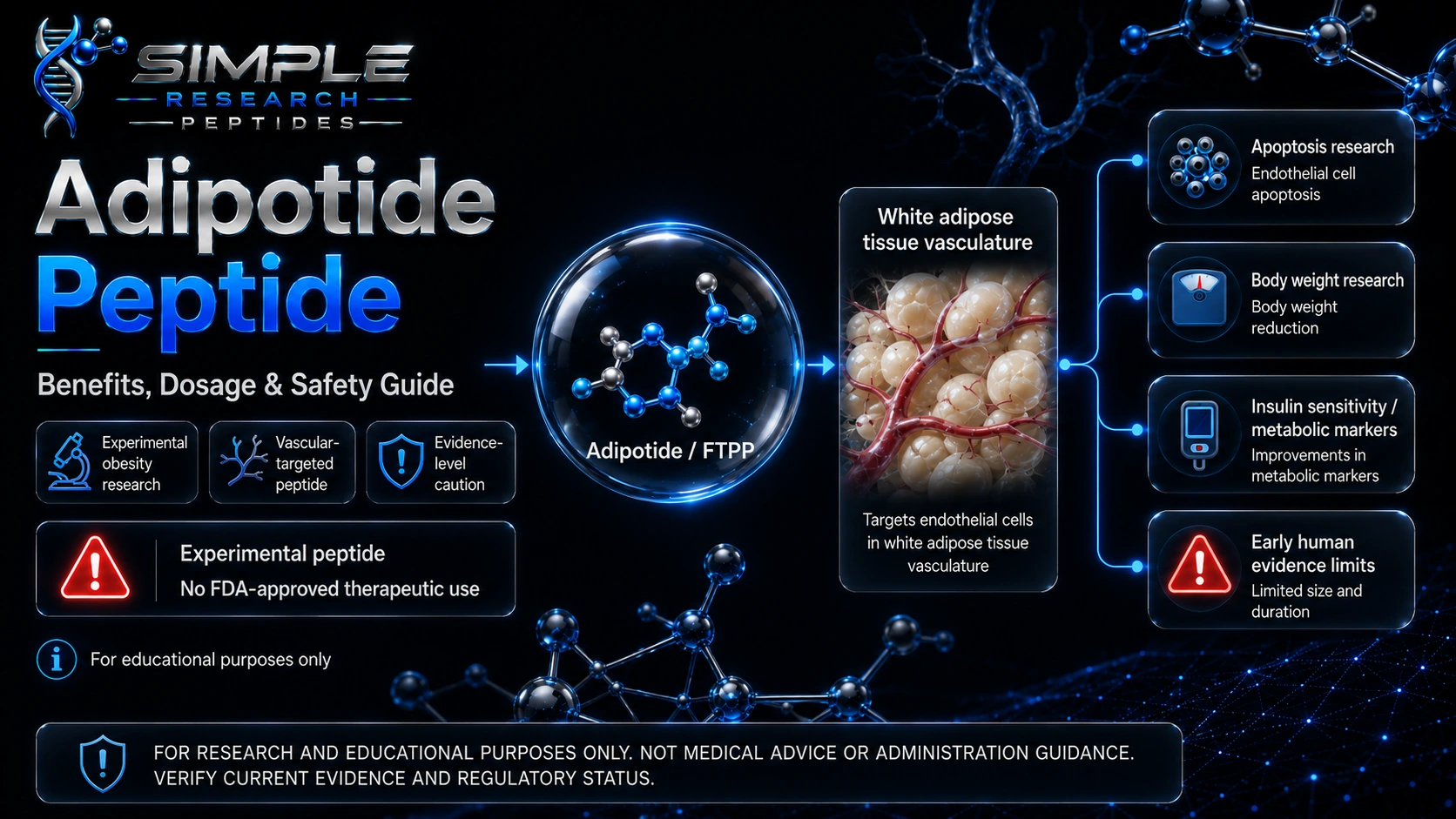
Mechanistic illustration. Interpret alongside the evidence and limitations below.
Back to the Research Compound Library
Animal evidence; kidney findings
Evidence reviewed September 13, 2026.
Research overview and identity
Adipotide is a ligand-directed peptidomimetic investigated for targeting blood vessels associated with white adipose tissue. The primary experiment below concerns nonhuman primates, not a demonstrated treatment in people.
Mechanism under investigation
The construct combines a targeting sequence with a cell-death-inducing segment. Its experimental aim was to disrupt the vascular support of white fat rather than reproduce the appetite-receptor action of a GLP-1 medicine.
What the studies report
A 2011 primate study reported reductions in body weight and white adipose tissue, with improved insulin-resistance measurements. Imaging supported the tissue changes. The same report described changes in kidney proximal-tubule function, characterized as reversible under the tested conditions. [1]
Limits of the evidence
Reversibility in a monitored animal experiment does not establish safety in humans. The renal findings are central to interpreting this work, not a minor footnote. Translation would require controlled human evidence and detailed toxicology; the reported fat changes alone cannot support a clinical recommendation.
Matching research material to a paper
Check the material identity, formulation and analytical methods against the study methods. A product name or milligram amount alone does not demonstrate experimental equivalence. Published research does not establish the identity, purity or potency of a retail batch; batch-specific analytical documentation must be assessed separately.
For laboratory research only. Not for human or veterinary use. This guide is educational and contains no dosing, reconstitution or administration instructions.