






Metabolism · Compound guide
Survodutide Research Guide
Explore the mechanisms, study findings and evidence limits behind this research topic.
Product artwork identifies the SRP listing. It does not demonstrate safety or clinical benefit. The evidence guide and its sources follow below.
View product label and documentation →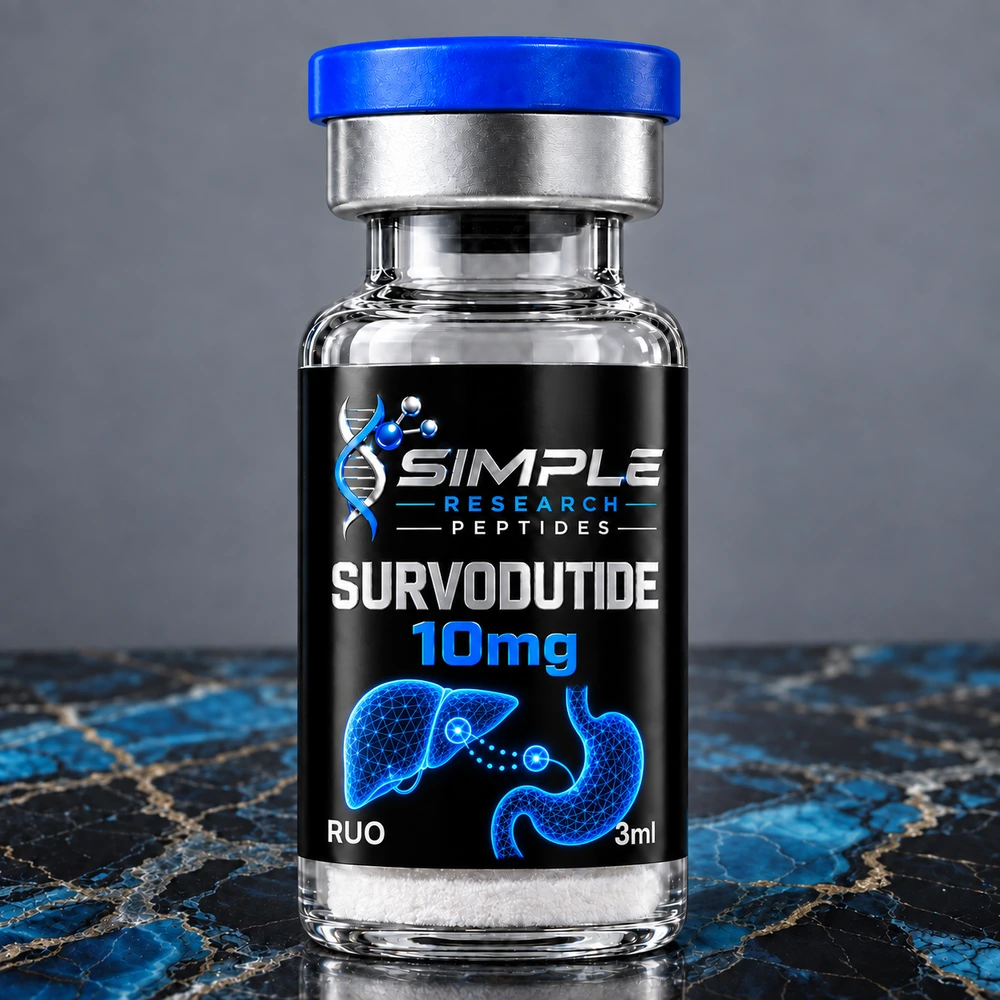
Back to the Research Compound Library
Human phase III clinical research
Evidence reviewed September 13, 2026.
Research overview and identity
Survodutide is a dual glucagon and GLP-1 receptor agonist investigated in metabolic disease. The spelling Survodutide should be used when matching the material to published trials; informal variants can lead to missed or incorrect references.
Mechanism under investigation
The two-receptor design is investigated for combined effects on metabolic regulation and body weight. Its net clinical action and tolerability must be measured in trials rather than inferred from either receptor pathway alone.
What the studies report
A 2026 randomized phase III trial evaluated survodutide in adults with obesity. The study reported greater body-weight reduction than placebo over 76 weeks. Its primary analysis accounted for events such as early discontinuation, making the analysis definition important when comparing headline results. [1]
Limits of the evidence
A trial of a controlled development formulation does not establish equivalence of a research vial. Weight change is one endpoint and should not be treated as proof of every possible long-term health outcome. Population, follow-up, adverse events and discontinuation patterns belong in any detailed assessment.
Matching research material to a paper
Check the material identity, formulation and analytical methods against the study methods. A product name or milligram amount alone does not demonstrate experimental equivalence. Published research does not establish the identity, purity or potency of a retail batch; batch-specific analytical documentation must be assessed separately.
For laboratory research only. Not for human or veterinary use. This guide is educational and contains no dosing, reconstitution or administration instructions.