






Brain & sleep · Compound guide
N-Acetyl Selank Amidate Research Guide
Explore the mechanisms, study findings and evidence limits behind this research topic.
Product artwork identifies the SRP listing. It does not demonstrate safety or clinical benefit. The evidence guide and its sources follow below.
View product label and documentation →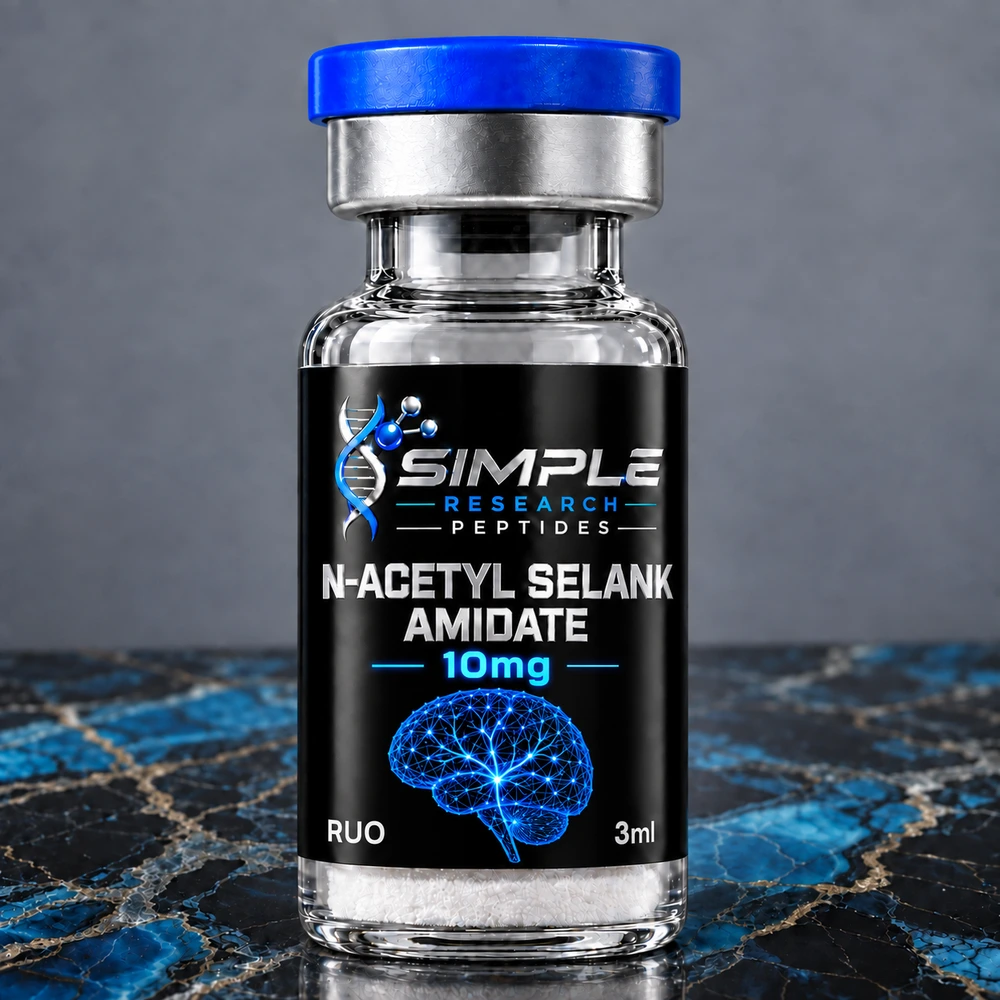
Back to the Research Compound Library
Analytical identity documented; direct clinical evidence limited
Evidence reviewed September 13, 2026.
Research overview and identity
N-Acetyl Selank Amidate is a terminally modified Selank-related peptide. Analytical literature identifies it as Ac-TKPRPGP-NH2. It is chemically distinct from unmodified Selank and from N-acetyl Selank without the terminal amide.
Mechanism under investigation
Changes at peptide termini can influence molecular behavior, but a chemical rationale is not a measured pharmacological result. This guide does not assign the modified material an established anxiety or cognition mechanism based solely on studies of its parent peptide.
What the studies report
Vanhee and colleagues reported analytical reference data that distinguish Selank-related forms by chromatographic and mass-spectrometric characteristics. This is useful identity evidence. It is not a clinical efficacy trial of N-Acetyl Selank Amidate. [1]
Limits of the evidence
In the sources reviewed, direct controlled human evidence for this exact modified form was not established. Claims of greater potency, improved brain delivery or a specific prolonged duration require direct comparative studies. Identifying a molecule correctly is the first step in research, not proof of a health benefit.
Matching research material to a paper
Check the material identity, formulation and analytical methods against the study methods. A product name or milligram amount alone does not demonstrate experimental equivalence. Published research does not establish the identity, purity or potency of a retail batch; batch-specific analytical documentation must be assessed separately.
For laboratory research only. Not for human or veterinary use. This guide is educational and contains no dosing, reconstitution or administration instructions.