






Peptide research · Compound guide
Melanotan I Research Guide
Explore the mechanisms, study findings and evidence limits behind this research topic.
Product artwork identifies the SRP listing. It does not demonstrate safety or clinical benefit. The evidence guide and its sources follow below.
View product label and documentation →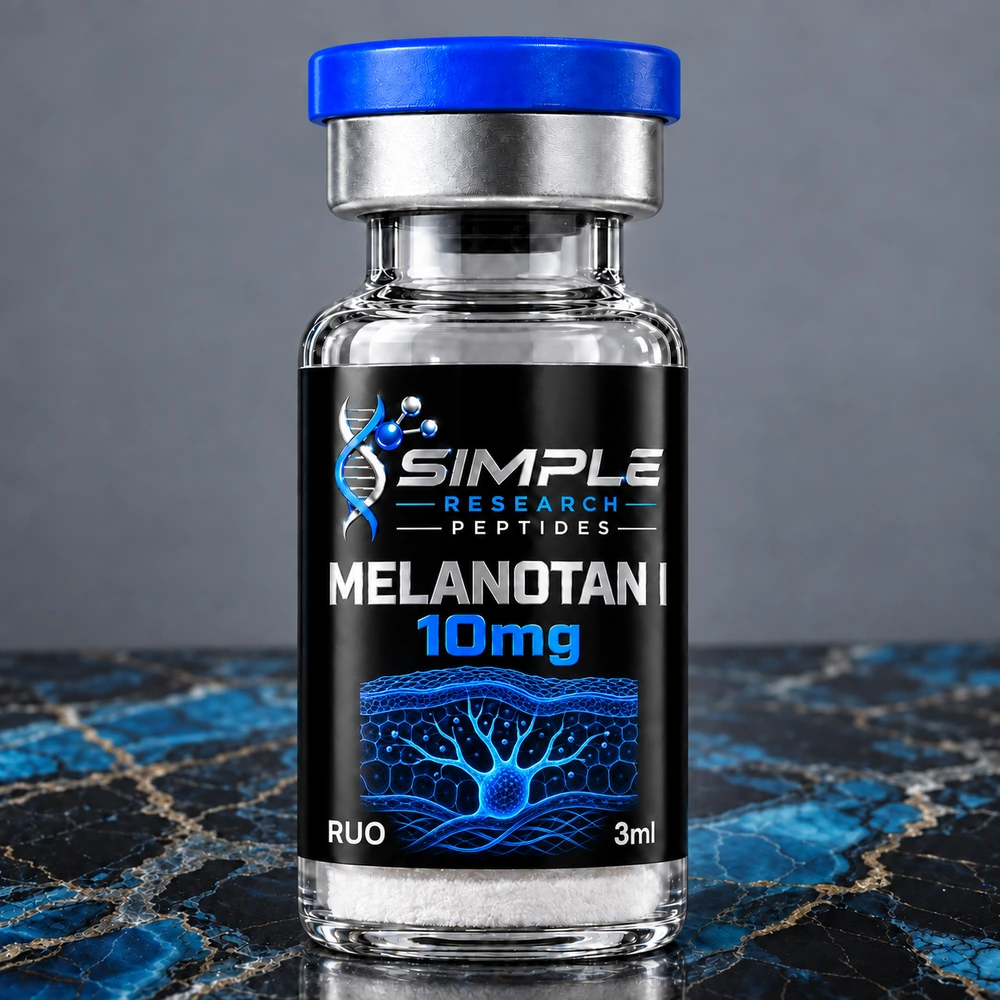
Back to the Research Compound Library
Human afamelanotide trials; formulation-specific evidence
Evidence reviewed September 13, 2026.
Research overview and identity
Melanotan I is associated with afamelanotide, a synthetic alpha-melanocyte-stimulating-hormone analogue. It is distinct from Melanotan II. The best-known clinical evidence concerns a controlled implant formulation for erythropoietic protoporphyria, not a research vial.
Mechanism under investigation
Melanocortin signaling provides the biological basis for investigating pigmentation and light tolerance. A pigmentation-related mechanism does not imply that ultraviolet exposure becomes harmless or that all cosmetic tanning claims are supported.
What the studies report
Two randomized, double-blind trials published in 2015 studied afamelanotide implants in patients with erythropoietic protoporphyria. Participants receiving active treatment had improvements in pain-free sunlight exposure in the evaluated setting. The studies used defined patient populations and controlled formulations. [1]
Limits of the evidence
Disease-specific implant results cannot be generalized to a different preparation or to ordinary cosmetic use. A research vial is not interchangeable with the studied implant. The evidence should be described in terms of the condition and outcomes tested rather than a general promise of safe tanning.
Matching research material to a paper
Check the material identity, formulation and analytical methods against the study methods. A product name or milligram amount alone does not demonstrate experimental equivalence. Published research does not establish the identity, purity or potency of a retail batch; batch-specific analytical documentation must be assessed separately.
For laboratory research only. Not for human or veterinary use. This guide is educational and contains no dosing, reconstitution or administration instructions.