






Hormone signaling · Compound guide
Kisspeptin-54 Research Guide
Explore the mechanisms, study findings and evidence limits behind this research topic.
Product artwork identifies the SRP listing. It does not demonstrate safety or clinical benefit. The evidence guide and its sources follow below.
View product label and documentation →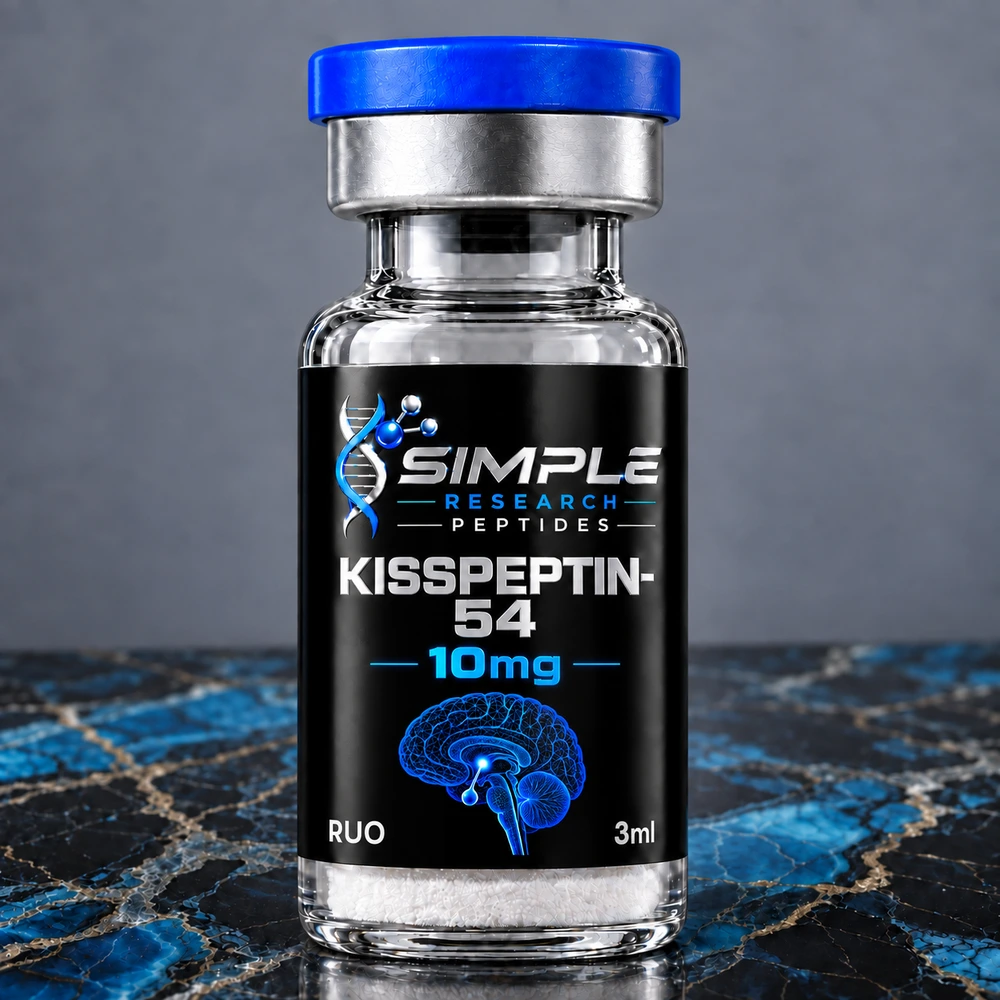
Back to the Research Compound Library
Controlled human reproductive research
Evidence reviewed September 13, 2026.
Research overview and identity
Kisspeptin-54 is a longer kisspeptin form investigated in reproductive endocrinology. It should be distinguished from kisspeptin-10 and from other compounds that act at different points in the reproductive hormone system.
Mechanism under investigation
Kisspeptin signaling helps regulate the hypothalamic reproductive axis and can stimulate downstream gonadotropin release. The response depends on endocrine context, which is why findings from closely monitored fertility protocols cannot be generalized to unsupervised use.
What the studies report
A 2014 study evaluated kisspeptin-54 as an oocyte-maturation trigger in women undergoing IVF. A subsequent randomized study examined whether an additional exposure improved mature-oocyte yield within a controlled assisted-reproduction protocol. Both investigated a specific clinical setting with specialist monitoring. [1] [2]
Limits of the evidence
Evidence for a component of an IVF protocol is not proof of a general fertility, libido or hormone-restoration effect. Study participants also received other protocol-specific care. Different kisspeptin forms and exposure patterns require their own pharmacology and safety evaluation.
Matching research material to a paper
Check the material identity, formulation and analytical methods against the study methods. A product name or milligram amount alone does not demonstrate experimental equivalence. Published research does not establish the identity, purity or potency of a retail batch; batch-specific analytical documentation must be assessed separately.
For laboratory research only. Not for human or veterinary use. This guide is educational and contains no dosing, reconstitution or administration instructions.
Sources and further reading
- Jayasena et al. (2014): kisspeptin-54 and oocyte maturation during IVF
- Abbara et al. (2017): randomized kisspeptin-54 IVF protocol study