






Cellular health · Compound guide
Humanin Research Guide
Explore the mechanisms, study findings and evidence limits behind this research topic.
Product artwork identifies the SRP listing. It does not demonstrate safety or clinical benefit. The evidence guide and its sources follow below.
View product label and documentation →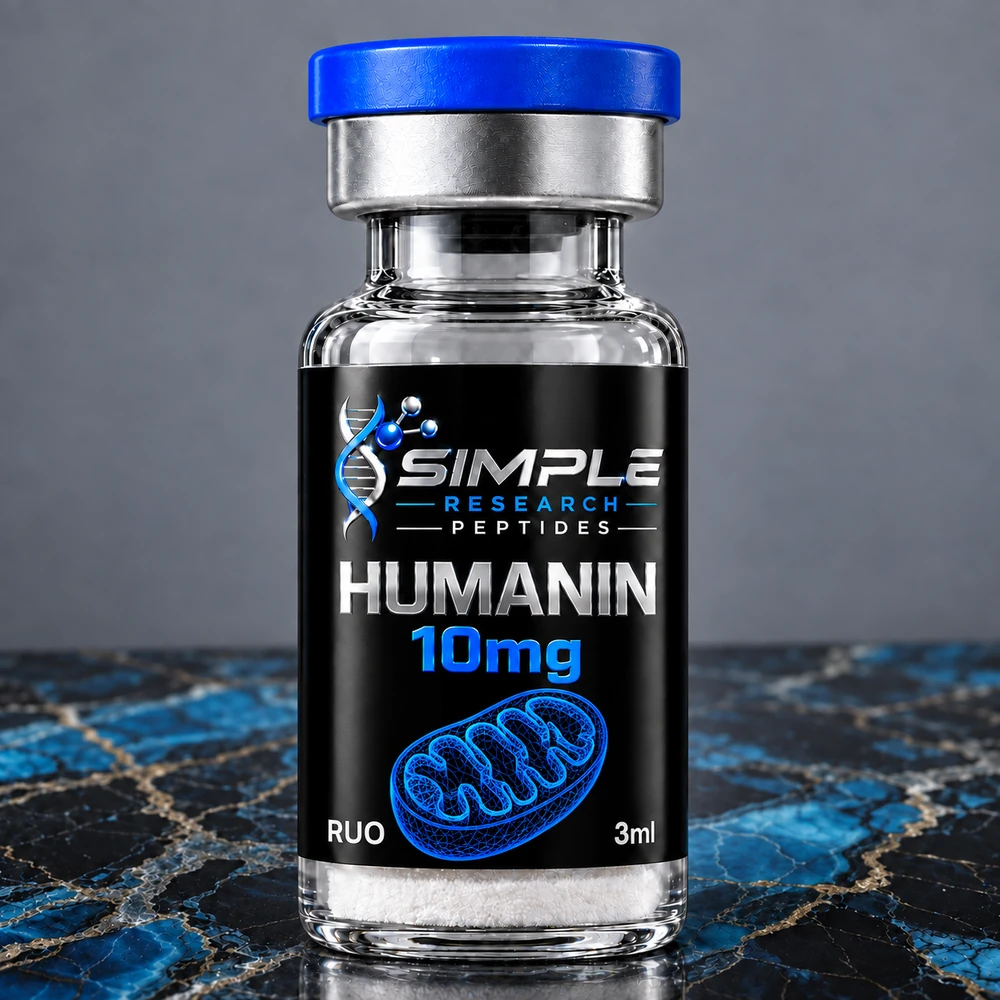
Back to the Research Compound Library
Cell-based mechanistic research
Evidence reviewed September 13, 2026.
Research overview and identity
Humanin is a small peptide investigated in cellular survival and stress-response models. The literature includes native humanin and modified analogues; substitutions can change experimental activity, so these materials should not be grouped as if they were identical.
Mechanism under investigation
Early work examined whether humanin could reduce cell death caused by selected Alzheimer-related insults. Such experiments test protective activity in a model, not whether a compound alters the full course of a complex human disease.
What the studies report
A 2001 primary study reported protection in cell systems involving amyloid-beta and familial Alzheimer-related genes. A later vascular smooth-muscle-cell study also described protection against amyloid-beta toxicity, without demonstrating prevention of amyloid deposition or fibril formation. [1] [2]
Limits of the evidence
Cell survival is distinct from memory improvement, disease modification or lifespan extension. The cited studies do not establish human efficacy or long-term safety. Native humanin should also be distinguished from analogues such as HNG when reviewing publications and analytical documentation.
Matching research material to a paper
Check the material identity, formulation and analytical methods against the study methods. A product name or milligram amount alone does not demonstrate experimental equivalence. Published research does not establish the identity, purity or potency of a retail batch; batch-specific analytical documentation must be assessed separately.
For laboratory research only. Not for human or veterinary use. This guide is educational and contains no dosing, reconstitution or administration instructions.
Sources and further reading
- Hashimoto et al. (2001): humanin in Alzheimer-related cell-death models
- Humanin and amyloid-beta toxicity in vascular smooth-muscle cells (2003)