






Hormone signaling · Compound guide
Hexarelin Research Guide
Explore the mechanisms, study findings and evidence limits behind this research topic.
Product artwork identifies the SRP listing. It does not demonstrate safety or clinical benefit. The evidence guide and its sources follow below.
View product label and documentation →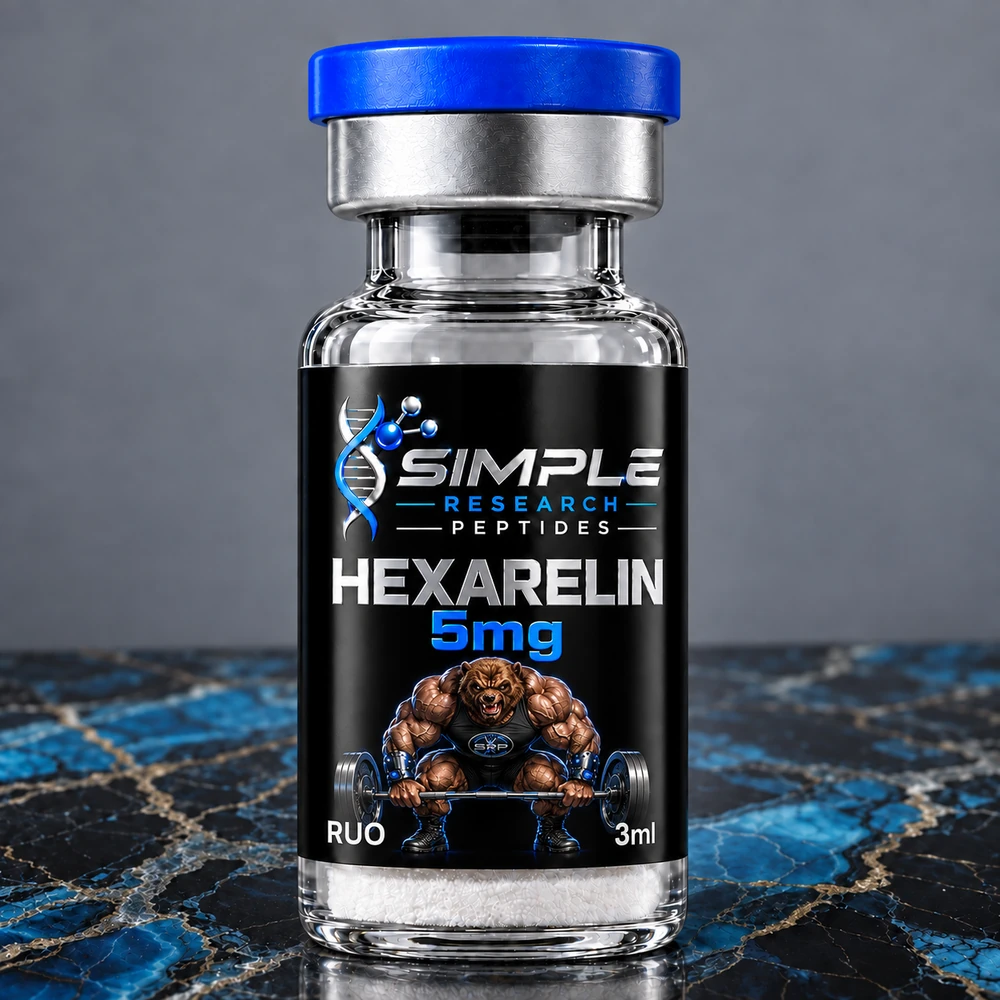
Back to the Research Compound Library
Small human endocrine studies
Evidence reviewed September 13, 2026.
Research overview and identity
Hexarelin is a synthetic growth-hormone secretagogue examined in early human pharmacology. These studies describe acute endocrine responses and related physiological effects rather than establishing a general therapeutic or performance benefit.
Mechanism under investigation
The research evaluates stimulation of growth-hormone release alongside other hormonal responses. Selectivity cannot be assumed merely because a compound is called a growth-hormone-releasing peptide; investigators also measure prolactin and stress-axis hormones.
What the studies report
A 1994 double-blind study in 12 men characterized acute growth-hormone responses. Later human work examined additional endocrine endpoints, and a small sleep study reported changes in sleep architecture alongside hormone effects. These findings show that the measured effects were not limited to one laboratory value. [1] [2]
Limits of the evidence
Brief experiments with small samples do not establish long-term safety, recovery benefits, or outcomes in older or medically complex populations. Acute growth-hormone release should be separated from sustained changes in function. Findings on sleep and other hormones also argue against treating the response as narrowly selective.
Matching research material to a paper
Check the material identity, formulation and analytical methods against the study methods. A product name or milligram amount alone does not demonstrate experimental equivalence. Published research does not establish the identity, purity or potency of a retail batch; batch-specific analytical documentation must be assessed separately.
For laboratory research only. Not for human or veterinary use. This guide is educational and contains no dosing, reconstitution or administration instructions.
Sources and further reading
- Early double-blind human hexarelin pharmacology (1994)
- Human hexarelin sleep and endocrine study (2004)