






Hormone signaling · Compound guide
GHRP-2 Research Guide
Explore the mechanisms, study findings and evidence limits behind this research topic.
Product artwork identifies the SRP listing. It does not demonstrate safety or clinical benefit. The evidence guide and its sources follow below.
View product label and documentation →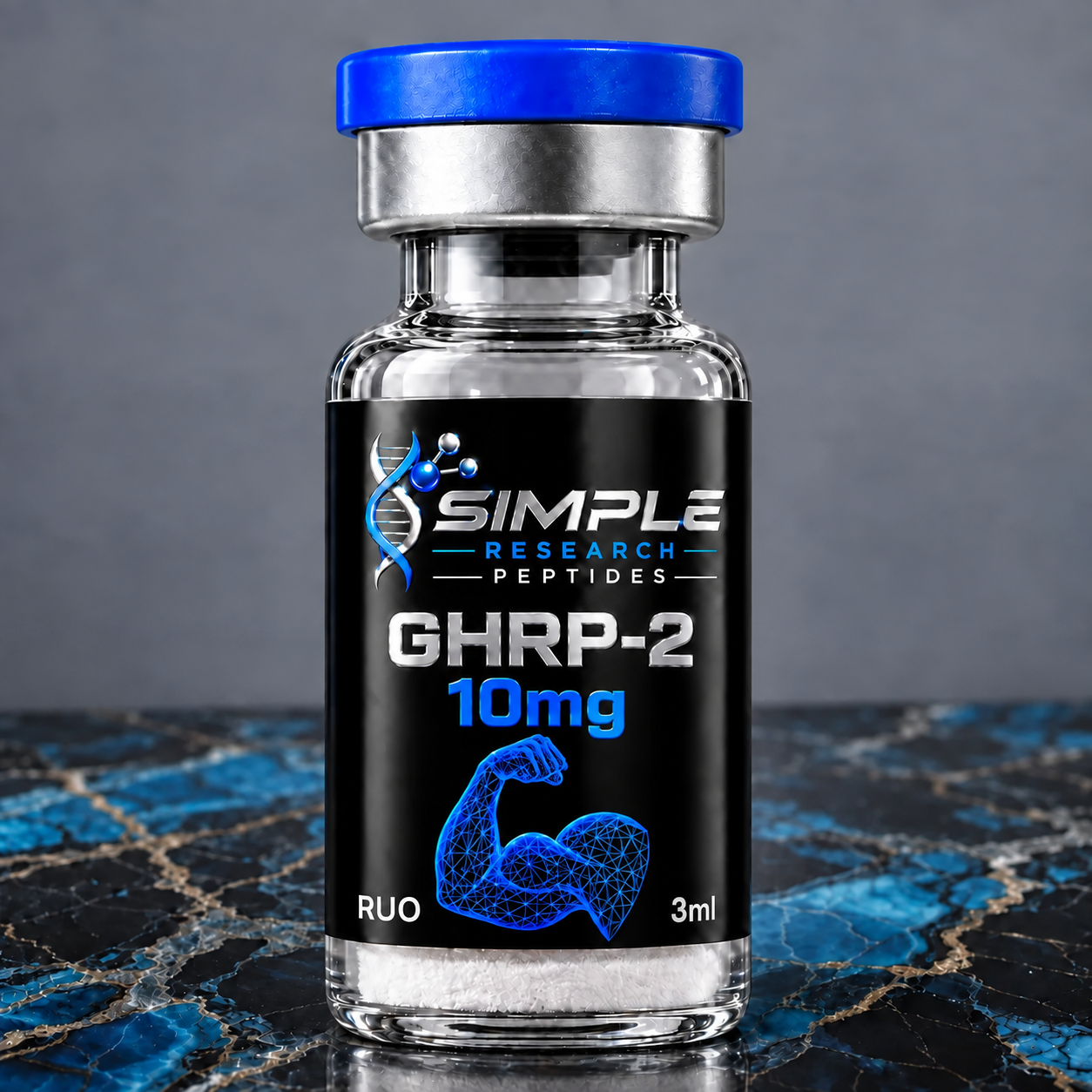
Back to the Research Compound Library
Human endocrine pharmacology
Evidence reviewed September 13, 2026.
Research overview and identity
GHRP-2 is a growth-hormone secretagogue studied through controlled endocrine challenges. Its literature primarily helps explain hormone secretion and feedback; observing a hormone response is not the same as demonstrating an improvement in strength, recovery or healthy aging.
Mechanism under investigation
Research uses GHRP-2 to probe the growth-hormone secretory system and its interaction with other endocrine signals. Hormonal background and co-administered experimental stimuli influence the response, making the study setting essential to interpretation.
What the studies report
A 2009 study in 24 healthy men examined growth-hormone responses after experimentally altering sex-steroid conditions. Responses to GHRP-2 were assessed alongside other secretory stimuli. The results characterized endocrine regulation under carefully controlled conditions rather than a general performance intervention. [1]
Limits of the evidence
This type of physiology experiment does not establish long-term functional benefit or safety in a broad population. Results from combined stimulation protocols should not be attributed to GHRP-2 alone, and findings in healthy men should not be assumed to apply to other groups.
Matching research material to a paper
Check the material identity, formulation and analytical methods against the study methods. A product name or milligram amount alone does not demonstrate experimental equivalence. Published research does not establish the identity, purity or potency of a retail batch; batch-specific analytical documentation must be assessed separately.
For laboratory research only. Not for human or veterinary use. This guide is educational and contains no dosing, reconstitution or administration instructions.