






Metabolism · Compound guide
Efinopegdutide Research Guide
Explore the mechanisms, study findings and evidence limits behind this research topic.
Product artwork identifies the SRP listing. It does not demonstrate safety or clinical benefit. The evidence guide and its sources follow below.
View product label and documentation →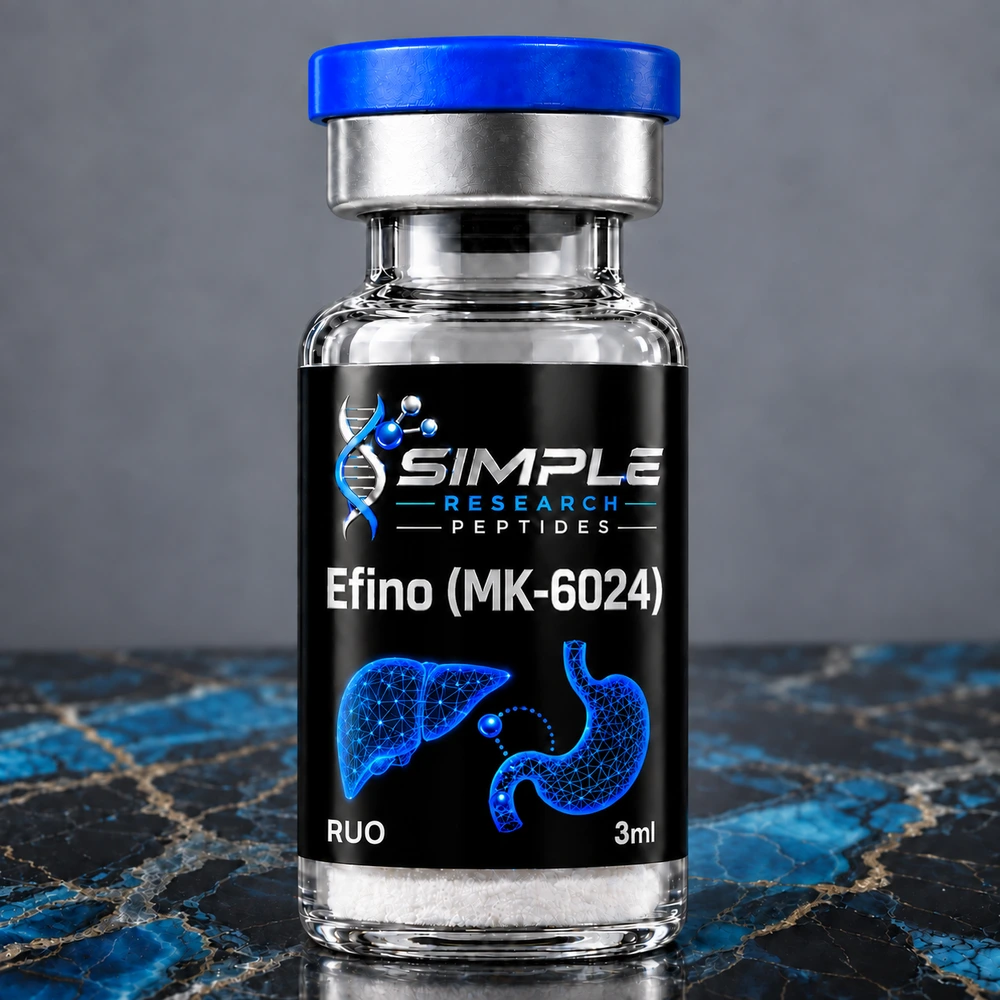
Back to the Research Compound Library
Human clinical research
Evidence reviewed September 13, 2026.
Research overview and identity
Efinopegdutide, also known as MK-6024, is a dual GLP-1 and glucagon receptor agonist investigated in metabolic liver disease. The research concerns a defined drug-development formulation; the abbreviation Efino and a retail vial label do not independently establish equivalence.
Mechanism under investigation
The compound combines signaling through two metabolic receptors. This creates a rationale for investigating liver-fat metabolism alongside body-weight and glucose-related outcomes, but receptor activity alone cannot establish an improvement in liver inflammation or fibrosis.
What the studies report
A 2023 randomized, open-label phase IIa trial enrolled 145 participants and compared efinopegdutide with semaglutide over 24 weeks. MRI-measured liver-fat reduction was greater with efinopegdutide. The between-group weight-loss difference was not statistically significant, and gastrointestinal adverse events were more frequent with efinopegdutide. [1]
Limits of the evidence
An active-comparator, open-label study of liver-fat change has a different evidentiary meaning from a blinded trial of clinical liver outcomes. These findings do not prove prevention of cirrhosis, long-term safety, or equivalence of research-market preparations. Readers should distinguish the measured imaging endpoint from broader treatment claims.
Matching research material to a paper
Check the material identity, formulation and analytical methods against the study methods. A product name or milligram amount alone does not demonstrate experimental equivalence. Published research does not establish the identity, purity or potency of a retail batch; batch-specific analytical documentation must be assessed separately.
For laboratory research only. Not for human or veterinary use. This guide is educational and contains no dosing, reconstitution or administration instructions.