






Peptide research · Compound guide
Crystagen Research Guide
Explore the mechanisms, study findings and evidence limits behind this research topic.
Product artwork identifies the SRP listing. It does not demonstrate safety or clinical benefit. The evidence guide and its sources follow below.
View product label and documentation →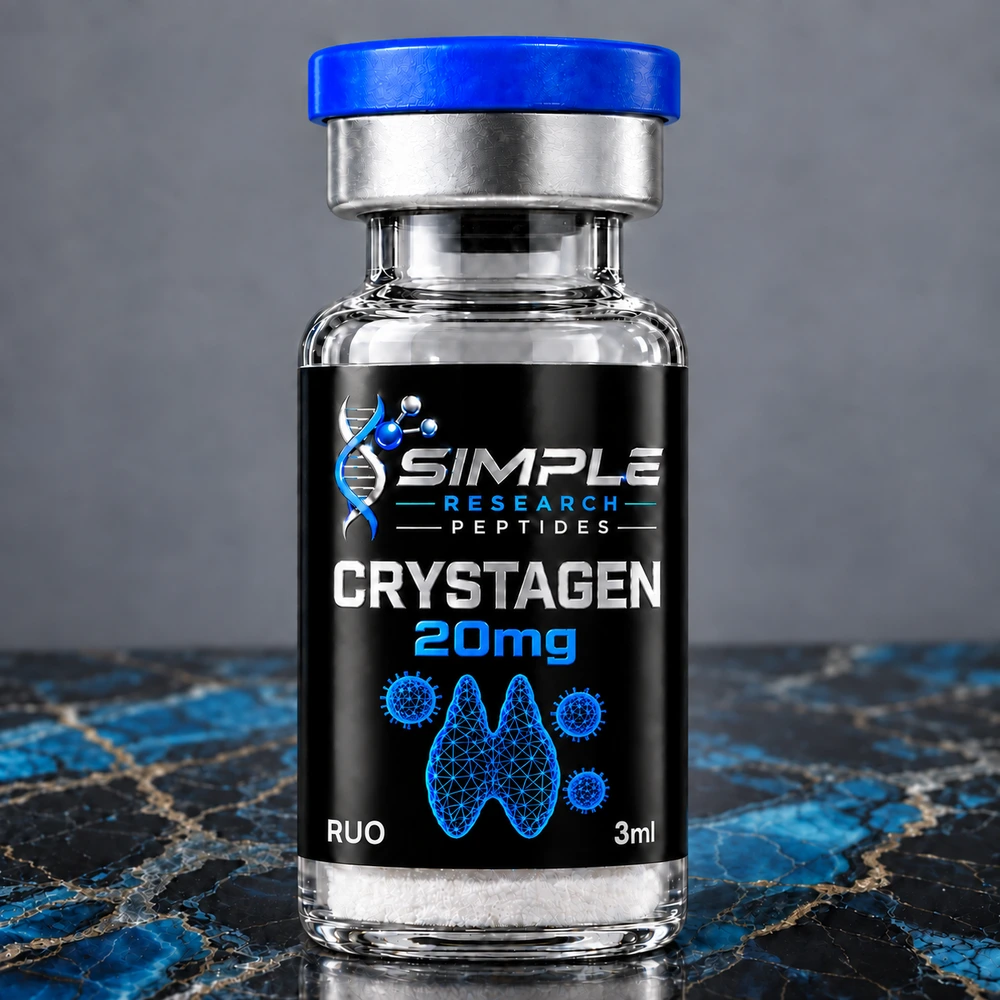
Back to the Research Compound Library
Limited preclinical immune-cell evidence
Evidence reviewed September 13, 2026.
Research overview and identity
Crystagen is a short-peptide name used in experimental research on immune tissues and aging. An immune-cell marker response is a narrower finding than a general claim to strengthen immunity or prevent infections.
Mechanism under investigation
The cited work compares changes in immune-cell populations and processes related to apoptosis, proliferation and differentiation. Those cellular endpoints help generate hypotheses but do not demonstrate improved resistance to disease.
What the studies report
A 2014 report on spleen aging compared Crystagen with Vilon, Timogen and R-1. Its abstract describes an effect on B-cell-related activity with Crystagen, while reporting no associated stimulation of cellular renewal in the aging spleen. Findings for the other peptides should not be attributed to Crystagen. [1]
Limits of the evidence
The available report supports a limited preclinical interpretation. It does not establish a human immune treatment or a disease-prevention benefit. The linked English abstract helps orient readers, but a detailed assessment of the model and methods requires the full Russian-language paper.
Matching research material to a paper
Check the material identity, formulation and analytical methods against the study methods. A product name or milligram amount alone does not demonstrate experimental equivalence. Published research does not establish the identity, purity or potency of a retail batch; batch-specific analytical documentation must be assessed separately.
For laboratory research only. Not for human or veterinary use. This guide is educational and contains no dosing, reconstitution or administration instructions.