






Peptide research · Compound guide
Bronchogen
Explore the mechanisms, study findings and evidence limits behind this research topic.
Product artwork identifies the SRP listing. It does not demonstrate safety or clinical benefit. The evidence guide and its sources follow below.
View product label and documentation →
Explore the mechanism chart
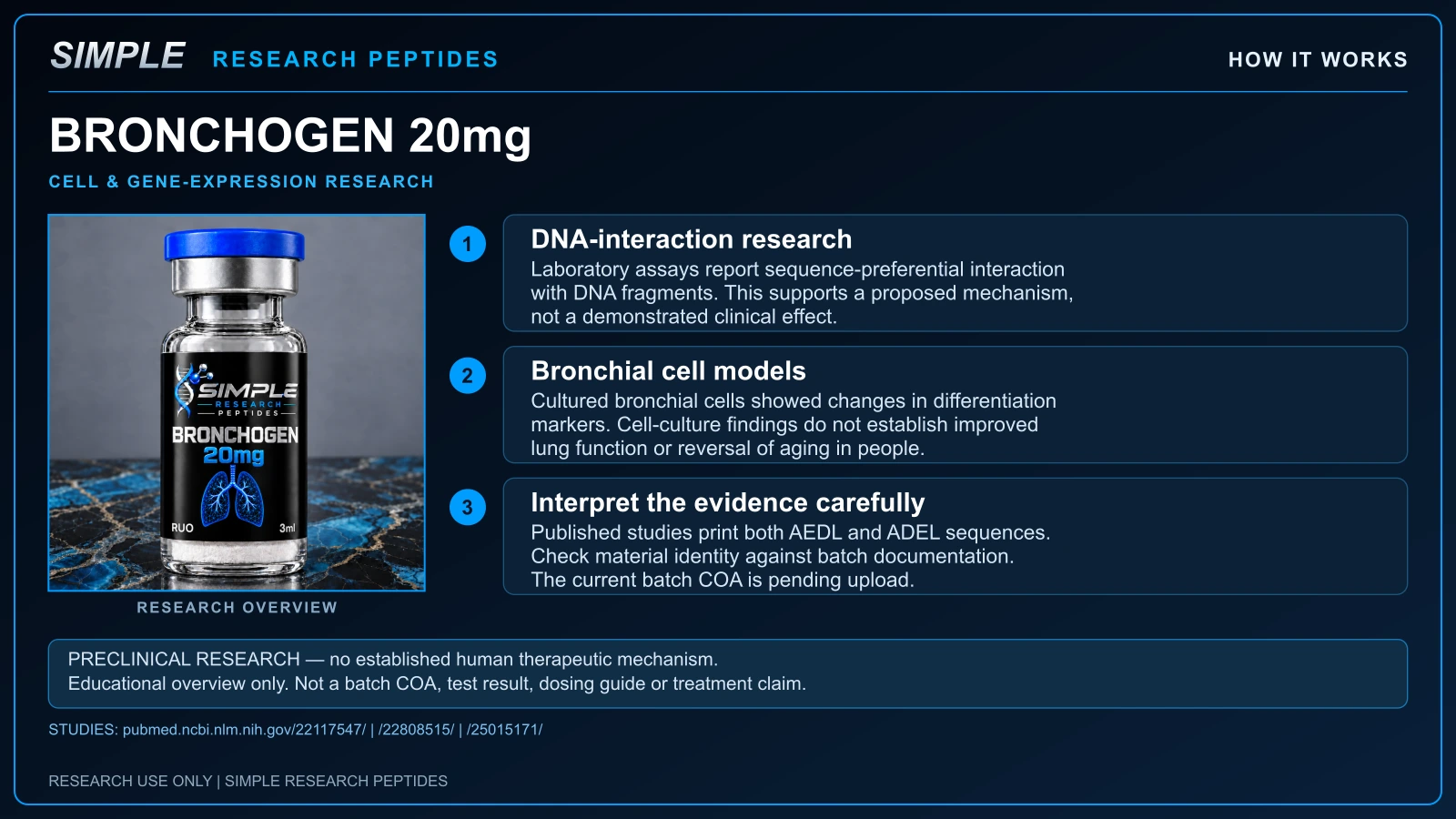
Mechanistic illustration. Interpret alongside the evidence and limitations below.
Bronchogen Research Guide
Preclinical evidence on bronchial epithelial cells and peptide–DNA interactions. Updated September 13, 2026.
What researchers have studied
Bronchogen is the name used for a short peptide in experimental respiratory research. The primary papers below examine isolated DNA, cultured bronchial epithelial cells, and an animal model. Those experiments address biological activity under specific laboratory conditions. They do not establish that a commercially supplied vial treats a respiratory disease or is suitable for human use.
Identity matters
The 2011 paper identifies its peptide as Ala-Asp-Glu-Leu, and the 2014 cell study uses the abbreviation ADEL. Researchers should match the ordered sequence and batch documentation to the material described in a study before applying its findings. A product name and milligram amount alone do not establish experimental equivalence. 2011 primary paper; 2014 primary paper.
Proposed mechanism and observed findings
A 2011 laboratory study measured DNA melting behavior using differential scanning microcalorimetry. The authors reported increased DNA thermal stability at certain peptide-to-DNA ratios. This is evidence of a physical interaction in that experimental system, rather than proof of selective gene targeting or a clinical effect. Monaselidze and colleagues, 2011.
In 2014, investigators examined human embryonic bronchial epithelial cell cultures at different passages. They measured protein markers and gene expression related to proliferation and differentiation, and separately studied interactions with DNA. The reported changes support further investigation of transcriptional and cellular responses. Human-derived cells in a dish are not a clinical trial, and the findings do not establish outcomes in patients. Khavinson and colleagues, 2014.
A 2017 rat study used repeated nitrogen-dioxide exposure to model obstructive lung pathology. Its abstract reports changes in inflammatory measures and bronchial epithelial structure after peptide treatment. The exposure model, species, and experimental endpoints limit direct translation to human respiratory disease. Titova and colleagues, 2017.
Evidence limits
The cited studies are preclinical. They do not establish a human dosing regimen, long-term human safety, or therapeutic effectiveness of SRP material. Study results also do not certify a retail batch’s identity or purity. Batch-specific analytical documentation must be evaluated separately.
For laboratory research only. Not for human or veterinary use. This educational guide provides no administration or treatment instructions.
Primary sources
- DNA thermostability experiment (2011), PMID 21240358. DOI: 10.1007/s10517-011-1146-x.
- Bronchial epithelial cell and gene-expression study (2014), PMID 25015171. DOI: 10.1007/s00408-014-9620-7.
- Rat obstructive-lung-pathology study (2017), PMID 30199201. Russian-language paper; the linked record provides an English abstract.