SRP RESEARCH PULSE
HUGE SALE ON FEATURED ITEMSKLOW 80mgGLOW 70mgHumanin 10mgFOXO4-DRI 10mgACE-031 1mgWolverine 20/20SS-31 10mg5-Amino-1MQ 50mgMOTS-c 40mgBPC-157/TB-500 10mg/10mgSelank 10mgNAD+ 500mgGHK-Cu 100mgRTZ-GLP 30mgTirzepatide 30mgEpithalon 10mgKisspeptin 10mg

Semax Research Guide

ACTH(4–7)PGP HEPTAPEPTIDE · MEHFPGP · RUO

Semax Research GuideMet-Glu-His-Phe-Pro-Gly-Pro / MEHFPGP · not ACTH · not Selank

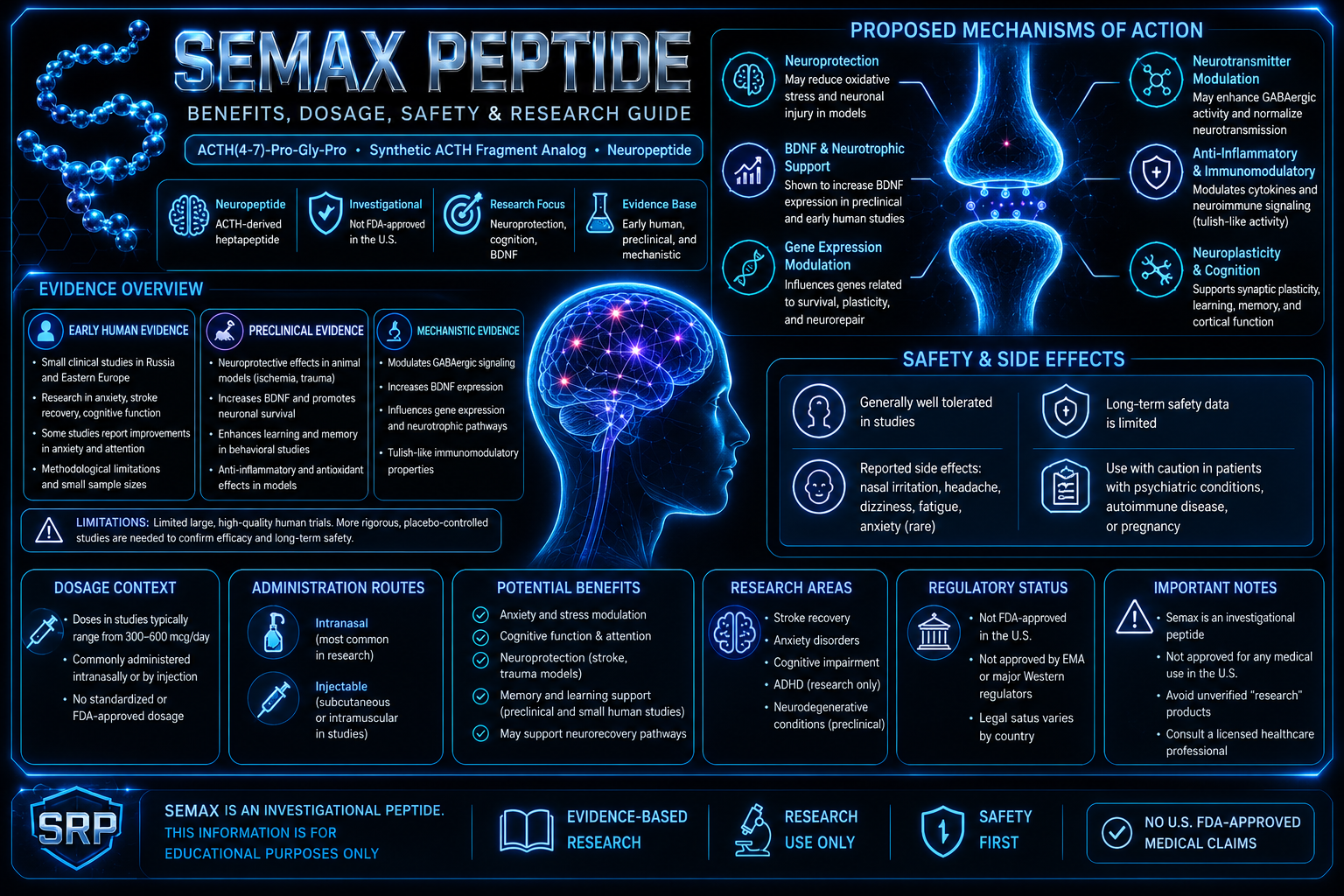
Semax research graphic: benefits, dosage context, safety, and research

Semax is a synthetic ACTH(4–7)–Pro-Gly-Pro heptapeptide with opened sequence Met-Glu-His-Phe-Pro-Gly-Pro / MEHFPGP (PubChem CID 9811102; CAS 80714-61-0; UNII I5FAL2585H; formula C37H51N9O10S; MW 813.9 g/mol). It is not intact ACTH, not ACTH(4–10) MEHFRWG, not Selank (TKPRPGP), and not an FDA-approved drug. Opened human reports are geographically concentrated. Human efficacy of a research-market 10 mg vial is not established. Historical Russian-language clinical papers and marketplace “nootropic / stroke” language are opened literature or vendor copy, not a treatment claim and not an FDA indication. Research use only. Not medical advice. Not for human use.

MEHFPGP / H-MEHFPGP-OH
CID 9811102
CAS 80714-61-0
UNII I5FAL2585H
0 NCT
Not FDA-approved
Research use only

Educational information only. This page describes an investigational laboratory research heptapeptide. It is not medical advice. Simple Research Peptides (SRP) materials are for laboratory research only and are not for human or veterinary use, consumption, administration, diagnosis, treatment, or therapeutic application. No human dosing, reconstitution, or administration protocol appears on this page. This page does not make nootropic or stroke treatment claims.

01 / Identity

Sequence and chemical identity (opened registries only)

SRP product and index pages do not print CAS, UNII, PubChem CID, molecular formula, sequence, termini (free acid vs amide), salt form, or a public COA. Identity below is taken only from opened public registries and from primary papers that name Semax / Met-Glu-His-Phe-Pro-Gly-Pro / ACTH(4–7)PGP.

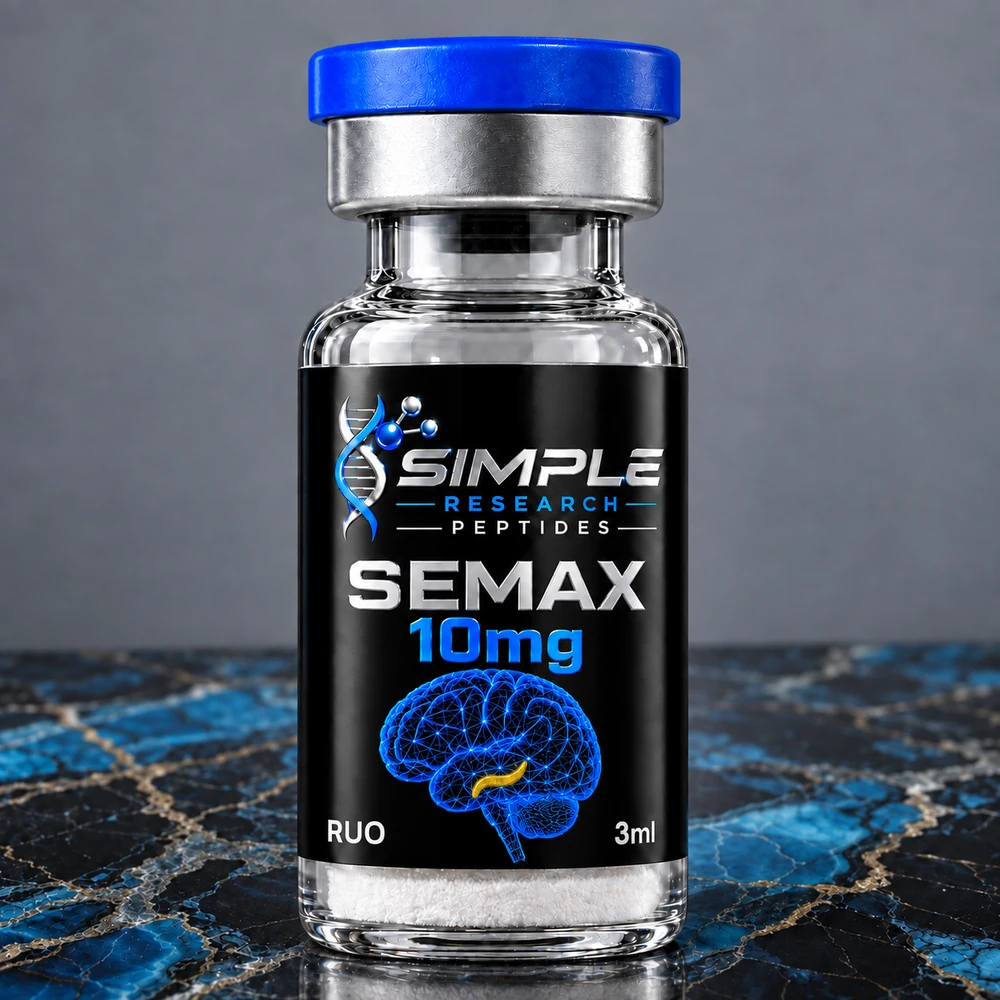
Opened SRP 10 mg product page (16 August 2026): title “Semax 10 mg Neuroscience Research Peptide Vial”. Category: Brain & Mind Research. Subhead: Semax (10 mg Vial) — COA verified research compound. For laboratory research use only. Not for human consumption. Also “Semax (10 mg / 3 mL Vial).” Also known as: ACTH(4-10) Analog. Bullets: 10 mg lyophilized research compound in a 3 mL research vial; COA available for batch verification; high-purity research material; intended for qualified laboratory and analytical research; securely packaged; For Research Use Only. Not for human or veterinary use. Description: supplied for controlled laboratory evaluation of Semax within Brain & Mind Research studies. Footer: for laboratory research only; not for human or animal use, consumption, administration, diagnosis, treatment, or therapeutic application. Availability: 4 in stock (can be backordered). Price was not printed on the opened product-page markdown. Product URL: http://simpleresearchpeptides.com/product/semax-10-mg-vial/.

Not printed on the opened product page and therefore not claimed as SRP-verified: MEHFPGP sequence; free acid vs amide termini; CAS; UNII; CID; salt/counter-ion; a public COA file; a published laboratory dose.

Opened SRP index card (compound-research-guides, 16 August 2026): “Semax (10 mg Vial)” under Cognitive; tagged Evidence profile. Overview: Semax is a synthetic ACTH(4-7)-derived heptapeptide studied in neuroprotection, cognition, and stress-related signaling. That index sentence is vendor/index copy, not a nootropic treatment claim. Mechanism: reported effects involve neurotrophic signaling, neurotransmitter systems, and gene expression without the classic adrenal steroidogenic activity of full ACTH. Evidence: clinical and preclinical publications exist, but much of the human evidence is regionally concentrated and not broadly replicated in large modern trials. Quality note: do not generalize from ACTH or other melanocortin fragments. Confirm the exact Semax sequence. Last editorial review on that index: August 2026.

Opened dedicated-guide URLs http://simpleresearchpeptides.com/research-compound-directory/semax-research/ and .../semax-research-guide/ returned HTTP 404. This page is written for that missing guide.

Peptide sequenceMEHFPGPDepositor strings Met-Glu-His-Phe-Pro-Gly-Pro; H-Met-Glu-His-Phe-Pro-Gly-Pro-OH. CID 9811102; Kost 2001 PMID 11443939; Dolotov 2006 PMID 16996037.
PubChem titleACTH (4-7), Pro-Gly-Pro-Not “Semax” as the record title. Depositor synonym Semax is printed. CID 9811102.
CAS80714-61-0PubChem synonym / RN block; NCATS UNII page.
UNIII5FAL2585HNCATS I5FAL2585H title SEMAX; Approval Year Unknown.
Formula / MWC37H51N9O10S / 813.9NCATS prints 813.92. Exact / monoisotopic mass 813.34796003 Da.
InChIKeyAFEHBIGDWIGTEH-AQRCPPRCSA-NDefined stereocenters 6 / 6 (NCATS).
EPA DSSTox / RxCUIDTXSID601001439 / 2049929NCATS.
Depositor synonymsSemax; MEHFPGPAlso ACTH (4-7), Pro-Gly-Pro-; Met-Glu-His-Phe-Pro-Gly-Pro; H-Met-Glu-His-Phe-Pro-Gly-Pro-OH; UNII-I5FAL2585H; Met-Glu-His-Phe-Pro-Gly-Pro [WHO-DD].
NCATS InxightSEMAX; OtherApproval Year Unknown; formula C37H51N9O10S. I5FAL2585H
ClinicalTrials.gov0 studiesquery.term=semax totalCount 0; query.intr=semax totalCount 0. Do not invent an NCT.
FDA-approved Semax drugNoneopenFDA generic_name:semax → No matches found. NCATS approval year: Unknown.
SRP listing10 mg vialBrain & Mind Research; AKA ACTH(4-10) Analog. Vendor alias, not native ACTH(4–10).
Critical identity point. CID 9811102 is the free-acid all-L heptapeptide H-MEHFPGP-OH. Vendor language “ACTH(4-10) Analog” is a marketplace alias. Native ACTH(4–10) is MEHFRWG, not MEHFPGP. Opened papers print Semax as ACTH(4–7)PGP / ACTH(4–10) analog for the MEHFPGP sequence. ACTH itself (39 aa) and ACTH(4–10) MEHFRWG are different molecules. Selank (CID 11765600; TKPRPGP) shares a C-terminal Pro-Gly-Pro and appears with Semax in Kost 2001 as a separate inhibitor. Not interchangeable. ClinicalTrials.gov returned 0 Semax studies.
02 / Overview

How Semax is not ACTH and not Selank

Catalog “Brain & Mind / nootropic / neuroprotection” language does not convert a research heptapeptide into ACTH, an approved stroke drug, or Selank. This page does not make nootropic treatment claims.

Identity What opened sources actually describe Peptide? Typical literature role
Semax (this page) 7 aa; MEHFPGP; CID 9811102; CAS 80714-61-0; UNII I5FAL2585H; C37H51N9O10S; 813.9 g/mol Yes (heptapeptide, free-acid CID) ACTH(4–7)+PGP analog. Preclinical BDNF / ischemia-transcriptome literature. Small, regionally concentrated human imaging reports. Not an approved drug.
ACTH (corticotropin) 39 aa pituitary peptide; adrenal steroidogenesis Yes (different molecule) Endocrine hormone. Semax papers explicitly distinguish it from classic ACTH steroidogenic activity.
ACTH(4–10) MEHFRWG Yes (different heptapeptide) Parent fragment. Semax replaces the C-terminal tripeptide with Pro-Gly-Pro.
Selank 7 aa; TKPRPGP; CID 11765600; CAS 129954-34-3; UNII TS9JR8EP1G Yes (different heptapeptide) Tuftsin analog. Separate SRP 10 mg listing.
Pro-Gly-Pro tail alone Shared C-terminal tripeptide of Semax and Selank Fragment, not the vial Shared design motif. Does not make the two heptapeptides interchangeable.

Semax is not intact ACTH. Opened index language and Dolotov 2006 (PMID 16996037) describe an ACTH(4–10) analog without assigning classic adrenal steroidogenesis to the heptapeptide. Do not cite ACTH replacement or cortisol literature as Semax evidence.

Semax is not Selank. Selank is Thr-Lys-Pro-Arg-Pro-Gly-Pro (CID 11765600), a tuftsin analog. They share a C-terminal Pro-Gly-Pro and appear together in Kost et al. 2001 (PMID 11443939) as separate inhibitors of human-serum enkephalin-degrading enzymes (opened IC50: Semax 10 µM; Selank 20 µM). Shared enzyme-assay data are not identity.

Do not equate this vial with ACTH, ACTH(4–10) MEHFRWG, Selank, melanotan, or an FDA-approved nootropic or stroke drug. Research use only.

03 / Mechanism

Proposed mechanism (labeled as such)

Opened primary papers support an ACTH-fragment / glyproline working model with effects on hippocampal BDNF/trkB, ischemia-associated gene/protein expression in rats, and in-vitro serum enkephalinase inhibition. It is not a treatment claim. It was not generated with an SRP 10 mg vial. Observed means a measurement in an opened paper. Proposed means a hypothesis. Not shown means the opened papers did not establish it for a research-market lot.

Observed

Enkephalin-degrading enzymes

Kost 2001 (PMID 11443939): Semax and Selank inhibited human-serum enkephalin-degrading enzymes. Opened abstract IC50: Semax 10 µM; Selank 20 µM. Heptapeptides and some pentapeptide fragments inhibited. In vitro. Not a receptor assignment.

Observed

Rat hippocampal BDNF / trkB

Dolotov 2006 (PMID 16996037): a single application of Semax (study condition 50 µg/kg) produced a maximal 1.4-fold increase of BDNF protein, a 1.6-fold increase of trkB tyrosine phosphorylation, and a 3-fold / 2-fold increase of exon-III BDNF and trkB mRNA in rat hippocampus. Rats. Not a human BDNF trial. The microgram-per-kilogram figure is a published study condition, not a protocol.

Observed

Rat ischemia transcriptome

Sudarkina 2021 (PMID 34201112) and Filippenkov 2020 (PMID 32580520): in a rat tMCAO / reperfusion model, Semax (printed as ACTH(4–7)PGP) altered brain protein-expression and transcriptome profiles. Authors note regional clinical use of Semax in ischemic stroke as background. That sentence is not an FDA indication and not evidence that an SRP 10 mg vial treats stroke.

Observed — resting-state fMRI in healthy volunteers (historical / small). Lebedeva et al. 2018 (PMID 30225715): resting-state fMRI in healthy volunteers (11 men and 13 women; mean age printed 43.9±9.5 years); Semax n=14 vs placebo n=10; scans before and 5 and 20 min after the paper’s intranasal 1% Semax session (study condition). Default-mode-network topography change reported. Panikratova et al. 2020 (PMID 32342318): resting-state functional connectivity in 52 healthy participants after Selank or Semax, with amygdala and DLPFC ROIs. These are opened small imaging reports. They are not Phase 3 packages, not FDA evidence, and not proof an SRP lyophilized vial reproduces those sessions. They are not nootropic treatment claims.

Not shown for an SRP 10 mg vial. Not shown on an opened page: a completed cell-surface receptor assignment; human PK of a research-market lot; proof that the SRP lot is CID 9811102 free acid; BDNF / ischemia data generated with that lot; a US ClinicalTrials.gov Semax administration record; FDA approval.

Mechanism in one line. Synthetic ACTH(4–7)–PGP heptapeptide with opened in-vitro enkephalinase-inhibition and rodent BDNF / ischemia-transcriptome literature. Not a treatment claim. Not for human use.
04 / Research Map

Where the literature actually sits

Label every row. Semax ≠ ACTH ≠ Selank. Historical “nootropic / stroke” language is not a completed therapeutic program and is not an instruction.

B · Small imaging

Not FDA evidence

Lebedeva 2018 default-mode network (PMID 30225715). Panikratova 2020 Selank + Semax connectomics (PMID 32342318). Geographically concentrated / small. Not an SRP-vial trial. Not a nootropic treatment claim.

C · ClinicalTrials.gov

No opened Semax NCT

query.term=semax totalCount 0. query.intr=semax totalCount 0. Do not invent a Semax administration NCT.

D · Regulatory

Approval year unknown

NCATS: Approval Year Unknown. openFDA generic_name:semax: no matches. No opened NDA/ANDA/BLA for Semax. Not an FDA-approved nootropic or stroke drug. Vendor identity is not independently verified: SRP prints the name Semax, AKA ACTH(4-10) Analog, 10 mg, “COA available,” and research-use-only footers, but does not display sequence, CAS, UNII, termini, salt, or a public COA file.

05 / Snapshot

Opened records, read as they actually sit

Read the “what it did not show” column. Published study designs are historical facts from those papers. They are not a protocol. Cell-culture micromolar concentrations, rodent µg/kg figures, and “intranasal 1%” imaging sessions are study conditions, not instructions for an SRP 10 mg research vial.

Study Species / model What was tested Actual finding (from the opened record) What it did not show
Kost et al., 2001 PMID 11443939. DOI 10.1023/a:1011373002885. Opened Europe PMC abstract. Human serum enzymes, in vitro Semax and Selank vs enkephalin-degrading enzymes Dose-dependent inhibition. IC50 Semax 10 µM; Selank 20 µM. Heptapeptides and some pentapeptide fragments active. Human RCT. Receptor assignment. SRP-vial identity. Semax = Selank.
Dolotov et al., 2006 PMID 16996037. DOI 10.1016/j.brainres.2006.07.108. Opened Europe PMC abstract. Rat hippocampus Semax (printed Met-Glu-His-Phe-Pro-Gly-Pro); study condition 50 µg/kg BDNF protein ↑ 1.4-fold; trkB phosphorylation ↑ 1.6-fold; exon-III BDNF / trkB mRNA ↑. Rats. Human BDNF trial. SRP lot. Treatment claim. A protocol.
Filippenkov et al., 2020 PMID 32580520. DOI 10.3390/genes11060681. Opened Europe PMC abstract. Rat tMCAO / reperfusion ACTH(4–7)PGP (Semax) transcriptome Altered ischemia-associated transcript profiles. Authors mention regional clinical use as background. FDA stroke indication. SRP lot. Human RCT. Not a nootropic treatment claim.
Sudarkina et al., 2021 PMID 34201112. DOI 10.3390/ijms22116179. Opened Europe PMC abstract. Rat cerebral ischemia-reperfusion Semax (Met-Glu-His-Phe-Pro-Gly-Pro) proteome Protein-expression profile consistent with a protective effect in that rat model. Human efficacy. Equivalence of a research vial.
Volodina et al., 2021 PMID 33418449. DOI 10.1016/j.npep.2020.102114. Opened Europe PMC abstract. White rats; early-life fluvoxamine Semax as ACTH(4–10) analogue Attenuated some behavioural / neurochemical alterations in that developmental model. Human SSRI-exposure indication.
Lebedeva et al., 2018 PMID 30225715. DOI 10.1007/s10517-018-4234-3. Opened Europe PMC abstract. 24 healthy volunteers Resting-state fMRI; Semax n=14 vs placebo n=10 Default-mode-network topography change after the paper’s intranasal 1% session. Small imaging report. Phase 3. FDA approval. SRP-vial equivalence. A dosing protocol. Not a nootropic claim.
Panikratova et al., 2020 PMID 32342318. DOI 10.1134/s001249662001007x. Opened Europe PMC abstract. 52 healthy participants Selank and Semax resting-state FC (amygdala, DLPFC) Functional-connectivity changes reported for each peptide as separate interventions. Identity collapse. FDA indication.

Human / NCT snapshot. No opened Semax administration NCT on ClinicalTrials.gov (term and intervention queries both 0). Do not invent one.

06 / Not established

Gaps in the opened record

These are gaps. Treating any of them as settled is incorrect.

No FDA-approved therapeutic use

NCATS approval year: Unknown. openFDA: no matches. Not an FDA-approved nootropic or stroke drug.

No opened US Semax NCT

CT.gov term and intervention queries: 0. Do not invent one.

No proof the SRP vial is CID 9811102 free acid

Sequence, termini, CAS, UNII, salt, and a public COA were not printed.

Vendor “ACTH(4-10) Analog” is not native ACTH(4–10)

Native ACTH(4–10) is MEHFRWG. Semax is MEHFPGP.

Enkephalinase inhibition is an in-vitro working model

Not shown for an SRP lot.

Rat BDNF / ischemia findings are not a human indication

Not a human stroke or nootropic indication. This page does not make those claims.

Selank findings are not Semax

Different sequence. Different parent.

Small fMRI reports are not Phase 3

Not internationally replicated. Not a reason to treat or dose a research vial.

Popular claim Status after this review
“Semax is an FDA-approved nootropic / stroke drug” False on the opened record.
“It is ACTH in a 7-aa vial” False identity. ACTH is 39 aa. Native ACTH(4–10) is MEHFRWG. Semax is MEHFPGP.
“It is Selank” False. Different sequence (MEHFPGP vs TKPRPGP); different parent (ACTH fragment vs tuftsin).
“Enkephalinase IC50 proves a human cognitive indication” Unsupported. In-vitro serum assay. Not a nootropic treatment claim.
“The SRP 10 mg vial is the Dolotov 2006 / Lebedeva 2018 lot” Not established. Sequence and salt not printed.
“CT.gov lists Semax trials” False. Opened queries returned 0.
“This page is a treatment or dosing guide” False. Research use only. No protocol.
07 / Studies

Key papers as short cards

Each card is a single opened record. Historical human language is not a protocol. Micromolar IC50 values, rodent µg/kg figures, and imaging-session conditions are study conditions, not instructions.

In vitro

Kost et al., 2001 — Bioorg Khim.

Semax and Selank inhibit human-serum enkephalin-degrading enzymes. IC50 10 µM (Semax) and 20 µM (Selank) in that assay. In vitro. Distinguishes the two heptapeptides while showing a shared enzyme class. PMID 11443939.

Rat BDNF

Dolotov et al., 2006 — Brain Res.

Semax (Met-Glu-His-Phe-Pro-Gly-Pro) regulated BDNF and trkB in rat hippocampus. Rats. PMID 16996037.

Rat transcriptome

Filippenkov et al., 2020 — Genes.

ACTH(4–7)PGP (Semax) transcriptome after rat cerebral ischaemia-reperfusion. Rats. PMID 32580520.

Rat proteome

Sudarkina et al., 2021 — Int J Mol Sci.

Semax protein-expression profile in a rat ischemia-reperfusion model. Rats. PMID 34201112.

Rat developmental

Volodina et al., 2021 — Neuropeptides.

Semax in a rat early-life fluvoxamine model. Rats. PMID 33418449.

Small imaging; not FDA

Lebedeva et al., 2018 — Bull Exp Biol Med.

Resting-state fMRI default-mode network after a paper-specified Semax session in healthy volunteers. Small imaging report. Not FDA evidence. Not a nootropic treatment claim. PMID 30225715.

Separate interventions

Panikratova et al., 2020 — Dokl Biol Sci.

Selank and Semax as separate interventions on resting-state functional connectivity in 52 healthy participants. PMID 32342318.

08 / Lab caution

Research-use-only notes

Semax is an investigational laboratory research heptapeptide. It is not an FDA-approved drug for human use. This page is educational. It does not provide dosing, reconstitution, administration, or any human-use instructions. The 10 mg mass is a vendor listing, not a published laboratory protocol.

Simple Research Peptides (SRP) materials are for laboratory research only and are not for human or veterinary use, consumption, administration, diagnosis, treatment, or therapeutic application.

Laboratory identity is the first practical issue. Opened registries describe Semax as CID 9811102 / CAS 80714-61-0 / UNII I5FAL2585H / H-MEHFPGP-OH. SRP product pages do not print sequence, CAS, UNII, termini, salt, or a public COA. A method written for ACTH, ACTH(4–10) MEHFRWG, Selank, or an approved neurologic drug is not automatically valid for this vial.

Confirm peptide identity, termini (free acid vs amide), stereochemistry, salt, and purity by LC-MS before treating a vial as the literature article. Independently sourced research peptides are not established as equivalent to Dolotov 2006 or Lebedeva 2018 material. Historical rodent schedules, micromolar enzyme IC50 values, and imaging-session conditions are study conditions from those papers. They are not a reconstitution scheme.

No reconstitution scheme, no administration route, and no human or veterinary use protocol appears on this page. Research use only.

No human dosing protocol. No reconstitution scheme. 0 NCT. Not a nootropic treatment claim. Research use only.

09 / FAQ

Frequently asked questions

Is Semax the same as ACTH?

No. ACTH is a 39-amino-acid pituitary peptide. Semax is the heptapeptide Met-Glu-His-Phe-Pro-Gly-Pro.

Is Semax the same as ACTH(4–10)?

No. Native ACTH(4–10) is MEHFRWG. Semax is MEHFPGP (ACTH(4–7) + Pro-Gly-Pro). Vendor “ACTH(4-10) Analog” is an alias, not identity.

Is Semax the same as Selank?

No. Selank is Thr-Lys-Pro-Arg-Pro-Gly-Pro (CID 11765600). They share a C-terminal Pro-Gly-Pro and appear as separate compounds in Kost 2001.

Does Semax work by raising BDNF?

Dolotov 2006 reported BDNF / trkB changes in rat hippocampus. That is not a human BDNF trial and not an SRP-lot result.

Is Semax an FDA-approved nootropic or stroke drug?

No. NCATS approval year: Unknown. openFDA: no matches. This page does not make treatment claims.

Is there a Semax NCT?

No. CT.gov semax term and intervention queries returned 0.

Is the SRP vial the same as the 2001–2021 literature material?

Not established. Sequence, termini, and salt are not printed. Confirm on a COA / LC-MS.

Can these findings be used as dosing or administration instructions?

No. SRP listings are for laboratory research only and are not for human or animal use. This page does not provide reconstitution, administration, or dosing instructions.

Does this page include human dosing?

No. There is no human dosing, reconstitution, or administration protocol on this page. Research use only. Not medical advice. Not for human use.

10 / References

Sources actually opened for this draft

Sources actually opened for this draft. Do not add PMIDs or NCTs that are not on the allowed list.

  1. Kost NV, Sokolov OIu, Gabaeva MV, et al. Semax and selank inhibit the enkephalin-degrading enzymes from human serum. Bioorg Khim. 2001;27(3):180-183. PMID 11443939. DOI 10.1023/a:1011373002885. In vitro. Abstract.
  2. Dolotov OV, Karpenko EA, Inozemtseva LS, et al. Semax, an analog of ACTH(4-10) with cognitive effects, regulates BDNF and trkB expression in the rat hippocampus. Brain Res. 2006;1117(1):54-60. PMID 16996037. DOI 10.1016/j.brainres.2006.07.108. Rat BDNF. Abstract.
  3. Filippenkov IB, Stavchansky VV, Denisova AE, et al. Novel insights into the protective properties of ACTH(4-7)PGP (Semax) peptide at the transcriptome level following cerebral ischaemia-reperfusion in rats. Genes (Basel). 2020;11(6):681. PMID 32580520. DOI 10.3390/genes11060681. Rat. Abstract.
  4. Sudarkina OY, Filippenkov IB, Stavchansky VV, et al. Brain protein expression profile confirms the protective effect of the ACTH(4-7)PGP peptide (Semax) in a rat model of cerebral ischemia-reperfusion. Int J Mol Sci. 2021;22(11):6179. PMID 34201112. DOI 10.3390/ijms22116179. Rat. Abstract.
  5. Volodina MA, Sebentsova EA, Glazova NY, et al. Semax, synthetic ACTH(4-10) analogue, attenuates behavioural and neurochemical alterations following early-life fluvoxamine exposure in white rats. Neuropeptides. 2021;88:102114. PMID 33418449. DOI 10.1016/j.npep.2020.102114. Rat. Abstract.
  6. Lebedeva IS, Panikratova YR, Sokolov OY, et al. Effects of Semax on the default mode network of the brain. Bull Exp Biol Med. 2018;165(5):653-656. PMID 30225715. DOI 10.1007/s10517-018-4234-3. Small human imaging report. Not a treatment claim. Abstract.
  7. Panikratova YR, Lebedeva IS, Sokolov OY, et al. Functional connectomic approach to studying Selank and Semax effects. Dokl Biol Sci. 2020;490:5-8. PMID 32342318. DOI 10.1134/s001249662001007x. Small human imaging report. Abstract.
  8. ClinicalTrials.gov API v2 query.term=semax and query.intr=semax (totalCount 0 each), opened 16 August 2026. No Semax NCT used.
  9. PubChem CID 9811102 (title ACTH (4-7), Pro-Gly-Pro-; synonym Semax; CAS 80714-61-0; UNII I5FAL2585H). https://pubchem.ncbi.nlm.nih.gov/compound/9811102
  10. NCATS UNII I5FAL2585H (SEMAX; Approval Year Unknown; CAS 80714-61-0; PubChem 9811102). I5FAL2585H
  11. openFDA Drugs@FDA search=openfda.generic_name:semax — no matches. Opened 16 August 2026.
  12. PubChem CID 11765600 (Selank) — distinction only.
  13. SRP pages (opened 16 August 2026): 10 mg http://simpleresearchpeptides.com/product/semax-10-mg-vial/; index compound-research-guides; dedicated-guide guesses http://simpleresearchpeptides.com/research-compound-directory/semax-research/ and .../semax-research-guide/ (404). For laboratory research only. Not for human or animal use.

Allowed PMID list used on this page: 11443939, 16996037, 32580520, 34201112, 33418449, 30225715, 32342318. No administration NCT.

Educational information only. The SRP listing Semax 10 mg is a research peptide corresponding, on opened registries, to Semax / MEHFPGP (CID 9811102; CAS 80714-61-0; UNII I5FAL2585H; H-MEHFPGP-OH; C37H51N9O10S; 813.9 g/mol). It is not ACTH, not Selank, and not an FDA-approved drug. No opened Semax NCT. Not FDA-approved. Termini and salt of an SRP lot are not printed. Historical rodent schedules, micromolar IC50 values, and small imaging reports are study conditions / historical literature, not instructions. This page does not make nootropic or stroke treatment claims. Laboratory research use only; not for human or animal use. Not medical advice. Not for human use. No human dosing protocol. Last source review: 16 August 2026 (America/Indianapolis). For laboratory research only. Not for human or veterinary use.

Identifier Value on opened page Source opened
Peptide sequence MEHFPGP; depositor strings Met-Glu-His-Phe-Pro-Gly-Pro; H-Met-Glu-His-Phe-Pro-Gly-Pro-OH CID 9811102 synonym / PUG block; Kost 2001 PMID 11443939; Dolotov 2006 PMID 16996037
PubChem title ACTH (4-7), Pro-Gly-Pro- (not Semax as the record title). Depositor synonym Semax is printed PubChem PUG + synonym JSON, opened 16 August 2026
PubChem CID 9811102 PubChem PUG REST name semax
CAS 80714-61-0 PubChem synonym / RN block; NCATS UNII page
UNII I5FAL2585H PubChem synonym; I5FAL2585H title SEMAX; Approval Year Unknown
Formula / MW C37H51N9O10S; 813.9 g/mol (NCATS prints 813.92) PubChem PUG; NCATS
Exact / monoisotopic mass 813.34796003 Da PubChem PUG
InChIKey AFEHBIGDWIGTEH-AQRCPPRCSA-N PubChem PUG; NCATS
Defined stereocenters 6 / 6 NCATS
EPA DSSTox DTXSID601001439 NCATS
RxCUI 2049929 NCATS
Depositor synonyms (selected) Semax; ACTH (4-7), Pro-Gly-Pro-; MEHFPGP; Met-Glu-His-Phe-Pro-Gly-Pro; H-Met-Glu-His-Phe-Pro-Gly-Pro-OH; UNII-I5FAL2585H; Met-Glu-His-Phe-Pro-Gly-Pro [WHO-DD] PubChem synonym JSON
NCATS Inxight SEMAX; Other; Approval Year Unknown; formula C37H51N9O10S I5FAL2585H
ClinicalTrials.gov query.term=semax totalCount 0; query.intr=semax totalCount 0 CT.gov API v2, opened 16 August 2026
FDA-approved Semax drug None. openFDA generic_name:semax → no matches Same
SRP listing 10 mg vial; Brain & Mind Research; AKA ACTH(4-10) Analog SRP product page

Registry chaos that must not be collapsed. ACTH(4-10) Analog on the SRP page is vendor language, not proof the vial is native ACTH(4–10). ACTH itself (39 aa) and ACTH(4–10) MEHFRWG are different molecules. Selank (CID 11765600; TKPRPGP) shares a C-terminal Pro-Gly-Pro and appears with Semax in Kost 2001 as a separate inhibitor. Not interchangeable. ClinicalTrials.gov returned 0 Semax studies. Do not invent an NCT.

One-sentence identity restated: Semax is a synthetic ACTH(4–7)–Pro-Gly-Pro heptapeptide with opened sequence Met-Glu-His-Phe-Pro-Gly-Pro / MEHFPGP (CID 9811102; CAS 80714-61-0; UNII I5FAL2585H; formula C37H51N9O10S; MW 813.9 g/mol). It is not intact ACTH, not ACTH(4–10) MEHFRWG, not Selank, and not an FDA-approved drug. This page does not make nootropic or stroke treatment claims.

Kost enkephalinase paper

PMID 11443939: Semax and Selank as separate inhibitors of human-serum enkephalin-degrading enzymes. Opened IC50 Semax 10 µM; Selank 20 µM. In vitro. Shared enzyme class is not identity.

Dolotov rat hippocampal BDNF / trkB

PMID 16996037: Semax (printed Met-Glu-His-Phe-Pro-Gly-Pro) regulated BDNF and trkB in rat hippocampus. Study-condition microgram-per-kilogram figure is not a protocol. Rats. Not a human BDNF trial.

Small resting-state fMRI reports

Lebedeva PMID 30225715 default-mode network; Panikratova PMID 32342318 Selank and Semax as separate interventions. Small imaging reports. Not Phase 3. Not nootropic treatment claims.

Rat ischemia transcriptome / proteome

Filippenkov PMID 32580520; Sudarkina PMID 34201112; Volodina PMID 33418449 early-life fluvoxamine rat model. Regional clinical-use language in those papers is background, not an FDA indication.

SRP index / product / dedicated URLs

Product page prints name, 10 mg / 3 mL, AKA ACTH(4-10) Analog, RUO footer. Price not printed. Sequence, CAS, UNII, termini, salt, and a public COA were not printed. Index tags Evidence profile. Dedicated semax-research and semax-research-guide URLs returned HTTP 404. CT.gov term and intervention queries: 0.

Workspace / index check (16 August 2026). The opened SRP index tags Semax (10 mg Vial) as Evidence profile (not Dedicated evidence guide). Opened dedicated-guide URLs returned HTTP 404. This HTML is a locked conversion of the citation-verified facts draft for that missing page. Not published. Not for WordPress in this pass.

Suggested slug recorded in the locked draft: semax-research. Status: locked citation-verified draft converted to a standalone facts page. Do not add PMIDs, NCTs, CAS, UNII, or CIDs that are not on the allowed identifier list. Allowed PMIDs: 11443939, 16996037, 32580520, 34201112, 33418449, 30225715, 32342318. Distinction-only CID: 11765600 (Selank).

Scroll to Top
View Cart