SRP RESEARCH PULSE
HUGE SALE ON FEATURED ITEMSKLOW 80mgGLOW 70mgHumanin 10mgFOXO4-DRI 10mgACE-031 1mgWolverine 20/20SS-31 10mg5-Amino-1MQ 50mgMOTS-c 40mgBPC-157/TB-500 10mg/10mgSelank 10mgNAD+ 500mgGHK-Cu 100mgRTZ-GLP 30mgTirzepatide 30mgEpithalon 10mgKisspeptin 10mg

Pinealon Research Guide

EDR TRIPEPTIDE · NEURONAL / OXIDATIVE-STRESS RESEARCH · RUO

Pinealon Research GuideGlu-Asp-Arg / EDR · not Vesugen · not Epitalon

Pinealon is a synthetic tripeptide printed in opened Khavinson-group papers as Glu-Asp-Arg (EDR) (opened PMID 21978084 prints “pinealon (Glu-Asp-Arg)”; opened PMID 35887081 Table 2 prints “Pinealon (EDR)”). It is positioned as a short peptide bioregulator associated with neuronal / oxidative-stress and gene-expression research. English-language independently replicated evidence is limited. ClinicalTrials.gov returned 0 Pinealon studies. It is not Vesugen, not Livagen, not Pancragen, not Epitalon, and not an FDA-approved drug on any opened registry. Research use only. Not medical advice. Not for human use.

Glu-Asp-Arg / EDR
CID 10273502
CAS 175175-23-2
UNII not found
0 NCT
Preclinical / small human literature
Not FDA-approved
Research use only

Educational information only. This page describes a short peptide bioregulator sold as a laboratory research material. It is not medical advice. Simple Research Peptides (SRP) materials are for laboratory research only and are not for human or veterinary use, consumption, administration, diagnosis, treatment, or therapeutic application. Sequence Glu-Asp-Arg / EDR is taken from opened papers that print the trade name Pinealon, plus PubChem CID 10273502 titled Glu-Asp-Arg (depositor synonym pinealon). SRP product-page aliases are vendor language, not a public COA. No human dosing, reconstitution, or administration protocol appears on this page. The product-page vendor dosage chart is not reproduced here.

01 / Identity

Sequence and chemical identity (opened registries only)

SRP product page prints the marketplace aliases “Glu-Asp-Arg (EDR Peptide).” That is vendor language, not an independent certificate of analysis. Sequence below is taken from opened primary papers that print the trade name Pinealon next to Glu-Asp-Arg / EDR, plus opened PubChem (title Glu-Asp-Arg; depositor synonym pinealon) and opened ChEBI (name Glu-Asp-Arg; synonym pinealon).

One-sentence identity: Pinealon is a synthetic tripeptide printed as Glu-Asp-Arg (EDR), associated with neuronal / oxidative-stress and gene-expression research. Independently replicated English-language evidence is limited. ClinicalTrials.gov returned 0 Pinealon studies. It is not Vesugen, not Livagen, not Pancragen, not Epitalon, and not an FDA-approved drug.

01 ClassificationSynthetic tripeptide (Khavinson-catalog bioregulator)A three-residue peptide printed as Glu-Asp-Arg / EDR in opened papers that also print the trade name Pinealon.
02 Reported sequenceEDR / Glu-Asp-ArgVerified on opened PMID 21978084, PMID 22567179, and opened PMID 35887081 Table 2. CID 10273502 is the matching L-tripeptide (title Glu-Asp-Arg; synonym pinealon). Confirm the vial by sequence and assay.
03 Evidence profilePreclinical / small human literatureSRP index tag. Most published findings come from the originating St. Petersburg research network: neuronal cell models, organotypic and hypoxia work, in-silico docking, one 5xFAD mouse paper that uses the sequence name EDR, and small regional human observations that are not ClinicalTrials.gov records.
04 Regulatory statusInvestigationalNot an FDA-approved drug. NCATS 0, openFDA 404, IUPHAR 404, UNII not found, NCT 0 for Pinealon.
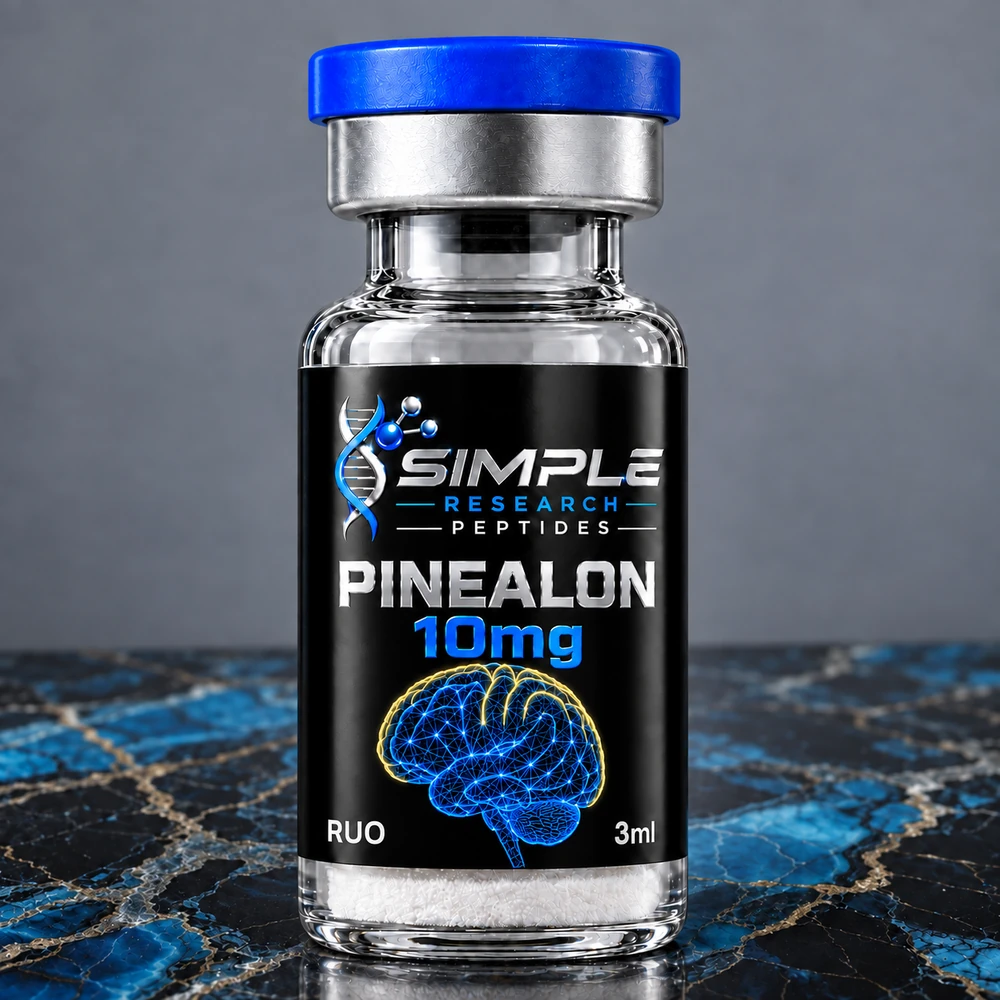
SRP listingPinealon (10 mg Vial)Page title and H1: 10 mg Vial. Subhead also prints “Pinealon (10 mg / 3 mL Vial).” Longevity / Bioregulator Research. Index: Cognitive listing; Evidence profile; tag Preclinical/small human literature. product/pinealon-10-mg. Alternate store URL product/pinealon.
PubChem CID10273502Title: Glu-Asp-Arg (not Pinealon as the record title). Formula C15H26N6O8. MW 418.40. Depositor synonym pinealon is printed. CID 10273502. Opened 16 August 2026.
CAS on that CID175175-23-2EPA DSSTox block on the opened HTML; also a depositor synonym. Not a separately opened CAS Common Chemistry record.
ChEBICHEBI:156374Name Glu-Asp-Arg; tripeptide; synonym pinealon; same InChIKey. Ontology “has role neuroprotective agent” is ChEBI classification language, not a clinical-use assignment.
UNII / NCATS / IUPHARNot foundNCATS pinealon total 0. IUPHAR name=pinealon HTTP 404. openFDA pinealon HTTP 404. INN/USAN none.
ClinicalTrials.gov0 studiesquery.term=pinealon returned totalCount 0. No NCT. Do not invent one.
Internal designationT-33 (Glu-Asp-Arg)Voicekhovskaya et al. 2012, PMID 22803085, a skin-explant paper that does not print the trade name Pinealon.
Other registry stringsDTXSID601359159 · Q106026341 · M0571175EPA DSSTox name Pinealon on the DSSTox link printed on PubChem. Wikidata Q106026341 (Glu-Asp-Arg). MeSH Unique ID M0571175 printed on PubChem.
Identifier Value on opened page Source opened
Trade name on SRP Pinealon (10 mg Vial) SRP product page
SRP listed strength / format Page title and H1: 10 mg Vial. Subhead: Pinealon (10 mg / 3 mL Vial). Body: 10 mg lyophilized research compound in a 3 mL research vial SRP product page
SRP store category Longevity / Bioregulator Research SRP product page (store taxonomy, not a clinical indication)
SRP index / evidence tag Cognitive listing Pinealon (10 mg Vial); Evidence profile; Preclinical/small human literature SRP compound-research-guides index
Dedicated guide URL HTTP 404 on 16 August 2026 /research-compound-directory/pinealon-research-guide/
Sequence printed with the name Pinealon Glu-Asp-Arg (one-letter EDR) Khavinson 2011 PMID 21978084; Arutjunyan 2012 PMID 22567179; Khavinson 2022 Table 2 PMID 35887081
PubChem CID 10273502. Title Glu-Asp-Arg. C15H26N6O8. MW 418.40. Exact mass 418.18121181. InChIKey QPRZKNOOOBWXSU-CIUDSAMLSA-N CID 10273502
PubChem name pinealon Resolves to CID 10273502 PubChem PUG, opened 16 August 2026
PubChem depositor synonyms Glu-Asp-Arg; glutamyl-aspartyl-arginine; CHEBI:156374; L-Glutamyl-L-aspartyl-L-arginine; pinealon; 175175-23-2; Pinealon acetate salt form; H-Glu-Asp-Arg-OH; E-D-R; DTXSID601359159 Acetate-salt string is not a COA for the SRP lot
Sequence / HELM EDR; H-Glu-Asp-Arg-OH; H-EDR-OH; PEPTIDE1{E.D.R} PubChem HTML biologic
IUPAC (PubChem computed) (4S)-4-amino-5-[[(2S)-3-carboxy-1-[[(1S)-1-carboxy-4-(diaminomethylideneamino)butyl]amino]-1-oxopropan-2-yl]amino]-5-oxopentanoic acid PubChem PUG
UNII / NCATS / IUPHAR / openFDA Not found / no substance / no ligand / HTTP 404 Opened 16 August 2026
ClinicalTrials.gov 0 studies for pinealon CT.gov API v2
Opened Khavinson-group papers print Pinealon as unmodified Glu-Asp-Arg (EDR). CID 10273502 is the corresponding L-tripeptide; the record title is Glu-Asp-Arg, and pinealon is a depositor synonym. ChEBI 156374 is the same structure. Salt form, counter-ion, and assay of any SRP vial were not printed on opened SRP pages as a public COA. Confirm sequence and assay on the batch.
02 / Not analogues

How it relates to — and is not — other Khavinson bioregulators

Pinealon (this page) is the tripeptide Glu-Asp-Arg (EDR) on opened papers that print the trade name, and on opened PMID 35887081 Table 2. That catalog is a research-network taxonomy, not a receptor-class assignment.

Opened page What it printed Why it is not interchangeable
Khavinson et al. 2011 PMID 21978084 pinealon (Glu-Asp-Arg) on cerebellar granule cells, neutrophils, PC12; ROS / necrosis / ERK 1/2 / cell cycle Defining trade-name + sequence paper
Voicekhovskaya et al. 2012 PMID 22803085 T-32 EDA, T-33 EDR, T-34 EDG, T-36 EDP, T-38 KED Five tripeptides in one skin-explant design
Khavinson et al. 2021 PMID 34071923 KED and EDR in 5xFAD mice Co-tested, not the same molecule
Meshchaninov et al. 2015 PMID 26390612 Vesugen and Pinealon in 32 people Two named preparations
Khavinson et al. 2022 Table 2 PMID 35887081 Pinealon (EDR), ICM −30.29, labeled Neuroprotector; separate rows for Vesugen (KED, −18.91), Livagen (KEDA, −22.01), Pancragen (KEDW-NH2, −23.47), Prostomax (KEDP, −13.58), Epitalon (AEDG, −20.38), Chonluten (EDG, −30.30) Same table, different sequences
Fedoreyeva et al. 2011 PMID 22117547 FITC-labeled epithalon, pinealon, and testagen enter HeLa nuclei Three named peptides
Kozina 2008 PMID 18546825 vilon, epitalon, vesugen, pinealon; pinealon most pronounced antihypoxic effect in that panel Shared panel, not identity collapse

What this is not, chemically.

  • Not Vesugen (Lys-Glu-Asp / KED). Opened PMID 35887081 Table 2 prints Pinealon (EDR) and Vesugen (KED) as separate rows. PMID 34071923 tests EDR and KED as distinct peptides in 5xFAD mice. PMID 26390612 names Pinealon and Vesugen as two preparations.
  • Not Livagen (Lys-Glu-Asp-Ala / KEDA). Same 2022 table, different row (ICM −22.01, Hepatoprotector).
  • Not Pancragen (Lys-Glu-Asp-Trp / KEDW, sometimes printed as the amide). Same table, labeled regulator of pancreatic functions.
  • Not Epitalon / Epithalon (Ala-Glu-Asp-Gly / AEDG). Fedoreyeva 2011 (PMID 22117547) tests epithalon, pinealon, and testagen as three labeled peptides.
  • Not Vilon (Lys-Glu / KE), Chonluten (EDG / T-34), Prostamax / Prostomax (KEDP), Testagen (KEDG), or Ovagen (EDL).
  • Not Cortexin or Cerebrolysin (tissue-extract polypeptide complexes). Mendzheritsky papers pair Pinealon with Cortexin as two different materials.
  • Not shown on any opened page to be compositionally identical to an SRP 10 mg lyophilized research vial.
03 / Overview

What is Pinealon?

Pinealon is the synthetic tripeptide Glu-Asp-Arg. Opened papers from the St. Petersburg Institute of Bioregulation and Gerontology and collaborators report four clusters of laboratory observations:

Cluster 2

Proposed DNA / nuclear interaction

FITC-labeled pinealon entered HeLa cytoplasm, nucleus, and nucleolus (Fedoreyeva 2011, PMID 22117547); later spectral / NMR / MD work on EDR-DNA with Mg2+ (Silanteva 2019, PMID 30762356); promoter-docking language for EDR (PMID 34071923; review PMID 33396470).

Cluster 3

Catalog docking and later EDR cell models

Trade name Pinealon often not printed. 5xFAD dendritic-spine study (PMID 34071923); LAT1 table row Pinealon (EDR), ICM -30.29 (PMID 35887081); later induced-neuron papers that co-test EDR with KED and AEDG (PMID 39518916).

Cluster 4

Small regional human observations

Meshchaninov et al. 2015 (PMID 26390612): 32 people aged 41-83 with polymorbidity and organic brain syndrome in remission received named Pinealon and Vesugen preparations. Bashkireva 2012 (PMID 23734521) is an occupational-medicine series that names pinealon and vezugen; not an NCT. Umnov 2013 (PMID 24738258) is a review, not a new trial.

Europe PMC REST query=pinealon returned hitCount 29 on 16 August 2026. Almost all originate from the Khavinson network. Independent Western replication of a receptor-level mechanism was not located. A well-validated receptor target is not established on any opened page.

The SRP index card (August 2026) already states this correctly: short peptide commonly described as Glu-Asp-Arg; a definitive receptor and full pharmacology are not established; most publications are preclinical or small and concentrated within a limited research network; large independent randomized trials are lacking; verify the three-amino-acid sequence.

Opened SRP product (16 August 2026): http://simpleresearchpeptides.com/product/pinealon-10-mg/ and http://simpleresearchpeptides.com/product/pinealon/. Dedicated pinealon-research-guide URL returned HTTP 404. Vendor dosage / reconstitution / injection copy on the product page is not reproduced here.

04 / Mechanism

Proposed research mechanisms (not confirmed clinical effects)

No opened paper establishes a classical receptor agonist/antagonist assignment for Pinealon.

ROS / viability. Opened PMID 21978084: pinealon (Glu-Asp-Arg) demonstrates dose-dependent restriction of ROS accumulation in cerebellar granule cells, neutrophils, and PC12 cells and decreases necrotic cell death measured by the propidium iodide test, with delayed ERK 1/2 activation and cell-cycle modification. Authors conclude that besides known antioxidant activity, pinealon is able to interact directly with the cell genome. That last sentence is the authors interpretation, not a crystal structure.

DNA / nuclear. PMID 22117547: FITC-pinealon produced fluorescence in HeLa cytoplasm, nucleus, and nucleolus; Stern-Volmer constants differed by oligonucleotide sequence; authors report preferential binding language for CNG / CAG-containing sequences. PMID 30762356: EDR can partly penetrate into the major groove of DNA and affect the base atoms, mainly the N7 and O6 of guanine; Mg2+ can promote DNA-EDR interaction. These are biophysical / cell-imaging results, not a validated receptor.

Docking. PMID 34071923: EDR docking to hexanucleotide DNA; authors list EDR binding-site language for CASP3, NES, GAP43, APOE, SOD2, PPARA, PPARG, GDX1 promoters. PMID 33396470 is a review that restates MAPK/ERK, caspase-3, p53, SOD2, GPX1, PPAR, serotonin, and calmodulin as proposed components. PMID 35887081 Table 2: Pinealon (EDR), ICM -30.29, labeled Neuroprotector. Docking / review, not a measured PEPT/LAT flux for Pinealon.

Hypoxia / aging rodent. PMID 18546825: among vilon, epitalon, vesugen, and pinealon, pinealon had the most pronounced antihypoxic effect in hypobaric hypoxia. PMID 21809624 and PMID 28976148: Pinealon vs Cortexin on behavior and caspase-3 after carotid occlusion or in Morris-maze learning. PMID 25051764 and PMID 28509493: Pinealon vs Cortexin on cytokines / caspase-3 / hypoxia-hypothermia in old rats. These are rodent model signals.

Not shown in a paper opened here: a registered ClinicalTrials.gov or WHO-ICTRP trial for Pinealon (NCT: none); a peer-reviewed randomized, placebo-controlled human efficacy trial; human pharmacokinetics; a modern receptor-panel Ki table or crystal structure; independent Western-laboratory replication of the ROS / nuclear-entry findings; FDA, EMA, or NCATS approval / UNII.

Do not treat as Pinealon evidence: Vesugen/KED-only endothelial papers; Livagen/KEDA liver papers; Epitalon telomerase papers; Cortexin-only extract papers; vendor blogs that assign a clinical indication; the SRP product-page educational dosage protocol.

Observed

Cell ROS / necrosis

PMID 21978084 cerebellar granule / PC12 / neutrophil models. Author genome-interaction sentence is interpretation.

Mechanism in one line. Short tripeptide printed as EDR; opened work is cell ROS/viability, biophysical DNA language, hypoxia-rodent panels, docking, and small same-network human observations. Not a receptor assignment. Not for human use.

05 / Research Map

Areas of investigation (Pinealon / EDR only)

Organized by experimental question rather than consumer benefit claims. Pinealon != Vesugen != Livagen != Pancragen != Epitalon. Review and docking language is not a completed therapeutic program.

01 Neuronal oxidative-stress

Viability models

Cerebellar granule cells, neutrophils, PC12; ROS, necrosis, ERK 1/2, cell cycle (PMID 21978084). Prenatal hyperhomocysteinemia offspring (PMID 22567179).

02 DNA / nuclear-entry

Biophysical work

HeLa nuclear fluorescence and oligonucleotide quenching (PMID 22117547); EDR-DNA major-groove / Mg2+ work (PMID 30762356).

04 AD-model / induced neurons

Sequence name EDR

5xFAD dendritic spines; later fibroblast-derived induced neurons (PMID 34071923; PMID 39518916). Distinguish EDR from co-tested KED / AEDG.

05 Catalog docking

LAT1 table row

Pinealon (EDR), ICM -30.29 (PMID 35887081). Computational only.

06 Evidence translation

The gap

Reproducibility, independent validation, pharmacology, toxicology, and the gap between regional bioregulator literature and controlled human evidence.

06 / Snapshot

Scientific evidence snapshot

A transparent view of what the research record can — and cannot — support.

Evidence tier Current signal Translation confidence Status
Animal models Prenatal hyperhomocysteinemia offspring; hypoxia / carotid-occlusion / Morris-maze aged-rat panels; one opened 5xFAD mouse paper (EDR +/- KED) Useful for hypothesis generation LIMITED
Cell / explant studies Cerebellar granule / PC12 / neutrophil ROS-viability; HeLa nuclear entry; skin explant T-33; induced-neuron panels Mechanistic, model dependent, geographically concentrated EMERGING / SPARSE
In-silico / biophysical docking EDR-DNA major groove; AD-gene promoters; LAT1 table ICM -30.29 Computational / biophysical HYPOTHESIS
Human evidence Opened n=32 regional observation (PMID 26390612); occupational-medicine series naming pinealon + vezugen (PMID 23734521); review sentences about elderly memory (PMID 33396470) that cite prior work not opened as RCTs Cannot establish clinical use LIMITED / SPARSE
Regulatory review NCATS 0; openFDA 404; IUPHAR 404; UNII none; NCT 0 Not FDA-approved INVESTIGATIONAL
Evidence boundary: Preclinical and small regional findings do not establish human safety, effectiveness, dosing, or therapeutic use. The Khavinson peptide-bioregulator literature is geographically concentrated. Do not overclaim.

Research timeline (opened pages only)

2008

Shared in-vitro / hypoxia panels

Kozina papers name pinealon among vesugen, vilon, and epitalon. No direct antioxidant activity; restricted lipoprotein peroxidation by structural modification; RBC membrane stabilization; pinealon strongest in hypobaric hypoxia (PMID 18546826; PMID 18546825).

2011-2012

Trade name printed next to Glu-Asp-Arg

Khavinson 2011: pinealon (Glu-Asp-Arg) ROS / necrosis / ERK (PMID 21978084). Fedoreyeva 2011: nuclear entry (PMID 22117547). Arutjunyan 2012: prenatal hyperhomocysteinemia offspring (PMID 22567179). Voicekhovskaya 2012: T-33 (Glu-Asp-Arg) in rat skin explants (PMID 22803085). Khavinson 2011: Glu-Asp-Arg among pineal signaling-molecule peptides (PMID 22803060).

2013-2015

Aged-rat hypoxia / caspase-3 and small human series

Carotid-occlusion and Morris-maze papers vs Cortexin (PMID 21809624; PMID 28976148). Cytokine / caspase-3 hypoxia papers (PMID 25051764; PMID 28509493). Meshchaninov 2015 n=32 named Pinealon and Vesugen (PMID 26390612). Bashkireva 2012 occupational series (PMID 23734521). Umnov 2013 review (PMID 24738258).

2019-2021

EDR biophysics and AD-model work

Silanteva 2019: EDR-DNA ions (PMID 30762356). Khavinson 2020 EDR review (PMID 33396470). Khavinson 2021: 5xFAD mouse + DNA docking (PMID 34071923).

2022-2024

Catalog docking and later cell models

Khavinson 2022 transport review Table 2: Pinealon (EDR), ICM -30.29 (PMID 35887081). Kraskovskaya 2024: EDR among KED / AEDG in induced neurons (PMID 39518916).

NOW

Translation remains the central question

Independent replication, standardized characterization, pharmacokinetics, toxicology, and controlled human data remain major evidence gaps. SRP index tag remains Preclinical/small human literature.

07 / Studies

Selected published studies (opened records only)

Inclusion does not imply clinical validation. Only records opened for the locked draft are listed. Printed animal or culture amounts are study conditions, not instructions for an SRP 10 mg research vial. No human dosing protocol appears here.

2011 cell model

Pinealon (Glu-Asp-Arg) ROS and necrotic death

Trade name + sequence printed. Cerebellar granule cells, neutrophils, PC12; ERK 1/2; cell cycle. PMID 21978084. DOI 10.1089/rej.2011.1172.

2012 animal model

Prenatal hyperhomocysteinemia rat-offspring model

Open-access. Pinealon (Glu-Asp-Arg). PMID 22567179. PMC3342713.

2011 cell / biophysical

FITC-pinealon nuclear entry in HeLa cells

Pinealon named next to epithalon and testagen. PMID 22117547.

2019 biophysical

EDR-DNA interaction

Sequence printed as Glu-Asp-Arg (EDR). Trade name Pinealon not required by this abstract. PMID 30762356.

2021 animal model

EDR and KED in a 5xFAD mouse model

Open-access. EDR docking list; KED also tested. Erratum noted on the opened record. PMID 34071923 . PMC8227791.

2022 review + docking

Transport-review table that prints Pinealon (EDR)

Table 2: Pinealon (EDR), ICM-score -30.29, labeled Neuroprotector. Not an uptake assay. PMID 35887081 . PMC9323678.

2015 small human series

Vesugen and Pinealon in 32 people

Not an NCT. PMID 26390612.

08 / Lab / RUO

Study design and handling (not human-use instructions)

Methodology-centered guidance for lawful laboratory research. The SRP product page contains a vendor dosage chart, reconstitution arithmetic, syringe-unit table, and injection-technique copy. That vendor protocol is not reproduced here and is not independent chemistry.

  • Identity and documentation. Record batch identity, analytical documentation, material condition, receipt date, and storage history before use. Confirm the three-residue sequence (Glu-Asp-Arg / EDR) and salt form. Do not treat the trade name as a substitute for molecular identification.
  • Controls and replication. Use appropriate vehicle, positive, and negative controls with predefined endpoints and adequate biological replication. If comparing bioregulators, include sequence-matched controls (KED, KEDA, AEDG, KE) rather than assuming tissue tropism.
  • Cold-chain handling. Follow the product label, batch documentation, and laboratory SOPs. Minimize uncontrolled temperature and light exposure. Do not copy consumer reconstitution charts into a research protocol without an analytical plan.
  • Transparent reporting. Document concentrations, preparation methods, model characteristics, exclusions, adverse observations, and complete outcomes. Report the actual sequence used, not only Pinealon.

Simple Research Peptides (SRP) materials are for laboratory research only and are not for human or veterinary use, consumption, administration, diagnosis, treatment, or therapeutic application. Research use only. Not medical advice. Not for human use.

No human dosing protocol. No reconstitution scheme. 0 NCT. UNII not found. Research use only.
09 / FAQ

Frequently asked questions

Is Pinealon approved for human use?

No. Pinealon is investigational and is not an FDA-approved drug for human treatment. Opened NCATS, openFDA, and IUPHAR queries returned no substance/ligand/label. UNII: none. NCT: none.

What type of evidence exists?

Preclinical / small human literature. Opened literature is mainly neuronal cell and hypoxia-rodent work, biophysical DNA interaction, in-silico docking, one 5xFAD mouse paper that uses the sequence name EDR, and small regional human observations. Almost all records sit in the Khavinson / St. Petersburg network. Controlled human evidence is insufficient to establish safety or effectiveness.

Is the sequence really Glu-Asp-Arg / EDR?

Yes, on opened papers that print the trade name next to that sequence (PMID 21978084; PMID 22567179; PMID 35887081 Table 2) and on papers that print T-33 (Glu-Asp-Arg) (PMID 22803085). CID 10273502 is the matching L-tripeptide (title Glu-Asp-Arg; synonym pinealon). SRP product page prints the same aliases as vendor language. Confirm the vial by sequence and assay.

How is this different from Vesugen, Livagen, Pancragen, or Epitalon?

Different sequences on opened pages: Vesugen KED; Livagen KEDA; Pancragen KEDW; Epitalon AEDG. PMID 35887081 Table 2 prints them as separate rows. PMID 34071923 and PMID 26390612 test or name Pinealon/EDR and Vesugen/KED as distinct materials.

Did any registered trial test Pinealon?

No opened registered trial. ClinicalTrials.gov API v2 query.term=pinealon returned totalCount: 0.

Does an animal or cell result predict a human outcome?

No. Animal and cell models are valuable for generating and testing hypotheses, but species differences, experimental conditions, exposure, and study quality limit direct translation.

How is this different from the product page?

This guide explains the evidence and its limitations. The product page provides batch, purchasing, and research-material information, plus vendor protocol language that this educational page does not repeat. A research product is not an approved medicine.

Can SRP vials be used as a human dose substitute?

No. SRP listings are for laboratory research only and are not for human or animal use. This page does not provide reconstitution, administration, or dosing instructions.

10 / References

Sources actually opened for this draft

Only IDs that appeared on a page opened for this draft. Do not add others. NCT: none.

  1. Khavinson V, et al. Pinealon increases cell viability by suppression of free radical levels and activating proliferative processes. Rejuvenation Res. 2011;14(5):535-541. PMID 21978084. DOI 10.1089/rej.2011.1172. pinealon (Glu-Asp-Arg).
  2. Fedoreyeva LI, et al. Penetration of short fluorescence-labeled peptides into the nucleus in HeLa cells. Biochemistry (Mosc). 2011;76(11):1210-1219. PMID 22117547. DOI 10.1134/s0006297911110022.
  3. Arutjunyan A, et al. Pinealon protects the rat offspring from prenatal hyperhomocysteinemia. Int J Clin Exp Med. 2012;5(2):179-185. PMID 22567179. PMC3342713.
  4. Voicekhovskaya MA, et al. Effect of bioregulatory tripeptides on the culture of skin cells from young and old rats. Bull Exp Biol Med. 2012;152(3):357-359. PMID 22803085. DOI 10.1007/s10517-012-1527-9. T-33 (Glu-Asp-Arg).
  5. Khavinson VKh, et al. Effect of short peptides on expression of signaling molecules in organotypic pineal cell culture. Bull Exp Biol Med. 2011;152(1):138-141. PMID 22803060. DOI 10.1007/s10517-011-1473-y. Glu-Asp-Arg named; Ala-Glu-Asp-Gly was the peptide the authors called tissue-specific for pinealocytes.
  6. Kozina LS. Investigation of antihypoxic properties of short peptides. Adv Gerontol. 2008;21(1):61-67. PMID 18546825. Pinealon most pronounced in that panel.
  7. Kozina LS, et al. Biological activity of regulatory peptides in model experiments in vitro. Adv Gerontol. 2008;21(1):68-73. PMID 18546826.
  8. Mendzheritskii AM, et al. Effects of introduction of short peptides before carotid artery occlusion. Adv Gerontol. 2011;24(1):74-79. PMID 21809624.
  9. Mendzheritski AM, et al. Effect of peptide geroprotectors on the navigation system learning and caspase-3. Adv Gerontol. 2013;26(2):252-257. PMID 28976148.
  10. Mendzheritskii AM, et al. Regulation of content of cytokines. Cortexin and Pinealon. Adv Gerontol. 2014;27(1):94-97. PMID 25051764.
  11. Mendzheritsky AM, et al. Pinealon and Cortexin in 18-month aged rats. Adv Gerontol. 2015;28(3):532-539. PMID 28509493.
  12. Khavinson VKh, et al. Short peptides stimulate serotonin expression in cells of brain cortex. Bull Exp Biol Med. 2014;157(1):77-80. PMID 24909721. DOI 10.1007/s10517-014-2496-y.
  13. Meshchaninov VN, et al. Synthetic peptides in chronic polymorbidity and organic brain syndrome. Adv Gerontol. 2015;28(1):62-67. PMID 26390612. Named Pinealon and Vesugen; n=32; not an NCT.
  14. Bashkireva AS, Artamonova VG. Peptide correction among professional truck-drivers. Adv Gerontol. 2012;25(4):718-728. PMID 23734521. Names pinealon and vezugen; not an NCT.
  15. Umnov RS, Linkova NS, Khavinson VKh. Neuroprotective effects of peptides bioregulators. Adv Gerontol. 2013;26(4):671-678. PMID 24738258. Review.
  16. Silanteva IA, et al. Role of ions in peptide Glu-Asp-Arg-DNA interaction. J Phys Chem B. 2019;123(9):1896-1902. PMID 30762356. DOI 10.1021/acs.jpcb.8b10359.
  17. Khavinson V, et al. EDR peptide review. Molecules. 2020;26(1):159. PMID 33396470. PMC7795577. DOI 10.3390/molecules26010159. Review.
  18. Khavinson V, et al. Tripeptides in a mouse Alzheimer-model paper. Pharmaceuticals (Basel). 2021;14(6):515. PMID 34071923. PMC8227791. DOI 10.3390/ph14060515. EDR + KED; 5xFAD.
  19. Khavinson V, et al. Transport of ultrashort peptides using POT and LAT carriers. Int J Mol Sci. 2022;23(14):7733. PMID 35887081. PMC9323678. DOI 10.3390/ijms23147733. Table 2: Pinealon (EDR), ICM -30.29.
  20. Kraskovskaya N, et al. Short peptides and fibroblast-derived induced neurons. Int J Mol Sci. 2024;25(21):11363. PMID 39518916. PMC11546785. DOI 10.3390/ijms252111363. EDR + KED + AEDG.
  21. PubChem CID 10273502 (Glu-Asp-Arg; C15H26N6O8; InChIKey QPRZKNOOOBWXSU-CIUDSAMLSA-N; CAS 175175-23-2; synonym pinealon). Opened 16 August 2026.
  22. ChEBI CHEBI:156374 (Glu-Asp-Arg; synonym pinealon). Opened 16 August 2026.
  23. ClinicalTrials.gov API v2 query.term=pinealon empty studies array (opened 16 August 2026). NCT: none.
  24. NCATS Inxight pinealon total 0. openFDA pinealon HTTP 404. IUPHAR pinealon HTTP 404.
  25. SRP product pages (opened 16 August 2026): product/pinealon and product/pinealon-10-mg. Index: compound-research-guides. Dedicated guide URL HTTP 404.

Allowed PMID list used on this page. Trade name Pinealon printed: 21978084, 22567179, 22117547, 21809624, 28976148, 25051764, 28509493, 26390612, 23734521, 24738258, 18546825, 18546826, 35887081. Sequence EDR / Glu-Asp-Arg / T-33 (trade name not always printed): 34071923, 33396470, 30762356, 22803085, 22803060, 24909721, 39518916. Opened PMC: PMC3342713, PMC8227791, PMC9323678, PMC7795577, PMC11546785. Registry: CID 10273502; InChIKey QPRZKNOOOBWXSU-CIUDSAMLSA-N; CAS 175175-23-2 (PubChem HTML EPA DSSTox + synonym); ChEBI 156374; DTXSID601359159. UNII: none. NCT: none.

Opened and not used as Pinealon-specific efficacy: Europe PMC pinealon-list titles 10.21203/rs.3.rs-9682683/v1 and 10.64898/2026.02.25.707674 (2026 longevity-assay preprints; titles do not print a Pinealon experiment); PMID 33876788 (Jiuzao protein hydrolysate; lexical EDR collision risk, unused); PMID 41490200 (2026 orthopaedics peptide review, unused as a Pinealon experiment); PMID 32019204 (Epitalon AEDG neurogenesis paper, unused as Pinealon primary).

Educational information only. Pinealon is a synthetic tripeptide printed as Glu-Asp-Arg (EDR). CID 10273502 is titled Glu-Asp-Arg; pinealon is a depositor synonym. CAS 175175-23-2 is the PubChem EPA DSSTox / synonym string, not a separately opened Common Chemistry record. It is not Vesugen, not Livagen, not Pancragen, not Epitalon, and not an FDA-approved drug. Evidence is preclinical / small human literature: one research network; 0 NCT; UNII not found. Laboratory research use only; not for human or animal use. Not medical advice. Not for human use. No human dosing protocol. Last source review: 16 August 2026 (America/Indianapolis). For laboratory research only. Not for human or veterinary use.

Scroll to Top
View Cart