



N-acetyl 28-mer
PMID 265536; CID 16130571; UNII W0B22ISQ1C. Identity, not a treatment claim.
Products are color coded by category
Peptide research · Compound guide
Explore the mechanisms, study findings and evidence limits behind this research topic.
Product artwork identifies the SRP listing. It does not demonstrate safety or clinical benefit. The evidence guide and its sources follow below.
View product label and documentation →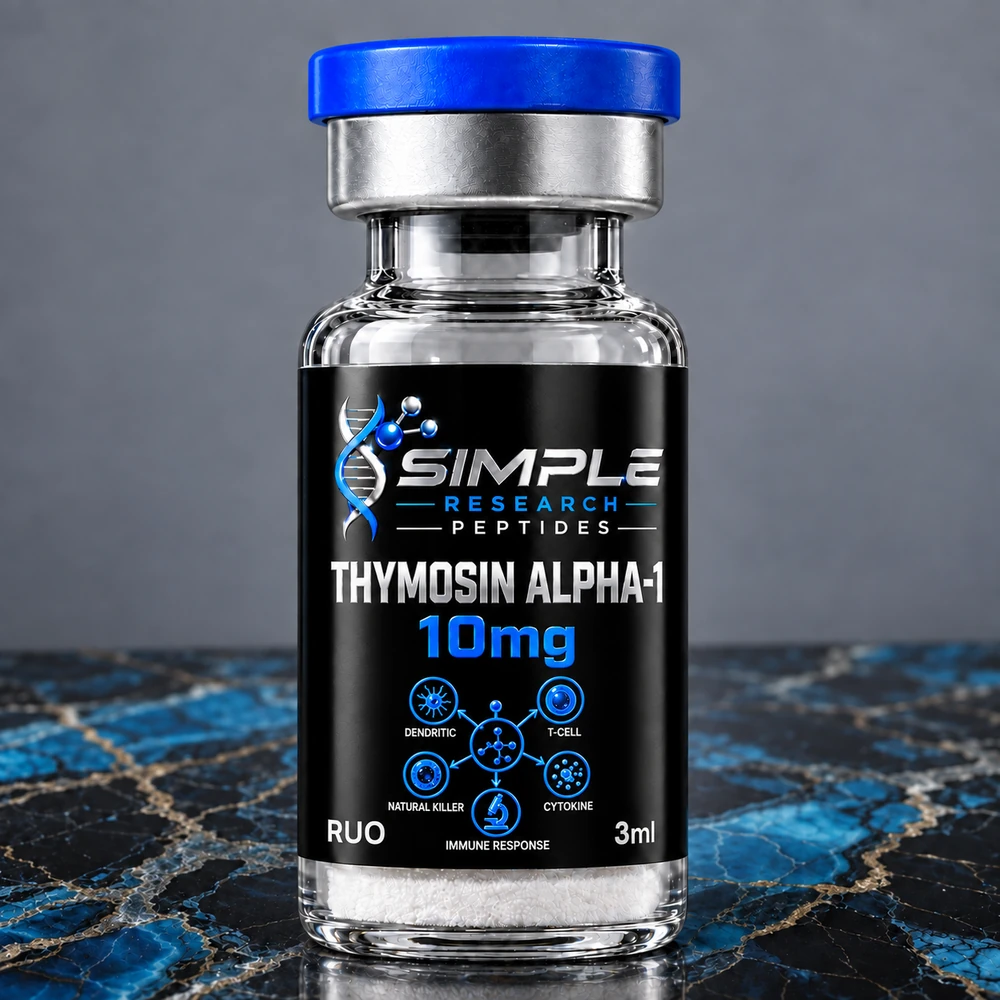
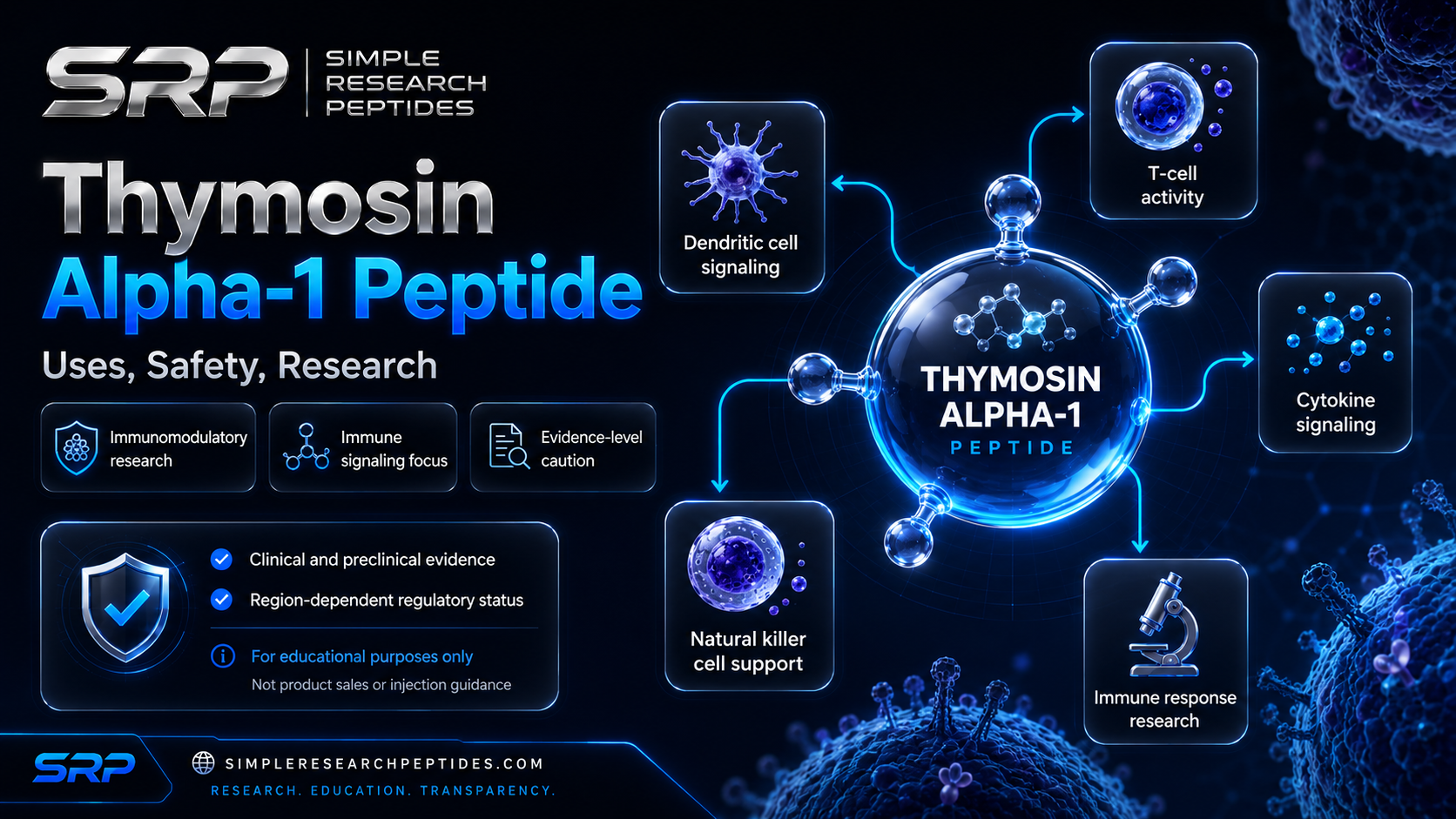
Thymosin alpha-1 is the N-acetylated 28-residue peptide whose opened PubChem condensed sequence is Ac-Ser-Asp-Ala-Ala-Val-Asp-Thr-Ser-Ser-Glu-Ile-Thr-Thr-Lys-Asp-Leu-Lys-Glu-Lys-Lys-Glu-Val-Val-Glu-Glu-Ala-Glu-Asn-OH (INN/USAN thymalfasin; CID 16130571; UNII W0B22ISQ1C; CAS numbers 62304-98-7 and 69521-94-4 both printed on the opened PubChem page). It is not thymosin beta-4, not TB-500, not thymosin fraction 5, and not the non-U.S. brand product Zadaxin. The SRP 10 mg lyophilized vial is research-use-only. Human efficacy of a research-market vial is not established. This page does not claim that thymosin alpha-1 treats, prevents, or cures any immune, infectious, or oncologic condition. Research use only. Not medical advice. Not for human use.
Educational information only. This page describes an investigational laboratory research peptide. It is not medical advice. Simple Research Peptides (SRP) materials are for laboratory research only and are not for human or veterinary use, consumption, administration, diagnosis, treatment, or therapeutic application. Sequence, N-acetyl status, CAS, UNII, CID, and a public COA were not printed on the fetched SRP page. No human dosing, reconstitution, or administration protocol appears on this page.
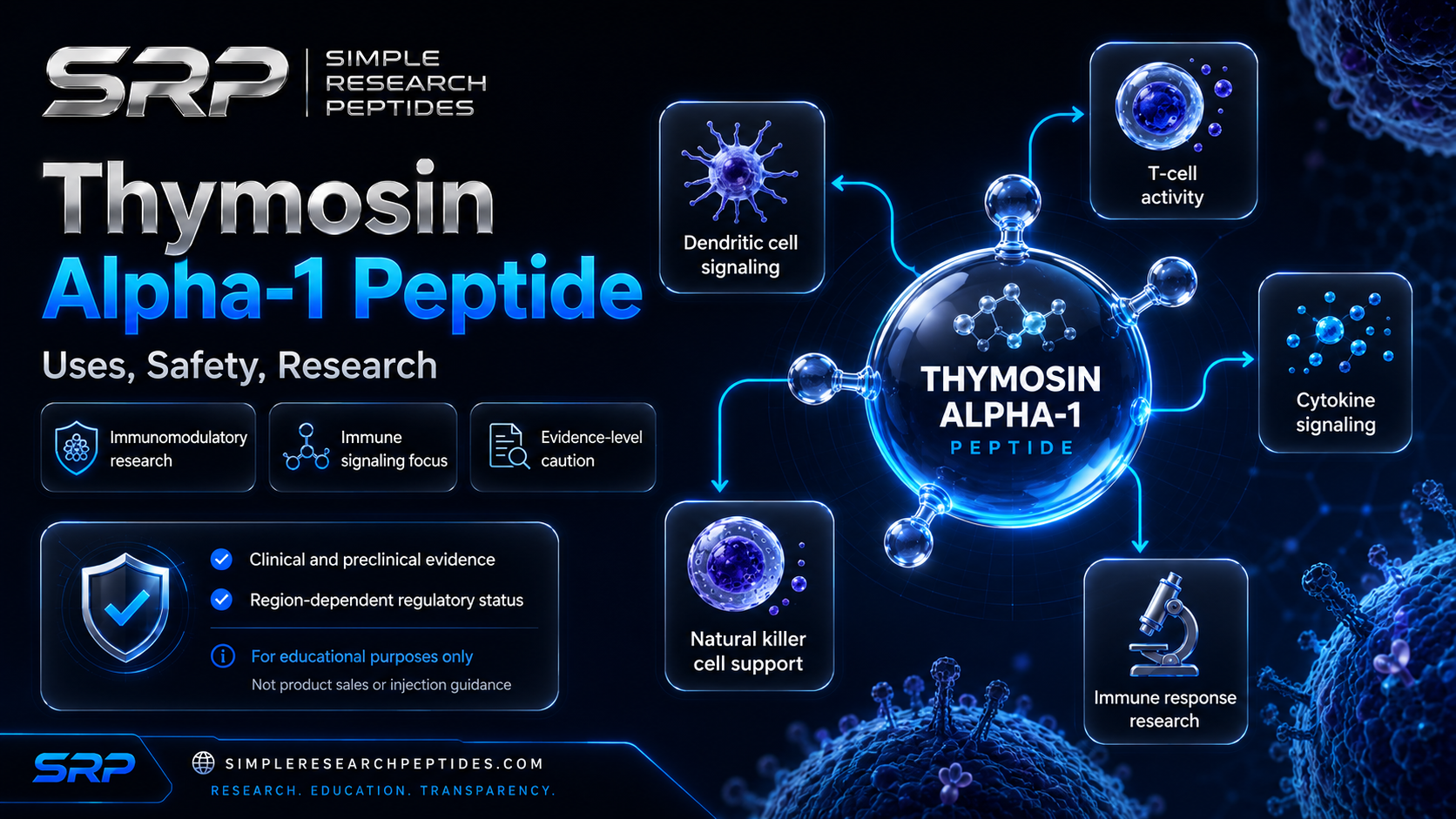
SRP product and index pages do not print CAS, UNII, PubChem CID, molecular formula, sequence, termini, salt stoichiometry, or a public COA. Identity below is taken only from opened public registries and from primary papers that name thymosin alpha-1 / thymalfasin.
Catalog thymosin language does not convert a 28-residue N-acetyl peptide into thymosin beta-4, a TB-500 fragment, a bovine thymus extract, or a non-U.S. branded medicine.
| Identity | What opened sources actually describe | Why it is not interchangeable |
|---|---|---|
| Thymosin alpha-1 / thymalfasin (this page) | Ac-SDAAVDTSSEITTKDLKEKKEVVEEAEN; 28 residues; CID 16130571; UNII W0B22ISQ1C | Yes — defined 28-mer. Isolated from thymosin fraction 5 (Goldstein 1977, {pm(265536)}); later synthetic thymalfasin. |
| Thymosin fraction 5 | Mixed bovine thymus extract that contains several polypeptides, including alpha-1. PMID 265536: one of several present in thymosin fraction 5 | Mixture, not a single sequence. Not an SRP 10 mg vial. |
| Thymosin beta-4 | CID 45382195, title Thymosin Beta 4; C212H350N56O78S; MW 4963; InChIKey UGPMCIBIHRSCBV-UHFFFAOYSA-N; 0 defined / 47 undefined stereocenters on that record | Yes — different, longer peptide. Actin-binding / tissue-repair literature. Different molecule. |
| TB-500 (marketplace name) | PubChem name TB-500 resolved to CID 62707662, title Unii-qhk6Z47gtg, C38H68N10O14, MW 889.0, InChIKey ADKDNDYYIZUVCZ-ZQNQAVPYSA-N | Short peptide / fragment-scale record. Not thymosin alpha-1. Not used as TA-1 evidence. |
| Zadaxin (brand) | PubChem / NCATS / ChEBI synonym for thymalfasin. NCATS: SciClone / non-U.S. marketing; not FDA-approved | A different, regulated-or-regional product context. Not the SRP lyophilized research vial. |
Goldstein et al. 1977 (PMID 265536; PMC392366; DOI 10.1073/pnas.74.2.725), opened abstract: thymosin alpha1 is a heat stable, highly acidic molecule composed of 28 amino acid residues isolated from calf thymus; one of several present in thymosin fraction 5. That nomenclature is why alpha-1 and beta-4 are different family members, not synonyms.
Thymosin alpha-1 is the N-acetylated 28-residue peptide later given the INN thymalfasin. Opened sources support four identity and research-context points — and stop short of treatment claims:
PubChem DrugBank-sourced narrative (opened 16 August 2026) describes in-vitro T-cell / dendritic-cell / TLR language and also prints indication-style sentences. Those sentences are database republishing, not a COA, not an FDA label, and not copied here as instructions or as efficacy claims for an SRP vial.
The SRP index card already states the correct boundary: regulatory status, indication, and formulation must be checked by country; research material is not equivalent to a regulated medicine. Dedicated guide URL returned HTTP 404 on 16 August 2026.
Opened SRP product (16 August 2026): http://simpleresearchpeptides.com/product/thymosin-alpha-1-10-mg-vial/. Title Thymosin Alpha-1 (10 mg Vial). Category Immune / Longevity Research. Price $95.00. Also Known As: TA-1, Thymalfasin. For Research Use Only. Not for human or veterinary use. Sequence, N-acetyl, CAS, UNII, CID, and a public COA file were not printed.
Mechanistic themes reported in experimental and review literature — not confirmed clinical effects of an SRP vial, and not treatment claims.
Identity / source. Goldstein 1977 (PMID 265536): 28 residues; acidic; isolated from calf thymus fraction 5; proposed as one member of a named polypeptide family that also includes beta peptides. That is identity, not a modern receptor-panel.
Cell signaling (as reported). King & Tuthill 2016 (PMID 27450734), opened abstract: Ta1 acts through Toll-like receptors in both myeloid and plasmacytoid dendritic cells, leading to activation and stimulation of signaling pathways and initiation of production of immune-related cytokines. Authors are SciClone-affiliated on that record. PubChem DrugBank block (opened) similarly lists TLR2/TLR9, NF-kB, and T-cell-subset language as in-vitro / database statements.
Not shown in a paper or registry opened here: FDA approval of thymalfasin / Zadaxin / an SRP vial (NCATS: not FDA-approved; openFDA 404); equivalence of a 10 mg research lyophilized vial to any branded or trial formulation; a single, universally accepted receptor Ki table on IUPHAR (ligand lookup 404); identity collapse with thymosin beta-4 or TB-500.
Do not treat as Thymosin Alpha-1 evidence: TB-500 / thymosin beta-4 tissue-repair papers; thymosin fraction 5 mixture papers that do not isolate alpha-1; vendor immune-boosting copy; any sentence that tells a reader to use this vial for infection, cancer, vaccine response, or immune optimization.
PMID 265536; CID 16130571; UNII W0B22ISQ1C. Identity, not a treatment claim.
PMID 27450734 review. Not adopted as a use claim.
CT.gov totalCount 63. NCATS: not FDA-approved. SRP vial is not Zadaxin.
Organized by experimental question rather than consumer benefit claims. Thymosin alpha-1 != thymosin beta-4 != TB-500 != fraction 5 != Zadaxin.
Sequence, N-acetyl, length 28, salt, impurities, and distinction from beta-4 / TB-500 / fraction 5.
Dendritic-cell TLR pathways, T-cell-subset markers, and cytokine readouts as reported in opened reviews. These are laboratory endpoints.
CT.gov intervention search totalCount 63. This page lists only NCT IDs that appeared on an opened first page or on the opened NCATS record. Listing a trial is not an efficacy claim and is not a protocol.
Country-by-country approval, brand vs research-chemical distinction, and the absence of a U.S. Drugs@FDA hit.
Formulation differences, manufacturing controls, and the gap between a branded non-U.S. product, a trial product, and a research-market vial.
| Evidence tier | Current signal | Translation confidence | Status |
|---|---|---|---|
| Chemical identity | Strong: CID, UNII, ChEBI, 1977 isolation paper, NCATS sequence | High for the defined 28-mer | ESTABLISHED IDENTITY |
| Cell / pathway studies | Large historical in-vitro immune-cell literature, summarized in opened reviews | Model- and context-dependent | LITERATURE EXISTS |
| Human / registered trials | CT.gov intervention search totalCount 63; not FDA-approved | Trial existence != SRP-vial evidence | CONTEXT-SPECIFIC; NOT TRANSFERRED |
| Regulatory review | NCATS: not FDA-approved; openFDA 404; IUPHAR 404; ATC L03AX25 is classification only | U.S. research-use only for this vial | INVESTIGATIONAL (US) |
| Distinction from TB-4 / TB-500 | Different CID, formula, length | Do not collapse | SEPARATE MOLECULES |
Goldstein et al., PNAS: thymosin alpha1 isolated from calf thymus; 28 amino acids; fraction-5 family nomenclature (PMID 265536).
Opened PubChem / NCATS / ChEBI print INN/USAN thymalfasin, UNII W0B22ISQ1C, CID 16130571, ATC L03AX25. Exact INN-publication year was not independently opened as a WHO PDF this session.
King & Tuthill, Vitam Horm: TLR / dendritic-cell review; SciClone affiliation on the opened record (PMID 27450734). Treatment-utility sentences in that abstract are author claims, not adopted here.
Dominari et al., World J Virol: literature review that discusses historical uses and hypothesizes further antiviral research (PMID 33362999). Not used as a treatment recommendation.
SRP sells a 10 mg RUO vial and indexes an Evidence profile. Dedicated guide URL is HTTP 404. NCATS still: not FDA-approved. CT.gov intervention search totalCount 63.
Opened NCT IDs (first API page + NCATS citation only; not a complete 63-ID dump). Listing these IDs documents that a trial footprint exists. It is not an efficacy table and not a use protocol.
| NCT | How opened | Notes |
|---|---|---|
| NCT06821100 | CT.gov first page | RECRUITING PHASE1; title names Thymalfasin (Thymosin Alpha 1; Ta1) |
| NCT06829355 | CT.gov first page | RECRUITING PHASE2; title names Thymalfasin |
| NCT07103408 | CT.gov first page | NOT_YET_RECRUITING PHASE2 |
| NCT00580450 | CT.gov first page | UNKNOWN PHASE1/PHASE2; Thymosin Alfa 1 |
| NCT01943617 | CT.gov first page | COMPLETED PHASE4 |
| NCT06139419 | CT.gov first page | COMPLETED PHASE2; title names Thymosin a-1 |
| NCT02366208 | CT.gov first page | COMPLETED PHASE2; PEG-Ta1 combination title |
| NCT06552598 | CT.gov first page | RECRUITING PHASE1; KD01 title — verify before citing as thymalfasin; listed only because it appeared on the same first page |
| NCT02473406 | NCATS W0B22ISQ1C page | PHASE4 COMPLETED; acute necrotizing pancreatitis — cited on the opened NCATS record |
Inclusion does not imply clinical validation. Reviews are not used as treatment protocols. No human dosing protocol appears here.
28 residues; thymosin fraction 5 family. PMID 265536. PMC392366. DOI 10.1073/pnas.74.2.725.
TLR / dendritic-cell language; SciClone-affiliated authors. PMID 27450734. DOI 10.1016/bs.vh.2016.04.003.
Historical-use discussion; authors hypothesize further antiviral research. PMID 33362999. PMC7747025. DOI 10.5501/wjv.v9.i5.67.
CID 16130571; NCATS UNII W0B22ISQ1C; ChEBI 135915 — opened 16 August 2026.
Simple Research Peptides (SRP) materials are for laboratory research only and are not for human or veterinary use, consumption, administration, diagnosis, treatment, or therapeutic application. This page does not claim immune, antiviral, or oncologic efficacy.
Not on any opened U.S. registry. NCATS: Thymalfasin is not approved by the FDA. openFDA Drugs@FDA thymalfasin returned HTTP 404. A non-U.S. brand (Zadaxin) is attached to the same INN in opened databases. The SRP vial is not that product.
No. Different length, formula, CID, and literature. Goldstein 1977 placed alpha and beta peptides in one family, not one structure. CID 45382195 is a thymosin-beta-4 record (C212H350N56O78S). PubChem name TB-500 resolved to a different, fragment-scale CID (CID 62707662).
Opened PubChem / NCATS: Ac-SDAAVDTSSEITTKDLKEKKEVVEEAEN (28 residues). SRP does not print it. Confirm the vial.
Both 62304-98-7 and 69521-94-4 are printed on the opened PubChem page. This page does not invent a single official CAS. Deprecated 69440-99-9 is not used.
No. Research-use only. No immune-treatment, infection-treatment, cancer-treatment, or vaccine-adjuvant claim is made for the SRP material.
A CT.gov intervention search returned totalCount 63. That is a trial-footprint count, not evidence that a research vial is effective or approved.
Yes, on opened PubChem and opened NCATS. It identifies the active-moiety / substance record, not an SRP lot.
No. SRP listings are for laboratory research only and are not for human or animal use. This page does not provide reconstitution, administration, or dosing instructions.
Only IDs that appeared on a page opened for this draft. Do not invent the other IDs inside the totalCount 63.
query.intr=thymalfasin — totalCount 63 (opened 16 August 2026).thymalfasin — HTTP 404. IUPHAR ligand API thymalfasin — HTTP 404.Allowed PMID list: 265536; 27450734; 33362999. Opened NCT IDs: NCT06821100; NCT06829355; NCT07103408; NCT00580450; NCT01943617; NCT06139419; NCT02366208; NCT06552598; NCT02473406. PMC: PMC392366; PMC7747025. Registry: CID 16130571; UNII W0B22ISQ1C; CAS 62304-98-7 and 69521-94-4; deprecated CAS 69440-99-9 (do not use); InChIKey NZVYCXVTEHPMHE-ZSUJOUNUSA-N; ChEBI 135915; ChEMBL CHEMBL2103979; DTXSID80211374; ATC L03AX25; DrugBank DB04900; NCI C1253; RxCUI 38221. Distinction: CID 45382195 (thymosin beta-4); CID 62707662 (TB-500 name lookup).
Educational information only. Thymosin alpha-1 is the N-acetylated 28-residue peptide (INN thymalfasin; CID 16130571; UNII W0B22ISQ1C). Two CAS numbers are printed (62304-98-7 and 69521-94-4). It is not thymosin beta-4, not TB-500, not thymosin fraction 5, and not Zadaxin. NCATS: not FDA-approved. This page does not claim immune, antiviral, or oncologic efficacy. Laboratory research use only; not for human or animal use. Not medical advice. Not for human use. No human dosing protocol. Last source review: 16 August 2026 (America/Indianapolis). For laboratory research only. Not for human or veterinary use.
2 mins ago