


Peptide research · Compound guide
Oxytocin
Explore the mechanisms, study findings and evidence limits behind this research topic.
Product artwork identifies the SRP listing. It does not demonstrate safety or clinical benefit. The evidence guide and its sources follow below.
View product label and documentation →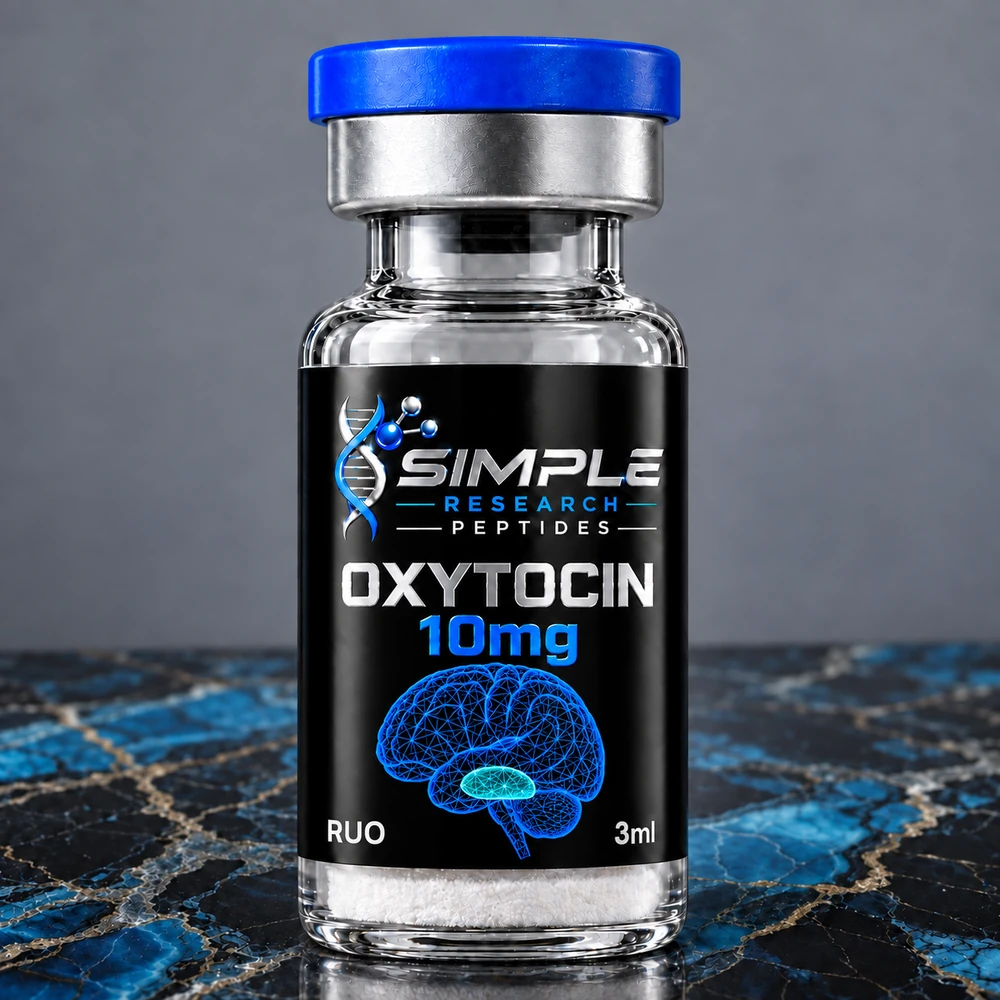
Oxytocin Research GuideCYIQNCPLG · not vasopressin · not a Pitocin lot
Oxytocin is the endogenous cyclic nonapeptide CYIQNCPLG (Cys-Tyr-Ile-Gln-Asn-Cys-Pro-Leu-Gly-NH2; disulfide Cys1–Cys6; C-terminal glycinamide) processed from the human *OXT* precursor (UniProt P01178), acting at the class A GPCR OXTR (UniProt P30559). It is not vasopressin/ADH, not carbetocin, not atosiban, not demoxytocin, and an SRP research vial is not the regulated Pitocin® / Syntocinon® injectable.
Educational information only. This page describes a laboratory research material. It is not medical advice. Materials are for laboratory research only and are not for human or veterinary use. No human-use protocol appears on this page.
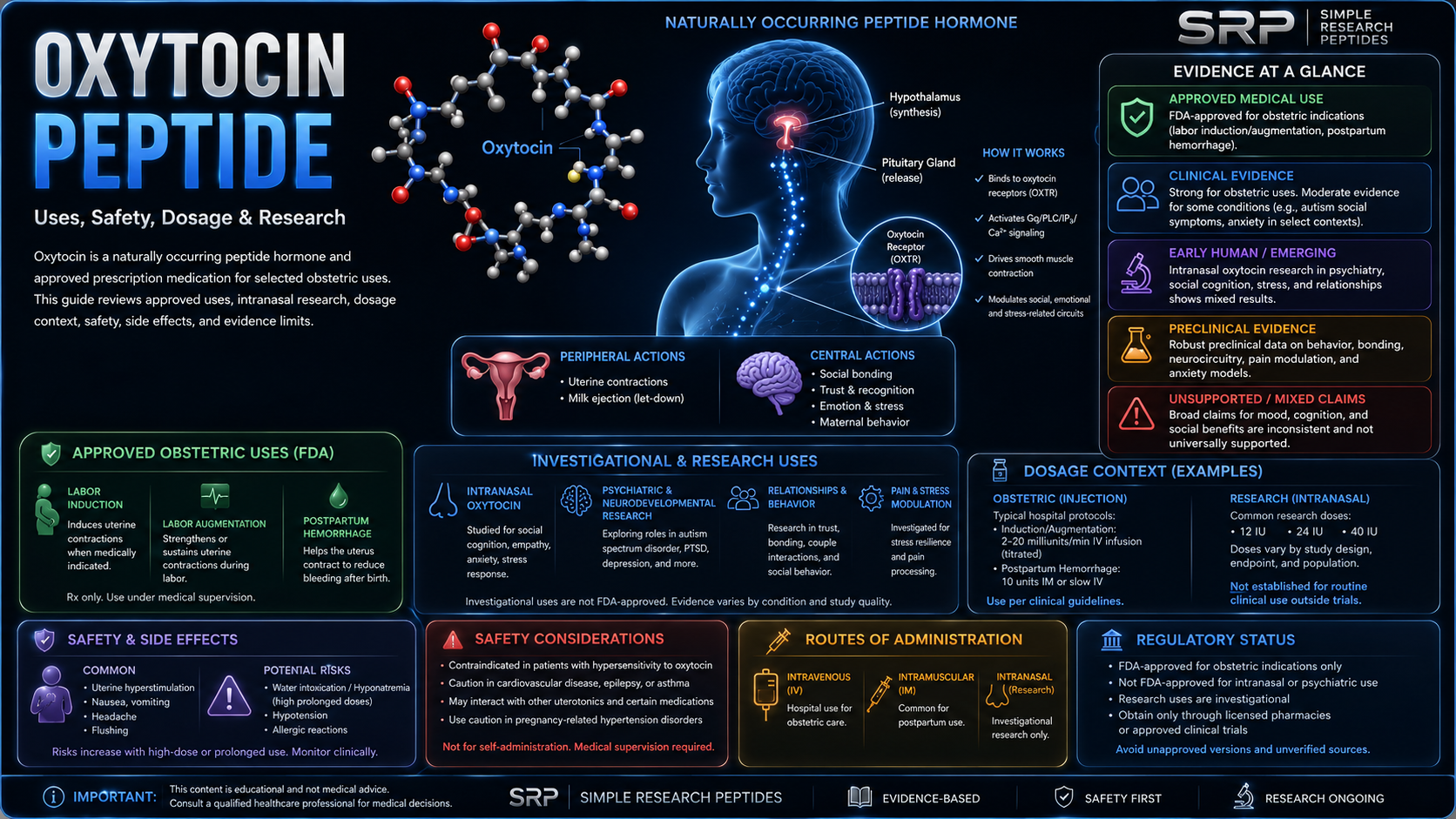
Oxytocin Research Guide
Research-use-only framing. This page describes an endogenous nonapeptide hormone sold as a laboratory research material. It is not medical advice. Simple Research Peptides (SRP) materials are for laboratory research only and are not for human or veterinary use, consumption, administration, diagnosis, treatment, or therapeutic application. Nothing on this page is a labor-induction, lactation, social-behavior, or other human-use claim for a research vial.
One-sentence identity. Oxytocin is the endogenous cyclic nonapeptide CYIQNCPLG (Cys-Tyr-Ile-Gln-Asn-Cys-Pro-Leu-Gly-NH2; disulfide Cys1–Cys6; C-terminal glycinamide) processed from the human *OXT* precursor (UniProt P01178), acting at the class A GPCR OXTR (UniProt P30559). It is not vasopressin/ADH, not carbetocin, not atosiban, not demoxytocin, and an SRP research vial is not the regulated Pitocin® / Syntocinon® injectable.
–-
Sequence / chemical identity (opened registries only)
SRP product and index pages do not print a sequence, CAS, UNII, molecular formula, or a public COA file. Identity below is taken only from opened public registries and primary papers that name oxytocin / OXT / CYIQNCPLG.
| Identifier | Value on opened page | Source opened |
|---|---|---|
| SRP listing name | Oxytocin (5 mg Vial) | SRP product page |
| SRP listed strength / format | Title and description print 5 mg Vial. The same page also prints a heading “Oxytocin (10 mg / 3 mL Vial)” and a bullet “10 mg lyophilized research compound in a 3 mL research vial.” Those two printed strengths were not reconciled on the opened page. | SRP /product/oxytocin/ and /product/oxytocin-5-mg-vial/ and /products/oxytocin-5-mg-vial |
| SRP store / research category | Research Compounds | SRP product page |
| SRP index listing | “Oxytocin (5 mg Vial)” under Other; Evidence profile; evidence tag Extensive human biology and clinical use | SRP compound-research-guides index |
| Chemical class | Cyclic (heterodetic) nonapeptide hormone; disulfide between Cys1 and Cys6; C-terminal amide | PubChem CID 439302; UniProt P01178 |
| Sequence (one-letter) | CYIQNCPLG | PubChem record description; UniProt P01178 peptide 20–28 |
| Sequence (three-letter / condensed) | Cys-Tyr-Ile-Gln-Asn-Cys-Pro-Leu-Gly-NH2, cyclic 1–6 disulfide; L-cysteinyl-L-tyrosyl-L-isoleucyl-L-glutaminyl-L-asparaginyl-L-cysteinyl-L-prolyl-L-leucylglycinamide cyclic (1–6)-disulfide | PubChem CID 439302 synonyms |
| PubChem CID | 439302. Title: Oxytocin | PubChem PUG REST / PUG View, opened 2026-08-16 |
| CAS on CID 439302 / NCATS | 50-56-6 (PRIMARY on NCATS) | PubChem PUG View; NCATS Inxight 1JQS135EYN |
| Extra RN on PubChem xrefs | 4248-64-0 also appears in PUG xrefs RN (and in Removed Synonyms). Not treated as a second identity. | PubChem PUG xrefs |
| UNII | 1JQS135EYN | PubChem synonyms (UNII-1JQS135EYN); NCATS Inxight; FDA Pharm Classes source ID |
| Molecular formula / MW | C43H66N12O12S2; 1007.2 g/mol | PubChem PUG REST |
| Exact / monoisotopic mass | 1006.43645793 | PubChem PUG REST |
| XLogP | −2.6 | PubChem PUG REST |
| InChIKey | XNOPRXBHLZRZKH-DSZYJQQASA-N | PubChem; IUPHAR ligand 2174 |
| IUPAC (computed) | (2S)-1-[(4R,7S,10S,13S,16S,19R)-19-amino-7-(2-amino-2-oxoethyl)-10-(3-amino-3-oxopropyl)-13-[(2S)-butan-2-yl]-16-[(4-hydroxyphenyl)methyl]-6,9,12,15,18-pentaoxo-1,2-dithia-5,8,11,14,17-pentazacycloicosane-4-carbonyl]-N-[(2S)-1-[(2-amino-2-oxoethyl)amino]-4-methyl-1-oxopentan-2-yl]pyrrolidine-2-carboxamide | PubChem PUG View |
| UniProt (human precursor) | P01178 · NEU1_HUMAN · oxytocin-neurophysin 1 proprotein (OT-NPI); gene OXT (synonym OT); HGNC 8528; peptide oxytocin = residues 20–28; Gly-28 amidated; disulfide 20–25 | UniProt JSON P01178, opened 2026-08-16 |
| UniProt (human receptor) | P30559 · OXYR_HUMAN · oxytocin receptor (OT-R); gene OXTR; HGNC 8529; 389 aa class A GPCR | UniProt JSON P30559 |
| IUPHAR / GtoPdb ligand | 2174 (oxytocin; endogenous peptide; approved-drug field Yes, US FDA 1980; INN 1480; CAS 50-56-6; CID 439302; UniProt P01178) | https://www.guidetopharmacology.org/GRAC/LigandDisplayForward?ligandId=2174 |
| ChEMBL | CHEMBL395429 | PubChem; NCATS; IUPHAR |
| DrugBank | DB00107 | PubChem; UniProt; IUPHAR |
| ChEBI | CHEBI:7872 | PubChem; IUPHAR |
| EC / EINECS | 200-048-4 | PubChem; NCATS |
| KEGG | C00746; D00089 | PubChem |
| NCI Thesaurus | C724 | PubChem; NCATS |
| EPA DSSTox | DTXSID8048361 | PubChem; NCATS |
| INN | oxytocin (INN number 1480 on IUPHAR) | IUPHAR ligand 2174; NCATS |
| ClinicalTrials.gov | API v2 query.intr=oxytocin returned totalCount 921. One opened record: NCT03033784 (Emory “Autism Oxytocin Brain Project”; completed; uses labeled syntocinon IN). Those records are not this SRP vial. | CT.gov API v2, opened 2026-08-16 |
What the molecule actually is. PubChem CID 439302 titles the record Oxytocin and describes “a cyclic nonapeptide hormone with amino acid sequence CYIQNCPLG.” UniProt P01178 prints the same nonapeptide as residues 20–28 of the human *OXT* precursor, with a Cys20–Cys25 disulfide and glycine amide at residue 28 (Light & du Vigneaud 1958, PMID 13591312, cited on that UniProt record). PubChem synonyms print Cys-Tyr-Ile-Gln-Asn-Cys-Pro-Leu-Gly-NH2, cyclic 1-6 disulfide. A research vial labeled “oxytocin” is not chemically identified until that cyclic amidated nonapeptide (and salt form) is confirmed analytically.
Registry notes that must not be collapsed.
- PubChem PUG name
oxytocinresolved to a single CID 439302. Do not invent a second CID. - Extra RN 4248-64-0 is on the xrefs list and in Removed Synonyms. Draft identity uses 50-56-6 only.
- PubChem also lists brand synonyms Pitocin and Syntocinon. Those are regulated-product names, not proof that an SRP lyophilized research vial is a Pitocin lot.
- IUPHAR ligand 2174 and PubChem synonym GTPL2176 both appear on opened pages. Draft uses the opened ligand page 2174 only.
- Kimura et al. 1992 (PMID 1313946) originally printed a 388-residue OXTR; UniProt P30559 is 389 aa and cites a 1992 *Nature* erratum (357:176). Use the UniProt length.
Not printed on SRP pages and therefore not claimed as SRP-verified: sequence, CAS, UNII, formula, disulfide/amide status, salt form, or purity numbers. The product page prints “COA (Certificate of Analysis) available for batch verification” but does not display a public COA file. SRP itself is a research-material listing, not a Pitocin / Syntocinon lot.
–-
How it is not vasopressin, carbetocin, atosiban, demoxytocin, or a Pitocin vial
This page is oxytocin / CYIQNCPLG only. Marketplace “love hormone” or brand-name language is a catalog nickname, not a receptor or product assignment.
| Identity | Opened chemistry | Peptide? | Why it is not this listing |
|---|---|---|---|
| Oxytocin (this page) | CYIQNCPLG; C43H66N12O12S2; MW 1007.2; CID 439302; CAS 50-56-6; UNII 1JQS135EYN; UniProt P01178 residues 20–28 | Yes (cyclic nonapeptide) | Endogenous *OXT* product; OXTR agonist |
| Arg-vasopressin / ADH | UniProt P01185 peptide 20–28 CYFQNCPRG; CID 644077 (Argipressin; InChIKey KBZOIRJILGZLEJ-LGYYRGKSSA-N); C46H65N15O12S2; MW 1084.2; CAS 113-79-1; UNII Y4907O6MFD. PubChem name lookup also lists CID 8230 (unspecified stereo; that CID page was not used). | Yes (related nonapeptide) | Differs at residues 3 (Phe vs Ile) and 8 (Arg vs Leu) — PubChem MeSH on CID 439302. Gene *AVP*, not *OXT*. Antidiuretic / V1/V2 pharmacology. Not oxytocin. |
| Carbetocin | CID 16681432; C45H69N11O12S; MW 988.2; CAS 37025-55-1; UNII 88TWF8015Y; InChIKey NSTRIRCPWQHTIA-DTRKZRJBSA-N. ChEBI: O-methyl Tyr, deamino Cys, Cys sulfur replaced by methylene (1-deamino-1-monocarba-[Tyr(OMe)]-oxytocin) | Yes (synthetic analogue) | Different formula (one S, not two). Not CYIQNCPLG. |
| Atosiban | CID 5311010; C43H67N11O12S2; MW 994.2; CAS 90779-69-4; UNII 081D12SI0Z; InChIKey VWXRQYYUEIYXCZ-OBIMUBPZSA-N. MeSH: 1-deamino-2-Tyr(OEt)-4-Thr-8-Orn-oxytocin. Opened DrugBank prose: inhibitor of oxytocin and vasopressin | Yes (antagonist analogue) | OXTR/V1a antagonist chemistry. Not an oxytocin agonist listing. |
| Demoxytocin | CID 449224; C43H65N11O12S2; MW 992.2; CAS 113-78-0; UNII 2N9HM3X95F; InChIKey GTYWGUNQAMYZPF-QPLNMOKZSA-N. ChEBI: deamino-oxytocin (free amino group on half-cystine replaced by hydrogen) | Yes (deamino analogue) | Missing the N-terminal amine of oxytocin. Not this sequence as isolated. |
| Pitocin® / Syntocinon® | Brand / MeSH synonyms on CID 439302 and IUPHAR 2174; NCATS lists PITOCIN and SYNTOCINON as names for UNII 1JQS135EYN | Same peptide in regulated injectables | A research vial is not an ANDA/NDA lot, not a labeled obstetric product, and is not interchangeable with those formulations. |
Oxytocin is not vasopressin. The two hormones are encoded by linked but opposite-strand genes on human chromosome 20 (Sausville, Carney & Battey 1985, PMID 2991279: 12 kb intervening). The mature peptides differ at two positions. Cross-talk at OXTR / AVPR subtypes is a research topic; it is not identity.
Oxytocin is not carbetocin, atosiban, or demoxytocin. Those are chemically modified analogues with their own CIDs, CAS numbers, and UNIIs on the opened PubChem records.
An SRP vial is not Pitocin. The SRP page prints “Also Known As: Pitocin®, Syntocinon®.” That is vendor synonym language. NCATS and IUPHAR attach those brands to the same UNII / same peptide in a regulated-drug context. A lyophilized research listing is not that product.
–-
SRP product (fetched 16 August 2026)
Product URLs opened:
- http://simpleresearchpeptides.com/product/oxytocin/
- http://simpleresearchpeptides.com/product/oxytocin-5-mg-vial/
- http://simpleresearchpeptides.com/products/oxytocin-5-mg-vial
Fetched page title: “Oxytocin (5 mg Vial)”. Listed price $59.00. Heading on the same body: “Oxytocin (10 mg / 3 mL Vial)”. Also Known As: Pitocin®, Syntocinon®. Bullets: 10 mg lyophilized research compound in a 3 mL research vial; COA available for batch verification; Made in the USA; high-purity research material; intended for qualified laboratory and analytical research; For Research Use Only. Not for human or veterinary use. Availability: 11 in stock (can be backordered). Description: “Oxytocin (5 mg Vial) is supplied for controlled laboratory evaluation of Oxytocin within Research Compounds studies.” Research material: Oxytocin. Listed strength and format: 5 mg Vial. Research category: Research Compounds. Disclaimer: “For laboratory research only. Not for human or animal use, consumption, administration, diagnosis, treatment, or therapeutic application.” Reviews (0). Shipping-box weight 1 lbs.
Index card on http://simpleresearchpeptides.com/research-compound-directory/compound-research-guides/ : Other → “Oxytocin (5 mg Vial)”; Evidence profile (not a dedicated long-form guide). Evidence tag: Extensive human biology and clinical use. Overview: nine-amino-acid peptide hormone involved in uterine contraction, milk ejection, and central social and stress-related signaling. Mechanism: activates the oxytocin receptor, a GPCR expressed in peripheral tissues and the nervous system; context, route, and timing strongly affect results. Evidence summary: established prescription uses in regulated obstetric formulations and a large research literature; social-behavior findings heterogeneous and should not be generalized. Research-quality note: a research product is not equivalent to an approved medicine; peptide stability, adsorption, and formulation can alter experimental exposure. Last editorial review printed on that index: August 2026.
Dedicated guide URL http://simpleresearchpeptides.com/research-compound-directory/oxytocin-research-guide/ returned HTTP 404.
Vendor-only language logged, not treated as independent chemistry: price, stock count, “Made in the USA,” “high-purity,” “COA available” without a linked file, and the unresolved 5 mg vs 10 mg print.
–-
Proposed mechanism in research (OXTR; not a treatment claim)
Opened primary papers and UniProt support a receptor-level working model. It is not a protocol and not a human-use claim.
- Biosynthesis. Human oxytocin is cut from pro-OXT / OT-NPI (P01178). UniProt: signal 1–19; peptide oxytocin 20–28; neurophysin 1 32–125. C-terminal amidation of Gly-28 by PAM completes activation (P01178 PTM; Light & du Vigneaud 1958, PMID 13591312). Rehbein et al. 1986 (PMID 3768139) report conserved mammalian precursor structures for oxytocin and vasopressin.
- Receptor. Kimura et al. 1992 (PMID 1313946) expression-cloned human OXTR from uterus: a 7-TM GPCR that, in *Xenopus* oocytes, specifically responded to oxytocin. Inoue et al. 1994 (PMID 7798245): single-copy *OXTR* at 3p26.2, ~17 kb, 4 exons / 3 introns. UniProt P30559: OXTR is mainly Gq-coupled (PLC-β → IP3 / DAG → Ca2+); high oxytocin can also couple Gi. Cholesterol and Mg2+ are allosteric activators.
- Structural mechanism. Waltenspühl et al. 2020 (PMID 32832646, PMC7439316, PDB 6TPK): crystal structure of human OTR with the nonpeptidic antagonist retosiban; extrahelical cholesterol between helices IV and V; conserved Mg2+ coordination site as a positive allosteric modulator. Meyerowitz et al. 2022 (PMID 35241813, PMC12101619, PDB 7RYC): cryo-EM of active human OTR bound to oxytocin and miniGq/i; Mg2+ coordination complex between OT and the receptor; TM7 disruption; a single cation-coordinating residue distinguishes cation-dependent vasopressin-family receptors. Waltenspühl et al. 2022 (PMID 35851571, PMC9293896, PDB 7QVM): cryo-EM of active OTR–oxytocin; binding mode and subtype specificity versus vasopressin receptors.
- Peripheral vs central context. Gimpl & Fahrenholz 2001 (PMID 11274341) review hypothalamic magnocellular synthesis, posterior-pituitary release, and widespread central projections, plus peripheral synthesis (uterus, placenta, ovary, testis, heart). Fuchs et al. 1982 (PMID 6278592): myometrial OXTR concentration rises toward early labor; decidual OXTR high at parturition; oxytocin increased prostaglandin production by decidua, not myometrium, in that in-vitro design. Jurek & Neumann 2018 (PMID 29897293): one receptor, Gαq or Gαi, MAPK / PKC / PLC / CaMK cascades; behavioral mapping remains incomplete.
- What social-cognition papers do *not* settle. Kosfeld et al. 2005 (PMID 15931222) reported that intranasal oxytocin increased trust in a human economic game versus a risk-only control. That is a historical experimental finding, not a research-vial instruction. Leng & Ludwig 2016 (PMID 26049207) argue that little of a large IN dose appears to reach CSF, that peripheral levels become supraphysiologic, and that many oxytocin assays and IN designs are methodologically weak. The opened SRP index itself says social-behavior findings are heterogeneous.
Not shown on an opened page: identity of an SRP lot as CYIQNCPLG-NH2; salt form; public COA; human PK of an SRP vial; proof that a research vial equals Pitocin.
–-
Evidence map (oxytocin / CYIQNCPLG only)
Label every row. Oxytocin ≠ AVP ≠ carbetocin ≠ atosiban ≠ demoxytocin ≠ Pitocin lot. Historical obstetric and social papers are listed as what they are — primary literature about the endogenous peptide or a regulated formulation — not as a completed therapeutic program for a research vial.
A. Sequence / precursor / gene (defines the name)
| Study | Species / model | What was tested | Actual finding (from the opened record) |
|---|---|---|---|
| du Vigneaud, Ressler & Trippett, 1953, PMID 13129273, DOI 10.1016/s0021-9258(18)49238-1. Opened Europe PMC record (no abstract). | Chemical sequence work on oxytocin | Amino-acid sequence / proposed structure | Title: “The sequence of amino acids in oxytocin, with a proposal for the structure of oxytocin.” UniProt P01178 cites this lineage (via Light 1958) for residues 20–28 and Gly-28 amidation. No abstract on the opened page. Not a receptor paper. Not an SRP COA. |
| Light & du Vigneaud, 1958, PMID 13591312, DOI 10.3181/00379727-98-24154. Opened Europe PMC (no abstract). | Human pituitary oxytocin and vasopressin | Nature of the human peptides | Title: “On the nature of oxytocin and vasopressin from human pituitary.” UniProt P01178 and P01185 cite protein sequence of 20–28 and amidation at Gly-28. Abstract empty on opened page; used via UniProt annotation + title only. |
| Sausville, Carney & Battey, 1985, PMID 2991279, DOI 10.1016/s0021-9258(17)39236-0. Opened abstract. | Human genomic clones; SCLC line H378 | *AVP* and *OXT* gene structure | Human prepro-AVP-NPII and prepro-OT-NPI genes similar in intron–exon structure, linked with 12 kb intervening, transcribed from opposite strands. H378 transcribes AVP, not OT. Gene architecture. Not a use paper. |
| Rehbein et al., 1986, PMID 3768139, DOI 10.1515/bchm3.1986.367.2.695. Opened abstract. | Rat, calf, human, pig cDNA | Precursor polyproteins | Complete cDNA sequences; essential conservation of oxytocin and vasopressin precursor structures in mammals; hypothalamic and novel expression sites. Precursor paper. |
B. Receptor cloning and structure
| Study | Species / model | What was tested | Actual finding (from the opened record) |
|---|---|---|---|
| Kimura et al., 1992, PMID 1313946, DOI 10.1038/356526a0. Opened abstract. Erratum *Nature* 1992;357:176. | Human uterine cDNA; *Xenopus* oocytes | OXTR clone | 7-TM GPCR; oocyte current specifically to oxytocin; mRNAs 3.6 kb (breast) and 4.4 kb (ovary, endometrium, myometrium); myometrial mRNA very high at term. Printed 388 aa; UniProt length is 389. Defines OXTR. Not an SRP-vial paper. |
| Inoue et al., 1994, PMID 7798245, DOI 10.1016/s0021-9258(18)31656-9. Opened abstract. | Human genomic *OXTR* | Gene organization | Single copy; 3p26.2; ~17 kb; 4 exons / 3 introns; intron 3 (12 kb) splits after TM6; TSS 618 and 621 bp upstream of ATG. Gene structure. |
| Waltenspühl et al., 2020, PMID 32832646, PMC 7439316, DOI 10.1126/sciadv.abb5419. Opened abstract (free PMC). | Human OTR crystal | Retosiban-bound OTR | Extrahelical cholesterol IV–V; Mg2+ PAM site. PDB 6TPK. Antagonist-bound structure, not an agonist-use paper. |
| Meyerowitz et al., 2022, PMID 35241813, PMC 12101619, DOI 10.1038/s41594-022-00728-4. Opened abstract (free PMC). | Human OTR–OT–miniGq/i cryo-EM | Active-state OT complex | Mg2+ coordination between OT and receptor; TM7 disruption; cation-dependence switch across the family. PDB 7RYC. Structural mechanism. |
| Waltenspühl et al., 2022, PMID 35851571, PMC 9293896, DOI 10.1038/s41467-022-31325-0. Opened abstract (free PMC). | Human OTR–OT cryo-EM | Active OTR + oxytocin | High-resolution OT binding mode and subtype specificity vs vasopressin receptors. PDB 7QVM. Structural mechanism. |
C. Classic physiology reviews and one historical social paper (not vial instructions)
| Study | Species / model | What was tested | Actual finding (from the opened record) |
|---|---|---|---|
| Fuchs et al., 1982, PMID 6278592, DOI 10.1126/science.6278592. Opened abstract. | Human myometrium / decidua | OXTR density; PG production | Myometrial OXTR max in early labor; decidual OXTR high at parturition; oxytocin increased PG production by decidua, not myometrium. Tissue receptor paper. Not a research-vial protocol. |
| Gimpl & Fahrenholz, 2001, PMID 11274341, DOI 10.1152/physrev.2001.81.2.629. Opened abstract. | Review | OT / OXTR system | Gq–PLC-β; Mg2+ and cholesterol required for high-affinity state; steroid dependence; milk-ejection essential in OT-deficient mice; parturition more complex. Review. Not a use claim for SRP material. |
| Kosfeld et al., 2005, PMID 15931222, DOI 10.1038/nature03701. Opened abstract. | Human economic trust game | Intranasal oxytocin vs control | Authors reported increased trust, not a general risk effect. Historical IN experiment. Not an SRP instruction. Subsequent literature is heterogeneous (SRP index; Leng 2016). |
| Leng & Ludwig, 2016, PMID 26049207, DOI 10.1016/j.biopsych.2015.05.003. Opened abstract. | Review / critique | Intranasal oxytocin methods | Little of large IN amounts appears to reach CSF; peripheral levels supraphysiologic; assay and design weaknesses; peripheral OT does not automatically report central release. Methodological caution. Not a dosing guide. |
| Jurek & Neumann, 2018, PMID 29897293, DOI 10.1152/physrev.00031.2017. Opened abstract. | Review | OXTR signaling to behavior | Single receptor; Gαq or Gαi; MAPK/PKC/PLC/CaMK; behavioral mapping still poorly understood. Review. |
D. Opened ClinicalTrials.gov record (identity context only)
| Record | What was opened | What it is not |
|---|---|---|
| NCT03033784 — Autism Oxytocin Brain Project (Emory; completed 2018-10-03). Opened CT.gov API v2 study JSON. | Phase 2 crossover fMRI dose-response of intranasal syntocinon vs placebo in adult males with ASD. Intervention names on the record include 8 / 24 / 48 IU syntocinon. | Not an SRP vial. Not copied as a laboratory or human-use instruction. Logged only to show that CT.gov oxytocin hits are real, numerous (921 for query.intr=oxytocin), and overwhelmingly about other products and routes. |
–-
What it is NOT
- Not vasopressin / ADH / argipressin. Sequence CYFQNCPRG (P01185); CID 644077 / 8230; different gene (*AVP*).
- Not carbetocin (CID 16681432; CAS 37025-55-1; UNII 88TWF8015Y).
- Not atosiban (CID 5311010; CAS 90779-69-4; UNII 081D12SI0Z) — an antagonist analogue.
- Not demoxytocin / deamino-oxytocin (CID 449224; CAS 113-78-0; UNII 2N9HM3X95F).
- Not a Pitocin® or Syntocinon® regulated injectable. Same peptide UNII on NCATS/IUPHAR; different product, formulation, and oversight.
- Not a labor-induction, PPH, lactation, autism, or “trust” product when sold as an SRP research vial. Those are regulated-label or experimental-literature contexts.
- Not proven identical to any SRP lot until sequence, amide, disulfide, salt, and assay are documented.
–-
Lab / RUO notes
- Confirm identity. Require a batch COA that reports the cyclic amidated nonapeptide (CYIQNCPLG-NH2, Cys1–Cys6), not only a catalog name. Distinguish free acid, linear (reduced) material, and deamido impurities.
- Do not assume brand equivalence. Pitocin / Syntocinon lots are formulated, potency-labeled (IU) injectables. An SRP milligram vial is a different article of commerce.
- Disulfide and amide are part of the structure. Reduced Cys or a free C-terminus is not the endogenous hormone described on P01178 / CID 439302.
- Adsorption and stability. The opened SRP index already warns that peptide stability, adsorption, and formulation can alter experimental exposure. Oxytocin is a small disulfide peptide; handle as such in aqueous systems.
- Receptor context. OXTR signaling is Mg2+- and cholesterol-sensitive (Waltenspühl 2020; Meyerowitz 2022). Buffer cation composition is a design variable, not a footnote.
- Cross-reactivity. Oxytocin can interact with vasopressin receptors (P01178 subunit comment, PMID 18174156). Assay selectivity vs AVP / AVPRs belongs in the methods.
- IN and social-cognition literature is not a lab SOP. Leng & Ludwig 2016 (PMID 26049207) is the opened caution on IN exposure, CSF penetration, peripheral spillover, and assay quality.
- No dosing, reconstitution, or administration instructions are provided here. RUO only.
–-
FAQ
Is oxytocin a nine-residue peptide?
Yes. Opened PubChem and UniProt print CYIQNCPLG with a Cys1–Cys6 disulfide and a C-terminal amide.
Is a research vial the same as Pitocin?
No. Pitocin® / Syntocinon® are brand names attached to the same UNII on NCATS/IUPHAR for regulated products. An SRP listing is research material. The opened product page even prints conflicting 5 mg and 10 mg text.
Is oxytocin the same as vasopressin?
No. Two residues differ (Ile3/Leu8 vs Phe3/Arg8). The genes are linked but distinct (PMID 2991279).
Does this page tell anyone how to induce labor or use oxytocin in people?
No. This is a research-identity guide. Regulated obstetric labels and IN trial records are cited only to separate those products from a research vial.
Why are social-oxytocin headlines unreliable as product claims?
Opened Kosfeld 2005 is one IN experiment. Opened Leng 2016 and the SRP index both treat IN / social findings as methodologically fragile or heterogeneous.
Did ClinicalTrials.gov return zero studies?
No. The opened API returned 921 studies for query.intr=oxytocin. That count is not evidence that an SRP vial was in those trials. The one opened NCT used syntocinon.
–-
References (opened this session)
- du Vigneaud V, Ressler C, Trippett S. The sequence of amino acids in oxytocin, with a proposal for the structure of oxytocin. *J Biol Chem.* 1953;205(2):949-957. PMID 13129273. DOI 10.1016/s0021-9258(18)49238-1.
- Light A, du Vigneaud V. On the nature of oxytocin and vasopressin from human pituitary. *Proc Soc Exp Biol Med.* 1958;98(4):692-696. PMID 13591312.
- Sausville E, Carney D, Battey J. The human vasopressin gene is linked to the oxytocin gene and is selectively expressed in a cultured lung cancer cell line. *J Biol Chem.* 1985;260(18):10236-10241. PMID 2991279.
- Rehbein M, et al. The neurohypophyseal hormones vasopressin and oxytocin. Precursor structure, synthesis and regulation. *Biol Chem Hoppe Seyler.* 1986;367(8):695-704. PMID 3768139.
- Fuchs AR, et al. Oxytocin receptors and human parturition: a dual role for oxytocin in the initiation of labor. *Science.* 1982;215(4538):1396-1398. PMID 6278592.
- Kimura T, et al. Structure and expression of a human oxytocin receptor. *Nature.* 1992;356(6369):526-529. PMID 1313946. Erratum *Nature* 1992;357:176.
- Inoue T, et al. Structural organization of the human oxytocin receptor gene. *J Biol Chem.* 1994;269(51):32451-32456. PMID 7798245.
- Gimpl G, Fahrenholz F. The oxytocin receptor system: structure, function, and regulation. *Physiol Rev.* 2001;81(2):629-683. PMID 11274341.
- Kosfeld M, et al. Oxytocin increases trust in humans. *Nature.* 2005;435(7042):673-676. PMID 15931222.
- Leng G, Ludwig M. Intranasal oxytocin: myths and delusions. *Biol Psychiatry.* 2016;79(3):243-250. PMID 26049207.
- Jurek B, Neumann ID. The oxytocin receptor: from intracellular signaling to behavior. *Physiol Rev.* 2018;98(3):1805-1908. PMID 29897293.
- Waltenspühl Y, et al. Crystal structure of the human oxytocin receptor. *Sci Adv.* 2020;6(29):eabb5419. PMID 32832646. PMC 7439316.
- Meyerowitz JG, et al. The oxytocin signaling complex reveals a molecular switch for cation dependence. *Nat Struct Mol Biol.* 2022;29(3):274-281. PMID 35241813. PMC 12101619.
- Waltenspühl Y, et al. Structural basis for the activation and ligand recognition of the human oxytocin receptor. *Nat Commun.* 2022;13:4153. PMID 35851571. PMC 9293896.
- UniProtKB P01178 (oxytocin-neurophysin 1); P30559 (OXTR); P01185 (AVP precursor). JSON opened 2026-08-16.
- PubChem CID 439302 (oxytocin); 16681432 (carbetocin); 5311010 (atosiban); 449224 (demoxytocin); name
vasopressin→ 644077 / 8230. - NCATS Inxight 1JQS135EYN.
- IUPHAR ligand 2174.
- ClinicalTrials.gov API v2
query.intr=oxytocin(totalCount 921); opened study NCT03033784. - SRP product and index URLs listed in section 01. Dedicated guide URL 404.
–-
*Locked 16 August 2026 (America/Indianapolis, UTC-4). Chrome was not used. WordPress was not opened. No invented PMID / NCT / UNII / CAS.*
Educational information only. Oxytocin is the endogenous cyclic nonapeptide CYIQNCPLG (Cys-Tyr-Ile-Gln-Asn-Cys-Pro-Leu-Gly-NH2; disulfide Cys1–Cys6; C-terminal glycinamide) processed from the human *OXT* precursor (UniProt P01178), acting at the class A GPCR OXTR (UniProt P30559). It is not vasopressin/ADH, not carbetocin, not atosiban, not demoxytocin, and an SRP research vial is not the regulated Pitocin® / Syntocinon® injectable. Materials are for laboratory research only and are not for human or veterinary use. Not medical advice. Not for human use. No human-use protocol. Last source review: 16 August 2026 (America/Indianapolis). For laboratory research only. Not for human or veterinary use.