SRP RESEARCH PULSE
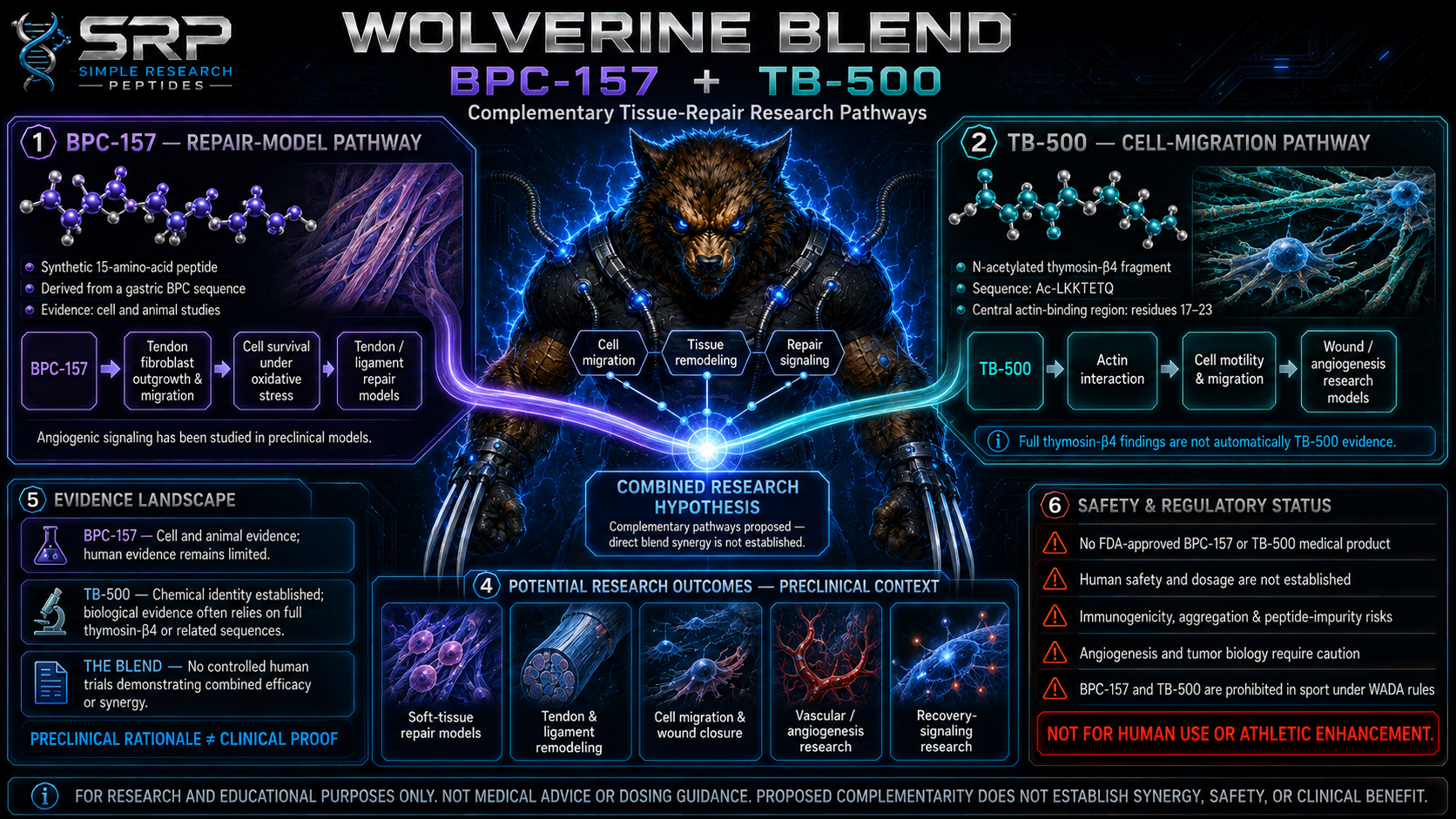
HUGE SALE ON FEATURED ITEMSKLOW 80mgGLOW 70mgHumanin 10mgFOXO4-DRI 10mgACE-031 1mgWolverine 20/20SS-31 10mg5-Amino-1MQ 50mgMOTS-c 40mgBPC-157/TB-500 10mg/10mgSelank 10mgNAD+ 500mgGHK-Cu 100mgRTZ-GLP 30mgTirzepatide 30mgEpithalon 10mgKisspeptin 10mg

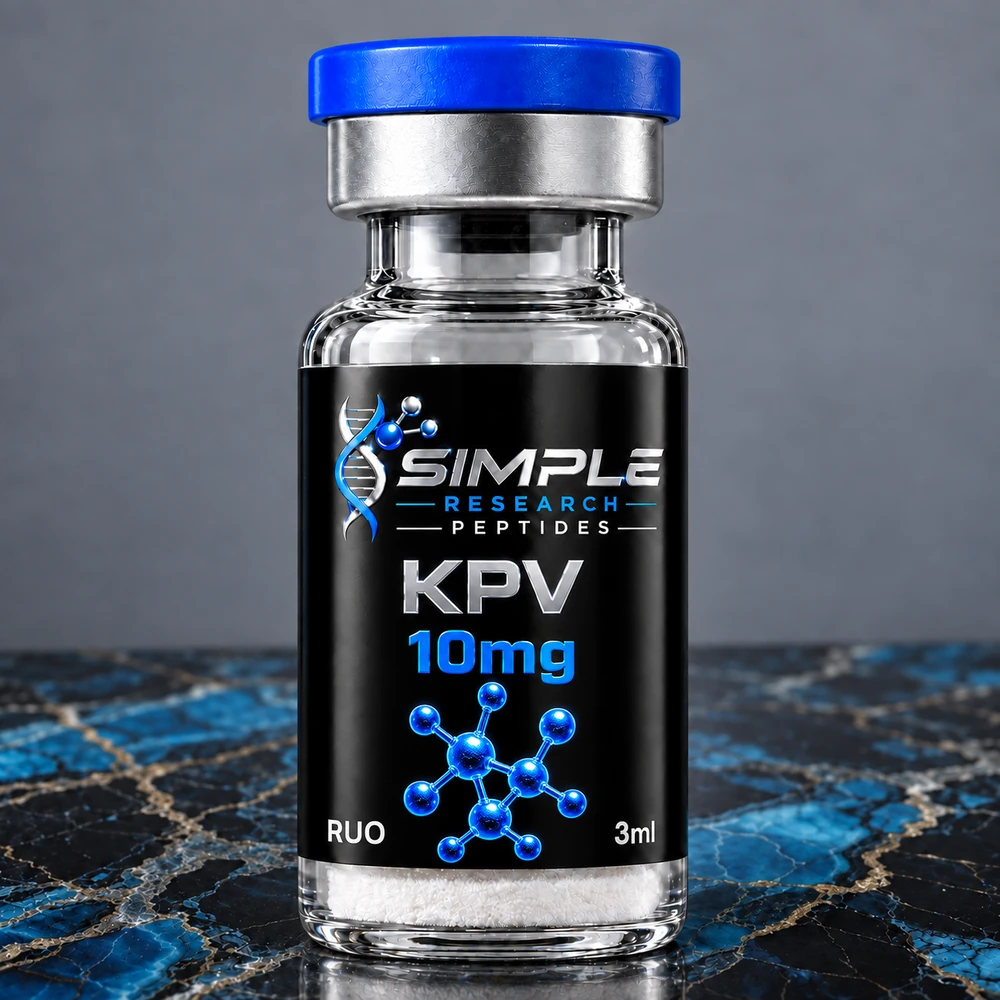
KPV Research Guide

Research library · α-MSH(11–13) tripeptide

KPV Research GuideLys-Pro-Val · not α-MSH · not the 50/10 blend

KPV is the C-terminal tripeptide of α-melanocyte-stimulating hormone (α-MSH residues 11–13): Lys-Pro-Val / H-Lys-Pro-Val-OH. Opened PubChem CID 125672 titles the free-acid record “Msh (11-13)” and prints CAS 67727-97-3, formula C16H30N4O4, and MW 342.43 g/mol. It is not α-MSH, not ACTH, not melanotan II, not bremelanotide / PT-141, not afamelanotide, not K(D)PT / KdPT, not GHK-Cu, and not the SRP GHK-Cu + KPV 50/10 mg blend. Opened evidence is preclinical (mouse irritant / edema / colitis models and keratinocyte signaling). ClinicalTrials.gov returned 0 studies. Human efficacy of a research-market 10 mg vial is not established. Research use only. Not medical advice. Not for human use.

Lys-Pro-Val
CID 125672
CAS 67727-97-3
No UNII
0 NCT
Preclinical evidence
Not FDA-approved
Research use only

Educational information only. This page describes an investigational laboratory research tripeptide. It is not medical advice. Simple Research Peptides (SRP) materials are for laboratory research only and are not for human or veterinary use, consumption, administration, diagnosis, treatment, or therapeutic application. The opened SRP listing is a 10 mg lyophilized research vial (Recovery / Inflammation Research). Sequence, CAS, UNII, CID, termini, salt, and a public COA were not printed on the fetched SRP page. No human dosing, reconstitution, or administration protocol appears on this page. Historical nanomolar cell-culture concentrations and mouse drinking-water exposure are study conditions from opened papers, not instructions for an SRP 10 mg vial. This dedicated page is the standalone 10 mg listing, not the 50/10 mixture. Do not contradict the live GHK-Cu + KPV blend guide.

01 / Identity

Sequence and chemical identity (opened registries only)

SRP product and index pages do not print CAS, UNII, PubChem CID, molecular formula, sequence, termini (free acid vs N-acetyl / C-amide), salt form, or a public COA. Identity below is taken only from opened public registries and from primary papers that name KPV, α-MSH[11-13], MSH 11-13, or Lys-Pro-Val.

One-sentence identity: KPV is the C-terminal tripeptide of α-MSH (residues 11–13), Lys-Pro-Val / H-Lys-Pro-Val-OH. Opened PubChem CID 125672 titles the free-acid record “Msh (11-13)” and prints CAS 67727-97-3, formula C16H30N4O4, and MW 342.43 g/mol. It is not α-MSH, not ACTH, not melanotan II, not bremelanotide / PT-141, not afamelanotide, not K(D)PT, not GHK-Cu, and not the SRP GHK-Cu + KPV 50/10 mg blend. This is a defined tripeptide sequence on opened registries, not a copper complex and not a 13-residue POMC hormone.

Opened SRP product page (16 August 2026): title “KPV 10 mg Inflammation Research Peptide Vial”. Category line: Recovery / Inflammation Research. Subhead: “KPV 10mg Research Peptide.” Bullets: Vial Size 10 mg; Purity ≥99%; COA available; Made in the USA; lyophilized research peptide; third-party tested; laboratory and research applications only. Description: supplied for controlled laboratory evaluation of KPV within Recovery / Inflammation Research studies. Research material: KPV. Listed strength: 10 mg Vial. Footer: for laboratory research only; not for human or animal use, consumption, administration, diagnosis, treatment, or therapeutic application. Price printed $60.00. Availability: “5 in stock (can be backordered).” Shipping-box fields: Weight 1 lbs; Dimensions 1 × .5 × 2 in. Reviews (0). Price, stock, and shipping-box fields are vendor listings, not chemistry.

Not printed on the opened product page and therefore not claimed as SRP-verified: Lys-Pro-Val sequence; free acid vs Ac-amide termini; CAS; UNII; CID; salt/counter-ion; a public COA file; a published 10 mg laboratory dose.

Opened SRP index card (compound-research-guides, 16 August 2026): “KPV (10 mg Vial)” under Recovery; tag Evidence profile (not “Dedicated evidence guide”); evidence tier Preclinical evidence; field Inflammation research. Overview: “KPV is the C-terminal tripeptide Lys-Pro-Val derived from alpha-melanocyte-stimulating hormone and studied for anti-inflammatory activity.” Mechanism: laboratory effects on inflammatory transcription and epithelial immune responses, including NF-κB; “a definitive standalone receptor mechanism remains under study.” Evidence: most from cell and animal models, including intestinal and skin-related research; controlled human efficacy and safety evidence limited. Quality note: distinguish KPV-specific data from full-length α-MSH or other melanocortin agonists.

Opened dedicated-guide URL http://simpleresearchpeptides.com/research-compound-directory/kpv-research-guide/ returned HTTP 404 on 16 August 2026. This page is written for that missing standalone listing. The live GHK-Cu + KPV Research Guide already treats KPV as component 2 (CID 125672; CAS 67727-97-3; no UNII; no IUPHAR ligand; 0 KPV NCT). Component papers remain component papers. Combination untested as a unit.

Peptide sequenceLys-Pro-Val / KPVIUPAC condensed H-Lys-Pro-Val-OH; PLN H-KPV-OH; HELM PEPTIDE1{K.P.V}. PubChem CID 125672 biologic description.
PubChem titleMsh (11-13)Opened PubChem HTML, 16 August 2026. Free-acid all-L tripeptide record.
PubChem CID1256723 defined / 0 undefined stereocenters. PubChem HTML + PUG REST.
CAS67727-97-3Only RN on PUG /xrefs/RN. PUG name 67727-97-3 resolves to CID 125672.
Formula / MWC16H30N4O4 / 342.43Exact / monoisotopic mass 342.22670545 Da. PubChem HTML + PUG.
InChIKeyYSPZCHGIWAQVKQ-AVGNSLFASA-NPubChem HTML + PUG. Stereo-defined all-L free acid.
UNII / NCATSNot foundCID 125672 HTML has no UNII heading. NCATS LYS-PRO-VAL hits are parent melanocortin / ACTH records, not a standalone KPV UNII. No KPV UNII is used on this page.
IUPHAR ligandNo ligandServices name=KPV and name=Lys-Pro-Val returned HTTP 404 / no ligands. Opened 16 August 2026.
ClinicalTrials.gov0 studiesquery.term=KPV and query.intr=KPV: 0 studies. Lys-Pro-Val lexical hits unused. Do not invent an NCT.
SRP standalone listingKPV 10 mg vialInflammation Research Peptide Vial; $60.00; Recovery / Inflammation Research; ≥99%; COA available; lyophilized. Sequence/CAS not printed.
SRP blend listingDifferent SKUGHK-Cu + KPV (50/10 mg Vial). Combination untested. Live blend guide: 0 blend NCT. Not this 10 mg listing.
FDA-approved KPV drugNoneopenFDA KPV: NOT_FOUND. No opened NDA/ANDA/BLA. CAS collision with ondansetron unused.
Identifier Value on opened page Source opened
Peptide sequence Lys-Pro-Val / KPV; IUPAC condensed H-Lys-Pro-Val-OH; PLN H-KPV-OH; HELM PEPTIDE1{K.P.V} PubChem CID 125672 biologic description
PubChem title Msh (11-13) PubChem HTML, opened 16 August 2026
PubChem CID 125672 (3 defined / 0 undefined stereocenters) PubChem HTML + PUG REST
CAS 67727-97-3 (only RN on PUG /xrefs/RN) PubChem CID 125672. PUG name 67727-97-3 resolves to CID 125672
Formula / MW C16H30N4O4; 342.43 g/mol PubChem HTML + PUG
Exact / monoisotopic mass 342.22670545 Da PubChem PUG
InChIKey YSPZCHGIWAQVKQ-AVGNSLFASA-N PubChem HTML + PUG
IUPAC (computed) (2S)-2-[[(2S)-1-[(2S)-2,6-diaminohexanoyl]pyrrolidine-2-carbonyl]amino]-3-methylbutanoic acid PubChem
MeSH entry terms MSH (11-13); L-lysyl-L-prolyl-L-valine; Lys-Pro-Val; alpha-MSH (11-13) PubChem MeSH
Depositor synonyms (selected) alpha-MSH (11-13) (free acid); ACTH-(11-13); alpha-Melanotropin(11-13); H-LYS-PRO-VAL-OH ACETATE SALT PubChem synonym block. Acetate-salt alias is a depositor string, not proof of the SRP lot salt
ChEBI CHEBI:160254; “Lys-Pro-Val is a tripeptide.” MeSH note on CID: RN refers to the (all-L)-isomer PubChem
EPA DSSTox DTXSID80987067 PubChem
Related acetate-salt CID (distinction) CID 90474670; L-lysyl-L-prolyl-L-valine acetate; C18H34N4O6; 402.5 g/mol; parent CID 125672 PubChem HTML CID 90474670. Salt, not a second peptide.
Ac-amide analog CID (distinction) CID 6453546; title N-acetyllysyl-prolyl-valinamide; CAS 57899-96-4; MeSH Ac-Lys-Pro-ValNH2; C16H32N4O3; 328.45 g/mol PubChem HTML CID 6453546. Not CID 125672. Do not collapse 57899-96-4 into 67727-97-3.
Precursor mapping (distinction) Human POMC UniProt P01189 / COLI_HUMAN, 267 aa; α-MSH feature residues 138–150 = SYSMEHFRWGKPV UniProt REST P01189.json. Precursor mapping, not a KPV drug record.
Other registry IDs on CID 125672 Metabolomics Workbench 83755; Nikkaji J488.954A; Wikidata Q82975228; CHEBI:160254; DTXSID80987067 PubChem HTML, opened 16 August 2026
UNII / NCATS dedicated drug record Not found. CID 125672 HTML has no UNII heading. NCATS search root_names_name:"LYS-PRO-VAL" returned total 13, first hits afamelanotide acetate, corticotropin porcine / bovine-ovine, seractide, tiplimotide — parent melanocortin / ACTH records, not a standalone KPV UNII. No KPV UNII is used on this page. PubChem HTML; NCATS API, opened 16 August 2026
IUPHAR ligand for KPV / Lys-Pro-Val No ligand. Services name=KPV and name=Lys-Pro-Val returned HTTP 404 IUPHAR services, opened 16 August 2026
Parent hormone (distinction only) α-MSH, IUPHAR ligand 1320; precursor POMC; CAS 581-05-5; PubChem CID 16162729 IUPHAR ligand 1320 HTML + services name=alpha-MSH
Adjacent IUPHAR ligands (distinction only) ACTH ligand 1331; afamelanotide ligand 1324 (EMA 2014 / FDA 2019); MT-II ligand 1323; bremelanotide ligand 10408 (INN bremelanotide; FDA 2019) IUPHAR services, opened 16 August 2026
ClinicalTrials.gov query.term=KPV and query.intr=KPV: 0 studies. query.term=Lys-Pro-Val returned unrelated lexical hits (not KPV peptide trials; unused) CT.gov API v2, opened 16 August 2026
openFDA Drugs@FDA KPV: HTTP 404 NOT_FOUND. CAS 67727-97-3 matched unrelated ANDA209389 ondansetronunused as KPV identity openFDA API, opened 16 August 2026
FDA-approved KPV drug None on opened PubChem / NCATS / openFDA / CT.gov / IUPHAR pages Same
SRP standalone listing “KPV 10 mg Inflammation Research Peptide Vial”; $60.00; Recovery / Inflammation Research; 10 mg; ≥99%; COA available; lyophilized SRP product page
SRP blend listing (different SKU) GHK-Cu + KPV (50/10 mg Vial). Combination untested. Live blend guide already states 0 blend NCT and component-level evidence only Live blend guide; do not contradict
Live GHK-Cu dedicated guide (do not contradict) Identity “Glycyl-L-histidyl-L-lysine copper complex.” Regulatory status: “No FDA-approved injectable GHK-Cu drug.” GHK-Cu dedicated guide

Form-chaos that must not be collapsed. CID 125672 is the free-acid tripeptide (H-Lys-Pro-Val-OH). Depositor synonyms also include “H-Lys-Pro-Val-OH AcOH” / acetate salt. Acetate salt ≠ a different sequence, but it is a different solid form (related CID 90474670). Hiltz & Lipton 1989 (PMID 2550304) tested α-MSH[11-13] and named lysine-proline-valine as the antipyretic message sequence; that abstract does not print N-acetyl / C-amide termini. Hiltz, Catania & Lipton 1991 (PMID 1788140) tested Ac-α-MSH(11-13)-NH2 and D-amino-acid analogs — an N-acetyl, C-amide tripeptide, not automatically CID 125672. Europe PMC chemical list for Hiltz 1990 (PMID 2284205) includes N-acetyllysyl-prolyl-valinamide, registry number 57899-96-4, alongside MSH (11-13) CAS 67727-97-3. That is a different CAS for the acetylated amide (CID 6453546). Do not collapse 57899-96-4 into 67727-97-3. Dalmasso 2008 (PMID 18061177) names KPV (Lys-Pro-Val); Europe PMC chemicals for that paper list MSH (11-13) CAS 67727-97-3. This page does not assume SRP “KPV 10 mg” is the acetylated amide, the free acid, or any 1989/1991/2008 lot. Confirm termini on a COA.

Critical identity point. CID 125672 is the free-acid all-L tripeptide H-Lys-Pro-Val-OH. Hiltz, Catania & Lipton 1991 (PMID 1788140) tested Ac-α-MSH(11-13)-NH2 and D-amino-acid analogs — an N-acetyl, C-amide tripeptide, not automatically CID 125672. Dalmasso 2008 (PMID 18061177) names KPV as Lys-Pro-Val. This page does not assume the SRP “KPV 10 mg” lot is the free acid, the acetate salt, or the 1989/1991 acetylated amide. Confirm termini, stereochemistry, and salt on a COA / LC-MS.

Registry chaos that must not be collapsed.

  • PubChem depositor synonyms include “H-LYS-PRO-VAL-OH ACETATE SALT” and “H-Lys-Pro-Val-OH AcOH”. Those sit on the free-acid CID. They are nomenclature noise, not proof of the SRP counter-ion.
  • NCATS LYS-PRO-VAL is a substring collision against longer POMC / ACTH / afamelanotide sequences that contain the three residues. Those UNIIs are not KPV. No KPV UNII is used on this page.
  • openFDA CAS 67727-97-3 → ondansetron ANDA209389 is a string collision. Unused as KPV identity.
  • ClinicalTrials.gov Lys-Pro-Val hits (opened examples: NCT02477644 PAOLA-1 olaparib; NCT04874688 CHAIN nutrition; NCT03017768 acute tryptophan depletion; NCT05214872 CKD) are lexical, not KPV-peptide trials. Unused. Do not invent a KPV NCT.
  • IUPHAR has ligands for α-MSH, ACTH, MT-II, bremelanotide, and afamelanotide. It has no KPV ligand.

Not printed on SRP pages and therefore not claimed as SRP-verified: sequence, CAS, UNII, CID, termini, salt, or a public COA file. The product page prints a “COA available” bullet but does not display a public COA. SRP itself is a research-material listing, not a Hiltz-lab or Dalmasso-lab lot.

Critical identity point: KPV on opened registries is the free-acid tripeptide Lys-Pro-Val / H-Lys-Pro-Val-OH (CID 125672; CAS 67727-97-3; C16H30N4O4; 342.43 g/mol; InChIKey YSPZCHGIWAQVKQ-AVGNSLFASA-N). No UNII. No IUPHAR ligand. 0 KPV NCT. Ac-α-MSH(11-13)-NH2 is a different termini set. The 50/10 blend is a different listing. Not FDA-approved. Research use only.
02 / Overview

How KPV is not α-MSH, not melanotan, not PT-141, not GHK-Cu, and not the 50/10 blend

KPV is three residues at the C-terminus of the 13-residue POMC peptide α-MSH. Catalog “inflammation / recovery” language does not convert a research tripeptide into Vyleesi, Scenesse, melanotan II, or a copper-peptide complex. This page is standalone KPV 10 mg only. The live GHK-Cu + KPV blend guide already states combination untested as a unit and 0 blend NCT. Do not merge streams.

Identity What opened sources actually describe Peptide? Typical literature role
KPV (this page) Lys-Pro-Val; CID 125672; CAS 67727-97-3; α-MSH(11–13) free acid. No UNII. No IUPHAR ligand. 0 NCT. Yes (tripeptide) Preclinical anti-inflammatory fragment literature. Not the blend.
α-MSH Tridecapeptide from POMC; IUPHAR ligand 1320; CAS 581-05-5; CID 16162729 Yes (13 aa) Principal endogenous MC1 agonist in IUPHAR. Not KPV.
ACTH IUPHAR ligand 1331; longer POMC peptide Yes Adrenal / melanocortin biology. Not KPV.
Melanotan II (MT-II) Cyclic analog; IUPHAR ligand 1323 Yes (cyclic peptide) Multi-MC receptor research ligand. Not KPV.
Bremelanotide / PT-141 IUPHAR ligand 10408; INN bremelanotide; FDA 2019 Yes (cyclic peptide) Approved-drug melanocortin agonist in a regulated product. Not this vial.
Afamelanotide IUPHAR ligand 1324; EMA 2014 / FDA 2019 Yes Approved α-MSH analogue in a regulated product. Not KPV.
K(D)PT / KdPT Luger & Brzoska 2007 (PMID 17934097): derivative of KPV corresponding to IL-1β 193–195 Different tripeptide Adjacent melanocortin-fragment literature. Not KPV.
Ac-α-MSH(11-13)-NH2 Hiltz 1991 (PMID 1788140); Europe PMC also lists CAS 57899-96-4 on the 1990 record; CID 6453546 Modified tripeptide Analog SAR. Not automatically CID 125672. Different form from free-acid CAS 67727-97-3.
GHK-Cu / prezatide copper Copper complex of Gly-His-Lys; live dedicated guide: “Glycyl-L-histidyl-L-lysine copper complex”; no FDA-approved injectable GHK-Cu drug Yes (peptide–Cu complex) Fibroblast / ECM literature. Not KPV. Different SRP 100 mg SKU.
SRP GHK-Cu + KPV 50/10 blend Vendor co-lyophilized 50 mg GHK-Cu + 10 mg KPV Two peptides Live blend guide: combination untested; 0 blend NCT. Not this 10 mg listing.

The standalone vial is not the blend

The 50/10 mg pair is a vendor listing on a different URL. No opened paper tested GHK-Cu plus KPV together. Do not cite a GHK-Cu fibroblast or rat-chamber paper as KPV evidence. Live blend guide: combination untested as a unit. Component papers remain component papers.

The standalone vial is not α-MSH

Elliott 2004 (PMID 15102092) asked whether KPV uses MC-1R / cAMP the way α-MSH does; the opened abstract reports no cAMP elevation in HaCaT or normal human keratinocytes for α-MSH, KPV, or ACTH in that system. That is not proof that KPV is a full MC1 agonist. α-MSH is IUPHAR ligand 1320; KPV has no IUPHAR ligand.

Not melanotan II, bremelanotide, or afamelanotide

Those are cyclic melanocortin ligands with IUPHAR records (1323, 10408, 1324). Two of them are approved drugs in other products. Catalog “inflammation / recovery” language does not convert Lys-Pro-Val into Vyleesi or Scenesse.

K(D)PT is a different tripeptide

Luger & Brzoska 2007 (PMID 17934097; PMC2095288) introduce K(D)PT as a derivative of KPV corresponding to IL-1β 193–195. Secondary review. Useful for KPV ≠ K(D)PT ≠ α-MSH. Not a human RCT and not this vial.

Do not equate this vial with α-MSH, ACTH, melanotan II, bremelanotide / PT-141, afamelanotide, K(D)PT, GHK-Cu, free GHK, or the 50/10 blend. KPV on opened registries is Lys-Pro-Val / CID 125672 / CAS 67727-97-3. No UNII. No IUPHAR ligand. 0 KPV NCT. Research use only.
03 / Mechanism

Proposed mechanism (labeled as such)

Opened primary papers support a C-terminal α-MSH-fragment working model. It is not a treatment claim. It was not generated with an SRP 10 mg vial. Observed means a measurement in an opened paper. Proposed means a hypothesis. Class / adjacent means distinction biology. Not shown means the opened papers did not establish it for a research-market lot.

Observed — mouse irritant / edema

Hiltz 1989 / 1990 ear and paw models

Hiltz & Lipton 1989 (PMID 2550304) reported that α-MSH[11-13] inhibited picryl-chloride ear swelling in mice in a dose-related fashion versus saline, compared with a large corticosteroid dose. Authors name lysine-proline-valine as the antipyretic message sequence and suggest endogenous α-MSH and COOH-terminal fragments may modulate host defense — a 1989 hypothesis, not an approval. Hiltz & Lipton 1990 (PMID 2284205) reported significant anti-inflammatory effects of α-MSH peptides, including the C-terminal tripeptide, in mouse-paw edema and contact sensitivity. Those are mouse topical-irritant / edema models. Not human dermatitis. Not GHK-Cu.

Termini matter — Ac-amide SAR

Hiltz 1991 is not automatically free-acid KPV

Hiltz, Catania & Lipton 1991 (PMID 1788140) used Ac-α-MSH(11-13)-NH2. The parent Ac-tripeptide reduced 3 h and 6 h ear swelling. Ac-[D-Lys11] was similar; Ac-[D-Pro12] was inactive; Ac-[D-Val13] and Ac-[D-Lys11,D-Val13] generally had greater activity than the parent (authors: D-Val13 substitution increased activity approximately four-fold). An SRP “KPV” free-acid lot is not automatically that analog set. Confirm termini on a COA.

Proposed — PepT1 working model

Not a completed receptor assignment

Dalmasso et al. 2008 (PMID 18061177; PMC2431115) open by stating that KPV’s mechanisms “still remain unknown,” then report that nanomolar KPV inhibited NF-κB and MAP-kinase pathways and reduced pro-inflammatory cytokine secretion in intestinal epithelial (Caco2-BBE, HT29-Cl.19A) and Jurkat cells; that KPV competed for PepT1 substrate uptake; and that oral KPV in drinking water reduced histologic inflammation and cytokine mRNA in DSS- and TNBS-colitis mice. The authors propose PepT1-mediated uptake and write that KPV “might be a new therapeutic agent for IBD.” That sentence is not an approved indication. IUPHAR still has no KPV ligand.

Observed — incomplete MC1 story

Kannengiesser 2008 MC1Re/e (PMID 18092346); Getting 2003 peritonitis / MC dissection (PMID 12750433); Cutuli 2000 in-vitro antimicrobial (PMID 10670585) mice

Kannengiesser et al. 2008 (PMID 18092346) reported earlier recovery, greater body-weight regain, reduced histologic infiltrates and colonic MPO in DSS colitis; recovery in CD45RB(hi) transfer colitis; and rescue from death during DSS colitis in MC1Re/e mice (nonfunctional MC1). Authors conclude effects are at least partially independent of MC1R and call KPV an “interesting therapeutic option” — not a human approval. That is a mouse colitis statement, not proof that KPV has no melanocortin biology in every tissue.

Keratinocyte signaling — no cAMP

Elliott 2004 HaCaT / NHK

Elliott et al. 2004 (PMID 15102092) found no cAMP elevation in HaCaT or normal human keratinocytes to α-MSH, KPV, or ACTH, but reported intracellular calcium responses in HaCaT cells to those peptides (including KPV and KP-D-V) in the presence of PIA, and calcium responses in CHO cells stably transfected with MC-1. In vitro signaling. Not a pigment-drug trial. Not proof that KPV is a full MC1 agonist.

Secondary review — KPV ≠ K(D)PT

Luger & Brzoska 2007

Luger & Brzoska 2007 (PMID 17934097; PMC2095288; opened abstract + PMC full text). Opened author line is Luger TA, Brzoska T (the live blend guide attributes this PMID to a longer Brzoska et al. author string; findings used here follow the opened record). Review: most anti-inflammatory activities of α-MSH “can be attributed to its C-terminal tripeptide KPV”; K(D)PT is a different tripeptide corresponding to IL-1β 193–195. The review also states that binding studies suggest KPV “seems not to bind to MC-1R and fails to increase cAMP.” Secondary. Useful for KPV ≠ K(D)PT ≠ α-MSH. Not a human RCT. The review’s “most likely will allow these agents to be developed” sentence is opinion, not approval.

Observed — peritonitis / MC dissection

Getting 2003: unlikely melanocortin receptors

Getting, Schiöth & Perretti 2003 (PMID 12750433) compared KPV with core MSH peptides in crystal-induced peritonitis. Systemic KPV reduced peritoneal PMN accumulation; the effect was not blocked by the MC3/4 antagonist SHU9119. KPV failed to increase cAMP in macrophages and did not inhibit macrophage KC / IL-1β release the way α-MSH and MTII did. Activity remained in IL-1β-induced peritonitis and in MC1-R e/e mice. Authors: effect “clearly different” from core MSH peptides; unlikely to be mediated through melanocortin receptors; “more likely to act through inhibition of IL-1β functions.” Mouse + cells. Not a completed IUPHAR assignment. Not human. Not GHK-Cu.

Observed — in-vitro antimicrobial

Cutuli 2000: S. aureus / C. albicans, not a human trial

Cutuli, Cristiani, Lipton & Catania 2000 (PMID 10670585) reported that α-MSH and its C-terminal tripeptide (11–13, KPV) inhibited S. aureus colony formation and reduced C. albicans viability and germ-tube formation in vitro. In-vitro microbiology, not a human infection trial. Authors’ “could be useful” sentence is not an approval. Not GHK-Cu. Not the 50/10 blend.

Hiltz & Lipton name the tripeptide

α-MSH[11-13] dose-related inhibition of picryl-chloride ear swelling vs saline. 1989 hypothesis about future peptide drugs is not an approval. Mouse. PMID 2550304.

C-terminal tripeptide included

Significant anti-inflammatory effects in both mouse models. Not human. Not GHK-Cu. PMID 2284205.

Not automatically CID 125672 free acid

Ac-α-MSH(11-13)-NH2 and D-analogs. D-Pro12 inactive. D-Val13 generally greater activity. Confirm termini. PMID 1788140.

Cutuli: α-MSH and KPV vs S. aureus / C. albicans

Inhibited S. aureus colony formation; reduced C. albicans viability and germ-tube formation. In vitro. Not a human infection trial. PMID 10670585. DOI 10.1002/jlb.67.2.233.

Getting: not blocked by SHU9119; no macrophage cAMP

KPV reduced PMN accumulation; activity in MC1-R e/e and IL-1β peritonitis. Authors: unlikely melanocortin receptors; more likely IL-1β-function inhibition. Mouse + cells. PMID 12750433. DOI 10.1124/jpet.103.051623.

No cAMP in HaCaT / NHK

α-MSH, KPV, ACTH: no cAMP elevation in keratinocytes. Calcium under restricted conditions. Not a pigment-drug trial. PMID 15102092.

KPV ≠ K(D)PT ≠ α-MSH

Most α-MSH anti-inflammatory activities attributed to C-terminal KPV. K(D)PT is a different tripeptide. Secondary. PMID 17934097.

Working model; MC1 incomplete

Dalmasso: PepT1 uptake; DSS/TNBS mice; mechanisms “still remain unknown.” PMID 18061177. Kannengiesser: at least partially MC1-independent in mice. PMID 18092346. Not a human approval.

Not shown for an SRP 10 mg vial: a completed receptor assignment; human PK; a ClinicalTrials.gov KPV record; proof that the SRP lot is free-acid CID 125672 rather than Ac-KPV-NH2; PepT1 or MC1 data generated with that lot; human IBD or dermatitis efficacy; chemical identity of termini on a public COA.

Mechanism in one line: C-terminal α-MSH fragment with mouse dermatitis/edema/colitis literature and a PepT1 working model; MC1 independence is incomplete, not absent; termini matter. Not a treatment claim. Not for human use.
04 / Research Map

Where the literature actually sits

Label every row. KPV ≠ α-MSH ≠ melanotan II ≠ PT-141 ≠ GHK-Cu ≠ the 50/10 vial. Historical language is not a completed therapeutic program. Nanomolar cell-culture concentrations and oral drinking-water exposure in mice are study conditions, not instructions for an SRP 10 mg research vial, and they are not claims that research-grade material works in people.

A. Opened KPV / α-MSH(11-13) papers

Mouse dermatitis, edema, colitis; keratinocyte signaling

Hiltz 1989 ear swelling (PMID 2550304); Hiltz 1990 paw edema / contact sensitivity (PMID 2284205); Hiltz 1991 Ac-amide SAR (PMID 1788140); Elliott 2004 keratinocytes (PMID 15102092); Dalmasso 2008 PepT1 / colitis (PMID 18061177); Kannengiesser 2008 MC1Re/e (PMID 18092346). Secondary: Luger & Brzoska 2007 (PMID 17934097; KPV ≠ K(D)PT). Not GHK-Cu. Not the blend. Not human IBD.

B. Human clinical program — none opened

0 KPV studies on ClinicalTrials.gov

ClinicalTrials.gov query.term=KPV and query.intr=KPV: 0 studies. Do not invent an NCT. Lys-Pro-Val lexical hits (NCT02477644, NCT04874688, NCT03017768, NCT05214872) are unused. No KPV NCT is listed on this page.

C. Blend-specific papers — none

Different listing; combination untested

The live GHK-Cu + KPV blend guide already states combination untested as a unit and 0 blend NCT. This page does not re-open GHK-Cu fibroblast or rat-chamber papers as KPV evidence. Component papers remain component papers.

D. Adjacent records — distinction / unused

IUPHAR parents; NCATS collisions; openFDA false hit

IUPHAR α-MSH 1320 / ACTH 1331 / MT-II 1323 / bremelanotide 10408 / afamelanotide 1324: distinction only. NCATS LYS-PRO-VAL hits (afamelanotide, corticotropins, seractide, tiplimotide): unused as KPV identity. openFDA CAS collision → ondansetron: unused. Live GHK-Cu dedicated guide: no FDA-approved injectable GHK-Cu drug — retained, not contradicted.

Regulatory — 0 KPV NCT, not FDA-approved

openFDA NOT_FOUND

openFDA KPV: NOT_FOUND. No opened NDA/ANDA/BLA for KPV. Do not invent NCTs. ChEMBL / NCATS parent-hormone approval years belong to afamelanotide / corticotropin records, not KPV.

E. Form-chaos — free acid vs Ac-amide

CAS 57899-96-4 is a different form

CID 125672 / CAS 67727-97-3 is the free-acid tripeptide H-Lys-Pro-Val-OH. CID 6453546 / CAS 57899-96-4 is N-acetyllysyl-prolyl-valinamide (Ac-Lys-Pro-ValNH2). Hiltz 1991 (PMID 1788140) tested the Ac-amide analog set. Europe PMC lists both CAS numbers on the 1990 record (PMID 2284205). Acetate-salt CID 90474670 is a salt of the same parent, not a second peptide. Do not collapse those records. Confirm termini on a COA. UniProt P01189 maps the parent POMC α-MSH feature (SYSMEHFRWGKPV) — distinction only.

Vendor identity — not independently verified

SRP 10 mg vial prints no sequence

SRP prints the name “KPV,” 10 mg, ≥99% as a bullet, and “COA available,” but does not display sequence, CAS, UNII, termini, or a public COA file. Product page.

05 / Snapshot

Opened records, read as they actually sit

Read the “what it did not show” column. Published study designs are historical facts from those papers. They are not a protocol. Nanomolar cell-culture concentrations and oral drinking-water exposure in mice are study conditions, not instructions for an SRP 10 mg research vial.

A. Opened KPV / α-MSH(11-13) papers

Study Species / model What was tested Actual finding (from the opened record) What it did not show
Hiltz & Lipton, 1989 PMID 2550304. DOI 10.1096/fasebj.3.11.2550304. Opened Europe PMC abstract. Mice; picryl-chloride ear swelling vs saline and a large corticosteroid dose α-MSH[11-13] (COOH-terminal tripeptide; authors name lysine-proline-valine) Dose-related inhibition of ear swelling. 1989 hypothesis about future peptide drugs is not an approval. Mouse. Human dermatitis RCT. SRP-vial identity. GHK-Cu. Free-acid vs Ac-amide proof.
Hiltz & Lipton, 1990 PMID 2284205. DOI 10.1016/0196-9781(90)90020-6. Opened Europe PMC abstract. Mouse paw acute edema and contact sensitivity α-MSH peptides including the C-terminal tripeptide Significant anti-inflammatory effects in both models. Authors note circulating α-MSH rises after endogenous pyrogen/endotoxin. Mouse. Human data. Blend synergy. GHK-Cu.
Hiltz, Catania, Lipton, 1991 PMID 1788140. DOI 10.1016/0196-9781(91)90131-8. Opened Europe PMC abstract. Mice; picryl chloride; 3 and 6 h ear swelling Ac-α-MSH(11-13)-NH2 and D-amino-acid analogs Parent Ac-tripeptide reduced swelling. Ac-[D-Lys11] similar; Ac-[D-Pro12] inactive; D-Val13 analogs generally greater activity. Amidated/acetylated analog SAR, not automatically CID 125672 free acid. Free-acid KPV identity of an SRP lot. GHK-Cu. Blend.
Elliott et al., 2004 PMID 15102092. DOI 10.1111/j.0022-202x.2004.22404.x. Opened Europe PMC abstract. HaCaT and normal human keratinocytes; CHO cells transfected with MC-1 α-MSH, KPV, KP-D-V, ACTH, ACTH 1-17 No cAMP elevation in keratinocytes to α-MSH, KPV, or ACTH. Calcium signals in HaCaT in the presence of PIA; CHO-MC-1 transfectants: α-MSH and KPV peptides elevated intracellular calcium. In vitro signaling. Proof that KPV is a full MC1 agonist. Human pigment-drug trial. GHK-Cu. Blend.
Dalmasso et al., 2008 PMID 18061177. DOI 10.1053/j.gastro.2007.10.026. PMC2431115. Opened Europe PMC abstract. Caco2-BBE, HT29-Cl.19A, Jurkat; DSS- and TNBS-colitis mice (KPV in drinking water) KPV (Lys-Pro-Val) Nanomolar KPV inhibited NF-κB and MAP kinase and reduced pro-inflammatory cytokine secretion; authors conclude action via PepT1; oral KPV reduced DSS- and TNBS-colitis by histology and cytokine mRNA. Opening sentence: mechanisms “still remain unknown.” Authors’ IBD-agent sentence is not an approved indication. Cells + mice. Human IBD. SRP-vial PepT1 data. GHK-Cu present.
Kannengiesser et al., 2008 PMID 18092346. DOI 10.1002/ibd.20334. Opened Europe PMC abstract. Mice: DSS colitis; CD45RB(hi) transfer colitis; MC1Re/e + DSS KPV / α-MSH(11-13) DSS: earlier recovery, stronger body-weight regain, reduced histologic infiltrates, reduced colonic MPO. Transfer colitis: recovery, weight regain, reduced histology. MC1Re/e: KPV rescued all animals in the treatment group from death during DSS colitis. Authors: effects at least partially independent of MC1R. Mouse. Human IBD approval. GHK-Cu. Blend. Proof of no melanocortin biology in every tissue.
Getting, Schiöth, Perretti, 2003 PMID 12750433. DOI 10.1124/jpet.103.051623. Opened Europe PMC abstract. Mice; crystal-induced peritonitis; IL-1β peritonitis; MC1-R e/e mice; macrophages KPV vs α-MSH vs core His-Phe-Arg-Trp vs MTII vs MS05 KPV reduced PMN accumulation; not blocked by SHU9119; no macrophage cAMP; activity in MC1-R e/e and IL-1β peritonitis. Authors: unlikely melanocortin receptors; more likely IL-1β-function inhibition. Mouse + cells. Human data. Completed IUPHAR assignment. GHK-Cu. Blend. Proof of no melanocortin biology in every tissue.
Cutuli, Cristiani, Lipton, Catania, 2000 PMID 10670585. DOI 10.1002/jlb.67.2.233. Opened Europe PMC abstract. In vitro S. aureus and C. albicans α-MSH and C-terminal tripeptide (11–13, KPV) Inhibited S. aureus colony formation; reduced C. albicans viability and germ-tube formation. In vitro. Authors’ “could be useful” sentence is not an approval. Human infection trial. SRP-vial microbiology. GHK-Cu. Blend.
Luger & Brzoska, 2007 PMID 17934097. DOI 10.1136/ard.2007.079780. PMC2095288. Opened Europe PMC abstract + PMC full text. Secondary review. Review of α-MSH-related peptides α-MSH; attributes most anti-inflammatory activities to C-terminal KPV; introduces K(D)PT as a different tripeptide Secondary. Useful for KPV ≠ K(D)PT ≠ α-MSH. Opened full text also states KPV “seems not to bind to MC-1R and fails to increase cAMP.” Development-language in the review is not an approval. Combination data. GHK-Cu efficacy. Human RCT.

B. Human / NCT snapshot

Empty of KPV trials. ClinicalTrials.gov returned 0 studies for KPV as term or intervention. Do not invent an NCT. Lys-Pro-Val lexical hits are unused (NCT02477644 PAOLA-1 olaparib; NCT04874688 CHAIN nutrition; NCT03017768 acute tryptophan depletion; NCT05214872 CKD). Those are not KPV-peptide trials.

C. Blend-specific snapshot

None opened as a unit. The live GHK-Cu + KPV blend guide already states combination untested and 0 blend NCT. This page does not re-open GHK-Cu fibroblast or rat-chamber papers as KPV evidence.

Human / NCT snapshot: empty of KPV trials. ClinicalTrials.gov returned 0 studies for KPV as term or intervention. Do not invent an NCT. Opened work is mouse dermatitis/edema, keratinocyte signaling, and mouse colitis. Not a human IBD or dermatitis program.
06 / Not established

Gaps in the opened record

These are gaps. Treating any of them as settled is incorrect.

  • No human clinical evidence for KPV as a drug. 0 KPV NCTs. Opened work is mouse dermatitis/edema, keratinocyte signaling, and mouse colitis.
  • No proof the SRP vial is CID 125672 free acid. Sequence, termini, CAS, UNII, and a public COA were not printed. Hiltz 1991 used Ac-amide analogs.
  • No FDA-approved therapeutic use. openFDA KPV: NOT_FOUND. CAS collision with ondansetron is unused.
  • No IUPHAR ligand and no UNII. Receptor assignment is incomplete. NCATS LYS-PRO-VAL hits are parent-hormone records.
  • PepT1-mediated uptake is a working model (Dalmasso 2008), not shown for an SRP lot, for skin fibroblasts, or in the presence of GHK-Cu.
  • MC1 independence is incomplete, not absent (Kannengiesser 2008). Elliott 2004 found no cAMP in keratinocytes.
  • α-MSH / melanotan / PT-141 / afamelanotide findings are not KPV. K(D)PT is a different tripeptide.
  • The 50/10 blend is a different listing. Combination untested. Do not merge GHK-Cu evidence into KPV claims.
  • No opened PK, bioavailability, chronic toxicology, carcinogenicity, or reproductive-tox package for an SRP 10 mg vial. Historical nanomolar concentrations and mouse drinking-water exposure are not instructions.
Popular claim Status after this review
“KPV is a studied human anti-inflammatory drug with clinical evidence” False on the opened record. Preclinical only; 0 NCTs.
“It is α-MSH / melanotan / PT-141 in a recovery vial” False identity. Different sequences, IUPHAR ligands, and (for bremelanotide/afamelanotide) regulated products.
“It works through MC1 like α-MSH” Not established as a complete receptor assignment. IUPHAR lists no KPV ligand. Kannengiesser 2008: at least partially MC1-independent in mice. Elliott 2004: no cAMP in keratinocytes.
“PepT1 proves a human IBD indication” Unsupported. Dalmasso 2008 is cells + mice. Authors’ IBD sentence is not approval.
“The SRP 10 mg vial is the Hiltz 1989 / 1991 lot” Not established. Termini not printed. 1991 paper used Ac-amide analogs.
“KPV has a UNII / IUPHAR ligand / NCT” Not on opened pages. No UNII. No IUPHAR ligand. 0 KPV NCT.
“KPV papers prove the GHK-Cu + KPV blend” Unsupported. Those papers did not include GHK-Cu. Live blend guide: combination untested.
“Injectable KPV is FDA-approved” False on opened openFDA / NCATS / CT.gov / IUPHAR pages.

No human KPV drug program

0 KPV NCTs. Opened work is mouse dermatitis/edema, keratinocyte signaling, and mouse colitis. Authors’ “therapeutic option” sentences are not approvals.

Termini of an SRP lot are not printed

CID 125672 is the free acid. Hiltz 1991 tested Ac-α-MSH(11-13)-NH2. Sequence, CAS, UNII, and a public COA were not printed on the SRP page.

No UNII, no IUPHAR ligand, no NCT

CID 125672 HTML has no UNII heading. NCATS LYS-PRO-VAL hits are parent-hormone records. IUPHAR services returned no KPV ligand. ClinicalTrials.gov: 0 studies.

The 50/10 blend is a different listing

Combination untested. Do not merge GHK-Cu fibroblast evidence into KPV claims. Live blend guide: 0 blend NCT. Component-level only.

Do not treat KPV as a human anti-inflammatory drug. Do not claim FDA approval. Do not claim a completed MC1 assignment. Do not equate KPV with α-MSH, melanotan II, PT-141, afamelanotide, K(D)PT, GHK-Cu, or the 50/10 blend. Research use only. Not for human use.
07 / Studies

Key papers as short cards

Each card is a single opened record. Reviews are secondary. Historical concentrations and mouse drinking-water exposure are study conditions, not instructions. No KPV NCT is attached because ClinicalTrials.gov returned 0 studies.

Mouse ear swelling Abstract only

Hiltz & Lipton, 1989 — FASEB J

Antiinflammatory activity of a COOH-terminal fragment of the neuropeptide alpha-MSH. α-MSH[11-13] dose-related inhibition of picryl-chloride mouse ear swelling vs saline. 1989 hypothesis about future peptide drugs is not an approval. Mouse. Not GHK-Cu. Not the blend. PMID 2550304. DOI 10.1096/fasebj.3.11.2550304.

Paw edema / contact sensitivity Abstract only

Hiltz & Lipton, 1990 — Peptides

Alpha-MSH peptides inhibit acute inflammation and contact sensitivity. Mouse paw edema + contact sensitivity; C-terminal tripeptide included. Mouse. PMID 2284205. DOI 10.1016/0196-9781(90)90020-6.

Ac-amide analog SAR Not automatically CID 125672

Hiltz, Catania, Lipton, 1991 — Peptides

Anti-inflammatory activity of alpha-MSH(11-13) analogs. Ac-α-MSH(11-13)-NH2 and D-analogs. D-Pro12 inactive. D-Val13 generally greater activity. Amidated/acetylated analog SAR, not automatically CID 125672 free acid. PMID 1788140. DOI 10.1016/0196-9781(91)90131-8.

No cAMP in keratinocytes In vitro signaling

Elliott et al., 2004 — J Invest Dermatol

alpha-MSH, MSH 11-13 KPV and ACTH signalling in human keratinocyte cells. No cAMP elevation in HaCaT/NHK to α-MSH, KPV, or ACTH; Ca2+ in restricted conditions; CHO-MC1 transfectants. Not a pigment-drug trial. PMID 15102092. DOI 10.1111/j.0022-202x.2004.22404.x.

PepT1 working model Cells + mice

Dalmasso et al., 2008 — Gastroenterology

PepT1-mediated tripeptide KPV uptake reduces intestinal inflammation. Nanomolar NF-κB/MAPK inhibition; PepT1 uptake; oral KPV in DSS/TNBS mice. Opening sentence: mechanisms still remain unknown. Authors’ IBD-agent sentence is not an approved indication. Cells + mice. Not human IBD. PMID 18061177. DOI 10.1053/j.gastro.2007.10.026. PMC2431115.

MC1Re/e rescue Not a human approval

Kannengiesser et al., 2008 — Inflamm Bowel Dis

Melanocortin-derived tripeptide KPV has anti-inflammatory potential in murine models of IBD. DSS + transfer colitis; MC1Re/e rescue-from-death statement; at least partially independent of MC1R. Mouse. Not a human approval. PMID 18092346. DOI 10.1002/ibd.20334.

Secondary review KPV ≠ K(D)PT

Luger & Brzoska, 2007 — Ann Rheum Dis

alpha-MSH related peptides: a new class of anti-inflammatory and immunomodulating drugs. Most α-MSH anti-inflammatory activities attributed to KPV; K(D)PT is a different tripeptide. Secondary. Opened author line Luger TA, Brzoska T. Opened full text: KPV “seems not to bind to MC-1R and fails to increase cAMP.” Development-language is not an approval. PMID 17934097. DOI 10.1136/ard.2007.079780. PMC2095288.

Two additional opened KPV / α-MSH(11-13) records sit on the locked draft and are kept here as component-level preclinical cards. They are not blend papers and they are not human efficacy.

Peritonitis / MC dissection Abstract only

Getting, Schiöth, Perretti, 2003 — J Pharmacol Exp Ther

Dissection of the anti-inflammatory effect of the core and C-terminal (KPV) alpha-melanocyte-stimulating hormone peptides. Systemic KPV reduced peritoneal PMN accumulation in crystal-induced peritonitis; the effect was not blocked by the MC3/4 antagonist SHU9119. KPV failed to increase cAMP in macrophages and did not inhibit macrophage KC / IL-1β release the way α-MSH and MTII did. Activity remained in IL-1β-induced peritonitis and in MC1-R e/e mice. Authors: effect “clearly different” from core MSH peptides; unlikely to be mediated through melanocortin receptors; “more likely to act through inhibition of IL-1β functions.” Mouse + cells. Not a completed IUPHAR assignment. Not human. Not GHK-Cu. Not the 50/10 blend. PMID 12750433. DOI 10.1124/jpet.103.051623.

In-vitro antimicrobial Not a human infection trial

Cutuli, Cristiani, Lipton, Catania, 2000 — J Leukoc Biol

Antimicrobial effects of alpha-MSH peptides. α-MSH and its C-terminal tripeptide (11–13, KPV) inhibited S. aureus colony formation and reduced C. albicans viability and germ-tube formation in vitro. In-vitro microbiology, not a human infection trial. Authors’ “could be useful” sentence is not an approval. Not GHK-Cu. Not the blend. PMID 10670585. DOI 10.1002/jlb.67.2.233.

08 / Lab caution

Research-only caution

KPV / α-MSH(11-13) is an investigational laboratory research tripeptide. It is not an FDA-approved drug for human use. This page is educational. It does not provide dosing, reconstitution, administration, or any human-use instructions.

Simple Research Peptides (SRP) materials are for laboratory research only and are not for human or veterinary use, consumption, administration, diagnosis, treatment, or therapeutic application.

Laboratory identity is the first practical issue. Opened papers and PubChem CID 125672 describe the free-acid all-L tripeptide Lys-Pro-Val / H-Lys-Pro-Val-OH (title “Msh (11-13)”; CAS 67727-97-3; C16H30N4O4; 342.43 g/mol; InChIKey YSPZCHGIWAQVKQ-AVGNSLFASA-N; 3 defined stereocenters). ChEBI CHEBI:160254 is the same tripeptide. A research vial labeled “KPV” is not chemically identified until sequence, termini (free acid vs N-acetyl / C-amide), stereochemistry, and salt are confirmed analytically.

Form-chaos that must not be collapsed.

  • CID 125672 is the free-acid tripeptide. Depositor synonyms also include “H-Lys-Pro-Val-OH AcOH” / acetate salt. Acetate salt ≠ a different sequence, but it is a different solid form.
  • Related acetate-salt CID 90474670 (L-lysyl-L-prolyl-L-valine acetate; C18H34N4O6; 402.5 g/mol; parent CID 125672) is a salt, not a second peptide.
  • Hiltz & Lipton 1989 (PMID 2550304) tested α-MSH[11-13] and named lysine-proline-valine as the antipyretic message sequence. That abstract does not print N-acetyl / C-amide termini.
  • Hiltz, Catania & Lipton 1991 (PMID 1788140) tested Ac-α-MSH(11-13)-NH2 and D-amino-acid analogs — an N-acetyl, C-amide tripeptide, not automatically CID 125672.
  • Europe PMC chemical list for Hiltz 1990 (PMID 2284205) includes N-acetyllysyl-prolyl-valinamide, registry number 57899-96-4, alongside MSH (11-13) CAS 67727-97-3. That is a different CAS for the acetylated amide. Do not collapse 57899-96-4 into 67727-97-3.
  • Ac-amide analog CID 6453546 (title N-acetyllysyl-prolyl-valinamide; CAS 57899-96-4; MeSH Ac-Lys-Pro-ValNH2; C16H32N4O3; 328.45 g/mol) is not CID 125672.
  • Dalmasso 2008 (PMID 18061177) names KPV (Lys-Pro-Val). Europe PMC chemicals for that paper list MSH (11-13) CAS 67727-97-3.
  • This page does not assume SRP “KPV 10 mg” is the acetylated amide, the free acid, or any 1989/1991/2008 lot. Confirm termini on a COA / LC-MS.

Registry chaos that must not be collapsed.

  • No UNII on CID 125672. NCATS LYS-PRO-VAL hits are longer POMC / melanocortin proteins that contain a KPV triplet (afamelanotide, corticotropins, seractide, tiplimotide, nonapeptide-1, CTCE-0214). Those UNIIs are not KPV.
  • IUPHAR has no KPV ligand. Receptor assignment is incomplete. Parent-hormone ligands (α-MSH 1320; ACTH 1331 / corticotropin 3633; MT-II 1323; bremelanotide 10408; afamelanotide 1324; MC1 target 282) are distinction only.
  • openFDA string 67727-97-3 hitting ondansetron ANDA209389 is a false-positive lexical match, not a KPV NDA.
  • PubChem depositor synonyms include ACTH-(11-13). A three-residue fragment is not corticotropin.
  • Human POMC UniProt P01189 / COLI_HUMAN, 267 aa; α-MSH feature residues 138–150 = SYSMEHFRWGKPV. Precursor mapping is distinction, not a KPV drug record.
  • ClinicalTrials.gov Lys-Pro-Val lexical hits (NCT02477644, NCT04874688, NCT03017768, NCT05214872) are not KPV peptide trials and are unused.

Confirm sequence, termini, stereochemistry, and salt by LC-MS before treating a vial as the literature article. Independently sourced research peptides are not established as equivalent to the Hiltz 1989 / 1991 lots, the Dalmasso 2008 drinking-water material, or CID 125672 free acid. Historical nanomolar cell-culture concentrations and mouse drinking-water exposure are study conditions from those papers. They are not a reconstitution scheme and they are not a use guide for an SRP 10 mg research vial.

Biological inference has the same problem. The opened record is mouse irritant / edema / colitis models, keratinocyte signaling without a cAMP response in HaCaT / NHK, a PepT1 working model, incomplete MC1 independence, in-vitro antimicrobial activity, and a secondary review that distinguishes KPV from K(D)PT. ClinicalTrials.gov returned 0 studies. That is not a completed human anti-inflammatory program and is not evidence for research-market vials.

The live GHK-Cu + KPV Research Guide already states combination untested as a unit and 0 blend NCT. Do not cite a GHK-Cu fibroblast or rat-chamber paper as KPV evidence. Do not merge this standalone 10 mg listing with the 50/10 mixture. The live GHK-Cu dedicated guide keeps GHK-Cu as glycyl-L-histidyl-L-lysine copper complex with no FDA-approved injectable GHK-Cu drug — retained, not contradicted.

No reconstitution scheme, no administration route, and no human or veterinary use protocol appears on this page. Research use only. Historical nanomolar cell concentrations and mouse drinking-water exposure are study conditions, not instructions. Confirm sequence, termini, stereochemistry, and salt by LC-MS before treating a vial as the literature article. This page is standalone KPV 10 mg, not the 50/10 blend.
09 / FAQ

Common questions

Is KPV the same as α-MSH?

No. KPV is the C-terminal tripeptide (residues 11–13). α-MSH is a 13-residue POMC peptide (IUPHAR ligand 1320; CAS 581-05-5; CID 16162729). Catalog inflammation / recovery language does not convert Lys-Pro-Val into the parent hormone.

Is KPV the same as melanotan II or PT-141?

No. Melanotan II is IUPHAR ligand 1323. Bremelanotide (PT-141, Vyleesi) is ligand 10408, FDA 2019 — a different, cyclic, approved-drug molecule in a regulated product. Afamelanotide is ligand 1324 (EMA 2014 / FDA 2019). None of those is this 10 mg research vial.

Does KPV work through MC1 like α-MSH?

Not established as a complete receptor assignment. IUPHAR lists no KPV ligand. Getting 2003 reported activity not blocked by SHU9119, no macrophage cAMP, and activity in MC1-R e/e mice (PMID 12750433). Kannengiesser 2008 reported DSS-colitis rescue in mice with nonfunctional MC1 (PMID 18092346). Dalmasso 2008 proposed PepT1-mediated uptake (PMID 18061177). Getting 2003 (PMID 12750433) dissected KPV vs core MSH peptides in peritonitis (not blocked by SHU9119; no macrophage cAMP). Cutuli 2000 (PMID 10670585) is in-vitro antimicrobial activity, not a human infection trial. Elliott 2004 reported no cAMP response in keratinocytes (PMID 15102092). Luger & Brzoska 2007 review: KPV “seems not to bind to MC-1R and fails to increase cAMP” (PMID 17934097).

Is the free-acid tripeptide the same as Ac-KPV-NH2?

No. CID 125672 is H-Lys-Pro-Val-OH. Hiltz 1991 tested Ac-α-MSH(11-13)-NH2 (PMID 1788140). Europe PMC lists a separate CAS 57899-96-4 for N-acetyllysyl-prolyl-valinamide on the 1990 record (PMID 2284205). CID 6453546 is that acetylated amide. Do not collapse 57899-96-4 into 67727-97-3.

Is there human clinical evidence for injectable or oral use of this vial?

No opened NCT or trial result supports that. ClinicalTrials.gov query.term=KPV and query.intr=KPV each returned 0 studies (opened 16 August 2026). Opened KPV work is preclinical (mouse irritant / edema / colitis models and keratinocyte signaling). Do not invent an NCT.

Does the SRP page prove sequence and termini?

No. It prints a name, 10 mg, ≥99% as a bullet, and “COA available,” but does not display sequence, CAS, UNII, termini, or a public COA file. The 10 mg mass is a vendor listing, not a published laboratory protocol.

Is this the same listing as GHK-Cu + KPV 50/10?

No. That is a two-component mixture with its own product page and live blend guide. Component KPV papers are not blend efficacy. The live blend guide already states combination untested as a unit and 0 blend NCT. This page is the standalone 10 mg listing.

Can these findings be used as dosing or administration instructions?

No. SRP listings are for laboratory research only and are not for human or animal use. This page does not provide reconstitution, administration, or dosing instructions. Historical nanomolar cell-culture concentrations and mouse drinking-water exposure are study conditions, not instructions.

Does this page contradict the live GHK-Cu + KPV blend guide?

No. Identity (CID 125672; CAS 67727-97-3; no UNII; no IUPHAR ligand; 0 KPV NCTs), form-chaos (free acid vs Ac-amide), PepT1 / incomplete MC1 framing, and “KPV papers are not blend papers” are retained. This page is the standalone 10 mg listing. Combination untested as a unit.

Is KPV the same as K(D)PT / KdPT?

No. Luger & Brzoska 2007 (PMID 17934097) introduce K(D)PT as a different tripeptide corresponding to IL-1β 193–195. Adjacent melanocortin-fragment literature. Not this vial.

Is KPV FDA-approved?

No. openFDA Drugs@FDA KPV returned NOT_FOUND. CAS 67727-97-3 matched unrelated ondansetron ANDA209389 — unused as KPV identity. No UNII. No IUPHAR ligand. 0 KPV NCT. Not FDA-approved. Research use only.

Does KPV have a UNII or an IUPHAR ligand?

Not on opened pages. CID 125672 HTML has no UNII heading. NCATS LYS-PRO-VAL hits are parent melanocortin / ACTH / afamelanotide records, not a standalone KPV UNII. IUPHAR services name=KPV and name=Lys-Pro-Val returned no ligand.

Is GHK-Cu evidence the same as KPV evidence?

No. GHK-Cu is a copper complex of Gly-His-Lys with its own SRP 100 mg listing and a live dedicated facts guide. Do not cite GHK-Cu fibroblast / rat-chamber papers as KPV evidence. The 50/10 blend is a different listing with no opened combination paper.

What about Getting 2003 and Cutuli 2000?

Getting, Schiöth & Perretti 2003 (PMID 12750433) is a mouse peritonitis / macrophage dissection: KPV activity not blocked by SHU9119; no macrophage cAMP; activity in MC1-R e/e mice; authors say unlikely melanocortin receptors. Cutuli et al. 2000 (PMID 10670585) is in-vitro antimicrobial activity against S. aureus and C. albicans — not a human infection trial. Both are component-level preclinical records, not blend papers and not human efficacy.

Does this page include human dosing?

No. There is no human dosing, reconstitution, or administration protocol on this page. Historical nanomolar concentrations and mouse drinking-water exposure are study conditions, not instructions. Research use only. Not medical advice. Not for human use.

10 / References

Citations used on this page

Sources actually opened for the locked draft. Do not add PMIDs or NCTs that are not on the allowed list. ClinicalTrials.gov returned 0 studies for KPV; no KPV NCT is listed. Reviews are secondary. Component papers remain component papers.

  1. Hiltz ME, Lipton JM. Antiinflammatory activity of a COOH-terminal fragment of the neuropeptide alpha-MSH. FASEB J. 1989;3(11):2282-2284. PMID 2550304. DOI 10.1096/fasebj.3.11.2550304. Mouse ear swelling; α-MSH[11-13]. Abstract.
  2. Hiltz ME, Lipton JM. Alpha-MSH peptides inhibit acute inflammation and contact sensitivity. Peptides. 1990;11(5):979-982. PMID 2284205. DOI 10.1016/0196-9781(90)90020-6. Mouse edema / contact sensitivity. Abstract. Europe PMC chemicals list MSH (11-13) CAS 67727-97-3 and N-acetyllysyl-prolyl-valinamide CAS 57899-96-4.
  3. Hiltz ME, Catania A, Lipton JM. Anti-inflammatory activity of alpha-MSH(11-13) analogs: influences of alteration in stereochemistry. Peptides. 1991;12(4):767-771. PMID 1788140. DOI 10.1016/0196-9781(91)90131-8. Ac-amide analog SAR. Abstract. Not automatically CID 125672 free acid.
  4. Getting SJ, Schiöth HB, Perretti M. Dissection of the anti-inflammatory effect of the core and C-terminal (KPV) alpha-melanocyte-stimulating hormone peptides. J Pharmacol Exp Ther. 2003;306(2):631-637. PMID 12750433. DOI 10.1124/jpet.103.051623. Peritonitis / MC dissection. Abstract. Not blocked by SHU9119; no macrophage cAMP.
  5. Cutuli M, Cristiani S, Lipton JM, Catania A. Antimicrobial effects of alpha-MSH peptides. J Leukoc Biol. 2000;67(2):233-239. PMID 10670585. DOI 10.1002/jlb.67.2.233. In-vitro antimicrobial. Abstract. Not a human infection trial.
  6. Elliott RJ, Szabo M, Wagner MJ, Kemp EH, MacNeil S, Haycock JW. alpha-Melanocyte-stimulating hormone, MSH 11-13 KPV and adrenocorticotropic hormone signalling in human keratinocyte cells. J Invest Dermatol. 2004;122(4):1010-1019. PMID 15102092. DOI 10.1111/j.0022-202x.2004.22404.x. Keratinocyte cAMP/Ca2+. Abstract. No cAMP in HaCaT / NHK.
  7. Dalmasso G, Charrier-Hisamuddin L, Nguyen HT, Yan Y, Sitaraman S, Merlin D. PepT1-mediated tripeptide KPV uptake reduces intestinal inflammation. Gastroenterology. 2008;134(1):166-178. PMID 18061177. DOI 10.1053/j.gastro.2007.10.026. PMC2431115. PepT1 / mouse colitis. Abstract. Mechanisms still remain unknown.
  8. Kannengiesser K, Maaser C, Heidemann J, et al. Melanocortin-derived tripeptide KPV has anti-inflammatory potential in murine models of inflammatory bowel disease. Inflamm Bowel Dis. 2008;14(3):324-331. PMID 18092346. DOI 10.1002/ibd.20334. DSS / transfer / MC1Re/e mice. Abstract. At least partially independent of MC1R.
  9. Luger TA, Brzoska T. alpha-MSH related peptides: a new class of anti-inflammatory and immunomodulating drugs. Ann Rheum Dis. 2007;66 Suppl 3:iii52-iii55. PMID 17934097. DOI 10.1136/ard.2007.079780. PMC2095288. Secondary; KPV vs K(D)PT distinction. Abstract + free full text. Opened author line Luger TA, Brzoska T.
  10. ClinicalTrials.gov API v2 zero-result queries for KPV (term and intervention) and for α-MSH(11-13) strings; Lys-Pro-Val lexical hits unused (NCT02477644, NCT04874688, NCT03017768, NCT05214872), opened 16 August 2026. No KPV NCT. Do not invent one.
  11. PubChem CID 125672 (Msh (11-13) / Lys-Pro-Val; CAS 67727-97-3; C16H30N4O4; 342.43 g/mol; InChIKey YSPZCHGIWAQVKQ-AVGNSLFASA-N). https://pubchem.ncbi.nlm.nih.gov/compound/125672 and PUG REST / HTML, opened 16 August 2026. No UNII heading on this page.
  12. ChEBI CHEBI:160254 (Lys-Pro-Val; CAS 67727-97-3; InChIKey match). Opened 16 August 2026.
  13. PubChem CID 90474670 (L-lysyl-L-prolyl-L-valine acetate; parent CID 125672). Distinction / salt form only.
  14. PubChem CID 6453546 (N-acetyllysyl-prolyl-valinamide; CAS 57899-96-4; MeSH Ac-Lys-Pro-ValNH2). Distinction only. Not CID 125672.
  15. NCATS Inxight substance search LYS-PRO-VAL (parent-hormone hits only: afamelanotide, corticotropins, seractide, tiplimotide, nonapeptide-1, CTCE-0214; no standalone KPV UNII). Opened 16 August 2026.
  16. IUPHAR/BPS Guide to PHARMACOLOGY: no KPV ligand; α-MSH ligand 1320; MT-II 1323; bremelanotide 10408; afamelanotide 1324; ACTH 1331 / corticotropin 3633; MC1 target 282. Opened 16 August 2026. Distinction only.
  17. openFDA Drugs@FDA: KPV NOT_FOUND; CAS 67727-97-3 ondansetron ANDA209389 false-positive unused. Opened 16 August 2026.
  18. UniProt REST P01189 (human POMC / COLI_HUMAN; α-MSH feature 138–150 = SYSMEHFRWGKPV). Precursor mapping, distinction only.
  19. SRP pages (opened 16 August 2026): product http://simpleresearchpeptides.com/product/kpv-10-mg-vial/ ; index http://simpleresearchpeptides.com/research-compound-directory/compound-research-guides/ ; dedicated KPV guide URL returned HTTP 404. Blend listing noted as a different SKU only. Live blend guide: http://simpleresearchpeptides.com/research-compound-directory/ghk-cu-kpv-research-guide/. Live GHK-Cu dedicated guide: http://simpleresearchpeptides.com/research-compound-directory/ghk-cu-research-guide/. For laboratory research only. Not for human or animal use.

Allowed PMID list used on this page (KPV / α-MSH(11-13) named — primary preclinical; do not cite as human efficacy or as GHK-Cu / blend efficacy): 2550304 (Hiltz 1989); 2284205 (Hiltz 1990); 1788140 (Hiltz 1991 Ac-amide analogs); 12750433 (Getting 2003 peritonitis / MC dissection); 10670585 (Cutuli 2000 in-vitro antimicrobial); 15102092 (Elliott 2004 keratinocytes); 18061177 (Dalmasso 2008 PepT1 / colitis); 18092346 (Kannengiesser 2008 colitis / MC1Re/e). Secondary / distinction: 17934097 (Luger & Brzoska 2007; KPV vs K(D)PT). NCT: none for KPV. Opened PMC: PMC2431115 (Dalmasso 2008; abstract used); PMC2095288 (Luger & Brzoska 2007; abstract + full text used for distinction). No other PMIDs were added. No NCT was invented.

Educational information only. KPV is the C-terminal tripeptide of α-melanocyte-stimulating hormone (α-MSH residues 11–13): Lys-Pro-Val / H-Lys-Pro-Val-OH (PubChem title Msh (11-13); CID 125672; CAS 67727-97-3; C16H30N4O4; 342.43 g/mol; InChIKey YSPZCHGIWAQVKQ-AVGNSLFASA-N). It is not α-MSH, not ACTH, not melanotan II, not bremelanotide / PT-141, not afamelanotide, not K(D)PT / KdPT, not GHK-Cu, and not the SRP GHK-Cu + KPV 50/10 mg blend. No UNII on opened pages. No IUPHAR ligand. ClinicalTrials.gov returned 0 studies for KPV; no NCT. Hiltz & Lipton 1989 (PMID 2550304) named the tripeptide in a mouse ear-swelling model. Hiltz 1991 (PMID 1788140) is Ac-amide analog SAR, not automatically CID 125672 free acid. Dalmasso 2008 (PMID 18061177) is a PepT1 working model in cells and mice. Kannengiesser 2008 (PMID 18092346) reported at least partial MC1 independence in mice. Elliott 2004 (PMID 15102092) found no cAMP in keratinocytes. Luger & Brzoska 2007 (PMID 17934097) distinguish KPV from K(D)PT. Historical nanomolar cell concentrations and mouse drinking-water exposure are study conditions, not instructions. Laboratory research use only; not for human or animal use. Not medical advice. Not for human use. No human dosing protocol. Last source review: 16 August 2026 (America/Indianapolis). Locked draft converted to HTML the same day. For laboratory research only. Not for human or veterinary use.

Scroll to Top
View Cart