SRP RESEARCH PULSE
HUGE SALE ON FEATURED ITEMSKLOW 80mgGLOW 70mgHumanin 10mgFOXO4-DRI 10mgACE-031 1mgWolverine 20/20SS-31 10mg5-Amino-1MQ 50mgMOTS-c 40mgBPC-157/TB-500 10mg/10mgSelank 10mgNAD+ 500mgGHK-Cu 100mgRTZ-GLP 30mgTirzepatide 30mgEpithalon 10mgKisspeptin 10mg

FOXO4-DRI Research Guide

Research library · D-retro-inverso peptide

FOXO4-DRI Research GuideD-retro-inverso · CID 167312269 · not D+Q · not navitoclax

FOXO4-DRI (FOXO4-D-Retro-Inverso) is a synthetic D-retro-inverso peptide designed to disrupt FOXO4–p53 binding in senescent cells, first reported by Baar, de Keizer and colleagues in Cell in 2017. It is not native FOXO4, not FOXO1 or FOXO3, not dasatinib plus quercetin, not fisetin, not navitoclax / ABT-263, and not an FDA-approved senolytic. Influential evidence is preclinical (cells and aged mice). Human pharmacokinetics, selectivity, efficacy, and safety are not established. D-retro-inverso stereochemistry cannot be inferred from molecular weight. Research use only. Not medical advice. Not for human use.

D-retro-inverso
CID 167312269
CAS 2460055-10-9
No UNII
Not FDA-approved
Preclinical
Research use only

Educational information only. This page describes an investigational laboratory research peptide. It is not medical advice. Simple Research Peptides (SRP) materials are for laboratory research only and are not for human or veterinary use, consumption, administration, diagnosis, treatment, or therapeutic application. The opened SRP listing is a 10 mg research vial. Sequence, CAS, UNII, molecular formula, D- vs L-stereochemistry, and a public COA were not printed on the fetched SRP page. The L-isoform was inactive in Baar 2017. No human dosing, reconstitution, or administration protocol appears on this page. Historical mouse 5 mg/kg and in-vitro μM figures are study conditions from opened papers, not vial instructions.

01 / Identity

Sequence and chemical identity (opened registries only)

SRP product and index pages do not print a sequence, CAS, UNII, molecular formula, or a public COA. Identity below is taken only from opened public registries and from the opened 2017 primary paper that names FOXO4-DRI. The target protein FOXO4 (UniProt P98177) is a different molecule and is listed only so it is not collapsed into the peptide.

One-sentence identity: FOXO4-DRI is a synthetic D-retro-inverso peptide designed to interfere with FOXO4–p53 binding in senescent cells, first reported by Baar, de Keizer and colleagues in Cell in 2017. It is not the native FOXO4 transcription factor, not FOXO1 or FOXO3, not dasatinib plus quercetin, not fisetin, not navitoclax / ABT-263, not a gene-therapy FOXO construct, and not an FDA-approved senolytic. Sequence stereochemistry is critical: D-retro-inverso chemistry cannot be inferred from molecular weight alone.

Trade / development namesFOXO4-DRI; FOXO4 D-Retro-InversoAlso FOXO4 D-Retro Inverso peptide; Foxo4-dri (PubChem title). PMID 28340339; PubChem CID 167312269.
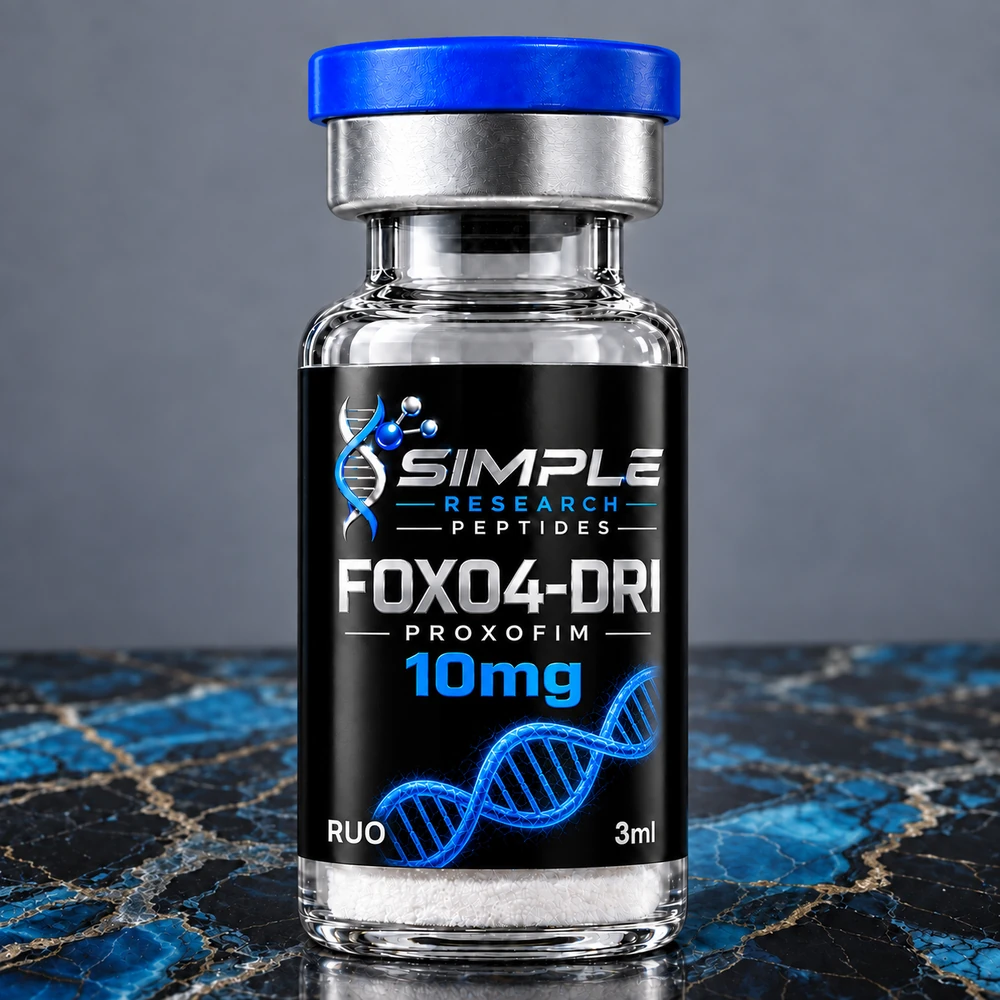
SRP listing nameFOXO4-DRI (10 mg Vial)Longevity Research. Lead: FOXO4/p53 interaction and cellular-senescence studies. Laboratory research use only.
SRP listed strength10 mg VialSKU not printed on the fetched /product/ or /products/ pages. Sequence, CAS, UNII, formula, and a public COA were not printed.
Index evidence tagPreclinical evidenceIndex listing: “FOXO4-DRI (10 mg Vial)” under Longevity. Field: Cellular-senescence research.
Chemical classSynthetic D-retro-inverso peptideAll residues in D-isoform except glycine (achiral); designed as a fusion with an HIV-TAT cell-uptake sequence.
Sequence (Baar 2017)H-ltlrkepaseiaqsileaysqngwanrrsggkrppprrrqrrkkrg-OHLowercase = D-amino acids on that page. 46 amino acids. MW 5358.2 in methods.
PubChem CID (used here)167312269Title: Foxo4-dri. Opened 16 August 2026. Stereo twin CID 168431240 is not a second peptide.
CAS on CID 1673122692460055-10-9 (PubChem synonym)Depositor-supplied synonym and RN. CAS Common Chemistry returned Unauthorized and was unused.
UNIINone foundNCATS Inxight FOXO4-DRI / FOXO4 / PROXOFIM total 0. GSRS FOXO4 total 0. Do not invent one.
Formula / MWC228H388N86O64 / 5358Baar 2017 methods: MW 5358.2. XLogP −34.1. InChIKey WVZCDZFJLXBWHG-XXZPGMBKSA-N.
IUPHAR / GtoPdbNo ligand recordNo FOXO4-DRI or FOXO4 ligand. Target search FOXO4 also returned no targets.
Target protein (not the peptide)P98177 FOXO4_HUMAN505 aa; Forkhead box protein O4 / AFX1; gene FOXO4 (AFX, AFX1, MLLT7). Reviewed Swiss-Prot.
Identifier Value on opened page Source opened
Trade / development names FOXO4-DRI; FOXO4 D-Retro-Inverso; FOXO4 D-Retro Inverso peptide; Foxo4-dri (PubChem title) Baar et al. 2017 PMID 28340339 accepted manuscript; PubChem CID 167312269
Marketplace alias seen in searches, not on opened NCATS/IUPHAR “Proxofim” appears in vendor/encyclopedia snippets. NCATS Inxight search for PROXOFIM returned 0 substances. Not used as an official name. NCATS API, opened 16 August 2026
SRP listing name FOXO4-DRI (10 mg Vial) SRP product page
SRP listed strength / format 10 mg Vial SRP product page
SRP SKU Not printed on the fetched /product/ or /products/ pages SRP product pages
SRP store / research category Longevity Research SRP product page (store taxonomy, not a clinical indication)
SRP index listing “FOXO4-DRI (10 mg Vial)”; Longevity; “Evidence profile”; evidence tag Preclinical evidence; field Cellular-senescence research SRP compound-research-guides index
Chemical class Synthetic D-retro-inverso peptide; all residues in D-isoform except glycine (achiral); designed as a fusion with an HIV-TAT cell-uptake sequence Baar 2017 methods (“D-Isoform”; “fusion with HIV-TAT”); PubChem biologic description (D-residues + Gly)
Sequence (as printed in the 2017 paper) H-ltlrkepaseiaqsileaysqngwanrrsggkrppprrrqrrkkrg-OH (lowercase = D-amino acids on that page) Baar 2017, section “FOXO4 D-Retro-Inverso peptide development”
Sequence (PubChem biologic description) One-letter LTLRKEPASEIAQSILEAYSQNGWANRRSGGKRPPPRRRQRRKKRG; IUPAC condensed H-D-Leu-D-Thr-D-Leu-D-Arg-D-Lys-D-Glu-D-Pro-D-Ala-D-Ser-D-Glu-D-Ile-D-Ala-D-Gln-D-Ser-D-Ile-D-Leu-D-Glu-D-Ala-D-Tyr-D-Ser-D-Gln-D-Asn-Gly-D-Trp-D-Ala-D-Asn-D-Arg-D-Arg-D-Ser-Gly-Gly-D-Lys-D-Arg-D-Pro-D-Pro-D-Pro-D-Arg-D-Arg-D-Arg-D-Gln-D-Arg-D-Arg-D-Lys-D-Lys-D-Arg-Gly-OH PubChem PUG View, CID 167312269, Biologic Description
Residue count on those printed strings 46 amino acids Counted from the opened Baar / PubChem strings
PubChem CID (used here) 167312269. Title: Foxo4-dri PubChem PUG REST name FOXO4-DRI and FOXO4 DRI; PUG View; opened 16 August 2026
Same-formula stereo twin CID 168431240. Same formula and MW; different InChIKey (WVZCDZFJLXBWHG-QLCXAPFOSA-N). Synonyms on that CID also include FOXO4-DRI and 2460055-10-9. Do not treat as a second peptide. PubChem PUG REST / synonyms
CAS on CID 167312269 2460055-10-9 appears as a depositor-supplied synonym and as RN. PubChem “Other Identifiers” heading on the opened Names-and-Identifiers view listed Wikipedia, not a separate CAS table. CAS Common Chemistry for this RN returned Unauthorized and was unused. PubChem PUG View / synonyms / xrefs
Deprecated / extra catalog codes on CID 167312269 RegistryID list includes BAT-006150, BM37385, HB00103, Molport-051-903-810, and others. PubChem marks BAT-006150 and “FOXO 4-DRI” as Removed Synonyms. Do not collapse vendor catalog codes into independent identities. PubChem PUG xrefs / PUG View
UNII None found. NCATS Inxight root_names_name:"FOXO4-DRI" total 0; same for “FOXO4” and “PROXOFIM”. GSRS search FOXO4 total 0. GSRS FOXO4-DRI returned an unrelated maltodextrin hit (CAS 8006-91-5 / 9050-36-6) and was unused. NCATS / GSRS APIs, opened 16 August 2026
Molecular formula / MW PubChem: C228H388N86O64; MW 5358. Baar 2017 methods: MW: 5358.2. XLogP −34.1 PubChem PUG property; Baar 2017
InChIKey (CID 167312269) WVZCDZFJLXBWHG-XXZPGMBKSA-N PubChem PUG REST / PUG View
IUPHAR / GtoPdb ligand No ligand record for FOXO4-DRI or FOXO4. Target search FOXO4 also returned no targets. IUPHAR services API, opened 16 August 2026
ClinicalTrials.gov (FOXO4-DRI / FOXO4 DRI / senolytic FOXO / proxofim / query.intr=FOXO4-DRI) 0 studies CT.gov API v2, opened 16 August 2026
ClinicalTrials.gov query FOXO4 1 adjacent study, NCT07494565 (celecoxib plus R-CHOP in CD5+ DLBCL). The record mentions FOXO3a/FOXO4 as protein biomarkers, not the DRI peptide. Unused as FOXO4-DRI evidence. Not a FOXO4-DRI trial. CT.gov API v2
openFDA Drugs@FDA No FOXO4-DRI match (NOT_FOUND) openFDA API, opened 16 August 2026
FDA-approved product None on the opened NCATS / openFDA / IUPHAR pages NCATS 0; openFDA NOT_FOUND; IUPHAR no ligand
Target protein (not the peptide) Human FOXO4 / Forkhead box protein O4 / AFX1; UniProt P98177; 505 aa; gene FOXO4 (AFX, AFX1, MLLT7); reviewed Swiss-Prot UniProt REST P98177, opened 16 August 2026

What the molecule actually is. Baar et al. 2017 (PMID 28340339; DOI 10.1016/j.cell.2017.02.031; PMC 5556182) designed a FOXO4 peptide in D-retro-inverso conformation “henceforth named FOXO4-DRI.” The opened accepted manuscript prints: “FOXO4-DRI consists of the following amino acid sequence in D-Isoform: H-ltlrkepaseiaqsileaysqngwanrrsggkrppprrrqrrkkrg-OH. MW: 5358.2.” It was manufactured by Pepscan (Lelystad) at >95% purity for that study. The same paper states that the peptide was designed as a fusion with HIV-TAT to allow cellular uptake, and that the same peptide in L-isoform (FOXO4-L) did not reduce senescent-cell viability. PubChem CID 167312269 encodes the matching 46-residue D-peptide (glycines achiral) as H-D-Leu-…-Gly-OH with formula C228H388N86O64. A research vial labeled “FOXO4-DRI” is not chemically identified until that D-retro-inverso sequence is confirmed analytically. Molecular weight alone cannot distinguish D-DRI from an L-peptide of the same residue string.

Registry chaos that must not be collapsed.

  • CID 167312269 (InChIKey WVZCDZFJLXBWHG-XXZPGMBKSA-N) is the record used here. CID 168431240 is a same-formula twin with a different stereo InChIKey (WVZCDZFJLXBWHG-QLCXAPFOSA-N). Do not treat it as a second drug.
  • CAS 2460055-10-9 is a PubChem synonym/RN. CAS Common Chemistry was not successfully opened. Do not invent a second CAS.
  • No UNII was found on opened NCATS or GSRS pages. Do not invent one.
  • UniProt P98177 is the 505-residue human FOXO4 transcription factor, not the 46-residue DRI peptide. Gene-level FOXO4 biology is not peptide pharmacology.
  • “Proxofim,” TFA-salt synonyms, and vendor catalog codes (BAT-006150 and others) are not SRP-verified identities.
  • ChEMBL / INN / approval-year fields were not present on the opened PubChem Names-and-Identifiers view for CID 167312269.
  • Other DRI peptides that have entered human trials (cited by Baar as chemistry precedent: Beydoun 2015, Deloche 2014, Suckfuell 2014, Warso 2013) are not FOXO4-DRI. Those papers were not opened as FOXO4-DRI evidence.

Not printed on SRP pages and therefore not claimed as SRP-verified: sequence, CAS, UNII, formula, D- vs L-stereochemistry, TAT fusion status, purity numbers, or a public COA. SRP itself is a research-material listing, not a Baar-lab or clinical lot.

Critical identity point: FOXO4-DRI on opened registries is the 46-residue D-retro-inverso peptide H-ltlrkepaseiaqsileaysqngwanrrsggkrppprrrqrrkkrg-OH (CID 167312269; C228H388N86O64; MW 5358 / 5358.2; InChIKey WVZCDZFJLXBWHG-XXZPGMBKSA-N). CAS 2460055-10-9 is a PubChem synonym only. No UNII. CID 168431240 is a stereo twin, not a second peptide. UniProt P98177 is the target protein, not the peptide. No sequence is printed on the SRP page. Not FDA-approved. Research use only.
02 / Overview

How it is not native FOXO4, other FOXOs, D+Q, navitoclax, or an approved senolytic

This page is FOXO4-DRI only. Marketplace “senolytic peptide” or “longevity peptide” language is a catalog nickname, not a receptor assignment and not an approval. FOXO4-DRI is a 46-residue synthetic D-retro-inverso peptide. It is not the 505-aa transcription factor, not a flavonoid, and not a BCL-2 small molecule.

Identity What opened sources actually describe Peptide? Typical literature role
Native FOXO4 (target protein) UniProt P98177, FOXO4_HUMAN, 505 aa; Forkhead box protein O4 / AFX1; DNA-binding fork-head domain ~100–188; transcription factor in insulin signaling, cell-cycle, and oxidative-stress literature Yes (endogenous protein) The target, not the research vial. Not FOXO4-DRI.
FOXO1 UniProt Q12778, FOXO1_HUMAN, 655 aa Endogenous protein Related forkhead factor. Baar chose a FOXO4 region that “differs from FOXO1 and FOXO3.” Not this peptide.
FOXO3 / FOXO3a UniProt O43524, FOXO3_HUMAN, 673 aa. NCT07494565 lists FOXO3a/FOXO4 as lymphoma biomarkers (adjacent unused; not a FOXO4-DRI trial). Endogenous protein Related forkhead factor. Not FOXO4-DRI.
Dasatinib IUPHAR ligand 5678; synthetic organic; INN dasatinib; FDA & EMA 2006; WHO Essential Medicine; CAS 302962-49-8; PubChem CID 3062316; Sprycel® No (small-molecule kinase inhibitor) Approved BCR-ABL / kinase drug. Combined with quercetin as a different senolytic class (Zhu 2015). Not FOXO4-DRI.
Quercetin IUPHAR ligand 5346; natural product; not approved on the opened IUPHAR record No (flavonol) Component of D+Q. Not FOXO4-DRI.
Fisetin IUPHAR ligand 5182; natural product; not approved on the opened IUPHAR record No (flavonol) Separate senolytic literature and several opened CT.gov studies. Not FOXO4-DRI.
Navitoclax / ABT-263 IUPHAR ligand 8319; synthetic organic; INN navitoclax; approved: false on the opened IUPHAR page; synonyms ABT-263; CAS 923564-51-6; PubChem CID 24978538 No (BCL-2/BCL-xL inhibitor) Senolytic small molecule (Chang 2015). Baar notes thrombocytopenia as a class limitation of pan-BCL inhibitors. Not FOXO4-DRI.
ABT-737 Named in Baar 2017 as a pan-BCL comparator that showed some senescent-IMR90 selectivity but also affected control cells at low doses No Different mechanism (BCL-2/W/XL). Not FOXO4-DRI.
FOXO4-L (L-isoform of the same residue string) Baar Fig. 3C–D: the same peptide in L-isoform did not affect senescent-cell viability at the tested 6.25 / 12.5 / 25 μM points Yes (L-peptide) Negative-control chemistry in the defining paper. Not interchangeable with DRI.
FOXM1-DRI Unrelated DRI peptide used as a negative control in Baar Fig. 3D Yes (different DRI) Control. Not FOXO4-DRI.
ES2 and other designed FOXO4–TP53 peptides Le et al. 2021 (PMID 34689087): rationally designed peptides, including ES2, intended to disrupt FOXO4–TP53. Not the Baar sequence. Yes (different peptides) Follow-on design paper. Not the SRP listing.
Gene-therapy / constitutively active FOXO constructs UniProt P98177 pharmaceutical note discusses a constitutively active FOXO4 mutant (Thr-32 / Ser-197 / Ser-262 → Ala) in HER2 models. That is a protein mutant, not a DRI peptide. Protein / genetic Not FOXO4-DRI.
FOXO4-DRI (this page) 46-residue D-retro-inverso peptide; C228H388N86O64; MW ~5358 Yes (synthetic DRI peptide) 2017 Cell design; later cell and mouse follow-ups; no opened human trial

FOXO4-DRI is not native FOXO4

FOXO4 is a 505-residue forkhead transcription factor (P98177). FOXO4-DRI is a short, all-D retro-inverso peptide built around a FOXO4-derived stretch plus a TAT uptake motif. Knocking down FOXO4 and dosing FOXO4-DRI are not the same experiment. Baar itself warns that chronic FOXO4 reduction is not advisable because FOXOs participate in DNA-repair biology and Foxo4−/− mice are susceptible to acute damage, whereas the peptide is intended as a protein–protein interaction competitor.

FOXO4-DRI is not FOXO1 or FOXO3

Those are separate UniProt entries (Q12778, O43524). Baar selected a FOXO4 region conserved in human and mouse but different from FOXO1/FOXO3. A catalog “FOXO peptide” is not chemically identified.

FOXO4-DRI is not dasatinib + quercetin

Zhu et al. 2015 (PMID 25754370) identified dasatinib and quercetin as small-molecule senolytics acting on pro-survival networks (ephrins, PI3Kδ, p21, BCL-xL, PAI-2). Dasatinib is an approved kinase inhibitor (IUPHAR 5678). Baar tested Q/D on senescent IMR90, found no selectivity, and did not explore the cocktail further. D+Q human trials (for example NCT04313634 on the opened senolytic CT.gov page) are adjacent unused and are not FOXO4-DRI trials.

FOXO4-DRI is not navitoclax / ABT-263 or ABT-737

Those are BCL-2-family small molecules. Chang et al. 2015 (PMID 26657143) identified ABT263 as a senolytic that depletes senescent cells in irradiated or aged mice. IUPHAR 8319 lists navitoclax as not approved. Baar compared ABT-737 with FOXO4-DRI on IMR90 and doxorubicin-senescent cells and separately noted thrombocytopenia as a limitation of pan-BCL senolytics; FOXO4-DRI did not noticeably change platelet counts in the opened mouse experiments. That is a mouse safety observation, not a human hematology claim.

FOXO4-DRI is not fisetin. Fisetin is IUPHAR 5182. Opened CT.gov senolytic hits (NCT05025956, NCT06133634, NCT06399809, NCT04313634) are fisetin or D+Q studies. None is FOXO4-DRI. Those IDs are adjacent unused and must not be presented as FOXO4-DRI trials.

FOXO4-DRI is not an FDA-approved senolytic. No opened NCATS, openFDA, or IUPHAR page lists an approved FOXO4-DRI product. There is no opened ClinicalTrials.gov study of FOXO4-DRI. Mouse restoration of fur, running, or plasma urea is not a human indication.

Do not equate FOXO4-DRI with native FOXO4, FOXO1/3, D+Q, fisetin, navitoclax, ES2, or an approved senolytic. FOXO4-DRI is the 46-residue D-retro-inverso peptide (CID 167312269; C228H388N86O64; MW 5358). P98177 is the 505-aa target protein. Dasatinib is IUPHAR 5678 (approved 2006). Navitoclax is IUPHAR 8319 (not approved on that page). ES2 is a different designed peptide (PMID 34689087). Not FDA-approved. Research use only.
03 / Mechanism

Proposed mechanism (FOXO4–p53 disruption → senescent-cell apoptosis)

Opened primary papers support a working laboratory model. It is not a treatment claim. Observed means a measurement in an opened cell, NMR, or mouse paper. Proposed means a hypothesis or in-vivo story. Class / adjacent means distinction biology (D+Q, navitoclax, ES2). Not shown means the opened papers did not establish it. L-isoform was inactive; DRI was active; cell-type dependence is documented (Huang 2021).

Observed — FOXO4 protein, not yet the peptide

FOXO4 as a viability pivot in senescent cells

Unbiased RNA-seq of ionizing-radiation–senescent primary human IMR90 fibroblasts showed upregulation of pro-apoptotic initiators PUMA and BIM and reduced BCL-2, suggesting senescent IMR90 are primed for apoptosis but restrained. FOXO4 mRNA and protein rose after senescence-inducing IR, unlike milder changes in FOXO1/3. Lentiviral FOXO4 shRNA released mitochondrial cytochrome c, produced BAX/BAK-dependent caspase-3 cleavage, and reduced viability of already-senescent cells but not controls. That is FOXO4-protein interference, not yet the peptide. (PMID 28340339.)

Observed — peptide design

D-retro-inverso + TAT; NMR competition

Baar selected a FOXO4 region conserved in humans and mice but different from FOXO1/FOXO3, then recast it as a D-retro-inverso peptide (citing Guichard 1994 and Borsello 2003 as chemistry precedent — those citations were not independently opened). FOXO4-DRI was fused to HIV-TAT for uptake. An anti-TAT antibody detected uptake by 2–4 h and signal for at least 72 h. NMR: titration of recombinant p53 (aa 1–312) into 15N-labelled FOXO4 forkhead (printed as aa 486–206 in the accepted manuscript; residue numbering is as printed and is not reinterpreted here) produced chemical-shift perturbations; stepwise addition of FOXO4-DRI reverted FOXO4 toward the unbound state, “indicating FOXO4-DRI competes with FOXO4 for p53 binding in a dose-dependent manner and doing so with higher affinity.”

Observed — senescent IMR90; L inactive

DRI active; L-isoform and FOXM1-DRI inactive

After uptake, FOXO4-DRI reduced senescence-induced FOXO4 foci, PML bodies, and 53BP1 DNA-SCARS without changing small 53BP1 foci. The paper reports p53 nuclear exclusion and cell-intrinsic apoptosis in senescent cells; caspase-3/7 dye imaging showed activation in senescent but not control cells. Pan-caspase inhibitors QVD-OPH or Z-VAD-FMK reduced the effect; p53 knockdown reduced targeting of senescent IMR90. Real-time density loss began about 24–36 h. FOXO4-L and FOXM1-DRI did not reduce senescent-cell viability at the tested concentrations (6.25, 12.5, 25 μM). Those micromolar figures are historical in-vitro assay concentrations, not vial instructions.

Observed — comparators in Baar

Q/D not selective; ABT-737 less selective

Quercetin/dasatinib showed no selectivity toward senescent IMR90 in their hands. ABT-737 showed some selectivity but also affected control cells at low doses. FOXO4-DRI, in consecutive lower-concentration rounds, was described as selective against senescent IMR90 and “safe to normal cells” in that assay. The discussion states that a more thorough analysis is required and that, “at least as far as tested here,” FOXO4-DRI “appears to be well tolerated.” That is the authors’ mouse/cell language, not a human safety package.

Observed — 2025 NMR refinement

Disordered FOXO4-DRI binds p53 TAD2

Bourgeois et al. 2025 (PMID 40593617; full PDF opened) report solution NMR models of the p53 transactivation domain in complex with the FOXO4 forkhead domain and with FOXO4-DRI. They find that disordered FOXO4-DRI binds disordered p53 TAD2 and forms a transiently folded complex in which both the FOXO4-derived region and the cationic cell-permeability peptide contribute. p53 phosphorylation enhanced affinity for both FOXO4 and FOXO4-DRI. The authors frame this as a basis for developing p53-interaction inhibitors. That is a biophysical follow-up, not clinical efficacy.

Proposed — mouse observations, not human therapy

Compete FOXO4–p53 → apoptosis of high-SASP cells

Baar reports that, under conditions where the peptide was “well tolerated in vivo,” FOXO4-DRI neutralized doxorubicin-induced chemotoxicity and restored fitness, fur density, and renal function in fast-aging XpdTTD/TTD and naturally aged mice. The proposed chain is: compete FOXO4–p53 → exclude active p53 from the nucleus → mitochondrial / caspase-dependent apoptosis of high-SASP senescent cells → lower senescent-cell burden → improved tissue readouts. The paper itself says phenotypical/behavioral results are “difficult to connect to a molecular mechanism” and therefore focused on kidney urea/creatinine as a more objective tissue function.

Baar et al. define FOXO4-DRI

Sequence H-ltlrkepaseiaqsileaysqngwanrrsggkrppprrrqrrkkrg-OH in D-Isoform; MW 5358.2; Pepscan; TAT fusion; L-isoform inactive at 6.25–25 μM; NMR competition vs p53; IMR90 apoptosis; mouse doxorubicin / TTD / natural-aging. PMID 28340339. PMC 5556182.

Krimpenfort & Berns restate the all-D peptide

Secondary commentary. “All-D amino acid peptide (FOXO4-DRI)” restates Baar. PMID 28340347.

Zhang et al.: senescent Leydig cells

FOXO4-DRI as FOXO4–p53 blocker in H2O2-TM3 cells; improved testicular microenvironment in aged mice. Mouse. Not a human testosterone drug. PMID 31959736.

Huang et al.: PDL9 cleared; chondrogenesis not enhanced

Removed more than half of PDL9 cells; PDL3 not significantly affected; did not enhance chondrogenic potential. In-vitro human cells, not a clinical ACI trial. PMID 33996787.

Han et al.: mouse pulmonary-fibrosis model

Decreased senescent cells and SASP; attenuated BLM morphology and collagen. Author “therapeutic option” sentence is interpretation, not an approval. PMID 35510614. Correction PMID 39166551 unused as new numbers.

Li et al.: aged-mouse sperm quality

Apoptosis in senescent Leydig cells; improved GC-1 SPG coculture; increased sperm quality in aged mice. Mouse / cell. Not a fertility drug. PMID 39025385.

Kong et al.: keloid senescent fibroblasts

FOXO4-DRI promoted apoptosis and p53-pS15 nuclear exclusion in keloid models. Human tissue explant / cell work. Not a keloid drug trial. PMID 39994346.

Bourgeois et al.: CPP contributes to binding

Disordered FOXO4-DRI binds disordered p53 TAD2; FOXO4-derived region and cationic CPP both contribute. Biophysics. Not a human trial. PMID 40593617.

Observed on opened pages: DRI stereochemistry required for the IMR90 viability effect; NMR competition with FOXO4–p53; TAT-dependent design; caspase- and p53-dependence in IMR90; mouse doxorubicin, TTD, and natural-aging readouts; later Leydig-cell, chondrocyte, keloid-fibroblast, and NMR papers.

Proposed / not shown on an opened page: human pharmacokinetics of any research-market vial; human senolytic selectivity; human efficacy or long-term safety; FDA approval; proof that an SRP 10 mg vial is the Baar D-isoform plus TAT sequence; a cloned “FOXO4-DRI receptor”; interchangeability with D+Q, fisetin, or navitoclax; gene-therapy FOXO effects.

Mechanism in one line: a D-retro-inverso peptide designed to compete FOXO4–p53, active where the L-isoform was inactive on senescent IMR90, with later NMR showing p53 TAD2 binding and cell-type dependence in chondrocytes. Not a treatment claim. Not for human use. Historical 6.25–25 μM and 5 mg/kg figures are study conditions, not instructions.
04 / Research Map

Where the literature actually sits

Label every row. FOXO4-DRI ≠ native FOXO4 ≠ FOXO1/3 ≠ D+Q ≠ fisetin ≠ navitoclax ≠ ES2. Mouse and cell papers are listed as what they are — preclinical — not as a completed therapeutic program. Historical mg/kg and μM figures are facts from opened papers, not reconstitution or dosing instructions for an SRP vial, and they are not claims that research-grade material works in people.

A. Design / chemistry / in vitro — defines the name

Baar 2017 + Bourgeois 2025 NMR

Baar et al., 2017, Cell 169:132–147.e16. PMID 28340339, DOI 10.1016/j.cell.2017.02.031, PMC 5556182. Opened Europe PMC abstract + accepted-manuscript PDF. Defines the name, sequence, and DRI requirement. FOXO4-DRI competes FOXO4–p53 by NMR, enters cells (TAT), and induces caspase-3/7 apoptosis in senescent but not control IMR90. L-isoform and FOXM1-DRI inactive at 6.25–25 μM. Q/D not selective on IMR90 here. Bourgeois et al., 2025, PMID 40593617: disordered FOXO4-DRI binds p53 TAD2; CPP contributes. Cell / NMR. Not human. Not an SRP-vial COA.

B. Mouse / preclinical in vivo

Baar doxorubicin, TTD, natural aging; later Leydig / PF

Baar 2017: doxorubicin 2× i.p. 10 mg/kg then FOXO4-DRI 3× i.v. 5 mg/kg every other day; XpdTTD/TTD fur, running, urea; naturally aged 3× 5 mg/kg i.p. Zhang 2020 PMID 31959736 testosterone-secretion insufficiency in aged mice. Li 2024 PMID 39025385 sperm quality / spermatogenesis in aged mice. Han 2022 PMID 35510614 bleomycin PF in mice. Historical mouse exposure. Not human therapy.

C. Human (FOXO4-DRI as the intervention) — none

Zero FOXO4-DRI trials

ClinicalTrials.gov API v2 returned zero studies for FOXO4-DRI, FOXO4 DRI, senolytic FOXO, proxofim, and query.intr=FOXO4-DRI. openFDA Drugs@FDA returned NOT_FOUND. NCATS Inxight had no FOXO4-DRI substance. IUPHAR had no ligand. Opened work that used human cells or human tissue (IMR90, expanded chondrocytes, keloid fibroblasts/organ cultures, human Leydig-cell expression staining in Zhang 2020) is ex vivo / in vitro. It is not a ClinicalTrials.gov efficacy program. Do not invent NCTs. Do not treat D+Q or fisetin registrations as FOXO4-DRI trials.

D. Regulatory — 0 studies, not FDA-approved

No NCATS substance; no openFDA hit

NCATS Inxight searches FOXO4-DRI / FOXO4 / PROXOFIM each returned total 0. openFDA: NOT_FOUND. IUPHAR: no ligand. CAS Common Chemistry 2460055-10-9 returned Unauthorized and was unused. Not FDA-approved.

E. Distinctions — not this peptide

D+Q, navitoclax, ES2, unused commentary

Zhu 2015 PMID 25754370 D+Q. Chang 2015 PMID 26657143 ABT263. Le 2021 PMID 34689087 ES2 / designed peptides. Krimpenfort PMID 28340347 preview. Unused as findings (no abstract): Serrano PMID 28489828, Allison PMID 28392563. Han correction PMID 39166551 unused as new numbers. Adjacent unused CT.gov IDs (not FOXO4-DRI trials): NCT07494565 (FOXO4 protein biomarker in DLBCL); NCT05025956, NCT06133634, NCT06399809, NCT04313634, NCT06280560 (fisetin / D+Q / other senolytic protocols).

Vendor identity — not independently verified

SRP 10 mg vial prints no sequence

Opened SRP page: FOXO4-DRI (10 mg Vial); Longevity Research; research use only. Sequence, CAS, UNII, molecular formula, SKU, and a public COA were not printed. Index tag: Preclinical evidence. Research-quality note on the index: sequence stereochemistry is critical; D-retro-inverso cannot be inferred from MW alone. Product page.

Baar’s remark that “several DRI-modified peptides have been shown to be well tolerated and therapeutically effective in clinical trials” refers to other DRI peptides (Beydoun / Deloche / Suckfuell / Warso). Those citations were not opened here as FOXO4-DRI human data.

05 / Snapshot

Opened records, read as they actually sit

Read the “what it did not show” column. Published study designs are historical facts from those papers. They are not a protocol. Mouse 5 mg/kg i.v./i.p. figures and 6.25–25 μM cell figures are study conditions, not instructions for an SRP research vial.

A. Design / chemistry / in vitro

Study Species / model What was tested Actual finding (from the opened record) What it did not show
Baar et al., 2017
Cell 169:132–147.e16. PMID 28340339. DOI 10.1016/j.cell.2017.02.031. PMC 5556182. Opened Europe PMC abstract + accepted-manuscript PDF (dusra.nl CELL-D-16-01775_R2).
Primary human IMR90 fibroblasts; IR- or doxorubicin-induced senescence vs proliferating controls; NMR of FOXO4 FH vs p53(1–312) FOXO4 shRNA; then FOXO4-DRI (D-isoform sequence printed above; Pepscan; >95% in that lot) vs FOXO4-L vs FOXM1-DRI; Q/D; ABT-737; p53 KD; QVD-OPH / Z-VAD-FMK Defines the name, sequence, and DRI requirement. FOXO4 rises in senescent IMR90 and maintains viability. FOXO4-DRI competes FOXO4–p53 by NMR, enters cells (TAT), reduces FOXO4/PML/53BP1-SCARS, excludes p53, and induces caspase-3/7 apoptosis in senescent but not control IMR90. L-isoform and FOXM1-DRI inactive at 6.25–25 μM. Q/D not selective on IMR90 here. Cell / NMR. Not human. Not an SRP-vial COA. Human data. Proof that an SRP 10 mg vial is the Baar D-isoform plus TAT sequence. A UNII. FDA approval. A human senolytic label.
Bourgeois et al., 2025
Nat Commun 16:5672. PMID 40593617. DOI 10.1038/s41467-025-60844-9. PMC 12216184. Opened abstract + full PDF.
Solution NMR of p53 TAD with FOXO4 forkhead and with FOXO4-DRI Structural models of the complexes Disordered FOXO4-DRI binds disordered p53 TAD2 in a transiently folded complex; FOXO4-derived region and the cationic CPP both contribute; p53 phosphorylation enhances affinity for FOXO4 and FOXO4-DRI. Authors discuss p53-inhibitor development. Biophysics. Not a human trial. Human trial. SRP-vial identity. The printed one-letter string from Baar was not re-printed as ltlrkep in this PDF.
Huang, He, Makarcyzk, Lin, 2021
Front Bioeng Biotechnol 9:677576. PMID 33996787. PMC 8116695. Opened abstract.
Human articular chondrocytes expanded to PDL9 (ACI-like) vs PDL3 controls FOXO4-DRI pretreatment, then pellet culture Removed more than half of PDL9 cells; PDL3 numbers not significantly affected; senescence markers fell in treated PDL9. Did not enhance chondrogenic potential in standard pellet culture; treated pellets had lower senescence-relevant secretory-factor expression. Authors: utility for cartilage formation “needs further investigation.” In-vitro human cells, not a clinical ACI trial. A clinical ACI trial. Proof that senolytic clearance equals improved cartilage formation. Human dosing. SRP-vial identity.
Kong et al., 2025
Commun Biol 8:299. PMID 39994346. PMC 11850796. Opened abstract.
Keloid tissue / fibroblasts; organ cultures; scRNA-seq context FOXO4-DRI on pro-senescence keloid models Authors report increased senescent fibroblasts and p53-Ser15 phosphorylation in keloids; FOXO4-DRI promoted apoptosis and decreased G0/G1 cells with p53-pS15 nuclear exclusion. Human tissue explant / cell work. Not a keloid drug trial. A keloid drug trial. An NCT. Equivalence to an SRP vial. Human PK.
Zhang et al., 2020 (in-vitro arm)
Aging (Albany NY) 12:1272–1284. PMID 31959736. PMC 7053614. Opened abstract (in-vitro arm).
H2O2-induced senescent TM3 Leydig cells FOXO4-DRI as FOXO4–p53 blocker Selectively induced p53 nuclear exclusion and apoptosis in senescent Leydig cells. Mouse cell line. See also mouse arm in table B. Human testosterone pharmacology. A late-onset hypogonadism approval. Full-text activity tables (abstract only; publisher PDF unused).

B. Mouse / preclinical in vivo

These rows report what the opened papers claimed in mice. They are not human indications and they are not instructions for an SRP 10 mg vial. Historical 5 mg/kg i.v. or i.p. figures are study conditions.

Study Species / model What was tested Actual finding (from the opened record) What it did not show
Baar 2017, doxorubicin chemotoxicity (Fig. 4) Mice; p16::3MR reporter; doxorubicin 2× i.p. 10 mg/kg; FOXO4-DRI 3× i.v. 5 mg/kg every other day (days 1, 3, 5) FOXO4-DRI vs PBS after doxorubicin Reduced p16-driven luminescence; limited body-weight loss vs PBS; fewer liver FOXO4-foci and IL-6+ cells; reduced doxorubicin-induced plasma AST and urea. Historical mouse exposure. Not a human chemo-protectant label. Human chemoprotection. An NCT. Equivalence to an SRP vial. A reconstitution scheme.
Baar 2017, fast-aging XpdTTD/TTD Young XpdTTD/TTD and XpdTTD/TTD-p16::3MR vs wild-type FOXO4-DRI vs PBS; also i.p. FOXO4-DRI vs GCV semigenetic clearance Reduced p16 luminescence; improved fur score and lower abdominal IR temperature (fur-density proxy); increased stimulus responsiveness; running-wheel distance rose in most treated TTD mice (TTD baseline 1.37 ± 0.54 km/day vs WT 9.37 ± 1.1). Kidney: SA-β-gal / IL-6 / FOXO4 foci; ex-vivo TUNEL in aged slices; plasma urea fell comparably to GCV. Platelets not noticeably changed at 30 d (Fig. 6F). TTD mouse model, not human TTD therapy. Human TTD therapy. Human healthspan. Proof that fur/running maps to a molecular mechanism (the paper itself said those endpoints are difficult to connect).
Baar 2017, naturally aged wild-type Naturally aged (including 110+ wk p16::3MR); running-wheel variation too large for that endpoint FOXO4-DRI 3× 5 mg/kg i.p. every other day vs PBS; GCV 5× 25 mg/kg/day as semigenetic control Reduced p16 RLUC; improved fur and responsiveness; more LMNB1+ kidney cells; less IL-6; lower plasma urea and creatinine; i.p. FOXO4-DRI and GCV reduced urea/creatinine similarly; platelets again not noticeably changed (Fig. 7B). Aged mice. Not human healthspan. Human healthspan. An approved senolytic indication. Research-vial identity.
Zhang et al., 2020
PMID 31959736. Opened abstract.
Naturally aged mice; human Leydig-cell expression context in the same paper FOXO4-DRI Improved testicular microenvironment and alleviated age-related testosterone-secretion insufficiency in aged mice. Authors discuss late-onset hypogonadism. Mouse. Not a human testosterone drug. A human testosterone drug. An NCT. Author “therapeutic potential” is interpretation, not an approval.
Li et al., 2024
Exp Gerontol 195:112522. PMID 39025385. Opened abstract.
Aged mice; senescent Leydig / GC-1 SPG coculture FOXO4-DRI Induced apoptosis in senescent Leydig cells, reduced some SASP, improved proliferation of cocultured GC-1 SPG cells; treated aged mice “exhibited increased sperm quality and improved spermatogenesis.” Mouse / cell. Not a fertility drug. A fertility-drug trial. Human spermatogenesis pharmacology. Full-text numbers (subscription; abstract only).
Han et al., 2022
J Cell Mol Med 26:3269–3280. PMID 35510614. PMC 9170815. Opened abstract. Later correction PMID 39166551 exists on Europe PMC.
Bleomycin-induced pulmonary fibrosis mice; TGF-β myofibroblasts in vitro FOXO4-DRI vs pirfenidone comparison in the abstract’s framing Decreased senescent cells and SASP, attenuated BLM morphological changes and collagen; increased AEC2 and fibroblast percentages and decreased myofibroblasts; preferential killing of TGF-β-induced myofibroblasts in vitro. Authors say it “may be served as a viable therapeutic option for PF.” That sentence is author interpretation, not an approval. Mouse PF model. Not a human IPF trial. A human IPF trial. An NCT. New efficacy numbers from the correction notice (unused as findings).

C. Human (FOXO4-DRI as the intervention)

None opened. ClinicalTrials.gov API v2 returned zero studies for FOXO4-DRI, FOXO4 DRI, senolytic FOXO, proxofim, and query.intr=FOXO4-DRI. openFDA Drugs@FDA returned NOT_FOUND. NCATS Inxight had no FOXO4-DRI substance. IUPHAR had no ligand.

Opened work that used human cells or human tissue (IMR90, expanded chondrocytes, keloid fibroblasts/organ cultures, human Leydig-cell expression staining in Zhang 2020) is ex vivo / in vitro. It is not a ClinicalTrials.gov efficacy program and is not evidence that an SRP vial is a human senolytic.

Baar’s remark that “several DRI-modified peptides have been shown to be well tolerated and therapeutically effective in clinical trials” refers to other DRI peptides (Beydoun / Deloche / Suckfuell / Warso). Those citations were not opened here as FOXO4-DRI human data.

Record Why it was opened Why it is not FOXO4-DRI efficacy evidence What it did not show How this page treats it
Zhu et al. 2015, PMID 25754370, D+Q senolytics Baar’s comparator class; IUPHAR distinction Dasatinib + quercetin, different chemistry and targets. Baar found no IMR90 selectivity. That D+Q is FOXO4-DRI. That Baar’s IMR90 non-selectivity is a human D+Q result. Distinction only. Not FOXO4-DRI efficacy.
Chang et al. 2015, PMID 26657143, ABT263 Navitoclax senolytic class BCL-2/BCL-xL small molecule. Not a peptide. That navitoclax is FOXO4-DRI. That mouse HSC clearance is a FOXO4-DRI finding. Distinction only. Not a peptide.
Le et al. 2021, PMID 34689087, ES2 and designed FOXO4–TP53 peptides Same PPI idea, different sequences Authors designed a series of peptides; characterized ES2, not the Baar FOXO4-DRI lot. That ES2 is the SRP listing. That designed peptides validate a research-market vial. Different sequences. Not the Baar lot.
Krimpenfort & Berns 2017, PMID 28340347 Cell preview of Baar Secondary commentary. “All-D amino acid peptide (FOXO4-DRI)” restates Baar. Independent experimental n. New sequence or mouse numbers. Secondary. Bibliographic identity.
Serrano 2017, PMID 28489828 Nature “Tools to eliminate senescent cells” No abstract on the opened Europe PMC page. Unused as findings. Any finding used on this page. Unused as findings.
Allison 2017, PMID 28392563 Nat Rev Nephrol comment No abstract. Unused as findings. Any finding used on this page. Unused as findings.
NCT07494565 Only CT.gov hit for query FOXO4 Celecoxib + R-CHOP in CD5+ DLBCL; FOXO3a/FOXO4 are biomarker proteins. Not FOXO4-DRI. A FOXO4-DRI intervention arm. Adjacent unused. Not a FOXO4-DRI trial.
NCT05025956, NCT06133634, NCT06399809, NCT04313634, NCT06280560 Opened as the first senolytic CT.gov page Fisetin, D+Q, or endometrial-senescence protocols. Adjacent unused. A FOXO4-DRI registration. Adjacent unused. Not FOXO4-DRI trials.
UniProt P98177 pharmaceutical note (constitutively active FOXO4 mutant) Target-protein page Genetic / protein-mutant idea. Not the DRI peptide. That a FOXO4 mutant is FOXO4-DRI. Target protein only.
Han 2022 correction PMID 39166551 Bibliographic honesty Correction notice; not used as new efficacy numbers. New efficacy numbers used here. Unused as findings.
SRP index FOXO4-DRI blurb Cross-check catalog language Not a primary experiment. Sequence, CAS, COA, or D-stereochemistry. Catalog language only.
CAS Common Chemistry 2460055-10-9 Attempted CAS verification Unauthorized / unused. An independent CAS confirmation. CAS taken only as PubChem synonym/RN.
GSRS hit on query FOXO4-DRI (maltodextrin) Negative-control search False-positive. Unused. A FOXO4-DRI UNII. Unused.

No ClinicalTrials.gov studies of FOXO4-DRI. Do not invent NCTs. Do not treat D+Q or fisetin registrations as FOXO4-DRI trials. Adjacent unused IDs that appeared on opened CT.gov pages are listed above only so they are not silently recycled as peptide evidence.

06 / Not established

Gaps in the opened record

These are gaps in the opened record. Treating any of them as settled is incorrect. Highlight: 0 NCT; no FDA approval; stereochemistry not optional; SRP-vial identity not shown; selectivity is cell-type dependent.

  • No FDA-approved therapeutic use of FOXO4-DRI. NCATS Inxight: no substance record. openFDA: no Drugs@FDA hit. IUPHAR: no ligand. “Senolytic” is a literature class, not an approval. Not FDA-approved.
  • No ClinicalTrials.gov study of FOXO4-DRI. Human PK, selectivity, efficacy, and long-term safety of FOXO4-DRI are not established.
  • Mouse senolytic findings ≠ human therapy. Baar’s doxorubicin, XpdTTD/TTD, and naturally aged-mouse readouts (fur, running, plasma urea/creatinine, liver AST) are preclinical. Zhang 2020 / Li 2024 testosterone and spermatogenesis data are mouse. Han 2022 is bleomycin PF in mice.
  • Stereochemistry is not optional. Baar: L-isoform inactive on senescent IMR90. PubChem encodes D-residues. A same-MW L-peptide or a mis-synthesized retro sequence would not be the 2017 material. D-retro-inverso cannot be inferred from molecular weight alone.
  • SRP-vial identity is not shown. The product page does not print sequence, CAS, UNII, TAT status, or a public COA. Pepscan >95% in 2017 is a study-lot statement, not an SRP certificate.
  • Selectivity is cell-type dependent on the opened record. Huang 2021: FOXO4-DRI cleared many PDL9 chondrocytes but did not improve chondrogenesis. Baar already preferred high-SASP subpopulations and said SASP heterogeneity is unclear. Index language that “senolytic effects may vary by cell type” matches the opened papers.
  • FOXO4-DRI is not whole-FOXO4 inhibition. Baar: Foxo4−/− mice are damage-sensitive; the peptide is a PPI competitor and did not sensitize healthy cells to acute doxorubicin in Fig. 4G. Do not treat FOXO4 genetics as peptide toxicology.
  • D+Q, fisetin, navitoclax, ES2, and FOXO gene-therapy findings are not FOXO4-DRI findings.
  • No opened chronic toxicology, carcinogenicity, reproductive-tox, or human ADME package for FOXO4-DRI.
  • No opened human dose, bioavailability, or vial-to-tissue exposure study that applies to an SRP 10 mg vial. Historical 5 mg/kg i.v./i.p. mouse figures and 6.25–25 μM cell figures are not instructions.
  • IUPHAR does not list a FOXO4-DRI ligand. There is no Ki table to cite.
  • UNII / INN / official USAN name were not found on opened NCATS/GSRS pages.
Popular claim Status after this review
“FOXO4-DRI is the FOXO4 protein / a FOXO4 gene therapy” False identity. P98177 is a 505-aa transcription factor. The vial name refers to a 46-residue DRI peptide.
“It is FOXO1 or FOXO3” False. Separate UniProt entries; Baar designed away from those paralogs.
“It is dasatinib + quercetin / fisetin / a flavonoid senolytic” False. Different chemical classes. Opened senolytic NCTs are D+Q or fisetin (adjacent unused; not FOXO4-DRI trials).
“It is navitoclax / ABT-263 / an approved BCL inhibitor” False. Navitoclax is IUPHAR 8319, not approved on that page. Different target class.
“Human trials proved it is an anti-aging drug” Unsupported. 0 FOXO4-DRI NCTs; no opened human intervention study.
“Mouse fur / kidney / testosterone results mean it works in people” Not established. Preclinical readouts only.
“Any 5358 Da FOXO4 peptide is FOXO4-DRI” False. L-isoform was inactive in Baar. Stereochemistry is required.
“It is FDA-approved” False on opened NCATS / openFDA / IUPHAR. Not FDA-approved.
Research vial = 2017 Pepscan study lot Not established. No sequence/CAS/public COA on the SRP page.
“Other DRI drugs in Phase I/IIb prove FOXO4-DRI is clinically validated” False. Those are different peptides cited as chemistry precedent.

0 NCT

ClinicalTrials.gov API v2 returned an empty studies array for FOXO4-DRI, FOXO4 DRI, senolytic FOXO, proxofim, and query.intr=FOXO4-DRI. Adjacent unused IDs are not FOXO4-DRI trials. Do not invent one.

Stereochemistry required

Baar: the L-isoform did not kill senescent IMR90. D-retro-inverso is a specific backbone/residue inversion, not a mass. A COA that only lists “MW ~5358” does not prove DRI configuration. CID 168431240 is a stereo twin, not a second peptide.

No UNII; not FDA-approved

NCATS Inxight and GSRS searches found no FOXO4-DRI UNII. openFDA returned NOT_FOUND. IUPHAR has no ligand. Not FDA-approved.

Cell-type dependence; SRP identity unknown

Huang 2021: senescent chondrocytes were reduced, cartilage-forming potency was not improved. SRP prints no sequence and no public COA. Confirm D-retro-inverso sequence before treating a vial as Baar material.

Do not claim FDA approval. Do not claim a human FOXO4-DRI trial. Do not claim that an SRP 10 mg vial is proven D-retro-inverso stereochemistry. Do not equate FOXO4-DRI with native FOXO4, D+Q, fisetin, navitoclax, or ES2. Research use only. Not for human use.
07 / Studies

Key papers as short cards

Each card is a single opened record. Historical 5 mg/kg mouse and 6.25–25 μM cell figures are study conditions, not instructions. No NCT is attached as a FOXO4-DRI trial because ClinicalTrials.gov returned 0 studies for FOXO4-DRI.

Defines FOXO4-DRI Accepted-manuscript PDF

Baar, Brandt, Putavet, et al., 2017 — Cell

Targeted apoptosis of senescent cells restores tissue homeostasis in response to chemotoxicity and aging. Defines the name, the D-isoform sequence H-ltlrkepaseiaqsileaysqngwanrrsggkrppprrrqrrkkrg-OH, MW 5358.2, Pepscan >95% study lot, HIV-TAT fusion, NMR competition vs p53(1–312), L-isoform and FOXM1-DRI inactive at 6.25 / 12.5 / 25 μM, Q/D not selective on IMR90, caspase-3/7 and p53 dependence, doxorubicin 2× i.p. 10 mg/kg then FOXO4-DRI 3× i.v. 5 mg/kg d1/3/5, XpdTTD/TTD fur / temperature / running / urea, naturally aged 3× 5 mg/kg i.p., platelets not noticeably changed. Cell / mouse. Not human. Not an SRP-vial COA. PMID 28340339. DOI 10.1016/j.cell.2017.02.031. PMC 5556182.

NMR of p53 TAD2 Full PDF

Bourgeois, Spreitzer, Platero-Rochart, et al., 2025 — Nat Commun

The disordered p53 transactivation domain is the target of FOXO4 and the senolytic compound FOXO4-DRI. Solution NMR models of p53 TAD with FOXO4 forkhead and with FOXO4-DRI. Disordered FOXO4-DRI binds disordered p53 TAD2 in a transiently folded complex; FOXO4-derived region and cationic CPP both contribute; p53 phosphorylation enhances affinity. Authors discuss p53-inhibitor development. Biophysics. Not a human trial. PMID 40593617. DOI 10.1038/s41467-025-60844-9. PMC 12216184.

Leydig / aged mice Abstract only

Zhang, Xie, Chen, et al., 2020 — Aging (Albany NY)

FOXO4-DRI alleviates age-related testosterone secretion insufficiency by targeting senescent Leydig cells in aged mice. FOXO4 in human Leydig cells; nuclear translocation in elderly related to decreased testosterone synthesis; H2O2-TM3 model; FOXO4-DRI selectively induced p53 nuclear exclusion and apoptosis in senescent Leydig cells; naturally aged mice: improved testicular microenvironment and age-related testosterone-secretion insufficiency. Author “therapeutic potential … late-onset hypogonadism” treated as author interpretation, not an approval. Mouse. Not a human testosterone drug. Opened abstract; publisher PDF unused. PMID 31959736. DOI 10.18632/aging.102682. PMC 7053614.

Cell-type dependence Chondrogenesis not enhanced

Huang, He, Makarcyzk, Lin, 2021 — Front Bioeng Biotechnol

Senolytic peptide FOXO4-DRI selectively removes senescent cells from in vitro expanded human chondrocytes. PDL9 vs PDL3 human chondrocytes; FOXO4-DRI removed more than half of PDL9 cells, not PDL3; senescence reduced; pellet culture chondrogenesis not enhanced; lower SASP-factor expression in treated pellets. In-vitro human cells, not a clinical ACI trial. Useful negative-control on over-claiming. PMID 33996787. DOI 10.3389/fbioe.2021.677576. PMC 8116695.

Spermatogenesis Abstract only

Li, Zhang, Cheng, et al., 2024 — Exp Gerontol

FOXO4-DRI improves spermatogenesis in aged mice through reducing senescence-associated secretory phenotype secretion from Leydig cells. Senescent Leydig apoptosis; reduced some SASP; GC-1 SPG coculture proliferation; aged mice increased sperm quality / spermatogenesis. Mouse / cell. Not a fertility drug. Publisher full text not opened (subscription). PMID 39025385. DOI 10.1016/j.exger.2024.112522.

Keloid explants Abstract only

Kong, Li, Liu, et al., 2025 — Commun Biol

FOXO4-DRI induces keloid senescent fibroblast apoptosis by promoting nuclear exclusion of upregulated p53-serine 15 phosphorylation. Keloid senescent fibroblasts / p53-pS15; FOXO4-DRI apoptosis and G0/G1 decrease with p53-pS15 nuclear exclusion in organ cultures and fibroblasts. Human tissue explant / cell work. Not a keloid drug trial. PMID 39994346. DOI 10.1038/s42003-025-07738-0. PMC 11850796.

Mouse PF model Abstract only

Han, Yuan, Zhang, et al., 2022 — J Cell Mol Med

FOXO4 peptide targets myofibroblast ameliorates bleomycin-induced pulmonary fibrosis in mice through ECM-receptor interaction pathway. FOXO4-DRI in BLM-PF mice; decreased senescent cells/SASP; attenuated morphology and collagen; AEC2/fibroblast vs myofibroblast shifts; in-vitro preference for TGF-β myofibroblasts. Authors say it may be a viable therapeutic option for PF — author interpretation, not an approval. Mouse PF model. Not a human IPF trial. Correction PMID 39166551 logged, not used for numbers. PMID 35510614. DOI 10.1111/jcmm.17333. PMC 9170815.

Secondary preview

Krimpenfort & Berns, 2017 — Cell

Rejuvenation by therapeutic elimination of senescent cells. Preview of Baar. Abstract restates: all-D peptide FOXO4-DRI restores p53 apoptotic role. Secondary. Does not add independent n. PMID 28340347. DOI 10.1016/j.cell.2017.03.014.

Distinction only D+Q, not this peptide

Zhu, Tchkonia, Pirtskhalava, et al., 2015 — Aging Cell

The Achilles’ heel of senescent cells: from transcriptome to senolytic drugs. Dasatinib / quercetin senolytics; mouse healthspan. Different chemistry and targets. Baar found no IMR90 selectivity for Q/D. Not FOXO4-DRI. PMID 25754370. DOI 10.1111/acel.12344. PMC 4531078.

Distinction only Navitoclax / ABT-263

Chang, Wang, Shao, et al., 2016 — Nat Med

Clearance of senescent cells by ABT263 rejuvenates aged hematopoietic stem cells in mice. BCL-2/BCL-xL small molecule. Not a peptide. IUPHAR 8319 lists navitoclax as not approved. Not FOXO4-DRI. PMID 26657143. DOI 10.1038/nm.4010. PMC 4762215.

Distinction only ES2 / designed peptides

Le, Cinaroglu, Manalo, et al., 2021 — EBioMedicine

Molecular modelling of the FOXO4-TP53 interaction to design senolytic peptides for the elimination of senescent cancer cells. Rationally designed FOXO4–TP53 peptides; ES2 characterized. Not the Baar FOXO4-DRI sequence. Not the SRP listing. PMID 34689087. DOI 10.1016/j.ebiom.2021.103646. PMC 8546421.

08 / Lab caution

Research-only caution

FOXO4-DRI is an investigational laboratory research peptide. It is not an FDA-approved drug for human use. This page is educational. It does not provide dosing, reconstitution, administration, or any human-use instructions.

Simple Research Peptides (SRP) materials are for laboratory research only and are not for human or veterinary use, consumption, administration, diagnosis, treatment, or therapeutic application.

Laboratory identity is the first practical issue. Opened papers and PubChem CID 167312269 describe the 46-residue D-retro-inverso peptide H-ltlrkepaseiaqsileaysqngwanrrsggkrppprrrqrrkkrg-OH (one-letter LTLRKEPASEIAQSILEAYSQNGWANRRSGGKRPPPRRRQRRKKRG; IUPAC condensed H-D-Leu-…-Gly-OH; C228H388N86O64; MW 5358 / 5358.2; InChIKey WVZCDZFJLXBWHG-XXZPGMBKSA-N). CAS 2460055-10-9 is a PubChem synonym/RN only. No UNII. CID 168431240 is a same-formula stereo twin, not a second peptide. UniProt P98177 is the 505-aa target protein FOXO4, not the peptide. Baar 2017: the same peptide in L-isoform did not reduce senescent-cell viability. SRP product pages do not print sequence, CAS, UNII, formula, D- vs L-stereochemistry, TAT fusion status, or a public COA. A method written for dasatinib + quercetin, fisetin, navitoclax / ABT-263, ES2, native FOXO4 knockdown, or a gene-therapy FOXO construct is not automatically valid for this DRI peptide.

Confirm the D-retro-inverso sequence before treating a vial as Baar material. Independently sourced research peptides are not established as equivalent to the 2017 Pepscan study lot. Molecular weight alone cannot distinguish D-DRI from an L-peptide of the same residue string. Historical 5 mg/kg i.v./i.p. mouse figures and 6.25–25 μM cell figures are study conditions from those papers. They are not a reconstitution scheme and they are not a use guide for an SRP 10 mg research vial.

Biological inference has the same problem. The opened record is a 2017 Cell design/mouse paper that still defines the field, a 2025 NMR refinement, and a handful of cell/mouse follow-ups (Leydig, chondrocyte, keloid, bleomycin PF) with no registered human FOXO4-DRI trial. Huang 2021 is a useful negative-control on over-claiming: senescent chondrocytes were reduced, cartilage-forming potency was not improved. That is not a completed longevity-drug program and is not evidence for research-market vials.

No reconstitution scheme, no administration route, and no human or veterinary use protocol appears on this page. Research use only. Historical 5 mg/kg mouse and 6.25–25 μM cell figures are study conditions, not instructions. Confirm D-retro-inverso sequence before treating a vial as Baar material. The SRP page does not prove D-stereochemistry.
09 / FAQ

Common questions

Is FOXO4-DRI a real, defined peptide?

In the 2017 Cell paper it is a defined D-isoform sequence, H-ltlrkepaseiaqsileaysqngwanrrsggkrppprrrqrrkkrg-OH, MW 5358.2, designed as a TAT fusion. PubChem CID 167312269 prints the matching D-residue condensed sequence. Whether a given research vial is that stereoisomer is not established without analytical identity testing.

Is it the FOXO4 transcription factor?

No. FOXO4 is UniProt P98177 (505 aa). FOXO4-DRI is a short synthetic DRI peptide intended to compete with FOXO4 for p53.

Is it FOXO1, FOXO3, D+Q, fisetin, or navitoclax?

No. Those are different proteins or small molecules (IUPHAR 5678 / 5346 / 5182 / 8319). Baar found Q/D non-selective on IMR90 and treated BCL inhibitors as a separate class. PMID 25754370 is D+Q distinction. PMID 26657143 is ABT263 distinction.

Has a human trial been registered?

Not on the opened ClinicalTrials.gov queries. Human PK, efficacy, and safety of FOXO4-DRI are not established. Adjacent unused CT.gov IDs (NCT07494565; NCT05025956, NCT06133634, NCT06399809, NCT04313634, NCT06280560) are not FOXO4-DRI trials.

Did the mouse studies use the same material as an SRP vial?

Not shown. Baar used Pepscan material, PBS stocks (2 mM in vitro; 5 mg/ml in vivo), and 5 mg/kg i.v. or i.p. on a three-dose every-other-day schedule in the printed figure legends. SRP does not print sequence, CAS, or a public COA. Those mouse numbers are historical, not instructions.

Why does stereochemistry matter?

Baar: the L-isoform did not kill senescent IMR90. D-retro-inverso is a specific backbone/residue inversion, not a mass. A COA that only lists “MW ~5358” does not prove DRI configuration. CID 168431240 is a stereo twin with a different InChIKey and must not be collapsed into CID 167312269.

Is there a UNII or INN?

Not on any opened NCATS, GSRS, or IUPHAR page. Do not invent one. “Proxofim” was not found as an NCATS substance.

Can SRP vials be used as a human dose substitute?

No. SRP listings are for laboratory research only and are not for human or animal use. This page does not provide reconstitution, administration, or dosing instructions.

Is the evidence mixed?

The opened record is preclinical and incomplete: a 2017 Cell design/mouse paper that still defines the field, a 2025 NMR refinement, and a handful of cell/mouse follow-ups (Leydig, chondrocyte, keloid, bleomycin PF) with no registered human FOXO4-DRI trial. Huang 2021 is a useful negative-control on over-claiming: senescent chondrocytes were reduced, cartilage-forming potency was not improved. That is not a completed longevity-drug program and is not evidence for research-market vials.

Is FOXO4-DRI FDA-approved?

No. NCATS had no substance record. openFDA returned NOT_FOUND. IUPHAR had no ligand. ClinicalTrials.gov returned 0 FOXO4-DRI studies. Not FDA-approved. Research use only.

What about ES2 or other designed FOXO4–TP53 peptides?

Different sequences. Le et al. 2021 (PMID 34689087) designed a series of peptides and characterized ES2. Even if those peptides work in their assays, they are not the Baar FOXO4-DRI sequence and are not this SRP listing.

Does this page include human dosing?

No. There is no human dosing, reconstitution, or administration protocol on this page. Historical 5 mg/kg mouse and 6.25–25 μM cell figures are study conditions, not instructions. Research use only. Not medical advice. Not for human use.

10 / References

Citations used on this page

Sources actually opened for this draft. Do not add PMIDs or NCTs that are not on the allowed list. ClinicalTrials.gov returned 0 studies for FOXO4-DRI; no NCT is presented as a FOXO4-DRI trial.

  1. Baar MP, Brandt RMC, Putavet DA, et al. Targeted apoptosis of senescent cells restores tissue homeostasis in response to chemotoxicity and aging. Cell. 2017;169(1):132-147.e16. PMID 28340339. DOI 10.1016/j.cell.2017.02.031. PMC 5556182. Defines FOXO4-DRI sequence, DRI vs L, NMR competition, IMR90 apoptosis, and mouse doxorubicin / TTD / natural-aging experiments. Europe PMC abstract opened; accepted-manuscript PDF opened.
  2. Bourgeois B, Spreitzer E, Platero-Rochart D, et al. The disordered p53 transactivation domain is the target of FOXO4 and the senolytic compound FOXO4-DRI. Nat Commun. 2025;16(1):5672. PMID 40593617. DOI 10.1038/s41467-025-60844-9. PMC 12216184. NMR of p53 TAD2–FOXO4 and p53 TAD2–FOXO4-DRI; CPP contributes. Full PDF opened.
  3. Zhang C, Xie Y, Chen H, et al. FOXO4-DRI alleviates age-related testosterone secretion insufficiency by targeting senescent Leydig cells in aged mice. Aging (Albany NY). 2020;12(2):1272-1284. PMID 31959736. DOI 10.18632/aging.102682. PMC 7053614. Opened abstract.
  4. Huang Y, He Y, Makarcyzk MJ, Lin H. Senolytic peptide FOXO4-DRI selectively removes senescent cells from in vitro expanded human chondrocytes. Front Bioeng Biotechnol. 2021;9:677576. PMID 33996787. DOI 10.3389/fbioe.2021.677576. PMC 8116695. Opened abstract; chondrogenesis not enhanced.
  5. Li Y, Zhang C, Cheng H, et al. FOXO4-DRI improves spermatogenesis in aged mice through reducing senescence-associated secretory phenotype secretion from Leydig cells. Exp Gerontol. 2024;195:112522. PMID 39025385. DOI 10.1016/j.exger.2024.112522. Opened abstract.
  6. Kong YX, Li ZS, Liu YB, et al. FOXO4-DRI induces keloid senescent fibroblast apoptosis by promoting nuclear exclusion of upregulated p53-serine 15 phosphorylation. Commun Biol. 2025;8(1):299. PMID 39994346. DOI 10.1038/s42003-025-07738-0. PMC 11850796. Opened abstract.
  7. Han X, Yuan T, Zhang J, et al. FOXO4 peptide targets myofibroblast ameliorates bleomycin-induced pulmonary fibrosis in mice through ECM-receptor interaction pathway. J Cell Mol Med. 2022;26(11):3269-3280. PMID 35510614. DOI 10.1111/jcmm.17333. PMC 9170815. Opened abstract. Correction: PMID 39166551 (unused as new numbers).
  8. Krimpenfort P, Berns A. Rejuvenation by therapeutic elimination of senescent cells. Cell. 2017;169(1):3-5. PMID 28340347. DOI 10.1016/j.cell.2017.03.014. Preview; abstract opened.
  9. Zhu Y, Tchkonia T, Pirtskhalava T, et al. The Achilles’ heel of senescent cells: from transcriptome to senolytic drugs. Aging Cell. 2015;14(4):644-658. PMID 25754370. DOI 10.1111/acel.12344. PMC 4531078. D+Q distinction; abstract opened.
  10. Chang J, Wang Y, Shao L, et al. Clearance of senescent cells by ABT263 rejuvenates aged hematopoietic stem cells in mice. Nat Med. 2016;22(1):78-83. PMID 26657143. DOI 10.1038/nm.4010. PMC 4762215. Navitoclax distinction; abstract opened.
  11. Le HH, Cinaroglu SS, Manalo EC, et al. Molecular modelling of the FOXO4-TP53 interaction to design senolytic peptides for the elimination of senescent cancer cells. EBioMedicine. 2021;73:103646. PMID 34689087. DOI 10.1016/j.ebiom.2021.103646. PMC 8546421. ES2 / designed peptides — distinction; abstract opened.
  12. ClinicalTrials.gov API v2 queries FOXO4-DRI, FOXO4 DRI, senolytic FOXO, proxofim, query.intr=FOXO4-DRI (0 studies); query FOXO4 (NCT07494565, unused as FOXO4-DRI evidence; FOXO3a/FOXO4 protein biomarkers in DLBCL, not the peptide); query senolytic (NCT05025956, NCT06133634, NCT06399809, NCT04313634, NCT06280560 — fisetin / D+Q / other senolytic protocols, adjacent unused). Opened 16 August 2026. No FOXO4-DRI NCT. Do not invent one. Do not present adjacent IDs as FOXO4-DRI trials.
  13. PubChem CID 167312269 (Foxo4-dri; C228H388N86O64; MW 5358; RN/synonym 2460055-10-9; InChIKey WVZCDZFJLXBWHG-XXZPGMBKSA-N; biologic D-sequence). https://pubchem.ncbi.nlm.nih.gov/compound/167312269 and PUG REST / PUG View (opened 16 August 2026). CID 168431240 opened as stereo twin (InChIKey WVZCDZFJLXBWHG-QLCXAPFOSA-N).
  14. UniProt FOXO4 P98177 (target protein, 505 aa); FOXO1 Q12778; FOXO3 O43524. REST opened 16 August 2026.
  15. NCATS Inxight API searches FOXO4-DRI / FOXO4 / PROXOFIM / 2460055-10-9 (no FOXO4-DRI UNII). GSRS searches FOXO4 (0) and FOXO4-DRI (false-positive unused). Opened 16 August 2026.
  16. IUPHAR/BPS Guide to PHARMACOLOGY: no FOXO4-DRI ligand; dasatinib ligand 5678; quercetin 5346; fisetin 5182; navitoclax 8319. Opened 16 August 2026.
  17. openFDA Drugs@FDA search FOXO4-DRI (NOT_FOUND), opened 16 August 2026.
  18. SRP pages (opened 16 August 2026): product http://simpleresearchpeptides.com/product/foxo4-dri-10-mg-vial/ ; alternate http://simpleresearchpeptides.com/products/foxo4-dri-10-mg-vial/ ; 404 http://simpleresearchpeptides.com/product/foxo4-dri-10mg/ ; index http://simpleresearchpeptides.com/research-compound-directory/compound-research-guides/. For laboratory research only. Not for human or animal use.

Allowed PMID list used on this page: 28340339 (Baar 2017 primary), 40593617, 31959736, 33996787, 39025385, 39994346, 35510614, 28340347. Distinction only: 25754370 (D+Q), 26657143 (ABT-263), 34689087 (ES2). Unused as findings: 28489828 (Serrano 2017; no abstract), 28392563 (Allison 2017; no abstract), 39166551 (Han 2022 correction notice). NCT: none for FOXO4-DRI. Adjacent unused IDs: NCT07494565, NCT05025956, NCT06133634, NCT06399809, NCT04313634, NCT06280560. Opened PMC: PMC5556182 (Baar 2017 — Europe PMC abstract; full text via author-hosted accepted PDF); PMC12216184 (Bourgeois 2025 PDF). No other PMIDs were added. No FOXO4-DRI NCT was invented.

Serrano 2017 PMID 28489828 and Allison 2017 PMID 28392563 were opened on Europe PMC (no abstract) and are unused as findings.

Educational information only. FOXO4-DRI (FOXO4-D-Retro-Inverso) is a synthetic D-retro-inverso peptide whose printed 2017 sequence is H-ltlrkepaseiaqsileaysqngwanrrsggkrppprrrqrrkkrg-OH (46 aa; PubChem CID 167312269; C228H388N86O64; MW 5358 / 5358.2; InChIKey WVZCDZFJLXBWHG-XXZPGMBKSA-N; CAS 2460055-10-9 as a PubChem synonym only; no UNII; no IUPHAR ligand). It is not native FOXO4 (UniProt P98177), not FOXO1 (Q12778), not FOXO3 (O43524), not dasatinib + quercetin, not fisetin, not navitoclax / ABT-263, not ES2, and not an FDA-approved senolytic. CID 168431240 is a stereo twin, not a second peptide. D-retro-inverso stereochemistry cannot be inferred from molecular weight. The L-isoform was inactive in Baar 2017. Not FDA-approved. ClinicalTrials.gov returned 0 studies for FOXO4-DRI; no NCT is a FOXO4-DRI trial. Baar et al. 2017 (PMID 28340339; PMC 5556182) defines the name. Historical 5 mg/kg mouse and 6.25–25 μM cell figures are study conditions, not instructions. Confirm D-retro-inverso sequence before treating a vial as Baar material. Laboratory research use only; not for human or animal use. Not medical advice. Not for human use. No human dosing protocol. Last source review: 16 August 2026 (America/Indianapolis). Locked draft converted to HTML the same day. For laboratory research only. Not for human or veterinary use.

Scroll to Top
View Cart