SRP RESEARCH PULSE
HUGE SALE ON FEATURED ITEMSKLOW 80mgGLOW 70mgHumanin 10mgFOXO4-DRI 10mgACE-031 1mgWolverine 20/20SS-31 10mg5-Amino-1MQ 50mgMOTS-c 40mgBPC-157/TB-500 10mg/10mgSelank 10mgNAD+ 500mgGHK-Cu 100mgRTZ-GLP 30mgTirzepatide 30mgEpithalon 10mgKisspeptin 10mg

Follistatin-344 Research Guide

Research library · glycoprotein precursor, not a short peptide

Follistatin-344 Research GuideFST-344 · P19883 · not ACE-083 · not AAV

Follistatin-344 (FST-344 / FS344 / preFS344) is the 344-amino-acid precursor of human follistatin (UniProt P19883 / NCBI NP_037541.1); it matures to circulating FS-315 after signal residues 1–29. It is an activin/myostatin ligand trap. It is not a short peptide, not FS-288, not ACE-083, not stamulumab, and not an AAV product. A 1 mg lyophilized vial is not automatically folded, glycosylated FS-315. Research use only. Not medical advice. Not for human use.

FST-344
P19883
NP_037541.1
FS-315 mature
No CID
Not FDA-approved
Not ACE-083
Research use only

Educational information only. This page describes an investigational laboratory research protein. It is not medical advice. Simple Research Peptides (SRP) materials are for laboratory research only and are not for human or veterinary use, consumption, administration, diagnosis, treatment, or therapeutic application. The opened SRP listing is a 1 mg lyophilized vial (SKU FOLLISTATIN-344-1MG-2). Sequence, CAS, UNII, formula, isoform, and a public COA were not printed on the fetched SRP page. Mass is not a functional glycoprotein. No human dosing, reconstitution, or administration protocol appears on this page. Historical AAV vg/kg and ACE-083 mg/muscle figures are study conditions for those products, not instructions for an SRP 1 mg vial.

01 / Identity

Sequence and chemical identity (opened registries only)

SRP product and index pages do not print a sequence, CAS, UNII, molecular formula, or a public COA. Identity below is taken only from opened public registries and primary papers that name human follistatin, FST-344 / FS344 / preFS344, or the mature FS-315 chain produced from that precursor.

One-sentence identity: Follistatin-344 is the 344-amino-acid precursor isoform of human follistatin (UniProt P19883; NCBI NP_037541.1), a secreted glycoprotein / activin-binding protein that traps selected TGF-β-family ligands; after removal of a 29-residue signal peptide the circulating mature chain is the 315-residue FS-315 form. It is not a short research peptide like BPC-157, not the FST-317 / FS-288 splice product, not ACE-083, not stamulumab / MYO-029, and not an AAV or plasmid gene-therapy product.

Trade / development namesFST-344 / FS344 / preFS344344-aa precursor isoform. Mature circulating chain = FS-315 / FS315. UniProt P19883; NCBI Gene 10468; PMID 3380788; PMID 1906804; PMID 18334646.
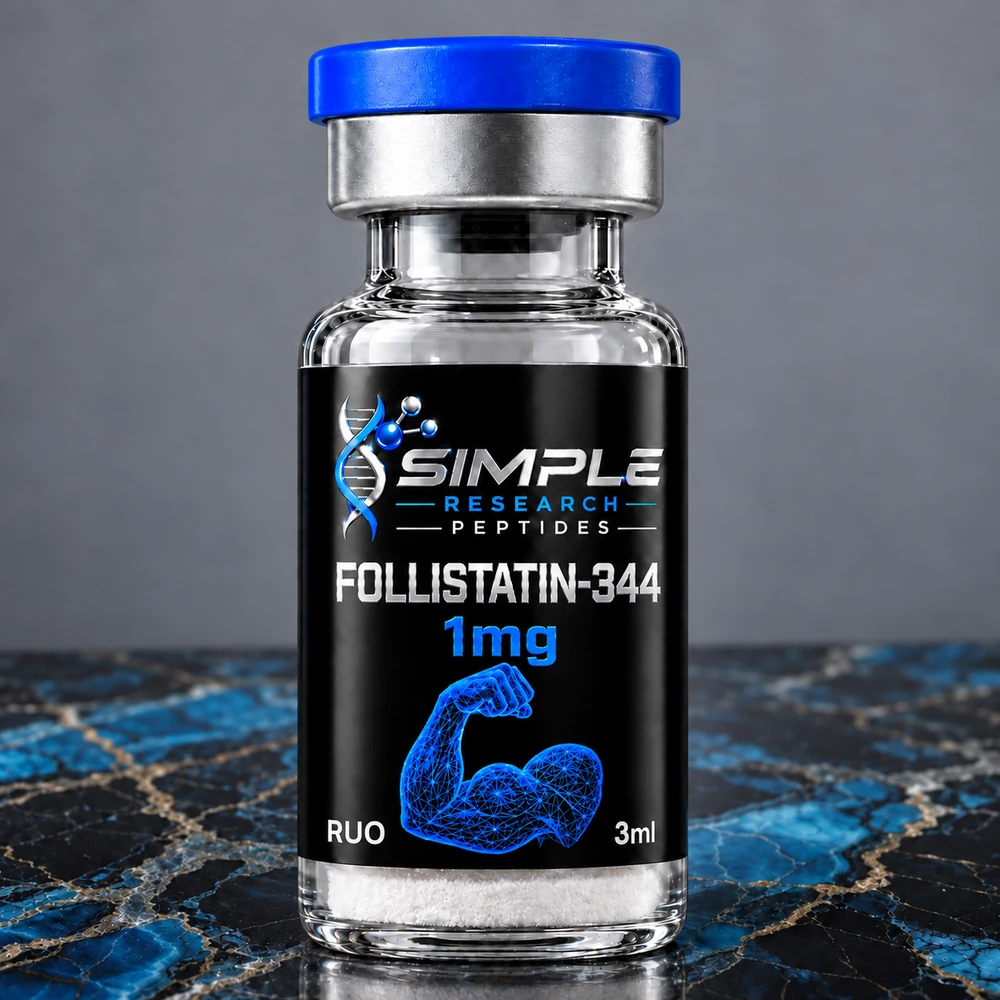
SRP listing nameFollistatin-344 (1 mg Vial)Page also prints “Follistatin-344 1mg Research Peptide.” Muscle Growth Research store category.
SRP listed strength1 mg VialSKU FOLLISTATIN-344-1MG-2 on /product/follistatin-344-1-mg-vial-2/. Sequence, CAS, UNII, isoform, and a public COA were not printed.
Index evidence tagPreclinical/biologic researchIndex listing: “Follistatin-344 (1 mg Vial)” under Growth; Evidence profile. Field: Muscle-signaling research.
Chemical classSecreted glycoproteinCysteine-rich activin-binding protein; not a short linear peptide. UniProt keyword Glycoprotein; 18 disulfide bonds annotated.
Precursor length344 aa including signalUniProt P19883 displayed sequence; NCBI NP_037541.1; Shimasaki 1988 (3 of 8 cDNA clones).
Signal peptideResidues 1–29MVRARHQPGGLCLLLLLLCQFMEDRSAQA. UniProt feature Signal 1–29, evidence PMID 15340161 (opened as UniProt/CT.gov xref only).
Mature circulating chainFS-315 = residues 30–344315 aa. N-terminus GNCWLRQAKNGR…; C-terminus …SISEDTEEEEEDEDQDYSFPISSILEW. NCATS UNII 506IY26H2I subunit length 315.
Alternate splice (not this listing)FST-317 → mature FS-288NCBI NP_006341.1; UniProt isoform 2 P19883-2. Lacks the acidic C-terminal tail. Not this listing.
PubChem CIDNonePUG REST name lookups for follistatin-344 / FST-344 / follistatin returned PUGREST.NotFound. No CID.
UNII (mature 315, not FST-344)506IY26H2INCATS FOLLISTATIN / ACTIVIN-BINDING PROTEIN. 315-aa mature sequence. Not labeled FST-344. Approval Year Unknown.
IUPHAR ligand4933 (approved: false)Name follistatin; type Peptide; precursor prepro-follistatin; UniProt P19883. Search FST-344 returned no ligand.
Identifier Value on opened page Source opened
Trade / development names Follistatin; FS; activin-binding protein; FST-344 / FS344 / preFS344 (344-aa precursor isoform); FS-315 / FS315 (mature circulating chain after signal cleavage) UniProt P19883; NCBI Gene 10468; Shimasaki 1988 PMID 3380788; Inouye 1991 PMID 1906804; Haidet 2008 PMID 18334646
SRP listing name Follistatin-344 (1 mg Vial); page also prints “Follistatin-344 1mg Research Peptide” SRP product page
SRP listed strength / format 1 mg Vial SRP product page
SRP SKU FOLLISTATIN-344-1MG-2 (printed on /product/follistatin-344-1-mg-vial-2/) SRP product page
SRP store / research category Muscle Growth Research SRP product page (store taxonomy, not a clinical indication)
SRP index listing “Follistatin-344 (1 mg Vial)”; Growth; “Evidence profile”; evidence tag Preclinical/biologic research; field Muscle-signaling research SRP compound-research-guides index
Chemical class Secreted glycoprotein; cysteine-rich activin-binding protein; not a short linear peptide UniProt P19883 (keyword Glycoprotein; 18 disulfide bonds annotated); Shimasaki 1988; Inouye 1991
Precursor length (FST-344) 344 aa including signal peptide UniProt P19883 displayed sequence; NCBI NP_037541.1; Shimasaki 1988 (3 of 8 cDNA clones)
Signal peptide Residues 1–29 (MVRARHQPGGLCLLLLLLCQFMEDRSAQA) UniProt feature Signal 1–29, evidence PMID 15340161 (opened as UniProt/CT.gov xref only); NCATS mature chain starts at residue 30
Mature circulating chain (FS-315) Residues 30–344 = 315 aa; N-terminus GNCWLRQAKNGR…; C-terminus …SISEDTEEEEEDEDQDYSFPISSILEW UniProt Chain 30–344; NCATS UNII 506IY26H2I subunit length 315
Alternate splice precursor (not this listing) FST-317 / preFS317, 317 aa → mature FS-288 (lacks the acidic C-terminal tail) NCBI NP_006341.1; UniProt isoform 2 P19883-2; Shimasaki 1988 (5 of 8 cDNA clones); Inouye 1991
UniProt P19883 (FST_HUMAN). Reviewed Swiss-Prot. Displayed isoform 1 is named FS315 / FS-315 and is the 344-aa precursor. Isoform 2 = FS288 / FS-288. Secondary accessions B5BU94, Q9BTH0. MW of displayed precursor 38007. UniProt REST JSON, opened 16 August 2026
NCBI Gene 10468 (FST, follistatin). RefSeq summary: single gene encodes FST317 and FST344. MIM 136470. HGNC 3971. https://www.ncbi.nlm.nih.gov/gene/10468
NCBI protein (FST344) NP_037541.1 / NM_013409.3; CCDS3959.1; 344 aa; “isoform FST344 precursor” NCBI E-utilities FASTA + GenBank, opened 16 August 2026
NCBI protein (FST317) NP_006341.1 / NM_006350.5; 317 aa; “isoform FST317 precursor” NCBI E-utilities FASTA, opened 16 August 2026
N-linked glycosylation (UniProt) Asn 124 and Asn 288 on the 344-aa numbering UniProt features; NCBI NP_037541.1 Site 288
Disulfide bonds UniProt annotates 18 disulfide bonds on the mature fold; NCATS lists the same 18 links on the 315-aa chain UniProt P19883; NCATS 506IY26H2I
PDB (opened as UniProt xrefs only) 2P6A chains C/D = 30–344 (includes the FST-344 C-terminus); 2B0U, 3HH2, 5JHW chains C/D = 30–317 UniProt xrefs. Used as identity, not as new functional claims.
PubChem compound CID None. PUG REST name lookups returned PUGREST.NotFound PubChem PUG REST, opened 16 August 2026
PubChem substance SID (generic follistatin, not FST-344-specific) SID 135287693 (ChemIDplus; synonyms Follistatin, Folstaxan, Gonadostatin; RN 117628-82-7); SID 178101631 (IUPHAR ligand 4933); SID 472421016 (GSRS UNII 506IY26H2I). Name lookups follistatin-344 and FST-344 returned no SID. PubChem PUG substance JSON / PUG View
CAS printed for recombinant FST-344 specifically None on an opened FST-344-specific registry record. ChemIDplus attaches 117628-82-7 to generic “Follistatin,” not to a 344-aa recombinant lot. NCATS FOLLISTATIN 506IY26H2I lists no CAS. Marketplace CAS 80449-31-6 resolved on PubChem xref/RN to CID 105102 titled Ulinastatin (C13H16O3) — not used. PubChem; NCATS
UNII 506IY26H2I is NCATS / GSRS FOLLISTATIN (preferred name ACTIVIN-BINDING PROTEIN), human complete protein, 315-aa mature sequence, UniProt cross-ref P19883, Approval Year Unknown, class Other. It is not labeled FST-344. NCATS name search FST-344 returned 0 substances. https://drugs.ncats.io/drug/506IY26H2I
IUPHAR / GtoPdb ligand Ligand 4933, name follistatin, type Peptide, abbreviation FS, species Human, compound class “Endogenous peptide in human, mouse or rat,” gene/precursor prepro-follistatin, UniProt P19883, approved: false. Search FST-344 returned no ligand. IUPHAR services + HTML, opened 16 August 2026
ClinicalTrials.gov (FST-344 / AAV-FST / ACE-083) Studies exist for gene-therapy constructs and for ACE-083, not for an SRP 1 mg vial. See section 5C. Every NCT on this page is labeled NOT the SRP vial. CT.gov API v2, opened 16 August 2026
openFDA Drugs@FDA / labels No follistatin / UNII 506IY26H2I match (NOT_FOUND) openFDA API, opened 16 August 2026
FDA-approved FST-344 product None on the opened record. IUPHAR approved=false; NCATS Approval Year Unknown; openFDA empty. IUPHAR; NCATS; openFDA

What the molecule actually is. Shimasaki et al. 1988 (PMID 3380788; PMC 280398; full PDF opened) cloned human testicular cDNAs and the genomic locus. Three of eight sequenced cDNA clones predicted a 344-aa precursor (preFS344); the other five encoded a 317-aa precursor (preFS317) from alternative splicing. Mature follistatin was described as a single-chain gonadal protein that inhibits pituitary FSH release, with four contiguous domains encoded by separate exons, three of them similar to EGF and pancreatic secretory trypsin inhibitor. NCBI still labels the long RefSeq protein “follistatin isoform FST344 precursor” (NP_037541.1, 344 aa). UniProt displays that same 344-aa translation as isoform 1 and names it FS315, because the mature secreted chain after the 29-aa signal is 315 residues. NCATS UNII 506IY26H2I stores exactly that 315-aa mature sequence (starts GNCWLRQAKNGR…, ends …FPISSILEW).

Naming that must not be collapsed.

  • FST-344 / FS344 / preFS344 = the 344-aa precursor (signal + mature FS-315). This is the cDNA used in the Nationwide / Mendell AAV construct rAAV1.CMV.huFollistatin344 / AAV1-FS344 (Haidet 2008; Kota 2009; Mendell 2015).
  • FS-315 / FS315 / rhFS-315 = the mature circulating 315-aa chain after signal cleavage, with an acidic C-terminal tail. Inouye 1991 expressed this form in CHO cells. Schneyer 2004 showed FS315 is the major serum isoform and was undetectable in follicular fluid.
  • FST-317 / preFS317 → mature FS-288 / rhFS-288. Shorter splice product. Higher heparin / cell-surface binding. Inouye 1991: rhFS-288 was 8–10× more potent than native porcine FS at suppressing FSH in rat pituitary cultures (ED50 9.6 ± 2.2 pM vs 86.7 ± 14.1 pM). Haidet 2008 explicitly avoided this form for gene transfer because of tissue binding and reproductive-axis concern.
  • FS-303 / ~300-aa follicular-fluid form. Inouye 1991 and Schneyer 2004: most native porcine / human follicular-fluid FS is a proteolytically processed intermediate, neither FS-315 nor FS-288.
  • UniProt’s displayed name “FS315” for a 344-aa sequence is not a third precursor. It is the same translation as NCBI FST344.

Registry chaos that must not be collapsed.

  • PubChem has no compound CID for follistatin or FST-344. Marketplace pages that print CID 178101631 are pointing at a substance SID (IUPHAR), not a small-molecule CID. Looking up 178101631 as a CID returns an unrelated chloro-fluoro-indazole. CID 5281027 is an unrelated nucleotide-like structure. Neither is FST-344.
  • CAS 80449-31-6, widely copied onto research-vial catalogs, resolved on PubChem xref/RN to ulinastatin (CID 105102). It is not used here.
  • ChemIDplus CAS 117628-82-7 is a generic “Follistatin / Folstaxan / Gonadostatin” substance record. It is not a verified recombinant-FST-344 lot identifier and is not on the NCATS 506IY26H2I code list.
  • NCATS 506IY26H2I is mature 315-aa follistatin, not a 344-aa precursor record and not an SRP-vial COA.
  • DrugBank xref DB01666 on UniProt P19883 is D-myo-inositol hexasulphate, a ligand, not a follistatin drug.

Not printed on SRP pages and therefore not claimed as SRP-verified: amino-acid sequence, isoform (344 vs 315 vs 288 vs 303), signal-peptide status, CAS, UNII, glycosylation, disulfide pairing, endotoxin, folding, or a public COA file. The product page prints “COA: Certificate of Analysis available” and “Purity: ≥99%” as catalog bullets. Those bullets do not establish that the lyophilizate is folded, glycosylated FS-315.

Critical identity point: FST-344 is the 344-aa precursor (P19883 / NP_037541.1) that can mature to circulating FS-315 after signal 1–29. It is not FS-288, not FS-303, not ACE-083, not stamulumab, and not an AAV product. UNII 506IY26H2I is mature 315-aa FOLLISTATIN, not labeled FST-344. No PubChem CID. Marketplace CAS 80449-31-6 is ulinastatin. Not FDA-approved. Research use only.
02 / Overview

How it is not ACE-083, stamulumab, a myostatin antibody, or a short peptide

This page is human FST-344 precursor / the FS-315 chain it can produce only. Catalog “myostatin inhibitor peptide” language is a nickname, not a chemical identity. FST-344 ≠ FS-288 ≠ ACE-083 ≠ stamulumab ≠ AAV product ≠ SRP vial.

Identity What opened sources actually describe Protein? Typical literature role
FST-344 / preFS344 (this page) 344-aa precursor of human FST; signal 1–29; matures to circulating FS-315 Yes (glycoprotein precursor) Isoform chosen for AAV-FS344 gene-transfer papers because it generates serum FS-315
FS-315 (mature chain) 315-aa secreted glycoprotein with acidic C-terminus; major circulating isoform Yes (mature protein) Serum ligand trap. Product of FST-344 processing, not a different gene. A vendor “Follistatin-315” vial is still not an AAV product.
FST-317 / FS-288 317-aa precursor → 288-aa mature chain; lacks the acidic tail; high heparin affinity Yes (different splice) Tissue-bound / follicular-fluid form; stronger FSH suppression in Inouye 1991. Not this listing.
FS-303 Proteolytic intermediate (~300 aa) in follicular fluid Yes (processed) Native ovarian form. Not a 1 mg research-vial specification.
ACE-083 “Recombinant fusion protein consisting of a modified form of human follistatin linked to the human IgG2 Fc domain”; designed to remain in injected muscle Yes (engineered fusion) Acceleron local-acting biologic. Phase 1 NCT02257489; Phase 2 FSHD and CMT terminated. Not FST-344. NOT the SRP vial.
Engineered FST315-ΔHBS-Fc (Lilly / Yaden–Datta-Mannan) FST315 with heparin-binding site removed, fused to murine IgG1 Fc Yes (engineered fusion) Mouse PK/PD engineering. Native FST315 called “poorly suited” as a parenteral biotherapeutic. Not a research vial.
Stamulumab / MYO-029 Neutralizing anti-myostatin monoclonal antibody. NCATS UNII V43X8G4797; CAS 705287-60-1; INN 8683 Antibody, not follistatin Wagner 2008 Phase 1/2 (NCT00104078). Not follistatin. NOT the SRP vial.
Myostatin / GDF8 IUPHAR ligand 5025; TGF-β-family ligand Ligand Pathway context. Binding target, not the vial.
Activin A IUPHAR ligand 4857; inhibin-βA dimer Ligand Classic follistatin ligand. Pathway context.
FSTL3 / FLRG NCATS UNII BGE87QS439 (follistatin-related protein 3) Different gene Related antagonist. Not FST.
Short research peptides (BPC-157, TB-500, etc.) Oligopeptides Different class Mass-spec identity is a sequence. Follistatin identity is a folded glycoprotein.

FST-344 is not “just another 1 mg peptide”

Opened papers describe a ~35–38 kDa glycoprotein with 18 disulfides and N-linked glycans. A catalog purity percentage on mass does not show that the chain is folded, paired, glycosylated, or activin-binding.

FST-344 is not interchangeable with FS-288

Haidet 2008 (full text opened) chose FS-344 specifically because peptide cleavage “exclusively generates the serum circulating FS-315 isoform” and because FS-288 “shows preferential localization to the ovarian follicular fluid and high tissue binding affinity through heparin sulfate proteoglycans.” Inouye 1991 found rhFS-288 far more potent than rhFS-315 at FSH suppression. Using FS-288 data as if it were an FST-344 vial is a category error. (PMID 18334646; PMID 1906804.)

FST-344 is not ACE-083

Glasser 2018 (full PDF opened): ACE-083 is a modified follistatin–IgG2 Fc fusion designed for local muscle residence and “rapid inactivation after entering the circulation.” CT.gov interventions call it a “recombinant fusion protein.” Phase 2 FSHD (Statland 2022) and CMT (Thomas 2022) increased muscle volume without consistent functional benefit and the programs were terminated. That dossier is not evidence for a 1 mg lyophilized FST-344 vial. (PMID 29486514; NCT02257489NOT the SRP vial.)

AAV-Follistatin gene therapy is not a vial

Kota 2009, Haidet 2008, Mendell 2015, and NCT01519349 / NCT02354781 delivered DNA encoding huFollistatin344 inside AAV1, so muscle cells produced the protein continuously. A research vial is a finite mass of lyophilized material of unstated fold. Those are different pharmaceutical objects. Every NCT on this page is NOT the SRP vial.

Do not equate FST-344 with FS-288, ACE-083, stamulumab, FSTL3, myostatin, or an AAV/plasmid product. Stamulumab is an antibody against myostatin (Wagner 2008; NCATS V43X8G4797). It does not contain the follistatin sequence. A 1 mg lyophilized SRP vial is not rAAV1.CMV.huFollistatin344 and is not automatically folded glycosylated FS-315.
03 / Mechanism

Proposed mechanism (ligand trap; observed vs proposed vs not shown)

Opened primary papers support a ligand-trap / extracellular neutralization model. It is not a treatment claim for an SRP vial. Observed means a measurement on the opened paper or registry. Proposed means a mechanistic inference the authors or this page mark as such. Class / adjacent means distinction biology (ACE-083, FS-288, antibody). Not shown means absent from the opened record.

Observed — structure / biochemistry

Follistatin binds selected TGF-β-family ligands

UniProt function text (PMID 11279126, PMID 16482217, PMID 18535106) states that follistatin antagonizes activin, myostatin, GDF11, and BMPs by binding ligands extracellularly and blocking the type II receptor site. Thompson 2005 (PMID 16198295): two FS molecules encircle activin A and occupy both type I- and type II-receptor sites. Harrington 2006 (PMID 16482217): Fs12 is the minimal fragment; Arg192 is a key contact. Cash 2009 (PMID 19644449): myostatin:FS288 structure. Sidis / Schneyer 2008 (PMID 18535106): activin neutralization is mainly FSD2; myostatin binding is more FSD1-dependent; mutants still bound GDF11.

Observed — isoform biochemistry is not identical

FS315 is the major serum isoform

Lerch et al. 2007 (PMID 17409095): FS288 and FS315 inhibit activin similarly in the complex, but heparin binding of FS315 is salt-sensitive and increases when FS315 is bound to activin, because the acidic C-terminal tail can no longer mask the heparin site. Schneyer 2004 (PMID 15472207): heparin/cell-surface binding ranks FS288 > FS303 > FS315; FS315 is the major circulating isoform and was undetectable in follicular fluid. Inouye 1991 (PMID 1906804): rhFS-315 equipotent to native porcine FS on pituitary FSH suppression (ED50 115.2 ± 16.2 pM vs 86.7 ± 14.1 pM); rhFS-288 ~8–10× more potent. Al-Zaidy 2015 (full PDF): FS315 “has a 10-fold lower affinity to activin compared to FS288.” That is why gene-therapy groups picked FS344 → FS315. (PMID 27858738.)

Observed in animals — construct matters

Blocking this pathway can enlarge muscle

Lee & McPherron 2001 (PMID 11459935; full PDF): recombinant FS blocked myostatin–ActRIIB (Ki ~470 pM). Short-form transgenic founder F3: muscle weights +194–327% — the short form, not an FST-344 vial. Lee 2010 (PMID 20810712): Fst heterozygotes stay smaller even on a Mstn-null background (activin A). Winbanks 2012 (PMID 22711699): rAAV6 FS-288 via Smad3/mTOR independent of myostatin — NOT FS344. Haidet 2008: one IM AAV1-FS344 injection enlarged muscle for >2 years; high-dose serum FS 15.3 ± 2.1 ng/ml. Kota 2009: AAV1-FS344 cynomolgus size/strength without abnormal key-organ morphology on the abstract. (PMID 18334646; PMID 20368179.)

Proposed — not shown for an SRP vial

Native FST315 is poorly suited as a parenteral biologic

That a lyophilized 1 mg catalog protein, once reconstituted, is folded, glycosylated, disulfide-correct, low-endotoxin, and competent to bind activin or myostatin the way CHO-expressed rhFS-315 or AAV-produced FS-315 did is proposed, not shown. Datta-Mannan et al. 2013 (PMID 23249626) stated that native FST315 has intrinsic PK/PD “poorly suited for acting as a parentally administered biotherapeutic with broad systemic effects,” and only an Fc fusion with the heparin-binding site removed produced a robust weekly subcutaneous effect in mouse atrophy models. That sentence is the opposite of assuming a raw 1 mg vial is a gene-therapy equivalent.

Not shown on an opened page

No cloned “FST-344 receptor”

Follistatin is the binder, not a GPCR agonist. Not shown: human PK of an SRP vial; proof that research-market material is FS-315 rather than FS-288, FS-303, aggregated chain, or a peptide fragment; an FDA-approved FST-344 drug; equivalence of vial protein to rAAV1.CMV.huFollistatin344 or to ACE-083.

Distinction — FS288 higher heparin / FSH potency

Inouye 1991 and Haidet 2008

Inouye 1991: rhFS-288 was 8–10× more potent than native porcine FS at suppressing FSH. Haidet avoided FS288 for gene transfer because of tissue binding and reproductive-axis concern. FS-288 papers are not interchangeable with FST-344. (PMID 1906804; PMID 18334646.)

Shimasaki defines preFS344 vs preFS317

3/8 human testis cDNAs = 344-aa precursor; 5/8 = 317-aa precursor; alternative splicing; four-domain exon structure. PMID 3380788. PMC 280398.

Inouye: rhFS-315 vs rhFS-288 potency

CHO-expressed isoforms; rhFS-288 8–10× more potent at FSH suppression; native porcine FS mostly ~300 aa. PMID 1906804.

Sidis disulfides; Lee short-form muscling

N-terminal disulfide disruption dropped activin binding to <5%. Lee short-form FS founder F3: +194–327% muscle. Not an FST-344 vial. PMID 11279126; PMID 11459935.

Schneyer FS315 serum; Thompson / Harrington / Cash

FS315 major circulating isoform. 2:1 FS:activin cage. Myostatin:FS288 structure. PMID 15472207; PMID 16198295; PMID 19644449.

Haidet mice; Kota macaques

FS-344 chosen because it exclusively generates circulating FS-315. AAV1-FS344, not a protein vial. PMID 18334646; PMID 20368179.

Datta-Mannan: native FST315 poorly suited

Fc fusion + heparin-site removal improved half-life ~100-fold. Directly limits “inject the native protein” assumptions. PMID 23249626.

Mendell BMD / sIBM; Greenberg dispute

Small open-label gene-transfer series. sIBM functional claim contested. PMID 25322757; PMID 28927986. NCT01519349NOT the SRP vial.

Glasser / Statland / Thomas; programs terminated

Modified FS–Fc fusion. Volume ≠ strength. PMID 29486514; PMID 35428982. NOT the SRP vial.

Not shown on an opened page: a cloned “FST-344 receptor” (follistatin is the binder, not a GPCR agonist); human PK of an SRP vial; proof that research-market material is FS-315 rather than FS-288, FS-303, aggregated chain, or a peptide fragment; an FDA-approved FST-344 drug; equivalence of vial protein to rAAV1.CMV.huFollistatin344 or to ACE-083.

Mechanism in one line: an extracellular ligand trap for selected TGF-β-family ligands. FS315 is the major serum isoform (Schneyer 2004). FS288 has higher heparin / FSH potency (Inouye 1991); Haidet avoided FS288 for gene transfer. Native FST315 is poorly suited as a parenteral biologic (Datta-Mannan 2013). Not a treatment claim. Not for human use. An SRP 1 mg vial is not those study products.
04 / Research Map

Where the literature actually sits

Label every row. FST-344 ≠ FS-288 ≠ ACE-083 ≠ stamulumab ≠ AAV product ≠ SRP vial. Human trial numbers are historical facts, not dosing instructions. Historical vg/kg and ACE-083 mg/muscle figures are study conditions for those products, not instructions for an SRP 1 mg vial, and they are not claims that research-grade material works in people.

A. Biochemistry / isoform — defines the name

Shimasaki, Inouye, Schneyer, structures

Shimasaki 1988 (PMID 3380788, PMC 280398): 3/8 cDNAs = 344-aa precursor (preFS344); 5/8 = 317-aa precursor. Inouye 1991 (PMID 1906804): rhFS-315 vs rhFS-288 potency. Schneyer 2004 (PMID 15472207): FS315 major circulating isoform. Thompson 2005 / Harrington 2006 / Lerch 2007 / Sidis 2008 / Cash 2009: ligand-trap structures and domain bias. Datta-Mannan 2013 (PMID 23249626): native FST315 poorly suited as a parenteral biologic. Not a vial COA. Not a muscle-drug paper for a lyophilizate.

B. Animal / AAV-FS344 — vector, not a vial

Haidet mice; Kota macaques; Lee transgene

Haidet 2008 (PMID 18334646): one-time AAV1-FS344 IM; durable muscle-mass and grip-strength gains; FS-344 chosen because it exclusively generates circulating FS-315. Kota 2009 (PMID 20368179): AAV1-FS344 cynomolgus. Lee 2001 (PMID 11459935): short-form transgenic muscling +194–327% — not FST-344 vial. Winbanks 2012 (PMID 22711699): rAAV6:Fst-288 — label NOT FS344. Yaden 2014 (PMID 24627466): FST315-ΔHBS-Fc, not native vial protein. Viral vectors or engineered fusions. Not a protein vial.

C. Human AAV small / open-label + Greenberg dispute

Mendell BMD / sIBM; n=3 DMD; plasmid

NCT01519349 (Nationwide; rAAV1.CMV.huFollistatin344; n=15 BMD+sIBM) — NOT the SRP vial. Mendell 2015 (PMID 25322757): n=6 BMD open-label 6MWT mixed. Mendell 2017 (PMID 28279643): n=6 sIBM vs unmatched comparators. Greenberg 2017 (PMID 28927986): letter titled “Unfounded Claims.” NCT02354781 n=3 DMD; NCT06411366 FST344 plasmid n=43, 0 cited publications; NCT07443826 AAV9 recruiting; NCT07285629 follistatin+klotho plasmid recruiting. All NOT the SRP vial.

D. ACE-083 volume without function / Phase 2 terminated

Glasser / Statland / Thomas

NCT02257489 + Glasser 2018 (PMID 29486514): ACE-083 50–200 mg IM; +8.9–14.5% volume; no significant strength change. NCT02927080 + Statland 2022 (PMID 35428982): FSHD TMV up, no consistent function; TERMINATED. NCT03124459 + Thomas 2022 (PMID 35545446): CMT volume without consistent function; TERMINATED. NCT03943290 OLE terminated. ACE-083, not FST-344. NOT the SRP vial.

E. Regulatory — none; not FDA-approved

IUPHAR approved:false; openFDA NOT_FOUND

IUPHAR ligand 4933: approved false. NCATS 506IY26H2I: Approval Year Unknown. openFDA Drugs@FDA and labels: NOT_FOUND. No opened CT.gov record exists for a lyophilized FST-344 research-protein vial as the investigational product. Stamulumab NCT00104078 / NCT00563810 is an antibody distinction only — NOT the SRP vial.

Vendor identity — not independently verified

SRP 1 mg vial prints no sequence

Opened SRP page: Follistatin-344 (1 mg Vial); Muscle Growth Research; SKU FOLLISTATIN-344-1MG-2; research use only. Sequence, CAS, UNII, isoform, glycosylation, and a public COA were not printed. Index tag: Preclinical/biologic research. Research-quality note on the index: isoform, folding, glycosylation, bioactivity, and endotoxin testing matter; mass alone does not establish a functional protein product. Product page.

05 / Snapshot

Opened records, read as they actually sit

Read the “what it did not show” column. Published study designs are historical facts from those papers. They are not a protocol. Historical AAV vg/kg and ACE-083 mg/muscle figures are study conditions for those products, not instructions for an SRP 1 mg vial. Label every human / ACE-083 / antibody row: NOT the SRP vial.

A. Protein / isoform / biochemistry

Study Species / model What was tested Actual finding (from the opened record) What it did not show
Shimasaki et al., 1988
PMID 3380788. PMC 280398. DOI 10.1073/pnas.85.12.4218. Opened full PDF.
Human testis cDNA + genomic clones; prior porcine follicular-fluid proteins Cloning of human follistatin precursors Defines the name. 3/8 cDNAs = 344-aa precursor (preFS344); 5/8 = 317-aa precursor (preFS317) by alternative splicing. Four-domain architecture; exons encode signal + domains. Prior purification: glycosylated single-chain proteins Mr 35,000 and 32,000. Not a muscle-drug paper. Not a vial COA. Muscle hypertrophy. SRP-vial identity. Folding or glycosylation of a catalog lyophilizate.
Inouye et al., 1991
PMID 1906804. DOI 10.1210/endo-129-2-815. Opened abstract.
CHO-expressed rhFS-315 and rhFS-288; comparison with native porcine FS; rat pituitary cells; ovariectomized rats Recombinant human isoforms Two splice products; rhFS-315 has an extra 27-aa C-terminus vs rhFS-288. Yield 3–5 mg/L after activin-affinity chromatography. Native porcine FS was mostly ~300 aa, glycosylated; <1% was FS-288. Pituitary FSH suppression: rhFS-315 ED50 115.2 ± 16.2 pM ≈ native porcine 86.7 ± 14.1 pM; rhFS-288 ED50 9.6 ± 2.2 pM (8–10× more potent; similar to inhibin-A 8.6 ± 0.9 pM). In vivo, rhFS-288 more potent / longer acting than inhibin-A. CHO recombinant protein, not a research-market vial. Abstract only for numbers. A research-vial COA. Human PK. Equivalence of FS-288 data to an FST-344 listing.
Sidis, Schneyer, Sluss, Johnson, Keutmann, 2001
PMID 11279126. DOI 10.1074/jbc.m100736200. Opened abstract.
CHO-expressed mutants; solid-phase activin binding; transcriptional and pituitary FSH assays Role of the N-terminal domain Deletion of the N-terminal domain, disruption of N-terminal disulfides, or deletion of the first two residues each reduced activin binding to <5% of wild-type and abolished suppression of activin-mediated transcription / FSH. Fold and disulfides are not optional. That a catalog lyophilizate is disulfide-correct. A vial bioassay.
Schneyer, Wang, Sidis, Sluss, 2004
PMID 15472207. DOI 10.1210/jc.2004-0162. Opened abstract.
Human serum and follicular fluid; FS315-specific immunoassay Which isoform circulates At least three isoforms (FS315, FS288, FS303). Heparin/cell-surface binding FS288 > FS303 > FS315. FS315 is the major circulating isoform and was undetectable in follicular fluid from normal women or PCOS. Serum FS is not from the ovarian follicle on this assay. Isoform of an SRP vial. A treatment claim.
Thompson, Lerch, Cook, Woodruff, Jardetzky, 2005
PMID 16198295. DOI 10.1016/j.devcel.2005.09.008. Opened abstract.
Crystal structure, activin A + follistatin How neutralization works Two FS molecules encircle activin; ~one-third of ligand residues buried; both type I and type II receptor sites blocked; N-terminal domain mimics a type I-receptor motif. Structural. Not a vial bioassay. Human efficacy. SRP-vial folding.
Harrington et al., 2006
PMID 16482217. DOI 10.1038/sj.emboj.7601000. Opened abstract.
Fs12 fragment + activin A crystal (2 Å) Minimal inhibitory fragment Fs12 is sufficient; 2:1 Fs12:activin-dimer complex; type II site blocked; Arg192 key. Domain biochemistry. A full-length FS-315 vial assay.
Lerch, Shimasaki, Woodruff, Jardetzky, 2007
PMID 17409095. DOI 10.1074/jbc.m700737200. Opened abstract.
FS315–activin A structure; heparin binding of FS288 vs FS315 Isoform heparin coupling Both isoforms inhibit activin similarly; FS315 FSD3 moves with the C-terminal extension. Heparin affinities similar at low salt; FS315 binding falls faster as salt rises. Activin-bound FS315 binds heparin like FS288. Heparin competence of a catalog vial.
Schneyer, Sidis, Gulati, Sun, Keutmann, Krasney, 2008
PMID 18535106. DOI 10.1210/en.2008-0259. Opened abstract.
Point and domain-swap FS mutants vs activin, myostatin, GDF11 Ligand selectivity Activin neutralization primarily FSD2; myostatin binding more FSD1-dependent. Deleting FSD2 or replacing it with extra FSD1 created myostatin antagonists with “vastly reduced activin antagonism” that still bound GDF11. Selectivity is incomplete. That trapping myostatin is a completed drug program. Vial ligand-binding data.
Cash, Rejon, McPherron, Bernard, Thompson, 2009
PMID 19644449. DOI 10.1038/emboj.2009.205. Opened abstract.
Crystal structure myostatin:Fst288 Myostatin complex Prehelix of myostatin resembles TGF-β-class ligands; Fst288 N-terminal domain rearranges to bind myostatin. FS288 complex, not FS315. FS-315 structure in that paper. Vial identity.
Datta-Mannan, Yaden, Krishnan, Jones, Croy, 2013
PMID 23249626. DOI 10.1124/jpet.112.201491. Opened abstract.
Native FST315 vs FST315-Fc Δ heparin-binding PK/PD of the native protein Authors: intrinsic PK/PD of native FST315 are poorly suited for a parenterally administered systemic biotherapeutic. Fc fusion + heparin-site removal improved terminal half-life ~100-fold and exposure ~1600-fold and produced weekly-SC activity in mouse atrophy models. Directly limits “inject the native protein” assumptions. That a raw 1 mg vial is a gene-therapy equivalent. Human vial PK.
UniProt P19883 + NCATS 506IY26H2I + NCBI NP_037541.1 Human reference sequences Isoform map Displayed 344-aa precursor; signal 1–29; mature 30–344; glycosylation N124, N288; 18 disulfides; isoform 2 = FS288. NCATS stores the 315-aa mature chain as UNII 506IY26H2I. A CID. An FST-344-specific CAS. An SRP COA.

B. Animal / muscle / gene-therapy preclinical

These rows test transgenes, AAV vectors, or engineered Fc fusions, not an SRP 1 mg vial. Viral-genome and protein-dose figures are historical experimental exposures for those constructs.

Study Species / model What was tested Actual finding (from the opened record) What it did not show
Lee & McPherron, 2001
PMID 11459935. PMC 55416. DOI 10.1073/pnas.151270098. Opened full PDF.
Transgenic mice; myosin light-chain promoter; human follistatin short form; also propeptide and dominant-negative ActRIIB Muscle-specific overexpression Follistatin blocked myostatin–ActRIIB binding (Ki ~470 pM). Short-form FS founder F3: muscle weights +194–327%; fiber number +66%; fiber diameter +28%. Propeptide lines +20–110%. Authors note F3 increases exceeded typical myostatin-null muscling in other backgrounds. Short-form transgene. Not FST-344 vial. Not human. FST-344 vial pharmacology. Human data. A lyophilized-protein protocol.
Lee et al., 2010
PMID 20810712. PMC 2954636. DOI 10.1210/me.2010-0127. Opened abstract.
Fst mutant mice; Mstn-null crosses Endogenous Fst gene dose Fst heterozygotes: smaller muscles, more oxidative fibers, impaired cardiotoxin remodeling, lower tetanic force, preserved specific force. Heterozygous loss still mattered on a Mstn-null background → Fst also inhibits other TGF-β ligands. Genetic evidence for activin A. Gene deletion, not a vial. That adding a catalog protein reproduces genetic overexpression.
Haidet et al., 2008
PMID 18334646. PMC 2393740. DOI 10.1073/pnas.0709144105. Opened full text.
C57BL/6 and mdx mice; AAV1 encoding human FS-344, FLRG, or GASP-1; 1×10¹⁰ or 1×10¹¹ vg; IM quadriceps + TA One-time gene transfer of FS344 FS-344 chosen because it “exclusively generates” circulating FS-315. FS-treated wild-type mice: largest muscle-mass and grip-strength gains among the three inhibitors, including remote muscles, durable to 725 days. mdx high-dose serum FS 15.3 ± 2.1 ng/ml. Young mdx: hypertrophy, lower serum CK, remote-muscle effects. Aged mdx (injected at 210 days): grip strength up from ~day 275 through 560 days; less fibrosis / fat replacement. No change in litter size (Table 1). AAV1-FS344. Not a protein vial. A lyophilized FST-344 vial. Human dosing. Equivalence of vg figures to a 1 mg catalog lot.
Kota et al., 2009
PMID 20368179. PMC 2852878. DOI 10.1126/scitranslmed.3000112. Opened abstract.
Cynomolgus macaques; IM quadriceps AAV1-FS344 Nonhuman-primate gene transfer Alternatively spliced human FS “that affects skeletal muscle but that has only minimal effects on nonmuscle cells.” Pronounced, durable increases in muscle size and strength; long-term expression without abnormal key-organ morphology/function on the abstract. AAV1-FS344 primate. Not a vial. SRP-vial evidence. A protein-dose conversion.
Winbanks et al., 2012
PMID 22711699. PMC 3384410. DOI 10.1083/jcb.201109091. Opened abstract + PDF front matter.
Mice; rAAV6:Fst-288 Intracellular pathway after FS-288 gene transfer Increased muscle mass and force, protein synthesis, mTOR activation; attenuated by mTOR inhibition or S6K1/2 deletion. Smad3 is the critical link; constitutively active Smad3 blocked growth and Akt/mTOR/S6K. Effects independent of myostatin overexpression or knockout. FS-288 AAV, not FS344. FST-344 vial data. Interchangeability with FS344.
Yaden et al., 2014
PMID 24627466. DOI 10.1124/jpet.113.211169. Opened abstract.
Mice; systemic FST315-ΔHBS-Fc (heparin-binding-deficient FST315–murine IgG1 Fc) Engineered fusion in injury models Weekly systemic dosing increased body weight and lean mass in normal mice; improved repair after injury/atrophy (macrophage density, Pax7+ cells). Fc fusion, heparin site removed. Not native vial protein. Native 1 mg vial PK/PD.
Rodino-Klapac, Haidet, Kota, Handy, Kaspar, Mendell, 2009
PMID 19208403. DOI 10.1002/mus.21244. Opened abstract.
Review FS344 as a myostatin-pathway strategy Reviews FS as a myostatin antagonist; flags FSH-suppression / reproductive-axis concern; describes alternatively spliced FS344 cDNA delivered by AAV to bypass off-target effects. Secondary. Not new vial data. A vial RCT. New primary efficacy numbers.

C. Human / gene-therapy / ACE-083 trials (clearly labeled: NOT the SRP vial)

Opened human programs used AAV or plasmid DNA encoding FS344, or the ACE-083 fusion, or an anti-myostatin antibody. None of these records is a randomized evaluation of a 1 mg lyophilized FST-344 research vial. Doses below are trial-lot exposures for those products. No opened ClinicalTrials.gov record exists for a lyophilized FST-344 research-protein vial as the investigational product.

Record What was tested n / design Actual finding (from the opened record) Why it is not SRP-vial evidence
NCT01519349 (CT.gov API + HTML fields). Nationwide Children’s Hospital. 2012-01 to 2017-10. Phase 1. NOT the SRP vial. rAAV1.CMV.huFollistatin344 IM. Cohorts: 2×10¹¹ vg/kg single-leg (n=3 sIBM); 3×10¹¹ vg/kg/quad (3 sIBM + 3 BMD); 6×10¹¹ vg/kg/quad (3 sIBM + 3 BMD) Actual enrollment 15. BMD + sIBM. Primary: safety / Grade III+ treatment-related toxicity Registry describes delivery of a gene for FS344 via AAV to build thigh-muscle size. Status COMPLETED. Viral gene transfer, not a protein vial. NOT the SRP vial.
Mendell et al., 2015
PMID 25322757. PMC 4426808. DOI 10.1038/mt.2014.200. Opened abstract. (NCT01519349 BMD cohort). NOT the SRP vial.
AAV1.CMV.FS344 bilateral IM quadriceps. Cohort 1: 3×10¹¹ vg/kg/leg (n=3). Cohort 2: 6×10¹¹ vg/kg/leg (n=3). Primary: 6MWT 6 BMD patients, open-label Authors used “alternatively spliced FS344 to avoid potential binding to off target sites.” 6MWT: +58 m and +125 m (pts 01, 02); no change (03); +108 m and +29 m (05, 06); no improvement (04). “No adverse effects were encountered.” Histology: less endomysial fibrosis, fewer central nuclei, hypertrophy especially at high dose. Small, open-label, no concurrent placebo. Gene therapy. NOT the SRP vial.
Al-Zaidy, Sahenk, Rodino-Klapac, Kaspar, Mendell, 2015
PMID 27858738. PMC 5240576. DOI 10.3233/jnd-150083. Opened full PDF. NOT the SRP vial.
Review of FS344 gene transfer + BMD trial Narrative of the first FS344 gene-transfer trial States FS344 is processed to FS315, “serum-based,” 10-fold lower activin affinity than FS288, chosen to limit pituitary FSH suppression. Reviews the BMD gene-transfer results. Secondary to Mendell 2015. Still AAV, not a vial. NOT the SRP vial.
Mendell et al., 2017
PMID 28279643. PMC 5383643. DOI 10.1016/j.ymthe.2017.02.015. Opened abstract. (sIBM cohort of the same construct). NOT the SRP vial.
rAAV1.CMV.huFS344 6×10¹¹ vg/kg to both quadriceps; plus an exercise regimen. Primary: 6MWT 6 treated sIBM vs 8 unmatched historical/untreated comparators Annualized 6MWT +56.0 m/year treated vs −25.8 m/year untreated (p=0.01). Four of six gained 58–153 m; two gained 5–23 m. Authors report less fibrosis and improved regeneration. Open-label; untreated comparators; exercise co-intervention. Not a vial RCT. NOT the SRP vial.
Greenberg, 2017
PMID 28927986. PMC 5628928. DOI 10.1016/j.ymthe.2017.09.002. Opened page (letter; no abstract). NOT the SRP vial.
Critique of Mendell 2017 sIBM claims Letter Title: “Unfounded Claims of Improved Functional Outcomes Attributed to Follistatin Gene Therapy in Inclusion Body Myositis.” Cites NCT01519349. Full letter body was not extracted beyond the title/metadata on the opened page; used as a published dispute, not as new efficacy numbers. Shows the sIBM functional claim is contested. Still not vial evidence. NOT the SRP vial.
NCT02354781 (CT.gov API). Sponsor Jerry R. Mendell. 2015-01 to 2017-11. Phase 1/2. NOT the SRP vial. rAAV1.CMV.huFollistatin344 (registry spelling also “huFollistin344”) IM to gluteal, quadriceps, TA. Planned total dose 2.4×10¹² vg/kg Actual enrollment 3 DMD patients (planned six) COMPLETED. Primary: dose-limiting toxicities. Brief summary says the BMD trial’s safety/6MWT signal motivated wider muscle distribution in DMD. No opened peer-reviewed efficacy paper for this n=3 run was used as a result table. Gene therapy; n=3; not a vial. NOT the SRP vial.
NCT06411366 (CT.gov API). Minicircle. 2022-08-18 to 2023-08-31. Phase 1. NOT the SRP vial. Follistatin-344 plasmid (non-viral), single dose, healthy subjects; frailty/aging listed Actual enrollment 43. Open-label Intervention name on the registry: “Follistatin-344 plasmid.” Brief summary: plasmid contains human FST344 intended to express/secrete “bioidentical human follistatin” into serum. Outcomes include DXA and adverse events. 0 cited publications on the opened record. Plasmid gene therapy, not a 1 mg protein vial. No opened results paper. NOT the SRP vial.
NCT07443826 (CT.gov API). Unlimited Biotechnology LLC. Start 2026-06-01. Phase 1/2. RECRUITING. NOT the SRP vial. IM AAV9-Follistatin ± VEGF plasmid Estimated n=12. Age-related muscle decline Safety primary through Day 90. Not a completed efficacy program. Different vector (AAV9), recruiting. Not a vial. NOT the SRP vial.
NCT07285629 (CT.gov API). Minicircle. Start 2025-12-16. Early Phase 1. RECRUITING. NOT the SRP vial. Nonviral plasmid follistatin + klotho Estimated n=30 healthy adults Combination plasmid. Not FST-344 protein. Combination gene therapy. Unused as efficacy. NOT the SRP vial.
NCT02257489 + Glasser et al., 2018
PMID 29486514. PMC 5969095. DOI 10.1002/mus.26113. Opened full PDF. NOT the SRP vial.
ACE-083 50–200 mg IM, 1 or 2 doses 3 weeks apart, unilateral RF or TA 58 healthy postmenopausal women; 42 ACE-083 / 16 placebo; randomized, double-blind ACE-083 = modified human follistatin–IgG2 Fc fusion; local acting. No SAE, DLT, or AE discontinuation. Max mean RF volume +14.5% ± 4.5%; TA +8.9% ± 4.7%. No significant change in mean muscle strength. ACE-083, not FST-344. Volume ≠ strength even for the fusion. NOT the SRP vial.
NCT02927080 + Statland et al., 2022
PMID 35428982. PMC 9321022. DOI 10.1002/mus.27558. Opened abstract. NOT the SRP vial.
ACE-083 240 mg/muscle vs placebo, bilateral BB or TA q3 weeks × 6 months, then OLE Part 1 n=37 open-label; Part 2 n=58 randomized; 55 evaluable TMV LS-mean difference +16.4% BB (P<0.0001) and +9.5% TA (P=0.01). CMV up; FF down in TA. No consistent functional or PRO improvement up to 12 months. Mild/moderate injection-site reactions. Study TERMINATED. Fusion protein; terminated. Volume without function. NOT the SRP vial.
NCT03124459 + Thomas et al., 2022
PMID 35545446. PMC 9202530. DOI 10.1212/wnl.0000000000200325. Opened abstract. NOT the SRP vial.
ACE-083 240 mg/muscle bilateral TA vs placebo N=63 CMT1/CMTX; Part 2 n=45 enrolled / 44 treated TMV LS-mean difference +13.5% (P=0.0096); CMV and ankle-dorsiflexion strength also differed; fat fraction and all other functional outcomes not significantly improved. TERMINATED. Class II evidence for volume, not function. Fusion protein; terminated. NOT the SRP vial.
NCT03943290 NOT the SRP vial. ACE-083 OLE in FSHD/CMT n=62. TERMINATED 2020-03-11 Extension of the two Phase 2 programs. No opened efficacy paper used. Same fusion. NOT the SRP vial.
NCT00104078 + Wagner et al., 2008
PMID 18335515. DOI 10.1002/ana.21338. Opened abstract. NOT the SRP vial.
MYO-029 / stamulumab, neutralizing anti-myostatin mAb, 1–30 mg/kg 116 adults with BMD, FSHD, or LGMD; double-blind, placebo-controlled Good safety except cutaneous hypersensitivity at 10 and 30 mg/kg. No improvements in exploratory strength/function; study not powered for efficacy. Trend toward increased muscle size on DXA/histology in a limited subset. Antibody, not follistatin. Distinction only. NOT the SRP vial.
NCT00563810 NOT the SRP vial. MYO-029 IV in healthy subjects n=72 Phase 1 Safety/PK/PD registry record. No opened results paper used as findings. Antibody. Distinction. NOT the SRP vial.
No opened ClinicalTrials.gov record exists for a lyophilized FST-344 research-protein vial as the investigational product. Every NCT printed above is gene therapy, ACE-083, or stamulumab — NOT the SRP vial.
06 / Not established

What is not established

These are gaps in the opened record. Treating any of them as settled is incorrect.

  • No FDA-approved therapeutic use of FST-344, FS-315, or recombinant follistatin. IUPHAR ligand 4933: approved false. NCATS 506IY26H2I: Approval Year Unknown. openFDA Drugs@FDA and labels: NOT_FOUND. ACE-083 Phase 2 programs were terminated. Stamulumab is a different molecule and did not become an approved dystrophy drug on the opened record.
  • A research 1 mg vial is not rAAV1.CMV.huFollistatin344, not a Minicircle FST344 plasmid, and not ACE-083. Gene-therapy papers delivered DNA. ACE-083 is a modified FS–Fc fusion designed to stay in the injected muscle. Datta-Mannan 2013 found native FST315 poorly suited as a systemic parenteral biologic until it was Fc-fused and heparin-site–edited. (PMID 23249626.)
  • Folding, disulfide pairing, glycosylation, heparin-binding competence, aggregation, and endotoxin of an SRP vial are not shown. Sidis 2001: N-terminal disulfide disruption dropped activin binding to <5%. UniProt/NCATS annotate 18 disulfides and N-glycans. Mass and a “≥99%” catalog bullet do not establish a functional glycoprotein. (PMID 11279126.)
  • Isoform of the vial is not shown. SRP does not print sequence. FS-315, FS-288, FS-303, and truncated or misfolded chains are different biochemistry (Inouye 1991; Schneyer 2004; Lerch 2007).
  • Human efficacy of vial protein is not established. Opened human work is gene transfer (n=6 BMD; n=6 sIBM with a published rebuttal; n=3 DMD registry; plasmid n=43 without an opened results paper) or ACE-083 (volume without consistent function). There is no opened RCT of lyophilized FST-344 protein.
  • The Mendell sIBM functional claim is disputed. Greenberg 2017 titled those claims “unfounded.” This page reports both the 2017 abstract numbers and the existence of the letter. It does not adjudicate a winner. (PMID 28279643; PMID 28927986.)
  • Muscle-volume increases are not automatically function. Glasser 2018: +8.9–14.5% volume, no significant strength change. Statland 2022 and Thomas 2022: significant TMV, no consistent functional / QoL benefit; both Phase 2 programs terminated. (PMID 29486514; PMID 35428982; PMID 35545446.)
  • Lee 2001 short-form transgenic muscling is not FST-344 vial pharmacology. The spectacular +194–327% mouse line expressed the short human form from a muscle promoter for the life of the animal. (PMID 11459935.)
  • Myostatin-pathway biology is not proof the vial “works.” Activin A, GDF11, and BMPs are also ligands (Sidis 2008; Lee 2010; UniProt). Broad ligand trapping is a risk context (pituitary FSH, reproduction, inflammation) as well as a muscle hypothesis. Haidet chose FS344 partly to reduce FS288-like FSH suppression — a concern, not a selling point.
  • No opened chronic toxicology, carcinogenicity, or reproductive-tox package for a research-vial lot. Haidet’s normal mouse litter sizes apply to AAV1-FS344, not to a catalog protein.
  • No opened human dose, bioavailability, or vial-to-serum exposure study that applies to an SRP 1 mg vial. Historical vg/kg and ACE-083 mg/muscle figures are not instructions.
  • IUPHAR does not list an FST-344-specific ligand. Ligand 4933 is generic endogenous follistatin.
Popular claim Status after this review
“Follistatin-344 is a small muscle peptide like BPC-157” False identity. It is a ~344-aa glycoprotein precursor / ~315-aa mature chain.
“The 1 mg vial is the same product used in the Mendell / Nationwide trials” False. Those trials injected AAV1 DNA encoding FS344. NCT01519349 is NOT the SRP vial.
“ACE-083 data prove a research vial builds functional muscle” False. ACE-083 is a modified FS–Fc fusion; Phase 2 increased volume without consistent function and was terminated.
“Stamulumab / MYO-029 is follistatin” False. It is an anti-myostatin antibody (UNII V43X8G4797).
“CAS 80449-31-6 identifies recombinant FST-344” Not used. That CAS resolved to ulinastatin on opened PubChem.
“There is an FDA-approved FST-344 drug” False on opened NCATS / IUPHAR / openFDA. Not FDA-approved.
“FS-288 papers are interchangeable with FST-344” False. Different splice, heparin binding, and FSH potency.
“Human gene therapy proved research-market vials work” Unsupported. Different product class; small open-label AAV series; sIBM claim contested; no vial RCT.
Research vial = folded, glycosylated, bioactive FS-315 Not established. No sequence/CAS/public COA on the SRP page.

No FDA-approved FST-344 product

IUPHAR approved:false. NCATS Approval Year Unknown. openFDA NOT_FOUND. ACE-083 Phase 2 terminated. Not FDA-approved.

Vial ≠ AAV, plasmid, or ACE-083

Gene-therapy papers delivered DNA. ACE-083 is a modified FS–Fc fusion. Datta-Mannan 2013: native FST315 poorly suited as a parenteral biologic.

Fold, glycans, endotoxin not shown

Sidis 2001: N-terminal disulfide disruption dropped activin binding to <5%. Mass and a ≥99% catalog bullet do not establish a functional glycoprotein.

sIBM claim contested; volume ≠ function

Greenberg 2017 titled Mendell 2017 claims unfounded. ACE-083 increased volume without consistent function and was terminated.

Do not treat an SRP 1 mg vial as rAAV1.CMV.huFollistatin344, ACE-083, FS-288, stamulumab, or folded glycosylated FS-315. Do not claim FDA approval. Do not use marketplace CAS 80449-31-6 (ulinastatin). Research use only. Not for human use.
07 / Studies

Key papers as short cards

Each card is a single opened record. Historical AAV vg/kg and ACE-083 mg/muscle figures are study conditions for those products, not instructions for an SRP 1 mg vial. Human / ACE-083 / antibody cards are labeled NOT the SRP vial.

Defines preFS344 Full PDF

Shimasaki et al., 1988 — Proc Natl Acad Sci U S A

Primary structure of the human follistatin precursor and its genomic organization. Defines preFS344 vs preFS317. 3/8 human testis cDNAs = 344-aa precursor; 5/8 = 317-aa precursor by alternative splicing. Four-domain exon structure. Prior porcine FS Mr 35,000 and 32,000 glycosylated single-chain proteins. Not a muscle-drug paper. Not a vial COA. PMID 3380788. DOI 10.1073/pnas.85.12.4218. PMC 280398.

rhFS-315 vs rhFS-288 Abstract only

Inouye et al., 1991 — Endocrinology

Recombinant expression of human follistatin with 315 and 288 amino acids. CHO rhFS-315 and rhFS-288; extra 27-aa C-terminus on 315; yield 3–5 mg/L; native porcine FS mostly ~300 aa, <1% FS-288. ED50 FSH suppression rhFS-315 115.2 ± 16.2 pM ≈ native 86.7 ± 14.1 pM; rhFS-288 9.6 ± 2.2 pM (8–10×). CHO recombinant protein, not a research-market vial. PMID 1906804. DOI 10.1210/endo-129-2-815.

FS315 circulates

Schneyer et al., 2004 — J Clin Endocrinol Metab

Differential distribution of follistatin isoforms. FS315 / FS288 / FS303; heparin binding FS288 > FS303 > FS315; FS315 major circulating isoform; undetectable in follicular fluid; serum FS not from ovarian follicle. PMID 15472207. DOI 10.1210/jc.2004-0162.

Native FST315 poorly suited

Datta-Mannan et al., 2013 — J Pharmacol Exp Ther

An engineered human follistatin variant. Authors: intrinsic PK/PD of native FST315 are poorly suited for a parenterally administered systemic biotherapeutic. Fc fusion + heparin-site removal improved terminal half-life ~100-fold and exposure ~1600-fold. Directly limits “inject the native protein” assumptions. PMID 23249626. DOI 10.1124/jpet.112.201491.

Short-form transgene Full PDF

Lee & McPherron, 2001 — Proc Natl Acad Sci U S A

Regulation of myostatin activity and muscle growth. Recombinant FS blocked myostatin–ActRIIB (Ki ~470 pM). Short-form FS founder F3: muscle weights +194–327%; fiber number +66%; fiber diameter +28%. Short-form transgene. Not FST-344 vial. Not human. PMID 11459935. DOI 10.1073/pnas.151270098. PMC 55416.

AAV1-FS344 mice Full text

Haidet et al., 2008 — Proc Natl Acad Sci U S A

Long-term enhancement of skeletal muscle mass and strength by single gene administration of myostatin inhibitors. FS-344 chosen because it exclusively generates circulating FS-315. AAV1-FS344 IM; durable to 725 days; mdx high-dose serum FS 15.3 ± 2.1 ng/ml. Why FS344 not FS288. AAV1-FS344. Not a protein vial. PMID 18334646. DOI 10.1073/pnas.0709144105. PMC 2393740.

n=6 BMD AAV NOT the SRP vial

Mendell et al., 2015 — Mol Ther

A phase 1/2a follistatin gene therapy trial for Becker muscular dystrophy. AAV1.CMV.FS344; n=6 BMD open-label; 6MWT mixed (+58 / +125 / no change / +108 / +29 / no improvement). Gene therapy. NCT01519349 is NOT the SRP vial. PMID 25322757. DOI 10.1038/mt.2014.200. PMC 4426808.

n=6 sIBM Contested; NOT the SRP vial

Mendell et al., 2017 — Mol Ther

Follistatin gene therapy for sporadic inclusion body myositis. rAAV1.CMV.huFS344 6×10¹¹ vg/kg + exercise; n=6 vs 8 unmatched comparators; annualized 6MWT +56.0 vs −25.8 m/year. Open-label. Contested by Greenberg. NOT the SRP vial. PMID 28279643. DOI 10.1016/j.ymthe.2017.02.015. PMC 5383643.

Published dispute NOT the SRP vial

Greenberg, 2017 — Mol Ther

Unfounded claims of improved functional outcomes attributed to follistatin gene therapy in inclusion body myositis. Letter; title used; body not fully extracted. Cites NCT01519349. Shows the sIBM functional claim is contested. Still not vial evidence. PMID 28927986. DOI 10.1016/j.ymthe.2017.09.002. PMC 5628928.

ACE-083 Phase 1 NOT the SRP vial

Glasser et al., 2018 — Muscle Nerve

Locally acting ACE-083 increases muscle volume in healthy volunteers. Modified human follistatin–IgG2 Fc fusion; 50–200 mg IM; n=58; RF volume +14.5% ± 4.5%; TA +8.9% ± 4.7%; no significant change in mean muscle strength. ACE-083, not FST-344. Full PDF opened. NCT02257489 is NOT the SRP vial. PMID 29486514. DOI 10.1002/mus.26113. PMC 5969095.

Volume without function; terminated NOT the SRP vial

Statland et al., 2022 — Muscle Nerve

Randomized phase 2 study of ACE-083 in facioscapulohumeral muscular dystrophy. TMV +16.4% BB / +9.5% TA; no consistent functional or PRO improvement; TERMINATED. Fusion protein. NCT02927080 is NOT the SRP vial. PMID 35428982. DOI 10.1002/mus.27558. PMC 9321022.

08 / Lab caution

Research-only caution

Follistatin-344 is an investigational laboratory research protein. It is not an FDA-approved drug for human use. This page is educational. It does not provide dosing, reconstitution, administration, or any human-use instructions.

Simple Research Peptides (SRP) materials are for laboratory research only and are not for human or veterinary use, consumption, administration, diagnosis, treatment, or therapeutic application.

Laboratory identity is the first practical issue. Opened papers and registries describe a 344-aa precursor (UniProt P19883; NCBI NP_037541.1) that matures to circulating FS-315 after signal 1–29, with 18 disulfides and N-glycans at Asn124 and Asn288. That is a folded glycoprotein, not a short linear peptide. SRP product pages do not print sequence, CAS, UNII, isoform, glycosylation, or a public COA. A method written for BPC-157, TB-500, ACE-083, stamulumab, FS-288, or an AAV construct is not automatically valid for this listing.

Confirm isoform, folding, glycosylation, disulfide pairing, and endotoxin before treating a vial as the literature article. Independently sourced research proteins are not established as equivalent to CHO-expressed rhFS-315, AAV-produced FS-315, rAAV1.CMV.huFollistatin344, or ACE-083. Gene-therapy papers used viral vectors, not a lyophilizate. Historical vg/kg and ACE-083 mg/muscle figures are study conditions for those products. They are not a reconstitution scheme and they are not a use guide for an SRP 1 mg vial.

Biological inference has the same problem. The opened record is strong on isoform biochemistry and ligand-trap structure, strong on mouse/primate AAV-FS344 and transgenic short-form muscling, thin and contested on human gene transfer, negative-to-terminated on ACE-083 function, and empty on research-vial lots. That is not a completed muscle-drug program for a 1 mg lyophilizate and is not evidence for research-market vials.

No reconstitution scheme, no administration route, and no human or veterinary use protocol appears on this page. Research use only. Historical AAV / ACE-083 / antibody regimens are study conditions for those products, not instructions for an SRP 1 mg vial. Confirm isoform, folding, glycosylation, disulfides, and endotoxin before treating a vial as the literature article. Gene-therapy papers used viral vectors, not lyophilizate.
09 / FAQ

Common questions

Is Follistatin-344 a real human protein with a known sequence?

Yes, as a gene product. Opened NCBI NP_037541.1 and UniProt P19883 print a 344-aa precursor (preFS344 / FST344) whose mature chain after the 29-aa signal is FS-315. Shimasaki 1988 defined both the 344- and 317-aa precursors. That is not the same as confirming that a given research vial contains that folded glycoprotein. PMID 3380788.

Is it a short peptide?

No. It is a cysteine-rich glycoprotein (18 disulfides; N-glycans at Asn124 and Asn288 on UniProt numbering). Catalog “research peptide” language on the SRP page is a store category, not a residue count.

How is FST-344 different from FST-315?

In the papers opened here, FST-344 is the precursor and FS-315 is the mature circulating protein made from it. UniProt names the 344-aa translation “FS315” for that reason. A separate splice, FST-317 → FS-288, is the form that lacks the acidic tail and binds heparin more tightly. Do not treat “Follistatin-315” marketplace labels as a third gene.

Is it ACE-083?

No. ACE-083 is a modified follistatin–IgG2 Fc fusion designed to act locally (Glasser 2018). Its Phase 2 FSHD and CMT trials increased muscle volume without consistent function and were terminated. NCT02257489 is NOT the SRP vial. PMID 29486514.

Is it stamulumab or any myostatin antibody?

No. Stamulumab / MYO-029 (UNII V43X8G4797; CAS 705287-60-1) is a monoclonal antibody. Wagner 2008 is an antibody safety study. NCT00104078 is NOT the SRP vial. PMID 18335515.

Were there human trials of “follistatin-344”?

There were gene-transfer trials of rAAV1.CMV.huFollistatin344 in BMD/sIBM (NCT01519349; Mendell 2015, 2017) and DMD (NCT02354781, n=3), plus a plasmid FST344 study (NCT06411366) and newer recruiting gene-therapy records. Those are historical facts about DNA products. They are not dosing instructions and they are not evaluations of an SRP vial. The 2017 sIBM functional claim was challenged in print (Greenberg 2017, PMID 28927986). Every NCT is NOT the SRP vial.

Did those studies use the same material as an SRP vial?

Not shown. They used viral or plasmid vectors that encode FS344 so host cells produce protein over time. SRP does not print sequence, CAS, or a public COA. An SRP 1 mg vial is not rAAV1.CMV.huFollistatin344.

Is there a UNII or CAS for recombinant FST-344 specifically?

Opened NCATS has UNII 506IY26H2I for generic mature FOLLISTATIN (315 aa), not a 344-aa-specific record. Name search FST-344 returned zero. No FST-344-specific CAS was verified. Marketplace CAS 80449-31-6 mapped to ulinastatin and was discarded. No PubChem CID for FST-344.

Can SRP vials be used as a human dose substitute for gene therapy or ACE-083?

No. SRP listings are for laboratory research only and are not for human or animal use. This page does not provide reconstitution, administration, or dosing instructions.

Is the evidence mixed?

The opened record is strong on isoform biochemistry and ligand-trap structure, strong on mouse/primate AAV-FS344 and transgenic short-form muscling, thin and contested on human gene transfer, negative-to-terminated on ACE-083 function, and empty on research-vial lots. That is not a completed muscle-drug program for a 1 mg lyophilizate.

Is Follistatin-344 FDA-approved?

No. IUPHAR ligand 4933: approved false. NCATS 506IY26H2I: Approval Year Unknown. openFDA returned NOT_FOUND. Not FDA-approved. Research use only.

Does this page include human dosing?

No. There is no human dosing, reconstitution, or administration protocol on this page. Historical AAV vg/kg and ACE-083 mg/muscle figures are study conditions for those products, not instructions for an SRP 1 mg vial. Research use only. Not medical advice. Not for human use.

10 / References

Citations used on this page

Sources actually opened for this draft. Do not add PMIDs or NCTs that are not on the allowed list. Every NCT is gene therapy, ACE-083, or stamulumab — NOT the SRP vial.

  1. Shimasaki S, Koga M, Esch F, et al. Primary structure of the human follistatin precursor and its genomic organization. Proc Natl Acad Sci U S A. 1988;85(12):4218-4222. PMID 3380788. DOI 10.1073/pnas.85.12.4218. PMC 280398. Defines preFS344 vs preFS317. Full PDF opened.
  2. Inouye S, Guo Y, DePaolo L, Shimonaka M, Ling N, Shimasaki S. Recombinant expression of human follistatin with 315 and 288 amino acids: chemical and biological comparison with native porcine follistatin. Endocrinology. 1991;129(2):815-822. PMID 1906804. DOI 10.1210/endo-129-2-815. rhFS-315 vs rhFS-288 potency; native FS mostly ~300 aa.
  3. Sidis Y, Schneyer AL, Sluss PM, Johnson LN, Keutmann HT. Follistatin: essential role for the N-terminal domain in activin binding and neutralization. J Biol Chem. 2001;276(21):17718-17726. PMID 11279126. DOI 10.1074/jbc.m100736200. Disulfide / N-terminus required for activin binding.
  4. Schneyer AL, Wang Q, Sidis Y, Sluss PM. Differential distribution of follistatin isoforms: application of a new FS315-specific immunoassay. J Clin Endocrinol Metab. 2004;89(10):5067-5075. PMID 15472207. DOI 10.1210/jc.2004-0162. FS315 circulates; undetectable in follicular fluid.
  5. Thompson TB, Lerch TF, Cook RW, Woodruff TK, Jardetzky TS. The structure of the follistatin:activin complex reveals antagonism of both type I and type II receptor binding. Dev Cell. 2005;9(4):535-543. PMID 16198295. DOI 10.1016/j.devcel.2005.09.008. 2:1 FS:activin cage.
  6. Harrington AE, Morris-Triggs SA, Ruotolo BT, Robinson CV, Ohnuma S, Hyvönen M. Structural basis for the inhibition of activin signalling by follistatin. EMBO J. 2006;25(5):1035-1045. PMID 16482217. DOI 10.1038/sj.emboj.7601000. Fs12 minimal fragment.
  7. Lerch TF, Shimasaki S, Woodruff TK, Jardetzky TS. Structural and biophysical coupling of heparin and activin binding to follistatin isoform functions. J Biol Chem. 2007;282(21):15930-15939. PMID 17409095. DOI 10.1074/jbc.m700737200. FS315 vs FS288 heparin.
  8. Schneyer AL, Sidis Y, Gulati A, Sun JL, Keutmann H, Krasney PA. Differential antagonism of activin, myostatin and growth and differentiation factor 11 by wild-type and mutant follistatin. Endocrinology. 2008;149(9):4589-4595. PMID 18535106. DOI 10.1210/en.2008-0259. FSD1/FSD2 ligand bias; GDF11 still bound.
  9. Cash JN, Rejon CA, McPherron AC, Bernard DJ, Thompson TB. The structure of myostatin:follistatin 288: insights into receptor utilization and heparin binding. EMBO J. 2009;28(17):2662-2676. PMID 19644449. DOI 10.1038/emboj.2009.205. Myostatin:FS288 structure.
  10. Lee SJ, McPherron AC. Regulation of myostatin activity and muscle growth. Proc Natl Acad Sci U S A. 2001;98(16):9306-9311. PMID 11459935. DOI 10.1073/pnas.151270098. PMC 55416. Short-form FS transgene; +194–327% muscle in founder F3. Full PDF opened.
  11. Lee SJ, et al. Regulation of muscle mass by follistatin and activins. Mol Endocrinol. 2010;24(10):1998-2008. PMID 20810712. DOI 10.1210/me.2010-0127. PMC 2954636. Fst haploinsufficiency; non-myostatin ligands; activin A.
  12. Haidet AM, et al. Long-term enhancement of skeletal muscle mass and strength by single gene administration of myostatin inhibitors. Proc Natl Acad Sci U S A. 2008;105(11):4318-4322. PMID 18334646. DOI 10.1073/pnas.0709144105. PMC 2393740. AAV1-FS344 mice; why FS344 not FS288. Full text opened.
  13. Kota J, et al. Follistatin gene delivery enhances muscle growth and strength in nonhuman primates. Sci Transl Med. 2009;1(6):6ra15. PMID 20368179. DOI 10.1126/scitranslmed.3000112. PMC 2852878. AAV1-FS344 cynomolgus.
  14. Winbanks CE, et al. Follistatin-mediated skeletal muscle hypertrophy is regulated by Smad3 and mTOR independently of myostatin. J Cell Biol. 2012;197(7):997-1008. PMID 22711699. DOI 10.1083/jcb.201109091. PMC 3384410. rAAV6:Fst-288; not FS344.
  15. Datta-Mannan A, Yaden B, Krishnan V, Jones BE, Croy JE. An engineered human follistatin variant: insights into the pharmacokinetic and pharmocodynamic relationships of a novel molecule with broad therapeutic potential. J Pharmacol Exp Ther. 2013;344(3):616-623. PMID 23249626. DOI 10.1124/jpet.112.201491. Native FST315 poorly suited as parenteral biologic.
  16. Yaden BC, et al. Follistatin: a novel therapeutic for the improvement of muscle regeneration. J Pharmacol Exp Ther. 2014;349(2):355-371. PMID 24627466. DOI 10.1124/jpet.113.211169. FST315-ΔHBS-Fc, not native vial.
  17. Rodino-Klapac LR, Haidet AM, Kota J, Handy C, Kaspar BK, Mendell JR. Inhibition of myostatin with emphasis on follistatin as a therapy for muscle disease. Muscle Nerve. 2009;39(3):283-296. PMID 19208403. DOI 10.1002/mus.21244. Review; FS344 rationale.
  18. Mendell JR, et al. A phase 1/2a follistatin gene therapy trial for becker muscular dystrophy. Mol Ther. 2015;23(1):192-201. PMID 25322757. DOI 10.1038/mt.2014.200. PMC 4426808. AAV1.CMV.FS344, n=6 BMD. NOT the SRP vial.
  19. Al-Zaidy SA, Sahenk Z, Rodino-Klapac LR, Kaspar B, Mendell JR. Follistatin gene therapy improves ambulation in Becker muscular dystrophy. J Neuromuscul Dis. 2015;2(3):185-192. PMID 27858738. DOI 10.3233/jnd-150083. PMC 5240576. Review of FS344 → FS315 choice. Full PDF opened. NOT the SRP vial.
  20. Mendell JR, et al. Follistatin gene therapy for sporadic inclusion body myositis improves functional outcomes. Mol Ther. 2017;25(4):870-879. PMID 28279643. DOI 10.1016/j.ymthe.2017.02.015. PMC 5383643. AAV FS344 sIBM n=6; contested. NOT the SRP vial.
  21. Greenberg SA. Unfounded claims of improved functional outcomes attributed to follistatin gene therapy in inclusion body myositis. Mol Ther. 2017;25(10):2235-2237. PMID 28927986. DOI 10.1016/j.ymthe.2017.09.002. PMC 5628928. Letter; title used; body not fully extracted. NOT the SRP vial.
  22. Glasser CE, Gartner MR, Wilson D, Miller B, Sherman ML, Attie KM. Locally acting ACE-083 increases muscle volume in healthy volunteers. Muscle Nerve. 2018;57(6):921-926. PMID 29486514. DOI 10.1002/mus.26113. PMC 5969095. ACE-083 construct + Phase 1. Full PDF opened. NOT the SRP vial.
  23. Statland JM, et al. Randomized phase 2 study of ACE-083, a muscle-promoting agent, in facioscapulohumeral muscular dystrophy. Muscle Nerve. 2022;66(1):50-62. PMID 35428982. DOI 10.1002/mus.27558. PMC 9321022. Volume without function; terminated program. NOT the SRP vial.
  24. Thomas FP, et al. Randomized Phase 2 Study of ACE-083 in Patients With Charcot-Marie-Tooth Disease. Neurology. 2022;98(23):e2356-e2367. PMID 35545446. DOI 10.1212/wnl.0000000000200325. PMC 9202530. Volume without consistent function. NOT the SRP vial.
  25. Wagner KR, et al. A phase I/II trial of MYO-029 in adult subjects with muscular dystrophy. Ann Neurol. 2008;63(5):561-571. PMID 18335515. DOI 10.1002/ana.21338. Stamulumab distinction. NOT the SRP vial.
  26. ClinicalTrials.gov API v2 records NCT01519349, NCT02354781, NCT06411366, NCT07443826, NCT07285629, NCT02257489, NCT02927080, NCT03124459, NCT03943290, NCT00104078, NCT00563810 (opened 16 August 2026). Each is gene therapy, ACE-083, or stamulumab — NOT the SRP vial.
  27. UniProt P19883 (FST_HUMAN) REST JSON + FASTA including isoform P19883-2 (opened 16 August 2026). https://rest.uniprot.org/uniprotkb/P19883.json
  28. NCBI Gene 10468; protein NP_037541.1 (FST344 precursor) and NP_006341.1 (FST317 precursor) via eutils FASTA/GenBank (opened 16 August 2026). https://www.ncbi.nlm.nih.gov/gene/10468
  29. NCATS Inxight FOLLISTATIN UNII 506IY26H2I. https://drugs.ncats.io/drug/506IY26H2I and API (opened 16 August 2026). Stamulumab UNII V43X8G4797 opened for distinction.
  30. IUPHAR/BPS Guide to PHARMACOLOGY ligand 4933 (follistatin); ligand 5025 (myostatin); ligand 4857 (activin A). Search FST-344 = no ligand. Opened 16 August 2026.
  31. PubChem PUG REST / substance SID 135287693, 178101631, 472421016; negative CID lookups; CAS 80449-31-6 → ulinastatin CID 105102 (opened 16 August 2026).
  32. openFDA Drugs@FDA / label searches for follistatin and UNII 506IY26H2I (NOT_FOUND) (opened 16 August 2026).
  33. SRP pages (opened 16 August 2026): http://simpleresearchpeptides.com/product/follistatin-344-1-mg-vial-2/ ; http://simpleresearchpeptides.com/product/follistatin-344-1-mg-vial/ ; http://simpleresearchpeptides.com/products/follistatin-344-1-mg-vial-2/ ; index http://simpleresearchpeptides.com/research-compound-directory/compound-research-guides/. For laboratory research only. Not for human or animal use.

Allowed PMID list used on this page (biochemistry): 3380788, 1906804, 11279126, 15472207, 16198295, 16482217, 17409095, 18535106, 19644449, 23249626. Animal/GT: 11459935, 20810712, 18334646, 20368179, 22711699 (FS-288 AAV — label NOT FS344), 24627466, 19208403. Human/adjacent NOT the SRP vial: 25322757, 27858738, 28279643, 28927986, 29486514, 35428982, 35545446, 18335515. Unused (opened as UniProt/CT.gov xref only, not separately opened as papers): PMID 15340161, PMID 19054851, PMID 15489334, PMID 20843798, PMID 31215115, PMID 28257634, PMID 40152935, PMID 17164329, PMID 39086961, PMID 32426485, PMID 31327755. No other PMIDs were added. No NCT was invented. No FST-344-specific CAS was claimed. Marketplace CAS 80449-31-6 (ulinastatin) was rejected.

Educational information only. Follistatin-344 (FST-344 / FS344 / preFS344) is the 344-amino-acid precursor of human follistatin (UniProt P19883; NCBI Gene 10468; NP_037541.1); it matures to circulating FS-315 after signal 1–29. It is not a short peptide, not FS-288, not ACE-083, not stamulumab / MYO-029, and not an AAV or plasmid gene-therapy product. A 1 mg lyophilized vial is not automatically folded, glycosylated FS-315. No PubChem CID. Marketplace CAS 80449-31-6 is ulinastatin and is rejected. NCATS UNII 506IY26H2I is mature 315-aa FOLLISTATIN, not labeled FST-344. IUPHAR ligand 4933 approved: false. Not FDA-approved. Shimasaki 1988 (PMID 3380788) defines preFS344. Haidet 2008 (PMID 18334646) and Mendell 2015 (PMID 25322757) used AAV-FS344 DNA, not a protein vial. Greenberg 2017 (PMID 28927986) contested the sIBM functional claim. Every NCT on this page is NOT the SRP vial. Historical AAV / ACE-083 / antibody regimens are study conditions for those products, not instructions. Laboratory research use only; not for human or animal use. Not medical advice. Not for human use. No human dosing protocol. Last source review: 16 August 2026 (America/Indianapolis). Locked draft converted to HTML the same day. For laboratory research only. Not for human or veterinary use.

Scroll to Top
View Cart