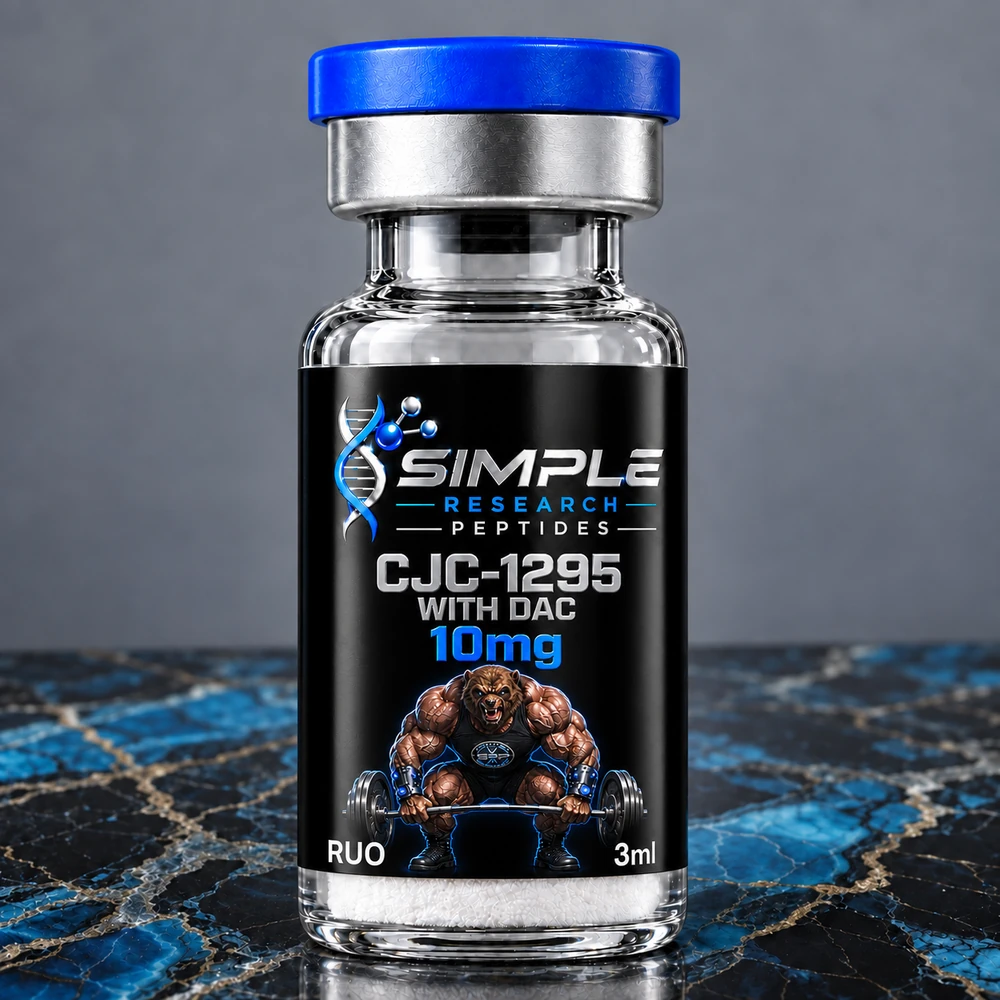
CJC-1295 with DAC Research GuideDAC:GRF · not No-DAC · not tesamorelin · not FDA-approved
CJC-1295 with DAC (also DAC:GRF / DAC-GRF) is a tetrasubstituted GHRH(1-29) amide carrying a C-terminal Nε-3-maleimidopropionamide-lysine Drug Affinity Complex that covalently binds serum albumin after administration. It is the ConjuChem long-acting construct studied in the opened 2005–2009 papers. It is not CJC-1295 No-DAC / Modified GRF 1-29, not tesamorelin, not sermorelin, and not an FDA-approved drug. Research use only. Not medical advice. Not for human use.
CAS 446262-90-4
UNII 62RC32V9N7
Not No-DAC
Not tesamorelin
Not FDA-approved
Educational information only. This page describes an investigational laboratory research peptide. It is not medical advice. Simple Research Peptides (SRP) materials are for laboratory research only and are not for human or veterinary use, consumption, administration, diagnosis, treatment, or therapeutic application. Sequence, CAS, UNII, and formula below are taken from opened public registries and primary papers that name CJC-1295 as the albumin-binding (DAC) construct — not from the SRP product page. No human dosing, reconstitution, or administration protocol appears on this page.
Sequence and chemical identity
SRP product and index pages do not print a sequence, CAS, UNII, molecular formula, or a public COA. Identity below is taken only from opened public registries and primary papers that name CJC-1295 as the albumin-binding (DAC) construct.
One-sentence identity: CJC-1295 with DAC (also DAC:GRF / DAC-GRF) is a tetrasubstituted GHRH(1-29) amide carrying a C-terminal Nε-3-maleimidopropionamide-lysine Drug Affinity Complex that covalently binds serum albumin after administration. It is the ConjuChem long-acting construct studied in the opened 2005–2009 papers. It is not CJC-1295 No-DAC / Modified GRF 1-29, not tesamorelin, not sermorelin, and not an FDA-approved drug.
| Identifier | Value on opened page | Source opened |
|---|---|---|
| Trade / development names | CJC-1295; DAC:GRF; DAC-GRF; DAC(TM):GRF | Jetté 2005 PMID 15817669; Teichman 2006 PMID 16352683; ConjuChem / BioSpace 2006-07-14; NCATS Inxight |
| SRP listing name | CJC-1295 DAC 5 mg Long-Acting Research Peptide Vial | SRP product page |
| SRP listed strength / format | 5 mg Vial | SRP product page |
| SRP store / research category | Growth Hormone Research | SRP product page (store taxonomy, not a clinical indication) |
| SRP index listing | “CJC-1295 DAC (5 mg Vial)”; Growth; “Evidence profile”; evidence tag Early human pharmacology | SRP compound-research-guides index |
| Chemical class | Maleimido derivative of hGRF(1-29); tetrasubstituted hGRF(1-29) plus C-terminal Nε-3-maleimidopropionamide-lysine | PubChem CID 91971820 (MeSH description); Jetté 2005 abstract |
| PubChem CID (DAC / maleimido construct) | 91971820. Title: Cjc 1295. Description: “a maleimido derivative of hGRF(1-29); structure in first source.” | PubChem PUG REST / PUG View, opened 16 August 2026 |
| CAS on CID 91971820 | 446262-90-4 | PubChem CID 91971820; NCATS Inxight |
| Deprecated CAS on that CID | 863288-34-0 (listed as deprecated) | PubChem CID 91971820 |
| UNII | 62RC32V9N7 | PubChem CID 91971820; NCATS Inxight |
| Molecular formula / MW | C165H269N47O46; 3647.2 g/mol | PubChem CID 91971820 |
| Exact / monoisotopic mass | 3646.0188391 / 3645.0154843 | PubChem PUG property |
| InChIKey | ZUQGTWKGESAQCD-ZGFIGYLBSA-N | PubChem CID 91971820 |
| NCATS Inxight | CJC-1295; Investigational; Approval Year: Unknown; cites NCT00267527 | https://drugs.ncats.io/drug/62RC32V9N7 |
| RxCUI | 1805005 | PubChem; NCATS |
| EPA DSSTox | DTXSID501027567 | PubChem; NCATS |
| MeSH | M0487015 (CJC 1295 / CJC-1295 / CJC1295) | PubChem PUG View |
| IUPHAR / GtoPdb ligand | No ligand record for CJC-1295 (services search 404 / empty) | IUPHAR services API, opened 16 August 2026 |
| IUPHAR receptor class (endogenous ligand) | GHRH receptor, target id 247; glucagon-receptor-family GPCR; endogenous ligand GHRH; pituitary; cAMP / GH-release assays | IUPHAR ObjectDisplay 247 |
| ClinicalTrials.gov (CJC-1295 / CJC1295) | 1 study: NCT00267527 (terminated Phase 2). Queries DAC:GRF, DAC-GRF, DAC:SGRF returned 0 | CT.gov API v2, opened 16 August 2026 |
| openFDA Drugs@FDA / labels | No CJC-1295 finished-drug match. A CJC-1295 string search returned unrelated products (varenicline, estradiol, others) — not used as identity | openFDA API, opened 16 August 2026 |
| INN / USAN | None on opened PubChem, NCATS, or IUPHAR pages | — |
| FDA-approved product | None. NCATS: Investigational; Approval Year Unknown | NCATS Inxight |
PubChem CID 91971820 systematic / IUPAC features (DAC construct). The opened systematic name begins L-Lysinamide, L-Tyrosyl-D-alanyl-L-α-aspartyl-L-alanyl-L-isoleucyl-L-phenylalanyl-L-threonyl-L-glutaminyl-… and the computed IUPAC name ends in a C-terminal residue 6-[3-(2,5-dioxopyrrol-1-yl)propanoylamino] (maleimidopropionyl on the lysine ε-amine). That is the DAC handle. Residue order on that CID matches tetrasubstituted GHRH(1-29) plus Lys30:
Y-(D-Ala)-DAIFTQSYRKVLAQLSARKLLQDILSR-K(MPA)-NH2
Versus native human GHRH(1-29) amide, the opened names encode D-Ala2, Gln8 (native Asn), Ala15 (native Gly), Leu27 (native Met), plus the extra C-terminal MPA-Lys. Jetté et al. 2005 print the same construct in words: “a tetrasubstituted form of hGRF(1-29) with an added Nε-3-maleimidopropionamide derivative of lysine at the C terminus.”
Registry chaos that must not be collapsed. PubChem CID 56841945 is a different structure: the 29-residue tetrasubstituted amide without the maleimide-lysine (formula C152H252N44O42; MW 3367.9; InChIKey XOZMWINMZMMOBR-HRDSVTNWSA-N). Depositor-supplied synonyms on that no-DAC CID include both “CJC 1295 with DAC” and “CJC-1295-no DAC acetate,” and the string 863288-34-0. On the DAC CID 91971820, 863288-34-0 is a deprecated CAS. Do not treat CAS 863288-34-0, CID 56841945, or a vendor “CJC-1295” label as proof of the DAC conjugate.
Not printed on SRP pages and therefore not claimed as SRP-verified: sequence, CAS, UNII, formula, maleimide occupancy, or purity numbers. The product page does not print a public COA. SRP itself is a research-material listing, not a ConjuChem clinical lot.
How it is not No-DAC, tesamorelin, sermorelin, or ipamorelin
This page is the DAC version only. SRP already has a dedicated No-DAC guide. The two listings are not interchangeable.
| Identity | What opened sources actually describe | Albumin-binding DAC | Typical literature role |
|---|---|---|---|
| Native GHRH / GRF | Human GRH(1-44)-NH2 and shorter C-terminal forms, including GRH(1-29)-NH2 | None | Endogenous ligand of GHRHR (IUPHAR 247) |
| Sermorelin | Unmodified GHRH(1-29) amide | None | Short fragment; historical GHRH(1-29) name |
| CJC-1295 No-DAC / Modified GRF 1-29 | Marketplace name for the tetrasubstituted GHRH(1-29) amide without MPA-Lys30 | Absent | Catalog synonym; not the molecule in Teichman / Ionescu / Alba / Sackmann-Sala |
| CJC-1295 with DAC (this page) | Jetté: tetrasubstituted hGRF(1-29) + C-terminal Nε-3-maleimidopropionamide-lysine; Teichman/Ionescu: long-acting analog that binds albumin | Present — Cys34 covalent handle | The 2005–2009 ConjuChem / academic construct |
| Tesamorelin (TH9507 / EGRIFTA WR) | DailyMed: 44-amino-acid human GRF plus an N-terminal hexenoyl (C6, double bond at position 3) on tyrosine | None (different modification) | FDA-approved finished drug (2010) for a narrow HIV-lipodystrophy indication |
| Ipamorelin | Ghrelin-receptor (GHSR1a) agonist / GH secretagogue | None | Different receptor class; combination papers are not DAC monotherapy evidence |
CJC-1295 No-DAC is a different research listing
Dedicated guide: CJC-1295 No DAC Research Guide. Product: CJC-1295 No DAC 5 mg vial. Indexed “CJC-1295” papers opened here study the albumin-binding DAC construct unless a paper explicitly tests a no-DAC sequence. Do not transfer Teichman’s 5.8–8.1 day half-life, multi-day GH/IGF-I elevation, Ionescu pulsatility data, or Alba mouse growth-rescue to a no-DAC vial.
Tesamorelin is a third, approved molecule
DailyMed EGRIFTA WR (revised March 2025; initial U.S. approval 2010): tesamorelin is the 44-residue human GRF sequence plus a hexenoyl moiety on the N-terminal tyrosine; in vitro it “binds and stimulates human GRF receptors with similar potency as the endogenous GRF.” Mean elimination half-life after a single subcutaneous 1.28 mg EGRIFTA WR dose in healthy subjects was 11 minutes. Approved only to reduce excess abdominal fat in HIV-infected adults with lipodystrophy. SRP tesamorelin research material is a separate listing and is not EGRIFTA. Tesamorelin NCTs (TH9507 / EGRIFTA) are not CJC-1295 DAC trials. Dedicated guide: Tesamorelin Research Guide.
Sermorelin is unmodified GHRH(1-29)
It lacks both the four substitutions and the DAC lysine. Do not cite sermorelin diagnostic or pediatric literature as CJC-1295 DAC evidence.
Ipamorelin is not a GHRH analogue
Combination / “stack” pages, including the SRP CJC-1295 + Ipamorelin Blend Research Guide, are combination context only. They do not supply DAC monotherapy outcomes.
Marketplace name chaos. Henninge et al. 2010 (PMID 21204297) identified a seized unknown pharmaceutical as a 29-amino-acid C-terminally amidated peptide “consistent with a peptide currently marketed under the name CJC-1295.” A 29-residue amide is the no-DAC-length backbone, not the 30-residue MPA-Lys conjugate on PubChem CID 91971820. A label that says only “CJC-1295” does not establish DAC status. Label: NOT DAC efficacy.
Proposed mechanism (GHRH receptor + albumin-binding DAC)
Opened primary papers support this working model. It is a receptor-pharmacology and PK description, not a treatment claim. Observed means a measurement in an opened DAC paper. Proposed means analogue-design rationale. Class / adjacent means related-family or tesamorelin-label context. Not shown means the opened papers did not establish it.
GHRHR + albumin Cys34 maleimide
Endogenous GHRH is a hypothalamic peptide that acts on the pituitary GHRH receptor (GHRHR / GRF receptor), a glucagon-family class B GPCR (IUPHAR target 247). Opened GHRHR functions include stimulation of GH release, somatotroph proliferation, and GH gene transcription, with cAMP used as a functional assay readout. Sackmann-Sala et al. 2009 restate the class biology: GHRH binds receptors on pituitary somatotropes to promote GH synthesis and release. Tesamorelin’s opened label is class-adjacent only: endogenous GHRF “acts on the pituitary somatotroph cells to stimulate the synthesis and pulsatile release of endogenous growth hormone (GH).”
Maleimide to albumin Cys34
Jetté et al. 2005: in vivo bioconjugation to the free thiol on Cys34 of serum albumin by a strategically placed reactive group extends plasma half-life. Three maleimido hGRF(1-29) derivatives were conjugated to human serum albumin ex vivo; the HSA conjugates showed enhanced in vitro stability against DPP-IV and were bioactive in a GH-secretion assay in cultured rat anterior pituitary cells. The selected compound, CJC-1295, is the tetrasubstituted hGRF(1-29) plus C-terminal Nε-3-maleimidopropionamide-lysine. After subcutaneous administration in Sprague-Dawley rats, a CJC-1295-immunoreactive species co-migrated with serum albumin from 15 min and remained beyond 24 h; peptide was still detectable in plasma beyond 72 h. (PMID 15817669.)
Why the backbone is tetrasubstituted
Native GRH is a DPP-IV substrate. Frohman et al. 1986 (PMID 3093533): after IV GRH(1-44)-NH2 in normal subjects, HPLC t½ of intact peptide was 6.8 min; in vitro plasma HPLC t½ was 17 min; the product is inactive GRH(3-44)-NH2 (bioactivity <10−3 of parent). Frohman et al. 1989 (PMID 2565342): primary cleavage is DPP-IV at the 2–3 bond; D-amino acid substitution at position 1 or 2 prevented that hydrolysis. Those papers justify analogue design. They are not DAC PK studies and are not no-DAC catalog-vial PK. Label: NOT DAC efficacy.
Minutes vs days
Native GRH lasts minutes (Frohman 1986). Tesamorelin, a different approved analogue, has an opened label t½ of 11 minutes. Jetté’s DAC construct was still detectable in rat plasma beyond 72 h and tracked with albumin. Teichman et al. 2006 estimated the human half-life of CJC-1295 (the long-acting analog in that trial) at 5.8–8.1 days. Ionescu and Frohman 2006 describe the same analog as binding permanently to endogenous albumin after injection (half-life = 8 d). That multi-day exposure is a DAC finding. It does not describe Modified GRF 1-29 / No-DAC. (PMID 16352683; PMID 17018654.)
GH / IGF-I up; pulsatility preserved
In opened human DAC studies, mean GH and IGF-I rose and stayed up for days (Teichman), and overnight GH pulsatility was preserved while trough GH rose (Ionescu). The analog still requires an intact pituitary GH-secretory apparatus (Ionescu conclusion; Alba used GHRH-knockout mice that retain a pituitary that can respond to a GHRH analog). Blog language that DAC “flattens pulses” is wrong on the opened Ionescu paper.
No human GHRHR Ki table; no vial = lot
No opened page showed a human GHRHR binding-affinity table or crystal structure for CJC-1295 DAC; proof that an SRP 5 mg vial matches ConjuChem clinical-lot conjugation chemistry; or FcRn recycling as a measured endpoint in a CJC-1295 paper (albumin half-life is class biology, not a DAC-paper result opened here). IUPHAR does not list a CJC-1295 ligand. Receptor assignment is by class (GHRHR) plus Jetté’s rat-pituitary GH-release assay.
Where the literature actually sits
Label every row. DAC ≠ No-DAC. Tesamorelin, sermorelin, Mod GRF, and ipamorelin combo papers are not DAC evidence. Human numbers below are historical results from opened papers and registries. They are not instructions for using SRP research vials, and they are not claims that research-grade material works in people.
Jetté 2005; Alba 2006
Jetté et al. 2005, PMID 15817669: defines CJC-1295 as tetrasubstituted hGRF(1-29) + C-terminal Nε-3-maleimidopropionamide-Lys; rat pituitary bioactivity; peptide in rat plasma beyond 72 h. Alba et al. 2006, PMID 16822960: GHRH knockout mice; 2 µg CJC-1295 every 24/48/72 h; daily dosing normalized body weight and length. Mouse growth-rescue. Not a human efficacy trial. Not No-DAC.
Teichman; Ionescu; Sackmann-Sala
Teichman 2006, PMID 16352683: healthy adults; t½ 5.8–8.1 days; GH 2–10× for ≥6 days; IGF-I 1.5–3× for 9–11 days. Ionescu 2006, PMID 17018654: pulsatility preserved; trough GH 7.5×. Sackmann-Sala 2009, PMID 19386527: exploratory proteomics in an Ionescu subset. Healthy-volunteer PK/PD, not a disease-outcome trial.
NCT00267527 TERMINATED
ConjuChem Phase 2 HIV-associated visceral obesity; CJC 1295 low dose / high dose / placebo; enrollment count 120. TERMINATED. Outcomes module empty. A 14 July 2006 ConjuChem announcement said the DAC:GRF program was placed on clinical hold after a patient death in Argentina, with cause and drug relationship then under investigation. This NCT is not tesamorelin. Do not invent unpublished efficacy numbers.
Native GRH, tesamorelin, seized 29-mer
Frohman 1986 PMID 3093533 and 1989 PMID 2565342: native GRH minutes-scale t½ and DPP-IV / D-Ala2 rationale — NOT DAC efficacy. DailyMed EGRIFTA WR: tesamorelin 44-aa, t½ 11 min. Henninge 2010 PMID 21204297: seized 29-aa amide sold as “CJC-1295” — length matches No-DAC, not MPA-Lys30. Tesamorelin NCTs are not DAC CJC-1295.
SRP 5 mg page prints no sequence
Opened SRP page: CJC-1295 DAC 5 mg Long-Acting Research Peptide Vial; Growth Hormone Research; COA verified research compound language on the lead line, but sequence, CAS, UNII, molecular formula, and a public COA were not printed. Index tag: Early human pharmacology. Product page.
False equivalences
DAC and No-DAC are the same peptide is false. It is tesamorelin / tesamorelin-lite is false. It is just sermorelin with a longer tail is false. DAC flattens GH pulses is a misread of Ionescu 2006. A 6–8 day half-life applies to any vial labeled CJC-1295 is unsupported unless the vial is the DAC conjugate. NCT00267527 proved efficacy or proved the drug caused a death: neither.
Chemistry / preclinical — DAC construct
Read the actual-finding column. Published study designs are historical facts from those papers. They are not a protocol. These two papers name the albumin-binding / maleimido construct. They are not No-DAC catalog-vial studies.
| Study | Species / model | What was tested | Actual finding (from the opened record) |
|---|---|---|---|
| Jetté et al., Endocrinology 2005 PMID 15817669. DOI 10.1210/en.2004-1286. |
Cultured rat anterior pituitary cells; male Sprague-Dawley rats, sc | Three maleimido hGRF(1-29) derivatives ± HSA conjugation | HSA conjugates were DPP-IV-resistant in vitro and bioactive. Best compound CJC-1295 gave a 4-fold increase in GH AUC over 2 h vs hGRF(1-29). Peptide present in rat plasma beyond 72 h; immunoreactive species on the albumin band from 15 min to >24 h. Defines CJC-1295 as tetrasubstituted hGRF(1-29) + C-terminal Nε-3-maleimidopropionamide-Lys. |
| Alba et al., Am J Physiol Endocrinol Metab 2006 PMID 16822960. DOI 10.1152/ajpendo.00201.2006. |
GHRH knockout mice, treated from 1 week of age for 5 weeks | 2 µg CJC-1295 (described as a synthetic GHRH analog that “selectively and covalently binds to endogenous albumin after injection”) every 24, 48, or 72 h | Daily dosing normalized body weight and length vs heterozygote controls. 48- and 72-h intervals improved growth vs placebo but did not fully normalize. Femur/tibia length normal at 24- and 48-h intervals. Increased pituitary RNA, GH mRNA, and somatotroph immunohistochemistry signal. Mouse growth-rescue. Not a human efficacy trial. Not No-DAC. |
Jetté, Léger, Thibaudeau, et al., 2005 — Endocrinology
Human growth hormone-releasing factor (hGRF)1-29-albumin bioconjugates activate the GRF receptor on the anterior pituitary in rats: identification of CJC-1295 as a long-lasting GRF analog. Three maleimido hGRF(1-29) derivatives were conjugated to HSA ex vivo. Conjugates were DPP-IV-resistant and bioactive in cultured rat anterior pituitary cells. After sc administration in Sprague-Dawley rats, a CJC-1295-immunoreactive species co-migrated with serum albumin from 15 min and remained beyond 24 h; peptide was still detectable in plasma beyond 72 h. Best compound CJC-1295 gave a 4-fold increase in GH AUC over 2 h vs hGRF(1-29). This paper is the chemical definition of the DAC construct used on this page. PMID 15817669. DOI 10.1210/en.2004-1286.
Alba, Fintini, Sagazio, et al., 2006 — Am J Physiol Endocrinol Metab
Once-daily administration of CJC-1295, a long-acting growth hormone-releasing hormone (GHRH) analog, normalizes growth in the GHRH knockout mouse. The analog is described as selectively and covalently binding to endogenous albumin after injection. Daily 2 µg dosing from week 1 for 5 weeks normalized body weight and length versus heterozygote controls; 48- and 72-h intervals improved growth versus placebo but did not fully normalize. This is mouse growth-rescue, not a human efficacy trial, and not a No-DAC experiment. PMID 16822960. DOI 10.1152/ajpendo.00201.2006.
Opened human studies that used the DAC / long-acting CJC-1295 construct
These three papers study CJC-1295 as a long-acting / albumin-binding GHRH analog. They are healthy-adult pharmacology, not disease-outcome trials, and not No-DAC catalog-vial studies. Teichman numbers below are from the opened abstract.
| Study | Species / model | What was tested | Actual finding (from the opened record) |
|---|---|---|---|
| Teichman et al., J Clin Endocrinol Metab 2006 PMID 16352683. DOI 10.1210/jc.2005-1536. |
Healthy adults, ages 21–61; two randomized, placebo-controlled, double-blind ascending-dose trials (28 and 49 d) at two investigational sites | Subcutaneous CJC-1295, a “long-acting GHRH analog”; one of four ascending single doses, or two or three weekly or biweekly doses | After a single injection: mean plasma GH 2- to 10-fold for ≥6 days; mean plasma IGF-I 1.5- to 3-fold for 9–11 days. Estimated half-life 5.8–8.1 days. After multiple doses, mean IGF-I remained above baseline for up to 28 days. No serious adverse reactions reported in that short program; authors described tolerability especially at 30 or 60 µg/kg. There was evidence of a cumulative effect after multiple doses. Healthy-volunteer PK/PD, not a disease-outcome trial. |
| Ionescu & Frohman, J Clin Endocrinol Metab 2006 PMID 17018654. DOI 10.1210/jc.2006-1702. |
Healthy men, 20–40 yr; overnight 12-h GH sampling (every 20 min) before and 1 week after | Single injection of 60 or 90 µg/kg CJC-1295; paper describes a synthetic GHRH analog that “binds permanently to endogenous albumin after injection (half-life = 8 d)” | Pulsatility preserved. Pulse frequency and magnitude unaltered. Basal (trough) GH 7.5-fold higher (P < 0.0001); mean GH +46% (P < 0.01); IGF-I +45% (P < 0.001). No significant difference between the two doses. IGF-I increases did not correlate with GH-secretion parameters. This paper does not show that DAC flattens GH pulses. |
| Sackmann-Sala et al., Growth Horm IGF Res 2009 PMID 19386527. DOI 10.1016/j.ghir.2009.03.001. PMC 2787983. |
Subset of 11 healthy men from the Ionescu cohort (BMI <25; ages 20–34); 2-D gels before vs 1 week after | Same CJC-1295 (ConjuChem Inc., Montreal) injection, 60–90 µg/kg sc; exploratory proteomics | GH and IGF-1 rose as previously reported. Five protein spots changed (ApoA1 isoform ↓, transthyretin isoform ↓, β-hemoglobin ↑, albumin / Ig fragments ↑). Spot B (Ig + albumin fragments) correlated with IGF-1 change. Exploratory biomarker work, not an efficacy or body-composition trial. |
Teichman, Neale, Lawrence, Gagnon, Castaigne, Frohman, 2006 — JCEM
Prolonged stimulation of growth hormone (GH) and insulin-like growth factor I secretion by CJC-1295, a long-acting analog of GH-releasing hormone, in healthy adults. Two randomized, placebo-controlled, double-blind ascending-dose trials (28 and 49 days). After a single injection: mean plasma GH 2- to 10-fold for ≥6 days; mean plasma IGF-I 1.5- to 3-fold for 9–11 days. Estimated half-life 5.8–8.1 days. After multiple doses, mean IGF-I remained above baseline for up to 28 days. No serious adverse reactions reported in that short program; authors described tolerability especially at 30 or 60 µg/kg. Cumulative effect after multiple doses. This is healthy-volunteer PK/PD, not a disease-outcome trial, and not a No-DAC result. PMID 16352683. DOI 10.1210/jc.2005-1536.
Ionescu & Frohman, 2006 — JCEM
Pulsatile secretion of growth hormone (GH) persists during continuous stimulation by CJC-1295, a long-acting GH-releasing hormone analog. Overnight 12-h GH sampling every 20 min in healthy men 20–40 yr, before and 1 week after a single 60 or 90 µg/kg injection. The analog “binds permanently to endogenous albumin after injection (half-life = 8 d).” Pulsatility preserved. Pulse frequency and magnitude unaltered. Trough GH 7.5-fold higher. Mean GH +46%. IGF-I +45%. No significant difference between the two doses. Blog language that DAC flattens GH pulses is wrong on this opened paper. PMID 17018654. DOI 10.1210/jc.2006-1702.
Sackmann-Sala, Ding, Frohman, Kopchick, 2009 — Growth Horm IGF Res
Activation of the GH/IGF-1 axis by CJC-1295, a long-acting GHRH analog, results in serum protein profile changes in normal adult subjects. Subset of 11 healthy men from the Ionescu cohort. Same ConjuChem Inc., Montreal CJC-1295 injection, 60–90 µg/kg sc. GH and IGF-1 rose as previously reported. Five protein spots changed. Exploratory biomarker work, not an efficacy or body-composition trial. PMID 19386527. DOI 10.1016/j.ghir.2009.03.001. PMC 2787983.
Registry trial that named CJC 1295 — no published results
The only opened CJC-1295 NCT is NCT00267527. It is TERMINATED, with no posted results. Tesamorelin NCTs (TH9507 / EGRIFTA) are a separate list and are not cited as CJC-1295 DAC evidence on this page.
| Record | What it is | What the opened page showed | What it did not show |
|---|---|---|---|
| NCT00267527 https://clinicaltrials.gov/study/NCT00267527 (API v2 opened 16 August 2026) |
ConjuChem Phase 2; multicenter, randomized, placebo-controlled, double-blind; CJC 1295 low dose / high dose / placebo for 12 weeks + 6-week follow-up in HIV-associated visceral obesity; ages 18–65; enrollment count 120; official title uses “CJC 1295” | TERMINATED. Status verified 2006-10. Start 2005-12; completion 2006-09. Outcomes module empty (no posted results). | Efficacy, PK tables, adverse-event tables, or a causality assessment. This NCT is not tesamorelin / TH9507. |
| ConjuChem announcement reprinted 2006-07-14 BioSpace / CNW reprint |
Company statement on the DAC(TM):GRF HIV-lipodystrophy Phase II program | Program placed on clinical hold; further dosing discontinued “due to a death of a patient involved in the trial.” Event at a clinical site in Argentina. “The cause of death and the relationship of the study drug to the event … is currently under investigation.” Company description: DAC:GRF covalently bonds to albumin and prolongs GRF half-life “from minutes to days.” | A published autopsy, independent adjudication, or the unpublished n=120 dataset. Secondary blogs that add myocardial-infarction / “eleventh injection” detail were not used. |
Adjacent records — opened for distinction only
Logged so they are not silently reused. Each distinction PMID is labeled NOT DAC efficacy. Do not cite these as DAC CJC-1295 proof. Tesamorelin NCTs are not listed as DAC evidence.
| Record | Why it was opened | Why it is not DAC CJC-1295 evidence |
|---|---|---|
| Frohman et al., J Clin Invest 1986 PMID 3093533. DOI 10.1172/JCI112679. PMC 423714. NOT DAC efficacy |
Native GRH plasma t½ (minutes) | Native GRH(1-44)-NH2, not the DAC conjugate. HPLC t½ of intact peptide 6.8 min after IV dosing; in vitro plasma HPLC t½ 17 min. |
| Frohman et al., J Clin Invest 1989 PMID 2565342. DOI 10.1172/JCI114049. NOT DAC efficacy |
DPP-IV cleavage; D-Ala2 blocks 2–3 hydrolysis | Analogue-design rationale. Not a DAC human PK curve. Not no-DAC catalog-vial PK. |
| DailyMed EGRIFTA WR, rev. Mar 2025 setid 839334d3-8c1d-4c26-9036-2ab524a6ea75. NOT DAC efficacy |
Tesamorelin chemistry, 11-min t½, approved indication, class GHRF mechanism, labeled risks | 44-aa N-hexenoyl GRF. Different drug. Tesamorelin NCTs are not CJC-1295. Initial U.S. approval 2010 for a narrow HIV-lipodystrophy indication. |
| Henninge et al., Drug Test Anal 2010 PMID 21204297. DOI 10.1002/dta.233. NOT DAC efficacy |
Marketplace / seized-vial identity | 29-aa C-terminal amide sold as “CJC-1295” — length matches No-DAC, not the MPA-Lys30 conjugate on CID 91971820. |
| SRP No-DAC guide / No-DAC 5 mg product | Cross-link; avoid duplication | Different listing. Do not copy its No-DAC conclusions onto this page. Dedicated guide: CJC-1295 No DAC Research Guide. |
Tesamorelin NCTs are not DAC CJC-1295. CT.gov tesamorelin returned a separate list (TH9507 / EGRIFTA studies). Those records were not treated as CJC-1295 evidence. DAC:SGRF returned 0 studies. Distinction PMIDs (label as NOT DAC efficacy): 3093533, 2565342, 21204297.
Regulatory status (opened pages only)
Bottom line from opened sources: CJC-1295 with DAC is an investigational ConjuChem construct. It is not FDA-approved as a US drug on any opened FDA or NCATS page. Tesamorelin’s 2010 approval is a different molecule. An SRP research vial is not a licensed medicine. Research use only. Not medical advice. Not for human use.
| Claim | What an opened page actually said | What we did not open / confirm |
|---|---|---|
| US FDA marketing approval | NCATS Inxight: Investigational; Approval Year Unknown. openFDA Drugs@FDA / labels: no CJC-1295 finished-drug match. A string search returned unrelated products and was not used as identity. | A Drugs@FDA NDA/BLA page (none found). Do not invent an NDA, ANDA, or BLA number. Tesamorelin’s 2010 approval is a different molecule. |
| UNII / GSRS | UNII 62RC32V9N7 on PubChem CID 91971820 and NCATS Inxight. | That UNII is a registry identity, not an approval. |
| INN / USAN | None on opened PubChem, NCATS, or IUPHAR pages. | A WHO INN list entry (not found, not opened). |
| IUPHAR ligand | No ligand record for CJC-1295. Receptor class is GHRHR target 247 (endogenous ligand GHRH). | A curated human-receptor Ki table for CJC-1295 DAC. |
| Clinical development | NCT00267527 TERMINATED; no posted results. ConjuChem 14 July 2006 statement: clinical hold after a death in Argentina; causality under investigation on that page. | The unpublished n=120 dataset, an autopsy, or independent adjudication. |
What is NOT established
These are gaps in the opened record. Treating any of them as settled is incorrect. Keep this list visible.
No FDA-approved therapeutic use of CJC-1295 with or without DAC
NCATS: Investigational; Approval Year Unknown. Tesamorelin’s 2010 approval is a different molecule and a narrow HIV-lipodystrophy indication.
No published results from NCT00267527
The only opened CJC-1295 NCT is terminated. Outcomes were not posted. Body-composition, visceral-fat, or metabolic efficacy in HIV lipodystrophy is not established for CJC-1295 DAC.
Death in the terminated program is not a completed causality finding
The opened ConjuChem statement reports a death in Argentina and says the cause and relationship to study drug were under investigation. This page does not convert secondary-blog reconstructions into facts.
Short-term healthy-adult tolerability is not long-term safety
Teichman reported no serious adverse reactions in two short (28- and 49-day) healthy-adult trials and singled out 30 or 60 µg/kg. That is not a chronic-use, disease-population, or research-vial safety dataset.
Research-market vials are not ConjuChem clinical lots
SRP does not print sequence, CAS, or a public COA. Henninge shows that material sold as “CJC-1295” can be a 29-aa amide. DAC status must be confirmed analytically (maleimide-Lys present vs absent).
No opened body-recomposition, fat-loss, muscle-gain, sleep, injury-recovery, “anti-aging,” or athletic-performance trial of DAC CJC-1295
Teichman/Ionescu/Sackmann-Sala measured GH, IGF-I, pulsatility, and exploratory serum spots in healthy adults. Alba measured growth in GHRHKO mice.
Ipamorelin combination efficacy is not established as DAC evidence
Combination pages are not monotherapy trials. The SRP blend guide is combination context only.
DAC does not “flatten” GH pulses in the opened human paper
Ionescu found pulse frequency and magnitude unaltered, with a large rise in trough GH (7.5-fold). Pulsatility was preserved.
No-DAC / Mod GRF half-life numbers do not apply here
The popular ~30-minute No-DAC figure was not a primary-paper result on the opened No-DAC guide either. Do not borrow it in either direction. Teichman’s 5.8–8.1 day estimate is DAC-only.
Tesamorelin label warnings are tesamorelin-label facts
Useful only as class-adjacent GH/IGF-1 context (neoplasm caution, elevated IGF-1, fluid retention, glucose intolerance/diabetes, hypersensitivity, injection-site reactions). They are not a CJC-1295 DAC safety trial.
Pediatric GHD, adult GHD, and sports-doping detection methods
Not established indications or quality programs for an SRP research vial.
IUPHAR does not list a CJC-1295 ligand
Receptor assignment is by class (GHRHR) plus Jetté’s rat-pituitary GH-release assay, not a curated human-receptor Ki table.
| Popular claim | Status after this review |
|---|---|
| “CJC-1295 DAC and No-DAC are the same peptide, just different half-lives you can dose around” | False identity. DAC is the MPA-Lys albumin-binding conjugate. No-DAC is a catalog 29-mer without that handle. Human multi-day PK/PD is DAC-only. |
| “It is tesamorelin / tesamorelin-lite / the approved GHRH drug” | False. Tesamorelin is N-hexenoyl-GRF(1-44); t½ 11 min on the opened label; approved 2010 for a narrow HIV-lipodystrophy indication. |
| “It is just sermorelin with a longer tail” | False. Sermorelin is unmodified GHRH(1-29). |
| “DAC flattens GH pulses; that is why people prefer No-DAC” | Misreads Ionescu 2006. Pulsatility was preserved on DAC CJC-1295. Trough GH rose 7.5-fold. |
| “6–8 day half-life applies to any vial labeled CJC-1295” | Unsupported unless the vial is the DAC conjugate. Teichman estimated 5.8–8.1 days for the long-acting analog in that trial. |
| Fat-loss / “GH stack” / ipamorelin synergy as published DAC fact | Not found in opened DAC papers. |
| NCT00267527 proved efficacy or proved the drug caused a death | Neither. Terminated; no posted results; opened company statement left causality under investigation. |
| Research vial = ConjuChem clinical lot | Not established. SRP does not print sequence, CAS, or a public COA. CID 56841945 synonym chaos and Henninge 29-aa seized vial both warn against label-only identity. |
Marketing claims vs opened evidence
Category names are store taxonomy, not clinical indications. Keep the early-human-pharmacology wording. Do not invent a sequence as if SRP verified it. Do not transfer Teichman / Ionescu numbers onto a No-DAC vial.
| Claim type | What opened pages actually support | Flag |
|---|---|---|
| SRP 5 mg page: “CJC-1295 DAC 5 mg Long-Acting Research Peptide Vial”; lead line COA-verified research compound; laboratory research use only; not for human consumption; Growth Hormone Research. | Quote-accurate for that URL. Sequence, CAS, UNII, molecular formula, and a public COA were not printed on the fetched page. http://simpleresearchpeptides.com/product/cjc-1295-dac-5-mg-vial/ | Category names are store taxonomy, not clinical indications. COA language on the lead line is not a public COA on the fetched page. |
| SRP index: Early human pharmacology; require sequence and DAC-status confirmation; mislabeling DAC versus non-DAC changes the scientific interpretation substantially. | Matches what this research pass found. | Keep that wording. DAC ≠ No-DAC. |
| Sequence is Y-(D-Ala)-DAIFTQSYRKVLAQLSARKLLQDILSR-K(MPA)-NH2; CAS 446262-90-4; UNII 62RC32V9N7; CID 91971820; C165H269N47O46. | Printed on PubChem CID 91971820 and/or NCATS; residue order matches Jetté’s words. | Do not present these as SRP-printed identifiers. CID 56841945 is a different 29-mer with chaotic synonyms. |
| FDA approved / same as tesamorelin / EGRIFTA. | Contradicted by NCATS Investigational, openFDA no finished-drug match, and DailyMed tesamorelin being a 44-aa N-hexenoyl GRF. | Do not use. |
| Using Teichman 5.8–8.1 d or Ionescu pulsatility as No-DAC facts. | Opened papers study the long-acting / albumin-binding analog. | Common catalog error. DAC-only. |
Research-only caution
CJC-1295 with DAC is a laboratory research peptide. It is not an FDA-approved drug for human use. This page is educational. It does not provide dosing, reconstitution, administration, or any human-use instructions.
Simple Research Peptides (SRP) materials are for laboratory research only and are not for human or veterinary use, consumption, administration, diagnosis, treatment, or therapeutic application.
Laboratory identity is the first practical issue. Opened papers and PubChem CID 91971820 describe a tetrasubstituted GHRH(1-29) amide plus C-terminal Nε-3-maleimidopropionamide-lysine (CAS 446262-90-4; UNII 62RC32V9N7; C165H269N47O46). CID 56841945 is the 29-mer without maleimide and must not be collapsed into this construct. SRP product pages do not print sequence, CAS, UNII, or formula. A method written for No-DAC / Modified GRF 1-29, tesamorelin, sermorelin, or ipamorelin is not automatically valid for this conjugate. Confirm maleimide-Lys occupancy before treating a vial as the literature DAC compound.
Biological inference has the same problem. Teichman, Ionescu, and Sackmann-Sala are short healthy-adult pharmacology papers. Alba is mouse growth-rescue. NCT00267527 was terminated without posted results. Independently sourced research peptides are not established as equivalent to ConjuChem clinical lots. Research use only. Not medical advice. Not for human use.
Common questions
Is this the same page as CJC-1295 No-DAC?
No. This page is CJC-1295 with DAC only. The No-DAC / Modified GRF 1-29 guide is a separate listing: http://simpleresearchpeptides.com/research-compound-directory/cjc-1295-no-dac-research-guide/
What does DAC mean on the opened papers?
Drug Affinity Complex: a C-terminal Nε-3-maleimidopropionamide-lysine (maleimidopropionyl-Lys) that covalently engages the free thiol of albumin Cys34 (Jetté 2005, PMID 15817669). That handle is what makes this construct long-acting. Mechanism: GHRHR + albumin Cys34 maleimide.
Did human studies actually use the DAC conjugate?
The opened Teichman, Ionescu, and Sackmann-Sala papers study CJC-1295 as a long-acting / albumin-binding GHRH analog (Ionescu: “binds permanently to endogenous albumin”; Teichman title: “long-acting analog”). Jetté defined that name as the maleimido-Lys construct. No opened human paper in this set tested a named “CJC-1295 No-DAC” vial.
Is CJC-1295 DAC FDA-approved?
No. NCATS lists it as investigational with unknown approval year. Tesamorelin is the approved GHRH analogue, and it is a different drug. Not FDA-approved.
Is tesamorelin the same drug?
No. Tesamorelin is 44 amino acids plus an N-terminal hexenoyl group. CJC-1295 DAC is a tetrasubstituted 1–29 core plus MPA-Lys30. DailyMed tesamorelin t½ is 11 minutes; Teichman’s DAC estimate is 5.8–8.1 days. Tesamorelin NCTs are not DAC evidence.
Does DAC flatten growth-hormone pulses?
Not in the opened Ionescu 2006 paper. Pulse frequency and magnitude were unaltered; trough GH rose 7.5-fold. Pulsatility was preserved. Blog language that DAC flattens pulses is wrong on that opened record. PMID 17018654.
What happened to NCT00267527?
ClinicalTrials.gov lists the ConjuChem Phase 2 HIV visceral-obesity study as TERMINATED, with no posted results. A 14 July 2006 ConjuChem announcement (BioSpace/CNW reprint) said the DAC:GRF program was placed on clinical hold after a patient death in Argentina, with cause and drug relationship then under investigation. This page does not treat that event as a completed causality finding and does not invent unpublished efficacy numbers.
Can Teichman’s half-life be cited for a No-DAC vial?
No. Teichman estimated 5.8–8.1 days for the long-acting analog in that trial. That multi-day PK/PD is DAC-only.
Can SRP vials be used as a human dose substitute?
No. SRP listings are for laboratory research only and are not for human or animal use. This page does not provide reconstitution, administration, or dosing instructions. Not medical advice. Not for human use.
Is the evidence mixed?
The opened DAC human record is early pharmacology: two short healthy-adult RCTs (Teichman), one overnight pulsatility study (Ionescu), and an exploratory proteomic subset (Sackmann-Sala). A later Phase 2 disease-population trial was terminated without posted results. Mouse growth-rescue (Alba) is preclinical. That is not a completed therapeutic program and is not evidence for research-market vials.
What about PubChem CID 56841945?
CID 56841945 is the 29-residue tetrasubstituted amide without the maleimide-lysine (C152H252N44O42). Depositor synonyms on that CID are chaotic and include both “CJC 1295 with DAC” and “CJC-1295-no DAC acetate.” Do not cite it as the DAC structure. The DAC CID is 91971820.
Does this page include human dosing?
No. There is no human dosing, reconstitution, or administration protocol on this page. Research use only.
Citations used on this page
Sources actually opened for this draft. DAC / long-acting CJC-1295 PMIDs: 15817669, 16352683, 17018654, 16822960, 19386527. Distinction PMIDs (label as NOT DAC efficacy): 3093533, 2565342, 21204297. NCT: ONLY NCT00267527 (TERMINATED, no posted results). Do not cite tesamorelin NCTs as DAC evidence.
- Jetté L, Léger R, Thibaudeau K, et al. Human growth hormone-releasing factor (hGRF)1-29-albumin bioconjugates activate the GRF receptor on the anterior pituitary in rats: identification of CJC-1295 as a long-lasting GRF analog. Endocrinology. 2005;146(7):3052-3058. PMID 15817669. DOI 10.1210/en.2004-1286. Defines the DAC construct.
- Teichman SL, Neale A, Lawrence B, Gagnon C, Castaigne JP, Frohman LA. Prolonged stimulation of growth hormone (GH) and insulin-like growth factor I secretion by CJC-1295, a long-acting analog of GH-releasing hormone, in healthy adults. J Clin Endocrinol Metab. 2006;91(3):799-805. PMID 16352683. DOI 10.1210/jc.2005-1536. Human PK/PD; DAC / long-acting analog. t½ 5.8–8.1 d; GH 2–10× ≥6 d; IGF-I 1.5–3× for 9–11 d (opened abstract).
- Ionescu M, Frohman LA. Pulsatile secretion of growth hormone (GH) persists during continuous stimulation by CJC-1295, a long-acting GH-releasing hormone analog. J Clin Endocrinol Metab. 2006;91(12):4792-4797. PMID 17018654. DOI 10.1210/jc.2006-1702. Human pulsatility; albumin-binding analog. Pulsatility preserved; trough GH 7.5×.
- Alba M, Fintini D, Sagazio A, et al. Once-daily administration of CJC-1295, a long-acting growth hormone-releasing hormone (GHRH) analog, normalizes growth in the GHRH knockout mouse. Am J Physiol Endocrinol Metab. 2006;291(6):E1290-E1294. PMID 16822960. DOI 10.1152/ajpendo.00201.2006. Mouse; albumin-binding analog.
- Sackmann-Sala L, Ding J, Frohman LA, Kopchick JJ. Activation of the GH/IGF-1 axis by CJC-1295, a long-acting GHRH analog, results in serum protein profile changes in normal adult subjects. Growth Horm IGF Res. 2009;19(6):471-477. PMID 19386527. DOI 10.1016/j.ghir.2009.03.001. PMC 2787983. Exploratory proteomics; Ionescu subset.
- Frohman LA, Downs TR, Williams TC, Heimer EP, Pan YC, Felix AM. Rapid enzymatic degradation of growth hormone-releasing hormone by plasma in vitro and in vivo to a biologically inactive product cleaved at the NH2 terminus. J Clin Invest. 1986;78(4):906-913. PMID 3093533. DOI 10.1172/JCI112679. PMC 423714. Native GRH minutes-scale t½ — distinction / PK contrast only. NOT DAC efficacy.
- Frohman LA, Downs TR, Heimer EP, Felix AM. Dipeptidylpeptidase IV and trypsin-like enzymatic degradation of human growth hormone-releasing hormone in plasma. J Clin Invest. 1989;83(5):1533-1540. PMID 2565342. DOI 10.1172/JCI114049. DPP-IV / D-Ala2 rationale — distinction only. NOT DAC efficacy.
- Henninge J, Pepaj M, Hullstein I, Hemmersbach P. Identification of CJC-1295, a growth-hormone-releasing peptide, in an unknown pharmaceutical preparation. Drug Test Anal. 2010;2(11-12):647-650. PMID 21204297. DOI 10.1002/dta.233. Seized 29-aa amide sold as “CJC-1295” — identity chaos. NOT DAC efficacy.
- ClinicalTrials.gov NCT00267527. A Study to Evaluate CJC 1295 in HIV Patients With Visceral Obesity. TERMINATED Phase 2; ConjuChem; no posted results. https://clinicaltrials.gov/study/NCT00267527 (API v2 opened 16 August 2026).
- ConjuChem Biotechnologies Inc. announcement, 14 July 2006, as reprinted: “ConjuChem Halts Phase 2 HIV Drug Test After Patient Death.” BioSpace / CNW. https://www.biospace.com/conjuchem-halts-phase-2-hiv-drug-test-after-patient-death-stock-drops-50-percent (opened 16 August 2026). Contemporaneous company statement; causality not resolved on that page.
- U.S. FDA / DailyMed. EGRIFTA WR (tesamorelin) for injection — full prescribing information. Label revised March 2025; initial U.S. approval 2010. DailyMed setid 839334d3-8c1d-4c26-9036-2ab524a6ea75. Tesamorelin distinction only. NOT DAC efficacy.
- PubChem CID 91971820 (Cjc 1295; maleimido hGRF(1-29); CAS 446262-90-4; UNII 62RC32V9N7; C165H269N47O46). https://pubchem.ncbi.nlm.nih.gov/compound/91971820 and PUG REST / PUG View (opened 16 August 2026).
- PubChem CID 56841945 (29-residue tetrasubstituted amide without maleimide-Lys; depositor-synonym chaos). https://pubchem.ncbi.nlm.nih.gov/compound/56841945 (opened 16 August 2026). Distinction only — do not cite as the DAC structure.
- NCATS Inxight Drugs, UNII 62RC32V9N7. https://drugs.ncats.io/drug/62RC32V9N7 (opened 16 August 2026). Investigational; Approval Year Unknown.
- IUPHAR/BPS Guide to PHARMACOLOGY, GHRH receptor target 247. https://www.guidetopharmacology.org/GRAC/ObjectDisplayForward?objectId=247 (opened 16 August 2026). Receptor class; no CJC-1295 ligand record.
- Simple Research Peptides pages (opened 16 August 2026): product http://simpleresearchpeptides.com/product/cjc-1295-dac-5-mg-vial/; index http://simpleresearchpeptides.com/research-compound-directory/compound-research-guides/; No-DAC guide http://simpleresearchpeptides.com/research-compound-directory/cjc-1295-no-dac-research-guide/; tesamorelin guide http://simpleresearchpeptides.com/research-compound-directory/tesamorelin-research-guide/. For laboratory research only. Not for human or animal use.
Allowed PMID list used on this page. DAC / long-acting CJC-1295 named on the opened record: 15817669; 16352683; 17018654; 16822960; 19386527. Opened for distinction / marketplace identity / native GRH PK — do not cite as DAC efficacy: 3093533; 2565342; 21204297. Allowed DOI list: 10.1210/en.2004-1286; 10.1210/jc.2005-1536; 10.1210/jc.2006-1702; 10.1152/ajpendo.00201.2006; 10.1016/j.ghir.2009.03.001; 10.1172/JCI112679; 10.1172/JCI114049; 10.1002/dta.233. NCT: NCT00267527 only. Opened PMC: PMC2787983 (Sackmann-Sala 2009). Bibliographic confirmation only: PMC423714 (Frohman 1986). No other PMIDs were added. Tesamorelin NCTs were not cited as DAC evidence.
Educational information only. CJC-1295 with DAC is a tetrasubstituted GHRH(1-29) amide plus C-terminal Nε-3-maleimidopropionamide-lysine (PubChem CID 91971820; CAS 446262-90-4; UNII 62RC32V9N7; C165H269N47O46). It is not No-DAC / Modified GRF 1-29, not tesamorelin, not sermorelin, and not an FDA-approved drug. CID 56841945 is the 29-mer without maleimide and has chaotic synonyms. Teichman: t½ 5.8–8.1 d; GH 2–10× ≥6 d; IGF-I 1.5–3× for 9–11 d. Ionescu: pulsatility preserved; trough GH 7.5×. NCT00267527 TERMINATED, no posted results; ConjuChem statement after a death in Argentina left causality under investigation. Laboratory research use only; not for human or animal use. Not medical advice. Not for human use. No human dosing protocol. Last source review: 16 August 2026 (America/Indianapolis). Locked draft converted to HTML the same day. For laboratory research only. Not for human or veterinary use.