
Not Semax
Different chemical class
Semax is a defined peptide. Cerebrolysin is a porcine-brain hydrolysate. Opened registries assign the mixture a UNII and CAS, not a sequence.
Products are color coded by category
Peptide research · Compound guide
Explore the mechanisms, study findings and evidence limits behind this research topic.
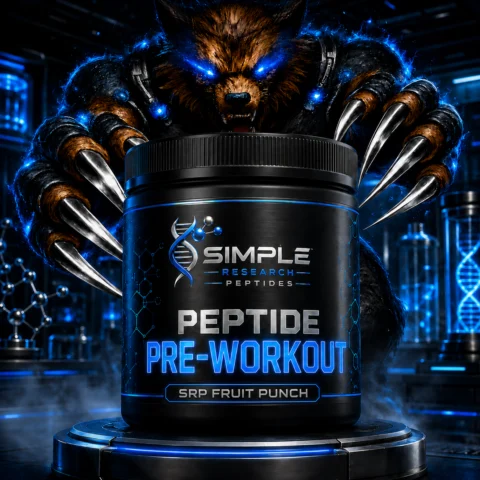
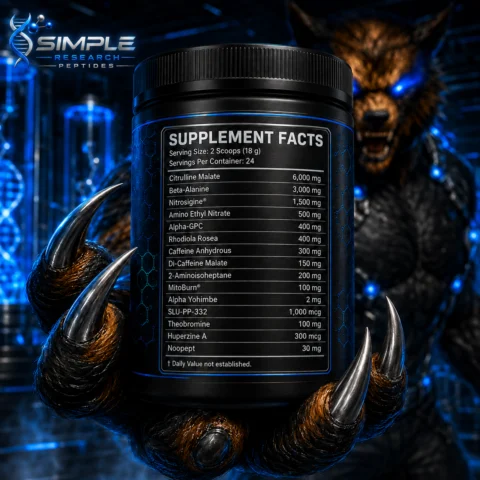
Product artwork identifies the SRP listing. It does not demonstrate safety or clinical benefit. The evidence guide and its sources follow below.
View product label and documentation →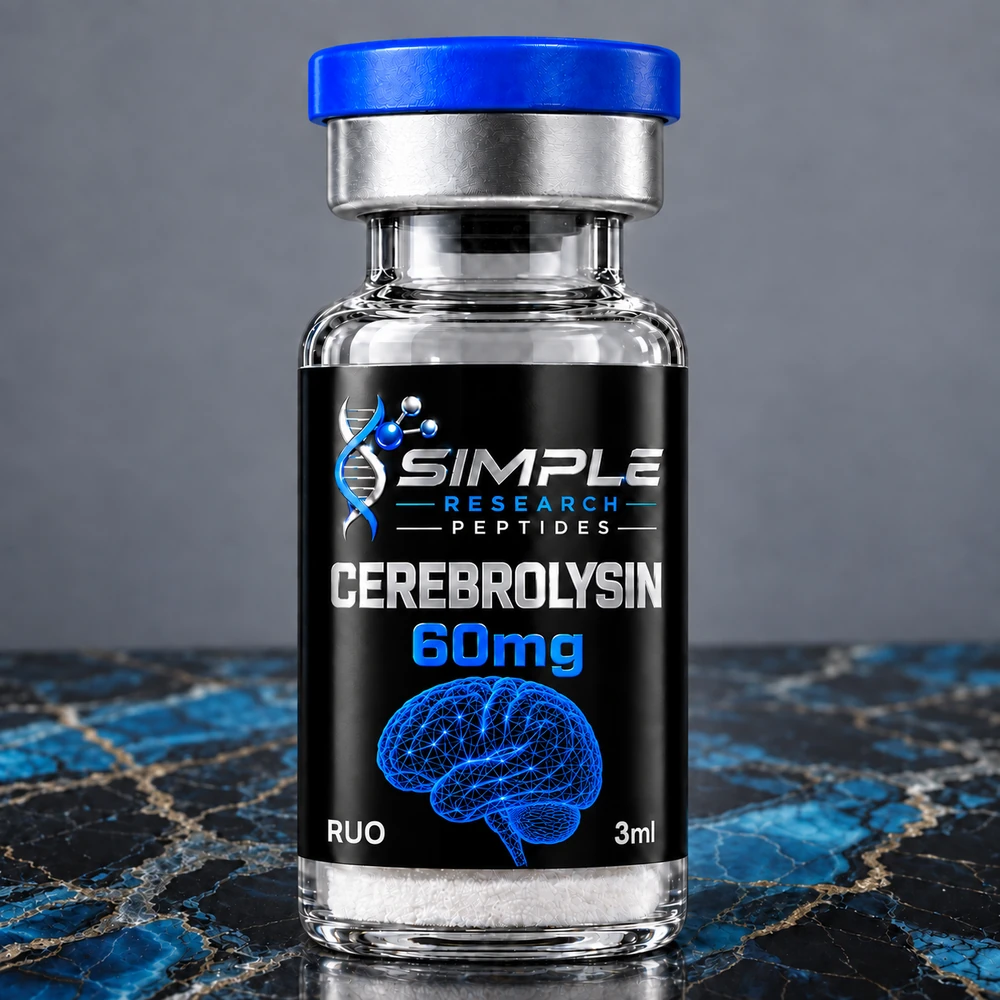
Cerebrolysin (also Cerebrolysin®, FPF-1070 / FPE 1070, Renacenz) is a porcine-brain-derived proteolytic peptide-and-amino-acid mixture (a hydrolysate), not a single defined peptide sequence. Not a single peptide. Not Semax. Not FDA-approved. Research use only. Not medical advice. Not for human use.
Educational information only. Cerebrolysin sold as a research material is a laboratory reagent. It is not an FDA-approved drug in the United States, not a dietary supplement, and is not for human or veterinary use, consumption, administration, diagnosis, or treatment. The SRP 60 mg / 3 mL research vial is NOT claimed identical to EVER Pharma 215.2 mg/mL Cerebrolysin®. No human dosing, reconstitution, or administration protocol appears on this page.
One-sentence identity: Cerebrolysin (also Cerebrolysin®, FPF-1070 / FPE 1070, Renacenz) is a porcine-brain-derived proteolytic peptide-and-amino-acid mixture (a hydrolysate), not a single defined peptide sequence.
Identity below is taken only from pages that were opened. No opened registry printed a unique amino-acid sequence, a molecular formula, an InChIKey, or a complete active-peptide inventory. Do not invent a sequence, a CAS for a “main peptide,” or an “active peptide list.”
Related product (vendor listing, not evidence): Simple Research Peptides lists “Cerebrolysin (60 mg Vial)” under Brain & Mind Research, printed as “Cerebrolysin (60 mg / 3 mL Vial)” and “Also Known As: Cerebrolysin Peptide Complex,” with research-use-only language. The opened product page did not print a peptide sequence, CAS number, UNII, molecular formula, or an active-peptide list. Vendor marketing, including the page’s educational reconstitution / “dosage chart” language, is not scientific evidence and is not reproduced here as a use instruction.
| Field | Value from opened registries / manufacturer pages | Source opened |
|---|---|---|
| Preferred name | CEREBROLYSIN | NCATS; FDA UNII search |
| Substance class (NCATS) | Structurally Diverse; source organism mammal; parent Sus scrofa (whole); part brain; fraction protein | NCATS substance record |
| Developmental / synonym codes | FPE 1070, FPE 1070 (IS), FPF 1070 (IS), Cerebrolysin Ebewe, Cerebrolyzin, Renacenz, Cerebrolysin [WHO-DD] | NCATS; FDA UNII |
| CAS | 12656-61-0 | NCATS; FDA UNII synonym list |
| UNII | 37KZM6S21G | NCATS; FDA UNII |
| Molecular formula | Blank / not assigned | FDA UNII (Formula field empty); NCATS (no formula printed) |
| Sequence | Not listed | All opened registries |
| Active-peptide list | Not listed | All opened registries |
| PubChem compound CID | Not found. PUG compound-name lookup for “cerebrolysin” returned HTTP 404. | PubChem PUG REST |
| PubChem substances | Name search returned SIDs (including 49902691). Opened SID 49902691 lists synonyms Cerebrolysin / Cerebrolysine / Fpf 1070 and no structure or formula. | PubChem PUG REST |
| DrugBank DB16599 | Page requested; Cloudflare challenge; not used for facts. | DrugBank |
| NCATS approval year | Unknown | NCATS |
| NCATS marketing note | “Possibly Marketed Outside US” | NCATS |
| NCATS other code | FDA ORPHAN DRUG 513315 (code only; indication not printed on the opened NCATS page) | NCATS |
| Licensed concentrate | “One ml contains 215.2 mg of Cerebrolysin® concentrate in aqueous solution.” Excipients: sodium hydroxide and water for injection. MAH: EVER Neuro Pharma GmbH, Unterach, Austria. | cerebrolysin.com About |
| US notice (manufacturer) | “Cerebrolysin is not registered with the U.S. Food and Drug Administration (FDA) and is not approved for sale or distribution in the United States.” | About and FAQs |
What opened registries do not list
FDA UNII disclaimer (printed on the opened UNII page): UNII availability “does not imply any regulatory review or approval.”
A lab cannot treat “Cerebrolysin 60 mg” as interchangeable with a sequence-defined peptide, and cannot assume a research vial is the same article as EVER Pharma Cerebrolysin® ampoules. The manufacturer’s own FAQ (opened) states that biological products cannot be copied 100% and that a similar composition would be a biosimilar requiring its own studies.
Not Semax. Semax is a defined peptide sequence. Cerebrolysin is an enzymatic hydrolysate of porcine brain protein. They are not synonyms, not interchangeable catalog items, and not the same chemical class.
| Defined research peptide (e.g. BPC-157, Semax) | Cerebrolysin / FPF-1070 | |
|---|---|---|
| Chemical class | One (or a short, specified) amino-acid sequence | Enzymatic hydrolysate of porcine brain protein |
| Sequence | Can be written and mass-checked | No unique sequence on opened registries |
| Typical identity check | HPLC, MS, amino-acid analysis vs a reference sequence | Mixture profile; batch-dependent peptide set |
| Opened analytical example | N/A for this page | Gevaert et al., 2015 (PMID 26017115): 638 unique peptides in one Internet-obtained sample; main sources tubulin α/β, actin, myelin basic protein; no fragments of NGF, BDNF, GDNF, or CNTF detected |
| Licensed presentation | Usually a synthetic peptide | Solution for injection, 215.2 mg concentrate per mL (Austrian SPC text) |
| SRP listing (opened) | Single named peptide + mg strength | “Cerebrolysin Peptide Complex,” 60 mg / 3 mL vial; no sequence |
Semax is a defined peptide. Cerebrolysin is a porcine-brain hydrolysate. Opened registries assign the mixture a UNII and CAS, not a sequence.
BPC-157 can be written and mass-checked. Cerebrolysin cannot. A 60 mg label is a catalog strength, not a sequence-defined load.
Gevaert 2015 found 638 unique peptides in one internet sample. That is not an SRP COA and not an EVER batch record.
Proposed, not proven Manufacturer / review language is a claim, not a receptor proof. Cochrane reviews describe Cerebrolysin as a mixture of low-molecular-weight peptides and free amino acids derived from porcine brain, with proposed neuroprotective and neurotrophic properties “similar to naturally occurring growth factors such as nerve growth factor and brain-derived neurotrophic factor” (Ziganshina et al., 2023, PMID 37818733; Cui et al., 2019, PMID 31710397). The 2023 Cochrane stroke review also printed a traditional 80% peptide / 20% free-amino-acid split and noted that there is no clear understanding of the molecular mechanism (citing Gulyaeva 2019 in that review; that secondary citation was not opened here).
Opened composition work Gevaert et al. (2015, PMID 26017115, DOI 10.1002/dta.1817) profiled an Internet-obtained Cerebrolysin sample by HPLC–ion-trap and UHPLC–ion-mobility–QTOF MS against the UniProt pig proteome plus de novo sequencing. They identified 638 unique peptides. Main components originated from tubulin alpha- and beta-chain, actin, and myelin basic protein. No fragments of GDNF, NGF, BDNF, or CNTF were found. The authors suggested that reported activities, if real, are more likely from “hitherto unknown cryptic peptides” than from intact neurotrophic-factor fragments.
What this does not show. Gevaert analyzed one internet sample, not an SRP vial and not a documented EVER production batch. Absence of NGF/BDNF fragments in that sample does not prove the licensed drug has none, and presence of tubulin/actin/MBP peptides does not prove a clinical effect. No opened paper established a high-resolution receptor complex for “Cerebrolysin” as a single ligand. Mixture pharmacology is not the same as a defined peptide–receptor pair.
One Internet-obtained sample. HPLC–ion-trap and UHPLC–ion-mobility–QTOF MS vs UniProt pig proteome plus de novo sequencing. PMID 26017115.
Main components originated from tubulin alpha- and beta-chain, actin, and myelin basic protein. Not a neurotrophic-factor fragment catalog.
Gevaert did not detect fragments of those four neurotrophic factors in the internet sample they profiled.
Traditional 80% peptide / 20% free-amino-acid split is printed in the review. Authors: no clear understanding of the molecular mechanism. PMID 37818733.
| Study (opened) | What was actually studied | What it did not show |
|---|---|---|
| Gevaert et al., 2015, Drug Test Anal, PMID 26017115 | Peptide profiling of one Internet-obtained sample; 638 unique peptides; tubulin/actin/MBP dominant; no NGF/BDNF/GDNF/CNTF fragments | Did not analyze an SRP vial or a documented EVER batch; did not prove clinical efficacy |
| ADDF Cognitive Vitality report (opened PDF, 2016-09-22) | Narrative: pig-brain peptide mixture; not US-approved; cites preclinical neuron/slice protection and AD-model work | Not a primary experiment; secondary citations in that PDF were not all opened here |
United States. Manufacturer pages state Cerebrolysin is not registered with FDA and not approved for sale or distribution in the United States (cerebrolysin.com FAQs; About). NCATS lists approval year Unknown and “Possibly Marketed Outside US.” FDA UNII 37KZM6S21G exists; the UNII page states that a UNII is not approval. No opened FDA label, NDA, or BLA was found.
European Union. No centralized EMA EPAR for Cerebrolysin was found among opened EMA pages. An opened EMA COMP minutes document (6–8 October 2020) refers to cerebrolysin as a product that “is authorised nationally in the EU” (used there as a comparator in an unrelated orphan-designation discussion). That is national authorization language, not a centralized EU-wide marketing authorization. EMA COMP minutes PDF.
Manufacturer Austrian SPC text (opened About page). Prescription-only solution for injection. Printed indications on that page: cerebrovascular disorders, especially senile dementia of Alzheimer’s type, vascular dementia, stroke, and craniocerebral trauma. Contraindications printed there: hypersensitivity, epilepsy, severe renal impairment. This is Austrian prescribing information for the licensed product, not a US label and not a description of a 60 mg research vial. Printed concentrate: 215.2 mg of Cerebrolysin® concentrate per mL in aqueous solution. Excipients: sodium hydroxide and water for injection. MAH: EVER Neuro Pharma GmbH, Unterach, Austria.
Use geography in Cochrane. The 2023 Cochrane stroke review states Cerebrolysin is widely used for acute ischaemic stroke in Russia, Eastern Europe, China, and other Asian and post-Soviet countries, and notes listing on some national essential-medicine lists (Russia, Slovakia, Romania, Vietnam, Uganda, Syrian Arab Republic) as printed in that review.
National approval abroad is not FDA approval and is not evidence that a research-catalog vial is that licensed medicine.
Opened work falls into four layers. None of it is a substitute for controlled laboratory characterization of a specific vial. Historical clinical regimens below are study conditions only. They are not use instructions. This page does not give human doses.
Headline results that must stay visible: CASTA n=1,070 PRIMARY NEUTRAL; CERE-LYSE-1 STOPPED; CARS exploratory; Cochrane 2023 no death benefit + more non-fatal SAEs. Vascular-dementia Cochrane: very-low-quality. AD Gauthier: 6-month cognition ns. TBI CAPTAIN: terminated, n=46 ITT missed.
Heiss 2012, n=1,070 enrolled (529 vs 541). Combined mRS / Barthel / NIHSS: no significant difference. NCT00868283. PMID 22282884.
Lang 2013, n=119. Alteplase plus Cerebrolysin vs alteplase plus placebo. Stopped at third interim analysis. NCT00840671. PMID 23009193.
Muresanu 2016. Authors: exploratory, relatively small sample, needs large-scale confirmation. Exact randomized n not printed in the opened abstract. PMID 26564102.
7 RCTs, 1,773 participants. All-cause death RR 0.96 (0.65–1.41), moderate-certainty. Non-fatal SAEs RR 2.39 (1.10–5.23). PMID 37818733.
6 RCTs, 597 participants. Cognition SMD 0.36 (0.13–0.58). Authors: data are not definitive. PMID 31710397.
Cognition SMD −0.37 at 6 months (95% CI −0.90 to 0.16, P=0.1710). PMID 25832905.
Poon 2020. Actual enrollment 46. Terminated for poor recruitment. ITT just missed. NCT01606111. PMID 31494820.
Tubulin/actin/MBP dominant. No NGF/BDNF/GDNF/CNTF fragments in one internet sample. PMID 26017115.
The largest confirmatory stroke trial that was opened is CASTA. It did not win its primary endpoint. A later alteplase-combination trial was stopped. Cochrane 2023 judged little to no effect on all-cause death and a potential increase in non-fatal serious adverse events. Smaller motor-recovery studies are exploratory and manufacturer-linked.
Largest confirmatory trial. PMID 22282884, DOI 10.1161/STROKEAHA.111.628537; NCT00868283 (opened). Design: multicenter, double-blind, placebo-controlled. Acute hemispheric ischaemic stroke, treatment within 12 hours. 30 mL IV daily × 10 days plus aspirin 100 mg. Follow-up 90 days. Sample: 1,070 enrolled (529 Cerebrolysin, 541 placebo). ClinicalTrials.gov lists enrollment 1071 actual. Primary (confirmatory) endpoint: no significant difference on the combined global directional test of mRS, Barthel Index, and NIHSS. Post hoc: authors reported a trend in NIHSS >12 (NIHSS OR 1.27, CI lower bound 0.97; mRS OR 1.27, CI lower bound 0.90) and 90-day cumulative mortality 20.2% placebo vs 10.5% Cerebrolysin in that subgroup (HR 1.9661, CI lower bound 1.0013). Authors said this “should be confirmed by a further clinical trial.” Did not show: a positive primary endpoint in the overall population.
PMID 23009193; NCT00840671 (opened). Design: alteplase plus Cerebrolysin vs alteplase plus placebo; 30 mL IV daily × 10 days starting within 3 hours. Sequential design. Sample: 119 patients. Stopped at the third interim analysis: no benefit on mRS at day 90. NIHSS responder rates favored Cerebrolysin at days 2, 5, 10, and 30 (secondary). Authors: combination “is safe … but did not improve outcome at day 90.” Did not show: a day-90 disability win. Cochrane later judged manufacturer involvement (statistician contracted by EVER) and 16% loss to follow-up.
PMID 26564102, PMC4689177; EudraCT 2007-000870-21. Design: exploratory, randomized, double-blind, placebo-controlled, multicenter. 30 mL/day × 21 days starting 24–72 hours after stroke, plus standardized rehabilitation. Primary: Action Research Arm Test at day 90. Authors reported large ARAT superiority (Mann–Whitney 0.71, 95% CI 0.63–0.79, P<0.0001) and small-to-medium multivariate superiority across 12 scales (MW 0.62, 95% CI 0.58–0.65). Premature discontinuation 3.8%. Authors themselves: “exploratory and had a relatively small sample size”; “results should be confirmed in a large-scale, randomized clinical trial.” EVER employees (Doppler, Meier, Moessler) are co-authors; several investigators reported EVER grants. Exact randomized n was not printed in the opened abstract; do not invent it.
PMID 28707130, DOI 10.1007/s10072-017-3037-z. Combined two “identical” studies by individual-patient data; N = 442. ARAT day 90 MW 0.62, P<0.0001. Early NIHSS NNT 7.1 (95% CI 4–22) as reported. CARS-2 was not opened as a standalone primary paper here. Combined, pre-planned, manufacturer-associated analyses are not independent confirmatory trials.
PMID 26934986; NCT01996761. Phase IV, 70 patients (35 vs 35) with moderate-to-severe motor impairment, treatment within 7 days, 21-day course plus rehabilitation. ClinicalTrials.gov lists n=71. Both groups improved; no significant difference between groups overall. In a severe-impairment subgroup, the Cerebrolysin arm improved more (p<0.05) as reported. Funded in part by EVER Neuro Pharma. Did not show: an overall between-group motor win.
PMID 37818733, PMC10565895, CD007026.pub7, DOI 10.1002/14651858.CD007026.pub7. Also opened: Cochrane plain-language page. 7 RCTs, 1,773 participants (including one Cortexin trial, 272 people). Search to June 2022. All-cause death: RR 0.96 (95% CI 0.65–1.41); 6 trials, 1,689 people; moderate-certainty; little to no difference. Total SAEs: RR 1.16 (0.81–1.66); 3 trials, 1,335 people; little to no difference. Non-fatal SAEs increased: RR 2.39 (1.10–5.23); same 3 trials. In the 30 mL × 10 days subgroup: RR 2.87 (1.24–6.69); 2 trials, 1,189 people. Death or dependence, early death, quality of life, time back to work: not reported in included trials. Manufacturer supported three multicenter studies. High attrition in several trials. Review authors: Cerebrolysin or Cerebrolysin-like mixtures probably have no beneficial effect on preventing all-cause death; potential increase in non-fatal serious adverse events. Cochrane also printed that the 2020 update informed two joint ESO/EAN post-stroke cognitive-impairment guidelines (Quinn 2021a/b in that review), which advise against Cerebrolysin use. Those guideline PDFs were not opened here; the statement is reported as Cochrane printed it.
Opened dementia evidence is smaller, older, and graded very low quality for vascular dementia. The opened Alzheimer’s meta-analysis lost its cognition signal by 6 months. None of this is a treatment recommendation, and none of it describes a 60 mg research vial.
PMID 31710397, PMC6844361, CD008900.pub3, DOI 10.1002/14651858.CD008900.pub3. 6 RCTs, 597 participants. No new eligible studies since the 2013 review. Follow-up 15 days to 3 years. Three industry-supported where funding was available. Cognition (MMSE or ADAS-cog+): SMD 0.36 (95% CI 0.13–0.58); 3 studies, 420 people; very-low-quality evidence. MMSE change: MD 1.10 (0.37–1.82); 2 studies, 379 people. Reviewers note that a reliable MMSE change is often cited as 2–4 points; smaller changes may not be clinically meaningful. Global-function responders (CIBIC+ or CGI): RR 2.69 (1.82–3.98); 2 studies, 379 people; very-low-quality. Adverse events (2 studies, 379 people): RR 0.91 (0.29–2.85); very-low-quality. Quality of life and caregiver burden: not reported. Authors: courses of IV Cerebrolysin “improved cognition and general function … with no suggestion of adverse effects. However, these data are not definitive.” High risk of bias, heterogeneity, modest effects that “may be too small to be clinically meaningful.” “Adequately powered, methodologically robust trials are needed.”
PMID 20656516; NCT00947531 (opened registry + posted results). 242 randomized (121 vs 121); ITT 117 vs 115. Two 4-week IV cycles of 20 mL (5 days/week) with an 8-week gap; aspirin background. Industry (EVER / EBEWE). Reported ADAS-cog+ improvement 10.6 vs 4.4 points (LS mean difference −6.17, P<0.0001); CIBIC+ 2.84 vs 3.68 (difference 0.84, P<0.0001). Combined response 67.5% vs 27.0%. Posted SAEs: 3/117 Cerebrolysin (acute pyelonephritis, malignant lung neoplasm, rectosigmoid cancer) vs 0/115 placebo; investigators judged unrelated. Cochrane rated this the only included VaD trial at low risk of bias, but the broader VaD evidence remained very low quality.
PMID 25832905, DOI 10.1159/000377672. Doppler is an EVER-affiliated co-author. 6 randomized double-blind placebo-controlled trials of 30 mL/day in mild-to-moderate AD. Cognition SMD −0.40 at 4 weeks (95% CI −0.66 to −0.13, P=0.0031) but at 6 months SMD −0.37 (95% CI −0.90 to 0.16, P=0.1710) — not statistically significant. Global clinical change ORs favored Cerebrolysin at 4 weeks and 6 months as reported. Authors conclude an “overall beneficial effect”; that is a manufacturer-associated synthesis, not an independent Cochrane AD review.
Opened ADDF PDF. “Not … approved for use in the United States and a large 2012 trial casts doubts on its usefulness in stroke, except perhaps in severe cases.” “Results from several clinical trials suggest it might offer small improvements to symptoms of Alzheimer’s disease and vascular dementia. It remains unknown if cerebrolysin might prevent dementia or slow cognitive decline.” Notes batch-to-batch content may vary because it is prepared from pig-brain homogenate. Notes animal-tissue contamination risk as a theoretical safety issue.
The opened dedicated RCT is small and terminated. Broader TBI meta-analyses are heterogeneous and cohort-heavy. Cochrane VaD (2019) summarized an earlier TBI review as suggesting possible benefit “weakened by imprecision and methodological flaws.”
PMID 31494820; NCT01606111. Registry: TERMINATED — “Poor patient recruitment.” Actual enrollment 46 (22 Cerebrolysin, 24 placebo). 50 mL/day × 10 days, then optional later 10 mL cycles. Funded by EVER Neuro Pharma. ITT primary multivariate ensemble: just missed (pWei-Lachin < 0.1; MWcombined 0.63, 95% CI 0.48–0.77). Per-protocol analysis was statistically significant as reported. Three single scales (Stroop; Color Trails 1 and 2) were significant on ITT. Europe PMC notes a correction: Neurol Sci. 2020;41(3):733. Authors: “should be confirmed by a larger RCT.” Did not show a clearly positive ITT primary in 46 patients. DOI 10.1007/s10072-019-04053-5.
PMID 27539610, DOI 10.1007/s10143-016-0775-y. Mixed neuroprotectant meta-analysis. Cerebrolysin subset n = 112 for GOS (OR 3.019, 95% CI 1.76–5.16). Cognition OR 3.4 (1.82–5.21). Survival did not differ (103 patients; OR 2.81, 95% CI 0.905–8.76). Authors: “Further research with high validity is needed.”
PMID 30643411, DOI 10.2147/ndt.s186865. 5 articles, 5,685 participants (figure driven by large cohorts). GOS SMD 0.30 (0.18–0.42), I² 87.8%; mRS SMD −0.29, I² 89.6%. Authors’ own limitations: mainly cohort studies, lack of clinical trials, high heterogeneity in dose, duration, and outcome measurement.
Opened papers leave the following unresolved. This list is not a residual “maybe it still works” sales hedge. It is the gap list from the sources that were actually opened.
CASTA (n=1,070) was neutral on the confirmatory combined endpoint (Heiss 2012, PMID 22282884). CERE-LYSE-1 (n=119) was stopped for no day-90 mRS benefit (Lang 2013, PMID 23009193).
Moderate-certainty evidence of no death benefit and a potential increase in non-fatal SAEs. Three multicenter trials had manufacturer support. Attrition >10% in several studies; LOCF used in some (Cochrane criticizes LOCF). PMID 37818733.
CARS authors called their study exploratory and in need of large-scale confirmation. CARS-2 was opened only as part of a combined IPD meta-analysis (N=442), not as a standalone paper here. E-COMPASS was overall null.
Effect sizes may be smaller than a clinically meaningful MMSE change. No new RCTs in the 2019 update. No quality-of-life or caregiver-burden data. PMID 31710397.
Gauthier 2015: 6-month cognition SMD −0.37, P=0.1710. Global-change ORs were. Synthesis includes an EVER-affiliated author. PMID 25832905.
Terminated for poor recruitment (n=46); ITT primary missed. Broader TBI meta-analyses are heterogeneous and cohort-heavy. PMID 31494820; NCT01606111.
Marketing and some reviews describe NGF/BDNF-like activity. Gevaert 2015 did not find those neurotrophic-factor fragments in an internet sample. PMID 26017115.
The 2023 stroke-review authors searched Retraction Watch (site and database) in June 2022 and reported nothing through that search for their included studies. That is not a claim that no later integrity issues exist; it is what that opened review printed.
A correction is recorded on Europe PMC (PMID 31494820 record): Neurol Sci. 2020;41(3):733. The correction text itself was not opened.
Manufacturer FAQ: biologicals cannot be copied 100%. SRP 60 mg / 3 mL listing is a different presentation from 215.2 mg/mL licensed solution. Not claimed identical.
Claims below appear on the opened SRP product page or manufacturer site, or are common in secondary marketing. The right-hand column is what opened papers and registries actually show. Vendor educational reconstitution / “dosage chart” language is not reproduced as a use instruction.
| Claim often seen | What opened evidence actually shows |
|---|---|
| “Crosses the BBB and supports neuronal survival”; “mimics NGF/BDNF” | Proposed in reviews. Gevaert 2015 found no NGF/BDNF/GDNF/CNTF fragments in one internet sample. Mechanism remains unclear (Cochrane). PMID 26017115; PMID 37818733. |
| “Human trials in stroke, dementia, and TBI with mixed but generally favorable tolerability” (SRP page) | Stroke: largest RCT neutral; Cochrane: no death benefit, more non-fatal SAEs. VaD: possible small cognitive signal, very-low-quality, not definitive. AD: 6-month cognition ns in Gauthier 2015. TBI: small terminated RCT, heterogeneous reviews. |
| Manufacturer: “clinically proven,” “excellent safety,” “SAFE category” per EMA classification | Manufacturer marketing. Cochrane 2023 reported a potential increase in non-fatal SAEs. No opened centralized EMA EPAR. |
| Manufacturer FAQ: research evidence from RCTs and meta-analyses is “highest quality” | Volume of trials is high; quality and independence are not. Cochrane downgraded for bias, attrition, and industry involvement. |
| SRP “dosage chart” / subcutaneous educational protocol | Not used on this page. Licensed-product trials that were opened used intravenous (or, in some pediatric registry records, IM) branded solution—not a 60 mg research vial. This facts page does not give human doses. |
| SRP 60 mg vial = Cerebrolysin® | Not shown. Different strength/presentation; no sequence or batch identity on the opened SRP page. Licensed concentrate is 215.2 mg/mL. |
Treat Cerebrolysin as an undefined mixture. Do not assume a sequence. If a COA is used, read it as batch-specific peptide/amino-acid profile data, not as proof of equivalence to Cerebrolysin®. Orthogonal methods (LC–MS peptide mapping, amino-acid analysis, residual-protein/endotoxin/bioburden as applicable) are the identity tools—not a catalog name.
Opened registries assign UNII 37KZM6S21G and CAS 12656-61-0 to the mixture name. A given vial is only as good as independent identity and purity data. Gevaert 2015 (PMID 26017115) is an analytical case study of one internet sample, not a certificate for an SRP lot.
This page summarizes published laboratory, animal, and investigational or licensed-abroad clinical research on the branded porcine-brain hydrolysate studied as Cerebrolysin® (EVER Neuro Pharma / Ebewe). It does not recommend use in people. Historical clinical regimens are study conditions only.
No opened registry or the opened SRP page printed one. Do not invent one. FPF-1070 is a synonym/code, not a separate defined peptide.
Different presentation. Manufacturer FAQ: biologicals cannot be copied 100%. A biosimilar would need its own studies.
No reconstitution, administration, or human-dose protocol on this page. Not for consumption, diagnosis, or treatment.
Answers below are research-use-only facts from opened pages. They are not medical advice and not a use protocol.
A porcine-brain-derived peptide mixture / hydrolysate, not a single peptide. Opened registries assign UNII 37KZM6S21G and CAS 12656-61-0 to the mixture name. A given vial is only as good as independent identity and purity data. Also known as FPF-1070 / FPE 1070, Renacenz, Cerebrolysin Ebewe.
No opened registry or the opened SRP page printed one. Do not invent one. PubChem compound-name lookup returned HTTP 404 (no CID). SID 49902691 lists synonyms only, no structure or formula.
Opened NCATS and FDA UNII records list FPF 1070 / FPE 1070 as synonyms/codes for Cerebrolysin, not as a separate defined peptide.
Not established. The licensed product, on the opened manufacturer page, is a 215.2 mg/mL solution for injection. The SRP page lists a 60 mg / 3 mL “peptide complex” research vial and no sequence. The manufacturer FAQ states biologicals cannot be copied 100%. The SRP 60 mg / 3 mL research vial is NOT claimed identical to EVER Pharma 215.2 mg/mL Cerebrolysin®.
No, on the opened manufacturer US notice and NCATS “approval year unknown.” A UNII is not an approval. Some countries have national authorizations (EMA COMP minutes; Cochrane use-geography). No centralized EMA EPAR was found among opened pages. Not FDA-approved.
No. CASTA (n=1,070) was neutral on the primary combined endpoint (NCT00868283; PMID 22282884). Cochrane 2023: probably no effect on death; possible increase in non-fatal SAEs (PMID 37818733). CERE-LYSE-1 was stopped (NCT00840671).
Opened VaD Cochrane: possible cognitive/global-function signal of very low quality, modest size, not definitive (PMID 31710397). Opened AD meta-analysis: 4-week cognition signal; 6-month cognition not significant (PMID 25832905).
CAPTAIN I enrolled 46 and was terminated for poor recruitment; ITT primary missed (NCT01606111; PMID 31494820). Reviews are mixed and limited (El Sayed PMID 27539610; Ghaffarpasand PMID 30643411).
No. Historical IV trial regimens are study conditions for a licensed hydrolysate, not instructions for a research vial. Research materials are not for human consumption. This is not medical advice. Not for human use.
Treat it as an undefined mixture. Do not assume a sequence. If a COA is used, read it as batch-specific peptide/amino-acid profile data, not as proof of equivalence to Cerebrolysin®. Orthogonal methods (LC–MS peptide mapping, amino-acid analysis, residual-protein/endotoxin/bioburden as applicable) are the identity tools—not a catalog name.
No. Not a single peptide. Not Semax. Semax is a defined sequence. Cerebrolysin is a porcine-brain hydrolysate (FPF-1070). They are not interchangeable.
638 unique peptides in one Internet-obtained sample. Main sources: tubulin α/β, actin, myelin basic protein. No NGF, BDNF, GDNF, or CNTF fragments detected. PMID 26017115. That sample is not an SRP vial and not a documented EVER batch.
Only sources that were opened. Do not add PMIDs, DOIs, or NCT numbers that are not on the Allowed lists.
Allowed PMID list used on this page: 37818733, 31710397, 22282884, 23009193, 26564102, 28707130, 26934986, 20656516, 25832905, 26017115, 31494820, 27539610, 30643411. Allowed NCT list (full pages): NCT00868283, NCT00840671, NCT01606111, NCT01996761, NCT00947531. CAS 12656-61-0. UNII 37KZM6S21G. EudraCT 2007-000870-21 as printed on the opened CARS abstract. No other PMIDs or NCTs were added.
Educational information only. Cerebrolysin is a porcine-brain hydrolysate (FPF-1070), not a single peptide, not Semax, and not an FDA-approved drug for human use. Laboratory research use only; not for human or veterinary use, consumption, administration, diagnosis, or treatment. The SRP 60 mg / 3 mL research vial is NOT claimed identical to EVER Pharma 215.2 mg/mL Cerebrolysin®. No human dosing protocol. Last source review: 16 August 2026 (America/Indianapolis). Locked draft converted to HTML the same day. For laboratory research only. Not medical advice. Not for human or veterinary use.
2 mins ago