Cagrilintide Research Guide
Cagrilintide (INN; also AM833, NNC0174-0833 / NN0174-0833) is a long-acting, N-terminally lipidated analogue of human amylin and a nonselective agonist of amylin receptors (AMY1R–AMY3R) and the calcitonin receptor (CTR). It is an investigational Novo Nordisk compound. It is not semaglutide, not tirzepatide, not pramlintide, and not CagriSema. Research use only.
Not pramlintide
Not FDA-approved
Research use only
XKCNTATCATQRLAEFLRHSSNNFGPILPPTNVGSNTP (X = N-terminal lipid)
Educational information only. Cagrilintide is not an FDA-approved drug for human use. Laboratory research use only; not for human or animal use, consumption, administration, diagnosis, treatment, or therapeutic application. CagriSema is a combination, not a synonym. No human dosing, reconstitution, or administration protocol appears on this page.
Sequence and chemical identity
Cagrilintide (INN number 11430; Latin INN cagrilintidum; USAN CAGRILINTIDE) is a long-acting, lipidated 37-residue amylin analogue. Opened development codes are AM833 / AM-833, analogue 23, NN0174-0833 (IUPHAR / Kruse), and NNC0174-0833 (ClinicalTrials.gov). It is still investigational as a monotherapy on the registries and papers opened for this page (16 August 2026).
SRP product pages do not print a sequence, CAS, UNII, or molecular formula. Identity below is taken only from opened public registries and primary chemistry/structure papers.
WHO Proposed INN List 123 (opened PDF, 29 July 2020) — official chemical description. N2.1-[N-(19-carboxynonadecanoyl)-L-γ-glutamyl]-[N14>E, V17>R, A25>P, S28>P, S29>P, Y37>P]-human amylin (islet amyloid polypeptide, IAPP; INN: amlintide), (35-40)-disulfide. Action and use on that list: amylin analogue. Formula and CAS on that list match PubChem (C194H312N54O59S2; 1415456-99-3).
PubChem biologic sequence (one-letter; X = N-terminal modification): XKCNTATCATQRLAEFLRHSSNNFGPILPPTNVGSNTP
Systematic name (PubChem synonym, condensed): L-prolinamide, N-(19-carboxy-1-oxononadecyl)-L-γ-glutamyl-L-lysyl-L-cysteinyl-L-asparaginyl-L-threonyl-L-alanyl-L-threonyl-L-cysteinyl-L-alanyl-L-threonyl-L-glutaminyl-L-arginyl-L-leucyl-L-alanyl-L-α-glutamyl-L-phenylalanyl-L-leucyl-L-arginyl-L-histidyl-L-seryl-L-seryl-L-asparaginyl-L-asparaginyl-L-phenylalanylglycyl-L-prolyl-L-isoleucyl-L-leucyl-L-prolyl-L-prolyl-L-threonyl-L-asparaginyl-L-valylglycyl-L-seryl-L-asparaginyl-L-threonyl-, cyclic (3→8)-disulfide.
Structural features recorded on opened pages
- 37-residue amylin-family backbone with a Cys2–Cys7 disulfide (cyclic 3→8 in the systematic numbering; WHO PL123 lists the bridge as (35-40) on the IAPP precursor numbering). (PubChem; WHO PL123; Cao et al. 2025.)
- N-terminal lipidation: N-(19-carboxynonadecanoyl)-L-γ-glutamyl attached at Lys1 (C20 fatty diacid via a γ-Glu linker). (WHO PL123; Cao et al. 2025.)
- C-terminus is prolinamide (not free acid). (PubChem systematic name; Cao et al. 2025: all peptides C-terminally amidated.)
- Substitutions versus human amylin, as printed on WHO PL123: N14E, V17R, A25P, S28P, S29P, Y37P. Cao et al. 2025 state the backbone used for generation of cagrilintide is pramlintide and mark residues that differ from pramlintide (N14E, V17R, Y37P plus the N-terminal lipid).
- Kruse et al. selected a pramlintide-like backbone rather than native human amylin to reduce amyloid fibril formation, then lipidated the analogue for once-weekly pharmacokinetics. (Kruse et al. 2021, PMID 34288673.)
Not printed on SRP pages and therefore not claimed as SRP-verified: sequence, CAS, UNII, formula, or purity numbers beyond the vendor’s own “COA available / high-purity” language.
How it relates to amylin / pramlintide — and how it is not semaglutide
Amylin (IAPP) is a 37-amino-acid pancreatic β-cell hormone. Hay et al. 2015 (opened review; predates cagrilintide clinical papers) describe it as a glucoregulatory and energy-metabolism peptide that activates multisubunit GPCRs formed by a core calcitonin receptor plus receptor activity-modifying proteins, giving multiple receptor subtypes. Reported actions in that review include energy-metabolism regulation and clinical use of the amylin-based peptide pramlintide in type 1 and type 2 diabetes; the review also notes obesity studies of amylin agonists, especially in combination with other agents. Lau et al. 2021 introduce native amylin as a pancreatic satiety hormone. Enebo et al. 2021 add delay of gastric emptying and suppression of postprandial glucagon as native-amylin actions in their background. (PMID 26071095; PMID 34798060; PMID 33894838.)
Pramlintide is a short-acting amylin analogue. Kruse et al. state that it is commercially available as an adjunct to insulin therapy but requires three daily injections because of a short half-life, and that native amylin’s fibril-forming propensity made analogue design difficult. Fletcher et al. classify pramlintide as an AMYR-selective agonist, in contrast to cagrilintide. (Kruse et al. 2021, PMID 34288673; Fletcher et al. 2021, PMID 33727283.)
Cagrilintide is a long-acting, lipidated analogue built on a pramlintide-like backbone (Kruse analogue 23 / AM833). Lipidation and residue changes (WHO PL123 substitutions; Cao: N14E, V17R, Y37P, C-terminal proline amide) were introduced to improve physical stability, reduce fibrillation, and extend duration. It is a nonselective AMYR and CTR agonist, not an AMYR-selective pramlintide copy. (Kruse et al. 2021; Fletcher et al. 2021; Cao et al. 2025, PMID 40204768.)
It is not semaglutide. Semaglutide is a GLP-1 receptor agonist (incretin analogue). Cagrilintide is an amylin / calcitonin-family peptide. They have different sequences, different primary receptors, and different development codes. Combination products and combination-trial results (CagriSema = cagrilintide + semaglutide) do not automatically describe cagrilintide as a single agent.
It is not tirzepatide. Tirzepatide is a dual GIP/GLP-1 receptor agonist. No opened registry lists cagrilintide as a GIP or GLP-1 ligand. REDEFINE 1 (NCT05567796) and REDEFINE 2 (NCT05394519) compare CagriSema with placebo and, in REDEFINE 1, with each single agent — not with tirzepatide.
CagriSema is a combination, not a synonym. NCATS lists “CagriSema component Cagrilintide.” REDEFINE 1/2 and the Frias 2023 phase 2 trial test co-administration. Those effect sizes must be labeled as combination data.
Proposed mechanism (amylin receptor / calcitonin-family)
Opened primary papers support this working model. It is a receptor-pharmacology description, not a treatment claim. Observed means a measurement in an opened paper. Proposed means a compiled or hypothesized mechanism. Class / combo means related-family or combination data. Not shown means the opened papers did not establish it.
CTR + RAMP heterodimers
Amylin receptors are heterodimers of the class B GPCR calcitonin receptor (CTR) plus a receptor activity-modifying protein (RAMP1, RAMP2, or RAMP3), giving AMY1R, AMY2R, and AMY3R. CTR can also signal without a RAMP. (Hay et al. 2015, PMID 26071095; Cao et al. 2025; Fletcher et al. 2021; Carvas et al. 2025.)
Nonselective AMYR + CTR agonist
Fletcher et al. profiled AM833 (cagrilintide) across 25 in vitro endpoints versus pramlintide (AMYR-selective), salmon calcitonin (nonselective), human calcitonin, rat amylin, and two other lipidated analogues (AM1213, AM1784). They report a unique binding / activation / regulation profile and explicitly call AM833 a nonselective AMYR and CTR agonist. (PMID 33727283.) IUPHAR’s ligand comment likewise calls it a nonselective agonist of calcitonin-family receptors (amylin and calcitonin receptors).
Amylin-like bypass binding
Cao et al. determined cryo-EM structures of cagrilintide bound to Gs-coupled AMY1R, AMY2R, AMY3R, and CTR. Cagrilintide adopts an amylin-like “bypass” binding mode; N14E/V17R form an intramolecular ionic lock; Y37P and N-terminal C20/γ-Glu lipidation change ECD dynamics and CTR engagement relative to rat amylin. The paper does not prove that those structural differences cause clinical weight change; it offers a mechanistic hypothesis. (PMID 40204768.)
AMY1R / AMY3R contribution in HFD mice
In male high-fat-diet mice, 3-week once-daily cagrilintide (3 nmol/kg s.c.) lowered body weight in wild-type animals (−3.4 ± 0.51 g). Loss of RAMP1 and RAMP3 (i.e., AMY1R and AMY3R) impeded that effect. Salmon calcitonin behaved differently (weight increased in WT). Area-postrema cFos after cagrilintide was reduced 57% in RAMP1/3 knockout versus WT. This supports AMY1R/AMY3R contribution to cagrilintide’s weight-lowering effect in this mouse model; it does not map a human dose or prove a single human brain nucleus is required. (Carvas et al. 2025, PMID 40609154.)
Gabery 0839 is not cagrilintide
Gabery et al. 2025 introduce 0174-0839 (0839) as a 95% sequence-homologous, identically acylated tool compound for mouse and rat studies, because clinical-development amylin analogues including cagrilintide (0833) are restricted by pharmacovigilance rules. Acute and sub-chronic 0839 and 0833 reduced food intake and body weight similarly in rats and DIO rodents and both added to semaglutide. This paper supports class pharmacology in rodents; it does not make 0839 interchangeable with a research vial labeled cagrilintide. (PMID 40628316.)
Satiety, emptying, glucagon
Physiologic readouts attributed to amylin-class agonists in opened clinical backgrounds (satiety / food intake, gastric emptying, post-prandial glucagon) are class-level descriptions from Hay and from Lau’s and Enebo’s introductions. They are hypothesized for cagrilintide, not independently proven as the sole mechanism in every trial.
Where the literature actually sits
Human trial numbers below are historical results from opened papers and registries. They are not instructions for using SRP research vials, and they are not claims that research-grade material “works in people.” Label every cluster. Monotherapy means cagrilintide without semaglutide. Combination means CagriSema or co-administration.
SAR, receptor profile, structures, mouse, tool compound
Kruse 2021: selection of a stable, lipidated, long-acting amylin analogue on a pramlintide-like backbone (analogue 23 = AM833 / NN0174-0833). (PMID 34288673.) Fletcher 2021: unique nonselective AMYR/CTR profile. (PMID 33727283.) Cao 2025: cryo-EM of cagrilintide–AMY1R/2R/3R/CTR–Gs. (PMID 40204768.) Carvas 2025: WT vs RAMP1/3 KO mice; cagrilintide lowered body weight in WT. (PMID 40609154.) Gabery 2025: tool compound 0839 is not cagrilintide. (PMID 40628316.)
Lau 2021; Frias alone-arm; REDEFINE 1 arm; Nielsen PK; RENEW 1
Lau 2021 / NCT03856047: phase 2, 26 weeks, adults without diabetes; trial-product estimand 6.0%–10.8% vs placebo 3.0%. (PMID 34798060.) Frias 2023 cagrilintide-alone arm (n=30): HbA1c −0.9 pp; body weight −8.1%. (PMID 37364590.) REDEFINE 1 randomized 302 people to cagrilintide 2.4 mg alone; the opened abstract does not report that arm’s percent change. (PMID 40544433; NCT05567796.) Nielsen 2026: single-dose renal and hepatic impairment PK; no dedicated monotherapy t½ printed in the opened abstract. (PMID 42228334; NCT04209049; NCT05564104.) RENEW 1 (NCT07220642) is an ongoing phase 3 monotherapy trial; no results posted on the opened registry page.
Enebo, Frias combo, REDEFINE 1/2
Enebo 2021 / NCT03600480: every arm received semaglutide 2.4 mg. Exploratory PK in this combination setting: cagrilintide t½ 159–195 h; median tmax 24–72 h. That half-life is combination-setting exploratory PK, not a dedicated monotherapy PK paper. (PMID 33894838.) Frias 2023 combo: CagriSema HbA1c −2.2 pp vs semaglutide −1.8 pp (p=0.075, not significant); weight CagriSema −15.6%. (PMID 37364590.) Garvey 2025 REDEFINE 1 combo vs placebo: −20.4% vs −3.0%. (PMID 40544433.) Davies 2025 REDEFINE 2: combo only; no cagrilintide-alone arm. (PMID 40544432; NCT05394519.)
Not available to prescribe
NCT04209049 states NNC0174-0833 “has not been approved by the US FDA.” NCT07220642 (RENEW 1) registry text: “Cagrilintide is a new investigational medicine. Doctors may not yet prescribe cagrilintide.” NCATS Inxight lists cagrilintide as Investigational with approval year Unknown. No opened Drugs@FDA page showed an approved cagrilintide NDA.
SRP listings quote-accurate; no sequence on page
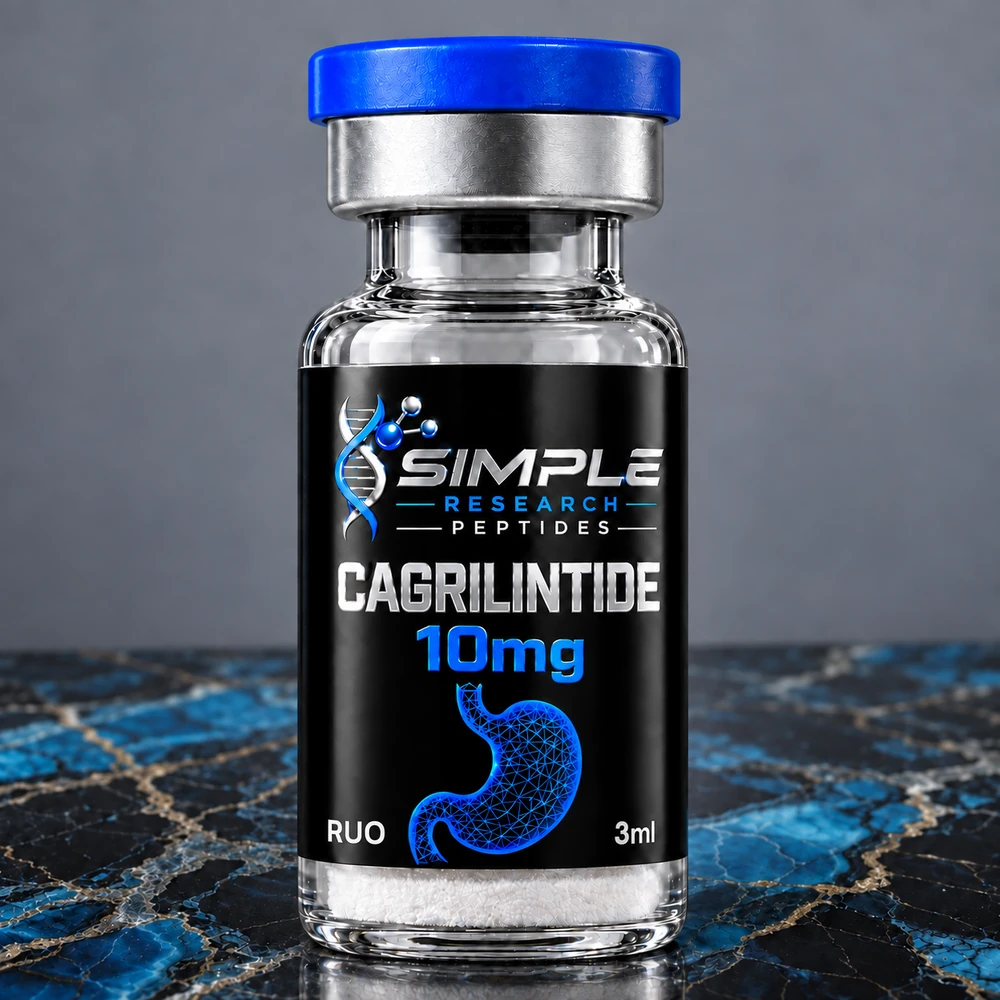
Opened SRP 10 mg and 5 mg pages name Cagrilintide, list AM833 on the 10 mg page, and carry a laboratory-research-only footer. Neither page printed sequence or CAS. Vendor “high-purity / Made in the USA / COA available” language is vendor-only and is not restated here as a scientific fact.
False equivalences
“Cagrilintide = CagriSema” is false. “Cagrilintide = semaglutide / tirzepatide / pramlintide” is false. Using REDEFINE 1’s −20.4% as a cagrilintide-alone number is false. “FDA approved” is contradicted by NCATS, NCT04209049, and NCT07220642.
What was studied, in what system
Read the “what it did not show” column. Published study designs are historical facts from those papers. They are not a protocol.
A. Preclinical / chemistry (single agent)
| Study | Model | What it showed | What it did not show |
|---|---|---|---|
| Kruse et al., J Med Chem 2021 PMID 34288673 |
Medicinal chemistry / SAR; analogue 23 = cagrilintide (AM833 / NN0174-0833). Novo Nordisk. | Selection of a stable, lipidated, long-acting amylin analogue on a pramlintide-like backbone for obesity-indication development; authors state it had induced weight loss when dosed alone or with semaglutide (that sentence is a high-level claim, not a new trial table). | A full public sequence table was not captured from the opened abstract; clinical effect sizes are not in this chemistry paper. |
| Fletcher et al., J Pharmacol Exp Ther 2021 PMID 33727283 |
In vitro receptor binding, activation, and regulation (25 endpoints); comparison with pramlintide, sCT, hCT, rat amylin, AM1213, AM1784. | Unique nonselective AMYR/CTR pharmacological profile. | In vivo weight change; human PK; clinical safety. |
| Cao et al., Nat Commun 2025 PMID 40204768 |
Cryo-EM of cagrilintide–AMY1R/2R/3R/CTR–Gs complexes; CRE-reporter and Gs-recruitment assays; MD on AMY3R. Insect-cell expressed human receptors. | Amylin-like bypass binding; distinct dynamics vs rat amylin / sCT; lipidation density only partly resolved. | Clinical efficacy; a claim that dynamics “explain” phase 3 outcomes. |
| Carvas et al., eBioMedicine 2025 PMID 40609154 |
Male WT vs RAMP1/3 KO mice; 23 weeks HFD then 3 weeks vehicle, sCT 150 nmol/kg, or cagrilintide 3 nmol/kg s.c. SID. | Cagrilintide lowered body weight in WT; RAMP1/3 deletion impeded that effect; both peptides activated DVC/LPBN cFos in WT. | Human translation; female mice; long-term toxicology; a human dose. |
| Gabery et al., Life Sci 2025 PMID 40628316 |
Normal-weight rats; DIO mice and DIO rats; 0833 (cagrilintide) vs tool compound 0839 ± semaglutide. | 0839 ≈ 0833 on food intake and body weight; both mainly reduced fat mass and potentiated semaglutide in DIO rats. | 0839 is not cagrilintide; not a human study; not SRP-vial identity. |
B. Human monotherapy (cagrilintide without semaglutide)
| Study | Design / population | Endpoints and opened results | What it did not show |
|---|---|---|---|
| Lau et al., Lancet 2021 PMID 34798060 NCT03856047 |
Phase 2, 26 weeks (+ up to 6-week escalation, 6-week off-treatment follow-up). 57 sites / 10 countries. Adults ≥18 y, without diabetes, BMI ≥30 or ≥27 with hypertension or dyslipidaemia. n=706 randomized: weekly cagrilintide 0.3 / 0.6 / 1.2 / 2.4 / 4.5 mg (100–102 per dose), daily liraglutide 3.0 mg (n=99), pooled placebo (n=101). Lifestyle counseling. | Primary: % body-weight change to week 26. Trial-product estimand: cagrilintide 6.0%–10.8% (6.4–11.5 kg) vs placebo 3.0% (3.3 kg); ETD 3.0%–7.8%; p<0.001 all doses vs placebo. Cagrilintide 4.5 mg 10.8% vs liraglutide 9.0% (ETD 1.8%, p=0.03). GI AEs 41%–63% vs placebo 32%; nausea 20%–47% vs 18%. | Not a diabetes trial (HbA1c ≥6.5% excluded). Not 68-week phase 3. Does not establish FDA approval. Does not describe CagriSema. |
| Frias et al., Lancet 2023 — cagrilintide-alone arm only PMID 37364590 NCT04982575 |
Phase 2, 32 weeks, 17 US sites. T2D, BMI ≥27, metformin ± SGLT2i. n=92; cagrilintide-alone n=30 (escalated to 2.4 mg). | Cagrilintide alone: HbA1c −0.9 percentage points (SE 0.15); body weight −8.1% (SE 1.23). No level 2/3 hypoglycaemia reported in the trial. | This arm is small (n=30) and 32 weeks. The trial’s primary comparison was CagriSema vs semaglutide for HbA1c (see combo table). Do not treat the CagriSema −15.6% weight figure as a monotherapy result. |
| Garvey et al., N Engl J Med 2025 — monotherapy arm exists; opened abstract does not report its effect size PMID 40544433 NCT05567796 (REDEFINE 1) |
Phase 3a, 68 weeks. Adults without diabetes, BMI ≥30 or ≥27 plus a complication. n=3417; 302 assigned to cagrilintide 2.4 mg alone. | Opened abstract reports coprimary combination vs placebo only (−20.4% vs −3.0%). It does not state the cagrilintide-monotherapy percent change. Registry confirms a cagrilintide + placebo-semaglutide arm. | Do not invent a monotherapy figure from secondary blogs. Until a page that prints the monotherapy estimand is opened, this page records only that a monotherapy arm was randomized. |
| Nielsen et al., Clin Pharmacokinet 2026 PMID 42228334 NCT04209049 (renal) NCT05564104 (hepatic) |
Two single-dose phase 1 studies. Renal: n=33 (normal 14; mild 7; moderate 7; severe 5); 0.6 mg. Hepatic: n=32 (normal 14; mild 7; moderate 7; severe 4); 0.9 mg. | AUC0–∞ and Cmax similar across impairment groups; no consistent PK pattern with renal or hepatic impairment; no serious TEAEs, withdrawals, or deaths; authors conclude dose adjustment is not warranted in these small studies. NCT04209049 states NNC0174-0833 “has not been approved by the US FDA.” | Small n in severe groups (5 and 4). Single dose, not chronic efficacy. Not a weight-loss outcome trial. Opened abstract does not print a standalone t½ number for these studies. |
| RENEW 1 NCT07220642 |
Phase 3 monotherapy, active, not recruiting. Estimated n=300. Weekly cagrilintide vs placebo, 64 weeks, lifestyle counseling. Adults with overweight/obesity without type 1 or type 2 diabetes. Registry text: “Cagrilintide is a new investigational medicine. Doctors may not yet prescribe cagrilintide.” | No results posted on the opened registry page. | Not evidence of efficacy. Confirms ongoing monotherapy development and investigational status. |
C. Combination (CagriSema) — do not treat as single-agent evidence
| Study | Design | Opened results (combination) | Why it is not monotherapy evidence |
|---|---|---|---|
| Enebo et al., Lancet 2021 PMID 33894838 NCT03600480 |
Phase 1b MAD. Single US centre. Ages 18–55, BMI 27.0–39.9, otherwise healthy. n=96 randomized (95 exposed). Weekly cagrilintide 0.16–4.5 mg or placebo, all with semaglutide 2.4 mg. No lifestyle intervention. 20 weeks. Primary: TEAEs. | 566 AEs in 92 people; 37% GI. Exposure proportional to cagrilintide dose; did not change semaglutide exposure/elimination. Exploratory PK (in this combination setting): cagrilintide t½ 159–195 h; median tmax 24–72 h. Week-20 weight change (all + semaglutide 2.4 mg): cagrilintide 1.2 mg −15.7%, 2.4 mg −17.1% vs pooled placebo+sema −9.8%; 4.5 mg −15.4% vs matched placebo+sema −8.0%. Glycaemic parameters improved in all groups, independent of cagrilintide dose. | Every arm received semaglutide. Weight and PK numbers describe co-administration. Half-life was an exploratory endpoint in this combo study, not a dedicated monotherapy PK paper. |
| Frias et al., Lancet 2023 PMID 37364590 NCT04982575 |
Phase 2, 32 weeks. CagriSema vs semaglutide vs cagrilintide (all 2.4 mg). T2D. n=92. Primary: HbA1c. | CagriSema HbA1c −2.2 pp vs semaglutide −1.8 pp (p=0.075, not significant) vs cagrilintide −0.9 pp (p<0.0001). Weight: CagriSema −15.6% vs semaglutide −5.1% vs cagrilintide −8.1% (both p<0.0001 vs combo). | Combo HbA1c was not statistically superior to semaglutide alone. Combo weight loss is not a cagrilintide-only result. Small, short trial. Cagrilintide-alone n=30. |
| Garvey et al., NEJM 2025 PMID 40544433 NCT05567796 REDEFINE 1 |
Phase 3a, 68 weeks. Combo 2.4/2.4 mg (n=2108) vs semaglutide 2.4 (n=302) vs cagrilintide 2.4 (n=302) vs placebo (n=705). No diabetes. | Combo vs placebo: −20.4% vs −3.0% (ETD −17.3 pp; 95% CI −18.1 to −16.6; p<0.001). ≥5/20/25/30% targets favored combo vs placebo. GI AEs 79.6% vs 39.9% placebo. | Coprimary is combination vs placebo. Opened abstract does not print monotherapy or semaglutide-alone percentages. Do not invent a REDEFINE 1 monotherapy %. |
| Davies et al., NEJM 2025 PMID 40544432 NCT05394519 REDEFINE 2 |
Phase 3a, 68 weeks. Overweight/obesity and T2D. Combo 2.4/2.4 mg (n=904) vs placebo (n=302). No cagrilintide-alone arm. | Combo −13.7% vs placebo −3.4% (ETD −10.4 pp; 95% CI −11.2 to −9.5; p<0.001). HbA1c ≤6.5% in 73.5% vs 15.9%. GI AEs 72.5% vs 34.4%. | Placebo-controlled combination trial. Cannot be used as cagrilintide monotherapy evidence. |
Opened papers and registries, in order
Dates are publication or registry years from opened records. This is a literature timeline, not a dosing history.
Hay et al. — amylin class physiology
Review of amylin pharmacology, physiology, and clinical potential. Class-level CTR–RAMP / AMYR description. Predates cagrilintide clinical papers. PMID 26071095.
WHO Proposed INN List 123
Official chemical description of cagrilintide / cagrilintidum as a lipidated human-amylin analogue (N14E, V17R, A25P, S28P, S29P, Y37P; C20 / γ-Glu). CAS 1415456-99-3. Action and use: amylin analogue.
Kruse + Fletcher + Lau + Enebo
Kruse: medicinal chemistry of analogue 23 / AM833 / NN0174-0833 (PMID 34288673). Fletcher: AM833 is a nonselective AMYR and CTR agonist (PMID 33727283). Lau / NCT03856047: phase 2 monotherapy dose-finding in adults without diabetes; 6.0%–10.8% vs placebo 3.0% at 26 weeks (PMID 34798060). Enebo / NCT03600480: phase 1b combination with semaglutide 2.4 mg; exploratory t½ 159–195 h is combination-setting exploratory PK (PMID 33894838).
Mathiesen review
Opened review of then-available phase 2 long-acting amylin analogue data; more studies needed for long-term effects. Not a primary trial. PMID 35066542.
Frias et al. — phase 2 T2D, combo primary
CagriSema vs semaglutide vs cagrilintide (all 2.4 mg); n=92; cagrilintide-alone n=30. Combo HbA1c not statistically superior to semaglutide (p=0.075). Cagrilintide-alone weight −8.1%; do not treat combo −15.6% as monotherapy. PMID 37364590. NCT04982575.
Cao, Carvas, Gabery, REDEFINE 1 and 2
Cao: cryo-EM of cagrilintide on AMY1R/2R/3R/CTR (PMID 40204768). Carvas: mouse AMY1R/AMY3R contribution to weight lowering (PMID 40609154). Gabery: tool compound 0839 is not cagrilintide (PMID 40628316). Garvey REDEFINE 1: combo vs placebo −20.4% vs −3.0%; 302 assigned to cagrilintide alone; opened abstract does not print that arm’s percent change (PMID 40544433; NCT05567796). Davies REDEFINE 2: combo only, no cagrilintide-alone arm (PMID 40544432; NCT05394519).
Nielsen PK; RENEW 1 ongoing; still investigational
Nielsen: single-dose renal (NCT04209049) and hepatic (NCT05564104) impairment PK; AUC/Cmax similar across groups; NCT04209049 states NNC0174-0833 has not been approved by the US FDA. (PMID 42228334.) NCT07220642 (RENEW 1) opened 16 August 2026: phase 3 monotherapy, active, not recruiting; no results posted. Registry: doctors may not yet prescribe cagrilintide. NCATS: Investigational; approval year Unknown.
What is NOT established
FDA-approved monotherapy or approved CagriSema
As of opened sources (16 August 2026), NCATS Inxight lists cagrilintide as Investigational with approval year Unknown. NCT04209049 states NNC0174-0833 “has not been approved by the US FDA.” NCT07220642 states “Cagrilintide is a new investigational medicine. Doctors may not yet prescribe cagrilintide.” No opened Drugs@FDA page showed an approved cagrilintide NDA. This page does not treat press reports of an NDA filing as an approval.
That CagriSema results describe cagrilintide alone
Frias 2023 is explicit: combo HbA1c was not significantly better than semaglutide (p=0.075), while combo weight loss exceeded either single agent. Those are combination findings. REDEFINE 1’s −20.4% is combination versus placebo.
A locked human half-life from a monotherapy PK paper
The 159–195 h figure is an exploratory PK result from Enebo 2021, in which every participant also received semaglutide 2.4 mg. Label it as combination-setting exploratory PK. Nielsen 2026 reports single-dose AUC/Cmax in renal/hepatic impairment but the opened abstract does not print a standalone t½ number for those studies.
Long-term CV, cancer, bone, or pediatric monotherapy outcomes
Long-term cardiovascular outcomes, cancer risk, bone outcomes, or pediatric use for cagrilintide monotherapy are not in the opened primary papers.
That research-vial material equals Novo Nordisk trial product
SRP pages do not print sequence, CAS, or a public COA in the fetched HTML. Vendor “high-purity / Made in the USA / COA available” language is vendor-only.
A research-use dose or reconstitution scheme
A research-use dose, reconstitution scheme, or “equivalent” to 2.4 mg weekly clinical product is out of scope for this facts page. No human dosing protocol appears here.
Species translation
Mouse RAMP1/3 dependence (Carvas), rodent 0839 work (Gabery), and insect-cell cryo-EM (Cao) do not establish human receptor occupancy at any research-vial amount.
REDEFINE 1 monotherapy percent change
The opened Garvey 2025 abstract does not state the cagrilintide-monotherapy percent change. Do not invent a monotherapy figure from secondary blogs.
Marketing claims versus opened evidence:
| Claim type | What opened pages actually support | Flag |
|---|---|---|
| SRP 10 mg page: name “Cagrilintide (10 mg Vial)”; also known as AM833; 10 mg lyophilized in a 3 mL vial; category Weight Loss / Metabolic Research; “For Research Use Only. Not for human or veterinary use.” | Quote-accurate for that URL. AM833 is a documented development code (IUPHAR, Kruse, Fletcher). | Category name is a store taxonomy, not a clinical indication. |
| SRP 5 mg page: “Cagrilintide (5 mg Vial)”; 3 ml vial; category Weight Loss / Metabolic Research; research-use-only / not for human consumption. | Quote-accurate for that URL. | Same taxonomy caveat. Neither page printed sequence or CAS. |
| SRP 10 mg: “High-purity research material”; “Made in the USA”; “COA available for batch verification.” | Vendor-only. Not independently verified in this research pass. | Do not restate as a scientific fact. |
| “Once-weekly amylin analogue for obesity.” | Accurate as a development / trial-design description (Kruse; Lau NCT03856047; RENEW 1). Not an approved indication. | Investigational. |
| “Cagrilintide = CagriSema.” | False. CagriSema is cagrilintide + semaglutide. | Common web error. |
| “Cagrilintide = semaglutide / tirzepatide / pramlintide.” | False. Different receptors and (for semaglutide/tirzepatide) different peptide classes. Pramlintide is a related but short-acting, AMYR-selective analogue. | Do not use. |
| Using REDEFINE 1’s −20.4% as a cagrilintide-alone number. | That figure is combination vs placebo (Garvey 2025 abstract). | Do not use. |
| “FDA approved.” | Contradicted by NCATS “Investigational,” NCT04209049 “has not been approved by the US FDA,” and NCT07220642 “doctors may not yet prescribe.” | Do not use. |
Opened primary papers, labeled
Each card is a paper or registry record actually opened for this draft. Combination cards are labeled as combination data.
Kruse, Hansen, Dahl, et al., 2021 — J Med Chem
Development of cagrilintide, a long-acting amylin analogue. Analogue 23 = AM833 / NN0174-0833. Pramlintide-like backbone, then lipidation. High-level claim of weight loss alone or with semaglutide; not a clinical results table. PMID 34288673. DOI 10.1021/acs.jmedchem.1c00565.
Fletcher, Keov, Truong, et al., 2021 — J Pharmacol Exp Ther
AM833 is a novel agonist of calcitonin-family GPCRs. 25 endpoints versus pramlintide, sCT, hCT, rat amylin, AM1213, AM1784. Unique nonselective AMYR/CTR profile. Not in vivo efficacy. PMID 33727283. DOI 10.1124/jpet.121.000567.
Cao, Belousoff, Johnson, et al., 2025 — Nat Commun
Structural and dynamic features of cagrilintide binding to calcitonin and amylin receptors. Amylin-like bypass binding; N14E/V17R ionic lock; Y37P; lipidation only partly resolved. Not a clinical outcome study. PMID 40204768. PMC 11982234. DOI 10.1038/s41467-025-58680-y.
Carvas, Leuthardt, Kulka, et al., 2025 — eBioMedicine
Cagrilintide lowers bodyweight through brain amylin receptors 1 and 3. Male WT vs RAMP1/3 KO; 3 nmol/kg s.c. SID for 3 weeks after HFD. WT −3.4 ± 0.51 g; RAMP1/3 deletion impeded the effect; AP cFos reduced 57% in KO. Not a human dose. PMID 40609154. PMC 12270663. DOI 10.1016/j.ebiom.2025.105836.
Gabery, Glendorf, Ballarin-Gonzalez, et al., 2025 — Life Sci
Characterization of 0839, a 95% sequence-homologous, identically acylated tool compound for pre-clinical mode-of-action studies of amylin analogues such as cagrilintide (0833). 0839 is not interchangeable with a research vial labeled cagrilintide. PMID 40628316. DOI 10.1016/j.lfs.2025.123845.
Lau, Erichsen, Francisco, et al., 2021 — Lancet
Once-weekly cagrilintide for weight management; phase 2 dose-finding; adults without diabetes; n=706. Trial-product estimand 6.0%–10.8% vs placebo 3.0% at week 26. Not CagriSema. Not FDA approval. PMID 34798060. NCT03856047. DOI 10.1016/s0140-6736(21)01751-7.
Enebo, Berthelsen, Kankam, et al., 2021 — Lancet
Phase 1b MAD of cagrilintide with semaglutide 2.4 mg. Every arm received semaglutide. Exploratory PK in this combination setting: t½ 159–195 h; median tmax 24–72 h. Not a dedicated monotherapy PK paper. PMID 33894838. NCT03600480. DOI 10.1016/s0140-6736(21)00845-x.
Frias, Deenadayalan, Erichsen, et al., 2023 — Lancet
Phase 2 T2D; CagriSema vs semaglutide vs cagrilintide. Alone-arm: HbA1c −0.9 pp; weight −8.1% (n=30). Combo HbA1c not significantly better than semaglutide (p=0.075). Combo weight −15.6% is not monotherapy. PMID 37364590. NCT04982575. DOI 10.1016/s0140-6736(23)01163-7.
Garvey, Blüher, Osorto Contreras, et al., 2025 — N Engl J Med
REDEFINE 1. Combo vs placebo −20.4% vs −3.0%. 302 assigned to cagrilintide 2.4 mg alone; opened abstract does not print that arm’s percent change. Do not invent it. PMID 40544433. NCT05567796. DOI 10.1056/nejmoa2502081.
Davies, Bajaj, Broholm, et al., 2025 — N Engl J Med
REDEFINE 2. Overweight/obesity and T2D. Combo −13.7% vs placebo −3.4%. Cannot be used as cagrilintide monotherapy evidence. PMID 40544432. NCT05394519. DOI 10.1056/nejmoa2502082.
Nielsen, Becker, Duus, et al., 2026 — Clin Pharmacokinet
Two single-dose phase 1 studies. Renal n=33 (0.6 mg); hepatic n=32 (0.9 mg). AUC0–∞ and Cmax similar across impairment groups. NCT04209049 states NNC0174-0833 has not been approved by the US FDA. Opened abstract does not print a standalone t½. PMID 42228334. NCT05564104. DOI 10.1007/s40262-026-01654-0.
Hay, Chen, Lutz, Parkes, Roth, 2015 — Pharmacol Rev
Amylin: pharmacology, physiology, and clinical potential. Class-level CTR–RAMP description used as background. PMID 26071095. DOI 10.1124/pr.115.010629.
Mathiesen, Bagger, Knop, 2022 — Curr Opin Endocrinol Diabetes Obes
Long-acting amylin analogues for the management of obesity. Summarizes then-available phase 2 cagrilintide data; more studies needed for long-term effects. PMID 35066542. DOI 10.1097/med.0000000000000716.
RENEW 1 — ClinicalTrials.gov
Phase 3 monotherapy, active, not recruiting. Weekly cagrilintide vs placebo, 64 weeks. No results posted on the opened registry page. Registry: doctors may not yet prescribe cagrilintide. NCT07220642.
Research-only caution
Cagrilintide is an investigational laboratory research peptide. It is not an FDA-approved drug for human use. This page is educational. It does not provide dosing, reconstitution, administration, or any human-use instructions.
Simple Research Peptides (SRP) materials are for laboratory research only and are not for human or veterinary use, consumption, administration, diagnosis, treatment, or therapeutic application.
Laboratory identity is the first practical issue. Opened registry records treat cagrilintide as a lipidated 37-aa amylin analogue (AM833 / NNC0174-0833; CAS 1415456-99-3; UNII AO43BIF1U8; PubChem CID 171397054; formula C194H312N54O59S2; sequence XKCNTATCATQRLAEFLRHSSNNFGPILPPTNVGSNTP, X = N-terminal lipid). SRP product pages do not print sequence, CAS, UNII, or formula. A method or protocol written for semaglutide, pramlintide, or CagriSema is not automatically valid for this analogue.
Biological inference has the same problem. Lau 2021 monotherapy body-weight change (6.0%–10.8% vs placebo 3.0% at 26 weeks), a 30-person Frias alone-arm, combination-setting exploratory PK from Enebo (t½ 159–195 h), and REDEFINE combination coprimaries are not interchangeable with marketplace claims that research-vial material “works in people.” CagriSema results must stay labeled as combination data. The opened REDEFINE 1 abstract does not print a cagrilintide-monotherapy percent change. RENEW 1 is ongoing and has no posted results.
Independently sourced research peptides are not established as equivalent to Novo Nordisk clinical-trial drug product. Confirm sequence (including N-terminal C20/γ-Glu lipidation, Cys2–Cys7 disulfide, C-terminal prolinamide, and WHO PL123 substitutions N14E / V17R / A25P / S28P / S29P / Y37P), mass, and purity before treating a vial as the literature compound. Gabery 0839 is a related rodent tool compound, not the labeled vial.
Common questions
What is cagrilintide in one sentence?
A synthetic, lipidated 37-residue amylin analogue (INN cagrilintide; AM833; NNC0174-0833) that opens as a nonselective AMYR/CTR agonist in the papers cited above. Investigational. Research-use-only on the SRP listings.
Is it the same as AM833 or NNC0174-0833?
Opened IUPHAR, Kruse, Fletcher, and ClinicalTrials.gov treat those codes as the same development compound as cagrilintide. This page does not treat unrelated vendor aliases (for example ZP8396, which was not on the opened IUPHAR/PubChem/NCATS/WHO records) as synonyms.
How is it different from pramlintide?
Pramlintide is a short-acting, AMYR-selective analogue used clinically as an insulin adjunct and dosed multiple times daily (Kruse; Fletcher). Cagrilintide is lipidated for extended exposure and is nonselective at AMYRs and CTR.
How is it different from semaglutide?
Semaglutide is a GLP-1 receptor agonist. Cagrilintide is an amylin/calcitonin-family analogue. CagriSema is both molecules together.
Did human trials test cagrilintide by itself?
Yes. Lau 2021 / NCT03856047 is a phase 2 monotherapy dose-finding trial in adults without diabetes (6.0%–10.8% vs placebo 3.0% at 26 weeks). Frias 2023 included a cagrilintide-alone arm in type 2 diabetes (n=30). REDEFINE 1 randomized 302 people to cagrilintide alone, but the opened abstract does not report that arm’s weight-change number. RENEW 1 (NCT07220642) is an ongoing phase 3 monotherapy trial with no results posted on the opened registry page. Combination-trial results still must be labeled as combination data.
Is it FDA-approved?
Not as a monotherapy on any opened FDA/NCATS/ClinicalTrials.gov page as of 16 August 2026. NCATS: Investigational. NCT04209049: not approved by the US FDA. NCT07220642: doctors may not yet prescribe it.
Can SRP vials be used as a human dose substitute for trial product?
No. SRP listings are for laboratory research only and are not for human or animal use. This page does not provide reconstitution, administration, or dosing instructions.
Is the evidence mixed?
For monotherapy body-weight change in adults without diabetes, Lau 2021 reported dose-dependent reductions versus placebo over 26 weeks; that is a single completed phase 2 trial, not a completed phase 3 monotherapy program with posted results. For glycaemia in type 2 diabetes, the Frias cagrilintide-alone arm showed a smaller HbA1c change than semaglutide or CagriSema, and CagriSema’s HbA1c advantage versus semaglutide was not statistically significant (p=0.075). Combination phase 3 programs (REDEFINE 1/2) are larger but are not single-agent evidence. Preclinical receptor data are consistent with AMYR/CTR agonism but do not by themselves establish a clinical indication.
What is the 159–195 h half-life?
An exploratory PK result from Enebo 2021 (PMID 33894838; NCT03600480), in which every participant also received semaglutide 2.4 mg. It is combination-setting exploratory PK, not a locked monotherapy half-life from a dedicated PK paper.
Does this page include human dosing?
No. There is no human dosing, reconstitution, or administration protocol on this page. Historical trial regimens are study conditions, not instructions.
Citations used on this page
Primary papers and registries actually opened for this draft. Do not add PMIDs or NCTs that are not on the allowed list.
- Kruse T, Hansen JL, Dahl K, et al. Development of Cagrilintide, a Long-Acting Amylin Analogue. J Med Chem. 2021;64(15):11183-11194. PMID 34288673. DOI 10.1021/acs.jmedchem.1c00565.
- Fletcher MM, Keov P, Truong TT, et al. AM833 Is a Novel Agonist of Calcitonin Family G Protein–Coupled Receptors: Pharmacological Comparison with Six Selective and Nonselective Agonists. J Pharmacol Exp Ther. 2021;377(3):417-440. PMID 33727283. DOI 10.1124/jpet.121.000567.
- Cao J, Belousoff MJ, Johnson RM, et al. Structural and dynamic features of cagrilintide binding to calcitonin and amylin receptors. Nat Commun. 2025;16:3389. PMID 40204768. DOI 10.1038/s41467-025-58680-y. PMC 11982234.
- Carvas AO, Leuthardt A, Kulka P, et al. Cagrilintide lowers bodyweight through brain amylin receptors 1 and 3. eBioMedicine. 2025;118:105836. PMID 40609154. DOI 10.1016/j.ebiom.2025.105836. PMC 12270663.
- Gabery S, Glendorf T, Ballarin-Gonzalez B, et al. Characterization of 0839 — A tool compound for pre-clinical mode-of-action studies of amylin analogues such as cagrilintide. Life Sci. 2025;378:123845. PMID 40628316. DOI 10.1016/j.lfs.2025.123845.
- Lau DCW, Erichsen L, Francisco AM, et al. Once-weekly cagrilintide for weight management in people with overweight and obesity: a multicentre, randomised, double-blind, placebo-controlled and active-controlled, dose-finding phase 2 trial. Lancet. 2021;398(10317):2160-2172. PMID 34798060. DOI 10.1016/s0140-6736(21)01751-7. NCT03856047.
- Enebo LB, Berthelsen KK, Kankam M, et al. Safety, tolerability, pharmacokinetics, and pharmacodynamics of concomitant administration of multiple doses of cagrilintide with semaglutide 2·4 mg for weight management: a randomised, controlled, phase 1b trial. Lancet. 2021;397(10286):1736-1748. PMID 33894838. DOI 10.1016/s0140-6736(21)00845-x. NCT03600480. Combination trial. Exploratory t½ 159–195 h is combination-setting exploratory PK.
- Frias JP, Deenadayalan S, Erichsen L, et al. Efficacy and safety of co-administered once-weekly cagrilintide 2·4 mg with once-weekly semaglutide 2·4 mg in type 2 diabetes: a multicentre, randomised, double-blind, active-controlled, phase 2 trial. Lancet. 2023;402(10403):720-730. PMID 37364590. DOI 10.1016/s0140-6736(23)01163-7. NCT04982575. Has a cagrilintide-alone arm (n=30); primary analysis is combination. Combo HbA1c vs semaglutide p=0.075, not significant.
- Garvey WT, Blüher M, Osorto Contreras CK, et al. Coadministered Cagrilintide and Semaglutide in Adults with Overweight or Obesity. N Engl J Med. 2025;393(7):635-647. PMID 40544433. DOI 10.1056/nejmoa2502081. NCT05567796 (REDEFINE 1). Combination coprimary −20.4% vs placebo −3.0%. Opened abstract does not print the cagrilintide-monotherapy percent change.
- Davies MJ, Bajaj HS, Broholm C, et al. Cagrilintide-Semaglutide in Adults with Overweight or Obesity and Type 2 Diabetes. N Engl J Med. 2025;393(7):648-659. PMID 40544432. DOI 10.1056/nejmoa2502082. NCT05394519 (REDEFINE 2). Combination only.
- Nielsen MJF, Becker NP, Duus HHH, et al. Renal or Hepatic Impairment Does Not Affect Pharmacokinetics, Safety, or Tolerability of Subcutaneous Cagrilintide. Clin Pharmacokinet. 2026. PMID 42228334. DOI 10.1007/s40262-026-01654-0. NCT04209049; NCT05564104.
- Hay DL, Chen S, Lutz TA, Parkes DG, Roth JD. Amylin: Pharmacology, Physiology, and Clinical Potential. Pharmacol Rev. 2015;67(3):564-600. PMID 26071095. DOI 10.1124/pr.115.010629. (Class physiology; predates cagrilintide clinical papers.)
- Mathiesen DS, Bagger JI, Knop FK. Long-acting amylin analogues for the management of obesity. Curr Opin Endocrinol Diabetes Obes. 2022;29(2):183-190. PMID 35066542. DOI 10.1097/med.0000000000000716. (Review.)
- WHO Proposed INN List 123 (cagrilintide / cagrilintidum). WHO Drug Information Vol. 34, No. 2, 2020. https://www.who.int/docs/default-source/international-nonproprietary-names-(inn)/pl123.pdf (opened 2026-08-16).
- PubChem CID 171397054, https://pubchem.ncbi.nlm.nih.gov/compound/171397054 (opened 2026-08-16). CAS 1415456-99-3; UNII AO43BIF1U8; formula C194H312N54O59S2; sequence XKCNTATCATQRLAEFLRHSSNNFGPILPPTNVGSNTP (X = N-terminal lipid).
- IUPHAR/BPS Guide to PHARMACOLOGY ligand 13768, https://www.guidetopharmacology.org/GRAC/LigandDisplayForward?ligandId=13768 (opened 2026-08-16).
- NCATS Inxight Drugs, UNII AO43BIF1U8, https://drugs.ncats.io/drug/AO43BIF1U8 (opened 2026-08-16). Investigational; approval year Unknown.
- ClinicalTrials.gov: NCT03856047, NCT03600480, NCT04982575, NCT05567796, NCT05394519, NCT07220642, NCT04209049, NCT05564104 (opened 2026-08-16).
- Simple Research Peptides. Cagrilintide (10 mg Vial) product page. http://simpleresearchpeptides.com/product/cagrilintide-10-mg-vial-2/ (opened 2026-08-16). Also known as AM833. Research use only. Sequence and CAS were not printed on the fetched page.
- Simple Research Peptides. Cagrilintide (5 mg Vial) product page. http://simpleresearchpeptides.com/product/cagrilintide-5-mg-vial/ (opened 2026-08-16). Research use only. Sequence and CAS were not printed on the fetched page.
- Simple Research Peptides. Compound Research Guides directory. http://simpleresearchpeptides.com/research-compound-directory/compound-research-guides/
Allowed PMID list used on this page: 34288673, 33727283, 40204768, 40609154, 40628316, 34798060, 33894838, 37364590, 40544433, 40544432, 42228334, 26071095, 35066542. Allowed NCT list: NCT03856047, NCT03600480, NCT04982575, NCT05567796, NCT05394519, NCT07220642, NCT04209049, NCT05564104. No other PMIDs or NCTs were added.
Educational information only. Cagrilintide is not semaglutide, not pramlintide, not CagriSema, and not an FDA-approved drug for human use. Investigational compound. Laboratory research use only; not for human or animal use. No human dosing protocol. Last source review: 16 August 2026 (America/Indianapolis). Locked draft converted to HTML the same day. PMIDs above were opened on Europe PMC and/or publisher pages as noted. Product URLs fetched the same day. For laboratory research only. Not for human or veterinary use.