



Not found — Adamax peptide
No assignable pathway
No opened paper administered a peptide named Adamax. No receptor, transporter, enzyme, or signaling cascade can be assigned to an undisclosed structure.
Products are color coded by category
Brain & sleep · Compound guide
Explore the mechanisms, study findings and evidence limits behind this research topic.
Product artwork identifies the SRP listing. It does not demonstrate safety or clinical benefit. The evidence guide and its sources follow below.
View product label and documentation →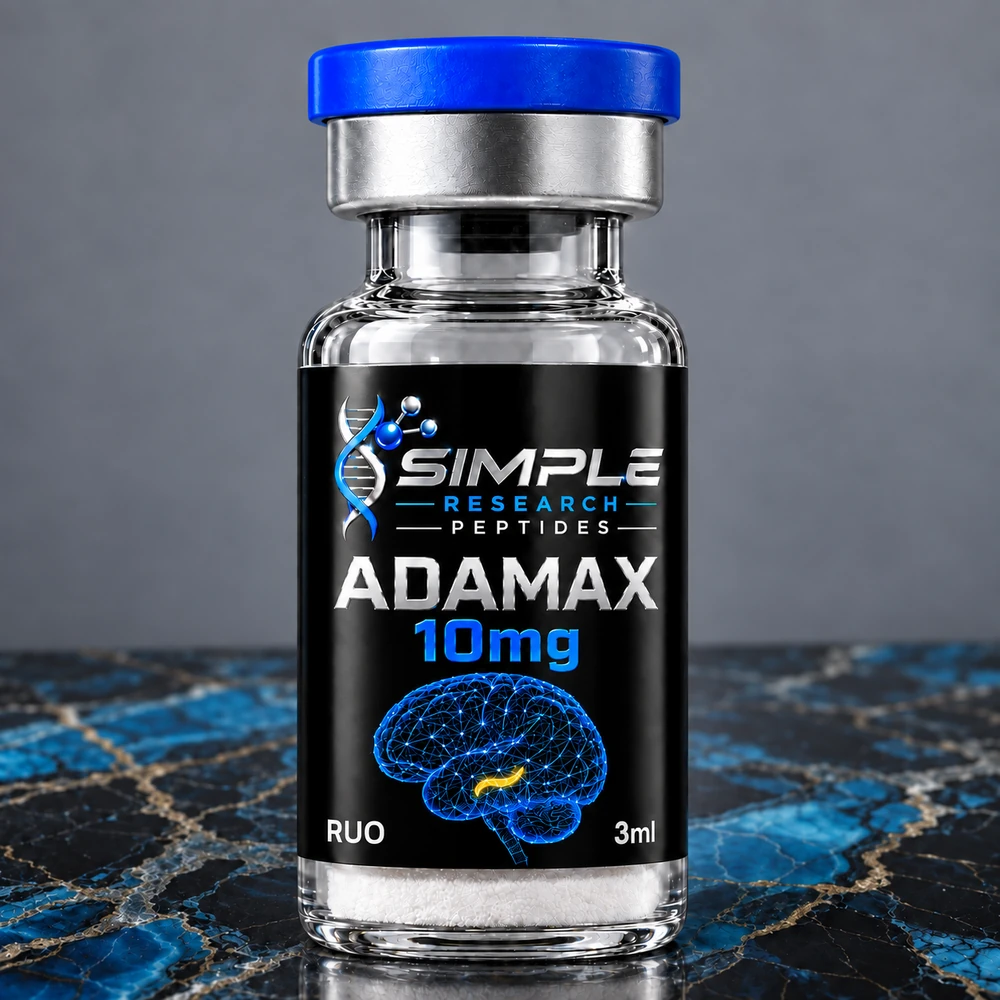
An evidence-mapped overview of the marketplace name Adamax covering what the live product page actually states, negative registry and literature lookups, a documented optimizer homonym, and why Semax papers cannot be re-labeled as Adamax evidence. Sequence is not established.
Educational information only. Adamax is not an FDA-approved drug for human use. Laboratory research use only; not for human or animal use. Identity / evidence uncertain. No human dosing, reconstitution, or administration protocol appears on this page.
Opened registry and literature lookups do not establish Adamax as a single indexed peptide. The live Simple Research Peptides page (Adamax 10 mg Research Compound Vial, fetched 16 August 2026) lists 10 mg lyophilized research material in the Brain & Mind Research category (SKU ADAMAX-10MG). That page claims ≥99% purity, a COA, Made in the USA, and third-party testing, and states: “For laboratory research only. Not for human or animal use, consumption, administration, diagnosis, treatment, or therapeutic application.” It published no amino-acid sequence, no CAS, no formula, no PubChem CID, and no UNII.
Registry payloads opened the same day:
name=Adamax: HTTP 404. No Adamax compound record.q=Adamax: total 0, content [].query.term=Adamax: {"studies":[]}.term=Adamax: 39 hits. The hit opened here, PMID 42236259 (Sawant & Ghongade, 2026, Diabetes Obes Metab), is an AdaMax optimizer paper, not a peptide.Adamax+peptide OR Adamax+Semax OR "N-acetyl-Semax" adamantane; Title/Abstract Adamax AND (peptide OR Semax OR adamantane); N-acetyl-Semax / "N-acetyl Semax" / "acetyl-Semax"): 0 items.Related but distinct — Semax, not Adamax. PubChem CID 9811102 is a Semax record (formula C37H51N9O10S, MW 813.9, InChIKey AFEHBIGDWIGTEH-AQRCPPRCSA-N). Synonyms on that record include Semax, 80714-61-0, ACTH (4-7), Pro-Gly-Pro-, I5FAL2585H, MEHFPGP, Met-Glu-His-Phe-Pro-Gly-Pro, H-Met-Glu-His-Phe-Pro-Gly-Pro-OH, UNII-I5FAL2585H. Dmitrieva et al. (2010) describe Semax as consisting of ACTH(4-7) plus C-terminal PGP and report a rat pMCAO neurotrophin-transcription study (PMID 19633950; PMCID PMC11498467). That is Semax evidence, not Adamax evidence.
Adamax, as sold on the fetched SRP page, is a trade-style marketplace name for a 10 mg lyophilized research-compound vial. The live page does not disclose a sequence, CAS, formula, PubChem CID, or UNII. This review cannot assign a mechanism, receptor, or pharmacologic class to that name. Mechanism follows identity. Identity is not documented in the opened registries or in an indexed Adamax peptide paper.
Semax is a related but distinct heptapeptide (Met-Glu-His-Phe-Pro-Gly-Pro) with its own PubChem record (CID 9811102) and one opened primary paper (PMID 19633950). Semax is not Adamax. Marketplace copy that treats Adamax as “a stronger Semax,” “N-acetyl Semax,” or “adamantane-Semax” is not a substitute for a disclosed structure plus a paper that used that structure.
The only PubMed record opened under the bare term Adamax in this review is an optimizer homonym (PMID 42236259), not a peptide study.
There is no invented receptor diagram and no fake chart on this page. Observed means a payload actually opened. Related / distinct means Semax, not Adamax. Marketing means vendor copy, not a paper. Not shown means this review did not open such a paper.
No opened paper administered a peptide named Adamax. No receptor, transporter, enzyme, or signaling cascade can be assigned to an undisclosed structure.
Sawant & Ghongade (2026) use “AdaMax” as a machine-learning optimizer in a glucose-dynamics / diabetes-management network paper (PMID 42236259). Name collision, not peptide pharmacology.
Dmitrieva et al. (2010): Semax (ACTH(4-7) + C-terminal PGP) and Pro-Gly-Pro activated transcription of neurotrophins and their receptor genes after cerebral ischemia in a rat pMCAO model (PMID 19633950). The opened abstract’s stroke-therapy sentence is about Semax. It is not an Adamax clinical claim.
Vendor claims that Adamax crosses the blood–brain barrier, raises BDNF, or is a more stable Semax analogue are unsourced relative to the opened record. They require a disclosed structure and a paper that used that structure.
No Adamax peptide sequence, CAS, formula, or registry ID. No Adamax peptide binding table, PK curve, or in-vivo study. No human cognition outcomes. No BBB, BDNF, or adamantane-PK results with Adamax. No equivalence to Semax or N-acetyl Semax amidate.
10 mg lyophilized research material; Brain & Mind Research; laboratory/research only. No sequence on the fetched page. Purity and COA claims on a product page are not a mechanism and are not a literature identity.
Label every cluster. Adamax peptide would mean a paper that named Adamax as the test article. Not found means this review did not open such a paper. Related but distinct means Semax.
PubChem name=Adamax: HTTP 404. GSRS q=Adamax: 0 substances. ClinicalTrials.gov query.term=Adamax: 0 studies. SRP page: 10 mg lyophilized research material; no sequence, CAS, formula, PubChem, or UNII.
Some pages: N-adamantyl-Semax (Ad-MEHFPGP). Some: 9-residue Ac-MEHFPGPAG-NH2 with C-terminal adamantane. Some: N-Acetyl Semax Amidate (Ac-MEHFPGP-NH2), no adamantane. A name alone is not a structure. This page does not pick a winner.
PubMed term=Adamax returned 39 hits. The opened paper is Sawant & Ghongade 2026, a diabetes / glucose-dynamics network study using the AdaMax optimizer (PMID 42236259). Not a peptide.
PubChem CID 9811102: Semax; C37H51N9O10S; MW 813.9; MEHFPGP; CAS 80714-61-0; UNII I5FAL2585H. Dmitrieva 2010: Semax + PGP, rat pMCAO neurotrophin transcription (PMID 19633950). Do not re-label as Adamax.
Adamax+peptide OR Adamax+Semax OR “N-acetyl-Semax” adamantane: 0 items. Title/Abstract Adamax AND (peptide OR Semax OR adamantane): 0 items. N-acetyl-Semax name variants: 0 items.
No opened Adamax peptide paper measured human cognition, blood–brain-barrier penetration, BDNF, or adamantane PK. No opened combination-product paper. Semax neurotrophin data remain Semax data.
Read the “compound actually studied” column first. Published study designs are historical facts from those papers. They are not a protocol.
| Domain | Compound actually studied | System | Status | Source |
|---|---|---|---|---|
| Marketplace listing | Name “Adamax”; 10 mg lyophilized vial | SRP product page, fetched 16 Aug 2026 | Trade name; no sequence | SRP product URL |
| PubChem name lookup | Query name=Adamax | PUG REST property | HTTP 404; no record | PubChem PUG REST |
| FDA/NCATS substance | Query q=Adamax | GSRS substances search | 0 substances | FDA/NCATS GSRS |
| Clinical trials | Query term=Adamax | ClinicalTrials.gov v2 API | 0 studies | ClinicalTrials.gov |
| PubMed name search | Term=Adamax (39 hits) | Bibliographic index | Opened hit is not a peptide | PMID 42236259 |
| Optimizer homonym | AdaMax optimizer | Diabetes / glucose-dynamics network paper | NOT A PEPTIDE | PMID 42236259 |
| Peptide-filtered PubMed | Adamax + peptide / Semax / adamantane | Title/Abstract and combined queries | 0 items | PubMed esearch |
| N-acetyl-Semax PubMed | N-acetyl-Semax name variants | Bibliographic index | 0 items | PubMed esearch |
| Semax registry | Semax (MEHFPGP) | PubChem CID 9811102 | Related but distinct | CID 9811102 |
| Semax neurotrophin transcription | Semax and Pro-Gly-Pro | Rat pMCAO | RELATED BUT DISTINCT | PMID 19633950 |
| Adamax peptide pharmacology | — | — | Not found | This review |
Dmitrieva et al.: Semax and Pro-Gly-Pro activate neurotrophin and receptor-gene transcription after cerebral ischemia in the rat; opened abstract frames Semax as ACTH(4-7) + PGP (PMID 19633950). Semax evidence only.
Vendor / encyclopedia pages disagree: N-adamantyl-Semax (Ad-MEHFPGP); 9-residue Ac-MEHFPGPAG-NH2 plus C-terminal adamantane; N-Acetyl Semax Amidate without adamantane. Flagged as marketing. Not used as structure.
Sawant & Ghongade, Diabetes Obes Metab: glucose-dynamics analysis network paper using the AdaMax optimizer (PMID 42236259).
SRP product page fetched (10 mg lyophilized research material; no sequence). PubChem name=Adamax 404. GSRS 0. ClinicalTrials.gov 0. Peptide-restricted PubMed 0. Semax CID 9811102 opened only as a related-but-distinct record.
These are gaps in the opened record. Treating any of them as settled is incorrect.
The SRP page does not give a sequence. PubChem, GSRS, and UNII lookups for Adamax returned nothing. Vendor write-ups that assign Ad-MEHFPGP, Ac-MEHFPGPAG-NH2-plus-adamantane, or Ac-MEHFPGP-NH2 are incompatible with each other and are not evidence.
Semax has a PubChem record (CID 9811102) and an opened primary paper (PMID 19633950). Adamax does not inherit Semax identity, Semax stroke-therapy framing, or Semax neurotrophin results.
Peptide-, Semax-, and adamantane-restricted PubMed queries returned 0 items. The opened Adamax-named paper is an optimizer homonym (PMID 42236259).
No opened paper reports human memory, focus, attention, mood, or “nootropic” outcomes with a peptide named Adamax.
No opened Adamax peptide paper measured blood–brain-barrier penetration, BDNF/NGF, or adamantane-related pharmacokinetics. The opened neurotrophin paper used Semax.
Even if a future COA disclosed a Semax-related conjugate, that would still not make Semax papers into Adamax papers. The three circulating vendor structures are not the same molecule.
No GSRS substance, no ClinicalTrials.gov study, no FDA-approved finished drug in the sources opened here. The SRP page is research-use only.
There is no human dosing, reconstitution, or administration protocol here. Research-use only; not an FDA-approved drug for human use.
| Popular claim | Status after this review |
|---|---|
| “Adamax is N-adamantyl-Semax (Ad-MEHFPGP)” | Marketing, not evidence. One of three incompatible vendor structures. SRP page silent. |
| “Adamax is Ac-MEHFPGPAG-NH2 with C-terminal adamantane” | Marketing, not evidence. Incompatible with the other two write-ups. |
| “Adamax is N-Acetyl Semax Amidate (no adamantane)” | Marketing, not evidence. Omits adamantane; cannot be the same molecule as the adamantane write-ups. |
| “Same thing as Semax” | False as identity. Semax is CID 9811102 / MEHFPGP. Adamax has no opened record. |
| “Published Adamax peptide papers / BDNF / BBB” | Not found in opened Adamax peptide searches. Semax neurotrophin data are Semax data. |
| “Human cognition / nootropic peptide” | Not found in a paper opened here. |
| “Indexed clinical trials” | ClinicalTrials.gov v2: 0 studies. |
| Marketplace vial = a registered peptide | Not established. Sequence, MS identity, and distinction from Semax-family names must be documented analytically. |
Every PMID below is from the verified set used to build this page. Allowed PMIDs on this page: 42236259 and 19633950 only.
Opened under PubMed term=Adamax. Title begins “Diabetes Management Through Glucose Dynamics Analysis Network…”. The Adamax string in this hit is the AdaMax optimizer, not a peptide. PMID 42236259. Do not cite as Adamax peptide evidence.
Semax and Pro-Gly-Pro activate the transcription of neurotrophins and their receptor genes after cerebral ischemia. Rat pMCAO study. Opened abstract: “Consisting of a fragment of ACTH(4-7) and C-terminal PGP tripeptide, the polypeptide Semax is successfully used for acute stroke therapy.” PMID 19633950. doi: 10.1007/s10571-009-9432-0. PMCID PMC11498467. This is Semax evidence, not Adamax.
Adamax, as listed on the fetched SRP page, is a research-compound marketplace name. It is not an FDA-approved drug for human use. This page is educational. It does not provide dosing, reconstitution, administration, or any human-use instructions.
SRP material is for laboratory research only. It is not for human or animal use, consumption, administration, diagnosis, treatment, or therapeutic application.
Laboratory identity is the first practical issue — and it is unresolved. Before treating a vial as a literature compound:
A marketplace / trade-style name. The fetched SRP page lists a 10 mg lyophilized research-compound vial (Brain & Mind Research; SKU ADAMAX-10MG) and does not give a sequence, CAS, formula, PubChem CID, or UNII. Opened registries returned no Adamax compound. Identity is uncertain.
No. Semax is a documented heptapeptide (Met-Glu-His-Phe-Pro-Gly-Pro; PubChem CID 9811102). Adamax has no opened compound record. Semax papers are not Adamax papers.
None established in opened sources. The SRP page is silent. Public vendor write-ups disagree (N-adamantyl-Semax vs a 9-residue adamantane conjugate vs N-Acetyl Semax Amidate without adamantane). Those cannot all be the same molecule. This page does not invent a sequence.
Not in the opened, peptide-restricted PubMed searches (0 items). A bare “Adamax” search hit opened here is an AdaMax optimizer paper (PMID 42236259), not a peptide.
No. ClinicalTrials.gov v2 API query.term=Adamax returned no studies. GSRS search returned 0 substances.
Not established in an opened Adamax peptide paper. The opened neurotrophin-transcription paper used Semax (PMID 19633950).
No. Educational information only. Not an FDA-approved drug for human use. Research compound listing only.
No. There is no human dosing, reconstitution, or administration protocol on this page.
Full citations for the verified set. Each line is a paper or registry record actually opened for this page. One-line findings are from those opened abstracts or API payloads. Allowed PMIDs: 42236259 and 19633950 only.
term=Adamax hit. AdaMax optimizer — not a peptide.Sources searched but not used as evidence: public vendor / encyclopedia pages that call Adamax N-adamantyl-Semax (Ad-MEHFPGP), a 9-residue Ac-MEHFPGPAG-NH2 with C-terminal adamantane, or N-Acetyl Semax Amidate (Ac-MEHFPGP-NH2) — flagged as marketing, not evidence, and not cited as structure; any Semax paper other than the opened PMID 19633950; price and sales copy from the product page, except as a fetch note that the live page listed 10 mg lyophilized research material.
Educational information only. Adamax is not an FDA-approved drug for human use. Identity / evidence uncertain. Laboratory research use only; not for human or animal use. Last source review: 16 August 2026 (America/Indianapolis). Product URL, PubChem, GSRS, ClinicalTrials.gov, and PubMed queries were opened the same day. Allowed PMIDs: 42236259, 19633950.
2 mins ago